Group-Oriented Fingerprinting
for Multimedia Forensics
Z. Jane Wang
Department of Electrical and Computer Engineering, University of British Columbia, 2356 Main Mall, Vancouver, BC, Canada V6T 1Z4
Email:[email protected]
Min Wu
Department of Electrical and Computer Engineering and Institute for Systems Research, University of Maryland, College Park, MD 20742, USA
Email:[email protected]
Wade Trappe
Wireless Information Network Laboratory (WINLAB) and the Electrical and Computer Engineering Department, Rutgers University, NJ 08854–8060, USA
Email:[email protected]
K. J. Ray Liu
Department of Electrical and Computer Engineering and Institute for Systems Research, University of Maryland, College Park, MD 20742, USA
Email:[email protected]
Received 7 April 2003; Revised 15 September 2003
Digital fingerprinting of multimedia data involves embedding information in the content signal and offers protection to the digital rights of the content by allowing illegitimate usage of the content to be identified by authorized parties. One potential threat to fingerprinting is collusion, whereby a group of adversaries combine their individual copies in an attempt to remove the underlying fingerprints. Former studies indicate that collusion attacks based on a few dozen independent copies can confound a fingerprinting system that employs orthogonal modulation. However, in practice an adversary is more likely to collude with some users than with other users due to geographic or social circumstances. To take advantage of prior knowledge of the collusion pattern, we propose a two-tier group-oriented fingerprinting scheme where users likely to collude with each other are assigned correlated fingerprints. Additionally, we extend our construction to represent the natural social and geographic hierarchical relationships between users by developing a more flexible tree-structure-based fingerprinting system. We also propose a multistage colluder identification scheme by taking advantage of the hierarchial nature of the fingerprints. We evaluate the performance of the proposed fingerprinting scheme by studying the collusion resistance of a fingerprinting system employing Gaussian-distributed fingerprints. Our results show that the group-oriented fingerprinting system provides the superior collusion resistance over a system employing orthogonal modulation when knowledge of the potential collusion pattern is available.
Keywords and phrases:multimedia fingerprinting, multimedia forensics, collusion resistance, group-oriented fingerprinting, multistage colluder identification.
1. INTRODUCTION AND PROBLEM DESCRIPTION
With the rapid deployment of multimedia technologies and the substantial growth in the use of the Internet, the protection of digital multimedia data has become increas-ingly critical to the welfare of many industries. Protecting multimedia content cannot rely merely upon classical se-curity mechanisms, such as encryption, since the content
a forensic technology that provides a mechanism for identi-fying the parties involved in unauthorized usage of content. By providing evidence to content owners or digital rights en-forcement agencies that substantiates the guilt of parties in-volved in the improper use of content, fingerprinting ulti-mately discourages fraudulent behavior.
However, in order for multimedia fingerprinting to pro-vide a reliable measure of security, it is necessary that the fingerprints can withstand attacks aimed at removing or de-stroying the embedded information. Many embedding tech-niques have been proposed that are capable of withstanding traditional attacks mounted by individuals, such as filtering and compression. However, with the proliferation of com-munication networks, the effective distance between adver-saries has decreased and it is now feasible for attacks to be mounted by groups instead of merely by individuals. Such at-tacks, known ascollusionattacks, are a class of cost-effective and powerful attacks whereby a coalition of users combine their different marked copies of the same media content for the purpose of removing the original fingerprints. Finger-printing must therefore survive both standard distortion at-tacks as well as collusion atat-tacks.
Several methods have been proposed in the literature to embed and hide fingerprints in different media through wa-termarking techniques [1,2,3,4,5,6]. The spread spectrum watermarking method, where the watermarks have a com-ponentwise Gaussian distribution and are statistically inde-pendent, has been argued to be highly resistant to classical attacks [2].
The research on collusion-resistant fingerprinting sys-tems involve two main directions of study: designing collusion-resistant fingerprint codes [7,8,9,10,11] and ex-amining the resistance performance of specific watermark-ing schemes under different attacks [12,13,14,15]. With a simple linear collusion attack that consists of adding noise to the average of K independent copies, it was concluded in [13] that, fornusers and fingerprints using N samples,
O(N/logn) independently marked copies are sufficient for an attack to defeat the underlying system with nonnegligi-ble probability, when Gaussian watermarks are considered. Gaussian watermarks were further shown to be optimal: no other watermarking scheme can offer better collusion resis-tance [13]. These results are also supported by [12]. Stone re-ported a powerful collusion attack capable of defeating uni-formly distributed watermarks that employs as few as one to two dozen independent copies of marked content [15]. In our previous work, we analyzed the collusion resistance of an orthogonal fingerprinting system under different collu-sion attacks for different performance criteria, and derived lower and upper bounds for the maximum number of col-luders needed to thwart the system [16].
Despite the superior collusion resistance of orthogo-nal Gaussian fingerprints over other fingerprinting schemes, previous analysis revealed that attacks based on a few dozen independent copies can confound a fingerprinting system using orthogonal modulation [12, 13, 16]. Ultimately, for mass market consumption of multimedia, content will be
distributed to thousands of users. In these scenarios, it is pos-sible for a coalition of adversaries to acquire a few dozen copies of marked content, employ a collusion attack, and thereby thwart the protection provided by the fingerprints. Thus, an alternative fingerprinting scheme is needed that will exploit a different aspect of the collusion problem in order to achieve improved collusion resistance.
In this paper, we introduce a new direction for improv-ing collusion resistance. We observe that some users are more likely to collude with each other than with other users, per-haps due to underlying social or cultural factors. We pro-pose to exploit this a priori knowledge to improve the fin-gerprint design. We introduce a finfin-gerprint construction that is an alternative to the traditional independent Gaussian fin-gerprints. Like the traditional spread-spectrum watermark-ing scheme, our fwatermark-ingerprints are Gaussian distributed. How-ever, we assign statistically independent fingerprints to mem-bers of different groups that are unlikely to collude with each other, while the fingerprints we assign to members within a group of potential colluders are correlated.
We begin, in Section 2, by introducing our model for multimedia fingerprinting. Throughout this paper, we con-sider additive embedding, a general watermarking scheme whereby a watermark signal is added to a host signal. We then introduce the problem of user collusion, and focus our studies on the averaging form of linear collusion attacks. Fur-ther, inSection 2, we highlight the motivation for our group-oriented fingerprinting scheme. InSection 3, we present our construction of a two-tier fingerprinting scheme in which the groups of potential colluders are organized into sets of users that are equally likely to collude with each other. We as-sume, in the two-tier model that intergroup collusion is less likely than intragroup collusion. The design of the finger-print is complemented by the development and analysis of a detection scheme capable of providing the forensic ability to identify groups involved in collusion and to trace collud-ers within each group. We extend our construction to more general group collusion scenarios in Section 4by present-ing a tree-based construction of fpresent-ingerprints. InSection 3.3, we evaluate the performance of our fingerprinting schemes by providing experimental results using images. Finally, we present conclusions inSection 6, and provide proofs of vari-ous claims in the appendices.
2. FINGERPRINTING AND COLLUSION
We begin by reviewing spread spectrum additive embed-ding. Suppose that the host signal is represented by a vectorx, which might, for example, consist of the most significant dis-crete cosine transform (DCT) components of an image. The owner generates the watermarksand embeds each compo-nent of the watermark into the host signal byy(l)=x(l)+s(l) with y(l),x(l), ands(l) being thelth component of the wa-termarked copy, the host signal, and the watermark, respec-tively. It is worth mentioning that, in practical watermarking, before the watermark is added to the host signal, each com-ponent of the watermarksis scaled by an appropriate factor to achieve the imperceptibility of the embedded watermark as well as control the energy of the embedded watermark. One possibility for this factor is to use thejust-noticeable dif-ference(JND) from a human visual model [19].
In digital fingerprinting, the content owner has a family of watermarks, denoted by{sj}, which are fingerprints
asso-ciated with different users who purchase the rights to access the host signalx. These fingerprints are used to make copies of content that may be distributed to different users, and al-low for the tracing of pirated copies to the original users. For the jth user, the owner computes the marked version of the contentyjby adding the watermarksjto the host signal,
meaningyj =x+sj. Then this fingerprinted copyyjis
dis-tributed to user j and may experience additional distortion before it is tested for the existence of the fingerprintsj. The
fingerprints {sj}are often chosen to be orthogonal
noise-like signals [2], or are built by using a modulation scheme employing a basis of orthogonal noise-like signals [11,20]. For this paper, we restrict our attention to linear modulation schemes, where the fingerprint signalssjare constructed
us-ing a linear combination of a total ofvorthogonal basis sig-nals{ui}such that
sj= v
i=1
bi jui, (1)
and a sequence{b1j,b2j,. . .,bv j}is assigned for each user j.
It is convenient to represent {bi j}as a matrix B, and
dif-ferent matrix structures correspond to different fingerprint-ing strategies. An identity matrix forB corresponds to or-thogonal modulation [2,21,22], wheresj =uj. Thus each
user is identified by means of an orthogonal basis signal. In practice it is often sufficient to use independently generated random vectors{uj}for spread spectrum watermarking [2].
The orthogonality or independence allows for distinguish-ing different users’ fdistinguish-ingerprints to the maximum extent. The simple structure of orthogonal modulation for encoding and embedding makes it attractive in identification applications that involve a small group of users. Fingerprints may also be designed using code modulation [23]. In this case, the ma-trix B takes a more general form. One advantage of using code modulation is that we are able to represent more thanv
users when usingvorthogonal basis signals. One method for constructing the matrixB is to use appropriately designed binary codes. As an example, we recently proposed a class of binary-valued anticollusion codes (ACC), where the shared bits within code vectors allow for the identification of up to
K colluders [11]. In more general constructions, the entries ofBcan be real numbers. The key issue of fingerprint design using code modulation is to strategically introduce correla-tion among different fingerprints to allow for accurate iden-tification of the contributing fingerprints involved in collu-sion.
In a collusion attack on a fingerprinting system, one or more users with different marked copies of the same host signal come together and combine several copies to gener-ate a new composite copyy such that the traces of each of the “original” fingerprints are removed or attenuated. Sev-eral types of collusion attacks against multimedia embed-ding have been proposed, such as nonlinear collusion attacks involving order statistics [15]. However, in a recent investi-gation we showed that different nonlinear collusion attacks had almost identical performance to linear collusion attacks based on averaging marked content signals, when the levels of mean square error (MSE) distortion introduced by the at-tacks were kept fixed. In aK-colluder averaging-collusion at-tack, the watermarked content signals yj are combined
ac-cording to Kj=1λjyj +d, where d is an added distortion.
Since no colluder would be willing to take higher risk than others, the λj are often chosen to be equal [10,12,13,14].
For the simplicity of analysis, we will focus on the averaging-type collusion for the rest of this paper.
2.1. Motivation for group-based fingerprinting One principle for enhancing the forensic capability of a mul-timedia fingerprinting system is to take advantage of any prior knowledge about potential collusion attacks during the design of the fingerprints. In this paper, we investigate mech-anisms that improve the ability to identify colluders by ex-ploiting fundamental properties of the collusion scenario. In particular, we observe that fingerprinting systems using or-thogonal modulation do not consider the following issues.
(1) Orthogonal fingerprinting schemes are designed for the case where all users are equally likely to collude with each other. This assumption that users collude together in a uniformly random fashion is unreason-able. It is more reasonable that users from the same so-cial or cultural background will collude together with a higher probability than with users from a different background. For example, a teenage user from Japan is more likely to collude with another teenager from Japan than with a middle-aged user from France. In general, the factors that lead to dividing the users into groups are up to the system designer to determine. Once the users have been grouped, we may take ad-vantage of this grouping in a natural way: divide fin-gerprints into different subsets and assign each subset to a specific group whose members are more likely to collude with each other than with members from other groups.
is beyond a certain value, catching one colluder suc-cessfully is very likely to require the detection system to suspect all users as guilty. This observation is ob-viously undesirable for any forensic system, and sug-gests that we introduce correlation between the finger-prints of certain users. In particular, we may introduce correlation between members of the same group, who are more likely to collude with each other. Therefore, when a specific user is involved in a collusion, users from the same group will be more likely accused than users from groups not containing colluders.
(3) The performance can be improved by applying appro-priate detection strategies. The challenge is to take ad-vantages of the previous points when designing the de-tection process.
By considering these issues, we can improve on the orthog-onal fingerprinting system and provide a means to enhance collusion resistance. The underlying philosophy is to intro-duce a well-controlled amount of correlation into user fin-gerprints. Our fingerprinting systems involve two main di-rections of development: the development of classes of fin-gerprints capable of withstanding collusion and the devel-opment of forensic algorithms that can accurately and effi-ciently identify members of a colluding coalition. Therefore, for each of our proposed systems, we will address the issues of designing collusion-resistant fingerprints and developing efficient colluder detection schemes. To validate the improve-ment of such group-oriented fingerprinting system, we will evaluate the performance of our proposed systems under the average attack and compare the resulting collusion resistance to that of an orthogonal fingerprinting system.
3. TWO-TIER GROUP-ORIENTED FINGERPRINTING SYSTEM
3.1. Fingerprint design scheme
As an initial step for developing a group-oriented finger-printing system, we present a two-tier scheme that consists of several groups, and within each group are users who are equally likely to collude with each other but less likely to col-lude with members from other groups. The design of our fin-gerprints are based upon: (1) grouping and (2) code modu-lation.
Grouping
The overall fingerprinting system is implemented by design-ingLgroups. For simplicity, we assume that each group can accommodate up toMusers. Therefore, the total number of users is n = M×L. The choice of M is affected by many factors, such as the number of potential purchasers in a re-gion and the collusion pattern of users. We also assume that fingerprints assigned to different groups are statistically in-dependent of each other. There are two main advantages provided by independency between groups. First, the de-tection process is simple to carry out, and secondly, when collusion occurs, the independency between groups limits the amount of innocent users falsely placed under suspicion
within a group, since the possibility of wrongly accusing an-other group is negligible.
Code modulation within each group
We will apply the same code matrix to each group. For each group i, there are v orthogonal basis signals Ui =
[ui1,ui2,. . .,uiv], each having Euclidean norm u. We
choose the sets of orthogonal bases for different groups to be independent. In code modulation, information is encoded intosi j, thejth fingerprint in groupi, via
si j= v
l=1
cl juil, (2)
where the symbolcl jis a real value, and allsanduterms are
column vectors with lengthN and equal energy. We define the code matrixC = (cl j) = [c1,c2,. . .,cM] as thev×M
matrix whose columns are the code vectors of different users. We have Si = [si1,si2,. . .,siM] = UC, with the correlation
matrix of{si j}as
Rs= u2R, R=CTC. (3)
The essential task in designing the set of fingerprints for each subsystem is to design the underlying correlation matrixRs.
With the assumption in mind that the users in the same group are equally likely to collude with each other, we create the fingerprints in one group to have equal correlation. Thus, we choose a matrixRsuch that all its diagonal elements are 1 and all the off-diagonal elements areρ. We will refer toρas theintragroup correlation.
For the proposed fingerprint design, we need to address such issues as the size of groups and the coefficientρ. The parameters M and ρ will be chosen to yield good system performance. In our implementation,Mis chosen to be the best supportable user size for the orthogonal modulation scheme [16]. In particular, when the total number of users is small, for instancen≤100, there is no advantage to having many groups, and it is sufficient to use one or two groups. As we will see later in (13), the detection performance for the single-group case is characterized by the mean difference (1−ρ)s/KforKcolluders. A larger value of the mean dif-ference is preferred, implying a negativeρ is favorable. On the other hand, when the fingerprinting system must accom-modate a large number of users, there will be more groups and hence the primary task is to identify the groups con-taining colluders. In this case, a positive coefficientρshould be employed to yield high accuracy in group detection. For the latter case, to simplify the detection process, we propose a structured design of fingerprints{si j}’s, consisting of two
components:
si j=
1−ρei j+ρai, (4)
where {ei1,. . .,eiM,ai} are the orthogonal basis vectors of
groupiwith equal energy. The bases of different groups are
independent. It is easy to check the fact thatRs=Nσu2R
Index of
Figure1: Model for collusion by averaging.
3.2. Detection scheme
The design of appropriate fingerprints must be comple-mented by the development of mechanisms that can cap-ture those involved in the fraudulent use of content. When collusion occurs, the content owner’s goal is to identify the fingerprints associated with users who participated in gen-erating the colluded content. In this section, we discuss the problem of detecting the colluders when the above scheme is considered. InFigure 1, we depict a system accommodat-ingnusers, consisting ofLgroups withMusers within each group. Suppose, when a collusion occurs involvingK collud-ers who form a colluded content copyy, that the number of colluders within groupiiskiand thatki’s satisfy
L
i=1ki=K.
The observed contentyafter the average collusion is
y= 1
describing the members of groupithat are involved in the collusion and thesi j’s are Gaussian distributed. We also
as-sume that the additive distortiondis anN-dimensional vec-tor following an i.i.d. Gaussian distribution with zero mean and variance σ2
d. In this model, the number of colludersK
and the subsetsSci’s are unknown parameters. The nonblind
scenario is assumed in our consideration, meaning that the host signalxis available at the detector and thus always sub-tracted fromyfor analysis.
The detection scheme consists of two stages. The first stage focuses on identifying groups containing colluders and the second one involves identifying colluders within each “guilty” group.
Stage 1—Group detection
Because of the independency of different groups and the as-sumption of i.i.d. Gaussian distortion, it suffices to consider the (normalized) correlator vectorTGfor identifying groups
possessing colluders. Theith component ofTGis expressed
by relation matrixRs, we can show that the distribution follows
pTG(i) K,ki,σd2
where ki = 0 indicates that no user within groupi is
volved in the collusion attack. We note that based on the in-dependence of fingerprints from different groups, theTG(i)
are independent of each other. Further, based on the distri-bution ofTG(i), we see that if no colluder is present in group i,TG(i) will only consist of small contributions. However, as
the amount of colluders belonging to groupiincreases, we are more likely to get a larger value ofTG(i).
We employ the correlatorsTG(i)’s for detecting the
pres-ence of colluders within each group. For eachi, we compare
TG(i) to a thresholdhGand report that theith group is
col-where the set ˆiindicates the indices of groups including col-luders. As indicated in the distribution (7), the thresholdhG
here is determined by the pdf. Since normally the number of groups involved in the collusion is small, we can correctly classify groups with high probability under the nonblind sce-nario.
Stage 2—Colluder detection within each group
After classifying groups into the colluder-absent class or the colluder-present class, we need to further identify col-luders within each group. For each group i ∈ ˆi, because of the orthogonality of basis [ui1,ui2,. . .,uiM], it is
suffi-cient to consider the correlatorsTi, with the jth component Ti(j) =(y−x)Tui j/
values are 1; andni = UidT/
u2, follows anN(0,σ2
dIM)
distribution. Thus, we have the distribution
pTi K,Sci,σd2
Suppose the parametersKandkiare assumed known, we can
estimate the subsetScivia
ˆ
where the jth component of the correlator vectorTsiis
de-fined as
andTsihas the distribution
pTsi K,Sci,σd2 However, applying (11) to locate colluders within groupiis not preferred in our situation for two reasons. First, knowl-edge ofKandkiare usually not available in practice and must
be estimated. Further, the above approach aims to minimize the joint estimation error of all colluders and it lacks the ca-pability of adjusting parameters for addressing specific sys-tem design goals, such as minimizing the probability of a false positive and maximizing the probability of catching at least one colluder. Regardless of these concerns, the observation in (11) suggests the use ofTsifor colluder detection within each
group.
To overcome the limitations of the detector in (11), we employ a colluder identification approach within each group
i∈ˆiby comparing the correlatorTsi(j) to a thresholdhiand indicating a colluder presence wheneverTsi(j) is greater than
the threshold. That is,
ˆji=argM
where the set ˆjiindicates the indices of colluders within group i, and the thresholdhiis determined by other parameters and
the system requirements.
In our approach, we choose the thresholds such that false alarm probabilities satisfy and the values ofα1andα2depend upon the system require-ments.
When the fingerprint design scheme in (4) is applied to accommodate a large number of users, we observe the fol-lowing:
is only useful in group detection and can be subtracted in detecting colluders. Therefore, the detection process (14) in stage 2 now becomes
ˆ
Now the thresholdhis chosen such that
PrTei(j)≥h| j /∈Sci
Note thathis a common threshold for different groups.
Ad-vantages of the process (18) are that components of the vec-tor Tei are independent and that the resulting variance is
smaller thanσ2
d.
3.3. Performance analysis
One important purpose of a multimedia fingerprinting sys-tem is to trace the individuals involved in digital con-tent fraud and provide evidence to both the company ad-ministering the rights associated with the content and law enforcement agencies. In this section, we show the per-formance of the above fingerprinting system under differ-ent performance criteria. To compare with the orthogonal scheme [16], we assume the overall MSE with respect to the host signal is constant. More specifically,
meaning the overall MSE equals the fingerprint energy. Therefore, the varianceσ2
dis based on{ki}correspondingly.
Different concerns arise in different fingerprinting appli-cations. In studying the effectiveness of a detection algorithm in collusion applications, there are several performance cri-teria that may be considered. For instance, one popular set of performance criteria involves measuring the probability of a false negative (miss) and the probability of a false pos-itive (false alarm) [12, 13]. Such performance metrics are significant when presenting forensic evidence in a court of law, since it is important to quantify the reliability of the evidence when claiming an individual’s guilt. On the other hand, if the overall system security is a major concern, the goal would then be to quantify the likelihood of catching allcolluders, since missed detection of any colluder may re-sult in severe consequences. Further, multimedia fingerprint-ing may aim to provide evidence supporting the suspicion of a party. Tracing colluders via fingerprints should work in concert with other operations. For example, when a user is considered as a suspect based on multimedia forensic analy-sis, the agencies enforcing the digital rights can more closely monitor that user and gather additional evidence that can be used collectively forproving the user’s guilt. Overall, iden-tifying colluders through anticollusion fingerprinting is one important component of the whole forensic system, and it is the confidence in the fidelity of all evidence that allows a colluder to be finally identified and their guilt sustained in court. This perspective suggests that researchers consider a broad spectrum of performance criteria for forensic ap-plications. We therefore consider the following three sets of performance criteria. Without loss of generality, we assume
i =[1, 2,. . .,l], whereiindicates the indices of groups con-taining colluders andlis the number of groups containing colluders.
3.3.1. Case 1 (catch at least one colluder)
One of the most popular criteria explored by researchers are the probability of a false negative (Pf n) and the probability
of a false positive (Pf p) [12,13]. The major concern is to
identify at least one colluder with high confidence without accusing innocent users. From the detector’s point of view, a detection approach fails if either the detector fails to identify any of the colluders (a false negative) or the detector falsely indicates that an innocent user is a colluder (a false positive). We first define a false alarm eventAiand a correct detection
eventBifor each groupi,
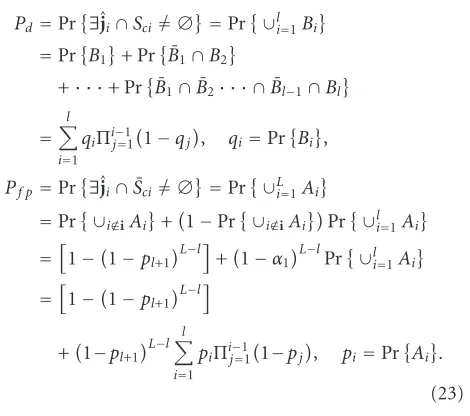
These formulas can be derived by utilizing the law of total probability in conjunction with the independency between fingerprints belonging to different groups and the fact that
pl+1 = pl+2 = · · · = pL since there are no colluders in
{Al+1,. . .,AL}. Based on this pair of criteria, the system
re-quirements are represented as
Pf p≤, Pd≥β. (24)
We can see that the difficulty in analyzing the collusion resistance lies in calculating joint probabilities pi’s andqi’s.
When the total number of users is small such that all the users will belong to one or two groups, stage 1 (guilty group identification) is normally unnecessary and thusρshould be chosen to maximize the detection probability in stage 2. We note that the detection performance is characterized by the difference between the means of the two hypotheses in (13) and hence is given by (1−ρ)s/K. Therefore, a negativeρ
is preferred. Since the matrix Rshould be positive definite, 1 + (M−1)ρ > 0 is required. We show the performance by examples when the total number of users is small, as in
Figure 2a, wheren=100,M=50, and a negativeρ= −0.01 is used. It is clear that introducing a negativeρhelps to im-prove the performance whennis small. It also reveals that the worst case in performance happens when each guilty group contributes equal number of colluders, meaningki=K/|i|,
fori∈i.
In most applications, however, the total number of users
Orthogonal fingerprints
Correlated fingerprints 1 :ρ= −0.01,k=[25 25] Correlated fingerprints 2 :ρ= −0.01,k=[40 10]
10−3 10−2 10−1 100
Pf p 0.5
0.55 0.6 0.65 0.7 0.75 0.8 0.85 0.9 0.95 1
Pd
(a)
Orthogonal: simulation Orthogonal: analysis
Correlated: simulation Correlated: appr. analysis
10−3 10−2 10−1 100
Pf p 0
0.1 0.2 0.3 0.4 0.5 0.6 0.7 0.8 0.9 1
Pd
(b)
Figure2: ROC curvesPdversusPf pof different examples, compared with the orthogonal scheme in [16], withN =104. In (a), a small number of usersn=100 and a negativeρ= −0.01 are considered. We haveM=50 andK=50. In (b), a large number of usersn=6000 and a positiveρ=0.4 are considered, whereM=60,α1=10−6, and eight groups are involved in collusion, with each group having eight colluders.
TG(i) andTei(j)’s are approximately uncorrelated, therefore
we have the following approximations in calculatingPf pand Pdin (24):
pi≈Pr
TG(i)≥hG
Pr
max
j /∈Sci
Tei(j)≥h
=Q
hG−kir0
σd
1−
1−Q
h σd1−ρ
M−ki
,
qi≈Pr
TG(i)≥hG
Pr
max
j∈Sci
Tei(j)≥h
=Q
hG−kir0
σd
1−
1−Q
h−(1−ρ)s/K
1−ρσd
ki
(25)
withr0 = s
1 + (M−1)ρ/K√M. Note that here we em-ploy the theory of order statistics [24]. We show an example inFigure 2b, wheren=6000,L=100, and there are eight groups involved in collusion with each group having eight colluders. We note that this approximation is very accurate compared to the simulation result, and that our fingerprint-ing scheme is superior to usfingerprint-ing orthogonal ffingerprint-ingerprints.
To have an overall understanding of the collusion resis-tance of the proposed scheme, we further study the maxi-mum resistible number of colludersKmaxas a function ofn. For a givenn,M, and{ki}’s, we choose the parametersα1,
which determines the thresholdhG,α2, which determines the
thresholdh, andρ, which determines the probability of the
group detection, so that
α1,α2,ρ
=arg max
{α1,α2,ρ}Pd
α1,α2,ρ subject toPf p
α1,α2,ρ≤.
(26)
In reality, the value ofρis limited by the quantization preci-sion of the image system andρshould be chosen at the finger-print design stage. Therefore,ρis fixed in real applications. Since, in many collusion scenarios the size|i|would be rea-sonably small, our results are not as sensitive toα1andρas to
α2, and the group detection in stage 1 often yields very high accuracy. For example, when|i| ≤5, the thresholdhGcan be
chosen such thatα1 and Pr(TG(i)≥hG) is sufficiently
close to 1 for at least one groupi∈i. Therefore, to simplify our searching process, we can fix the values ofα1. Also, in the design stage, we consider the performance of the worst case, whereki =K/|i|, fori ∈ i. One important efficiency
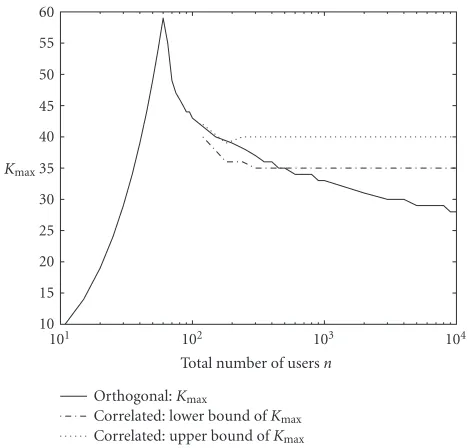
measure of a fingerprinting scheme isKmax, the maximum number of colluders that can be tolerated by a fingerprinting system such that the system requirements are still satisfied. We illustrate an example inFigure 3, whereM =60 is used since it is shown to be the best supportable user size for the orthogonal scheme [16], and the number of guilty groups is up to five. It is noted thatKmaxof the proposed scheme (in-dicated by the dotted and the dashed-dotted lines) is larger than that of the orthogonal scheme (the solid line) whenn
Orthogonal:Kmax
Correlated: lower bound ofKmax Correlated: upper bound ofKmax
101 102 103 104
Total number of usersn 10
Figure3: Comparison of collusion resistance of the orthogonal and the proposed group-based fingerprinting systems to the average at-tack. Here,N =104,M =60,k
i =K/|i|,|i| =5, and the system requirements are represented by=10−3andβ=0.8.
Overall, the group-oriented fingerprinting system provides the performance improvement by yielding better collusion resistance. It is worth mentioning that the performance is fundamentally affected by the collusion pattern. The smaller the number of guilty groups, the better chance the colluders are identified.
3.3.2. Case 2 (fraction of guilty captured versus fraction of innocent accused)
This set of performance criteria consists of the expected frac-tion of colluders that are successfully captured, denoted asrc,
and the expected fraction of innocent users that are falsely placed under suspicion, denoted asri. Here, the major
con-cern is to catch more colluders, possibly at a cost of accus-ing more innocents. The balance between capturaccus-ing collud-ers and placing innocents under suspicion is represented by these two expected fractions. Suppose the total number of usersnis large, and the detection scheme in (18) is applied. We have
0, otherwise. (29)
Based on this pair{ri,rc}, the system requirements are
repre-sented by
ri≤αi; rc≥αc. (30)
We further notice that TG(i) and Tei(j)’s are
approxi-mately uncorrelated, therefore, we can approxiapproxi-mately apply
p1i = Pr{TG(i) ≥ hG}Pr{Tei(j) ≥ h | j ∈ Sci}, fori =
1,. . .,l, andp0i=Pr{TG(i)≥hG}Pr{Tei(j)≥h| j /∈Sci},
fori=1,. . .,l+ 1 in calculatingriandrc. With a givenn,M,
and{ki}’s, the parametersα1which determines the threshold
hG,α2which determines the thresholdh, andρwhich deter-mines the probability of the group detection, are chosen such that
Similarly, finite discrete values ofα1andρare considered to reduce the computational complexity.
We first illustrate the resistance performance of the sys-tem by an example, shown in Figure 4a, where N = 104,
ρ = 0.2, and three groups involved in collusion with each group including 15 colluders. We note that the proposed scheme is superior to using orthogonal fingerprints. In par-ticular, for the proposed scheme, all colluders are identified as long as we allow 10 percent innocents to be wrongly ac-cused. We further examineKmaxfor the case thatki=K/|i|
when different number of users is managed, as shown in
Figure 4b by requiringr ≤ 0.01 andPd ≥ 0.5 and setting M =60 and the number of guilty groups is up to ten. The
Kmaxof our proposed scheme is larger than that ofKmaxfor orthogonal fingerprinting when largenis considered.
3.3.3. Case 3 (catch all colluders)
This set of performance criteria consists of the efficiency rate
r, which describes the amount of expected innocents accused per colluder, and the probability of capturing allKcolluders, which we denote byPd. The goal in this scenario is to capture
Orthogonal fingerprints Correlated fingerprints
10−2 10−1 100
ri 0.4
0.5 0.6 0.7 0.8 0.9 1
rc
(a)
Orthogonal:Kmax
Correlated: lower bound ofKmax Correlated: upper bound ofKmax
101 102 103 104
Total number of usersn 0
10 20 30 40 50 60 70 80 90 100
Kmax
(b)
Figure4: The resistance performance of the group-oriented and the orthogonal fingerprinting system under the criteriariandrc. Here, N =104. In (a), we haveM=50,n=500,ρ=0.2;K
maxversusnis plotted in (b), whereM=60, the number of colluders within guilty groups are equal, meaningki=K/|i|, the number of guilty groups is|i| =10, and the system requirements are represented byα=0.01 and β=0.5.
in whichp0iandp1iare defined as in (27). Based on this pair
{r,Pd}, the system requirements are expressed as
r≤α, Pd≥β. (33)
Similar to the previous cases, we further notice thatTG(i)
andTei(j)’s are approximately uncorrelated, and we may
ap-proximately calculatep1i’s andp0i’s as done earlier. Using the
independency, we also apply the approximation
Pr
Ci
=Pr
TG(i)≥hG
Pr
min
j∈SciTei
(j)≥h
=Q
hG−kir0
σd
Q
h−(1−ρ)s
σd1−ρ
ki (34)
in calculatingPd. With a givenn,M, and{ki}’s, the
param-etersα1which determines the thresholdhG,α2which deter-mines the thresholdh, andρwhich determines the probabil-ity of the group detection, are chosen such that
max
{α1,α2,ρ}Pd
α1,α2,ρ subject torα1,α2,ρ≤α. (35)
Similarly, finite discrete values ofα1andρare considered to reduce the computational complexity.
We illustrate the resistance performance of the proposed system by two examples shown inFigure 5. It is worth men-tioning that the accuracy in the group detection stage is crit-ical for this set of criteria, since a miss-detection in stage 1 will result in a much smallerPd. When capturing all
collud-ers with high probability is a major concern, our proposed
group-oriented scheme may not be favorable in cases where there are a moderate number of guilty groups involved in collusion or when the collusion pattern is highly asymmet-ric. The reason is that, under these situations, a threshold in stage 1 should be low enough to identify all colluder-present groups, however, a low threshold also results in wrongly ac-cusing innocent groups. Therefore, stage 1 is not very useful in these situations.
4. TREE-STRUCTURE-BASED FINGERPRINTING SYSTEM
In this section, we propose to extend our construction to represent the natural social and geographic hierarchical re-lationships between users by generalizing the two-tier ap-proach to a more flexible group-oriented fingerprinting sys-tem based on a tree structure. As in the two-tier group-oriented system, to validate the improvement of such tree-based group fingerprinting, we will evaluate the performance of our proposed system under the average attack and com-pare the resulting collusion resistance to that of an orthogo-nal fingerprinting system.
4.1. Fingerprint design scheme
Orthogonal fingerprints Correlated fingerprints
10−2 10−1 100
r 0.7
0.75 0.8 0.85 0.9 0.95 1
Pd
(a)
Orthogonal fingerprints Correlated fingerprints
100 101
r 0
0.1 0.2 0.3 0.4 0.5 0.6 0.7 0.8 0.9 1
Pd
(b)
Figure5: Performance curvesPdversusr of different examples, compared with the orthogonal scheme in [16]. Here,N =104. In (a), K=23, a small number of usersn=40, and a negativeρ= −0.023 are considered. In (b),M=60, a large number of usersn=600, and a positiveρ=0.3 are considered. Three groups are involved in collusion, with numbers of colluders being [32, 8, 8], respectively.
a1 a2
a11 a12 a21 a22
a111 . . . s111
a112 . . . s112
a113 . . . s113
i1
a121 . . . s121
a122 . . . s122
a123 . . . s123
i2
a211 . . . s211
a212 . . . s212
a213 . . . s213
i3
a221 . . . s221
a222 . . . s222
a223 . . . s223
i4
Figure6: A tree-structure-based fingerprinting scheme.
collude with some groups than with other groups. If we al-low for a more general tree structure in the fingerprint de-sign, we can achieve more flexibility in capturing the col-lusion dynamics between different groups. For instance, we may consider a simple region-based collusion pattern: users within Maryland are more likely to come together in generat-ing an attacked copy than they are likely to collude with other users from Texas, and the probability for these two groups to come together to collude is higher than they would with users from Asia. We may view this subgroup hierarchy via a tree structure, as depicted inFigure 6. In this diagram, we as-sume that (1) users in regioni1are equally likely to collude with each other with a probability p1and (2) each user in regioni1is equally likely to collude with users within region
i2with a probability p2and users within other regions cor-responding to different subtrees with a probabilityp3, where
p1> p2> p3. Therefore, it is desirable for us to design a fin-gerprint tree that matches the large-scale collusion pattern (e.g., represented by the cultural, social, and geographic re-lationships among users) in such a way that the fingerprints on the same branch of the tree are more correlated with each other than with those on other branches, and correspond-ingly the associated users on the same branch of the tree are more likely to collude with each other.
More generally, we design a tree withMlevels where each node at the (m−1)th level supports a total ofLmnodes. Let
[i1,. . .,iM] indicate the index vector of a user/fingerprint.
Ex-ploiting the tree structure, we propose the following design of fingerprints{si1,...,iM}:
si1,...,iM=
ρ1ai1+· · ·+ρM−1ai1,...,iM−1+ # $ $ $ %1−
M−1
j=1
ρjai1,...,iM,
(36) where theavectors correspond to orthogonal basis vectors with equal energya = s, eachρjsatisfies 0≤ρj≤1, and ρM=1−
M−1
j=1 ρj. In this design scheme, the correlations
be-tween fingerprints are controlled by adjusting the coefficients
ρi’s, which are determined by the probabilities for users
un-der different tree branches to carry out collusion attacks.
4.2. Detection scheme
vector [i1,. . .,iM] is represented asyi1,...,iM=x+si1,...,iM, where
xis the host signal. When a collusion occurs, suppose that a total of K colluders are involved in forming a copy of col-luded contenty, and the number of colluders within each levelmsubregion represented by an index vector [i1,. . .,im]
observed contentyafter the average collusion is
y= 1
whereicindicates the index vector of lengthM,Scindicates
a vector set of sizeK, and each element ofScis an index
vec-tor. We also assume that additional noisedis introduced af-ter the average collusion anddis a vector following an i.i.d. Gaussian distribution with zero mean and varianceσd2. The
number of colludersK and the setScare the parameters to
be estimated. We consider the nonblind scenario, where the host signalxis available at the detector and thus always sub-tracted fromyfor analysis.
Using such a formulation, we will address the issue of detecting the colluders. The tree-structured, hierarchical na-ture of group-oriented fingerprints leads to amultistage col-luder identification scheme: the first stage focuses on identi-fying the “guilty” regions at the first level; at the second stage, we further narrow down by specifying “guilty” subregions within each “guilty” region. We continue the process along each “guilty” branch of the tree until we detect the collud-ers at the leaf level. More specifically, at each levelm, with
m = 1,. . .,M, and with a previously identified region
in-Stagem—subregion detection at levelmof the tree structure
With a previously identified region indexed by i = [i1,. . .,im−1], we need to further examine the subregions in-dexed byi = [i1,. . .,im] forim = 1,. . .,Lm. Due to the
or-thogonality of basis{ai1,...,im}, it suffices to consider the
(nor-malized) correlator vectorTi1,...,im−1for identifying subregions
including colluders. Theimth component of Ti1,...,im−1 is
ex-detection process in stagemis
ˆ
where ˆjmindicates the indices of subregions containing
col-luders within the previously identified region represented by [i1,. . .,im−1].
Finally, we note that the individual colluders are identi-fied at levelM(the leaf level). Now with previously identi-fied region represented by [i1,. . .,iM−1], we have, foriM =
Now the detection process in stageMis
ˆ
where ˆjMindicates the indices of colluders within the
previ-ously identified region represented by [i1,. . .,iM−1].
In our approach, at each levelm, we specify a desired false positive probabilityαmand choose the thresholdhmsuch that
Pr
In summary, the basic idea behind this multistage detection scheme is to keep narrowing down the size of the suspicious set. An advantage of this approach is its light computational burden since, when the number of colludersKis small or the number of subregions involved in collusion is small, the total amount of correlations needed can be significantly less than the total number of users.
4.3. Parameter settings and performance analysis In this subsection, we will address the issue of setting the pa-rameters (e.g., how to choose the values of coefficientsρm’s,
thresholdshm’s, and the sizesLm’s) and examine the
perfor-mance metrics characterized byPf pandPd. Due to the
mul-tistage nature of the proposed detection approach, calculat-ing the overall performancePf pandPf ninvolves computing
A1(2)
Figure7: Demonstration of the types of false alarm events for a three-level tree structure, where at the leaf level the square-shape nodes indicate colluders and the circle-shape nodes indicate innocents. (a) The dark and light arrows represent an event inB3andB2, respectively. (b) The eventA1(2).
We first examine the types of false alarm events pos-sible for our tree-structured scheme. A false alarm occurs when the detector claims colluders are present in a colluder-absent region. A colluder-colluder-absent region is characterized by
ki1,...,im =0. As shown inFigure 7, where the gray rectangles
represent colluder-absent regions, we can characterize false alarm events in these regions byAM(·),AM−1(·),. . .,A1(·):
The probability of these events is given by
pM =Pr
of a collusion pattern represented in the tree structure,Pf pis
a complicated function of the collusion pattern.
During the system design process, we normally do not have knowledge of the location of the colluders. As such, we
use the upper bound ofPf p, which does not require detailed
knowledge of the collusion pattern, to guide our selection of parameter values. Let K be the total number of collud-ers. Based on the analysis of probability and order statistics [24,25], as presented inAppendix B, we have
innocent. As we can see, theLmpmterm in the above
expres-sion is due to the type of false alarm eventAm. Intuitively, we
want the probability of an event of typeAmto decrease with
a decreasing levelm. In particular, we want the probability that a false alarm occurs in an innocent region connected di-rectly to the root,Pr{B1}to be negligible, thus implying that α1 is small. This is due to the fact that our tree-structured fingerprint system can be deployed in such a way that typ-ically only a very small number of regions at the first level are involved in collusion, thus a miss-detection is rare at the first level even with a high thresholdh1. To simplify the pa-rameter setting process, we relate the false alarm probabilities at different levels with a multiplicative factorc. That is, if at the leaf level we have the probability of a false positive repre-sented byp, then for the (M−1) level, we scalepby a factor ofcand use p/cto represent the probability of the events of typeBM−1. We apply this scaling to upper levels in a similar way. Further, using the upper bound of pm in (48), we can
summarize the process as
Using this choice ofαmand thushmin (51), we have a positive constant larger than 1. The detail of this derivation is provided inAppendix B. Basically, for largerKand p, or for smallerc, we will see a largerPf p. Based on the chosen
With this design scheme, we fix the thresholds at levels 1 to (M−1) and only leave the threshold at the last level adjustable in our performance evaluation.
Now we proceed to study the behavior ofPd. We have
Pd=Pr It is worth mentioning that, due to the independency of the basis vectors a’s in fingerprint design, all eventsCm(·)’s at
the same level mare independent of each other. Without loss of generality, given a region{i1,. . .,im}, we assume that
ing this relationship, we can calculate the probability of de-tectionPd for a given collusion pattern. Intuitively, we can
see that Pr{Ti1,...,im−1(im) ≥ hm} plays an important role
in Pd, thus the more tightly the colluders are concentrated
in a subregion, the higher the Pd is. We want the
proba-bility Pr{Ti1,...,im−1(im) ≥ hm} to be larger at lower levels,
since a miss-detection in a lower level is more severe. Re-ferring to the distribution of Ti1,...,im−1(im) in (41), we note
tem design, since it characterizes the worst case of the detec-tion performance due to higher levels (e.g.,Πmj=1Lj≥K). To
simplify our problem, we chooseρ1= · · · =ρM−1andL2= · · · =LM−1. Since the final decision is made in the last level
andαMis usually low (thushMis large), we want to maintain
enough power at theMth level to yield reasonable detection probability. In our case, we simply choose 1−M−1
m=1ρm=0.5,
meaning half power is kept at the last level. Given the to-tal number of usersn, the WNR, and the total levelsM, we choose L1 andh1 such that Q((µlow1 −h1)/σd) is close to 1
(e.g., 0.99) andα1 < 1/(L1c). This strategy ensures that at least one colluder-present region will pass the detection at level 1 with very high probability. We chooseLM to
maxi-mize the number of colluders that the system can tolerate. For instance, based on the example shown inFigure 3, we can chooseLM =60. Therefore, in addition to choosingL1and
LMas above, we set other parameters as follows by choosing
ρ1= · · · =ρM−1=
Now the overall performance is a function ofαM(thushM)
andc.
We demonstrate the performance of such a fingerprint-ing system through examples and compare it with a ffingerprint-inger- finger-printing system employing orthogonal modulation. As in the group-oriented scheme, the overall power of the colluded ob-servation y is maintained as s2 in our simulations for a fair comparison. We consider a tree structure with four lev-els, whereL1=8,L2=L3=5, andL4=50, therefore it can accommodaten = 104 users. Suppose the total number of colludersK=40. We first examine a scenario where the col-lusion pattern is balanced, that is, at each levelm, all nonzero
ki1,...,im’s are equal. One example is illustrated in Figure 8,
where we choose α1 = 10−3 andc = 10. In this example, two regions at level 1 include colluders (e.g.,k1=k2=K/2), and in turn two subregions at level 2 within each guilty re-gion from level 1 are colluder present, then one subrere-gion at level 3 within each guilty region of level 2 is colluder present, and finally 10 colluders are present within each guilty sub-region of level 3. This example illustrates the improved col-lusion resistance that the tree-structured system can provide when compared to orthogonal fingerprinting.
Orthogonal fingerprints Tree-based fingerprints
10−3 10−2 10−1 100
Pf p 0
0.1 0.2 0.3 0.4 0.5 0.6 0.7 0.8 0.9 1
Pd
(a)
Orthogonal fingerprints Tree-based fingerprints
10−3 10−2 10−1 100
ri 0
0.1 0.2 0.3 0.4 0.5 0.6 0.7 0.8 0.9 1
rc
(b)
Figure8: Performance curves of one example of the tree-structure-based fingerprinting system with a symmetric collusion pattern, com-pared with the orthogonal scheme in [16]. Here,n=104, the number of levelsM =4, andK=40. (a) The ROC curveP
dversusPf pis plotted and (b) the curve of the fractionsrcversusriis shown.
Orthogonal fingerprints
Tree-based fingerprints: random pattern 1 Tree-based fingerprints: random pattern 2
10−2 10−1 100
Pf p 0
0.1 0.2 0.3 0.4 0.5 0.6 0.7 0.8 0.9 1
Pd
Figure9: The ROC curvePdversusPf pof one example of the tree-structure-based fingerprinting system with random collusion pat-terns, compared with the orthogonal scheme. Heren = 104, the number of levelsM=4, andK=60.
together in a totally random manner, representing that all users are equally likely to collude with each other; while in random pattern 2, the colluders are randomly distributed in the first region at level 1. InFigure 9, we provide the ROC curves,PdversusPf p, for both random patterns, as well as for
orthogonal fingerprints. From this figure, we have two obser-vations: first, when the collusion pattern that the fingerprints
were designed for is similar to the actual collusion pattern, as in the case of random pattern 2 at the first level, the results show improved collusion resistance. Second, when there is no similarity between the assumed collusion pattern and the true collusion pattern, as in the case of random pattern 1, orthogonal fingerprints can yield higher collusion resistance than the tree-based scheme. Therefore, it is desirable for the system designer to have good knowledge of the potential col-lusion pattern and design the fingerprints accordingly.
One additional advantage of the tree-structure-based fin-gerprinting system over the orthogonal one is its computa-tional efficiency, which is reflected by the upper bound of the expected computational burden of this approach. The upper bound is in terms of the amount of correlations required as a function of a set of parameters including the number of col-luders, the threshold at each level of the tree, and the number of nodes at each level. We denote byC(n,K) the number of correlations needed in our proposed detection scheme. De-noting byE(Am) the number of expected correlations needed
in an eventAmandtbeing the number of colluder-present
subregions at level (M−1), we have
C(n,K)<2t M
m=1
Lm<2K M
m=1
Lm. (61)
(a) (b) (c)
Figure10: (a) The host images, (b) colluded images withK=40, and (c) difference images for Lena and Baboon under the average attack. The collusion pattern for Lena image is the same as inFigure 11, and as inFigure 12for the Baboon image.
5. EXPERIMENTAL RESULTS ON IMAGES
We now compare the ability of our fingerprinting scheme and a system using orthogonal fingerprints for identify-ing colluders when deployed in actual images. In order to demonstrate the performance of orthogonal, Gaussian fin-gerprints, we apply an additive spread spectrum watermark-ing scheme similar to that in [19], where the original host image is divided into 8 × 8 blocks, and the watermark (fingerprint) is perceptually weighted and then embedded into the block DCT coefficients. The detection of the fin-gerprint is nonblind, and is performed with knowledge of the host image. To generally represent the performance, the 256×256 Lena and Baboon images were chosen as the host images since they have different characteristics. The finger-printed images have an average PSNR of 44.6 dB for Lena, and 41.9 dB for Baboon. We compare the performance of the thresholding detector under average collusion attack. We show inFigure 10the original host images, the colluded im-ages, and the difference images. WithK =40, we obtain an average PSNR of 47.8 dB for Lena and 48.0 dB for Baboon after collusion attack and the JPEG compression.
Denoting sj as the ideal Gaussian fingerprint, the ith
component of the fingerprint, indexed byic, is actually
em-bedded as
sic(i)
t=
α(i)sic(i) (62)
with α being determined by the human visual model parameters in order to achieve imperceptibility. Therefore, the composite embedded fingerprintytafter attacking is
rep-resented as
y(i)t= 1 Kα(i)
ic∈Sc
sic(i) +x(i) +d(i), (63)
where the noise d is regarded as i.i.d N(0,σ2
d) distributed.
Due to the nonblind assumption,αi’s are known in the
de-tector side and thus the effects of real images can be partially compensated by correlating (yt−x) with theα-scaled basis or
fingerprints in the test statisticsT(·)’s defined in earlier sec-tions and adjusting the norm to best = N
i=1α(i)2s. For instance, the detection scheme in (41) is now defined as
Ti1,...,im−1
im
=
yt−xTa i1,...,imt
&&st&& (64)
with each componentai1,...,im(i)
t=
α(i)ai1,...,im(i).
We illustrate examples where the collusion pattern is symmetric. We consider a four-level tree structure withL1= 8, L2 = L3 = 5, and L4 = 50. We present the results for the Lena image inFigure 11 based on 104 simulations, where K = 40 and we choose α1 = 10−3 and c = 10. In this example, one region at level 1 is guilty, while at levels 2 and 3 we assumed that each guilty region had 2 subregions containing colluders. Finally, 10 colluders are present within each guilty sub-region at the final level, that is, level 3. Additionally, we present the results for Baboon im-age inFigure 12based on 104 simulations, where K = 40,
Orthogonal fingerprints Tree-based fingerprints
10−2 10−1 100
Pf p 0
0.1 0.2 0.3 0.4 0.5 0.6 0.7 0.8 0.9 1
Pd
(a)
Orthogonal fingerprints Tree-based fingerprints
10−3 10−2 10−1 100
ri 0
0.1 0.2 0.3 0.4 0.5 0.6 0.7 0.8 0.9 1
rc
(b)
Figure11: One example of the detection performance of the group-oriented fingerprinting system on Lena image under average attack. Here,M=4,n=104,K=40, and the Lena image with equivalentN=13691. (a) The curveP
dversusPf p. (b) The curvercversusri.
region had 2 subregions containing colluders. Finally, 5 col-luders are present within each guilty subregion at level 3. We can see that the detection performance of the proposed tree-structure-based fingerprinting system is much better than that of the orthogonal system under this colluder scenario.
6. CONCLUSION
In this paper, we investigated a method for enhancing the collusion resistance performance of fingerprinting systems using orthogonal modulation. We proposed a group-oriented fingerprinting system by exploiting the fundamen-tal property of the collusion scenario that adversaries are more likely to collude with some users than others due to ge-ographic or social circumstances. With this underlying phi-losophy, we then introduced a well-controlled amount of correlations into user fingerprints in order to improve col-luder identification.
We first developed a two-tier group-oriented fingerprint-ing system that involved the design of ffingerprint-ingerprints and a two-stage detection scheme for identifying colluders. We evalu-ated the resistance performance of the proposed system un-der the average attack by examining different sets of perfor-mance criteria. It was demonstrated that the proposed fin-gerprinting scheme is superior to orthogonal finfin-gerprinting system. In particular, as shown in one example, the proposed scheme can identify all colluders when we allow for up to 10 percent of the innocents to be wrongly accused. In stark con-trast, a system using orthogonal fingerprints would require the detection system to suspect almost all users as guilty.
Our work was further extended to a more flexible tree-structure-based fingerprinting system in order to represent
the natural hierarchical relationships between users due to social and geographic circumstances. We proposed an effi-cient and simple scheme for fingerprint design, and proposed a multistage colluder identification scheme by exploiting the hierarchical nature of the group-oriented system where the basic idea is to successively narrow down the size of the suspi-cious set. Performance criteria were analyzed to guide the pa-rameter settings during the design process. We demonstrated performance improvement of the proposed scheme over the orthogonal scheme via examples. Furthermore, we derived an upper bound on the expected computational burden of the proposed approach and showed that one additional ad-vantage of the tree-structure-based fingerprinting system is its computational efficiency. We also evaluated the perfor-mance on real images and noted that the experimental results match the analysis. Overall, by exploiting knowledge of the dynamics between groups of colluders, our proposed scheme illustrates a promising mechanism for enhancing the collu-sion resistance performance of a multimedia fingerprinting system.
APPENDICES
A. DERIVATION OF (11) AND (13)
Recall the distribution and the correlation coefficients
pTi K,Sci,σd2
=N
u
K CΦi,σ
2
dIM
,
cTjcl=
1, if j=l,
ρ, if j=l.
Orthogonal fingerprints
Figure12: One example of the detection performance of the group-oriented fingerprinting system on Baboon image under average attack. Here,M=4,n=104,K=40, and the Baboon image is with equivalentN=19497. (a) The curveP
dversusPf p. (b) The curvercversusri.
Now assume the parametersKandkiare known, we can
es-timate the subsetScivia
ˆ
where the vectorTsiis defined as
Tsi=CTiTi=CT statistics involving the colluded observationy, the host
sig-nal x, and the fingerprintssi j’s. SinceTsi = CTTi,Tsi
con-ditioned onK andSci is also Gaussian distributed with the
mean vector and the covariance matrix decided as
µi=CTET
according to the properties of the vector-valued Gaussian distribution [26].
B. DERIVATION OF (53) pendency of the basis vectorsa’s, we have