R E S E A R C H
Open Access
Analysis of dual-channel ICA-based blocking
matrix for improved noise estimation
Yuanhang Zheng
*, Klaus Reindl and Walter Kellermann
Abstract
For speech enhancement or blind signal extraction (BSE), estimating interference and noise characteristics is decisive for its performance. For multichannel approaches using multiple microphone signals, a BSE scheme combining a blocking matrix (BM) and spectral enhancement filters was proposed in numerous publications. For such schemes, the BM provides a noise estimate by suppressing the target signal only. The estimated noise reference is then used to design spectral enhancement filters for the purpose of noise reduction. For designing the BM, ‘Directional Blind Source Separation (BSS)’ was already proposed earlier. This method combines a generic BSS algorithm with a geometric constraint derived from prior information on the target source position to obtain an estimate for all interfering point sources and diffuse background noise. In this paper, we provide a theoretical analysis to show that Directional BSS converges to a relative transfer function (RTF)-based BM. The behavior of this informed signal
separation scheme is analyzed and the blocking performance of Directional BSS under various acoustical conditions is evaluated. The robustness of Directional BSS regarding the localization error for the target source position is verified by experiments. Finally, a BSE scheme combining Directional BSS and Wiener-type spectral enhancement filters is described and evaluated.
1 Introduction
Blind signal extraction (BSE) aiming at extracting one source signal from a mixture of an unknown number of acoustic sources in noisy environments is a generic task in acoustic signal processing. It has a wide range of applications in many fields: As popular examples, hands-free interfaces for acoustic communications and human-machine interaction offer many challenging and relevant application scenarios, such as teleconferencing, interac-tive television, humanoid robots, and gaming. Moreover, acoustic signal extraction techniques are also highly rele-vant for assistive devices, such as hearing aids.
If multiple microphones are available, data-dependent multichannel approaches for signal extraction can be classified into unsupervised and supervised approaches. The class of unsupervised methods does not require prior knowledge on the spatial distribution of sources and sensors. The lack of prior knowledge is compen-sated by exploiting fundamental signal characteristics. Conventional unsupervised signal extraction approaches
*Correspondence: [email protected]
Chair of Multimedia Communications and Signal Processing, University of Erlangen-Nuremberg, Cauerstraße 7, Erlangen 91054, Germany
are, e.g., independent component analysis (ICA)-based [1,2] or sparseness-based blind source separation (BSS) algorithms [3,4]. However, conventional ICA-based approaches cannot be used for underdetermined cases, where the number of sensors is less than the number of sources, and sparseness-based methods are highly dependent on the sparsity of the mixing signals. Recently, model-based multichannel approaches gained a lot of attention. These are, e.g., approaches based on a spa-tial covariance model [5] or multichannel nonnegative matrix factorization (NMF) methods based on model-ing complex Gaussian distributions [6,7]. As opposed to [1-4] they do not solely rely on the independence or the sparsity of the underlying signals and can be used for underdetermined source separation.
signal(s) represented by linear constraints in order to sup-press interfering sources and to preserve target signal(s) from known directions [11]. As an alternative form of the LCMV beamformer, the generalized sidelobe can-celer (GSC) was proposed in [12], which converts the constrained optimization problem into an unconstrained problem.
Under realistic acoustic conditions, prior information is often exploited for practical realizations of supervised and unsupervised signal extraction approaches. This leads to the class of informed signal processing algorithms, where relevant information of the underlying conditions is exploited to realize the signal extraction algorithms or to render these algorithms more robust and reliable for practical conditions. Prior knowledge, which can be spa-tial information in terms of the direction of arrival (DoA) of source signals, coherence or diffuseness of the sound field, etc., may be given or estimated from the acquired sensor data. An overview of the relevant work belonging to this class is given in the following.
To realize the MWF, an estimate of the second-order statistics (SOS) of the noise signals is required. Based on the assumption of a diffuse noise field, several methods are derived for estimating the SOS of the noise compo-nents in terms of the auto-power spectral density (PSD) [13-15] or the cross PSDs between all channels for both the target source(s) and the noise and interference com-ponents [16]. Furthermore, it was recently proposed to exploit the direct-to-diffuse ratio (DDR) to realize the MWF for stationary noise and babble noise conditions [17]. It was also suggested to exploit the position informa-tion to estimate the cross PSDs of direcinforma-tional speech inter-ferences [18]. For unsupervised algorithms, prior spatial information such as information about the source posi-tions or the sensor constellation is often incorporated to improve the robustness. Model-based multichannel approaches [6,7] can incorporate the directional infor-mation by initialization of a part of the spatial model. Parra and Alvino [19] proposed to combine an ICA algo-rithm with geometric constraints in order to improve the separation performance, where BSS was regarded as a set of beamformers whose response is constrained to a set of DoAs for recovering all sources from the mix-ture. Inspired by [19], Directional BSS [20] was proposed to serve as a blocking matrix (BM) when using a differ-ent constraint for the opposite purpose: this constraint forces essentially a spatial null towards a certain direc-tion in order to suppress the target source and to preserve the interfering and noise components. The precondition not only for Directional BSS but also for Parra’s method is that the DoA information on the target source(s) must be given. Furthermore, based on the noise estimate produced by Directional BSS, a two-unit source extrac-tion/noise reduction scheme combining a BM and a noise
reduction unit was proposed in [21], where the spectral weights in the noise reduction stage are designed based on a diffuse noise field assumption. In this paper, we focus on the discussion of Directional BSS operating as a BM.
The concept of a BM was originally proposed in [12] for the structure as shown in Figure 1. The structure sep-arates the LCMV beamformer into two main processing paths: the first path comprises a fixed beamformer (FB) with constraints on the target signal. The second path contains a BM and an adaptive interference canceler (AIC) that adaptively minimizes the noise power in the output. The BM is defined as a matrix used to reject (block) the target signal at its output, hence providing references of all undesired interference signals and noise components required for interference cancellation schemes.
Originally in [12], the BM was designed for time-invariant free-field environments and rejected the source signal from one direction only, requiring precise source location information. This BM can be regarded as mini-mum variance distortionless response (MVDR) BM as the MVDR beamformer imposes the distortionless constraint only for the desired direction. For the dual-channel case, the conventional MVDR BM is given by the delay-and-subtract beamformer (DSB) and can only suppress the direct path of the target source. Theoretically, the con-ventional LCMV BM can suppress the direct path and reflections by formulating the corresponding constraints in the BM if the perfect knowledge on the angle of arrival for each reflection is given [22]. However, the conven-tional LCMV/MVDR BM will likely lead to target signal leakage as it is conceived for time-invariant scenarios, and any movement of the target source will lead to a steering error relative to the true DoA for the target signal and its reflections. To improve the robustness against the steer-ing error, an adaptive BM was proposed in [23,24], which needs an adaptive control requiring source activity infor-mation. In [25], the relative transfer function (RTF)-based BM for LCMV/MVDR beamforming was proposed. The RTF-based BM can perfectly suppress the target signal if the RTFs are given. However, estimating RTFs usually requires estimation of the source activity or a double-talk detector, as noise-only frames or time segments where both the transfer functions (TFs) and the noise signals are assumed to be stationary need to be available for RTF estimation [25-27].
Figure 1Structure of a general sidelobe canceler.
diffuse background noise) was proposed. This approach can be applied in both determined and underdetermined scenarios. Unlike for beamforming approaches, correlated components arriving from other directions, i.e., reflec-tions and reverberation will also be suppressed to the greatest extent possible by Directional BSS. This con-cept can deal with underdetermined scenarios such that a meaningful instantaneous estimate for all undesired signals comprising interfering speech signals and diffuse background noise can be obtained using only two micro-phones and regardless of the noise statistics. Note that for applying the directional constraint, the directional information on the target source must be given or esti-mated by a source localizer. Even with a source localizer, a predefined angular range of the target source must be given. This range was set to be−20° to 20° in front of the microphone array [20]. The algorithm of Directional BSS was introduced and its efficiency was shown in [20] with respect to the blocking performance. In this paper, we provide an in-depth analysis of the heuristically moti-vated BM in [20] and provide new insights with respect to several decisive aspects: (1) the relation of the ICA-based BM to other BMs, (2) the blocking performance if the target source arrives from directions which are differ-ent from broadside direction, (3) the robustness against localization errors, and (4) the BSE/speech enhancement performance when using the noise estimate produced by Directional BSS for Wiener-type spectral enhancement. Additionally, a BSE scheme combining Directional BSS and spectral enhancement filters under various acoustical conditions will be evaluated. Therefore, the main contri-butions of this paper compared to our earlier work are the following: For one, we show by a theoretical analysis and by experimental results that Directional BSS converges to an RTF-based BM. In addition, the performance of the proposed method is for the first time analyzed regarding some practically highly relevant aspects, e.g., the block-ing ability for sources impblock-ingblock-ing from arbitrary directions and the noise reduction performance of the applied noise reduction scheme.
The paper is organized as follows: In Section 2, the generic BSS algorithm is reviewed. In Section 3, we provide a theoretical analysis to show that Directional BSS converges to an RTF-based BM and describe the algorithm of Directional BSS. Moreover, the relation/ difference of Directional BSS to other conventional/state-of-art BMs is discussed. Furthermore, in Section 4, experimental results with respect to the blocking per-formance and the robustness against localization errors in various acoustical scenarios are presented. Finally, a BSE scheme combining Directional BSS and Wiener-type spectral enhancement filters is presented and evaluated in Section 5. Note that in this paper, we restrict our consideration to two-channel cases.
2 Determined blind source separation: generic ICA-based BSS algorithm
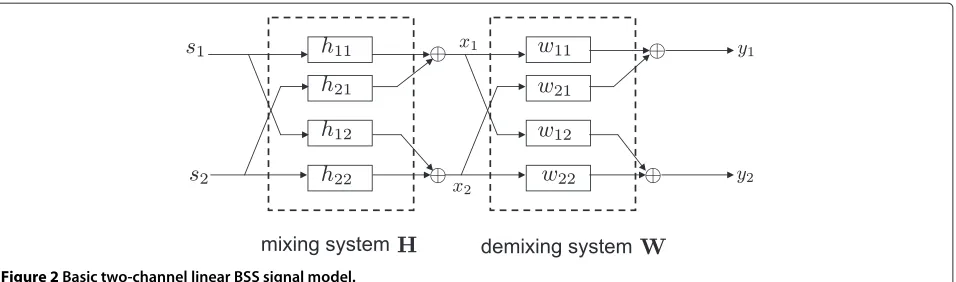
In this section, we briefly review a two-channel ICA-based BSS algorithm. Figure 2 depicts the basic two-channel BSS signal model for two point sourcess1,s2. The microphone
signals can be described in the discrete time domain by
xp(k)= denote the finite acoustic impulse responses from themth point source to thepth microphone in discrete time andk
is the discrete time index.
BSS algorithms aim at determining demixing filters to extract the individual sources from the mixed signals. The output signals of the demixing systemyq,q ∈ {1, 2}are
where wpq(k) denotes the demixing filter from the pth
microphone to theqth output channel.
Figure 2Basic two-channel linear BSS signal model.
sources are statistically independent. In this paper, we use triple-N independent component analysis for convolutive mixtures (TRINICON) [30] for BSS, where mutual infor-mation between the output channelsy= [yT1(k),yT2(k)]T should be minimized. As the algorithm is derived for block processing of convolutive mixtures, for each output yq(k), a sequence ofDoutput samples corresponding toD
successive time lags is taken into account.
The generic cost function used to determine a demixing systemWis then given by [31]
JBSS(W)= ˆE
logPpˆy,PD(y)
q=1pˆyq,D(yq)
, (3)
where Eˆ{·}is the estimate of the statistical expectation, with ensemble averaging being replaced by temporal aver-aging overNblocks assuming ergodicity within the indi-vidual blocks.pˆy,PD is an estimate of the joint probability
density function (pdf ) of dimensionPDover allP (here,
P= 2) output channels, andpˆyq,Dis the estimated
multi-variate pdf for channelqof dimensionD. MatrixW cap-tures all the impulse response coefficients of the demixing filters, with a detailed description of its structure given in [31,32]. Minimizing JBSS(W) corresponds to minimizing
the Kullback-Leibler divergence (KLD) betweenpˆy,PD(y)
andPq=1pˆyq,D(yq), which leads to maximization of the
statistical independence of the output vectorsyq.
3 Directional blind source separation as a blocking matrix
In this section, we firstly discuss the relation of Directional BSS with a conventional RTF-based BM in Subsection 3.1. The Directional BSS algorithm is described in Subsection 3.2 before comparing it to alternative approaches in Subsection 3.3.
3.1 From system identification to RTF-based blocking matrix
In [33], the relation between the optimum broadband solution of blind source separation and blind system
identification was presented. For a single-input/multiple-output (SIMO) system as shown in Figure 3, the perfect suppression of a broadband source implies for system identification:
h11(k)∗w11(k)+h12(k)∗w21(k)=0
⇒h11(k)∗w11(k)= −h12(k)∗w21(k). (4)
The optimum filters fulfilling (4) read in thez-domain [33]:
W11(z) = αH12(z),
W21(z) = −αH11(z). (5)
As a precondition for identifying this solution,H11(z)and H21(z)may not have common zeros and the filter lengths
equal the lengths of room impulse responses. Obviously, the optimum filters can only be determined up to a scaling factorα.
Let us consider the case wherew21is forced to be a delay τ, then (4) reads in thez-domain:
W11(z) = − H12(z) H11(z)
z−τ,
W21(z) = z−τ. (6)
In the frequency domain, (6) can be expressed by:
w11() = −h12() h11()e
−jτ,
w21() = e−jτ, (7)
where underlined characters denote frequency-domain representations. The normalized frequencyis given as
2πf
fs , wherefsdenotes the sampling frequency. The ratio of the two frequency responses h12()
h11() is known as the RTF or the TF ratio.
If we dividew11()byw21(), we get:
˜
hRTF= − h12()
h11(), (8)
which is exactly the form of the RTF-based BM proposed in [25].
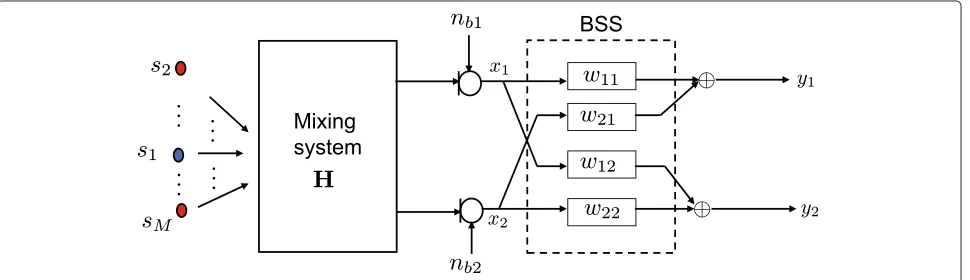
For a multiple-input/multiple-output (MIMO) system, in [33], it is shown that the optimum BSS solution is the generalization of the SIMO identification solution. This holds however only for determined cases. For an under-determined scenario as shown in Figure 4, there is no determined solution. However, here, our aim is not to find a determined BSS solution in underdetermined scenarios, but to exploit BSS as a BM to suppress the target sources1
only. Therefore, it still follows that
s1(k)∗h11(k)∗w11(k)+s1∗h12(k)∗w21(k)=0 ⇒h11(k)∗w11(k)= −h12(k)∗w21(k), (9)
which is the same as in (4) for the system identification in a SIMO system. As BSS has no determined solution in underdetermined scenarios, the problem is how to force BSS to suppress the target source only and preserve the other sources to form a joint noise estimate. For this purpose, we combine the generic BSS with a geometric constraint to force a spatial null towards the direction of the target source. We denote the combined algorithm as ‘Directional BSS’ and analyze it in the following sections.
3.2 Algorithm
Blind source separation can be regarded as ‘blind adaptive beamforming’ (blind ABF) [34] as BSS and ABF have sim-ilar goals and a simsim-ilar structure: Both attempt to extract a target signal and reduce the interference by multichan-nel array processing as described in [35,36]. In [34] it is shown that BSS is equivalent to a set of adaptive beam-formers which form multiple null-beams steered towards the directions of interfering sources and its reflections. On the other hand, there are fundamental (characteris-tic) differences between BSS and ABF: generic BSS usually does not require prior information on source locations and sensor constellations, while ABF requires the spatial information on the locations of sources and sensors. In [19] a method was proposed to combine BSS and beam-forming for achieving a better separation performance by utilizing the geometric information of sources. The kind of combination is known as geometric source separation, where the response of BSS demixing filters is additionally constrained to a set of directions.
The original algorithm of geometric source separation was described in the discrete Fourier transform (DFT) domain. The response of BSS at the qth BSS output is constrained to the directionθ, which can be expressed by
wTq()d(,θ)=ξ, (10)
where ξ denotes the constraint, wq () =
[w1q(),w2q()]T describes the demixing filters for the
qth BSS output channel at the frequency = 2πνN (ν is the frequency bin and N is the length of the demixing filter) in the DFT domain;{·}Tis the transpose operator; d(,θ)is the steering vector pointing to directionθ:
d(,θ) = [e−jζ, 1]T, (11)
ζ = dmicfssinθ
c , (12)
wherecis the sound velocity. Note that both the micro-phone spacingdmic and the angleθ relative to the array
axis must be given. For simplicity, we omit the frequency variablein the sequel.
More generally, to constrain the response of the BSS demixing matrix to a set ofP=2 directions, we write:
Two constraints were proposed in [19], and they are
diag(WD())=I, (14)
or WD()=I, (15)
whereIrefers to a 2×2 identity matrix. As both of the two constraints aim at extracting the sources, not at blocking the sources, we will not discuss them here, but a detailed discussion can be found in [19,37]. The constraint for blocking sources was proposed in [37]:
offdiag(WD())=0, (16)
which restricts the output channels to have a zero response for the signals arriving from the directions given in , i.e., it forces each output channel to form a null beamformer steered to the source which should be blocked in this output channel.
The constraint (16) can be incorporated into the overall cost function for the source separation (3) as an additional penalty term:
JC(W) = offdiag(WD())2F, (17)
whereA2F=traceAAHis the Frobenius norm of the matrixA.{·}Hrefers to the conjugated transpose operator. Combining this with the cost function for the generic BSS algorithm given in (3), we obtain:
Jtotal(W)=JBSS(W)+ηCJC(W), (18)
where the weighting parameterηCcan be chosen to
con-trol the importance of the geometric constraint relative to the separation criterion represented byJBSS(3).
As Directional BSS serves as a BM for a single desired source, only the target source needs to be suppressed. Therefore,JC(W)is modified by considering the following
conditions:
• The direct path for the target signal issuppressed by the penalty term analogously to null-steering beamforming, i.e, a spatial null is forced toward the directionθof the target source.
• As only the target signal needs to be suppressed, only one BSS output channel is controlled by the
geometric constraint. Without loss of generality, the output channel 1 is chosen to be controlled with the penalty termJC(W)in the sequel.
• In order to converge to the RTF-based BM,w21is set
to be a pure delay and remains unchanged during adaptation of the demixing system. Note that we could equivalently use the first channel as the reference and in that casew11is a pure delay.
The simplified cost function for the constraint then reads:
As JC(W) is complex-valued, the gradient-descent
update for the constrained part forWis obtained by tak-ing the derivative of the cost functionJC(W)with respect
toWH [38]. Besides, as we want to keepw21 fixed, the
constraint must be applied to the demixing filterw11only.
Thus, the filter update term for the constraint part in the DFT-domain yields:
wherea∗ refers to the complex conjugate ofa. It should be noted that both frequency-domain and time-domain BSS algorithms can be associated with the geometric constraint. As we use the time-domain TRINICON SOS-based algorithm given in [32], the filter is updated in the time-domain for blockm˘ after iterationk˘as follows:
Wk˘+1(m˘)=Wk˘(m˘)− ˘μWtotal, (21)
where DFT−1{·} denotes the inverse discrete Fourier transform yielding a nonzero update contribution of the same length as the demixing filter length N. ∂JC(W)
∂WH is already given in (20). In [32] a detailed description for the applied TRINICON-based update ∂JBSS(W)
∂W can be found. The natural gradient update is given as [32]:
where Ryy denotes the 2D× 2D correlation matrix of the output signal vectory of length 2D, bdiag refers to considering block matrix and describes the operation of setting all off-diagonal block matrices of the block matrix to zero. β(˘i,m˘) is a weighting function normalized to m˘
˘
i=0β(˘i,m˘) = 1 allowing for online, offline or
block-online realization of the algorithm [32].
By applying Directional BSS, the target sources1should
be suppressed in BSS output channel 1. Thus, the noise estimatenˆis given by the outputy1as follows:
ˆ
ponent contained in microphonep, respectively.
Besides, in [19] the efficiency of a proper geometrical initialization was shown. For the geometric constraint, the direction of the target source needs to be knowna priori or it needs to be estimated. If the target source position is not known, an additional source localizer is necessary. Many localization algorithms can be used as, e.g., GCC-PHAT [39] or an ICA-based source localizer [40]. With the given DoA information, we can initial-ize the filter structure corresponding to a DSB in order to accelerate convergence. The initialization is performed after each movement of the target source. Defining a vectordsub(θ) = [−1,e−jdmiccfssinθ]T, for the
constraint-controlled channel 1, the filter coefficients can be initial-ized as follows:
w1=dsub(θ). (25)
3.3 Comparison to alternative approaches
The original BM proposed by Griffith and Jim [12] is con-structed by subtracting pairs of time-aligned signals with respect to the target signal. For the dual-channel case, this is exactly a DSB, which is attractive for its simple structure. However, a major limitation in real acoustic scenarios is that the performance of a DSB will signif-icantly degrade for an imprecise target source position information, i.e., for steering errors. Additionally, due to reflections of the target signal impinging from directions other than the steering direction, significant signal leak-age into the noise reference needs to be expected. As a possible countermeasure, an adaptive BM (ABM) with coefficient constraints was proposed in [23]. In this con-ventional ABM, the output of the FB (see Figure 1) is used as a reference signal for the target source and adap-tively subtracted from the microphone signal. The least mean squares (LMS) algorithm is usually used for the
ABM adaptation. However, the adaptation can only be carried out in time segments, where only the target source is active. Therefore, a double-talk detector is necessary, which requires significant sophistication and will still be imperfect in complex acoustic scenarios. The difference of our approach to this BM is that (1) the adaptation criterion is different and very important for its practical relevance, and (2) a double-talk detector is not required.
The transfer-function-generalized sidelobe canceler (TF-GSC) was proposed by Gannot et al. [25], where the BM is constructed based on RTFs. This approach takes the reverberant nature of the enclosure into account. The RTFs are estimated by a least squares method and for this, two assumptions are necessary: (1) the RTFs change slowly over time compared to the time variations of the signals, which effectively precludes movements of the source, and (2) time segments are available, where both the TFs and the noise signal are assumed to be station-ary. In Section 3.1 we already show that our approach converges to an RTF-based BM. In contrast to [25], our approach does not rely on such time segments but only a coarse DoA estimation is required.
Warsitz et al. presented a BM based on a general-ized eigenvalue decomposition. They construct the BM directly by using the beamformer filter coefficients result-ing from maximizresult-ing the output signal-to-noise ratio, where the filter coefficients are computed iteratively by solving a generalized eigenvalue problem [41,42]. This approach indirectly estimates the RTFs and does not require periods of absence of noise and the DoA of the target source. On the other hand, it works only for station-ary noise while our approach can work in a nonstationstation-ary multispeaker scenario.
Recently, a subspace approach for estimating RTFs in multiple-noise scenarios was proposed in [27], which was used to construct the RTF-based BM efficiently. However, this approach needs an estimation for source activities.
same direction as the target source, as then Directional BSS is not able to provide an estimate for the interfer-ing source. Compared to these alternative approaches, the main advantage of the proposed approach is that no tar-get source activity estimation or prior knowledge on the source characteristics is necessary and no model needs to be matched, but only a coarse DoA estimation is required.
4 Evaluation of blocking matrices
In order to evaluate the proposed BM, comprehensive experiments were carried out. The system behavior and the target suppression performance of Directional BSS in single-source scenarios (only one directional source is active) and multiple-source scenarios (multiple direc-tional sources are simultaneously active) are evaluated. For showing the system behavior, Directional BSS is com-pared to (1) an ideal RTF-based BM and (2) a BM based on a DSB. The ideal RTF-based BM is calculated from the measured room impulse responses (RIRs). In order to evaluate the target suppression performance, Directional BSS is compared to (1) a perfect adaptive BM (we name it ideal ABM) and (2) a BM based on a DSB. The ideal ABM is adapted in a single-source scenario. It should be noted that state-of-art BMs are mostly based on an estimation of source activities and require perfectly detected target source-only time segments. Therefore, we compare Direc-tional BSS always with the DSB and not to other BMs as only these two BMs do not require estimating any source activities. The comparison to the ideal ABM can show us how close Directional BSS can reach to the perfectly supervised case. Besides, the robustness of Directional BSS against localization errors is analyzed in Section 4.3.
4.1 Experimental setup
Two real rooms were considered for evaluation: (1) room A: a living-room-like environment with a moderate rever-beration time of T60 ≈ 250 ms and a critical distance
[49] of 1.3 m and (2) room B: a more reverberant liv-ing room withT60 ≈ 400 ms and a critical distance of
0.9 m. As source-array, distances 1 and 2 m were consid-ered. The experiments are based on RIR measurements carried out with a two-channel array. The measurements were performed for two different microphone spacings,
dmic ∈ {6, 11.5} cm at a sampling frequency of 48 kHz
using the maximum length sequences (MLS) method [49]. For the following evaluation, the RIRs were downsampled to a sampling frequencyfs=16 kHz. We combine the
effi-cient SOS-based online BSS algorithm presented in [32] with the geometric constraint (22) to perform Directional BSS. The filter length of the finite impulse response (FIR) filters wpq (21) is 1024, the block length for estimation of the correlation matrix Ryy (23) is 2048. The number of iterations per data block of 125 ms is 15 (see [32] for details on the adaptation). Three male and female speech
signals of length 10 s were used as source signals. Diffuse background noise components were simulated using the method proposed in [50]. All sources (including speech sources and diffuse source signals) are continuously active and normalized to equal average power. For the experi-ments, the DoA information of the target source is given. However, as in practice, a source localizer is necessary to estimate the target DoA, in Section 4.3, the robustness of Directional BSS against localization errors is investigated.
4.2 Performance of the blocking matrices
As performance measures, we use (1) the frequency response of the overall system to show the system behav-ior in different scenarios under various acoustical condi-tions, (2) the target suppression gain and the root mean square error between the estimated RTF and the true RTF to measure the blocking performance, and (3) the signal-to-interference ratio (SIR) difference between the BM input and the BM output signal to measure the ability of the BM to preserve all interfering signals. Note that here the interference includes interfering sources and diffuse background noise.
4.2.1 Frequency response of the overall system
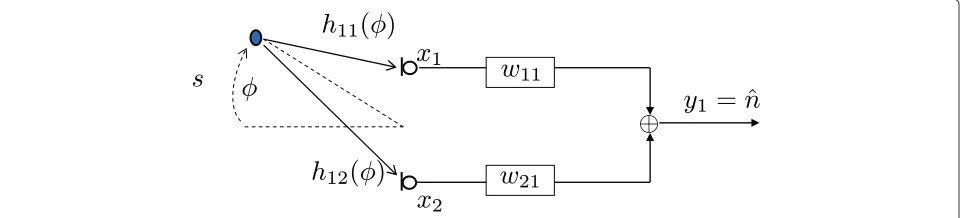
To study the overall system behavior, we investigate the frequency response of the transfer function for a BM sup-plied with perfect localization information. The transfer function for different source positions−90° ≤ φ ≤ 90° is evaluated as depicted in Figure 5. The spatiotemporal frequency response associated with the BM is given by
htrans(φ)= nˆs
s =h11(φ)w11+h12(φ)w21, (26)
where nˆs refers to the residual of the target signal com-ponentsin the noise estimatenˆ (‘leakage’). This charac-terization is similar to but not equal to a beam pattern in the usual sense where it is assumed that the acous-tic waves propagate in free field and no scattering is considered. Instead, (26) also considers the acoustic envi-ronment by accounting for the transfer functions from the source position to the microphones. Thereby, htrans
captures reflections of source signals determined by the given source positions. Thus, if (26) exhibits a minimum for a certain angle relative to a certain distance to the microphone array, it indicates that all signal components originating from this angle at this distance, including pos-sible reflections at surfaces in the acoustic environment, are suppressed to the given extent.
Figure 5System to evaluate the frequency response of different BMs.
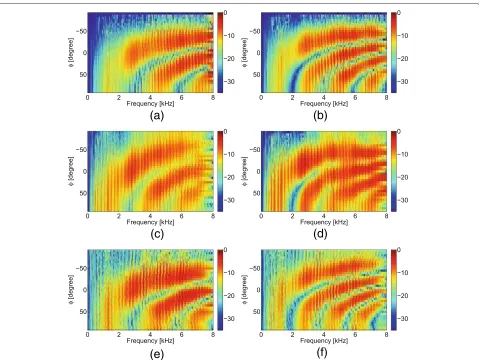
delay between the two microphone signals. For Direc-tional BSS, the BM coefficients are a set of converged BSS demixing filters of length 1024 adapted for the corresponding scenarios. We first show the magnitude response for the BMs adapted/calculated for single-source scenarios.
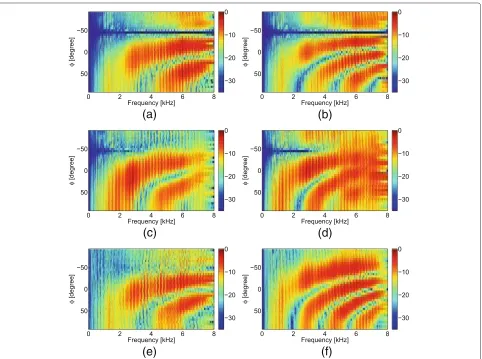
In Figure 6 the magnitude responses for three BMs (ideal RTF-based BM, Directional BSS, DSB) steered
towards 0° are depicted for the array ofdmic=6 cm and dmic=11.5 cm, respectively, in room A with 1-m
source-array distance. Comparing all plots in Figure 6, the three BMs have similar magnitude responses. For all three BMs, spatial aliasing is unavoidable atf >5 kHz (dmic=6 cm)
and atf > 3 kHz (dmic =11.5 cm). Besides, they do not
have a significant spatial selectivity for low frequencies (lower than 300 Hz), and it is observed that the frequency
(a)
(b)
(c)
(d)
(e)
(f)
Figure 6Magnitude responses for all three BMs steered to 0° (room A, 1 m).(a)Ideal RTF-BM (dmic= 6 cm).(b)Ideal RTF-BM (dmic= 11.5 cm).
range with no spatial selectivity is larger fordmic =6 cm
than for dmic = 11.5 cm. In this frequency range, not
only the target source but also interferers located at posi-tions differing from 0° is suppressed to a large extent and consequently, no noise estimate can be obtained. Despite similar behaviors in the range of low frequencies, it is clearly noticeable that both the ideal RTF-based BM and Directional BSS achieve a more pronounced spatial null than the DSB, which reflects a much better suppression performance of these two BMs compared to the DSB.
In Figures 7 and 8, the magnitude responses for three BMs are depicted for steering directions −45° and−90° in room A with 1 m source-array distance. Obviously, the behaviors of the BMs change if the target source moves towards−90°. For the steering direction of−45°, the ideal RTF-based BM can still perfectly suppress the source but the null becomes broader. For Directional BSS and a DSB, the spatial null becomes apparently weaker and broader. Besides, it is observed that the spatial null reaches only up to approximately 4 kHz. In practice, it will not affect the
performance of Directional BSS for suppressing speech signals too significantly, as most of the energy of speech signals is usually in the frequency range below 4 kHz. For the steering direction of −90°, the spatial null of Directional BSS becomes broader especially at low fre-quencies, whereas almost no spatial null can be observed for the DSB. The target suppression gain (discussed in Section 4.2.2) for Directional BSS degrades from 20 dB for the target signal at 0° to about 10 dB for the target signal at 90°, where the target suppression performance is still acceptable, but the missing selectivity will suppress inter-fering sources located close to the target source as well. In the following experiments, we limit the target source posi-tion to the range [−20°, 20°] relative to the broadside of the microphone array. Besides, we note that the spatial null of the proposed method is limited to frequencies below 4 kHz, which is due to the fact that we use speech signals as the test signals and the energy of speech signals is con-centrated to the frequency range below 4 kHz. However, it should be noted that the spatial null can be extended to
(a)
(b)
(c)
(d)
(e)
(f)
Figure 7Magnitude responses for all three BMs steered to -45° (room A, 1 m).(a)Ideal RTF-BM (dmic= 6 cm).(b)Ideal RTF-BM (dmic= 11.5 cm).
(e)
(a)
(b)
(c)
(d)
(f)
Figure 8Magnitude responses for all three BMs steered to -90° (room A, 1 m).(a)Ideal RTF-BM (dmic= 6 cm).(b)Ideal RTF-BM (dmic= 11.5 cm).
(c)DirBSS (dmic= 6 cm).(d)DirBSS (dmic= 11.5 cm).(e)Dsub BF (dmic= 6 cm).(f)Dsub BF (dmic= 11.5 cm).
a higher frequency range by using other wideband-signals with sufficient support at those frequencies.
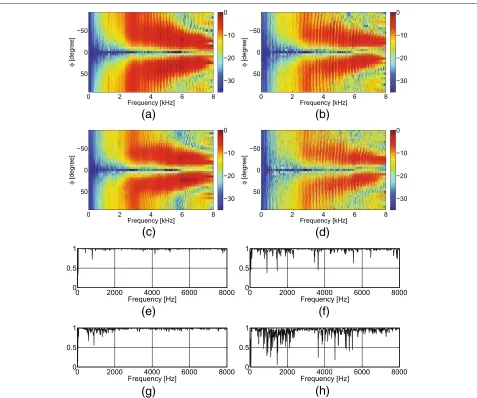
In Figure 9a, the magnitude response of Directional BSS for different rooms and different source-array dis-tances are depicted. It can be seen that the spatial null of Directional BSS becomes slightly weaker with increased reverberation.
To explain the performance degradation, we plot the magnitude squared coherence (MSC) of the target signal between the two microphones for each testing scenario in Figure 9e-9h. The MSC is estimated by using Welch’s averaged periodogram method. The block length for esti-mating the MSC is 2048, which is the same as the block length for BSS adaptation. As can be seen, the target sig-nal for room A with 1-m distance is strongly correlated (MSC≈1). With the increasing reverberation, the coher-ence of the target signal becomes weaker. Consequently, the blocking performance of Directional BSS degrades. If we increase the block length to be larger than the length of the measured RIRs, the bias of the coherence towards
zero will reduce according to [51]. The MSC will be close to 1 again. Therefore, theoretically, increasing both the fil-ter length of the demixing system and the block length will increase the performance. However, a deteriorating con-vergence of the BSS algorithm must be expected for very long demixing filters. This is a general problem of adaptive filtering realized in the time domain.
(a)
(b)
(c)
(d)
(e)
(f)
(g)
(h)
Figure 9Magnitude responses for Directional BSS and MSC of target signal under various testing conditions (dmic=6 cm).(a)Room A, 1 m.(b)Room A, 2 m.(c)Room B, 1 m.(d)Room B, 2 m.(e)MSC (room A, 1 m).(f)MSC (room A, 2 m).(g)MSC (room B, 1 m).(h)MSC (room B, 2 m).
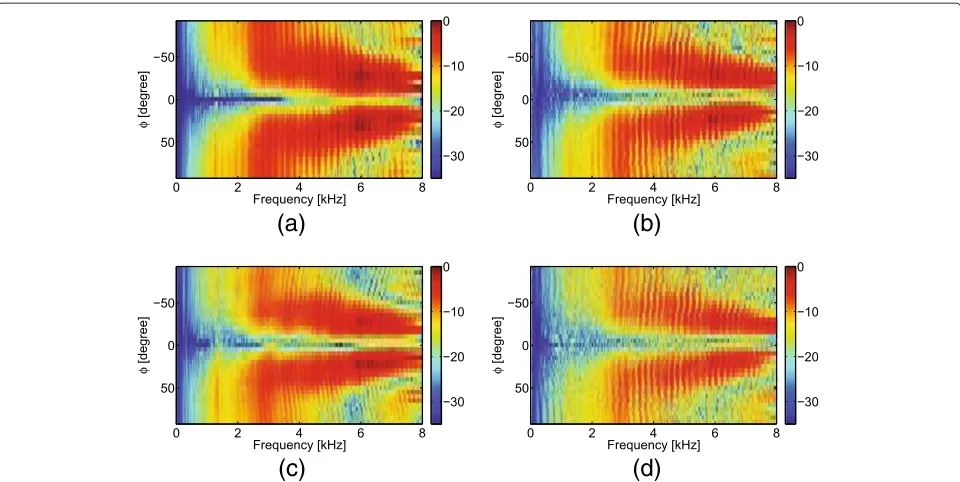
(degration about 1 to 4 dB in terms of the target suppres-sion gain) due to the existence of the interfering signal.
4.2.2 Target suppression performance
The blocking performance should be quantified to show how well the target source can be suppressed. We propose to use two measures to evaluate the performance. One is the target speech suppression gain which is defined as follows:
Gainsup=
1 2
2
p=1
10 log10
σ2 xs,p σ2
ˆ
ns
, (27)
whereσa2denotes the (long-term averaged) signal power of the signala, xs,p denotes the target component
con-tained in pth microphone, and nˆs denotes the target
residual contained in the noise estimate. The target sup-pression gain of the ideal RTF-based BM is infinity. A higher target suppression gain indicates a higher blocking performance for the signal from the target source direc-tion. This measure is very similar to the ‘signal blocking factor’ used in [52]. We compare the target suppression performance with (1) the DSB and (2) a simulated ideal ABM, where one microphone channel is simply adap-tively subtracted with a LMS-type algorithm from the other. For this simulation, an ideal case is assumed, i.e., the microphone signal contains only the target signal. The simulated ABM can be regarded as an ideal version (in a supervised case) of a conventional ABM using an LMS algorithm as proposed in [23,24].
(a)
(b)
(c)
(d)
Figure 10Magnitude responses for Directional BSS with one-point interfering source at -30° (dmic=6 cm).(a)Room A, 1 m.(b)Room A, 2 m.(c)Room B, 1 m.(d)Room B, 2 m.
calculated from the measured RIR to evaluate the esti-mation of the RTF. The NSE is calculated as follows:
NSEBM=10 log10
N−1
k=0
˜
RTFBM(k)−RTFtrue(k)2
N−1
k=0 RTFtrue(k)2
,
(28)
whereRTF˜ BM denotes the RTF estimated by a BM, e.g., ˜
RTFDirBSS refers to the RTF estimated by Directional
BSS, k is the time sample index, and N is the filter length of the BM; in our experiments, it was chosen to be 1024.
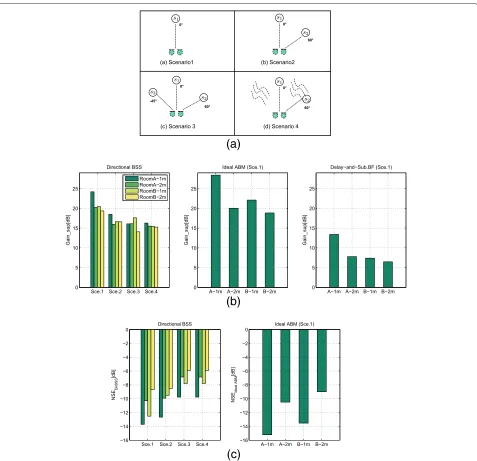
The scenarios as depicted in Figure 11a are consid-ered for evaluating the blocking performance. In sce-narios 1 to 3, only point sources are active. One male speech signal of 10 s was used as the target source. A female speech signal of the same length was used as the interferer in scenario 2. For scenario 3, a female and a male speech signal were used as the interferers. In sce-nario 4, additional diffuse background noise is added to the microphone. All test signals are normalized to equal power.
Figure 11b shows the target suppression gain for the three BMs. As the DSB is only dependent on the target direction and the target source-array distance, the tar-get suppression gain of the DSB for scenarios 2 to 4 is the same as for scenario 1. We simulate the ideal ABM by adapting the BM filter in a single-source scenario, i.e.,
scenario 1. Therefore, the performance of the ideal ABM is only shown for this scenario. It can be seen that in a single-source scenario, the target suppression gain of an ideal ABM is only slightly higher than Directional BSS, which indicates that in a single-source scenario, Directional BSS can reach to the upper limit. For scenarios 2 to 4, the target suppression gain of Directional BSS degrades but is always over 10 dB and clearly superior compared to the DSB. In Figure 11c, the NSEDirBSSand NSEidealABMare shown.
For scenario 1, where only the target source is active, the NSEs of the both BMs are very close and very low, which indicates that in a single-source scenario, the estimated RTFs are very close to the true RTF. With an increased number of sources or with more complicated acoustical conditions (higher reverberation time and larger source-array distance), it is more difficult to estimate the RTF. We can see that NSEDirBSSincreases and the target
There-(a)
(b)
(c)
Figure 11Test scenarios and performance comparison for evaluating the BMs (dmic=6 cm).(a)Testing scenarios.(b)Target suppression gain.(c)Normalized squared error.
fore, different signal characteristics will lead to different results.
4.2.3 Preservation of interfering sources
The target suppression gain can only be used to evaluate the blocking performance for the target signal. From the magnitude response for the overall system, it can be seen that spatial aliasing appears in a certain frequency range. The goal of a BM is to produce a noise reference by sup-pressing the target source, which indicates that the noise signals should be well preserved while the target source should be well suppressed. Therefore, besides the target suppression gain, we need to measure how well the noise
signals are preserved. To this end, we define the SIRdiffas
follows:
SIRdiff=SIRin−SIRoutBM, (29)
where SIRinand SIRoutBMare given by
SIRin=
1 2
2
p=1
10 log10
σ2 xs,p σ2
xn,p
,
SIRoutBM=10 log10
σ2
ˆ
ns σ2
ˆ
nn
where nsˆ and nnˆ denote the target and the noise com-ponent contained in noise estimate nˆ, respectively. The higher SIRdiff , the better the noise signals are preserved
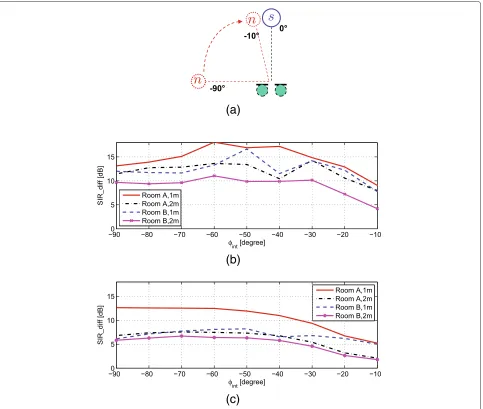
relative to the target signal. We carried out a test for the scenario shown in Figure 12a, where the target source is located at 0°, while the interfering source is located at varying DoA from−90° to−10°.
Figure 12b,c shows the SIRdiff achieved by
Direc-tional BSS and the DSB for the testing scenario. We observe that due to the increased reverberation, SIRdiff
decreases. The interfering sources located near to the tar-get source, e.g., the interfering source at −20° or −10° BSS may treat them as one source. Both the interfering sources and the target source are suppressed to a cer-tain extend. Comparing the performance of Directional BSS and the DSB, it can be seen that Directional BSS
is clearly superior to the DSB especially in reverberant environments.
As the target source is defined to impinge from the range−20° to 20° relative to the broadside of the micro-phone array, the blocking performance including the preservation of the interfering source for the target located other than 0° is of interest. Figure 13 shows the obtained Gainsupand SIRdifffor a scenario where the
tar-get is located at−10° or−20°, and an interfering source is located at 60° and diffuse noise is active. It can be seen that Directional BSS can still achieve a target suppression gain of more than 10 dB. Here, the results of DSB for the same scenarios are not shown as even for the source located at 0°, only less than 10 dB Gainsup can be obtained (see
Figure 11b). For the source located off 0°, the performance of the DSB degrades further.
(a)
(b)
(c)
Figure 12Comparison of SIRdiffachieved by Directional BSS and DSB (dmic=6 cm).(a)Scenario for measuring the SIRdiff.(b)SIRdiffof
(a)
(b)
Figure 13Performance of Directional BSS for different target direction (dmic=6 cm).(a)Target suppression gain.(b)SIR difference.
4.3 Robustness against localization errors
In practical applications, usually the target direction is unknown and needs to be estimated using a source localization algorithm [39,40] so that estimation errors must be expected. Hence, the robustness of Directional BSS against localization errors is of special interest. To this end, we experimentally evaluate the sensitivity of Directional BSS with respect to the localization errors. The scenario for evaluation is illustrated in Figure 14a, where the target source is always located at 0°, and one active interferer varies its direction from−90° to−10°. The target localization error is 5°, 10°, or 15°. Vari-ous values for ηC from 0.1 to 0.8 are applied for the
constraint.
In Figure 14b-14g, the target suppression results are shown. The performance of SIRdiff for measuring the
preservation of the interfering sources as discussed in Section 4.2.3 is shown in Figure 15. From Figure 14b,d,f and Figure 15a,c,e, it can be seen that fordmic = 6 cm,
a localization error of 15° can be tolerated, the Gainsup
is above 10 dB and SIRdiff is above 6 dB if the
inter-ferer is far from the target source. However, as indicated above, if the interferer is close to the target source, BSS might treat th e interferer and target source as a single
source and jointly suppress the target source and the inter-ferer. This leads to a certain confusion in BSS adaptation, which results in a performance degradation (low SIRdiff
for the interferer close to the target source). Similar results are observed for dmic = 11.5 cm. It shows that with
larger microphone spacing, BSS is more sensitive to the localization error, especially if the interfering sources are near to the target source. Besides, for a large localiza-tion error, with lower ηC, Directional BSS achieves a
better performance. Basically, if BSS runs freely with-out any constraint (ηC = 0), it automatically adapts to
(a)
(b)
(c)
(d)
(e)
(f)
(g)
Figure 14Target suppression gain as a function of the localization error and the weighting parameterηC.(a)Scenarios for evaluating the sensitivity against localization errors.(b)dmic=6 cm, error=5°.(c)dmic=11.5 cm, error=5°.(d)dmic=6 cm, error=10°.(e)dmic=11.5 cm,
error=10°(f)dmic=6 cm, error=15°.(g)dmic=11.5 cm, error=15°.
from a predefined direction only but not to constrain BSS too much in order to tolerate a possible localization error. This is balanced by the weighting factorηCin (22)
which controls the importance of the geometric con-straint relative to the separation criterion. A lower ηC
indicates less weight for the geometric constraint, and the estimation of the demixing filters is more based on statis-tical independence for source separation. Hence, a lower ηC should be chosen for unreliable DoA information so
that Directional BSS can better adapt to the true target direction.
5 Application of a DirBSS-based noise estimate to blind signal extraction
(a)
(b)
(c)
(d)
(e)
(f)
Figure 15SIRdiffas a function of the localization error and the weighting parameterηC.(a)dmic=6 cm, error=5°.(b)dmic=11.5 cm,
error=5°.(c)dmic=6 cm, error=10°.(d)dmic=11.5 cm, error=10°.(e)dmic=6 cm, error=15°.(f)dmic=11.5 cm, error=15°.
5.1 A two-unit scheme: BM plus spectral enhancement filters
The noise estimate obtained by the above method can be used for various applications. Conventionally, it can be used for a realization which relies on a noise estimate produced by an RTF-based BM [25,53] or for the MWF which requires an SOS estimate of the noise [54]. In this section, we discuss one generic application to show the effectiveness of the noise estimation of the proposed BM. A two-channel BSE scheme combining Directional BSS as BM and Wiener-type spectral enhancement filters will be presented. The scheme is depicted in Figure 16a. It com-prises two units. In the first unit, an estimate of noise components is produced by a BM. The noise estimate as well as the microphone signals is fed into the noise reduc-tion unit so that the desired speech components can be extracted from the microphone signals.
Typical approaches which can be considered for the speech enhancement unit include an interference canceler or Wiener-type spectral enhancement filters. However, in underdetermined cases, an interference canceler is not
able to suppress all noise sources [55]. Therefore, Wiener-type spectral enhancement filters based on the obtained noise estimate are used for the noise reduction unit. The real-valued spectral weights for frequency at output channelpare given by [56]
g
p = max
1−μ Sˆnˆnˆ
ˆ
Svpvp,gmin
, (31)
where, Sˆaa represents the auto-PSD of a, vp = wp1 ∗ xp denotes thepth microphone signal filtered by
Direc-tional BSS, g
min refers to the minimum value of the
(a)
(b)
Figure 16Speech enhancement/blind signal extraction scheme and test scenarios for evaluating its performance.(a)Speech enhancement/blind signal extraction scheme.(b)Test scenarios.
The spectrum of the enhanced signal at thepth output channel is thus given by
zp=g
pxp. (32)
5.2 Improved noise estimate by assuming an ideal diffuse noise field
The obtained noise estimate nˆ is biased relative to the original noise components as (1) the noise estimatenˆ is spectrally shaped by the BSS filters and (2)nˆ is a sum of all the filtered interference and noise components. A bias correction function is proposed based on an assumed coherence [21,56]. If the noise field is approximated as spherically isotropic [49], the theoretical noise coherence function reads:
diffuse= −sinc dmicfs
c . (33)
The noise estimate is corrected with the noise coherence function [21]:
ˆ
Snˆnˆ = Sˆnˆnˆ
2(1+ {diffuse})
, (34)
wheredenotes the real part of a complex value. Note thatdiffuseandSˆnˆnˆ are frequency-dependent. The
spec-tral weights are then calculated with the corrected noise estimate:
g
p = max
1−μ Sˆnˆnˆ
ˆ Svpvp
,g min
. (35)
5.3 Experimental results
In this section, the performance of the proposed scheme with two spectral enhancement filters ((31) and (35)) is evaluated in terms of signal-to-interference ratio improve-ment (SIRgain) and speech distortion (SD) for various
scenarios under various testing conditions. Besides, we show the performance of the proposed scheme based on the noise estimate provided by the ideal RTF-based BM and the DSB for comparison.
5.3.1 Experimental setup
Two different rooms and two source-array distances are considered for evaluating the BMs. The scenarios as shown in Figure 16b are considered for evaluating the per-formance of the speech enhancement scheme. All tested signals are the same as used in the experiments for evalu-ating the performance of BMs.
The same algorithm of Directional BSS and the same parameters are used as in Section 4 (see (22) and (23)). The frequency-domain Wiener filter is implemented with a polyphase filter bank [60] using a prototype FIR filter of length 1024, with 512 complex-valued subbands and a downsampling rate of 128.
5.3.2 Performance measures
The performance of the proposed scheme is evaluated in terms of SIRgainand SD using the following definitions:
SIRgain=SIRout−SIRin, (36)
wherexs,pandzs,pdenote the target speech components at
thepth input and thepth output of the proposed scheme, respectively; σxs2,p and σzs2,p denote the (long-term) sig-nal power of the target speech components at the pth input and thepth output; whereasσxn2,p andσzn2,p denote the (long-term) signal power of all noise and interference components at thepth input andpth output, respectively. τg refers to the overall signal delay caused by the filter
bank.
5.3.3 Performance of the proposed BSE scheme
In order to establish a reference for the two-stage BSE methods, we first consider a 2×2-channel time-domain ICA algorithm as an uninformed BSE system where we identify the target signal in one of the output channels. The SIR improvement for the various scenarios is shown in Figure 17. The SD is not shown as it is meaningless for BSS due to the known filtering ambiguity of opti-mum BSS solutions [31]. As a generic ICA algorithm is designed only for the determined case, the this algorithm can achieve high separation performance only in scenario 1. For scenario 2, it has no determined solution. The three sources are separated into two groups but the grouping is unpredictable, as can be seen by the results, e.g., for the testing conditions [rooms (A,B), 1 m], the target source is extracted alone, while for the other testing conditions, the target source is separated together with one interfer-ing source as one group. For scenarios such as 3 and 4, where the diffuse noise is active, generic ICA is usually not capable to separate the point source from the diffuse noise. A corresponding analysis can be found in [28]. With these results, it is documented that the generic ICA algo-rithm cannot be expected to extract the target source for underdetermined scenarios.
The SIR improvement and speech distortion of the speech enhancement scheme with two spectral filters g
(31) and g (35) are shown in Figure 18a,b, respectively. The upper plot and the lower plot show the results for the spectral filter g and the improved spectral filter g, respectively. It should be noted that for the four con-sidered scenarios, the parameters of the spectral filters are optimized with respect to the best perceptual quality
Sce.1 Sce.2 Sce.3 Sce.4
(a)
(b)
Figure 18SIR improvement and speech distortion for BSE scheme based on spectral filtersgandg(dmic=6 cm).(a)SIR improvement.(b) Speech distortion.
as judged by informal listening tests. For all scenarios, the proposed BSE scheme with the two spectral filters can achieve a good noise reduction performance (above 6 dB) and maintain a very low speech distortion (lower than −11 dB). For scenarios 1 and 2 where only point
sources are active, the performance of the spectral filterg
of ideal diffuse noise is matched to a certain degree, a significant improvement for the spectral filterg can be observed.
For comparison, the performance of the proposed scheme based on the noise estimate produced by the ideal
RTF-based BM and the DSB is shown in Figure 19a,b. Note that here the speech enhancement scheme with only the spectral filterg(31) is evaluated.
Although the ideal RTF-based BM can perfectly sup-press the target source, the produced noise estimate is still
(a)
(b)
Figure 19SIR improvement and speech distortion for BSE scheme based on ideal RTF- and DSB-based BM.(No bias correction,dmic=6 cm).
biased relative to the true noise components contained in the microphone signal. Therefore, we cannot expect a per-fect noise reduction for the speech enhancement scheme with the biased noise estimate. However, the noise reduc-tion performance achieved with this noise estimate can be regarded as the upper limit for the scheme with the noise estimate produced by Directional BSS without applying a bias correction. It can be seen that for all scenarios, with Directional BSS as BM, the noise reduction performance is almost the same as the performance achieved by the ideal-RTF (1 dB less), but clearly superior to the perfor-mance achieved by a DSB. Obviously, for the latter, the large residual of the target component reduces the SIR improvement and leads to a significant distortion of the target source.
6 Conclusions
In our earlier work, Directional BSS was proposed as a BM for source extraction. The concept combines BSS with a geometric constraint to cope with the underdeter-mined scenario such that a meaningful and joint estimate of all interfering speech signals and diffuse background noise can be obtained using only two microphones. In this paper, we show that Directional BSS converges to an RTF-based ideal BM. Experimental results analyzing the system behavior and the blocking performance of Directional BSS under various acoustical conditions were presented. These results verify that Directional BSS can successfully estimate the RTF in underdetermined non-stationary noise scenarios without requiring source activ-ity information. The target suppression performance of Directional BSS is clearly superior to a common DSB. Sim-ulation results confirm also that Directional BSS is very robust against localization errors. Additionally, we eval-uate a source extraction scheme which combines Direc-tional BSS and Wiener-type spectral enhancement filters. It is shown that the noise reduction performance achieved by this scheme using Directional BSS is very close to the performance achieved by the proposed scheme using an ideal RTF-based BM. Therefore, for exploiting Direc-tional BSS as a BM, no source activity information and no information on the number of active sources is nec-essary. The only required information for this informed algorithm is some coarse DoA information of the target source.
Competing interests
The authors declare that they have no competing interests.
Received: 17 June 2013 Accepted: 10 February 2014 Published: 4 March 2014
References
1. A Hyvärinen, E Oja,Independent Component Analysis(Wiley, New York, 2001)
2. S Makino, TW Lee, H Sawada,Blind Speech Separation(Springer, Berlin, 2007)
3. Ö Yilmaz, S Rickard, Blind separation of speech mixtures via time-frequency masking. IEEE Trans. Signal Process.52, 1830–1847 (2004)
4. S Araki, H Sawada, R Mukai, S Makino, A novel blind source separation method with observation vector clustering, inProceedings of the International Workshop on Acoustic Echo and Noise Control (IWAENC)
(Eindhoven, September 2005), pp. 117–120
5. NK Duong, E Vincent, R Gribonval, Under-determined reverberant audio source separation using a full-rank spatial covariance model. IEEE Trans. Audio Speech Lang. Process.18, 1830–1840 (2010)
6. A Ozerov, C Fevotte, Multichannel nonnegative matrix factorization in convolutive mixtures with application to blind audio source separation, in
Proceedings of the IEEE International Conference on Acoustics, Speech, and Signal Processing (ICASSP)(Taipei, March 2009), pp. 550–563
7. H Sawada, H Kameoka, S Araki, N Ueda, New formulations and efficient algorithms for multichannel NMF, inProceedings of IEEE Workshop on Applications of Signal Processing to Audio and Acoustics (WASPAA)(New York, October 2011), pp. 153–156
8. T Van den Bogaert, S Doclo, J Wouters, M Moonen, Speech enhancement with multichannel Wiener filter techniques in multimicrophone binaural hearing aids. J. Acoust. Soc. Am.125, 360–371 (2009)
9. B Cornelis, M Moonen, A VAD-robust multichannel Wiener filter algorithm for noise reduction in hearing aids, inProceedings of the IEEE International Conference on Acoustics, Speech, and Signal Processing (ICASSP)(Prague, May 2011), pp. 281–284
10. OL Frost, An algorithm for linearly constrained adaptive array processing. Proc. IEEE.60, 926–935 (1972)
11. HL Van Trees,Optimum Array Processing (Detection, Estimation, and Modulation Theory, Part IV),1st edn (Wiley, New York, 2002) 12. LJ Griffiths, CW Jim, An alternative approach to linear constrained
adaptive beamforming. IEEE Trans. Speech Audio Process.30, 27–34 (1982)
13. R Zelinski, A microphone array with adaptive post-filtering for noise reduction in reverberant rooms, inProceedings of the IEEE International Conference on Acoustics, Speech, and Signal Processing (ICASSP)(Las Vegas, March 2008), pp. 2578–2581
14. I McCowan, H Bourlard, Microphone array post-filter based on noise field coherence. IEEE Trans. Speech Audio Process.11, 709–716 (2003) 15. N Ito, H Shimizu, N Ono, S Sagayama, Diffuse noise suppression using
crystal-shaped microphone arrays. IEEE Trans. Audio Speech Lang. Process.19, 2101–2110 (2011)
16. T R Hendriks, Gerkmann, Noise correlation matrix estimation for multi-microphone speech enhancement. IEEE Trans. Audio Speech Lang. Process.20, 223–233 (2012)
17. M Taseska, EAP Habets, MMSE-based blind source extraction in diffuse noise fields using a complex coherence-based a priori sap estimator, in
Proceedings of the International Workshop on Acoustic Echo and Noise Control (IWAENC)(Aachen Germany, September 2012)
18. M Taseska, EAP Habets, MMSE-based source extraction using position-based posterior probabilities, inProceedings of the IEEE International Conference on Acoustics, Speech, and Signal Processing (ICASSP)(Vancouver, May 2013)
19. L Parra, C Alvino, Geometric source separation: merging convolutive source separation with geometric beamforming. IEEE Trans. Speech Audio Process.10, 352–362 (2002)
20. Y Zheng, K Reindl, W Kellermann, BSS for improved interference estimation for blind speech signal extraction with two microphones, in
Proceedings of 3rd International Workshop on Computational Advances in Multi-Sensor Adaptive Processing (CAMSAP)(Dutch Antilles Aruba, December 2009), pp. 253–256
21. R Maas, A Schwarz, Y Zheng, K Reindl, S Meier, A Sehr, W Kellermann, A two-channel acoustic front-end for robust automatic speech recognition in noisy and reverberant environments, inProceedings of the International Workshop on Machine Listening in Multisource Environments (CHiME)
(Florence, September 2011), pp. 41–46
22. BD Van Veen, KM Buckley, Beamforming: a versatile approach to spatial filtering. IEEE ASSP Mag.5, 4–24 (1988)
24. W Herbordt, W Kellermann, Frequency-domain integration of acoustic echo cancellation and a generalized sidelobe canceller with improved robustness. Eur. Trans. Telecommun.13, 123–132 (2002)
25. S Gannot, D Burshtein, E Weinstein, Signal enhancement using beamforming and nonstationarity with applications to speech. IEEE Trans. Signal Process.49, 1614–1626 (2001)
26. I Cohen, Relative transfer function identification using speech signals. IEEE Trans. Speech Audio Process.12(5), 451–459 (2004)
27. S Golan, S Gannot, I Cohen, Multichannel eigenspace beamforming in a reverberant noisy environment with multiple interfering speech signals. IEEE Trans. Audio Speech Lang. Process.17, 1071–1086 (2009) 28. Y Takahashi, T Takatani, K Osako, H Saruwatari, K Shikano, Blind spatial
subtraction array for speech enhancement in noisy environment. IEEE Trans. Audio Speech Lang. Process.17, 650–664 (2009)
29. P Smaragdis, Blind separation of convolved mixtures in the frequency domain. Neurocomputing.22, 21–34 (1998)
30. H Buchner, R Aichner, W Kellermann, The TRINICON framework for adaptive MIMO signal processing with focus on the generic Sylvester constraint, inProceedings of the ITG Conference on Speech Communication
(Aachen October, 2008)
31. H Buchner, R Aichner, W Kellermann, Blind source separation for convolutive mixtures exploiting nongaussianity, nonwhiteness, and nonstationarity, inProceedings of International Workshop on Acoustic Echo and Noise Control (IWAENC)(Kyoto, September 2003), pp. 275–278 32. R Aichner, H Buchner, F Yan, W Kellermann, A real-time blind source
separation scheme and its application to reverberant and noisy acoustic environments. Signal Process.86, 1260–1277 (2006)
33. H Buchner, R Aichner, W Kellermann, Relation between blind systemidentification and convolutive blind source separation, in
Proceedings of Workshop for Hands-Free Speech Communication and Microphone Arrays (HSCMA)(Piscataway, March 2005)
34. S Araki, S Makino, Y Hinamoto, R Mukai, T Nishikawa, H Saruwatari, Equivalence between frequency-domain blind source separation and frequency-domain adaptive beamforming for convolutive mixtures. EURASIP J. Adv. Signal Process.2003, 1157–1166 (2003)
35. SV Gerven, DV Compernolle, Signal separation by symmetric adaptive decorrelation: stability, convergence, and uniqueness. IEEE Trans. Signal Process.43, 1602–1612 (1995)
36. E Weinstein, M Feder, A Oppenheim, Multichannel signal separation by decorrelation. IEEE Trans. Speech Audio Process.1, 405–413 (1993) 37. Y Zheng, A Lombard, W Kellermann, An improved combination of directional BSS and a source localizer for robust source separation in rapidly time-varying acoustic scenarios, inProceedings of the Workshop on Hands-free Speech Communication and Microphone Arrays (HSCMA)
(Edinburgh, May 2011)
38. A Hjørungnes,Complex-valued matrix derivatives: with applications in signal processing and communications(Cambridge University Press, Cambridge, 2011)
39. C Knapp, G Carter, The generalized correlation method for estimation of time delay. IEEE Trans. Acoustics Speech Signal Process. ASSP.24, 320–327 (1976)
40. A Lombard, T Rosenkranz, H Buchner, W Kellermann, Multidimensional localization of multiple sound sources using averaged directivity patterns of blind source separation systems, inProceedings of the IEEE International Conference on Acoustics, Speech, and Signal Processing (ICASSP)(Taipei, April 2009), pp. 233–236
41. E Warsitz, Ar Krueger, R Haeb-Umbach, Speech enhancement with a new generalized eigenvector blocking matrix for application in a generalized sidelobe canceller, inProceedings of the IEEE International Conference on Acoustics, Speech, and Signal Processing (ICASSP)(Las Vegas, March 2008), pp. 73–76
42. A Krueger, E Warsitz, R Haeb-Umbach, Speech enhancement with a GSC-like structure employing eigenvector-based transfer function ratios estimation. IEEE Trans. Audio Speech Lang. Process.19, 206–219 (2011) 43. T Gerkmann, R Hendriks, Noise power estimation based on the
probability of speech presence, inProceedings of IEEE Workshop on Applications of Signal Processing to Audio and Acoustics (WASPAA)(New Paltz, October 2011), pp. 145–148
44. R Martin, Noise power spectral density estimation based on optimal smoothing and minimum statistics. IEEE Trans. Speech Audio Process.
9(5), 504–512 (2001)
45. I Cohen, Noise spectrum estimation in adverse environments: improved minima controlled recursive averaging. IEEE Trans. Speech Audio Process.
11(5), 466–475 (2003)
46. A Ozerov, E Vincent, Using the FASST source separation toolbox for noise robust speech recognition, inProceedings of International Workshop on Machine Listening in Multisource Environments (CHiME 2011)(Florence, September 2011)
47. N Moritz, M Schädler, K Adiloglu, B Meyer, T Jürgens, T Gerkmann, S Goetze, Noise robust distant automatic speech recognition utilizing NMF based source separation and auditory feature extraction, in
Proceedings of The 2nd International Workshop on Machine Listening in Multisource Environments (CHiME 2013)(Vancouver, June 2013), p. 1 48. K Jeon, N Park, H Kim, M Choi, K Hwang, Mechanical noise suppression
based on non-negative matrix factorization and multi-band spectral subtraction for digital cameras. IEEE Trans. Consum. Electron.59(2), 296–302 (2013)
49. H Kuttruff,Room Acoustics(Taylor & Francis, London, 2000)
50. EAP Habets, S Gannot, Generating sensor signals in isotropic noise fields. J. Acoustical Soc. Am.122, 3464–3470 (2007)
51. R Martin,Kurzfassung Freisprecheinrichtung mit mehrkanaliger Echokompensation und Störgeräuschreduktion(RWTH Aachen University, PhD thesis, 1995)
52. R Talmon, I Cohen, S Gannot, Relative transfer function identification using convolutive transfer function approximation. IEEE Trans. Audio Speech Lang. Process.17, 546–555 (2009)
53. K Reindl, Markovich-S Golan, H Barfuss, S Gannot, W Kellermann, Geometrically constrained TRINICON-based relative transfer function estimation in underdetermined scenarios, inProceedings of IEEE Workshop on Applications of Signal Processing to Audio and Acoustics (WASPAA)(New York, October 2013)
54. W Kellermann, K Reindl, Y Zheng, Method and acoustic signal processing system for interference and noise suppression in binaural microphone configurations. US Patent 2011/0307249 A1 (2011)
55. K Reindl, Y Zheng, W Kellermann, Speech enhancement for binaural hearing aids based on blind source separation, inProceedings of 4th International Symposium on Communications, Control, and Signal Processing (ISCCSP)(Limassol, March 2010)
56. K Reindl, Y Zheng, A Schwarz, S Meier, R Maas, A Sehr, W Kellermann, A stereophonic acoustic signal extraction scheme for noisy and reverberant envi