Linear and Nonlinear Oblivious Data Hiding
Litao Gang
InfoDesk, Inc., 660 White Plains Road, Tarrytown, NY 10591, USA Email:[email protected]
Ali N. Akansu
Department of Electrical and Computer Engineering (ECE), New Jersey Institute of Technology, University Heights, Newark, NJ 07102-1982, USA
Email:[email protected]
Mahalingam Ramkumar
Department of Computer Science and Engineering, Mississippi State University, MS 39762-9637, USA Email:[email protected]
Received 31 March 2003; Revised 6 October 2003
The majority of the existing data hiding schemes are based on the direct-sequence (DS) modulation where a low-power random sequence is embedded into the original cover signal to represent hidden information. In this paper, we investigate linear and non-linear modulation approaches in digital data hiding. One typical DS modulation algorithm is explored and its optimal oblivious detector is derived. The results expose its poor cover noise suppression as the hiding signature signal always has much lower energy than the cover signal. A simple nonlinear algorithm, called set partitioning, is proposed and its performance is analyzed. Analysis and simulation studies further demonstrate improvements over the existing schemes.
Keywords and phrases:data hiding, watermarking, ML detection, data security.
1. INTRODUCTION
Multimedia data hiding is the art of hiding information in a multimedia content cover signal, like image, video, audio and so forth. Its potential applications include, but not limit to authentication, copyright enforcement, piracy tracking, and others. Various data hiding techniques are deployed in different scenarios. For instance, fragile data hiding is often used for multimedia content authentication, while the robust data hiding techniques are mostly employed for copyright and ownership proof, illegal replication prevention, and the like. The requirements and techniques in different applica-tions vary considerably. This paper focuses on the robust data hiding techniques.
Transparency and robustness are the two basic requiments in the robust data hiding applications. The former re-quires that the information embedding not compromise the multimedia perceptual quality; and the latter guarantees that the embedded information can be reliably identified under unintentional attacks and malicious tampering efforts. The data hiding employment can be further classified into two categories,obliviousandescrowcases. In the oblivious scenar-ios, the hidden information can be extracted without
refer-ence to the original signal; by contrast, the cover signal is nec-essary for embedded message identification in escrow cases. In practice, the most useful and challenging application is the oblivious data hiding since the original cover signal is often unavailable at the decoder. Most work in the paper is devoted to the oblivious data hiding.
part, a novel data hiding algorithm is proposed, and its per-formance is analyzed and compared with existing schemes.
The rest of this paper is organized as follows. InSection 2, the performance of a widely used DS modulation is investi-gated. Both analytical and simulation studies unveil its in-ferior results in oblivious applications. Further analysis also reveals that the ubiquitously-used correlation detector is not optimal. This paper proposes the maximum likelihood (ML) detector and its performance is analyzed. In Section 3, a modified version of the scheme is presented and its perfor-mance gains are validated through simulation studies. In-stead of linearly superimposing a hiding signal into the cover signal, a nonlinear hiding scheme called set partitioning is proposed in Section 4. The distortion introduced for data embedding is calculated, and the corresponding ML detec-tor and suboptimal detecdetec-tors are discussed inSection 5. In
Section 6, the data embedding and detection performance is measured in terms of bit error rate (BER) versus distortion-to-noise ratio (DNR). Simulation results demonstrate per-formance improvements of the set partitioning technique over the DS and existing nonlinear data hiding schemes. Fi-nally, the conclusion is presented inSection 7.
2. DIRECT-SEQUENCE MODULATION EMBEDDING
2.1. Modulation and correlation detection
Most of the existing DS modulation schemes are based on the simple idea: embedding a low-energy random sequence into the cover signal while keeping the distortion transpar-ent. The hidden information is usually extracted via a cor-relation decoder. Perceptual threshold analysis is often nec-essary to shape the artifacts introduced. And it is a requisite to guarantee that the distortion is below the just noticeable distortion (JND) threshold to meet the data hiding trans-parency requirement. On the other hand, it is favorable to in-ject the maximum permissible embedding energy (deep em-bedding) that enhances the detection reliability without per-ceptual degradation.
The hidden information is usually embedded in a trans-form domain of discrete cosine transtrans-form (DCT) and wavelets are the most frequently used domains for image data hiding, for instance. Given an original coefficient valueci in the hiding domain, we exercise one of the most popular deep-hiding schemes [2], and the resulting coefficient xiis expressed as
whereαis the perceptual threshold ratio andwiis a binary random value of either +1 or −1. The value of α can be obtained from empirical experiments or perceptual models. The bit is embedded into an original sequencecinstead of one single coefficient in practice. Ifw is the key-generated random sequence, given a received sequencerresulting from a noisy channel transmission of signalx, the test statistic in
the escrow correlation detector is obtained as
q=
whereNis the sequence length andnis the channel noise. If q >0, and a bit value 1 is decided, and a bit value 0 otherwise. In the oblivious data hiding applications where the origi-nal cover sigorigi-nalcis not available, (2) still works. Assume that the embedded information bit value is 1; the correlation-like detector output is calculated as
q= term that degrades detection reliability. Considering the in-dependence ofcandw, we can make the approximation
N−1
i=0
ciwi≈0 (4)
if the sequence lengthNis sufficiently large.
In the oblivious hiding scenarios, the original signal is unavailable and therefore treated as a noise (known as “cover noise”) by the decoder. Its energy dominates the channel noise. For simplicity, in the oblivious detection discussion, merely the cover noise is considered, that is, assumingni=0. Subsequently, (3) is reduced to
q=
Note thatwiassumes a value of either +1 or−1; therefore, pi = ci+α|ci|or pi = ci−α|ci|. Due to the symmetry of the probability density function (PDF) of ci, the statistical distribution ofpiis independent of the specific value ofwi. It has the same mean value and variance as the random variable
yi=ci+αci. (7)
Suppose that the original coefficientciis identically and independently distributed (i.i.d.) with the Gaussian PDFci∼ N(0,σ2). The expectation ofyiis computed as
The variance ofyibecomes
0.31
Sequence length (N) Simulation result
Analytical result
Figure1: Correlation detection performance.
For a large value ofN, the test statisticqin (5) is
approx-Similarly, if a bit value 0 is embedded, the probability dis-tribution results in
If the decision threshold is set asγ=0, then the BER is expressed as
whereQ(·) is the Gaussian-PDF tail integral function. Our simulation results are depicted inFigure 1. The dis-tortion threshold ratio is chosen asα=0.1 in the simulation and the original coefficient xi is Gaussian distributed with zero mean and varianceσ2 = 502. The information bit is
embedded and decoded using (1) and (3), respectively. The above analysis result in (12) agrees perfectly with the simula-tion output. Equasimula-tion (12) gives us a good performance es-timate of the DS embedding scheme. In fact, the above BER holds even ifciis not Gaussian distributed, according to the central limit theorem (CLT) [9]. This result unveils the inad-equacy in the DS approach. Lower BER can only be achieved with a very large value ofN. In other words, the hidden in-formation detection reliability can only be obtained at the sacrifice of the hiding capacity.
2.2. Maximum likelihood detection
The modulated signal is not independent of the noise in the above deep-hiding oblivious scheme (1). Hence the correlator-like detection may not be optimal.
Provided a received sequencer, the decoder deals with the hypothesis testing problem
H1: ri=ci+ciki, bit value 1 is embedded,
H0: ri=ci−ciki, bit value 0 is embedded, (13)
whereki=wiα(kiis either +αor−α). The ML ratio is expressed as
R= P(H1|r)
P(H0|r). (14)
According to the previous assumption thatciis Gaussian distributed, the conditional PDF immediately follows:
fri|H1
Similarly, f(ri|H0) can be obtained. If H1 and H0 have equal a priori probabilities,P(H0) = P(H1), the ML ratio yields wheres(·) is the sign function defined as
s(x)=
If one single bit is embedded in a sequencex, the final ML ratio in (14) becomes
IfR >1, a bit value 1 is decoded, or 0 otherwise. Never-theless, the above ML detector is quite complicated and com-putationally extensive. Moreover, the accurate value of the noise varianceσ2is usually unavailable. A suboptimal
0.4 0.35 0.3 0.25 0.2 0.15 0.1 0.05
BER
40 50 60 70 80 90 100
Random sequence length (N) Correlation detection
Suboptimal detection ML detection
Figure2: Detection performance comparison.
sufficiently large sequence lengthN, N−1
i=0
1−ki 1 +ki
s(ri)
≈1. (19)
This assumption is reasonable as a randomly gener-ated sequence implies that the counts of −1’s and +1’s are roughly equal. Under this approximation, a suboptimal de-tector statistic can be derived immediately from (18),
q= N−1
i=0
−sri·r2
iγ·s
ki. (20)
The suboptimal detector has comparable computational complexity as (5). Nevertheless, it outperforms the latter as depicted in Figure 2. In our simulation studies, one single information bit is embedded into an original coefficient se-quence using (1). The coefficients in the sequence are i.i.d.
distributed with zero mean and varianceσ =502. The
per-ceptual distortion threshold ratio value is chosen asα=0.1. The embedded bit is detected using (2), the ML detector using (18), and the suboptimal detector using (19), respec-tively. The embedding and decoding process is repeated for different sequence lengthsN, and the BER-Nplot is shown inFigure 2. The suboptimal detector improvement over the correlation-type detector is impressive although it is still in-ferior to the optimum detector (18) due to the approxima-tion (19).
Any data hiding scheme alters some statistical proper-ties of the original cover signal. In the embedding operation, the main impact of the hiding operation (1) is the modifi-cation of variance value ofxi. The ML decoder bases the de-tection decision on the variance value distinction, while the correlation-like test statistics targets at the mean value. The gains in the suboptimal detection are intuitive in this per-spective.
In the next section, we make further attempts to boost the hiding performance.
3. LINEAR MODULATION AND DETECTION
In the hiding scheme aforementioned, we remove the abso-lute value operator. The data-hiding hypotheses testing be-comes
H1: ri=ci+ciki, bit value 1 is embedded,
H0: ri=ci−ciki, bit value 0 is embedded. (21)
After embedding, the variance of the modified coeffi-cients is equal toσ12=(1 +α)2σ2orσ02=(1−α)2σ2.
Similar to the analysis inSection 2, the ML ratio on ri yields
Pri|H1 Pri|H0 =
1−ki 1 +ki
·exp N−1
i=0
−ski·r2
iγ
ri=0.
(22) In the above equation, if the sequence lengthNis even andwhas the equal number of +1’s and−1’s, it can be easily shown that
N−1
i=0
1−ki
1 +ki =1. (23)
Finally, the detection test statistic is obtained as
q= N−1
i=0
ski·r2
iγ (24)
and the decision threshold value isq=0.
The above detector is easy to implement. To guarantee that the sequencewhas equal number of +1’s and−1’s, we can simply setw = [p,−p], wherepis anN/2 random quence length. The shortcoming of this adaptation is the se-quence security compromise.
The detection performance is computed as follows. In this hiding scheme, all the original coefficientscican be di-vided into two sets, A andB, based on the variance value modification polarity. Suppose that the variance values of the elements inAare increased while the variances of those inB are decreased; the statistic test follows as
q= {ri∈A}
r2
iγ−
{ri∈B}
r2
iγ. (25)
After we define two variablest1 =
{ri∈A}r
2
i andt0 =
{ri∈B}r
2
i, it can be proved mathematically that botht1and
t0 have M = N/2 degree of freedom Γdistribution whose
PDF is expressed as
fti= tiM/2−1·e−ti/2σ 2 i
σM
i ·2M/2·Γ(M/2)
0.2
Sequence length (N) Analytical result
Simulation result
Figure3: Performance comparison in the linear modulation.
With two defined variablesAi=1/σM
i ·2M/2·Γ(M/2) and
Suppose that the bit value 1 is embedded; detection prob-ability BER turns out to be
BER=Pt1< t0
For an integern, using the formula
after some algebraic steps, the final result is
BER=
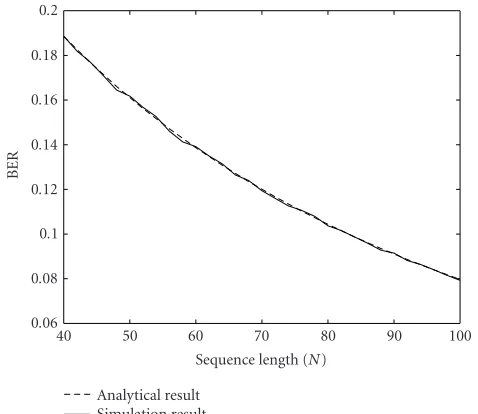
Figure 3illustrates the BER curves obtained from (30) and the simulation results. In our simulations, the cover sig-nal vector is ofNcomponents that are i.i.d. with zero mean
0
0 200 400 600 800 1000 1200 1400 1600 1800 2000 Random sequence length (N)
Figure4: Analytical result in the linear modulation.
and varianceσ2=502. One single information bit is
embed-ded via (3) and thereafter extracted using (24). Again, the distortion threshold ratio is chosen asα=0.1. The embed-ding and detection operations are repeated for different se-quence lengths.
This scheme boasts a simple ML detector and its per-formance matches the optimum detection in the previous scheme (1). Bear in mind that the latter has only theoreti-cal values but limited meanings in practice. Compared with the feasible suboptimal detector (20), the improvement in the former is substantial. Furthermore, the neat and com-pact BER result allows us to predict performance with high accuracy for a specific hiding parameter set.
In spite of all the optimizations, the DS schemes are still unsuitable for oblivious data hiding. Figure 4 depicts the achievable performance at different sequence lengths with the distortion ratio fixed at α = 0.1. To embed one sin-gle bit into a 1000-coefficient sequence, the BER upper limit is BER = 3.91·10−6. To achieve BER performance up to
BER≤10−9, the sequence length must beN >1800. It is the
theoretical limit for the DS approaches (1) and (3). The poor performance is explained by the inherent limitations of the DS schemes.
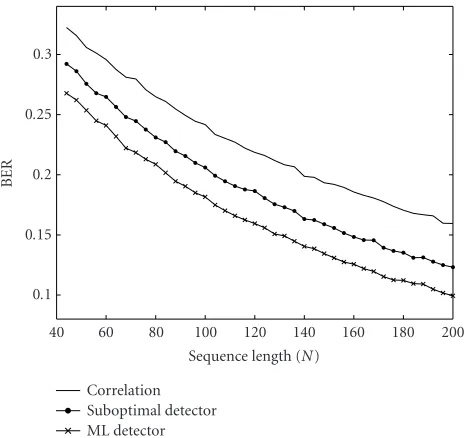
It should be stressed that the Gaussian distributed origi-nal coefficients are assumed in the above aorigi-nalysis. In practice, ciis usually a coefficient in some transform domain. The PDF of ci is often modeled as a generalized Gaussian or Lapla-cian distribution [10]. In such cases, the ML detectors are no longer optimal. Nevertheless, with embedding scheme (1), the suboptimal detector (20) still outperforms (3).
Figure 5 displays simulation results for Laplacian dis-tributed coefficients using embedding algorithm (1). The original coefficients are Laplacian distributed with zero mean and variance σ2 = 502. The various detector performances
0.3
0.25
0.2
0.15
0.1
BER
40 60 80 100 120 140 160 180 200
Sequence length (N) Correlation
Suboptimal detector ML detector
Figure5: Performance with Laplacian distributed data.
linear data hiding scheme (3) exceeds the DS embedding (1). It should be noted that the channel noise is neglected in the above discussions. Even if it is taken into considera-tion, further simulations and studies show that the proposed linear embedding still beats the DS embedding approach and correlation-like detection.
4. HYPOTHESIS TESTING AND SET PARTITIONING The shortcoming of the DS schemes lies in its inefficiency in the cover noise suppression. The hidden signal energy is much lower than that of the original cover signal which acts as noises. The inferior performance stems from the very low signal-to-noise ratio (SNR).
Hidden data detection in essence is a hypothesis testing problem. Supposecis an original coefficient in which one bit information is embedded,xdenotes the resulting coefficient after embedding, andrrefers to the received coefficient. The two hypotheses are
H0: bit value 0 is embedded inr,
H1: bit value 1 is embedded inr. (31)
Obviously, H0 and H1 have different statistical proper-ties. Otherwise, it is not possible to achieve reliable detection. A good hiding algorithm should modify the statistical prop-erties of the original signal without perceptual degradation.
In a noise-free scenario wherer = x, how can the de-coder make a reliable decision H1 or H0 on a givenr? The answer is simple and straightforward—just to make H0 and H1 havenoelement in common. Since the conditional prob-ability P(H0|x) = 0 orP(H1|x) = 0, a correct decision is always expected.
In order to increase the robustness in a noisy environ-ment, we can simply keep the elements in H0 and H1 some distance apart. This simple data hiding idea thus leads toset
Set 0 Set 1 Set 0 Set 1 Set 0 Set 1
d1 d
Figure6: Set partitioning scheme.
partitioningscheme. Two separate sets are constructed on the real axis (Figure 6). The coefficient after embedding should
be kept in a set according to the bit value to be hidden. To embed a bit value 1, the coefficientxshould be kept in Set 1. If the value of the original coefficient cis already in Set 1, no modification is needed. Otherwise, it is replaced by the nearest element in Set 1 to minimize distortion. Similarly, the value ofxis kept in Set 0 to embed a bit value 0.
To embed one bit information in a coefficient sequence c, the simplest solution is to define a pattern to represent bit values. In our example, one bit is embedded in a 5-coefficient sequence. Two sequence patterns, similar to the antipodal signaling, are defined as follows:
Pattern A (bit 1): [Set 1, Set 0, Set 1, Set 0, Set 1] Pattern−A (bit 0): [Set 0, Set 1, Set 0, Set 1, Set 0]. (32)
The modified sequencexshould comply with Pattern A to hide the bit value 1, or Pattern −A to hide the value 0. For instance, the resulting sequence should be x0 ∈ Set 1,
x1∈Set 0,x2∈Set 1,x3∈Set 0, andx4∈Set 1 in order to
embed the value 1.
To further measure the hiding performance, the distor-tion injected in the scheme is evaluated as follows. In many transform domains,cis assumed to be Laplacian distributed or generalized Gaussian distributed. For simplicity, here we make approximations and assumecis uniformly distributed in the limited range (−a,a), whereais some big value. This assumption is reasonable because analytical and simulation results for uniform distributed data are quite close to those obtained with Laplacian distributed data. This assumption is a good compromise between accuracy and ease of analytical work. The hiding distortion can be easily proved indepen-dent of the specific value ofa.
Denote the error introduced in embedding ase=x−c, in the case where a bit value 1 is embedded, and consider the typical regionADas depicted inFigure 7.
Ifcis in the rangeAB, no modification is needed, thus e=0. Ifcis in the rangeBD,eis uniformly distributed in the range (−d−d1/2,d+d1/2). The conditional probability can be expressed as
P(c∈AB|c∈AD)= d1 2d1 + 2d,
P(c∈BD|c∈AD)= 2d+d1 2d1 + 2d.
(33)
The average distortion follows immediately,
D= (2d+d1) (2d1 + 2d)·
(2d+d1)2
12 = 1 12
(2d+d1)3
(2d+ 2d1). (34)
Set 1 Set 0 Set 1 Set 0 Set 1 d1 d d1
A B C D
Figure7: Average distortion calculation.
5. DETECTION IN SET PARTITIONING
5.1. Hard decision detection
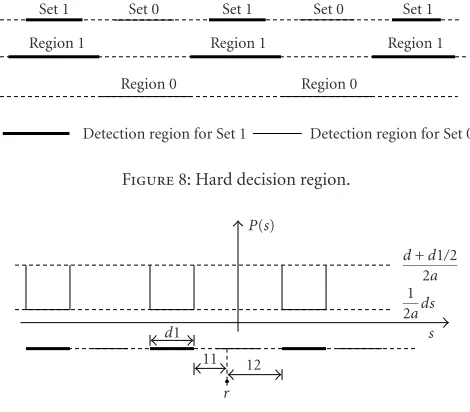
In the N-coefficient sequence embedding, the simplest tector is the majority vote which is a hard decision de-coder based on individual coefficients. In this approach, a real axis is divided into decision Regions 1 and 0 (Figure 8). If the received coefficientri falls in Region 1, it is decided that the transmitted signal x comes from Set 1. Other-wise, it is assumed to originate from Set 0. In the exam-ple mentioned in Section 4, if a received sequence pattern is {Set 0, Set 0, Set 1, Set 0, Set 0}, which is more similar to Pattern A (2-coefficient difference) than to Pattern −A (3-coefficient difference), the decision is made in favor of the bit value 1.
5.2. Maximum likelihood detection in Gaussian noise
The detection reliability can be enhanced using a soft deci-sion detector. Provided the received coefficient ri after the Gaussian channel transmission, the ML ratio is [11]
R= P
xi∈Set 1|ri
Pxi∈Set 0|ri. (35)
The above equation can be written by introducing vari-ablesτiandξi:
R=
τi∈Set 1P
τi|ri
ξi∈Set 0P
ξi|ri, (36)
where
Pτi|ri=P
τifri|τi fri ,
Pξi|ri=P
ξifri|ξi fri .
(37)
The ML ratio is expressed as
R=
τi∈Set 1P
τifri|τi
ξi∈Set 0P
ξifri|ξi, (38)
where f(ri|τi) is the Gaussian-noise conditional probability density,
fri|τi=√1 2πσ ·exp
−ri−τi2 2σ2
. (39)
Set 1 Set 0 Set 1 Set 0 Set 1
Region 1 Region 1 Region 1
Region 0 Region 0
Detection region for Set 1 Detection region for Set 0
Figure8: Hard decision region.
P(s)
d+d1/2 2a 1 2ads d1
11 12 r
s
Figure9: Calculation of ML ratio.
Under our previous assumption that the original coef-ficient ci is uniformly distributed, the PDF f(ci) = (1/2a) (−a ≤ ci ≤ a). The probability of the transmitted signal P(τi) is depicted inFigure 9after embedding the bit value 1. Note that the probability pulses appear at the endpoints. These signal points are transmitted with higher probability because any ci out of Set 1 is replaced by these endpoints. The probability can be expressed as
τi∈Set 1
Pτifri|τi
= 1 2a
ri−l1
ri−l1−d1
1 √
2πσe
−(τi−ri)2/2σ2dτi
+√1 2πσ
d+d1/2 2a e
−l2
1/2σ2
+ 1 2a
l1−2d−2d1 l1−2d−3d1
1 √
2πσe
−(τi−ri)2/2σ2dτi+· · ·.
(40)
In the same manner,ξi∈Set 0P(ξi)f(ri|ξi) can be
calcu-lated and a similar result is obtained. Nevertheless, this result does not lead to any closed-form result of ML ratio. More-over, as the noise powerσ2is usually unavailable at the
de-coder, this detector is infeasible in practice.
The challenge in detection is that the transmitted signal can assume any values in these two sets. The ML ratio calcu-lation involves all elements in Set 1 and Set 0, thereby greatly increases the computational cost. In the following subopti-mal methods, we assume that the transmitted signals are dis-crete instead of continuous.
5.3. Suboptimal detection 1
As a first approximation, it is simply assumed that the trans-mitted signals are at the centers of the continuous segments, and the signaling has a pattern like XOXOas depicted in
Set 1 Set 0 Set 1 Set 0 Set 1
X O X O X
(a) Suboptimal detection 1.
Set 1 Set 0 Set 1 Set 0 Set 1
X X O O X X O O X X
(b) Suboptimal detection 2.
Figure10: Suboptimal detection in set partitioning.
The ML ratio thus follows as in (35).
This result greatly simplifies the ML ratio calculation, but it still involves infiniteXandOpoints. Our simulation stud-ies show that we can further simplify it by merely considering the nearestXandOpoints. Thus (35) reduces to
R=P
ri|xi=ui
Pri|xi=vi, (41)
whereui/viis the nearest pointsX/Oin Set 1 and Set 0.
5.4. Suboptimal detection 2
InFigure 9, it is observed that the endpoints are transmitted with much higher probabilities. Another reasonable approx-imation assumes that the transmitted signals have XXOO pattern (Figure 10b).
Given a received signal coefficient ri, only the nearest endpoints in those two sets are considered. Therefore, two signal candidatesuiandviare identified. This yields the same ML ratio as in (41). The only difference is the selection of
possible transmitted signal candidates.
In the case where one single bit is embedded in anN -coefficient sequence, a sequence detector can be employed. In the aforementioned example inSection 4, given a received 5-coefficient sequencer, we denote the nearestXandOpoints toriasui(in Set 1) andvi(in Set 0), respectively. Comply-ing with the predefined pattern in Section 4, two sequence candidates are constructed as follows:
Pattern A type: a=u0,v1,u2,v3,u4 ,
Pattern−A type: b=v0,u1,v2,u3,v4 .
(42)
Ifr−a<r−b, the received sequence is more “sim-ilar” to Pattern A, leading to decoding the bit value 1. Other-wise, a bit value 0 is decided.
6. RESULTS OF SET PARTITIONING
6.1. Performance analysis
Data hiding is the game played between distortion and ro-bustness and there is a tradeoffbetween these two factors.
0.5 0.45 0.4 0.35 0.3 0.25 0.2 0.15 0.1 0.05 0
BER
0 0.5 1 1.5 2 2.5 3 3.5 4 SNR (linear scale)
Suboptimal detector 2 Suboptimal detector 1 Majority vote
Figure11: Detection performance comparison (1 bit embedded in
an 11-coefficient sequence).
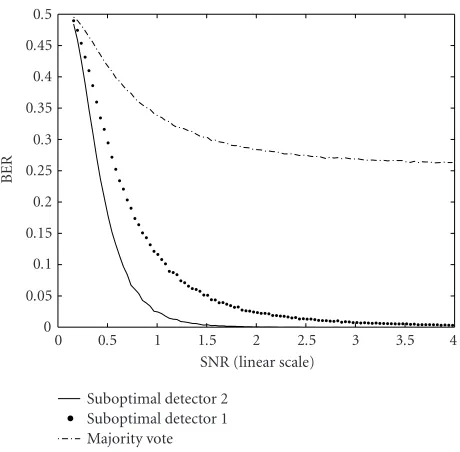
The more the distortion introduced is, the more reliable it could be. To evaluate the performance of set partitioning scheme, detection of BER is measured for various SNRs in a Gaussian noise environment. As the data hiding signal en-ergy is equivalent to distortion injected, the DNR is used in-stead of SNR in the following discussions. The DNR is de-fined as the ratio of distortion energyDto the noise variance σ2, that is, DNR=D/σ2. It should be noted that the
distor-tion energyDis less than the noise energy in most practical cases.
Our simulation studies use the following Monte Carlo procedure. A generated random sequence c is composed of N i.i.d. random variables with zero mean and variance σ2 = 502. The above set partitioning embedding algorithm
is applied to the sequence to hide the bit value 1 or 0. Subse-quently, a noise vectornwithNzero-mean Gaussian random variables is added toc, which simulates the effect of the addi-tive Gaussian channel transmission. Given the received signal sequence, the information bit is extracted using the afore-mentioned detectors. To validate our algorithms, the simu-lation procedure is repeated for different values of sequence lengthN, signaling parametersd,d1, and Gaussian channel noise variance.
0.5 0.45 0.4 0.35 0.3 0.25 0.2 0.15 0.1 0.05 0
BER
0 0.2 0.4 0.6 0.8 1 1.2 1.4 1.6 1.8 2 SNR (linear scale)
d/d1=1/1 d/d1=1/2 d/d1=2/1
Figure12: BER-DNR at differentd/d1 (1 bit embedded in an
8-coefficient sequence ).
X O X O X O X O
Figure13: QIM embedding.
It is established that the BER-DNR is only related to the ratio ofd/d1, not the individual values ofdandd1.Figure 12
displays the performance in one 1 bit/8-coefficient sequence embedding. It is apparent that thed/d1 performs better at lower DNR. However, larger d/d1 is more advantageous at higher DNR because in practice, data hiding distortion is not expected to be more than moderate or severe compression distortion. Consequently, data hiding always works at lower DNR, usually DNR <1. Hence smallerd/d1 is advisable in the real world.
6.2. Comparison with existing schemes
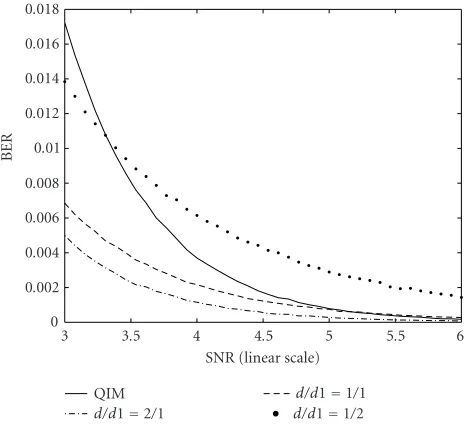
An existing oblivious data hiding scheme, quantization index modulation (QIM) [12,13], is a special case of the set parti-tioning scheme where the value ofd1 is selected asd1=0. In the QIM scheme, the embedding output coefficientXis dis-crete instead of continuous (Figure 13). In contrast, the set partitioning scheme provides us with the flexibility to choose different values ofdandd1. In most applications where DNR is low, we will see that the signaling withd/d1= ∞(QIM) is not well suited.
In Figure 14, one single bit is embedded into a 4-coefficient sequence. Several d/d1 ratio selections demon-strate substantial improvements over the QIM scheme. The performance gain is remarkable at lower DNR. At the higher DNR, the QIM scheme performs only slightly better than the signaling scheme d/d1 = 1, as shown in Figure 15. The proposed set partitioning method offers the designer
0.5 0.45 0.4 0.35 0.3 0.25 0.2 0.15 0.1 0.05 0
BER
0 0.5 1 1.5 2 2.5 3 3.5 4 SNR (linear scale)
QIM d/d1=2/1
d/d1=1/1 d/d1=1/2
Figure 14: BER-DNR at lower DNR (1 bit embedded in a
4-coefficient sequence ).
0.018 0.016 0.014 0.012 0.01 0.008 0.006 0.004 0.002 0
BER
3 3.5 4 4.5 5 5.5 6
SNR (linear scale) QIM
d/d1=2/1
d/d1=1/1 d/d1=1/2
Figure 15: BER-DNR at higher DNR (1 bit embedded in a
4-coefficient sequence).
an improvement over the QIM technique by choosing an appropriate signaling ratiod/d1. The reason to select smaller values ofd/d1 ratio in data hiding is twofold; first, data hid-ing operates at lower DNR in practice; second, this selection guarantees a fair detection performance even at severe com-pressions or tampering attacks. In contrast, the QIM scheme does not survive noisy channels well.
O X O X O X O
(a)
X O
(b)
Figure16: BER in (a) periodic signaling and (b) nonperiodic signaling.
0.5 0.45 0.4 0.35 0.3 0.25 0.2 0.15 0.1 0.05 0
BER
0 0.5 1 1.5 2 2.5 3 3.5 4 SNR (linear scale)
QIM case Antipodal case
Figure17: BER-SNR in QIM and antipodal cases.
maximum error constraint, which implies less distortion en-ergy ind/d1=1 signaling, the proposed scheme still demon-strates significant improvements over the QIM scheme at lower DNR.
Bear in mind that the BER in QIM scheme is different from the BER in the antipodal signaling case. Chen and Wor-nell [12] point out that the BER in QIM could be calculated the same way as the binary antipodal signaling communica-tion model. Derived from that, the performance in the an-tipodal case is BER=Q(d/2σ), whereQ(·) is the Gaussian-PDF tail integral [13]. Actually this conclusion is not quite accurate for most data hiding scenarios, especially consider-ing that the data hidconsider-ing often takes place at lower DNR in the real world. It is readily see that the BERs are the area of the shadowed regions inFigure 16,
BER= 0
−d 1 √
2πσe
−(x+d/2)2/2σ2 dx
+ 2d
d 1 √
2πσe
−(x+d/2)2/2σ2
dx+· · ·.
(43)
The analytical BER curves in QIM scheme and the an-tipodal signaling case are depicted inFigure 17. The gap be-tween these two schemes is explained by the shadowed area difference inFigure 16. A more general and rigorous mathe-matical analysis on QIM data hiding was recently presented by Perez-Gonzalez [14]. Although the closed-form BER can-not be obtained, an accurate upper bound is produced in the work.
The proposed nonlinear scheme can be employed in place of the direct-sequence hiding presented in Sections2
and3. The algorithm can be employed in various data hiding domains. In our image data hiding experiments, information bits are embedded in the discrete Fourier transform (DFT) amplitude domain. A signaling pattern is embedded in the medium frequency coefficients. The results validate the pposed set partitioning scheme, and have demonstrated ro-bustness to common compression and various filtering at-tacks.
The above set partitioning scheme is just a very simple nonlinear scheme. Its detection is mostly heuristic as seen from the above discussions. More accurate analysis is very difficult if not impossible at all. Our detectors are simplified versions from the ML detection analysis. The above results and conclusions are derived from our simulations and exper-iments. They may not be true in all scenarios. For example, the detection comparisons between Method-1 and Method-2 may not be true at alld/d1 ratios. Premature as they are, the algorithms give good results in practice. Rigorous analysis is under further investigation. More accurate artifacts control and higher hiding capacity are also our next research topics.
7. CONCLUSIONS
detection and performance analysis, and comparison with the existing algorithms are further discussed. Both simula-tion studies and theoretical analysis demonstrate improve-ments over current data hiding algorithms.
ACKNOWLEDGMENT
The authors would like to thank Dr. Y. Tang for his editorial contributions.
REFERENCES
[1] L. Boney, A. H. Tewfik, and K. N. Hamdy, “Digital water-marks for audio signals,” inProc. 3rd IEEE International Con-ference on Multimedia Computing and Systems, pp. 473–480, Hiroshima, Japan, June 1996.
[2] I. J. Cox, J. Kilian, T. Leighton, and T. Shamoon, “A secure, robust watermark for multimedia,” inProc. Workshop on In-formation Hiding, pp. 185–206, Cambridge, UK, May 1996. [3] F. Hartung, P. Eisert, and B. Girod, “Digital watermarking
of MPEG-4 facial animation parameters,” Computers and
Graphics, vol. 22, no. 4, pp. 425–435, 1998.
[4] F. Hartung and B. Girod, “Watermarking of uncompressed and compressed video,” Signal Processing, vol. 66, no. 3, pp. 283–301, 1998.
[5] M. D. Swanson, B. Zhu, and A. H. Tewfik, “Multiresolution scene-based video watermarking using perceptual models,”
IEEE Journal on Selected Areas in Communications, vol. 16, no. 4, pp. 540–550, 1998.
[6] M. Ikeda, K. Takeda, and F. Itakura, “Audio data hiding
by use of band-limited random sequences,” inProc. IEEE
Int. Conf. Acoustics, Speech, Signal Processing (ICASSP ’99), vol. 4, pp. 2315–2318, Phoenix, Ariz, USA, March 1999. [7] I. Cox and M. L. Miller, “Review of watermarking and the
importance of perceptual modeling,” inHuman Vision and
Electronic Imaging II, vol. 3016 ofProceedings of SPIE, pp. 92– 99, Bellingham, Wash, USA, February 1997.
[8] C. I. Podilchuk and W. Zeng, “Image-adaptive watermarking using visual models,”IEEE Journal on Selected Areas in Com-munications, vol. 16, no. 4, pp. 525–539, 1998.
[9] A. Leon-Garcia, Probability and Random Processes for Electri-cal Engineering, Addison-Wesley Publishing Company, Read-ing, Mass, USA, 1994.
[10] M. Barni, F. Bartolini, A. Piva, and F. Rigacci, “Statistical mod-elling of full frame DCT coefficients,” inProc. 9th European Signal Processing Conference (EUSIPCO ’98), vol. 3, pp. 1513– 1516, Island of Rhodes, Greece, September 1998.
[11] S. M. Kay, Fundamentals of Statistical Signal Processing. Vol. 2: Detection Theory, Prentice Hall PTR, Englewood Cliffs, NJ, USA, 1998.
[12] B. Chen and G. W. Wornell, “Digital watermarking and in-formation embedding using dither modulation,” inProc. 2nd IEEE Workshop on Multimedia Signal Processing, pp. 273–278, Redondo Beach, Calif, USA, December 1998.
[13] B. Chen and G. W. Wornell, “Dither modulation: a new ap-proach to digital watermarking and information embedding,” inSecurity and Watermarking of Multimedia Contents, vol. 3657 ofProceedings of SPIE, pp. 342–353, San Jose, Calif, USA, January 1999.
[14] F. Perez-Gonzalez, F. Balado, and J. R. H. Martin, “Perfor-mance analysis of existing and new methods for data hiding
with known-host information in additive channels,” IEEE
Trans. Signal Processing, vol. 51, no. 4, pp. 960–980, 2003.
Litao Gangreceived the B.S. and M.S. de-grees in electrical engineering from Bei-jing Institute of Technology, China, and the Ph.D. degree from New Jersey Institute of Technology, Newark, New Jersey, in 2001. He is currently a software engineer in In-foDesk Inc, Tarrytown, New York, USA. His research interests include multimedia signal processing, multimedia copyright protec-tion management, watermarking and data
hiding, and software/hardware implementations of multimedia al-gorithms.
Ali N. Akansureceived the B.S. degree from the Technical University of Istanbul in 1980, and the M.S. and Ph.D. degrees from the Polytechnic University in 1983 and 1987, re-spectively, all in electrical engineering. Since 1987, he has been with the New Jersey In-stitute of Technology, where he is a Pro-fessor of electrical and computer engineer-ing. He was the Founding Director of the New Jersey Center for Multimedia Research
(NJCMR) between 1996 and 2000, and NSF Industry-University Cooperative Research Center for Digital Video between 1998 and 2000. Dr. Akansu was the vice president of R&D of IDT Corpora-tion (NYSE: IDT) between June 2000 and September 2001. He was also the Founding President and CEO of PixWave (IDT subsidiary). He was an Academic Visitor at IBM T. J. Watson Research Center and at GEC-Marconi Electronic Systems Corp. during the summers of 1989 and 1996, and 1992, respectively. He has been a Consultant of the industry and he sits on the boards of several companies. His current research interests include signal theory, linear transforms and algorithms, signal processing for digital communications, In-ternet multimedia including security aspects, and genes & signals. Dr. Akansu has published more than 200 refereed conference and journal articles and four books.
Mahalingam Ramkumar received his B.S. degree from the University of Madras, dia, 1987, M.S. degree from Indian In-stitute of Science, Bangalore, India, 1997, and Ph.D. degree from New Jersey Institute of Technology, Newark, NJ, (all degrees in electrical engineering). Since August 2003, he has been an Assistant Professor with the Department of Computer Science and En-gineering, Mississippi State University.