Potentiometer
Slidewire
Materials
METALLURGICAL CONSIDERATIONS INVOLVED
IN THEIR SELECTION AND DEVELOPMENT
By A.
s.
Darling,
Ph.D., A.M.1.Mech.E.Research Laboratories, Johnson Matthey & Co Limited
The slidewire potentiometer i s a device intended to produce a signal voltage uniquely related to the mechanical dis- plucements involved, and its materials of construction must provide therefore a reasonably accurate embodiment of the desired mathematical relationships. Aoble metal alloys are usually selected for such applications because of their stability and freedom from corrosion. I n this paper, based on a lecture given recently to the Control and Automation Division of the Institution of Electrical Engineers, some general correlations between electrical performance and metallurgical characteristics are dis- cussed and it is shown hozv the applica- tion of these principles has led to the deeelopment of new and improved
potentiometer slidewire materials.
Although it is axiomatic that resistance wires should have a high resistivity, prevailing circumstances will always determine the interpretation placed on this general require- ment. Alloys with specific resistances ranging from 10 to 150 microhm-cm are fairly regu- larly employed and it is safe to say that high resistivity is frequently a subordinate con- sideration when the final selection of a slide- wire material comes to be made.
The balance finally achieved between the conflicting requirements of high resolution and minimum volume is generally determined by the qualities of electrical stability and mechanical permanence required from the component, and the importance of resistance
constancy frequently overrides all other considerations.
Because of the obvious desirability of low and constant contact resistances, the use of noble metal alloys for precision potentio- meters has become almost mandatory. The contact resistance provided by a particular slidewire/wiper combination is, however, de- pendent upon the load applied, so that we can sometimes envisage the successful use of
base metals in those situations where high loads and torques are possible. As heavy loads accentuate the rate of wear on the slidewire this solution is of rather limited application. A good deal of the voltage signal generated across a sliding contact manifests itself as electrical noise, and some of the traditional slidewire materials are successful because of their ability to keep this undesirable character- istic within tolerable proportions.
Potentiometers used in servo-mechanisms sometimes develop signals of several hundred volts and in such instances thermo-electric effects are small enough to be neglected. At the other end of the scale, however, are those slidewires used to sub-divide small fractions of a volt, where thermal potentials can intro- duce errors comparable in magnitude to the quantities being measured. Between these two extremes can be distinguished an area in which the main disadvantage of a high thermo-electric force is the ‘hunting’ effect which it can introduce when null points are being sought by automatic methods. A low thermal e.m.f. against copper is, therefore, important particularly in d.c. devices.
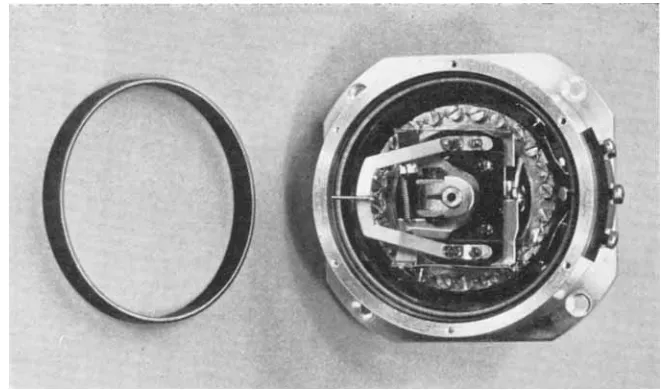
There are many different types of potentiometers, each requiring individual selection of the winding material to meet the specified performance of the instrument. This illustration shows a Colvern cam-corrected single-turn precision potentiometer and its toroidal winding.
The wire in this case is 20 per cent copper-platinum their effective use as slidewire materials.
Higher resistivities and lower temperature coefficients can be achieved by suitable alloy- ing procedures and the improved mechanical properties of the alloys facilitate winding techniques and ensure greater resistance to abrasion in service.
Composition
and
Resistivity
To assist in attaining the freedom from tarnishing necessary for low contact resist- ance, precision potentiometer alloys are generally based on either platinum or palla- dium. A discussion of the theory of alloying with respect to electrical properties is not within the present context, but it is worth
considering a simple practical example, such as that afforded by the palladium-gold system, which illustrates many of the general prin- ciples employed.
Fig. I illustrates the effect of gold on the
electrical resistivity and temperature coeffi- cient of palladium. The specific resistance of pure palladium at zo°C is 9.93 microhm-cm, and its temperature coefficient of resistance is 0.0038 per "C. The addition of 20 per cent by weight of gold increases the specific resist- ance to 18 microhm-cm, and reduces the tem- perature coefficient of resistance by a corresponding amount. The peak resistivity is
correspond with the minimum temperature coefficient, which occurs at rather higher gold concentrations.
The gold-palladium system tends to be regarded as a classical example of one in which the two constituents are soluble in all proportions so that no discontinuous variation of properties with composition occurs. Al- though the slight inflexions exhibited by the two curves in Fig. I do indicate some de- parture from ideal conditions, the general implications are that high resistivity corres- ponds with low temperature coefficient and that the resistivity rises to a maximum at the highest degree of alloying. As long ago as
1860 Matthiessen suggested (I) that the total resistance of a metal or alloy should be separated into temperature-dependent and temperature-independent constituents. If we imagine that the alloying constituent is temperature-independent the situation can be represented graphically as in Fig. 2.
Temperature coefficients calculated at 300°K
from such an elementary model show roughly the same trends as those experimentally derived, although the numerical discrepancies suggest that these simple rules are not directly applicable to concentrated alloys.
The alloy containing 50 per cent of gold would be the most valuable to select for a resistance slidewire as its resistivity lies at the peak of the concentration curve. Slight variations in composition would be unlikely therefore to have much influence on the elec- trical resistance, and slidewires of constant diameter should show few problems due to non-linearity. The maximum resistance of gold-palladium alloys is, however, rather low for many applications and they are too soft
to resist abrasion. The high thermal e.m.f.s they generate against copper could moreover be undesirable in certain precise work.
Silver and palladium form a continuous series of solid solutions. The peak resistivity of 42 microhm-cm is achieved with a silver content of 40 per cent by weight and this alloy has the remarkably low temperature coefficient of 0.00003 per "C. Where low noise values and steady contact resistances are matters of particular concern, this alloy is widely employed, and for really precise work its low temperature coefficient is of extreme value. Its mechanical properties are unfortunately rather lower than could be desired, and its resistance to wear and abra- sion is not high. Since the low noise values appear to be a direct consequence of the low hardness, attempts to improve the mechanical properties of this valuable resistance material have usually resulted in inferior electrical characteristics.
Platinum Alloys
Platinum alloys containing approximately
Iridium-platinum alloys had far more reproducible characteristics and their electrical properties re- mained stable over long periods of
time. Combined with an inter- mediate electrical resistivity of ap- proximately 25 microhm-cm, the 10
per cent iridium-platinum alloy has an excellent resistance to tarnishing and corrosion and has high mech- anical properties.
As an alloying addition, rhodium is less effective than iridium in increasing resistivity, although binary rhodium-platinum wires are still effectively employed in some low resistance potentiometers. The elec- trical properties of rhodium-plati- num solid solutions are considerably improved by ruthenium additions,
and the platium alloy containing 5 per cent of ruthenium and 15 per cent of rhodium is widely used for precise work where low contact resistance and freedom from wear is essential. This alloy has a specific resistance of 31 microhm-cm. and a temperature coefficient of 0.0007 per 'C.
Copper and platinum form, at temperatures below the solidus, a continuous series of solid solutions, the electrical resistance of quenched alloys being as indicated in Fig. 3. T h e peak resistance of approximately 93 microhm-cm is exhibited by the alloy containing 24.5 per cent by weight of copper. This corresponds to the Cu Pt equi-atomic composition and a tendency to order makes this alloy somewhat unstable. Prolonged heat treatment of the quenched alloy between ZOO' and 300°C results in ordering; the copper and platinum atoms line up on alternate planes and the resistance falls from 93 to 14 microhm-cm. This tendency can be reduced to manageable proportions by moving away from the stoichiometric composition (2). The alloy now produced contains approximately 20 per cent
by weight of copper and is stable at tempera- tures up to 200°C. Since this adjustment involved some sacrifice of resistivity and the
alloy still had a base metal content rather higher than was thought to be desirable in a precision material of this type, there appeared to be considerable scope for a new noble metal alloy of higher resistivity and freedom from corrosion.
Palladium Alloys
Detailed literature and laboratory surveys showed that palladium alloys tended to develop higher specific resistances than those based on platinum or gold. In particular it
The effect of molybdenum upon the elec- trical properties of palladium is illustrated in Fig. 4, which shows that resistivities of the order of IOO microhm-cm can be developed in a workable alloy which contains 10 atomic per cent of molybdenum. Higher resistivities were obtained by adding the molybdenum to a gold-palladium base. The composition finally selected for general purposes contained
5 per cent by weight of molybdenum and 40
per cent of gold, the balance being palladium (5). This material has a specific resistance of
IOO microhm-cm which does not change
appreciably either by working or heat treat-
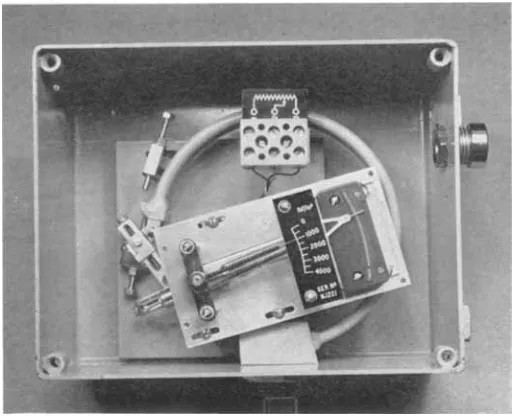
This precision potentio- meter for a pressure trans- ducer, by Delta Controls, is
shown jitted to a Bourdon tube pressure gauge. The winding here is i n 5 per cent molybdenum - 40 per cent palladium-gold
ment. Its temperature coefficient of 0.00012
per "C between on and
100°C
is acceptably low for most purposes and its high tensile strength (approximately 70 tons per sq. inch in the hard drawn condition) ensures high wear resistance and ease of winding.Accurate control of temperature coeficierct of resistance is essential in the manufacture of precision resistance wires. This equipment, designed and built by Johnson Matthey, gives a
continuous indication of temperature and re- sistance of $ne wires over the range -60' to
250°C
(3, 4). This was because work hardening the alloys of higher vanadium content had the un- usual effect of reducing the specific resistance to a significant extent, Small additions of
aluminium reduced this effect considerably
(6). The alloy selected for commercial evalua- tion contains 9 per cent by weight of vanadium and I per cent of aluminium. Combined with a specific resistance of 150 microhm-cm at room temperature is a temperature coefficient of - 80 p.p.m. per "C and a tensile strength in excess of 50 tons per sq. inch in the annealed condition. Wire of this composition can be drawn down to diameters of the order of
0.0005 inch.
Contact Resistance
Some typical curves indicating the effect of load on contact resistance are shown in Fig. 6.
The wiper used for these determinations contained 62.5 per cent by weight of gold, the remainder being silver and copper. These measurements were obtained at currents of ten milliamps. At pressures below three grams, contact resistance increases rapidly with
decreasing load. Although this behaviour is
observed with all materials there is no doubt that it is less pronounced with the softer resistance wires.
Typical Physical Properties of Noble Metal Resistance Wires
0.0017 0.0013
0.0011
Alloy
30 47 75 117 -0.10 35 55 80 125 +0.55
40 63 90 42 -0.38 10 per cent rhodium-platinum
10 per cent iridium-platinum
10 per cent rhodium-platinum
15 per cent rhodium-platinum
20 per cent iridium-platinum
40 per cent silver-palladium
10 per cent ruthenium-platinum
8 per cent tungsten-platinum
5 per cent molybdenum-
20 per cent copper-platinum
5 per cent molybdenum-
40 per cent palladium-gold
9 per cent vanadium-palladium
5 per cent gold-
5 per cent ruthenium-
platinum 19 24.5 26 31 32 42 42 62 64 82.5 100 150 Specific Resistance 114 147 156 186 192 252 252 372 3 84 495 600 900
pLl-cm. Q/circ. mil. ft 0.0007 0.00085 0.00003 0.00047 0.00028 0.00024 65 45 24 50 60 60 101 70 38 79 94 94 110 105 70 90 95 90 173 165 110 140 150 140 +G.03 +0.61
-
4.20 +0.14+
0.71-k 0.77
0.000098
I
38I
60I
90I
140I
-0.670.0001 2
-0.00008 ~
::
~;;
70
90 40 -0.56
I 1 O ~ -0.19
and noise cannot be considered independently, and detailed studies now being undertaken should lead to valuable correlations between noise, load, contact resistance, and speed of sliding. A major difficulty in this work lies in separating the behaviour characteristics of the materials under test from effects which reflect the construction and design of the testing apparatus.
For purposes of comparison, contact re- sistance measurements were made on copper- nickel and nickel-chromium resistors. For noble metal slidewires, the relationship between load and contact resistance is well
F I N E SILVER
Fig. 6 E’ect of a load on the contact resistance between a gold alloy wiper and Jine silver, 40 per cent silver-palladium, 5 per cent molybdenum - I 2 3 4 s 6 7 a 9 10 II 12 I3 14 40 per cent palladium-gold and 9 per cent
vanadium-palladium 2
:
: CONTACT LOAD IN GRAMS
Platinum Metals Rev., 1968, 12, ( 2 )
60
Temperature Coefficient of Thermal e.m.f. against copper
a t 100°C
mV
Tensile Strength
Annealed
I
Hard Drawntons/ in2 tons/
in2 tons/ in2
Resistance
(o-iooocj
defined, but similar relationships are not observed with base metal slidewires. Although low contact resistances are sometimes ob- tained, load and contact resistance are not uniquely related and a very wide scatter of results is obtained. This scatter is undoubt- edly associated with the high noise values generated between sliding contacts and base metal resistors. Noise and uncertainty in- crease rapidly as the contact load decreases and it is difficult, therefore, to
obtain accurate
results from low torque potentiometers wound with base metal wires.
Characteristics
of
Potentiometer MaterialsThe characteristics of a few of the main important potentiometer wires are summar- ised in the table. Of those listed the most noble and resistant to corrosion is the 20 per cent iridium-platinum alloy which unfortunately has a temperature coefficient rather higher than
is acceptable in certain precision applications. Because of their high catalytic activity platinum and palladium alloys sometimes cause difficulty when operated in atmo- spheres containing high concentrations of organic vapours. A recently developed rhodium-platinum alloy containing 5 per cent
of gold does not readily promote low temperature organic reactions and might therefore be of considerable help in those applications where the danger of polymer formation exists.
References
I A. Matthiessen, Ann. Physik Chem. (Pogx.
2 Unpublished data, Johnson Matthey Research
3 W. KBster, W. Gmohling and D. Hagmann,
4 E. Kudielka-Artner and B. B. Argent, Proc.
5 Johnson Matthey, B.P. 861,646 6 Johnson Matthey, Prov. Pat. 21853/67 7 Johnson Matthey, B.P. 868,259
Folge), 1860, 110, 190; Zbid., 1864, IZZ, 10
Laboratories
Z . Metallkunde, 1963, 54, 325
Phys. Soc., 1962, 80, 1143
Frictional Characteristics of the Refractorv
JPlatinum
Metals
A recent report by D. H. Buckley of the Lewis Research Centre (NASA Tech. Note T N D-4152, 1967, (Sept.), 1-15) conveys at first glance the impression that osmium and ruthenium, the hexagonal refractory metals, have, when rubbed against themselves, lower coefficients of friction than their cubic counterparts rhodium and iridium, and are therefore to be preferred for sliding electrical contacts. The author states dogmatically that ‘from the results of this investigation, it would appear that ruthenium, with its hexagonal crystal structure, would certainly be highly superior to the face centred cubic metal rhodium in sliding electrical contact applications’. Detailed study of the paper, however, shows that this conclusion is based entirely on experiments made under ultra high vacuum conditions. The superiority of ruthenium over rhodium is only apparent at pressures below I O - ~ torr and results reported show that at higher pressures rhodium has a much lower coefficient of friction than
ruthenium. No information on the frictional characteristics of iridium or osmium at pressures above 10-* torr is given in this re-
port.
Within the context of space applications covered by NASA, it is perhaps logical to assume that atmospheric pressures below
10-8 torr constitute a perfectly normal am-
bient environment. Such clean conditions should certainly help when attempts are made to correlate surface properties such as friction with the crystallographic characteristics of pure metals. It is disappointing, therefore, to find in this report no indication of the purity of the materials studied or the way in which the test specimens were fabricated and pre- pared for examination. In subsequent publi- cations it is hoped that fuller details will be supplied of the process, whereby the disc and rider specimens were ‘finished to a roughness of 4 to 8 micro inches and then fully annealed’.