Ursula Pretzlik
Child Development and Learning
Institute of Education
University of London
Thesis submitted for the degree of Doctor of Philosophy
October 1996
-oD'ns
For the whole of this journey it was the children who gave me courage when I needed it; to those of you who came from the three London schools and your teachers, thank you. And to those of you who came from the two London hospitals and your parents and the medical teams who looked after you and who so generously tolerated my presence, thank you.
My grateful thanks to Professor Kathy Sylva at the Institute of Education for her support and thoughtful supervision throughout this process. Our intellectual debates were always to the point and wonderfully stimulating, her incisive interventions greatly valued. Dr Daniel Wright's extraordinary facility for statistics brought clarity from confusion and I loved discussing the problems and analysing and re-analysing the data - he is so funny, brilliant and enthusiastic about his subject that he makes it come alive. Dan's students at the University of Bristol are lucky to know him. To Dr John Versey, who has exchanged a busy work schedule at the Institute of Education for his peaceful garden, thank you John for the comments and suggestions you made. I would have felt lost without your experience and judgement.
A special thank you to Dr Peter Hindley, Dr Graham Davies and Dr Sarah Ball at St George's Hospital and Professor Tim Eden and Dr Judith Kingston at St Bartholomes Hospital and the ethics committees without whose approval this research would not have been possible.
Oh, and thanks too to Helen and Vanessa - two special friends from the past - who cheered me on.
Five of us worked neck and neck on our studies - we worried and laughed together. Our chats over chocolate cake and steaming tea in polystyrene cups won't be forgotten. While I head off to Amsterdam, Sandra and Miriam remain in London, Milita has gone back to Lisbon and Lily returned to Hong Kong. Thank goodness for e-mail!
ABSTRACT 2
ACKNOWLEDGEMENTS 3
TABLE OF CONTENTS 4
TABLES 11
HGURES 14
CHAPTER ONE
CHILDREN COPING WiTH AN ILLNESS 16
1.1 Early approaches to stress and coping 17
1.1.1 The response based paradigm 18
1.1.2 Stable and predictable characteristics 20
1.1.3 Sunimarising the three coping models 23
1.1.4 Assessing the three coping models 24
1.2 The transactional model of stress and coping 25
1.2.1 Coping: the definition 26
1.2.2 Coping: a theoretical framework 26
1.2.2.1 Stress 27
1.2.2.2 Appraisal and reappraisal 28
1.2.2.3 Coping 30
1.3 Self.report method based on the transactional model 34
1.3.1 For adults: the Ways of Coping Scale 35
1.3.2 For children: the Kidcope Checklist 37
1.4 Assessing coping in ill children 38
1.4.1 Assessing coping: a variety of methods 39 1.4.2 Assessing coping: the Kideope Checklist 43
1.5 Assessing distress in ill children 48
1.5.1 Assessing sellreported distress: the Kidcope Checklist 50 1.5.2 Assessing coping and distress behaviour: a variety of methods 51 1.5.3 Observing distress during a medical procedure: the
Observation Scale of Behaviour Distress 54
PSYCHOLOGICAL AND SOCIAL FACI'ORS
DWLUENCING TO COPING IN ILL ChILDREN 58
2.1 Individual differences and coping 58
2.1.1 Age, sex and experience and coping 59
2.1.2 Self-esteem and coping: the Self Perception
Profile for Children 60
2.2 Parents coping with a seriously ill child 64
2.2.1 Parents coping with their child's illness 65
2.3 Family factors and coping 68
2.3.1 Models of the family and coping 68
2.3.2 The social climate of the family and coping 74
2.3.3 The family structure and coping 78
2.4 A final comment 79
2.4.1 Relating the above to this thesis 80
CHAPTER THREE Study 1
MEASURING CHILDREN'S COPING 82
3.1 Kidcope: the checklist 82
3.1.1 The coping strategies 83
3.1.2 Self-reported distress 85
3.1.3 Perceived helpfulness 85
3.1.4 Validity and reliability 86
3.1.4.1 Validity of Kidcope 86
3.1.4.2 Reliability of Kidcope 88
3.2 The colour coded response strip 91
3.3 The sample 91
3.4 Measuring children's coping: the procedure 93
3.5 Reliability and validity 95
3.6 The scenarios 96
3.7 Kidcope: selfreported distress 98
3.8.2 Reliability in the illness related context 106 3.8.3 Consistency: coping strategies reported on day 0 and day 7 107
3.9 Kidcope: perceived helpfulness 109
3.9.1 Reliability and validity in the common context 110 3.9.2 Reliability and validity in the illness related context 112
3.10 School, age and sex effects 115
3.11 A sumznaiy of the results 115
CHAPTER FOUR
A METHODOLOGICAL OVERVIEW RELATED
TO THE HOSPITAL BASED STUDIES 117
4.1 The sample 117
4.1.1 Gaining access 121
4.2 A bnef overview of the procedures of the five hospital based studies 122
4.2.1 Data collection 122
4.3 Pilot work 123
4.3.1 Pilot work on Kidcope for Older Children 124 4.3.2 A study using Kidcope for Younger Children in the community 125 4.3.3 Pilot work on the Observation Scale of Behaviour Distress 125 4.3.4 Pilot work on competence and self-worth 126 4.3.4.1 The SelfPerception Profile for Children 126
4.4 Analysing the data 127
4.4.1 The core of coping 127
4.4.2 Individual differences and their possible influence on coping 129 4.4.3 The parents and the family and their possible influence on
their children's coping 129
4.4.4 The understanding part of the data 129
SELF-REPORTED COPING Ar1) SELF-REPORTED DISTRESS 131
5.1 Assessing coping in seriously ill children 132
5.1.1 Rational for using Kidcope 133
5.2 Categorisation and reliability of the children's self-reported stressors 134
5.3 The Kidcope Checklist: the procedure 134
5.3.1 The scenario: describing a stressor 135
5.3.2 Self.reported distress 136
5.3.3. The coping strategies and their perceived helpfulness 136
5.3.4 A final comment about the procedure 136
5.4 The spontaneous process of coping: a theoretical 'remindef 137 5.5 Describing differences and similarities between coping strategies
used and their helpfulness 138
5.5.1 The coping strategies 139
5.5.2 Perceived helpfiulness 141
5.5.3 A summary of the data discussed so far illustrated graphically 146 5.6 Differences of individual coping strategies across
the three contexts: common, illness related and the blood test 148 5.7 Illness related stressors versus common stressors: comparing
coping strategies used by the same child across the two contexts 150 5.8 Specific types of stressors reported within two given contexts 151 5.8.1 A common stressor: the scenarios and their content 152 5.8.2 An illness related stressor: the scenarios and their content 155 5.9 Common and illness related scenarios: types of stressor and the way
children cope with them within a context 158
5.9.1 A common scenario: stressor types and coping 159 5.9.2 An illness related scenario: stressor types and coping 160 5.10 Self.reported distress: a part of the Kidcope Checklist 162 5.11 Distress and coping strategies: their relationship 166
OBSERVED DISTRESS AND COPING BEHAVIOUR 169
6.1 The Observation Scale of Behaviour Distress 170
6.1.1 Validity of the OSBD 171
6.1.2 Reliability of the OSBD 173
6.2 Taking an active interest in the blood test 173
6.3 Inter-observer reliability in this study 174
6.4 Distress behaviour and coping behaviour: the procedure 175
6.4.1 Observing a medical procedure 175
6.4.1.1 Defining the three phases 177
6.4.1.2 Scoring the OSBD 178
6.4.2 The 'taking an active interest' coping behaviour 179 6.5 The blood test: observing the children's distress behaviour 179 6.5.1 Distress behaviour during three phases 180
6.5.2 The seven behaviour categories 183
6.6 Validating the distress element of the Kidcope Checklist 185 6.7 Comparing coping behaviours with
distress behaviours and self-reported distress 187 6.7.1 Differences between coping behaviour and distress behaviour 187 6.7.2 Differences between coping behaviour and self-reported distress 190
6.8 A summary of the results 191
CHAPTER SEVEN Study 4
CHILDREN'S INDWII)UAL DIFFERENCES AND COPING INCLUDING
THEIR PERCEPTION OF COMPETENCE AND SELF-WORTH 193
7.1 Self-Perception Profile for Children: a self-report instrument 194
7.1.1 Validity of the SPPC 199
7.1.2 Reliability ofthe SPPC 200
7.2 Self-Perception Profile for Children: the procedure 201
7.2.1 The scale structure 202
7.2.2 The question format 202
7.3 Individual differences: coping in children with a serious illness 203 7.4 Self-Perception Profile for Children: self-esteem and children's
7.4.2 Five domains and their relationship with Global Selfworth 206 7.4.3 The five domains and Global Self.worth: children's self:
reported coping and coping behaviour 208
7.4.3.1 Coping strategies and their competence and
Global Self.worth 209
7.4.3.2 Coping behaviour and their competence and
Global Self-worth 209
7.4.5 The five domains and Global-Self:worth: children's
self:reported distress and distress behaviour 212 - 7.4.5.1 Self:reported distress and their competence and
Global Self.worth 212
7.4.5.2 Distress behaviour and their competence and
Global Selfworth 214
7.5 Being younger or older: the children's coping and distress 214
7.5.1 Coping strategies and age 214
7.5.2 Coping behaviour and age 218
7.5.3 SeIf.reported distress and age 218
7.5.4 Distress behaviour and age 219
7.6 Being a girl or a boy: the children's coping and distress 220
7.6.1 Coping strategies and sex 220
7.6.2 Coping behaviour and sex 221
7.6.3 Self:reported distress and sex 221
7.6.4 Distress behaviour and sex 221
7.7 Time since first diagnosis: the children's coping and distress 222
7.7.1 Coping strategies and experience 222
7.7.2 Coping behaviour and experience 223
7.7.3 Self:reported distress and experience 223
7.7.4 Distress behaviour and experience 225
PARENTAL INFLUENCE ON CHILDREN COPING
wITH AN ILLNE 230
8.1 Parental coping with their child's illness 231
8.1.1 Validity and reliability of CHEP 235
8.2 The Coping Health Inventory for Parents: the procedure 237
8.2.1 The subscale structure 237
8.2.2 The question format 237
8.3 The Coping Health Inventoiy for Parents: parental coping and
children's coping and distress 238
8.3.1 The four coping patterns: similaiities and differences
between parent groups 238
8.3.2 Parental coping: children's self-reported coping and
their coping behaviour 244
8.3.2.1 The level of significance 245
8.3.2.2 Parental coping and children's coping strategies 245 8.3.2.3 Parental coping and children's coping behaviour 249 8.3.3 Parental coping: children's self-reported distress and
their distress behaviour 249
8.3.3.1 Parental coping and children's self .reported distress 250
8.3.3.2 Parental coping and children's distress behaviour 251
8.4 A summary of the results so far 251
8.5 Parental presence or absence during the blood test 253
8.6 Parental presence: the procedure 253
8.7 Parental presence during the blood test and the children's
coping and distress 254
8.7.1 Parental presence: children's self .reported coping and
their coping behaviour 254
8.7.1.1 Parental presence and children's coping strategies 255 8.7.1.2 Parental presence and children's coping behaviour 257 8.7.2 Parental presence: children's self .reported distress and
their distress behaviour 258
CIIAIPTER NINE Study 5
FAMILIAL INFLUENCE ON CHILDREN COPING
WITH AN ILLNESS 263
9.1 The Family Environment Scale: a self-report measure 264
9.1.1 Validity and reliability of the FES 269
9.2 The Family Environment Scale: the procedure 270
9.2.1 The structure of the FES 271
9.2.2 The question format 271
9.3 The Family Environment Scale: the social climate and its
influence on children's coping and distress 272
9.3.1 The FES: the subscales and dimensions 273 9.3.1.1 The FES: similarities and differences between
family types 275
9.3.1.2 Subscales and dimensions and their relationship 276 9.3.1.3 The three dimensions: a factor analysis 278 9.3.2 The family environment: children's Self-reported coping
and their coping behaviour 281
9.3.2.1 The family environment and children's
coping strategies 281
9.3.2.2 The family environment and children's
coping behaviour 284
9.3.3 The family environment: children's self-reported distress and
their distress behaviour 284
9.3.3.1 The fhmily environment and children's
self-reported distress 285
9.3.3.2 The family environment and children's
distress behaviour 285
9.4 A summary of the results so far 285
9.5 The family structure: one parent and two parent families 287 9.6 The family type and its influence on the children's coping and distress 288
9.6.1 The family type: children's self-reported coping and
9.6.1.2 The fimily and children's coping behaviour 290 9.6.2 The family type: children's self-reported distress and
their distress behaviour 290
9.6.2.1 The family and children's selcreported distress
9.6.2.2 The family and children's distress behaviour 290
9.7 A summary of the results 290
CHAPTER TEN
TIlE DISCUSSION 292
10.1 Assessing ill children's coping 294
10.2 The influence of the context 298
10.3 The influence of individual differences 303
10.4 The influence of the family 308
10.5 The way forward 314
10.6 The children: a personal note 317
REFERENCES 320
Table 3.1 The Kidcope Checklist: 15 coping items generate
10 coping strategies (Spirito eta!., 1991) 84 Table 3.2 The composition of the school children (the sample) 92
Table 3.3 A slimmaly of the procedure 94
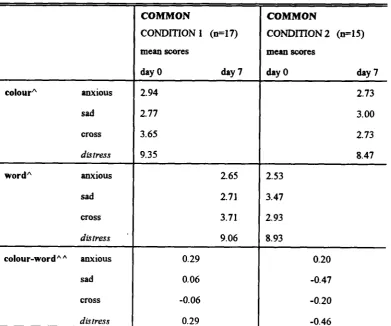
Table 3.4 Common and illness related scenarios: descriptive examples 97 Table 3.5 Selfreported distress as measured by Kidcope: time and
condition in the common context 99
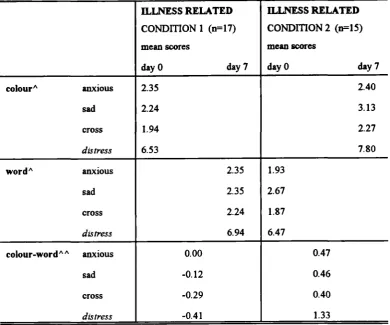
Table 3.6 Self-reported distress as measured by Kideope: time and
condition in the illness related context 102 Table 3.7 Coping strategies used by the children at day 0 and day 7
when reporting on a specific common stressor 105 Table 3.8 Coping strategies used by the children on day 0 and day 7
when reporting on a specific illness related stressor 106 Table 3.9 Day 0 versus day 7: comparing coping strategies used
by the individual child 108
Table 3.10 Helpfulness as perceived and reported by the children 109 Table 3.11 Perceived helpfulness of coping strategies used in the
two conditions in the common context on day 0 and day 7 110 Table 3.12 The coping strategies and their perceived helpfulness in
the common context 111
Table 3.13 Perceived helpfWness of coping strategies used in the tWo
conditions in the illness related context on day 0 and day 7 113 Table 3.14 The coping strategies and their perceived helpfulness in
the illness related context 114
Table 4.1 The composition of the sample 119
Table 4.2 The family stmcture and the number of children within it 120 Table 5.1 Coping strategies reported by the children within each
of the three contexts 140
Table 5.2 Perceived helpfulness of coping strategies used across
and within the three contexts 142
Table 5.5 Table 5.6 Table 5.7 Table 5.8 Table 5.9 Table 5.10 Table 5.11 Table 5.12 Table 5.13 Table 6.1 Table 6.2 Table 6.3 Table 6.4 Table 6.5 Table 7.1 Table 7.2 Table 7.3 Table 7.4
their perceived helpfulness and the three contexts 145 The ten individual coping strategies across the three contexts
A common stressor type: content analysis of the 53 scenarios 148 Categorising stressors in the common context: descriptive
examples 153
An illness related stressor type: content analysis of the
53 scenarios 155
Categorising stressors in the illness related context: descriptive
examples 156
Stressors in the common context: comparing stressor types
in the school and in the home setting 160 Stressors in the illness related context: comparing stressor types
in the medical setting 161
Self.reported distress as measured by Kidcope across
the three contexts 163 Correlation coefficients between contexts, distress and coping 166 The behaviour categories for the OSBD (Elliott & Jay, 1986) 171 Inter-observer reliability coefficients for the OSBD and the
'taking an interest' coping behaviour 174
Describing the relationship between the three phases and the
observed distress behaviour 182
Correlation coefficients: intercorrelations between the distress
behaviours 184
Differences between observed distress behaviour and the
avoidant and active copers 189
Self-Perception Profile for Children: the five domains and
Global Selfworth (Harter, 1985) 197
The six subscales 198
Describing the five domains and Global Self-worth 206 Correlation coefficients: intercorrelations between
Table 7.6 Table 7.7 Table 7.8 Table 8.1 Table 8.2 Table 8.3 Table 8.4 Table 9.1 Table 9.2 Table 9.3 Table 9.4 Table 9.5 Table 9.6 Table 9.7
Selfworth in the avoidant and active copers Feeling cross or angry and self.esteem
Associations between younger and older children and the coping strategies they used to cope with a stressor in the three contexts
A summary: individual differences associated with children's coping
The Coping Health Inventory for Parents: the four coping patterns (Eiser & Havermans, 1992)
Describing the four coping patterns
Correlation coefficients: intercorrelations between parental coping and single mothers
Correlation coefficients: intercorrelations between parental coping and mothers and fathers
The Family Environment Scale: ten subscales and three dimensions (Moos & Moos, 1986)
The Family Environment Scale: the sub scales The Family Environment Scale: the dimensions
Describing the ten subscales: results are based on the FES standard scores
Correlation coefficients: intercorrelations between the three dimensions as measured by the FES
The rotated factor loadings
The family environment and children's way of coping
Figure 1.1 An illustration of three models of coping 23
Figure 1.2 The stress and coping model 33
Figure 3.1 The colour coded response strips 90
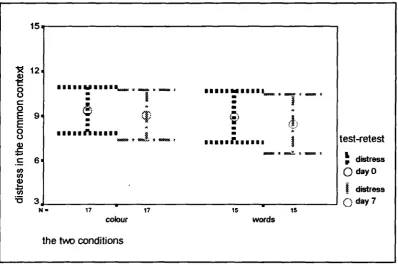
Figure 3.2 Selfreported distress: test-retest and two conditions in
the common context 100
Figure 3.3 Self-reported distress: test-retest and two conditions in
the illness related context 103
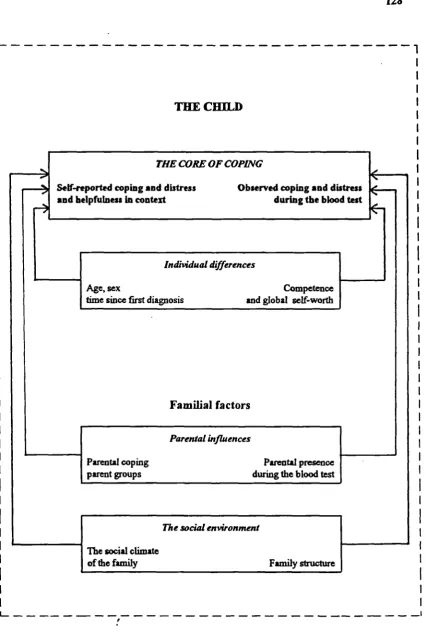
Figure 4.1 The conceptual model guiding this thesis 128 Figure 5.1 The three contexts: the total number of coping strategies used 139 Figure 5.2 The illness context: the association between coping strategies
used and their perceived helpfulness 146
Figure 5.3 The relationship between coping strategies used their
helpfulness in the three contexts 147
Figure 5.4 The three contexts: comparing the self-reported
distress scores 162
Figure 5.5 Self-reported distress across the three contexts 164 Figure 5.6 Correlation patterns between context and distress 165 Figure 6.1 Observed distress: the three phases 181 Figure 6.2 Observed distress: the seven behaviour categories 183 Figure 6.3 Distress during a routine blood test: the relationship between
the children's self-reported distress and their distress
behaviour observed by the researcher 186
Figure 6.4 Distress behaviour: interested and non interested copers 188 Figure 6.5 Self-reported distress: interested and non interested copers 191 Figure 7.1 The Self-Perception Profile for Children: the six subscales 205 Figure 7.2 Children's coping behaviour during the blood test: the five
Figure 7.4
Figure 7.5
the children's age and their coping with a stressor related to the illness
An example showing a weak association between the children's age and their selfreported distress when coping with a stressor related to their illness
Older children displayed less distress behaviour during
215
219
the blood test than younger children 220
Figure 7.6 The children's experience and the total coping strategies
used when coping with a stressor related to their illness 222 Figure 7.7 An example showing no significant association between the
children's experience and their self-reported distress when
coping with a stressor related to the illness 224 Figure 8.1 The Coping Health Inventory for Parents: the four coping
patterns and the three parent groups 239
Figure 8.2 The children using Social Support when coping with a stressor related to the illness and mothers coping patterns
related to their child's illness 247
Figure 8.3 Interaction between Social Support and mothers
coping patterns 248
Figure 8.4 The relationship between Emotion Regulation, parental
presence and feeling nervous during the blood test 257 Figure 8.5 Selfreported distress related to the blood test stressor and
Figure 8.6
Figure 9.1 Figure 9.2 Figure 9.3 Figure 9.4
parental presence or absence during the blood test 259 The children's distress behaviour and parental presence or
absence during the blood test 260
A profile of the median family environment 273 The social climate of the family: two parent and single parent 275 The factor scree plot: the ten FES subscales 279 The family structure and the coping strategies the children
CHAPTER ONE
CHILDREN COPING WiTH AN ILLNESS
Coping is a multidimensional and conceptually complicated process. Research on children's coping needs to establish a solid empirical base, while at the same time criticising and formulating theories. Currently, there is little literature that deals with children's coping, and research which does deal with seriously ill children's coping is even more limited. Given this lack of research literature, empirical studies are needed to validate research instruments for studying how paediatric patients cope and to establish individual and contextual factors associated with it.
It is not the intention of this chapter to provide a complete overview of children's coping but to allow the reader to sample dominating issues and controversies. The chapter confronts the inevitable conflict between theory driven conceptualisations and field based methodology while focusing on children coping with illness. With the exception of Section 1.1, research related to adults is excluded but has been reviewed many times in the past (e.g. Aidwin, 1994; Lazarus, 1993a, 1993b; Pearlin, 1991; Cohen, 1987; Thoits, 1983, 1991; Billings & Moos, 1981, 1982).
1.1 Early approaches to stress and coping
Coping Ls a reaction to stress and although coping is a familiar term in everyday use,
the provision of an all embracing operational definition is difficult. However, clarity of definition is fundamental to the methodological issues of measurement. Definitions vary according to the theoretical framework, which in turn largely determines the research design.
According to Cox (1978) there are at least three different ways of defining the term
stress. Two of these have been termed stimulus-based (used by engineers) and
response-based (used by clinical practitioners and physiologists). The stimulus-based
stress approach treats stress as a harmful or aversive characteristic of the environment in which individuals find themselves - for example, sound levels (excessive noise) or hours of restraint (animal studies) - and assumes that certain situations are stressful irrespective of individual differences and cognitions. The response-based approach on the other hand defines stress in terms of the physiological response of an individual to aversive stimuli. In these early approaches the term 'coping' was restricted to occasions when a response or a reaction to a stressor was considered to have produced a successful outcome.
A conceptually more demanding definition of stress is the one which refers to stress
and implies an element of cognition, ie. the thinking which underlies the coping process and sets it in motion.
Having said that coping is a reaction to stress it may involve either direct action such as avoidant or escape behaviour, or aggressive or compliant behaviour, or it might involve cognitive efforts, i.e. problem-focused or emotion-focused, or a combination of cognition and direct action.
1.1.1 The response-based paradigm
In the 17th centuly, Descartes put forward the proposition of a fundamental dualism between mind and body. The mind was believed to engage in abstract thought and language, quite separate and distinct from the operations of the body. This Cartesian dualism has long been a cornerstone of the reductionist paradigm underlying the biological sciences (Aldwin, 1994). It assigns the study of the physiological workings of the body to science, and the consideration of the mind and soul to philosophy. Descartes further assumed that the mind and the body were influenced by completely different factors and that very little communication occurred between the two.
Cannon (1939) hypothesised that any threat resulted in a fight-flight reaction and that such a reaction was a general response to any stress - physical or sociaL Selye's
(1956) expanded on Cannon's fight-flight proposal and attempted to characterise an
objective indicators of stress which Selye defines as a general bodily response to any demands made upon the body.
The range of stressors was extended through animal studies including events which caused arousal as a result of novelty, uncertainty or unpleasantness but not necessarily a physical threat or challenge (Hennessy & Levine, 1979 in Rutter, 1981).
Similarly, human studies where adults had to cope with a variety of life events, for instance, examinations, parachute jumping and admission to hospital have also been undertaken (Cox, 1978). At first the results of these studies, where physiological responses were measured, appear to be reasonably consistent, yet work with parents of children dying of Ieukaemia (Wolff Fiiedman, Hofer & Mason, 1964) and children admitted to hospital for tonsillectomy (Knight, Atkins, Eagle, Evans, Finklestein, Fukushinia, Katz & Weiner, 1979) has shown subsequently that some individuals fiiled to exhibit the expected physiological changes and lead to the idea that coping differs according to emotional responses within a given situation.
Although there is little disagreement with the explanation of the biological processes involved in coping, the validity of such non-specific concepts of stress and coping has been widely questioned. Nevertheless in two recently presented papers immunological changes resulting from daily stress were monitored (Kipp-Campbell & Gunnar, 1996; Spangler, 1996). Using salivary cortisol sampling these researchers assessed children's coping with potentially stressful situations in natural settings - in the classroom and in the home. This marked a return to assessments of physiological changes stemming from coping with an everyday stressor, in one case a study involving children in day care in America, and in the other a lasting life change, children starting primary school in Germany.
psychoanalytic ego psychology as discussed in Section 1.1.2. In the former approach experimental psychologists investigated coping as escape and avoidance learning by an animal fced with a threatening stimulus. The animal model focuses on the concept of drive (arousal or activation) and portrays coping as a behaviour response which controls aversive conditions, lowering drive and excitement (Miller, 1980). In other words, if the underlying theoretical model is based on the animal model. coping is equivalent to performing adaptive tasks successfully, that is to say the
outcome of coping is observable.
The stimulus- and response-based concepts of stress and coping are now considered inadequate to assess an individuaFs coping, and interactive models have been
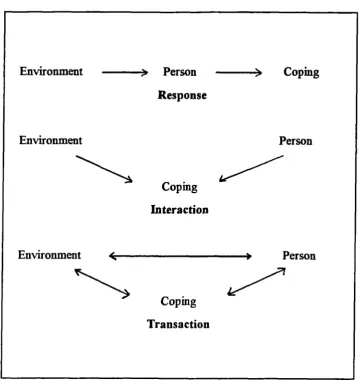
developed which tend to focus on the individual's dynamic relationship with the environment, and emphasise the critical importance of perceptual-cognitive processes and of individual differences (Lazarus, 1976, cited in Cox, 1978). The new theories treat stress and coping not so much as a 'stimulus' or a 'response' but more as a process. The stimulus and response definitions are urn-dimensional, and it will be argued later, are of limited use in describing coping (Figure 1.1).
1.1.2 Stable and predictable characteristics
In the psychoanalytic ego psychology model, coping is defined as realistic and flexible thoughts and acts which solve problems and thereby reduce stress. According to Lazarus and Folkman (1991) the main differences between the treatment of coping in this model compared to the animil model is the focus on ways of perceiving and thinking about an individual's relationship with the environment.
Although behaviour is not ignored, it is treated as less important than cognition.
influenced personality and clinical psychology was that each form of psychopathology was associated with a specific defensive style (e.g. hysterical neuroses to repression; paranoia to projection). According to Lazarus (1993b) the link between forms of psychopathology and particular defense is more a conceptual ideal than a clinical reality.
The work of Haan and Vaillant (1977 and 1969 respectively, in Lazarus 1993b) was derived from a developmental psychoanalytic framework. When the concept of coping was formulated within the tradition of psychoanalytic ego psychology, it was not only concerned with behaviour but also with cognition. The processes used by people to manage troubled relationships were examined and it was found that the criteria for evaluating coping within the theoretical model of ego-psychology were concerned with recognising reality and keeping to it (Haan, 1977).
Research and measurement approaches based on the ego-psychology models tend to assess coping traits and coping styles rather than coping processes. They view coping structurally as a style or traits rather than as a dynamic ego process. Coping
traits refer to stable, predictable characteristics of an individual, that is to say a person behaves as he usually behaves without being influenced by the environment in which the stressor occurs. Defined in this way coping styles are similar to traits. They both refer to the enduring qualities in an individual which serve an explanatory role in accounting for regularities and consistencies in thought and behaviour. This model, unlike the transactional model described in Section 1.2, assesses outcome and assumes the coping mechanism to be fairly stable within individuals and across contexts (Figure 1.1).
tend to underestimate both the complexity and the variability of the ways individuals actually cope (Lazarus & Fo1kmin, 1984).
As will be discussed in this thesis, to be concerned with change is to be concerned with process as opposed to structure. Structure refers to stable factors such as individual differences including seIfesteem or locus of control (Moos & Billings,
1982) or static features of the environment (Monat & Lazarus, 1991). Even though the importance of the notion of process in the stress and coping literature has been written about time and time again (e.g. Mechanic, 1991; Perlin, Lieberman, Menaghan & Mullan, 1981) research questions have tended to emphasise the stable,
structural properties of the person or the environment. In the adult literature studies of coping have focused on coping traits (e.g. Goldstein, 1973; Chan, 1977) and social support (e.g. Monat & Lazarus, 1991). Social support, for example, is believed to be a mediator or buffer between stress and health, and is usually described in terms
of the relatively stable size and characteristics of an individual's social network.
However, Folkman and Lazarus (1985) comment:
1.13 Summarizing the three coping models
Environment > Person > Coping
Response
Environment Person
Copmg Interaction
Environment Person
Copmg Transaction
Figure 1.1 An illustration of the three models of coping
single stressful situation. Here, the person and environmental variables influence
appraisal, which in turn determines the way of coping.
1.1.4 Assessing the three coping models
Traditionally psychology has relied on four basic research techniques. First, research questions were answered through experimental or laboratoiy-based techniques where the stimulus and the expected response are clearly defined and measured in a specified or controlled setting. Second, other research has answered questions using
'paper and pencil' tests. In this type of research psychometric properties such as
internal and test-retest reliability are critical and external validity is often tested against other paper and pencil instruments. The third technique is the observational method where researchers record what the individual does at a given point in the laboratory or in a real-life situation. The recordings are made in a systematic way often relying on predetermined behaviour categories. And finally qualitative research studies what people actually think and do in real situations and is mainly used by clinicians and qualitative ecologists. These researchers conduct field studies through observations and interviews relying upon simple coding techniques to make sense of the information gathered.
There is a consensus among researchers that coping is a crucial variable in understanding the effect of stress on physical and mental health and general well being, yet researchers disagree on how it should be measured. Ongoing discussions, certainly in the adult literature, fuel the controversy between assessing the coping
styles, thought to be stable characteristics of individuals, and coping processes,
simpl(fied dimensions that are thought to underlie more complex characteristics be assessed, and should coping scale items be used to assess coping effort or simply dichotomous items to indicate whether or not a particular coping strategy was applied when dealing with a stressor?
The methods used in any particular research design must surely depend on the questions asked. Therefore, whether specific or general coping strategies are assessed, whether this is done through self-report or observational methods, and whether the design is cross-sectional or longitudinal depends entirely upon the aim of the study.
1.2 The transactional model of stress and coping
A transactional model by definition combines an active person with an active environment. Transaction means that not only does the environment affect the individual, as in the stimulus-response sequence, but also that the individual affects the environment; both influence each other during an encounter. The action of an individual changes reality, which in turn affects the behaviour and emotional state of the individual. Outcomes, therefore, are the result of the interplay between the individual and the context across time in wiuich the state of one affects the state of the other in a continuous dynamic process.
1.2.1 Coping: the defmition
The term coping implies a reaction to stress irrespective of whether the stressor is a minor or a major event. Coping is thought to be an important mediator of the experiences which shape an individuats development. It influences subsequent vulnerability and resilience in different situations.
Richard Lazarus and Susan Folkman (1984) define coping as:
'Constantly changing cognitive and behavioural efforts to manage specific external and/or internal demands appraised as taxing or exceeding the resources' (p.144).
This definition highlights three characteristics of coping: first, it is process-oriented in that it refers to what the individual actually thinks or does. The changes which occur in these thoughts and actions adapt to an unfolding, altered situation. Secondly, the definition is contextual and related to what an individual thinks or does within a specific context. Thus coping is determined not only by personal qualities but by the individual's assessment or judgement of the demands of a particular situation. The contextual approach highlights specific stressful situations as opposed to general stressful conditions. Finally, Lazarus and Folkman define coping without reference to its immediate outcome and without reference to a result or a visible effect. They consider coping as the efforts made by an individual to manage the situation and are not concerned with the 'success' of these efforts.
1.2.2 Coping: a theoretical framework
theoretical framework, coping is only one of the elements wiuich make up the model -the o-thers being stress, appraisal and reappraisal
The 'position' of coping in the stress and coping cycle is illustrated by Figure 1.2 and discussed in the following three sections.
1.2.2.1 Stress
Stress is an inevitable aspect of everyday life, however it has only recently been systematically conceptualized. The differences in hiimn functioning lie not only with the stressors encountered but also in the way individuals cope with stress. As reported in the adult literature (e.g. Monat & Lazarus, 1991; Lazarus, 1993; Aldwin,
1994) the interaction between a person and the environment corresponds to the contemporary medical concept of recovery from illness.
A more realistic way of looking at this latest approach is to explore the relationship and interaction between an individual and the environment while taking into account the characteristics of that individual and the nature of his or her environment. As a model of stress and subsequent coping, the interaction forms an important part of this thesis and will be considered in detail.
Psychological stress - emotional, social and cognitive - stems from the interaction of people and their environment. This interaction is evaluated, consciously or unconsciously, by the individual If the result of the assessment is found to be taxing and going beyond his or her existing resources the coping mechanism is then set into motion. It can therefore be said that psychological stress is the result of the assessment or judgement of a particular person-environment relationship and is subjected to cognitive appraisaL
1.2.2.2 Appraisal and reappraisal
Appraisal refers to the evaluation, judgment or assessment of cognitive processes. It is these cognitive processes which intervene between the stressor and the reactions that lie between stress and coping. Through the cognitive appraisal process the individual evaluates, consciously or subconsciously, the significance of what is happening and what action needs to be taken.
The stressor is reappraised after coping and is then either set to rest, which is to say that the problem has been solved, or is appraised once more. This procedure is illustrated by Figure 1.2. Reappraisal refers to an altered appraisal based on new information from the enironment and/or the person. At this stage of the process the original stressor, even if not set to rest, has invariably changed.
are likely to be deficient whereas a resilient person, with better coping resources, may find the same situation less stressful.
Some of the early work on psychosocial stressors assumed that life-events could be studied without reference to their meaning to the individual This view, however, is no longer held by most investigators (Rutter, 1981). Depending on the resilience of an individual, the same situation may be perceived by different individuals as either inelevant, or benign and positive, or threatening and harmful. Resilient children may defy expectation by recovering from or coping successfully with significant life stresses and develop into well-adapted individuals. According to Fonagy, Steele, Steele and Iliggitt (1994) characteristics that appear to protect children from stress include IQ and problem solving, task related self-efficacy, autonomy, a sense of seIf worth, interpersonal awareness and empathy as well as planning abilities and a sense of humour - findings largely supported by Masten, Best and Garmezy (1990). They found that children who experience chronic adversity fare better or recover more successfully when they have a positive relationship with a competent adult, when they are good learners and problem-solvers, are engaging to other people, and have areas of competence and perceived efficacy valued by self or society. Much productive work has also been done on resilience and vulnerability by Rutter, 1979, 1981; Gannezy, Masten & Tellegen, 1984; Garmezy, 1985 and others. However the Lazarus and Folkman (1984) model does not take account of an individual's histoiy and vulnerability factors except to the extent that coping is determined not just by personal qualities but by the individual's assessment orjudgement of the demands of a particular situation, thereby highlighting specific stressful situations as opposed to generally stressful conditions.
resources, and the histoiy of previous experience with stressful situations and the way he or she coped with them.
As discussed above, appraisal forms part of the process through which the individual assesses a person-environment relationship or situation (primary appraisal). This process also evaluates the resources and options for changing that relationship (secondary appraisal). Primary appraisal and secondary appraisal converge to shape the meaning and emotional quality of each encounter. Cognitive appraisals and reappraisals are not necessarily conscious, nor are the factors which shape appraisal always easily recognised or understood. The environment and personal factors are interdependent (Lazarus & Folkman, 1984). The significance of appraisal and reappraisal in stress and coping is derived from the operation of cognitive processes that give weight to one within the context of another. As Figure 1.2 shows, when the individual is exposed to a stressor, the stressor is appraised and, subject to the stressor being assessed as stressful, the coping mechanism is set in motion.
1.2.2.3 Coping
Coping has at least two major functions: to manage or alter the stressor that is causing the distress (problem focused coping), and to regulate the emotional response to the stressor (emotion focused coping). Problem and emotion focused coping influence each other throughout the stressful encounter. They can assist andlor obstruct each other (see Figure 1.2 for a visual explanation). In general, problem focused forms of coping are more helpful when the stressor is perceived as susceptible to change. On the other hand, emotion focused forms of coping are more frequently relied upon when the stressor is perceived as more or less constant.
time management and goal setting. Problem focused coping strategies are used when the stressor is likely to be controlled and resolved. Emotion focused forms of coping include cognitive efforts that change the appreciation of a stressor without changing the environment; for example looking on the bright side of things, or making behavioural efforts to make oneself feel better. Emotion focused coping strategies are used to manage situations associated with an uncontrollable stressor. However, in this thesis the distinction between these two functions did not form part of the research questions.
Coping can affect the individual directly, psychologically, socially and physiologically. The psychological effects include emotional reactions such as anxiety or depression, whereas the social effects may include changes in interpersonal relationships with peers, siblings or parents. The physiological effects are known to reveal themselves through changes in body temperature or blood pressure. However, stress at the social level does not necessarily mean that it will also be experienced at the psychological or physiological levels. If it should be, then it may be experienced in a different way. The critical link among the three levels is the cognitive appraisal discussed earlier.
As discussed above the effectiveness of coping does not form part of this modeL Lazarus and Folkman (1984) freed the concept of coping from judgement of effectiveness, and as a result of their work any effort an individual makes in reaction or response to a stressor is now termed 'coping'. However, its omission will be criticised in Chapter 10 and more specifically in Section 10.5.
Coping should not be compared vith 'mastezy over the environment'. Many sources of stress cannot be mastered and under these conditions, therefore, effective coping is that whióh allows the person to tolerate, minimize, accept or ignore what cannot be mastered.
A popular prayer states:
'God grant me the grace to accept things I cannot change, courage to change the things I can, and wisdom
to know the difference.' Amen
To summarize the theory of coping which guides this thesis, coping refers to changing cognitive and behavioural efforts and attempts to manage specific demands that are assessed as taxing and exceeding the resources of the individual (Lazarus & Folkman, 1984).
Figure 1.2 Stress and coping model
Some researchers argue that coping is best assessed as a set of observable behaviours. Others dispute this suggestion, arguing that coping is an internal process best evaluated through self.report measures (La (Ireca, Siegel, Wallander & Walker, 1992). In this thesis both methods will be used to explore the way ill children cope.
1.3 Self-report method based on the transactional model
Research on children's coping processes has been heavily reliant on the approach adopted with adults. Current literature on adult coping tends to employ designs involving interviews, semi-structured interviews or seIfreport checklists to investigate an individual's way of coping. For example, in open-ended interviews where a person is asked how he or she coped with a stressor, problems arise because each person may interpret the question differently (Horowitz & Wilner, 1980). This diversity complicates any form of quantitative or qualitative analysis.
Structured interviews are an alternative to the open-ended interview. Preset questions ask about an individual's feelings, thoughts and approach to dealing with a previously encountered problematic situation (Cohen, 1987). With the structured interview format it is possible to establish validity and inter-rater reliability, although it is time-consuming. When children are involved, it is sometimes difficult to hold their attention throughout an interview.
The process of coping is evaluated through the kinds and number of coping strategies used. To assess coping strategies used by children self-report questionnaires were devised. When developing Kidcope for Younger Children (Spirito, Stark, Grace & Stamoulis, 1991) and Kidcope for Older Children (Spirito, Stark & Williams, 1988)
the Ways of Coping Scale was used as the fundamental starting point.
1.3.1 For adults: the Ways of Coping Scale
The self.report checklist developed by Folkman and Lazarus (1980) was designed for adults. The Ways of Coping Scale was originally used with 68 items and these items describe a broad range of cognitive and behavioural coping strategies. Two notable properties reflect the transactional model discussed earlier. First, the questionnaire is intended to be used as a measure across varying situations and time. Secondly, the person reports both cognitive and behavioural strategies in terms of a specific stressful situation that has recently occurred. The 68 items were answered as used or not used when dealing with the problem and resulted in nominal data.
Lazarus and FolkmRn (1984) subsequently revised the scale and changed it to a 4 point Likert-type format ranging from not used, used somewhat, used quite a bit to used
a great deal, resulting in ordinal data. Here the individual indicates to what extent
he or she used each strategy while coping with a specific situation described earlier. A psychometric instrument measuring responses which result in ordinal data is thought to be preferable to the responses which result in nominal data. This preference stems from a less restricted measurement scale and the wider range of statistical tests available for ordinal data.
items on the Ways of Coping Scale. As subjects are asked to respond to a spec/1c stressful situation when completing the scale and not what usually happens, this hardly seems sensible.
The revised Ways of Copmg Scale is made up of 67 items, for example: Q8 'I talked to someone to find out more about the situation', Q13 'I went on as if nothing had happened', Q38 'I rediscovered what is important in life' and Q54 'I tried to keep my feeling from interfering with other things too much'. This questionnaire is complex and lengthy with a high demand on participants' literacy skills. The modified version of the Ways of Coping has been used with adults in several different studies (Baum, Fleming & Singer, 1983; McCrae, 1984; Parker, 1984, and Nakell, 1985; all in Cohen 1987). However, there does not seem to be a standard way to score this instrument. Both general and more in-depth methods of analysis have been employed. Some researchers used only a few broad categories, for example emotion focused coping versus problem focused coping, to give an indication or a general outline of the coping process. Others used a large number of items, often submitting them to factor analysis.
Furthermore, the inconsistencies can also be related to two important features of the coping definition stated by Lazarus and Folkman (1984). First, coping is seen to be
process oriented; that is to say coping refers to what each person actually thinks or
does and not to what the person is 'expected' to do. And secondly, it refers to what a person thinks and does within a specific context, a specific stressilil situation, and not to general stressful conditions. It might therefore be said that the inconsistencies between factors found in the four studies are influenced by the subject population as well as by differences in the stressfiul situations studied; for example, students at university, patients in hospital or middle-aged adults in their place of work.
1.3.2 For children: the Kidcope Checklist
The Kidcope Checklist, one of the instruments used in this thesis is brief and easy to administer yet is a complex instrument which taps numerous aspects of coping. The validity and reliability ofKidcope are discussed in Chapter 3 and Section 6.6.
The Kidcope Checklist requires children to think of a recent problem and to rate their
distress response to it. They then complete the questionnaire with regard to that
problem. The child indicates whether he or she had used one or more of the ten cognitive and behavioural coping strategies (Distraction, Social Withdrawal,
Cognitive Restructuring, Self-criticism, Blaming Others, Problem Solving, Emotion
Regulation, Wishful Thinking, Social Support and Resignation) and rates how
helpful those strategies were when dealing with the problem. Kidcope can be
administered more than once during an interview or repeated over time. The methodology and procedure are described in Chapter 3 and Section 4.1.
populations. He suggests that when studying an individual over time and across stressful encounters, it is possible to assess the degree of stability and change of given coping patterns. The settings and types of encounters that influence these patterns can be examined. According to him research of this kind is best generated within the transactional modeL Developing ways of measuring coping may depend on the processes and changes that occur from moment to moment within the same encounter, or across encounters. In this thesis the validity of this claim will be considered in the context of ill children's way of coping.
1.4 Assessing coping in ill children
It is important to understand what it is that children with a seriously illness find stressful. At the same time the coping mechanisms they use need to be identffied. Even though researchers and clinicians agree that coping forms an important part of the understanding of adaptation to stressors, including stressors associated with serious illness, the sparse empirical literature on young patients highlights the gap between theoiy and research. According to Spirito, Stark and Knapp (1992) it is not only research that lags behind, but assessment of coping in clinical practice is also limited. As coping is said to change across person, time and stressor, the study of coping is naturally complex. These complexities are magnified in children's coping. A child's ability to assess a situation as stressful and to recognise the available coping resources depend partly on the child's developmental leveL
However, these so called trait theories of coping have been unable to predict how children will cope in different contexts (Lazarus & Folkman, 1984).
Although a person may characteristically respond to similar stressors in a fkmiliar way, consistency across different stressors is not to be expected, even with the same individual (Peterson, 1989). For example, how a young patient with an aversion to blood tests copes while anticipating a blood test may be very different from the coping method used while holding out their arm and cooperating with the doctor as the needle goes in.
The two approaches to coping measurement, those of coping style and coping process, ask different questions and provide different answers. Coping style focuses on individual differences, while the coping process emphasises the temporal and contextual influences on coping. Thus, when looking for a predictable pattern of coping it is not only the individual differences of the children that need to be taken into account (for example, sex, age, time since diagnosis) but also the types of stressor reported by the children within different contexts (for example, a fight with a friend at school or missing a friend while staying in hospital). In the past there was a lack of conformity in the methods used to collect and analyse data. The different ways in which coping was evaluated limit the extent to which comparisons can be made across studies.
1.4.1 Assessing coping: a variety of methods
of children's contact with medical stressors, relating those outcomes to the children's temperament and to their mother's behaviour before the venipuncture and anaesthesia induction.
Peterson et aL and Lumely et a!. attempted to measure child based factors predicting different responses to stress while Richie et a!. targeted the degrees of experience with stressfiul medical procedures (a fingerprick procedure) as a predictor. The studies by Lumley et a!. and Richie et a!. will be reported in more detail in Section
1.5.2. The work by Peterson eta!., discussed below, considered different phases of
children's transaction with the stressor. All three studies struggle with the challenge of devising measures that take account of critical aspects of the child (such as experience, temperament, or typical mode of coping) and the environment (such as procedure type or parental influences) which influence coping.
By attempting to establish a conceptual base for children's coping with medical procedures, Peterson et a!. (1990) started by considering some of the literature on adults ways of coping with major life events and daily hassles (Folkman & Lazarus,
1980; Moos & Billings, 1982; Stone & Neale; 1984). Peterson eta!. argued for and
worked on a developmentally specific model, using some of the essential components from adult coping models, for example the transactional model of coping.
It was found that the seeking of information for others was used significantly more often than information seeking for themselves.
Peterson et aL made a start with the conceptual base of children's ways of coping by drawing on adult literature. They attempted to construct a child-specific model to describe and predict coping with an invasive medical procedure, arguing for the need to consider the component stages of coping. They urge consideration of developmental levels when assessing children's coping. Unfortunately the empirical work presented in their paper, which was based on healthy children with little if any experience of a consulting room or a hospital setting, is weak and yields few results to build on.
Peterson (1989a) summarised a set of eight studies examining children's coping in
response to various stressfiul medical procedures to illustrate research trends in coping. Only one dimension of coping was considered, which resulted in the suggestion that children used either information-seeking or information-avoiding strategies. Information-avoidant coping was defined in a variety of ways: the tendency of a child to avoid or deny stress by selecting toys not relevant to the medical encounter, not asking questions about the medical procedure, and by looking away during the preparation of the medical procedure. Information-seeking coping was conceptualized as a willingness to encounter information, such as playing with medically relevant toys, watching the preparation with interest, or asking questions related to the medical procedure.
different ways of assessing coping behaviour (active or avoidant) by children with cancer and is reported in Section 1.5.2.
Eve Band (1990) used a structured interview format to explore potential differences in coping by diabetic children. Sixty four children aged 7 to 17 were interviewed. They were asked to rate their perceptions of control and coping competence and to describe their coping efforts in response to various stressful aspects of their illness and its treatment. The children's descriptions of coping behaviour were coded along a single dimension of primaiy control, defined as 'trying to directly change stressful conditions' and secondary control, defined as 'trying to adjust to circumstances as they are'. Sex and age of the children were also considered.
The direction of the group-means indicated greater secondary control coping, which requires more abstract thinking among older children than among the younger children. This result supports an earlier finding by Band and Weisz (1988) where an
age effect in healthy children's self.report coping was established. Younger children used more primary than secondary coping, indicating they preferred to perform an action to change the environment rather than use cognitive abstraction to fit into existing stressful situations. Band found no differences between boys and girls with diabetes and their use of primary or secondary control coping. She concluded her paper by reminding the reader that the challenge remains to explore more specific interactions between coping strategies and various stressors.
et aL, 1987) was used to assess the children's perceptions of their coping strategies
in response to general life stressors and a structured interview was carried Out to assess children's reactions to specific cancer-related stressors.
Thirty nine children with cancer aged 7 to 17 completed the two coping measures, the CSI and the structured interview. Significant differences were found in the way the children coped with stressors related to school or siblings, and treatment or a handicap resulting from the illness. In their study, Bull and Drotar measured coping across the self-selected stressors with different instruments, one of which assessed the everyday stressors and the other the illness related stressors. The methodology applied makes comparisons between the two situations and the coping strategies used subject to doubt.
It is essential that stressors, coping processes and coping outcomes are clearly conceptualized before introducing further complexities in this area. In order to achieve consistency across studies, there must be a consensus about what is being measured and how it is measured. The development of the Kidcope Checklist (Spirito et al., 1988, 1991; Pretzlik & Hindley, 1993), may go some way towards overcoming this problem.
1.4.2 Assessing coping: the Kidcope Checklist
As part of a clinical interview Spirito eta!. (1988) asked 38 paediatric patients with a variety of illnesses and an age range of 10 to 18 years to complete the recently developed Kidcope Checklist for Older Children in response to a personal illness
related stressor. The patients reported the number of strategies used and how often
was reported on a 4 point Likert-type scale (not at all, sometimes, a lot, and almost all the time) and not simply yes or no. By using the Likert-type scale the idea of dealing with 'a specific stressor in a specific situation', which forms part of the Lazarus and Folkman theory, was ignored. As Kidcope was completed within one context only (illness related), comparisons as far as stability or instability of coping strategies across situations was concerned could not be evaluated.
These 38 children were compared to a sub-sample of 68 healthy adolescents who reported coping strategies they had used for a school related stressor. The frequencies are reported in percentages and use the terms 'a lot of the time' and 'most of the time'
from the 4 point Likert-type scale. Distraction and Social Withdrawal were used significantly more often by the patient group reporting an illness related problem than by the healthy children reporting a school related problem. However, Self-criticism
was used more by the comparison group (healthy adolescents) than by the paediatric patients.
Asking different groups of children to report on different problems and then comparing how often they used coping strategies seems an unsatisfactory way of looking at the process of coping. Spirito eta!. collected the data in the form of clinical interviews, and this may have contributed to the lack of scientific rigour. It is clear that a tighter design and a more systematic approach to data analysis was needed.
In 1991 Spirito et al. published the first paper using the Kidcope Checklist for
with groups of children in the classroom. In all 676 children from 9 to 14 years were asked to describe a common or everyday problem.
The children's scenarios were categorised and four typical stressors emerged. They were related to the children's parents or siblings, and to school or their friends. The type of stressor reported by boys and girls, and whether they were older or younger, did not differ significantly. After looking at the content of the stressors (scenarios), the way of coping with these stressors was considered. The kinds of coping strategies used differed by age and type of stressor. Younger children (9-11 years) reported to have used Distraction, Problem Solving and Emotion Regulation more than the older children, and older children (11-14 years) used Blaming Others more than the younger group. Significant differences were found between some of the coping strategies and the type of stressor used; Cognitive Restructuring and Self criticism were used more for dealing with school related stressors than sibling related stressors and Blaming Others more for friend related stressors than either sibling or school related stressors.
The overall number of coping strategies reported to have been used by younger children was higher than those used by older children. This finding and the results by Curry and Russ (1985), Wertlieb, Weigel and Feldstein (1987) and Pretzlik and Hindley (1993) suggest that younger children (9-11 years) use a greater number and variety of coping strategies than older children or children younger stilL
Although Spirito and his colleagues (1991) asked the children to report on the perceived helpfiulness of each coping strategy, the results of this data were not published.
contexts. Given such a large sample of 676 children the number and kinds of coping strategies used for the type of stressor (j)arent, siblings, school or friends) within the common context could and should have been compared.
Given that coping is an interactive process as portrayed by the transactional model, it may be that it is affected both by individual differences and by the context. However, if coping is more strongly affected by individual differences than by contexts, then age and sex effects should be relatively stable across different contexts.
One hundred and seventy seven chronically ill children took part in a recently published study by Spirito, Stark, Gil and Tyc (1995). The children suffered from sickle cell disease n=6, diabetes n41, cancer n=23, migraine n=15 and others n=32. They were between 7 and 18 years of age. The Kidcope Checklists for Younger and for Older Children were completed across two contexts, a common or everyday problem and a chronic illness related problem.
In this latest study by Spirito et a!. several analyses were undertaken to see if coping is stable and affected by individual differences or whether it is affected by the context in which the problems are reported. First, the age and sex of the children were considered, and whether or not they influenced the way the patients coped within and across the two contexts - a common problem and a chronic illness related problem. Results for age suggest more situational variation in coping; out of the ten coping strategies used for each of the two problems only one, Resignation, was used significantly more by the older children than by the younger children. Blaming
Others was also used more by the older children when describing a chronic illness
related problem, but not when describing a common problem.
and Social Support more than boys. However, when referring back to a common problem no differences were found between boys and girls and the type and number
of coping strategies they used. These results show a degree of consistency within but
not across contexts.
Analyses were also carried out comparing coping strategies used by the same child for different problems. Kappa coefficients were calculated and moderate agreement was found. This result confirmed that the children tended to use the same coping strategy for the two specific scenarios they had reported across two contexts (common and illness related) and suggests that the individual child used similar coping strategies to cope with different problems. Yet, these results indicating consistency across contexts deviate from the results reported on the same group of children in respect of age and sex mentioned above. There some stability was found within but not across contexts. Moreover the reported stability across the two contexts also deviates from the definition by Lazarus and Folkman. Their transactional model assumes that an individual will cope with similar situations in the same manner, depending on the degree to wiuich the same discriminative stimuli are presented across situations. Lazarus and Folkman maintain the notion that what a person thinks and does is influenced more by the context in which the problem occurs than by the person's individual differences or traits.
experience gamed should assist a child to cope with a similar stressor to the one which provided that experience in the first place. Thus, a child will cope with similar stressors or situations in similar ways. So far no empirical data has been published to support this reasoning.
It is encouraging to note that the three studies discussed in this section used similar methods to assess coping strategies, thereby making comparisons possible. Spirito
et al. (1988, 1991, 1995) looked for consistency and similarities between children
and/or stressors. The links reported to have been found are weak and somewhat inconsistent, as is the methodology. Not all results of data reported to have been collected were published. For example, what throughout this thesis is called self: reported distress and what Spirito et a!. call appraisal, and what here is called perceived helpfulness and Spirito et a!. call efficacy, were mentioned but not addressed.
Researchers should start with a solid and simple base of enquiry, then expand gradually. The first task in this thesis will be to establish reliability and validity of the Kidcope Checklist. The second task will be to veriii some of Lazarus and Follunan's theoretical claims. Only then can a more complex assessment of children's coping mechanisms be addressed.
1.5 Assessing distress in ill children