1
Catalogue of pests and pathogens of trees on the island of Ireland
12
Richard O’Hanlon1, Cathal Ryan2, James Choiseul2, Archie K. Murchie1, Christopher 3
Williams3 4
R O’Hanon ORCID ORCID iD: https://orcid.org/0000-0002-0595-0246), 5
Corresponding author: R. O’Hanlon [email protected] 6
1 Agri-Food and Biosciences Institute, Belfast, Northern Ireland, UK 7
2 Department of Agriculture, Food and the Marine, Ireland 8
3 School of Biological and Environmental Sciences, Liverpool John Moores University, 9
Byrom Street, Liverpool. L3 3AF, UK. 10
Abstract 11
Trees provide key ecosystem services, but the health and sustainability of these plants is 12
under increasing biotic and abiotic threat, including from the growing incidences of non-13
native invasive plant pests (including pathogens). The island of Ireland (Ireland and Northern 14
Ireland) is generally accepted to have a high plant health status, in part due to its island status 15
and because of the national and international regulations aimed at protecting plant health. To 16
establish a baseline of the current pest threats to tree health for the island of Ireland, the 17
literature and unpublished sources were reviewed to produce a dataset of pests of trees on the 18
island of Ireland. The dataset contains 396 records of pests of trees on the island of Ireland, 19
the majority of pests being arthropods and fungi, and indicating potentially more than 44 non-20
native pest introductions. The reliability of many (378) of the records was judged to be high, 21
therefore the dataset provides a robust assessment of the state of pests of trees recorded on the 22
island of Ireland. We analyse this dataset and review the history of plant pest invasions, 23
including (i) discussion on notable native and non-native pests of trees, (ii) pest interceptions 24
at borders and (iii) pests and climate change. The dataset establishes an important baseline for 25
the knowledge of plant pests on the island of Ireland, and will be a valuable resource for 26
future plant health research and policy making. 27
28
Introduction 29
The incidences of non-native pests (including pathogens) of plants are increasing globally, 30
and these pests threaten important ecosystem services (Boyd et al. 2013; Crous et al. 2016), 31
with this increase mainly thought to be due to increased globalisation (Desprez-Loustau et al. 32
2010; Liebhold et al. 2012; Santini et al. 2013), and climate change (Desprez-Loustau et al. 33
2007; Bebber 2015; Ramsfield et al. 2016). Reviews in the USA (Aukema et al. 2010), New 34
Zealand (Sikes et al. 2018) and the UK (Freer-Smith and Webber 2015) have shown an 35
2
increase in the records of highly damaging non-native pests of woody plants since the late 36
20th century. One such pest causing significant economic and environmental damage is the 37
emerald ash borer (Agrilus planipennis Fairmaire) in North America, spreading since its 38
introduction in the 1990s (Herms and McCullagh 2014). This pest is considered a very 39
serious threat to ash (Fraxinus excelsior) in Europe (EPPO 2013), where another non-native 40
pest (Hymenoscyphus fraxineus Baral et al) is causing widespread decline and mortality in 41
the form of ash dieback disease (Kowalski 2006; Gross et al. 2014). Ash dieback is estimated 42
to be costing many billions of euros in economic damage, with estimated from the UK alone 43
reaching £15 billion (Hill et al. 2019). Eradication of these pests is difficult (Liebhold and 44
Kean 2019), and bioeconomic modelling indicates that resources are best allocated to 45
activities preventing these invasive species introductions rather than those trying to 46
eradicated or control invasive species (Leung et al. 2002). 47
Forests provide vital ecosystem services (FAO 2018), but these are under threat from 48
non-native pests (Boyd et al. 2013). Ireland is one of the least forested countries in the EU 49
(FRA 2015), with forests covering 770,020ha or around 11% of the land area (Anon 2018). 50
Northern Ireland has over 112,000 ha of forestry (DAERA 2018), equating to roughly 8% of 51
the land area. Historic forest clearance across the island of Ireland (i.e. Ireland and Northern 52
Ireland) led to almost complete deforestation, with estimates of just 1% remaining forest 53
cover in the late 18th century (Cross 1998). The forest area in Ireland has increased in recent 54
years, being composed primarily of the exotic species Picea sitchensis (Bong.) Carr. (51% of 55
forest area), Pinus controta Douglas (10%), Picea abies (L.) H. Karst. (4%), and Larix 56
kaempferi (Lamb.) Carr. (3&)(Anon 2018). In Northern Ireland, almost 62% of the forest 57
area is composed of conifer or conifer mixtures (DAERA 2018). Outside of forests, there are 58
also a large number of trees scattered across the island of Ireland, with estimates from 59
Northern Ireland indicating there are more than 5 million trees in hedgerows (Spaans et al 60
2018). The low cover of forest across the island of Ireland probably had a significant impact 61
on the numbers of know forest associated species, such as forest associated fungi (O’Hanlon 62
and Harrington 2011) and insects (Morris 1993; Reilly 2008), compared to that in similar 63
regions such as England or Scotland. The historically low level of forest cover (as low as 1% 64
in the early 1900s; Rackham 1997 as cited in Cross 2006) probably also contributed to the 65
development of a depauperate community of forest associated pests, with the forests of the 66
island of Ireland generally known to have less diseases due to pests than similarly sized 67
European regions (Grégoire and Evans 2004; McCracken 2013). 68
As well as the newness of the forest estate, the island status also confers a strong 69
natural advantage in terms of forest health (DAFM, 2014); and at a European level Ireland’s 70
forests are recognised as being relatively healthy. However, in the 1970s due to the then 71
structure and composition of Ireland’s spruce plantations, de Brit and McAree (1977) flagged 72
their potential susceptibility to introduced pests, and in recent years there has been a growing 73
concern over the threat that non-native pests pose to tree and forest health on the island of 74
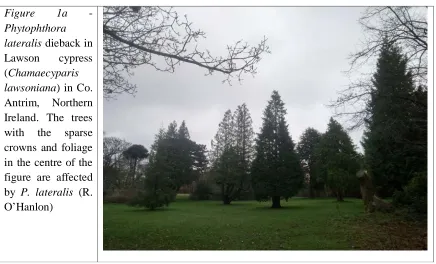
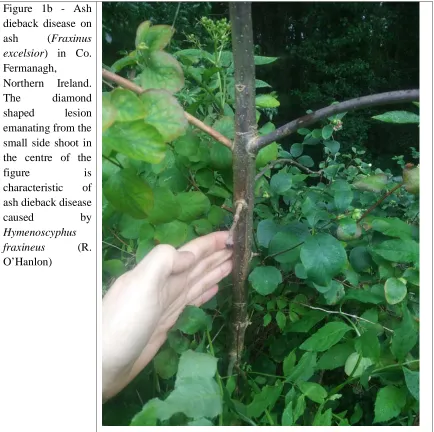
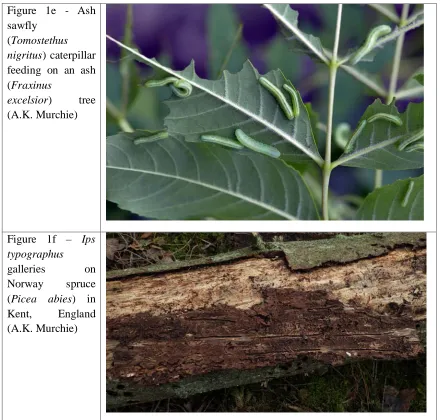
Ireland (McCracken 2013; O’Hanlon 2015)(Figure 1a,b,c,d,e,f). Many of the recently 75
3
al. and the eucalyptus psyllid Ctenarytaina eucalypti Maskell on plants for planting (Purvis et 77
al. 2002; O’Hanlon et al. 2016a). Plants for planting, and wood packaging material such as 78
pallets and crates are known pathways for introducing non-native pests worldwide (Kenis et 79
al. 2007; Brasier 2008; Humble 2010; Liebhold et al. 2012; Eyre et al. 2018), and thus are 80
regulated under plant health legislation. 81
82
Plant disease, phytosanitary measures and the international year of plant health 83
The United Nations General Assembly declared 2020 as the International Year of Plant 84
Health (IYPH; http://www.fao.org/plant-health-2020/home/en/). Governments and 85
organisations across the world have seized on the opportunity to raise global awareness on 86
how protecting plant health can help end hunger, reduce poverty, protect the environment, 87
and boost economic development. Plant diseases are caused by biotic and abiotic factors, and 88
in recent years the threat from plant diseases to global food security and environmental 89
sustainability had come to prominence (Boyd et al. 2013; MacLeod et al. 2016). Protection of 90
plant health worldwide is enshrined in the agreements of the International Plant Protection 91
Convention (IPPC; www.ippc.int). This convention aims to protect the world's plant 92
resources from the spread and introduction of pests, while also promoting safe trade. Within 93
the EU the measures to calculate and reduce the risk to plant health are contained in the EU 94
Plant Health Regulation (EU 2016/2031), which replaces the previous Plant Health Directive 95
(2000/29/EC). 96
There are three types of regulated pests in the EU Plant Health Regulation: (i) priority 97
pests, (ii) quarantine pests, and (iii) regulated non-quarantine pests (RNQP). There are 20 98
priority pests, and EU Member States (MS) must carry out annual surveys and monitoring to 99
ensure that these highly threatening pests are not present in their jurisdiction. For each of the 100
priority pests, MS have to put in place contingency plans and information/outreach activities 101
in order to prevent these pests establishing in their jurisdiction. Quarantine pests are those 102
whose presence would have an unacceptable economic, social or environmental impact 103
within the EU. These pests are made up of union quarantine pests (n=173) and protected zone 104
(PZ) pests (n=31). Member States are required to conduct one survey every five years for 105
each union quarantine pest, if that pest has the potential to establish in their jurisdiction. 106
Ireland and Northern Ireland enjoy PZ status for many harmful forest pests. A PZ is 107
essentially an area in the EU where a pest of quarantine significance, established in other 108
parts of the EU, is not present despite favourable conditions for it to establish. Annual 109
surveys for PZ pests must be conducted to prove freedom from the pest, in order to maintain 110
a PZ status. RNQP are those pests that are spread on plants for planting or planting material, 111
and can cause unacceptable yield or quality losses on those plants. 112
The EU plant health regulation is administered and implemented by the National Plant 113
Protection Organisations (NPPO), which in Ireland is the Department of Agriculture, Food 114
and the Marine (DAFM). In the UK, plant health is a devolved matter, with the Department 115
4
matters in Northern Ireland. DAERA work closely with the Department of the Environment, 117
Food and Rural Affairs, who act as the NPPO for the UK. The island of Ireland is treated as a 118
single epidemiological unit when it comes to matters of plant or animal health. Due to the 119
harmonised approach to plant health on the island (DAFM 2019a), and the EU Plant Health 120
Regulation, there are limited physical checks on plants or plant products moving between 121
Ireland and Northern Ireland, or vice-versa. However, with the new EU Plant Health 122
Regulation, conifer wood that is not bark-free needs to be accompanied by a plant passport 123
which provides assurance that the commodity has been inspected by the NPPO of the 124
exporting country and complies with the rules of the Plant Health Regulation. The UK plans 125
to leave the EU in 2020; however, at present the specific plant health rules that the UK will 126
implement are as of yet unclear and will be agreed during the transitional period (Spence 127
2020). 128
Developing a dataset of pest detections on the island of Ireland 129
The aim of this article is to provide a list of occurrences of pests of trees on the island of 130
Ireland. Despite having a strong history of plant pathology expertise (Muskett 1976; 131
Kavanagh and Brennan 1993), the island of Ireland has in recent years seen a reduction in the 132
number of practicing forest pathologists, mycologists and entomologists (Copeland and 133
Dowley 2010; Skilling and Batzer 1995; Battisti and Faccoli 2004; Dahlberg et al. 2009; 134
O’Hanlon 2016; O’Hanlon et al. 2016b). Data from the Tree CD project found that just 2% of 135
forest researchers’ time in Ireland was devoted to forest protection compared to 13, 17 and 136
11% in Austria, Switzerland and the UK, respectively (Bystriakova and Schuck 1999). This is 137
in line with similar recent declines in tree and forest health specialists in Britain (Jones and 138
Baker 2007; Anon 2013c) and more widely in Europe (EPPO 2004). The information and 139
results from years of work in the disciplines of forest pathology and entomology on the island 140
of Ireland is scattered across many sources, both published and unpublished. Collating this 141
type of historic data is important because it offers the opportunity to assess if trends are 142
evident in new pest invasions, or if climate change may be having an effect on the 143
distribution of pests (Jeger and Pautasso 2008). 144
This research provides a dataset containing a range of important details of pests 145
detected on the island of Ireland is presented here (Supplementary table 1). Pests in this 146
article and dataset are taken to include arthropods, fungi, oomycetes, and bacteria. Although 147
viruses and nematodes are also important pests of woody plants, the published knowledge on 148
the diseases of woody plants on the island of Ireland caused by these groups is particularly 149
scant (NBDC 2010). For example, in a published dataset of nematode abundances from 150
around the world, no data was available for nematodes of forest sites from the island of 151
Ireland (van Hoogen et al. 2020). A number of literature sources were examined for reports 152
of diseases of trees. Some reports of disease on other woody plants, though not generally 153
considered trees, were also included. Many pests that cause disease on woody shrubs can also 154
cause disease on trees, and therefore pose a risk to tree health. In this case a disease is any 155
damage or ill health, which may or may not have been caused by a pest. This literature 156
5
the Annual Reports of the respective Departments of Agriculture in Ireland, and Northern 158
Ireland; Table 1), and the private records of the authors and colleagues. A search of the 159
literature was conducted in Google scholar using the search terms “pathogen OR pest AND 160
forest OR tree AND Ireland”. The results were reviewed, and relevant literature examined. 161
The Trees of Great Britain and Ireland (Elwes and Henry 1906) were also searched for the 162
terms “pest”, “parasite”, “pathogen”, “insect”, “fungus”, and “disease”. 163
Along with developing the dataset for the island of Ireland, other sources were also 164
consulted to compare the detections of pests with those in Britain (i.e. England, Scotland and 165
Wales) and Europe. These sources provided information on pest detections, risk rating, and 166
native status for pathogens (Kloet and Hincks 1945; Moore 1959; Jones and Baker 2007; 167
Freer-Smith and Weber 2015; FRDBI 2020; CABI 2020a; DAERA 2020) and arthropod 168
pests (Browne 1968; BRC 2018; CABI 2020a) in Britain, and for pathogens (Santini et al. 169
2013) and arthropod pests (Day and Leather 1997) in Europe. Pests not found in either 170
Britain or the island of Ireland, but with a risk rating of over 80 on the Northern Ireland 171
health risk register (DAERA 2020) were also included. Information on a pests’ behaviour and 172
ecology in its native range is useful in designing control strategies for that pest in areas where 173
it has potential to invade (Webber et al. 2012). However, assigning native or non-native 174
status to pests, especially microbial pests is not straightforward (Regan et al. 2010; Jung et al. 175
2016), therefore this information should be taken as evidence of putative native status. 176
Synonyms were resolved for fungi by means of the Index Fungorum 177
(www.indexfungorum.org), and for arthropods using a number of websites (e.g. NBN atlas 178
2020). The taxonomic position of the pest was also listed from EPPO (2020a), along with the 179
binomial authority for the species. In cases where the year of first detection was not specified, 180
the date of the publication was taken as the date of the detection. There were many relevant 181
pest records reported in Browne (1968), which unfortunately does not assign a year of 182
detection. Therefore, the dataset reflects that many pests records were reported in 1968, 183
though this does not mean these pests were first recorded in 1968. The pest detections in 184
regular surveys and monitoring carried out in Ireland (by, or on behalf of the DAFM and its 185
precursor Departments) and Northern Ireland (by, or on behalf of the DAERA and its 186
precursor Departments) were split by year of publication, in order to provide a measure of a 187
pests’ frequency of occurrence. Where available, the host on which the pest was detected was 188
also noted. 189
The records of pest detections on the island of Ireland were scored on their reliability, 190
based on the guidelines given in ISPM 8 (FAO 2017). For reports published by the NPPO, or 191
in peer reviewed scientific journals within the last 20 years, a rank of 1 (the most reliable 192
source) was given. The European and Mediterranean Plant Protection Organisation (EPPO) 193
Reporting Service (EPPO 2020b) was the primary source for NPPO reports of pests, although 194
the official websites of the NPPO in Ireland also provided several pest reports. For reports 195
that were either an official historical record (>20 years old), or published in a non-peer 196
reviewed scientific journal or a technical journal, a rank of 2 was given. Rank 3 was 197
6
technical documents. Rank 4 (the least reliable source) was given to reports in non-technical 199
media (e.g. periodical, newspaper), or to personal communications or unpublished records. 200
Ranking the reliability of records is important to allow readers attach a degree of uncertainty 201
to any analysis that uses these records. The economic consequences of a pest presence in a 202
country can be significant, therefore great care should be taken in interpreting these reports. 203
Contact directly with the NPPO via their respective websites in Ireland 204
(https://www.agriculture.gov.ie/farmingsectors/planthealthtrade/) and Northern Ireland 205
(https://www.daera-ni.gov.uk/topics/plant-and-tree-health) is the most reliable way of finding 206
information about the official status of a pest in that jurisdiction. 207
Sources of notable pests of trees on the island of Ireland 208
There is speculative evidence from pollen core and tree ring radiocarbon dating of a pest 209
contributing to the decline of elm trees in Ireland and the UK around 5000 years ago (Parker 210
et al. 2002; Mitchell 2006). Following this, and up to the early 1900’s there were few records 211
found of tree pests, and these were scattered in periodicals such as Gardeners Chronicle and 212
its successor titles. Some of these reports were included in reviews of pests of plants and trees 213
in Ireland and the UK (Johnson and Halbert 1902; Massee 1913; Adams and Pethybridge 214
1910; Brooks 1928; McKay 1952; Muskett 1976; Moore 1959; Peace 1962; Browne 1968; 215
Muskett and Malone 1978, 1980a, 1980b, 1983, 1984, 1985; Phillips and Burdekin 1982; 216
Mangan 2008), while other records appeared sporadically in the more nationally important 217
journals Irish Naturalists Journal (previously known as Irish Naturalist) and Irish Forestry. 218
The first published reports from the government departments responsible for forest health 219
(the name of which changed several times; OCarroll and Joyce 2004) started in Ireland in 220
1933, and in Northern Ireland in 1952 (Table 1). These continued almost annually and are 221
considered here up until 2015, although the level of detail on the pests reported varies widely 222
across the years. The research reports from the horticulture, horticulture and forestry, plant 223
sciences and crop husbandry, and soils divisions of An Foras Taluntais (now known as 224
Teagasc) between 1962 and 2002 were also examined for information on pests of woody 225
plants. 226
Monitoring for forest pests during the period 1938 and 1956 was commissioned by 227
the Department of Agriculture Ireland and carried out by scientists from University College 228
Dublin (Anon 1938; 1943). Between 1986 and 2006 a European forest health monitoring 229
scheme known as the International Co-operative Programme (ICP) was established as part of 230
an EU wide programme to monitor forest condition in response to concerns over increasing 231
atmospheric pollution. These plots were established across Ireland, with results reported 232
sporadically (Keane et al 1989; McCarthy 1993; Ward and Keane 1993; Anon 2006a, 2007a, 233
2008a). Recording focussed on disease symptoms rather than causal organisms, limiting the 234
use of the data for the purposes of this pest list. There were no ICP plots were established in 235
Northern Ireland (Brown et al. 2019). The National Forest Inventory of Ireland recorded the 236
presence of forest damage in the assessment plots during its three previous cycles (Anon 237
2007, 2013, 2018). In the most recent inventory, 24% of the forests had obvious damage due 238
7
recording damage from pests was based on the presence of symptoms of the pests 240
Heterobasidion. annosum, Armillaria spp., Rhizina undulata Fr., H. fraxineus, P. ramorum, 241
Phytophthora alni Brasier & S.A. Kirk, Dothistroma sp., Hylobius abietis (L.), Elatobium 242
abietinum (Walker), Rhyacionia buoliana (Denis & Schiffermüller). 243
244 245
8 Figure 1b - Ash
dieback disease on ash (Fraxinus excelsior) in Co. Fermanagh,
Northern Ireland. The diamond shaped lesion emanating from the small side shoot in the centre of the
figure is characteristic of
ash dieback disease
caused by Hymenoscyphus
9 Figure 1c - Aerial
view of roadside Sitka spruce (Picea sitchensis) damage caused by green spruce aphid (Elatobium
abietinum) in Co. Antrim, Northern Ireland. The grey coniferous trees in the centre of the figure are diseased due to E. abietinum (DAERA)
Figure 1d – Heterobasidion
10 Figure 1e - Ash
sawfly (Tomostethus nigritus) caterpillar feeding on an ash (Fraxinus
excelsior) tree (A.K. Murchie)
Figure 1f – Ips typographus
galleries on Norway spruce (Picea abies) in Kent, England (A.K. Murchie)
Figure 1, a, b, c, d, e, f. Symptoms of pests and pathogens of woody plants and trees recorded 246
on the island of Ireland 247
There have been several initiatives nationally and internationally to increase plant 248
health expertise and knowledge sharing previously. The Society of Irish Plant Pathologists 249
(SIPP) was founded in 1968, and organised seminars on plant health almost every year since 250
its inception. Reports of forest pathology activities can be found in several of SIPPs 251
newsletters, including details of the involvement of SIPP members in the informal Forest 252
Pathology group, which included experts from Ireland and the UK, which met regularly from 253
1960 to 1996 (SIPP 1970, 1975, 1982, 1987), even hosting a joint meeting with members of 254
the British Mycological Society in 1969 (SIPP 1970). In an attempt to build a forest health 255
resource for future research and diagnostics, a herbarium for forest disease and mycorrhizal 256
fungi was set up in 1981 (Forest and Wildlife Service 1982). This herbarium was maintained 257
11
included the development of an All-island Plant Health and Research Strategy in 2005 (Anon 259
2006a), and the All Ireland Chalara Control Strategy in 2013 (Anon 2013a). 260
261
Table 1 Details of the annual plant health survey information published by the responsible 262
government department in Ireland and Northern Ireland and included in this review. The data 263
from these reports is included in the dataset (Supplementary table 1). 264
Region Years Reference
Ireland 1933-1975 Report of the Minister for Lands on Forestry
1971-1985 Forest and Wildlife Service reports
1986-1988 Forest Service reports
1991-2011 DAFF annual report
2012-2015 DAFM annual report
Northern Ireland 1952-1967 Record of agricultural research
1963-1969 Annual progress report on research and technical work 1963 Ministry of Agriculture NI
1970-1987 Annual report NI
1995-2017 AFBI records 265
266
The dataset of pest of trees on the island of Ireland 267
A total of 396 pests were recorded on trees on the island of Ireland. Also included in the 268
dataset are 49 cases from the island of Ireland where the pest could not be identified, and are 269
indicated in the dataset by “?” preceding the name. A further 57 pests are also included in the 270
dataset, which have not been detected on the island of Ireland, but are judged to be of high 271
risk to the health trees on the island of Ireland if they have been recorded in Britain, or have a 272
risk rating of 80 or above on the Northern Ireland Plant Pest Risk Register. There is evidence 273
that 45 of the pests recorded on the island of Ireland are potentially native, with a further 129 274
of the pests being native to at least some parts of Europe. The literature suggests that 12 pests 275
are non-native to the island of Ireland, while 31 are non-native to Europe. A further 12 276
species have a cryptic biology and so their native status is not easy to conclude. No 277
information could be found on the native status of the remaining 216 pests. A total of 294 of 278
12
frequently recorded (i.e. more than 20 pests associated with them) were Larix, Populus, 280
Quercus, Alnus, Betula, Picea, Pinus and Salix. Of the 396 pests detected in Ireland, 378 281
have a reliability rating of 1 or 2, indicating a high degree of certainty in their detection. 282
A total of 33 of the pests listed in the dataset are regulated under the EU plant health 283
regulation, of which 23 have been recorded on the island of Ireland, with 5 of these as 284
interceptions at ports and 12 being RNQP. None of the priority pests have ever been recorded 285
on the island of Ireland. Of the 123 pathogens listed as threatening to forests in Europe 286
(Santini et al. 2013), 41 have been recorded in Ireland. A total of 63 of the 99 pests listed by 287
Day and Leather (1997) as major forest pests in Europe have been recorded on the island of 288
Ireland. 289
The 396 recorded pests included 11 bacteria, 20 oomycetes, 150 fungi and 215 290
arthropods. It is likely that all of these groups have been under-recorded, given the lack of 291
experts in certain groups of pests including insects and bacteria (NBDC 2010; Regan et al. 292
2010), fungi (Dahlberg et al. 2009; O’Hanlon and Harrington 2011; O’Hanlon 2016) and 293
oomycetes (O’Hanlon et al. 2016b). Between 1970 and 2004, Jones and Baker (2007) 294
examined records from several sectors (including horticulture, agriculture and forestry) and 295
recorded 234 pathogens in Britain, while only 42 were recorded during the same period on 296
the island of Ireland. It is also likely that the number of microbial (bacteria, fungal and 297
oomycete) pests are under-recorded because of inherent difficulties in detecting and 298
identifying these pests (Brasier 2008; Morales et al. 2019), and their ability to infect plants 299
asymptomatically (e.g. Migliorini et al. 2015). Recent studies by O’Hanlon et al. (2016a) and 300
McEvoy et al. (2016) used molecular analysis to identify 13 new records of plant pathogenic 301
microorganisms for Ireland. Similarly, analysis of P. sitchensis needle endophytes in four 302
sites in Scotland identified 13 taxa of fungi (Stewart et al. 2018), of which none have been 303
recorded from conifers on the island of Ireland. This lack of understanding of the fungal and 304
bacterial communities of plants in Ireland is worrying as these are some of the most 305
threatening pests to tree and plant health globally (Wingfield et al. 2001; Crous et al. 2016). 306
The Irish forest estate was relatively free from serious diseases cause by pests during 307
the 20th century, as evidenced by the low number of publications dealing with plant health in 308
the primary technical journal for Irish foresters, Irish forestry (Quirke 1946; Clear 1951; 309
McKay and Clear 1953, 1957; de Brit 1967; McAree 1975, 1987; de Brit and McAree 1977; 310
Keane 1986). Indeed, several other sources highlight the relatively low impact of disease in 311
Irish forests during the 20th century (Anon 1920; Quirke 1946; McCarthy 1993). In recent 312
years, pest reports have continued to increase at a relatively steady rate (Fig. 2). This is in line 313
with records of new non-native pathogens (Jones and Baker 2007) and arthropod pests (Smith 314
et al. 2007) in Britain. The large spike (71 new arthropod pests) in records in the year 1968 315
(Fig 2) in the dataset is due to the publication of a large number of reports in Browne (1968). 316
As the Browne (1968) did not give the source of the records, the date of publication of the 317
book (i.e. 1968) is used as the first report. During the five decades starting in the 1970s, the 318
13 320
321
Figure 2 Species accumulation curve for the pests (including pathogens) reported from trees 322
on the island of Ireland. 323
324
Important diseases caused by native pests 325
Native plants develop mechanisms to reduce the amount of disease from native pests through 326
co-evolution. However, in certain circumstances native pests gain an advantage over native 327
plants, allowing them to cause more disease than normal. Several examples of this are 328
reviewed in Riggins and Londo (2009), including an increased amount of damage caused by 329
the oak pinhole borer, Platypus cylindrus (Fabricius) in Britain following several years of 330
favourable breeding conditions for the pest. Diseases caused by native pests on non-native 331
hosts are probably more threatening, as there is probably a lack of co-evolution in the host 332
(Wingfield et al. 2010). Liebhold (2012) identified non-native forest plantations as high risk 333
and prone to catastrophic damage from both native and non-native pests. More than 60% of 334
the forest estate in Ireland is composed of two non-native tree species (P. sitchensis and P. 335
contorta), therefore pests pose a major threat to the Irish forest industry. Species 336
diversification and the use of alternative silvicultural systems (e.g. uneven aged silviculture) 337
have been identified as ways to buffer against large scale pest epidemics in forests (Ennos 338
2015; Jactel et al. 2017; Roberts et al. 2020). 339
The dataset contains reports of 77 native pests associated with native genera of trees 340
and woody plants, and 51 native pests associated with non-native genera of trees and woody 341
14
Quirke (1946) noted the fungi Armillaria mellea (Vahl) P. Kumm. to be damaging to various 343
native broadleaf trees, and Neonectria ditissima (Tul. & C. Tul.) Samuels & Rossman 344
causing disease on native Betula and Fraxinus. Large native bracket forming fungi such as 345
Ganoderma, Inonotus and Porodaedalea (previously Phellinus) are probably a factor in the 346
death of many mature native trees, however they are generally known as secondary or 347
destabilising pathogens and are not suited to causing large epidemics in native trees (Hansen 348
and Goheen 2000). Disease caused by native pests on non-native trees are more frequently 349
reported. Damage caused by the gall adelgid (Adelges cooleyi [Gillette]) in 1930s and 1940s 350
led to Douglas fir (Pseudotsuga menzeisii [Mirbel] Franco) falling out of favour with many 351
Irish foresters (Clear 1951). The pest R. buoliana has been an issue for Irish forestry for many 352
years. Regular surveys were carried out, using pheromones traps in Northern Ireland in the 353
early 1980’s (Anon 1982a, 1983a). 354
Group dying of conifers (especially P. sitchensis) caused by Rhizina undulata 355
(Schaeff.) Sacc. was first noted (under the synonym Rhizina inflata) in Ireland in 1952 356
(McKay and Clear 1953, 1955), after similar reports in Britain in 1936 (Murray 1953). The 357
pathogen that causes the disease was noted to fruit prolifically on fire sites, and restrictions 358
on burning fires in forest sites has led to the disease being controlled (Joyce and OCarroll 359
2002). Quirke (1946) listed several pests of importance to Irish forestry, including pests of 360
broadleaves (N. ditissima, and Prays fraxinella Bjerkander) and conifers (R. buoliana, E. 361
abietinum, A. mellea, and H. annosum). The fungus H. annosum causes annosus root disease 362
in many trees, and is listed as the most significant pathogen for forestry in Ireland (Joyce and 363
OCarroll 2002). Records of this fungus go back as far as 1836, while records of A. mellea go 364
to back 1843 (Muskett and Malone 1980), indicating that both are probably native. Reviews 365
by de Brit (1968), McAree (1975) and de Brit and McAree (1977) discussed several of these 366
pathogens and their significance on the island of Ireland. These pests have also affected 367
forestry practices on the island of Ireland, with the forest service in Northern Ireland stopping 368
the use of chemical thinning in coniferous forests over concerns that this encouraged H. 369
annosum (Anon 1992). 370
Ever since the establishment of plantation forestry in Europe, the large pine weevil 371
(Hylobius abietis L.) has been a major pest (Munro, 1927). In newly clear-felled stands adult 372
female weevils are attracted by the volatiles and oviposit just under the bark of the stumps. 373
Weevil larvae subsequently develop in the protected environment under the bark for one to 374
three years depending on temperature (Leather et al., 1999; Inward et al., 2012). Following 375
emergence, adults feed on the bark of young trees and replanted sites can suffer up to 100% 376
mortality of newly planted trees if no control measures are taken. Pine weevil was estimated 377
to cost the UK economy £2 million per annum (Weslien 1998; Leather et al. 1999). Current 378
control measures include the synthetic chemicals alpha cypermethrin or cypermethrin, which 379
are administered in nursery pre-treatment either via electrodyne application or dipping of 380
young trees prior to planting and/or through on-site post-planting spray. However, with 381
concerns over potential environmental impacts, cypermethrin is being phased out across 382
15
cypermethrin and cypermethrin are considered “highly hazardous chemicals” applied only 384
under derogation, so there is an obligation on FSC certified companies to find alternatives to 385
chemical control. Furthermore, current pesticides have a repellent effect on the pine weevil 386
and, while this protects young plants, it does little to impact on the local populations of the 387
pest (Torr et al., 2005; Leather et al. 1999). 388
In Ireland there has been much work on the use of biological control agents to help 389
mitigate the pine weevil problem. There have been many studies assessing the efficacy of 390
entomopathogenic nematodes (EPN) in the control of pine weevil (Brixey et al., 2006; Dillon 391
et al., 2006; Dillon et al., 2007; Dillon et al., 2008; Torr et al., 2007). Williams et al. (2013a) 392
in a meta-analaysis of EPN efficacy found, for two EPN species, Steinernema carpocapsae 393
(Weiser) and Heterorhabditis downesi Stock, Griffin & Burnell, that efficacy was greater on 394
sites with a peaty substrate than sites with a mineral substrate. The species of the tree stump 395
did not affect efficacy and there was no density-dependence. A more recent study by 396
Kapranas et al. (2017) found site specific differences were more important than substrate type 397
per se. More recently there has been a focus on entomopathogenic fungi (EPF) with 398
Beauveria bassiana (Bals.-Criv.) Vuill., Metarhzium anisopliae (Metchnikoff) Sorokin and 399
Beauveria caledonica Bissett & Widden being used in combination with EPNs (Williams et 400
al, 2013b and McNamara et al., 2018). 401
402
Important diseases caused by non-native pests 403
The first reported outbreak in the dataset of a non-native pest of trees in Ireland was that of 404
Dutch elm disease. This disease is caused by fungi from the genus Ophiostoma (namely 405
Ophiostoma ulmi (Buisman) Melin & Nannf., and Ophiostoma novo-ulmi Brasier) which are 406
vectored by the bark beetle of the genus Scolytus. The first outbreak in Ireland was caused by 407
the less pathogenic O. ulmi in 1958 (Mangan and Walsh 1980), after a similar outbreak in 408
Britain in 1927 (Moore 1959). Following further reports of widespread elm decline in Britain 409
in the late 1960’s, the more aggressive pathogen Ophiostoma novo-ulmi Brasier was detected 410
in Britain in 1965 (Potter et al. 2011) and in Ireland in 1977 (Walsh and Mangan 1977). The 411
pathogen was recorded as causing large amounts of mortality to Ulmus in Northern Ireland 412
throughout the 1970s. The vectors of O. ulmi and O. novo-ulmi on the island of Ireland are 413
the non-native elm bark beetles (Scolytus multistriatus Marsham and Scolytus scolytus 414
[Fabricius]), which were first reported in Ireland in 1980 and 1943, respectively (O'Callaghan 415
1982; Quirke, 1943). 416
The link between pest findings in Britain and Ireland has been indicated previously 417
(O’Hanlon 2015; O’Hanlon et al. 2016b). The pests Blumeriella jaapii, Pulvinaria regalis, O. 418
novo-ulmi, Seiridium cardinal, Kabatina juniper, Chondroplea populea, Cinara kochiana, 419
Gymnosporangium asiaticum, Cinara cupressi, Cylindrocladium buxicola, Pseudomonas 420
syringae pv. aesculi, Cameraria ohridella, P. ramorum, Phytophthora kernoviae, 421
Phytophthora lateralis, and Hymenoscyphus fraxineus are all non-native pests that 422
16
The average delay in these pests being recorded on the island of Ireland after their detection 424
in Britain is 10 years. Pests that have established in Britain pose a higher risk to plant health 425
on the island of Ireland due to the similar conditions (suitable environment, similar hosts), 426
close geographic proximity, and the high amounts of movement of consignments and 427
travellers between the two regions. In 2018 an estimated 30,000 tonnes of conifer roundwood 428
from Scotland was moved into Northern Ireland for processing (Smith 2019). 429
The fungus that causes larch canker (Lachnellula willkommii [Hartig] Dennis) has 430
been noted as native to parts of Europe (Yde Anderson 1979; Santini et al. 2013), and was 431
first recorded in Ireland in 1840 (Muskett and Malone 1983), having been recorded in Britain 432
since 1800 (Oppermann 1923 as cited in Yde Anderson 1979). Lachnellula willkommii is 433
specific to Larix and Pseudolarix (Yde Anderson 1979; CABI 2020a; FRDBI 2020). During 434
the 1970s and 80s investigations into Pinus controta shoot dieback identified a causal 435
relationship with the fungal pathogens Sydowia polyspora (Bref. & Tavel) E. Müll. (syn. 436
Sclerophoma pithyophilla V. Hohn.) and Ramichloridium pini de Hoog & Rhaman. Further 437
testing and assessments during the 1980s confirmed Ramichloridium pini was the main cause 438
of the shoot dieback of lodgepole pine (Anon 1986b). Whether S. polyspora and R. pini are 439
native or not is unclear. Santini et al. (2013) noted that the cryptic lifestyle of R. pini made it 440
difficult to say if it was native to Europe. Sydowia polyspora has been detected on healthy 441
pine plants and seeds in the USA (Ridout and Newcombe 2018), possibly identifying the 442
trade in seed as a pathway for this pathogen into Ireland, if the pathogen is non-native. 443
The next major outbreak of a non-native pest of trees and woody plants was that of 444
the bacteria Erwinia amylovora (Burrill) Winslow et al. in 1986 (Hume and Conway 1993), 445
which causes a disease of woody plants called fireblight. The pest had previously been 446
detected in Northern Ireland on plants (Stranvaesia sp. and Crataegus sp.) imported from the 447
Netherlands in 1985 (Anon 1985a). This outbreak led to a strict eradication programme being 448
instigated, with a Fireblight prevention programme launched in 1986 (Anon 1990). In 1992, 449
both Ireland and Northern Ireland were granted PZ status for E. amylovora, with Northern 450
Ireland relinquishing this in 2016 in favour of restricted buffer zone status due to the 451
increased spread of the pest in the wider environment (DAERA 2016). Most of Ireland, 452
except Galway city, retains a PZ for E. amylovora to mid-2020. Efforts to eradicate the pest 453
in the Galway city area between 2005 and 2013 were not successful. The pest is also 454
regulated by the NPPO as an RNQP pest under the EU plant health regulation. Genotypic 455
analysis of the E. amylovora isolates detected in Ireland showed no clear genetic structuring 456
in relation to host or location (Brennan et al. 2002), possibly indicating that multiple 457
genotypes had been introduced into Ireland. Indeed, E. amylovora infected plants have been 458
intercepted at the Irish border on several occasions (EUROPHYT 2016). 459
McAree and MacKenzie (1993) listed eight forest pests (Bupalus piniaria [L.], 460
Cephalcia lariciphila Wachtl, Dendroctonus micans (Kugelann), Gilpinia hercyniae (Htg.), 461
Ips cembrae (Heer), Ips sexdentatus (Börner), Pristiphora abietina (Christ), and G. abietina 462
(Lagerberg) Morelet) that were present in Britain, but absent from the island of Ireland. The 463
17
Ireland. Gremmeniella abietina is a threat to several coniferous trees, especially Pinus (Jeger 465
et al. 2017a), and up until recently, both Ireland and Northern Ireland have PZ for G. 466
abietina. This history of detections of G. abietina in Northern Ireland provides a useful 467
insight into the process for official detections of plant health pests. Official detections of 468
pests should follow international legislation, and should work according to international or 469
regional guidance. For many regulated pests, official diagnostic standards exist, either 470
published by international (i.e. International Standards for Phytosanitary Measures, ISPM; 471
FAO 2020) or regional (EPPO) organisations. For G. abietina, the EPPO standard (EPPO 472
2009) relies on morphological detection of the pest, and although molecular identification 473
methods did exist when the standard was agreed, these were not deemed suitable due to 474
confusion over the taxonomy of the pest. In 2008 in Northern Ireland, samples from three 475
sites indicated the present of the pest using a nested PCR method (Zeng et al. 2005), however 476
no morphological structures of the fungus were observed. In 2009, DNA sequencing of 477
extracts of fungal DNA from symptomatic Pinus samples indicated a match to the type 478
culture of G. abietina. The records in 2008 and 2009 did not satisfy the EPPO standard and 479
so were not officially recognised. Apothecia (i.e. fruiting structures) of the pathogen were 480
first visually observed on Pinus in Northern Ireland in the 2012, and hence count as the first 481
valid official record of the pest. Isolation of the fungus into pure culture, which is another 482
acceptable identification method, was achieved in Northern Ireland in 2015. These findings 483
of G. abietina in Northern Ireland have led to removal of the PZ in that jurisdiction, while the 484
pest has not been confirmed in Ireland and the PZ status is maintained. Findings of the needle 485
blight pathogen Lecanosticta acicola (now listed as an RNQP under the Plant Health 486
Regulation 2016/2031) in Ireland (Mullett et al. 2018) in recent years warrant further surveys 487
to delimit the distribution of this pest on the island of Ireland. The case of G. abietina, L. 488
acicola and P. kernoviae represent detections of pathogens in one jurisdiction, but not in the 489
other. Indeed, the case of the distribution of the lineages of P. ramorum on the island of 490
Ireland is another example of a clear difference between Ireland and Northern Ireland. In 491
Ireland, only the EU1 lineage has been detected, while in Northern Ireland both the EU1 and 492
EU2 lineages have been detected, though the EU1 has never been detected in the wider 493
environment (O’Hanlon et al. 2016b). Both Ireland and Northern Ireland have 14 PZ in place 494
for pests of woody plants and trees in Ireland, with most common to both jurisdictions (Table 495
2). It is planned to apply for PZ for Thaumetopoea pityocampa (pine processionary moth) for 496
Ireland in the near future, and surveys are currently being compiled to demonstrate its 497
absence from the jurisdiction. 498
499
Table 2 Protected zone status of pests of woody plants and trees in Ireland and Northern 500
Ireland as per Commission Implementing Regulation (EU) 2019/2072 501
502
18
Erwinia amylovora Yes
Xanthomonas arboricola pv. pruni Yes
Cryphonectria parasitica Yes Yes
Entoleuca mammata Yes Yes
Gremmeniella abietina Yes
Cephalcia lariciphila Yes Yes
Dendroctonus micans Yes Yes
Dryocosmus kuriphilus Yes Yes
Gilpinia hercyniae Yes Yes
Ips amitinus Yes Yes
Ips cembrae Yes Yes
Ips duplicatus Yes Yes
Ips sexdentatus Yes Yes
Ips typographus Yes Yes
Thaumetopoea pityocampa Yes
Thaumetopoea processionea Yes Yes
503
Since the beginning of the 21st century, there have been a number of pest epidemics of 504
trees and forestry. One particular group of plant pathogens, the genus Phytophthora, is a 505
serious risk to plant health globally (Martin et al. 2012; Jung et al. 2018), and have been 506
reasonably well studied in agricultural settings on the island of Ireland (O’Hanlon et al. 507
2016b). The outbreak of P. ramorum in 2002 initially started as a pest of the horticulture and 508
ornamental plant industries (EPPO 2020b), which was followed by findings in wild invasive 509
rhododendron in forests. The pathogen became a major threat to the forest estate in 2010 510
when found causing disease on Japanese larch (Larix kaempferi) (EPPO 2020b). Since the 511
original detection on imported Rhododendron spp. and Viburnum spp. in Ireland in 2002 512
(EPPO 2020b), the pest has caused disease on 30 different hosts in both horticultural and 513
forest environments (O’Hanlon et al. 2016a). The introduction of P. ramorum was followed 514
by the detection of other non-native Phytophthora species, including Phytophthora kernoviae 515
Brasier in 2008 (not detected in Northern Ireland) and P. lateralis Tucker & Milbrath in 2011 516
19
pseudosyringae has also been found in the last decade in the course of DAFM official 518
surveys. This pathogen is also damaging to Nothofagus species in the UK (Scanu et al. 2012). 519
The pathogen Phytophthora cinnamomi is one of the 10 most threatening oomycetes globally 520
(Kamoun et al. 2014), but has only been causing minor issues to woody plants and trees on 521
the island of Ireland, mainly in the plant nursery industry (Anon 1969a; Anon 1975a; 522
Shafizadeh and Kavanagh 2005). Phytophthora disease of alder (caused by several different 523
Phytophthora species) is causing many issues across Europe (Bjelke et al. 2016), and this was 524
confirmed in Ireland in 2001 (Clancy and Hamilton 2001), while evidence of the disease was 525
noted as far back as 1995 (McCracken 1996). In 2019, alder disease caused by Phytophthora 526
plurivora was recorded along the river Lagan in Belfast, Northern Ireland (O’Hanlon et al. 527
2019). It is likely that there a many Phytophthora species present but yet to be recorded, as 528
O’Hanlon et al. (2016b) suggested that based on the species richness in Britain, at least 11 529
more species of Phytophthora are potentially to be discovered on the island of Ireland. 530
More recently, the ash dieback fungal pathogen Hymenoscyphus fraxineus (T. 531
Kowalski) Baral, Queloz & Hosoya has spread across Europe from Poland in the 1990’s 532
(Gross et al. 2014) finally being confirmed in Ireland and Northern Ireland in 2012 (EPPO 533
2020b; DAERA 2017). Notable attempts to eradicate the pest from the island of Ireland were 534
made early in the invasion, with clear efforts at cooperation established via the All Ireland 535
Chalara control strategy (Anon 2013a). The disease causes dieback of European ash 536
(Fraxinus excelsior) and is now recorded in every county in Northern Ireland and Ireland 537
(DAERA 2017; Ryan 2018). The economic value (over 13,000 ha of ash were grant aided by 538
government in Ireland between 1992 and 2012; McCracken et al. 2017) and ecosystem 539
services (there are more than 2.9 million ash trees in Northern Irish hedgerows; Spaans et al. 540
2019) provided by ash trees on the island of Ireland are now under serious threat from by H. 541
fraxineus. As well as the large economic losses incurred because of ash dieback (Hill et al. 542
2019), the disease also threatens biodiversity associated with ash trees (e.g. over 1000 species 543
thought to be associated with ash trees in the UK; Mitchell et al. 2014). Ash dieback disease 544
causes high levels of mortality in European ash in forests (Gross et al. 2014), though recent 545
evidence suggests that survival of solitary trees and those isolated from other ash trees may 546
be better than previously expected (Grosdidier et al. 2020). 547
Another recent non-native pest (though only locally important) on trees has been the 548
outbreak of horse chestnut leaf miner Cameraria ohridella Deschka & Dimić on horse 549
chestnut (Aesculus hippocastanum L.) in Dublin in 2013 (Moths Ireland 2020). Symptoms of 550
the pest have now been reported from several counties along the east of Ireland and Northern 551
Ireland. The damage due to C. ohridella, combined with other present threats to horse 552
chestnut, namely bacterial canker of horse chestnut (Pseudomonas syringae aesculi) and 553
Guignardia leaf blotch (Guignardia aesculi), mean that the health of horse chestnut is under 554
increasing threat. Horse chestnut is a commonly planted tree in urban environments, with 684 555
present within the Belfast city area, or which 171 are in poor health. The ash sawfly 556
20
2017), and led to defoliation of hundreds of trees in 2017 in south Belfast (Ian Rea 558
unpublished data). 559
560
Pest interceptions at borders 561
The two most recognised pathways for introduction of exotic plant pests are (i) wood 562
packaging material (Eyre et al. 2018; Meurisse et al. 2019 and (ii) plants for planting 563
(Liebhold et al. 2012). Although phytosanitary treatments are in place for both of these 564
pathways, there are a number of examples where pests have been transported on commodities 565
despite controls. Haack (2006) reviewed 25 new beetle (Coleoptera) pest records in the USA 566
and found that most were associated with wood packaging material. Similarly, Brockerhoff et 567
al. (2006) examined interception data from the USA and New Zealand and found that 82% of 568
the most frequently intercepted pests have become established as invasive plant pests 569
worldwide. Inward (2019) highlighted potential shortcomings in debarking of roundwood as 570
an effective treatment for regulation of plant pest ambrosia beetles, and concluded that 571
appropriate heat treatment, fumigation or irradiation are more effective measures than 572
debarking alone. 573
It is the remit of the NPPO of each country to survey for and apply controls for 574
quarantine organisms. These pests are usually identified using a risk based approach, such as 575
using the Northern Irish Plant Health Risk Register (DAERA 2020) in Northern Ireland. 576
Commodities imported into the EU that are found to have harmful pests present are reported 577
to the EU and the country of export via the Europhyt reporting system (EUROPHYT 2016). 578
Europhyt is the database of consignments received by the EU MS that violate any of the EU’s 579
plant health requirements. Northern Ireland reports of pests are included in the overall UK 580
reports. Based on the Europhyt data between the dates February 2006 and November 2016, 581
inspections of imports into the UK and Ireland intercepted numerous pests including the 582
following that are known tree pests: Anoplophora chinensis (Forster) (in 2006, 2007, 2008, 583
2010), Anoplophora glabripennis (Motschulsky) (2016), H. fraxineus (2012), Ips 584
typographus (L.) (2009), Oemona hirta Fabricius (2010), Opogona sacchari (Bojer) (2010), 585
Monochamus alternatus Hope (2013, 2015), Phytophthora ramorum (2006-2016), and 586
Thaumetopoea processionea (L.) (2016)(EUROPHYT 2016). Anoplophora chinensis was 587
also intercepted in Britain in 2005 (EPPO 2020b). There are potentially many more pests 588
going undetected, as a recent analysis by Eyre et al. (2018) indicated that the surveillance 589
systems in place in most EU countries are not sufficient to detect all of the potential pests on 590
wood packaging material. Brockerhoff et al. (2003) also highlight the threat of wood and 591
wood packaging material for transferring pests, listing 1468 records of interceptions of at 592
least 98 plant pest beetles into New Zealand between 1952 and 2000. While it would be 593
extremely difficult to inspect all wood packaging imported, in recent years an EU-wide 594
monitoring programme has focussed on wood packaging associated with imports of high risk 595
21
new EU plant health regulation MS are required to implement a risk-based surveillance 597
regime on wood packaging imports. 598
Ashe et al. (2002) published findings of beetles imported into Ireland on commodities 599
from China, finding M. alternatus and Cryptorhynchus rufescens Roelofs. The former is very 600
threatening due to its ability to vector the Pine wood nematode Bursaphelenchus xylophilus 601
(Steiner & Buhrer) Nickle, currently causing a large epidemic in Portugal and Spain (Futai 602
2013). There is no evidence to indicate that Monochamus spp. are native to the island of 603
Ireland, though Kloet and Hincks (1945) judged Monochamus sutor to be at least native to 604
parts of Europe. Interestingly, one adult of M. sutor was detected in a furniture shop in 605
Northern Ireland in 2017, presumably emerging as an adult having pupated for several years 606
inside a wooden piece of imported furniture (A.K. Murchie unpublished data). Further 607
detections of arthropods pests present on imported wood and wood packaging into Ireland 608
included Dendroctonus rufipennis Kirby, Dryocoetes affaber (Mannerheim), Ips acuminatus 609
(Gyllenhal) and Ips typographus as part of the ‘Insects imported into Ireland’ series of 610
articles (O’Connor and Nash 1979, 1982, 1983). There is no evidence that any of the latter 611
insect pests have become established in Ireland or Northern Ireland. O’Connor et al. (1991) 612
identified insect pests (specifically Scolytids) that had been found in Britain but which were 613
not yet known from Ireland. These included Dendroctonus micans, Ips amitinus (Eichhoff), 614
Ips cembrae and Ips sexdentatus. These pests are the subject of longstanding annual PZ 615
surveys and are not present on the island of Ireland. Furthermore, phytosanitary checks and 616
monitoring are carried out on imports of unprocessed conifer wood (a high risk for 617
transporting bark beetles) from Scotland. These imports are only allowed if the wood has 618
come from an officially designated area that has been surveyed by the NPPO there and shown 619
to be free from the pest D. micans. However, it is likely that, great spruce bark beetle, D. 620
micans, is the most imminent insect pest threat to Northern Irish forestry since it is present in 621
Dumfries and Galloway, approximately 70 km from Northern Ireland, and is expanding its 622
range in Scotland (Jeger et al. 2017b; Forest Commission Scotland 2019). To counter this, a 623
contingency plan is currently being drawn up by DAERA. In addition to plant health 624
biosecurity measures, the contingency plan also considers the release of the predatory beetle 625
Rhizofagus grandis Gyllenhal, which has been used successfully to control D. micans in 626
Great Britain (Fielding and Evans 1997; Jeger et al. 2017b). 627
628
To prevent the establishment of high risk pests, early detection and eradication is 629
vital. There have been two major eradication campaigns against insect pests in England in the 630
last 10 years, the first was the Asian longhorn beetle (Anoplophora glabripennis) in 2012, 631
and the second Ips typographus in 2018. The eradication operation for the A. glabripennis 632
was recently concluded in England (Anon 2019a), successfully eradicating the outbreak in 633
2019 (EPPO 2020b). Detailed research at the site has indicated that the beetle (or beetles) 634
probably arrived at the site around 2000, and from there colonised the surrounding trees. In 635
total, the cost of monitoring and eradication actions for A. glabripennis was estimated at £2 636
22
Acer plants for planting (EPPO 2020b) and wood packaging material from China (EPPO 638
2020b). This pest was first found in Europe in 2001, after which it has since been detected in 639
10 EU countries. Genetic testing of the European populations indicates that there were most 640
likely several introductions of this pest into Europe, probably originally on wood and/or 641
wood packaging material before moving within Europe by similar pathways (Javal et al. 642
2019). The related Citrus longhorn beetle Anoplophora chinensis has never been intercepted 643
on the island of Ireland, but there have been several interceptions in England. This pest has 644
also been discovered causing infestations in several countries in Europe, notably on 36 645
occasions in Italy (Hérard and Maspero 2019). 646
A population of the eight-toothed spruce bark beetle Ips typographus, a PZ quarantine 647
pest, was discovered in Kent, England in November 2018. A demarcated area was set up and 648
intensive monitoring and eradication actions are ongoing (Forestry Commission 2019). This 649
being the first established population of I. typographus in the British Isles, it represents an 650
increased threat from this damaging pest to spruce forests on the island of Ireland and has 651
prompted increased risk-based surveys and monitoring to bolster existing surveys for the 652
beetle. Considered as the most damaging insect pest of spruce, I. typographus has a 653
widespread distribution throughout continental Europe and northern Asia. The summers of 654
2018 and 2019 were hot and dry, which stressed trees and led to I. typographus outbreaks 655
across much of the spruce-growing parts of Europe (Jonsson 2020), with for example, the 656
Czech Republic seeing an increase in salvaged timber from bark beetle outbreaks from 5.3 657
million m3 in 2017 to 18 million in 2018 (Hlásny et al. 2019). Although not conclusive, it is 658
thought that the incursion into Kent was from windborne migratory beetle flight and may 659
have occurred several years earlier, with beetle populations only becoming detectable 660
following a second generation during the hot summer of 2018 (Forest Research, pers. 661
comm.). For the island of Ireland, importation of timber and bark remain the most likely 662
pathway for introduction of I. typographus. In February 2004, 9,000 m3 of wood bark from 663
Estonia were detained at Belfast port following a routine examination for quarantine pests. 664
Despite having the necessary documentation showing with evidence of fumigation by methyl 665
bromide, living invertebrates (larval Diptera, Coleoptera, mites and rhabditid nematodes) 666
were found, along with galleries typical of I. typographus. The consignment was reloaded 667
onto the ship and fumigated at sea, at a cost exceeding €170,000. Subsequently, two live 668
adult I. typographus were reared from incubated bark samples (S. Clawson, pers. comm.). 669
670
While wood and wood packaging material is known as the main vector for insect 671
pests (Humble 2010), plants for planting is the commodity most often associated with the 672
transfer of non-native plant pathogens (Jones and Baker 2007; Liebhold et al. 2012). 673
Migliorini et al. (2015) tested plants from 2 large nurseries in Italy and found that 70% of the 674
asymptomatic plants contained a plant pathogenic Phytophthora species. The records from 675
the island of Ireland for harmful pathogens being intercepted during border inspections are 676
less frequent than those of arthropod pests, probably because pathogens often have cryptic 677
23
was reported on Japanese bonsai juniper plants imported into Northern Ireland in 1974 (Anon 679
1974), while the pathogen Discula destructiva (Fr.) Munk ex H. Kern was reported on 680
dogwood (Cornus sp.) in Northern Ireland in 1995 (McCracken 1996). Apart from the 681
already noted cases of E. amylovora, P. ramorum and H. fraxineus on imported plants for 682
planting to the island of Ireland, the low level of reports of pathogens on imported 683
consignments is most likely due to pathogens often having cryptic lifecycles (see Migliorini 684
et al. 2015), and the difficulty in surveying for plant pathogenic microorganisms in general 685
(Morales et al. 2019). Furthermore, the use of pesticides on plants for planting can often mask 686
symptoms of disease caused by pathogens, leading to the pathogen not being detected during 687
border surveillance (Brasier 2008). New technologies, such as those based using high 688
throughput sequencing offer the potential to identify the presence of even latent microbial 689
pests in plants (Tedersoo et al. 2018), though the application of these techniques for 690
phytosanitary and biosecurity purposes is not straightforward (e.g. McTaggart et al. 2016; 691
Holdaway et al. 2017). 692
The global trade in tree seed has recently been identified as a plant health risk (Cleary 693
et al. 2019; Franic et al. 2019). The latter two references sampled seed of three conifer and 694
one broadleaf tree genera and detected potential pests from the genera Megastigmus, 695
Diaporthe, Fusarium, Giberella, Pestalotiopsis, Neonectria, and Diplodia. The 696
hymenopteran genus Megastigmus is a known plant health threat with potential to be spread 697
by seed trade, with 11 of the 21 seed wasp species in the genus Megastigmus being 698
introduced to Europe (Roques and Skrzypczyńska 2003). Seeds of trees are currently subject 699
to the same rules as they were under the previous EU plant health legislation (2000/29/EC), 700
but this will change at the end of 2020 when they will be regulated under the same rules as all 701
other plant material. At present, seeds of the trees in the genus Pinus and Pseudotsgua 702
menziesii can be imported into and moved within the EU only if they have official 703
certification to show that they are free of the pitch canker pathogen of pine Fusarium 704
circinatum Nirenberg & O'Donnell. Franic et al. (2019) concluded that seeds of trees 705
represented a large threat to plant health in the EU. 706
707
Pests and climate change 708
The island of Ireland is expected to have fewer frost days, more rain in winter, increased 709
chance of drought in summer and increased average annual temperatures by up to 2°C by the 710
mid-21st century (Sweeney and Fealy, 2002). These changes are likely to affect the amounts 711
of damage caused by pests in trees, through a combination of effects related to range shifts in 712
pests and their natural enemies, adapted physiological or behavioural responses in pests and 713
phenological changes in host (Zvereva and Kozlov 2006; Cornelissen 2011). Across Europe, 714
Neumann et al. (2017) found that recent variations in climate have led to large scale tree 715
mortality. Research has shown that recent outbreaks of bark beetles such as Ips typographus 716
in continental Europe and defoliating insects could be linked to climate change (Heliovaara 717
24
Paykull (Leahy et al. 2007) and green spruce aphid E. abietinum (Westgarth-Smith et al. 719
2007) may increase under warming conditions. This could be due to milder winter 720
temperatures which can result in reduced arthropod mortality and decreased diapause, thus 721
directly affecting arthropod abundance (Ramsfield et al. 2016). Indirectly, more frequent 722
weather extremes (e.g. drought) led to compromised tree host defences and increased 723
frequency of arthropod damage. Secondary pests such as E. abietinum are likely to become 724
primary pests causing mortality of trees when the tree is suffering from drought conditions as 725
is predicted for future summer months in Ireland with climate change (Sweeney and Fealy, 726
2002). 727
The threat from pathogens of plants may also change under different climate 728
scenarios. This includes bacterial (Wainhouse et al. 2016), oomycete (Jung et al. 2018) and 729
fungal pathogens (La porta et al 2008; Pautasso et al. 2012). Jung et al. (2018) suggest that 730
disease in oaks (Quercus spp.) in Europe due to Phytophthora will increase under future 731
climate scenarios. Several pests may become more of a threat to the forest health in Ireland 732
under future climate scenarios, including the temperature limited pathogens Phytophthora 733
kernoviae and Phytophthora cinnamomi. The dataset should be useful in tracking the effects 734
of climate change on damage caused by pests. For example, the fungus Neonectria fuckeliana 735
(C. Booth) Castl. & Rossman is currently associated with widespread damage to Sitka spruce 736
forests in Northern Ireland (O’Hanlon and Fleming 2018). Whether this is a new or re-737
emerging disease is not clear, as records of other similar Nectria/Neonectria taxa (the genus 738
has been through several taxonomic changes) causing frequent damage on conifers in 739
Wicklow in 1984 (Anon 1985b). 740
The tree species planted in forests on the island of Ireland in the coming years will 741
need to be resilient against the pressures of future climate and pest outbreaks. Building 742
resilience through greater species and structural diversity would seem to be a useful strategy 743
(Ennos 2015). DAFM currently supports the grant aided forest planting of over thirty species 744
of conifers and broadleaves (DAFM, 2016) yet from 2012 to 2018 Sitka spruce dominated 745
the species mix being planted under DAFM grant aided afforestation schemes and its 746
proportion actually increased significantly (DAFM, 2019b). This is likely linked with the 747
removal of ash and Japanese larch from the menu of grant-aided species but increasing 748
reliance on Sitka spruce should take into account the biotic threats to that species (Cameron 749
2015; Tuffen and Grogan 2019). Tree suitability modelling in Ireland has shown that some 750
conifers from the pacific northwest of America have potential to replace larch in future 751
planned Sitka spruce forest mixtures (Walsh et al. 2017). 752
753
Conclusions 754
The forests of Ireland have generally suffered less damage from pests than mainland 755
European countries, but this trend is changing with increased damage occurring in recent 756
years caused by invasive pests. Until quite recently pest management in Irish forestry 757