Aryabhatta Journal of Mathematics and Informatics (Impact Factor- 5.856)
MHD BOUNDARY LAYER FLOW AND HEAT TRANSFER OVER AN EXPONENTIALLY SHRINKING VERTICAL SHEET WITH SUCTION
A. K. JHANKAL Department of Mathematics
Army Cadet College, Indian Military Academy, Dehradun – 248 007, INDIA
ABSTRACT
An analysis is made to study the problem of steady laminar two-dimension MHD boundary layer flow and heat transfer of an incompressible viscous fluid in the presence of buoyancy force over an exponentially shrinking vertical sheet with suction. The shrinking velocity and wall temperature are assumed to have specific exponential function forms. The governing partial differential equations are transformed into self-similar ordinary differential equations using similarity transformations, which are then solved numerically using Runge-Kutta-Fehlberg fourth-fifth order method. The numerical results are plotted in some figures and the variations in physical characteristics of the flow dynamics and heat transfer for several parameters involved in the equations are discussed. It is found that these parameters have significantly effects on the flow and heat transfer.
Keywords: MHD boundary layer flow, heat transformation, shrinking sheet, similarity transformation, numerical study.
NOMENCLATURE
Constant applied magnetic field Specific heat at constant pressure Grashof number
Dimensionless stream function Acceleration due to gravity Characteristic length of the sheet Magnetic parameter
Nusselt number Prandtl number Reynold number
Wall mass transformation parameter, S>0 Temperature of the fluid
Characteristic velocity
Velocity component of the fluid along the x and y directions, respectively Cartesian coordinates along the surface and normal to it, respectively
Greek symbols
Thermal diffusivity
Thermal expansion coefficient Similarity variable
Viscosity of the fluid Stream function
Electrical conductivity Kinematic viscosity
Dimensionless temperature
Superscript
‘ Derivative with respect to
Subscripts
Properties at the plate Free stream condition
1. INTRODUCTION
The study of boundary layer flow over a shrinking sheet has generated much interest in recent years in view of its significant applications in industrial manufacturing such as glass-fibber and paper production, hot rolling, wire drawing, drawing of plastic films, metal and polymer extrusion and metal spinning etc. In his pioneering work, Sakiadis [29] developed the flow field due to a flat surface, which is moving with a constant velocity in a quiescent fluid. Crane [7] extended the work of Sakiadis [29] for the two-dimensional problem where the surface velocity is proportional to the distance from the flat surface. As many natural phenomena and engineering problems are worth being subjected to MHD analysis, the effect of transverse magnetic field on the laminar flow over a stretching surface was studied by number of researchers [5, 6, 14, 23, 25].
Aryabhatta Journal of Mathematics and Informatics (Impact Factor- 5.856)
Midya [18] obtained a closed form analytical solution for the distribution of reactant solute in a MHD boundary layer flow over a shrinking sheet.
Motivated by works mentioned above and practical applications, the main concern of the present paper is to study the problem of MHD boundary layer flow over a vertical shrinking sheet with suction involving boundary conditions of exponential velocity and temperature distribution. The numerical results are plotted in some figures and the variations in physical characteristics of the flow dynamics and heat transfer for several parameters involved in the equations are discussed. It is found that these parameters have significantly effects on the flow and heat transfer.
2. FORMULATION OF THE PROBLEM
Let us consider the problem of steady two-dimensional laminar MHD flow past a permeable vertically moving sheet with exponential velocity towards the origin and an exponential surface temperature. The fluid is an electrically conducting incompressible viscous fluid. The x and y are the coordinate along and normal to the shrinking sheet respectively. The velocity of the shrinking sheet is , the free stream temperature is constant, the surface temperature is , where corresponds to a heated sheet (assisting flow) and corresponds to a cooled sheet (opposing flow). is the externally imposed magnetic field in the y-direction. The induced magnetic field effect is neglected for the small magnetic Reynolds number flow. It is also assumed that the external electric field is zero, the electric field owing to polarization of charges and the Hall effect are neglected. Incorporating the Boussineq’s approximation within the boundary layer, the governing equations of continuity, momentum and energy(Pai [24], Schlichting [31], Bansal [2]) under the influence of externally imposed transverse magnetic field (Jeffery [13], Bansal [3]) are:
…(1) …(2) …(3)
Along with the boundary conditions are:
( ) ( )
…(4)
The stream function is defined by and v , therefore, the continuity equation is automatically satisfied.Invoking the following similarity variables:
√ (
), √ ⁄ ,
…(5)
Where is the independent similarity variable. The transformed nonlinear ordinary differential equations are:
…(6)
…(7)
The transformed boundary conditions are:
Where prime denotes differentiation with respect to,
⁄ is the dimensionless magnetic parameter, is the Prandtl number, is the buoyancy parameter, is the Grashof number, and is the Reynolds number. It is worth mentioning that >0 corresponds to an assisting flow where the plate is heated, <0 corresponds to the opposing flow where the plate is cooled and finally, =0 corresponds to forced convection flow i.e. non-buoyant case.
3. RESULTS AND DISCUSSION
The system of coupled ordinary nonlinear differential equations (6) and (7) along with boundary conditions (8) has been solved numerically using Runge-Kutta-Fehlberg forth-fifth order method. To solve these equations we adopted symbolic algebra software Maple. Maple uses the well knownRunge-Kutta-Fehlberg forth-fifth order (RKF45) method to generate the numerical solution of a boundary value problem. The boundary conditions = were replaced by those at = 2 in accordance with standard practice in the boundary layer analysis. Numericalcomputations of these solutions have been carried out to study the effect of various physical parameters when Pr=1.
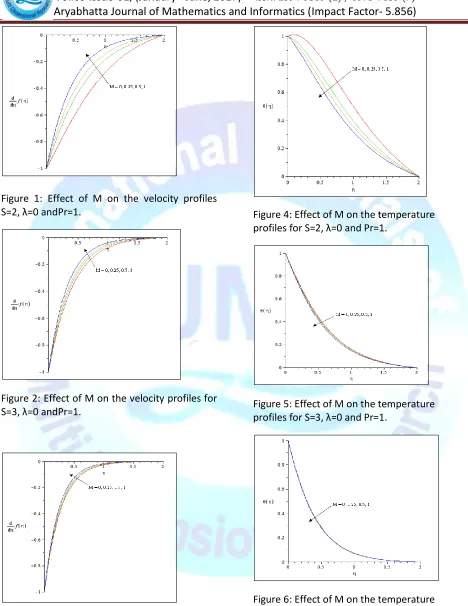
For = 0:The velocity profiles for various values of magnetic parameter M are depicted in figures 1 to 3. From the figures it is noted that for a fixed values of , velocity profiles increase as magnetic parameter M increases and it makes the momentum boundary layer thickness thinner. This happens due to the Lorentz force arising from the interaction of magnetic and electric fields during the motion of the electrically conducting fluid. To reduce momentum boundary layer thickness the generated Lorentz force enhances the fluid motion in the boundary layer region. On the other hand, from figures 4 to 6, it is noticed that temperature ( ) at a point decreases with magnetic parameter.
Now we see the effects of mass suction parameter S on the velocity and temperature profiles. The velocity profiles (figures 1 to 3) increase as applied suction increases and it makes the momentum boundary layer thickness thinner. This is because suction implies an increase in skin friction coefficient which is caused by the reduction momentum boundary layer thickness. The dimensionless temperature profiles for several values of suction parameter are demonstrated in figures 4 to 6. It is seen that the wall mass suction affects temperature distribution in addition to the velocity field, with increasing suction the temperature ( ) for fixed decreases and consequently, the thermal boundary layer thickness reduces.
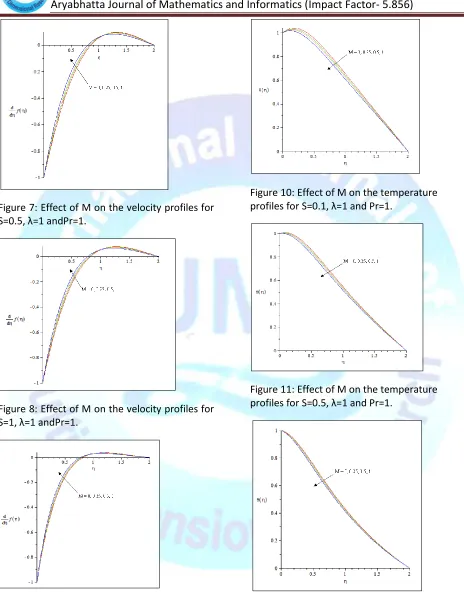
For = 1:The velocity profiles for various values of magnetic parameter M are depicted in figures 7 to 9. Fluid velocity increases due to increase in magnetic parameter M for <1, while reverse effect is observed when >1. Further, from figures 10 to 12, it is noticed that temperature ( ) at a point decreases with magnetic parameter. It is also observed from figures 7 to 9 velocity profile increases as mass suction parameter S increases for <1, while reverse effect is observed when >1. On the other hand, temperature decreases with increasing values of S.
Aryabhatta Journal of Mathematics and Informatics (Impact Factor- 5.856)
Figure 1: Effect of M on the velocity profiles S=2, =0 andPr=1.
Figure 2: Effect of M on the velocity profiles for S=3, =0 andPr=1.
Figure 3: Effect of M on the velocity profiles S=2, =0 andPr=1.
Figure 4: Effect of M on the temperature profiles for S=2, =0 and Pr=1.
Figure 5: Effect of M on the temperature profiles for S=3, =0 and Pr=1.
Figure 7: Effect of M on the velocity profiles for S=0.5, =1 andPr=1.
Figure 8: Effect of M on the velocity profiles for S=1, =1 andPr=1.
Figure 9: Effect of M on the velocity profiles for S=2, =1 andPr=1.
Figure 10: Effect of M on the temperature profiles for S=0.1, =1 and Pr=1.
Figure 11: Effect of M on the temperature profiles for S=0.5, =1 and Pr=1.
Aryabhatta Journal of Mathematics and Informatics (Impact Factor- 5.856)
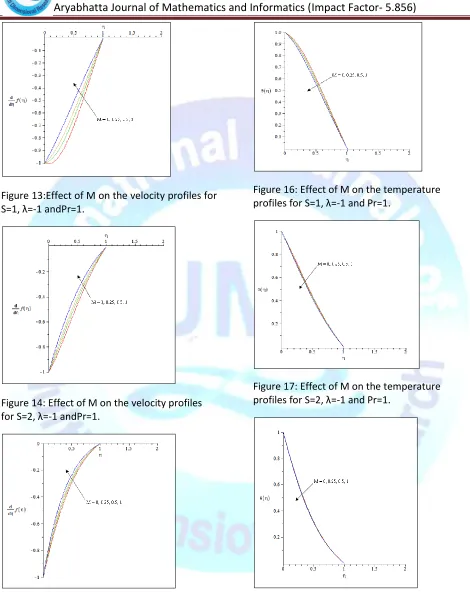
Figure 13:Effect of M on the velocity profiles for S=1, =-1 andPr=1.
Figure 14: Effect of M on the velocity profiles for S=2, =-1 andPr=1.
Figure 15: Effect of M on the velocity profiles for S=3, =-1 andPr=1.
Figure 16: Effect of M on the temperature profiles for S=1, =-1 and Pr=1.
Figure 17: Effect of M on the temperature profiles for S=2, =-1 and Pr=1.
4. CONCLUSION
A mathematical model has been presented for the MHD boundary layer flow and heat transfer over an exponentially shrinking vertical sheet with suction. The governing partial differential equations are converted into ordinary differential equations by using similarity transformations. The effect of magnetic parameter M and mass suction parameter S controlling the velocity and temperature profiles for Pr=1 are shown graphically and discussed briefly. The influence of the physical parameters viz., the Magnetic parameter , and the mass suction parameter S on dimensionless velocity and temperature profiles were examined. From the study, following conclusion can be drawn:
(i) As the magnetic parameter M increases, we can find the velocity profile increases in the
flow region (but reversed phenomenon is observed when =1 and >1) and to decrease the temperature profile. This happens due to the Lorentz force arising from the interaction of magnetic and electric fields during the motion of the electrically conducting fluid. Thus we conclude that we can control the velocity field and temperature by introducing magnetic field.
(ii) The velocity gradient increases with increasing values of mass suction parameter S. Since
the effect of suction is to suck away the fluid near the wall, the velocity boundary layer is reduced due to suction. Consequently the velocity increases. Hence the velocity gradient increases with increasing suction.
(iii) The temperature in the boundary layer decreases due to suction. The effect of suction can
be used as means of cooling.
REFERENCES
[1] Al-Odat, M. Q., Damseh, R. A. and Al-Azab, T. A. “Thermal boundary layer on an exponentially stretching continuous surface in the presence of magnetic field effect”. Int.J. Appl. Mech. Eng., 11, (2006), pp. 289-299.
[2] Bansal, J. L., (1977), “Viscous Fluid Dynamics”. Oxford & IBH Pub. Co., New Delhi, India.
[3] Bansal, J. L. (1994), “Magnetofluiddynamics of Viscous Fluids”. Jaipur Publishing House, Jaipur, India.
[4] Bidin, B. and Nazar, R. “Numerical solution of the boundary layer flow over an exponentially stretching sheet with thermal radiation”. Eur. J. Sci. Res., 33, (2009), pp. 770-717.
[5] Chakrabarthi, A. and Gupta, A.S. “A note on MHD flow over a stretching permeable surface”, Q.Appl.Math. Vol. 37, (1979), pp. 73-78.
Aryabhatta Journal of Mathematics and Informatics (Impact Factor- 5.856)
[7] Crane, L. “Flow past a stretching plate”. Z. Angew Math Phys(ZAMP),Vol.21, (1970), pp.645-647.
[8] Elbahbeshy, E. M. A. “Heat transfer over an exponentially stretching continuous surface with suction”. Arch. Mech., 53, (2001), M3-651.
[9] Fang, T. and Zhang, J. “Viscous flow over an unsteady shrinking sheet with mass transfer”. Chin. Phys. Lett., 26(1):014703, (2009a), pp.1-4.
[10] Fang, T. and Zhang, J. “Closed form exact solutions of MHD viscous flow over a shrinking sheet”. Commun. in Nonlinear Sc. and Numer. Simul., 14(7), (2009b), pp. 2853-2857.
[11] Fang, T. and Zhang, J. “Thermal boundary layer over a shrinking sheet : an analytical solution”. ActaMech, 209, (2010), pp. 325-343.
[12] Hayat, T., Abbas, Z. and Sajid, M. “On the analytic solution of magnetohydrodynamic flow of a second grade fluid over a shrinking sheet”. J. Appl. Mech. Trans ASME, 74(6), (2007), pp. 1165-1171.
[13] Jeffery, A. (1966) “Magnetohydrodynamics”. Oliver and Boyed, New York, USA.
[14] Jhankal, A. K. and Kumar, M. “MHD Boundary Layer Flow Past a Stretching Plate with Heat Transfer”. International J. of Engineering and Science, Vol 2 (3), (2013), pp. 9-13.
[15] Khan, S. K. and Sanjayanand, E. “Viscoelastic boundary layer flow and heat transfer over an exponential stretching sheet”. lnl J. Heat Mass Transf. 48, (2005), pp.1534-1542.
[16] Magyari, E. and Keller, B. “Heat and mass transfer in the boundary layers on an exponentially stretching continuous surface”. J. Phys. D Appl. Phys., 32, (1999) pp. 577-585.
[17] Midya, C. “Hydromagnetic boundary layer flow and heat transfer over a linearly shrinking permeable surface”. Int. J. of Appl. Math. and Mech., 8(3), (2012a), pp. 57-68.
[18] Midya, C. “Exact Solutions of Chemically Reactive Solute Distribution in MHD Boundary Layer Flow over a Shrinking Surface”. Chin. Phys. Lett., 29(1):014701, (2012b), pp.1-4.
[19] Miklavcic, M. and Wang, C.Y. “Viscous flow due to a shrinking sheet”. Quart. of Appl. Math., 64(2), (2006), pp. 283-290.
[20] Muhaimin, Kandasamy, R. and Hashim, I. “Effect of chemical reaction, heat and mass transfer on nonlinear boundary layer past a porous shrinking sheet in the presence of suction”. Nuclear Engineering and Design, 240(5), (2010), pp. 933-939.
[22] Noor, N.F.M., Abdulaziz, O. and Hashim, I. “MHD flow and heat transfer in a thin liquid film on an unsteady stretching sheet by the homotopy analysis method”. International Journal for Numerical Methods in Fluids, 63, (2010), pp. 357–373.
[23] Noor, N.F.M., Kechilb, S.A. and Hashimc, I. “Simple non-perturbative solution for MHD viscous flow due to a shrinking sheet”. Commun. in Nonlinear Sc. and Numer. Simul., 15(2), (2010), pp. 144-148.
[24] Pai, S. I., (1956), “Viscous Flow Theory: I – Laminar Flow”. D.VanNostrand Co., New York, USA.
[25] Pavlov, K. B. “Magnetohydrodynamic flow of an incompressible viscous fluid caused by the deformation of a plane surface”, Magn. Gidrondin, vol.4, (1974), pp.146-152.
[26] Rohni, A.M., Ahmad, S., Ismail, A.I.M. and Pop, I. “Boundary layer flow and heat transfer over an exponentially shrinking vertical sheet with suction”, 64, (2013), pp. 264-272.
[27] Sajid, M. and Hayat, T. “Influence of thermal radiation on the boundary layer flow due to an exponentially stretching sheet”. lnt. Commun. Heat Mass Transf., 35, (2008), pp. 347-356.
[28] Sajid, M. and Hayat, T. “The application of homotopy analysis method for MHD viscous flow due to a shrinking sheet”. Chaos, Soliton& Fractals, 39(3), (2009). pp. 1317-1323.
[29] Sakiadis, B. C. “Boundary-layer behavior on continues solid surfaces: II. The boundary-layer on continuous flat surfac”. AIChEJ.vol. 7, (1961), pp. 221-225.
[30] Sanjayanand, E. and Khan, S. K. “On heat and mass transfer in a viscoelastic boundary layer flow over an exponentially stretching sheet”. Int. J. Therm. Sci. 45, (2006), pp. 819-828.
[31] Schlichting, H., (1968), “Boundary layer theory”, 6th edn. McGraw-Hill, New York, NY.