IJEDR1403063
International Journal of Engineering Development and Research (www.ijedr.org)3199
A Parallel System with Priority to Preventive
Maintenance over Replacement Subject To Maximum
Operation and Repair Times
R. Rathee, S.C. Malik
Research Scholar, Professor
Department of Statistics, M.D. University, Rohtak-124001, India
________________________________________________________________________________________________________
Abstract - The present study deals with profit analysis of a parallel system of two identical units by giving priority to preventive maintenance of one unit over replacement of the other. Each unit has two modes- operative and complete failure. A single server is provided immediately to conduct the repair activities whenever needed. The preventive maintenance of the unit is done after a maximum operation time up to which no failure occurs. The failed unit is replaced by new one in case its repair is not possible by the server in a given maximum repair time. The unit performs with full efficiency as new after repair and preventive maintenance. All random variables are statistically independent. The distributions for failure time, replacement time and the rate by which unit undergoes for preventive maintenance are taken as negative exponential while that of preventive maintenance, repair and replacement rates are assumed as arbitrary with different probability density functions. The semi-Markov process and regenerative point technique are adopted to derive the expressions for some measures of system effectiveness in steady state. The variation of mean time to system failure (MTSF), availability and profit function has been observed graphically for arbitrary values of various parameters and costs.
Key Words - Parallel system, preventive maintenance, replacement, priority and profit analysis.
I. INTRODUCTION
The main intension of the manufacturers is to get maximum profit by selling their products with minimum efforts. And, they have managed it up to a considerable level by using proper operational and repair techniques in their systems. The method of parallel redundancy has been considered as one of the effective strategies for improving performance of the systems and thus profit. Several studies have been conducted on parallel systems under a common assumption that system can work for a long time without requiring any maintenance. But, this assumption seems to be unrealistic as continued operation and ageing of operable systems reduce their performance, reliability and safety. In such a situation preventive maintenance can be conducted after a specific operation time in order to slow the deterioration process. Kishan and Kumar (2009) studied a parallel system with preventive maintenance. The system of parallel units can be made more profitable by making replacement of the failed unit in case server fails to get its repair in a fixed time. Malik and Gitanjali (2012) obtained reliability measures of a parallel system with replacement of the unit subject to maximum repair time. Furthermore, the concept of priority in repair disciplines is one of the best ideas to enhance the profit of the system. Malik and Nandal (2010), Malik and Sureria (2012) and Kumar et al. (2012) have developed reliability models for the standby systems using the concept of priority. However, the idea of priority to preventive maintenance over replacement has not been introduced while analyzing system reliability models of two or more units.
Thus, the focus of the present study is to fill up this gap while carrying out profit analysis of a parallel system of two identical units. Each unit has two modes- operative and complete failure. A single server is provided immediately to conduct the repair activities whenever needed. The preventive maintenance of the unit is done after a maximum operation time up to which no failure occurs. The failed unit is replaced by new one in case its repair is not possible by the server in a given maximum repair time. Priority is given to preventive maintenance of one unit over the replacement of the other unit. The unit works as new after repair and preventive maintenance. All random variables are statistically independent. The distributions for failure time, replacement time and the rate by which unit undergoes for preventive maintenance are taken as negative exponential while that of preventive maintenance, repair and replacement rates are assumed as arbitrary with different probability density functions. The semi-Markov process and regenerative point technique are adopted to derive the expressions for some measures of system effectiveness in steady state. The variation of mean time to system failure (MTSF), availability and profit function has been observed graphically for arbitrary values of various parameters and costs.
II. NOTATIONS
E/ : Set of regenerative/ non-regenerative states λ : Constant failure rate
α0 : The rate by which system undergoes for preventive maintenance (called maximum constant rate
of operation time)
IJEDR1403063
International Journal of Engineering Development and Research (www.ijedr.org)3200
time)FUr /FWr : The unit is failed and under repair/waiting for repair FURp : The unit is failed and under replacement
UPm : The unit is under preventive maintenance WPm : The unit is waiting for preventive maintenance
FUR/FWR : The unit is failed and under repair / waiting for repair continuously from previous state FURP : The unit is failed and under replacement continuously from previous state
UPM : The unit is under preventive maintenance continuously from previous state WPM : The unit is waiting for preventive maintenance continuously from previous state g(t)/G(t) : pdf/cdf of repair time of the unit
f(t)/F(t) : pdf/cdf of preventive maintenance time of the unit r(t)/R(t) : pdf/cdf of replacement time of the unit
qij (t)/ Qij(t) : pdf / cdf of passage time from regenerative state Si to a regenerative stateSj or to a failed state
Sj without visiting any other regenerative state in (0, t]
qij.kr (t)/Qij.kr(t) : pdf/cdf of direct transition time from regenerative state Si to regenerative state Sj or to a failed
state Sj visiting state Sk, Sr once in (0, t]
Mi(t) : Probability that the system up initially in state Si E is up at time t without visiting to any
regenerative state
Wi(t) : Probability that the server is busy in the state Si up to time „t‟ without making any transition to
any other regenerative state or returning to the same state via one or more non-regenerative states.
i : The mean sojourn time in state which is given by
where denotes the time to system failure.
mij : Contribution to mean sojourn time (i) in state Si when system transits directly to state Sj so that
i ij j
m
and mij =*
'
( )
(0)
ij ij
tdQ t
q
&
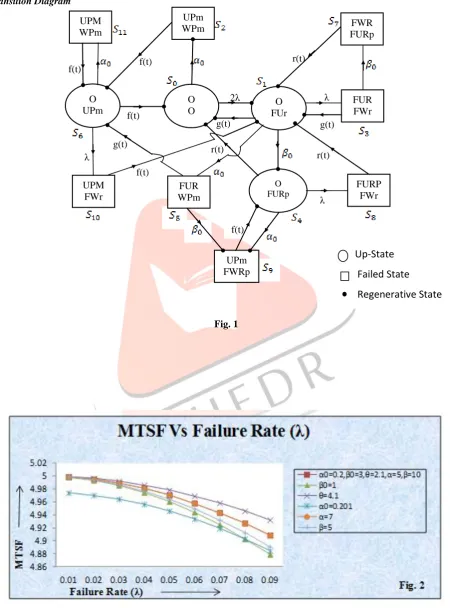
: Symbol for Laplace-Stieltjes convolution/Laplace convolution */** : Symbol for Laplace Transformation /Laplace Stieltjes Transformation The possible transition states of the system model are shown in fig.1III. TRANSITION PROBABILITIES AND MEAN SOJOURN TIMES
Simple probabilistic considerations yield the following expressions for the non-zero elements as
0
(
)
)
(
q
t
dt
Q
p
ij ij ij(1) 01 0
2
,
2
p
0 02 0,
2
p
*10
(
0 0),
p
g
13 * 0 00 0
(1
(
)),
(
)
p
g
*
40
(
0),
p
r
48 41.8 * 00
(1
(
)),
(
)
p
p
r
* 0
6,11 66.11 0
0
(1
(
)),
(
)
p
p
f
*
31 56
(
0),
p
p
g
49 0 * 00
(1
(
)),
(
)
p
r
*
6,10 61.10 0
0
(1
(
)),
(
)
p
p
f
* 0
14 0 0
0 0
(1
(
)),
(
)
p
g
* *
11.3 0 0 0
0 0
(
)(1
(
)),
(
)
p
g
g
* 0
15 0 0
0 0
(1
(
)),
(
)
p
g
* *
0
16.5 0 0 0
0 0
g (
)(1
(
)),
(
)
p
g
*
37 31.7 59
1
(
0),
p
p
p
g
19.5 0 * 0 * 0 00 0
(1
(
))(1
(
)),
(
)
p
g
g
*
60
(
0),
p
f
11.37 * 0 * 0 00 0
(1
(
))(1
(
)),
(
)
p
g
g
p
26
p
71
p
81
p
94
p
10,1
p
11,6
1
(2) It can be easily verified that01 02 10 13 14 15 40 48 49 60 6,10 6,11
1
p
p
p
p
p
p
p
p
p
p
p
p
10 14 11.3 11.37 16.5 19.5 40 41.8 49 60 6,10 66.11
1
IJEDR1403063
International Journal of Engineering Development and Research (www.ijedr.org)3201
The mean sojourn times ( ) is in the state Si are0
m
01m
02
,
1
m
10
m
13
m
14
m
15 ,
2
m
26,
4
m
40
m
48
m
49,6
m
60m
6,10m
6,11
,
9
m
94,
1'
m
10
m
14
m
11.3
m
11.37
m
16.5
m
19.5,
'
4
m
40m
41.8m
49,
6'
m
60
m
6,10
m
66.11 (3)IV. RELIABILITY AND MEAN TIME TO SYSTEM FAILURE (MTSF)
Let
i(t) be the cdf of first passage time from regenerative state Si to a failed state. Regarding the failed state as absorbingstate, we have the following recursive relations for
i(t):1 02
0
(t)
Q
01(t)
Q
(t)
&
0 14 4
1
(
t)
Q
10(
t)
Q
(t)
(
t
)
Q
13( )
t
Q
15(t
)
&
&
0
4
(t)
Q
40(t)
Q
48(t)
Q
49( )
t
&
(4) Taking LST of above relation (4) and solving for (s), we have
** *
1
( )
(s)
s
R
s
(5)
The reliability of the system model can be obtained by taking Inverse Laplace transform of (5). The mean time to system failure (MTSF) is given by
**
0
1
( )
lim
s
s
N
MTSF
s
D
(6) Where
0 01 1 01 14 4
N
p
p p
and
D
1
p p
01 10
p p p
01 14 40(7) V. STEADY STATE AVAILABILITY
Let Ai(t) be the probability that the system is in up-state at instant „t‟ given that the system entered regenerative
state Si at t = 0.The recursive relations for
A t
i( )
are given as:0
( )
0(t) q
01( )
1( )
02(
)
2( )
A t
M
t
A t
q
t
A t
0 14 4 11.3
1
( )
1(
t
) q ( )
10( )
( )
(
) (q
( )
11.37( ))
1( )
16.5( )
6(t)
19.5( )
9( )
t
A
t
M
t
A t
q
t
A t
t
q
t
A t
q
t
A
q
t
A
2
( )
26( )
6( )
A
t
q
t
A
t
0 41.8 1 4
4 4 9 9
4
(
)
( )
0( )
( ) q
( )
( ) q ( )
( )
A t
M t
q
t
A t
t
A t
t
A
t
0 61.10
6
( )
6( )
60(
)
A t
( ) q
(
t
)
A t
1( ) q
66.11(
t
)
6( )
A t
M t
q
t
A t
9
9
( )
q ( )
4t
A t
4( )
A t
(8) Where
0
(2 ) 0
( )
t
M t
e
, ( 0 0)1
( )
( ) ,
t
M t
e
G t
( 0)4
( )
R( )
t
M t
e
t
, ( 0)6
( )
F( )
t
M t
e
t
(9) Taking LT of above relations (8) and solving for A0*(s). The steady state availability is given by
* 1
0 0
0 1
( )
lim
( )
s
N
A
sA s
D
(10) Where
1 0
{ (1
1 01)
4(
14 19.5)}
6and
N
X
p
p
p
Y
Z
' ' '
1
(
0 2p )
02{
1(1
49)
4(p
14p
19.5)
9(p p
14 49p
19.5)}Y
6D
X
p
Z
(11) VI. BUSY PERIOD ANALYSIS FOR SERVER
(a) Due to Repair
Let BiR( )t be the probability that the server is busy in repair the unit at an instant„t‟ given that the system entered regenerative state Si at t=0.The recursive relations for B tiR( )are as follows:
0 01 1
(
02 2IJEDR1403063
International Journal of Engineering Development and Research (www.ijedr.org)3202
14 11.3
1
( )
1(t) q (
10)
0( )
( )
4( ) (q
( )
11.37( ))
1( )
16.5(
)
6(t)
19.5( )
9(t)
R R R R R R
t
q
t
t
t
q
t
t
q
t
q
t
B
t
W
t
B
B
B
B
B
2
( )
26( )
6( )
R R
B
t
q
t
B
t
41.8
4
( )
40( )
0( ) q
( )
1(
) q ( )
49 9( )
R R R R
t
t
B
t
q
t
B
B
t
t
B
t
6
( )
60(
)
0( ) q
61.10( )
1( ) q
66.11( )
6(
)
R R R R
t
t
t
t
B
t
q
t
B
B
B
t
9
9
( )
q ( )
4 4( )
R R
t
t
B
t
B
(12) Where
0 0 0 0 0 0
( ) ( ) ( )
1
( )
( ) (
1) ( )
(
01) ( )
t t t
W
t
e
G t
e
G t
e
G
t
(13) Taking LT of above relations (12) and solving for B0R*( )s .The time for which server is busy due to repair is given by0 0* 2
0 1
( )
lim
(s)
R R
s
N
B
sB
D
(14)Where *
2 1
(0)(1
49) Y
N
W
P
and D1 is already mentioned. (15)
(b) Due to Replacement
Let BiRp( )t be the probability that the server is busy in replacement the unit at an instant „t‟ given that the system entered regenerative state Si at t=0.The recursive relations for BiRp( )t are as follows:
0 01 1 02 2
B
Rp( )
t
q (
t
)
B
Rp( )
t
q
(
t
)
B
Rp( )
t
14 11.3 11.37 16
1
( )
q
10(
)
0( )
( )
4( ) (q
( )
( ))
1( )
.5( )
6(t)
19.5( )
9(
t
)
Rp Rp Rp Rp Rp Rp
t
q
t
t
t
q
t
t
B
t
t
B
B
B
q
t
B
q
t
B
2
( )
26( )
6( )
Rp Rp
B
t
q
t
B
t
41.8 49
4
( )
4( )
40( )
0( ) q
( )
1( ) q ( )
9(
)
Rp Rp Rp Rp
B
t
W t
q
t
B
t
t
B
t
t
B
t
6
( )
60( )
0( ) q
61.10( )
1( )
q
66. 11( )
6( )
Rp Rp Rp Rp
t
t
t
t
B
t
q
t
B
B
B
t
9
9
(
)
q ( )
4 4(
)
Rp Rp
t
t
B
t
B
(16)Where
0 0
( ) ( )
4
( )
( ) (
1) ( )
t t
W t
e
R t
e
R t
(17) Taking LT of above relations (16) and solving for *0 ( )
Rp
B s .The time for which server is busy due to replacement is given by
0 0 * 3
0 1
( )
lim
( )
Rp Rp
s
N
B
s
sB
s
D
(18)Where *
3 4
(0)(
14 19.5)
N
W
p
p
Y
and D1 is already mentioned. (19)(c) Due to Preventive Maintenance Let P( )
i
B t be the probability that the server is busy in preventive maintenance the unit at an instant „t‟ given that the system entered regenerative state Si at t=0.The recursive relations for BiP( )t are as follows:
0 01 1
(
02 2B (
Pt
)
q
( )
t
B
Pt
)
q
( )
t
B
P( )
t
14 11.3 11.37 16.5 19
1
( )
q ( )
10 0( )
( )
4( ) (q
( )
( ))
1( )
( )
6(t
)
.5( )
9(t)
P P P P P P
t
q
t
t
t
q
t
t
q
t
q
t
B
t
t
B
B
B
B
B
2
( )
2(
)
26(
)
6(
)
P P
B
t
W t
q
t
B
t
41.8
4
( )
40( )
0( ) q
( )
1(
) q ( )
49 9( )
P P P P
t
t
B
t
q
t
B
B
t
t
B
t
61.10 66.1
6
( )
6( )
60(
)
0( ) q
( )
1(
) q
1(
)
6(
)
P P P P
B
t
W t
q
t
B
t
t
B
t
t
B
t
9
(
)
9( )
t
q (
94)
4(
)
P P
IJEDR1403063
International Journal of Engineering Development and Research (www.ijedr.org)3203
Where2
( )
9( )
( )
W t
W t
F t
andW t
6( )
e
( 0) tF t
( ) (
0e
( 0)t
1) ( ) (
F t
e
( 0)t
1) ( )
F t
(21) Taking LT of above relations (20) and solving for B0P*( )s .The time for which server is busy due to preventive maintenance is given by0 0* 4
0 1
( )
lim
( )
P P
s
N
B
sB
s
D
(22)Where
* * *
4 2
(0)
02 6(0) Z
9(0)(p
14 49 19.5) Y
N
W
p X
W
W
p
p
and D1 is already mentioned. (23)VII. EXPECTED NUMBER OF REPAIRS
Let R ti( )be the expected number of repairs by the server in (0, t] given that the system entered the regenerative state Si at t = 0. The recursive relations for R ti( )are given as:
0
( )
01(
)
R t
1( )
Q
02( )
2(
)
R t
Q
t
&
t
&
R
t
0 14 4 11.3 1
11.37 1 16.5 6 1
1 1
5 0
9. 9
(1
( ))
( )
( )
( )
(1
( ))
( )
( )
( )
(1
(t)
( )
( )
)
( )
(t)
R t
Q
t
R t
Q
t
R t
Q
t
R t
Q
t
R
Q
t
R
R t
Q
t
&
&
&
&
&
&
2
( )
26(
)
6( )
R t
Q
t
&
R
t
0 41.8 4 9
40 9
4
(
)
( )
R t
( )
Q
( )
t
R t
1( )
Q
( )
t
R t
(
)
R t
Q
t
&
&
&
0 61.10 1 66.11
60 6
6
( )
(
)
R t
( )
Q
( )
t
R t
( )
(
)
( )
R t
Q
t
&
&
Q
t
&
R
t
9
9
( )
4( )
4( )
R t
Q
t
&
R t
(24)
Taking LST of above relations (24) and solving for
R
0**( )
s
.The expected no. of repairs per unit time by the server are giving by
** 5
0 0
0 1
( )
lim
(s)
s
N
R
sR
D
(25)Where
5
(
10 11.3 16.5)(1
49)
N
P
P
P
P
Y
and D1 is already mentioned. (26)VIII. EXPECTED NUMBER OF REPLACEMENTS
Let
Rp t
i( )
be the expected number of replacements by the server in (0, t] given that the system entered the regenerative state Si at t = 0. The recursive relations forRp t
i( )
are given as:0 2
0
( )
1( )
Rp t
1(
)
Q
02( )
( )
Rp t
Q
t
&
t
&
Rp
t
0 14 4 11.3 1
11.37 1 16
1 10
.5 6 19.5 9
( )
( )
( )
( )
( )
( )
(1
( ))
( )
(t)
( )
(t
(
)
)
)
(
Rp t
Q
t
Rp t
Q
t
Rp t
Q
t
Rp t
Q
t
Rp
Q
t
Rp t
Q
Rp
t
&
&
&
&
&
&
2 6
2
( )
6(
)
( )
Rp t
Q
t
&
Rp
t
0 41.8
4
( )
40( )
(1
Rp t
( ))
Q
( )
t
(1
1( ))
49( )
9( )
Rp t
Q
t
&
&
Rp t
Q
t
&
R
p
t
6
( )
60(
)
Rp t
0( )
Q
61.10( )
t
Rp t
1( )
Q
66.11(
)
6(
)
Rp t
Q
t
&
&
t
&
R
p
t
9 4
9
( )
4( )
( )
Rp t
Q
t
&
Rp t
(27)Taking LST of above relations (27) and solving forRp**0 ( )s .The expected number of replacements per unit time by the server is giving by
0 0** 6
0 1
( )
lim
( )
s
N
Rp
sRp
s
D
(28)Where
6
(1
49)(
14 11.3 19.5)
N
Y
p
p
p
p
and D1 is already mentioned. (29) IX. EXPECTED NUMBER OF PREVENTIVE MAINTENANCES
IJEDR1403063
International Journal of Engineering Development and Research (www.ijedr.org)3204
0
( )
01(
)
P t
1( )
Q
02( )
2(
)
P t
Q
t
&
t
&
P
t
0 14 4 11.3 11.37
1 10 1
16.5 6 19.5 9
(
)
( )
( )
( )
( )
(
( )
( ))
( )
( )
P (t)
( )
(t)
P t
Q
t
P t
Q
t
Q
t
P t
Q
t
Q
t
P
P t
Q
t
&
&
&
&
&
2
( )
Q
26( )
t
(1
P
6( ))
t
P t
&
0 41.8 4 9
40 9
4
(
)
( )
P t
( )
Q
( )
t
P t
1( )
Q
( )
t
P t
(
)
P t
Q
t
&
&
&
0 61.10 1 66.
6
(
)
60( )
(1
P t
( ))
Q
( )
t
(1
P t
( ))
Q
11( )
t
(1
6( )
)
P t
Q
t
&
&
&
P t
9
9
( )
Q
4( )
t
(1
P t
4( )
)
P t
&
(30) Taking LST of above relations (30) and solving for **0 ( )
P s .The expected number of preventive maintenances per unit time by the
server is giving by
** 7
0 0
0 1
( )
lim
( )
s
N
P
sP
s
D
(31)Where
7 02
(
14 49 19.5)
N
p X
p p
p
Y
Z
and D1 is already mentioned. (32)Where
49 11.3 11.37 66.11 61.10 16.5 41.8 66.11 14 19.5
(1
){(1
)(1
) p
}
(1
)(
)
X
p
p
p
p
p
p
p
p
p
01(1
66.11)
61.10 02Y
p
p
p
p
49 01 16.5 11.3 11.37 02 02 41.8 14 19.5
(1
){
(1
)
}
(
)
Z
p
p p
p
p
p
p p
p
p
(33) X. PROFIT ANALYSISThe profit incurred to the system model in steady state can be obtained as
0 0 1 0 2 0 3 0 4 0 5 0 6 0
Rp
R P
P
K A
K B
K B
K B
K R
K Rp
K P
(34) WhereP = Profit of the system model
K0 = Revenue per unit up-time of the system
K1 = Cost per unit time for which server is busy due to repair
K2 = Cost per unit time for which server is busy due to replacement
K3 = Cost per unit time for which server is busy due to preventive maintenance
K4 = Cost per unit time repair
K5 = Cost per unit time replacement
K6 = Cost per unit time preventive maintenance
XI. CONCLUSION
The results for some important reliability measures have been evaluated for the particular case
g t
( )
=
et, r t( ) =et,( )
f t =
et. Graphs are drawn to show the behavior of MTSF, availability and profit with respect to failure rate (λ) as shown in figures 2, 3 and 4 respectively. It is observed that MTSF, availability and profit go on decreasing with the increase of failure rate (λ) and the rate (α0) by which unit undergoes for preventive maintenance while their values increase with the increase of repair rate (θ) and replacement rate (β). MTSF and availability keep on increasing as the rate (β0) by which unit undergoes for replacement increases while system becomes less profitable. Also, there is no effect of preventive maintenance rate (α) on MTSF whereas system becomes more profitable with the increase of preventive maintenance rate (α). Thus, the study reveals that a parallel system of two identical units in which priority to preventive maintenance is given over replacement can be made more reliable and profitable to use by increasing repair, preventive maintenance and replacement rates.REFERENCES
[1] R. Kishan and M. Kumar, “Stochastic analysis of a two-unit parallel system with preventive maintenance”, Journal of Reliability and Statistical Studies, vol. 22, pp. 31- 38, 2009.
[2] S.C. Malik and P. Nandal, “Cost-analysis of stochastic models with priority to repair over preventive maintenance subject to maximum operation time”, Learning Manual on Modeling, Optimization and Their Applications, Edited Book, Excel India Publishers, pp165-178, 2010.
[3] S.C. Malik and Kumar Ashish, “Stochastic modeling of a computer system with priority to PM over S/W replacement subject to maximum operation and repair times”, International Journal of Computer Applications, vol.43 (3), pp. 27-34, 2012.
IJEDR1403063
International Journal of Engineering Development and Research (www.ijedr.org)3205
[5] S.C. Malik and Gitanjali, “Cost-benefit analysis of a parallel system with arrival time of the server and maximum repairtime”, International Journal of Computer Applications, vol.46 (5), pp. 39-44, 2012.
State Transition Diagram
Fig. 1
r(t)
g(t)
r(t)
f(t) r(t) f(t)
g(t)
f(t) f(t)
f(t)
g(t)
λ λ
λ
2λ UPM
WPm
UPm
WPm FWR
FURp
UPm FWRp UPM
FWr
FUR WPm
FURP FWr FUR FWr O
UPm
O FURp O
O
O FUr