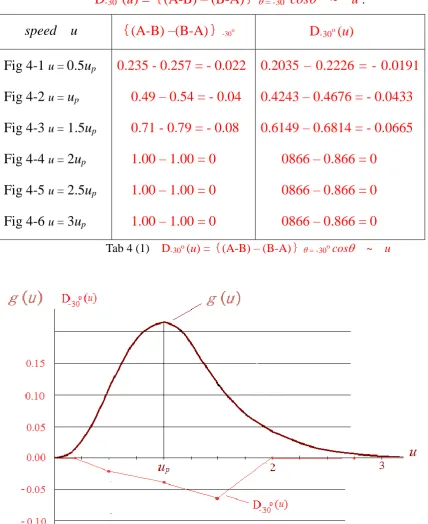
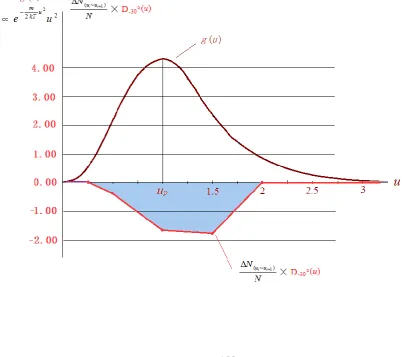
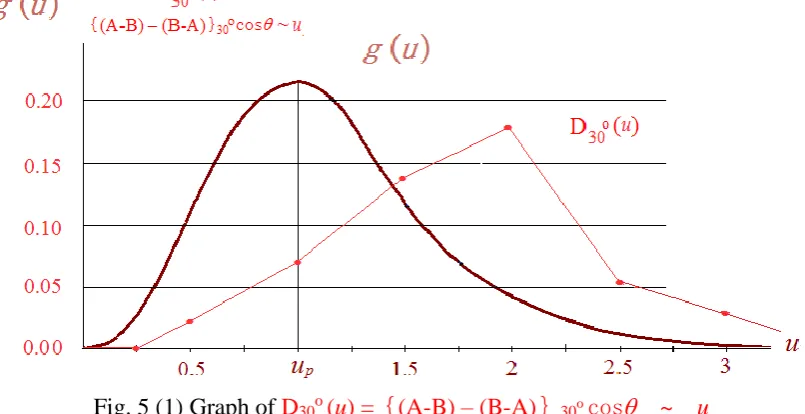
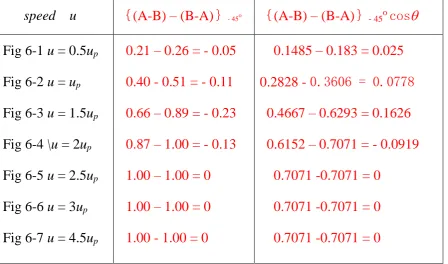
A Graphical Survey of the Various Trajectories of Thermal
Electrons in Fu & Fu’s Heat-electric Conversion
Xinyong Fu & Zitao Fu 2020/7/30
[email protected]
[email protected]
Key words
Maxwell’s demon magnetic demon
entropy decrease entropy elimination
Abstract
This is a graphical survey of the various thermal electron trajectories
and their contribution to the output current in Fu and Fu’s experiment of
heat-electric conversion. The thermal electrons were emitted at room
temperature from two symmetric Ag-O-Cs surfaces in a vacuum tube,
with various exiting angles, speeds, and exiting spots. Due to the
magnetic field, a certain part of the thermal electrons were transferred
from A to B or from B to A, and the survey shows that the former
exceeds the latter a little bit more, resulting in an electric charge
distributio
n,
with A positively charged and B negatively (or vice versa).
A potential difference between A and B emerges, enabling an output
Introduction
In our experiment of electron tube FX12-51, two identical and parallel
Ag-O-Cs surfaces (work function 0.8eV) ceaselessly emit thermal
electrons at room temperature. The speeds of the thermal electrons, as
discovered by Richardson in his famous retarding potential experiments
in 1907~1909, are governed by Maxwell’s gas molecule speed
distribution law,
dv
v
e
kT
m
n
dv
v
f
k Tvm
2 2
2
3 2
)
2
(
4
)
(
(1)
Fig.1
Maxwell’s speed distribution lawvolume distribution, three-dimension speed
Equation (1) and Fig.1 gives the numbers of gas molecules or thermal
electrons
in unit space
volume
(n = N/V) and in the speed interval from
v to v + dv for an equilibrium state at temperature T.
It is a
volume distribution.
and the mean kinetic energy of the gas molecules or thermal electrons by
equation (1).
m
kT
v
p
2
m
kT
v
8
m
kT
v
2
3
kT
2
3
(2)
Maxwell’s speed distribution concentrates in the speed range of
0.125v
p~ 2.75v
p, here v
pis
the most probable speed
of the gas
molecules or thermal electrons.
0.125v
p< v <
2.75v
p,
⊿
N
/
N = 99.70%
When a static uniform magnetic field is applied to the electron tube in
the direction of the axis of the tube, along axis OZ, as shown in Fig.2 (b),
the electrons will fly clockwise in the XOY plane along circles of
different radii according to the component of their speed in the XOY
plane, u
u
eB
m
R
u
v
x2
v
y2(3
)
Hence, for the graphical survey of the trajectories of the thermal
electrons in the XOY plane, we need a Maxwell’s speed distribution of
two dimensions.
The Maxwell’s velocity distribution of three dimensions may also take
the following form,
z y x v v v kT m z y x z y
x
e
dv
dv
dv
kT
m
n
dv
dv
dv
v
v
v
f
32 2 ( x y z )2 2 2
)
2
(
)
,
,
(
. (4)
By integration over all the v
z, equation (4) reduces to two dimensions
y x v v k T m y x y
x
e
dv
dv
kT
m
n
dv
dv
v
v
f
2 ( x y )2 2
)
2
(
)
,
(
With a cylindrical coordinate system, we may have
udu
e
kT
m
n
du
u
f
k Tum
)
2
2
(
)
(
2 2
udu
e
kT
m
n
du
u
f
k Tum 2
2
)
(
(5)
It is the number of gas molecules or thermal electrons
in unit volume
and
in the speed interval from u to u+d u. This is also a
volume distribution
,
and speed u is of two dimensions.
Moreover, in the case of our experiment, for all the trajectories, the
thermal electrons are just ejected from the two emitters and will soon
return back to them. The speed distribution of the ejected electrons is
actually not a volume distribution, but a
beam distribution
, or a
wall
emission distribution
,.
It is a
gas molecule hole-passing or wall colliding speed distribution, or,
a thermal electron wall emission speed distribution. Conventionally, all
these are called the
beam distribution.
Beam speed distribution of two dimensions
(For beam speed distribution of gas molecules or thermal electrons of
three dimensions, see the appendix.)
As shown in Fig 3, at time t, all the gas molecules or thermal electrons
in a cylinder udtdAcos
with a speed from u to u + du and in the
Fig 3 the number of molecules of u ~ u + du and dpass dA in dt
direction from
to
+ d
will pass through the hole
dA on the
separation in a duration dt, and their number is
The factor cos
repersents Lambert law.
For
dA
= 1 and
dt
= 1, and integrate over
from
to
we
derive
du
u
e
kT
m
n
u
d
k Tum 2 2 2
)
(
(6
)
The general collision ( or emission) number of thermal electrons in unit
time and on unit area is the so called
wall collision number (or wall
emission number)
, which may be derived by integrate (6) over u from 0
to
∞
Briefly
Briefly
n
u
4
1
(7
)
The beam distribution, i.e., the ratio of the number of molecules or
thermal electrons of speed interval u ~ u+du in the beam to the number of
the molecules or thermal electrons of all speeds in the same beam, is
(8)
m
kT
n
m
kT
kT
m
n
du
u
e
kT
m
n
k Tum
8
4
1
)
2
(
4
1
232 2 2
u
n
du
u
e
kT
m
n
d
du
u
g
u k T m4
1
)
(
2 2 2
du
u
e
kT
m
du
u
g
k TuFig 4 Beam distribution, two-dimensional speed
The two different distribution functions, equation (1) and (8), one
is the volume distribution of three dimensions and the other is the
beam distribution of two dimensions, are alike exactly!
We may also easily derive the three characteristic speeds and the mean
kinetic energy of the gas molecules or thermal electrons for the beam
distribution of two dimensional speeds,
m
kT
u
p
2
m
kT
u
8
m
kT
u
2
3
kT
2
3
(9
)
Equation (2) and (9) are also alike exactly.
The beam distribution of two dimensions also concentrates in the speed
range of 0.125u
p~2.75u
p, here u
pis
the most probable speed
of u, u
p= v
p.Divide the area under the beam distribution graph of Fig 4 into nine
parts, A0, A1, A2, A3, A4, A5 A6, A7, A
∞, as shown in Fig 5: for A0 ,
u =
0.25u
p, for each of A1 to A7,
u
= 0.5u
p, and for A
∞,
u
=
∞
(
from
Fig 5 The nine areas under Maxwell’s beam distribution, two dimensional speeds.
Table 1 The nine areas under Maxwell’s distribution graph, ∑Ai=100% (beam distribution, two dimensions)
Range of speed
u
N
N
N
N
N
A
ui ui ui uii ~ 0 ~ 0 ) ~
( 1
1
0.0
~ 0.25
u
p0.0 ~ 0.125
u
p0.125 ~ 0.25
u
p0.25 ~ 0.75
u
p0.75 ~ 1.25
u
p1.25 ~ 1.75
u
p1.75 ~ 2.25
u
p2.25 ~ 2.75
u
p2.75 ~ 3.25
u
p3.25 ~ 3.75
u
p3.75
u
p~
∞
A0 =
〔
0.276326 - 0.265004
〕
= 0.011358 = 1.13%
A
01=
〔
0.140222-138860
〕
= 0.001362 = 0.14 %
A
02=
〔
0.011358-0.001362
〕
= 0.009996 = 0.99%
A1 = 0.228958 - 0.011358 = 0.217599 = 21.76%
A2 = 0.627286 - 0.228958 = 0.398328 = 39.83%
A3 = 0.894316 - 0.627249 = 0.267067 = 26.71%
A4 = 0.982467 - 0.894316 = 0.088151 = 8.82%
A5 = 0.998287 - 0.982467 = 0.015820 = 1.58%
A6 = 0.999900 - 0.998287 = 0.001613 = 0.16%
A7 = 0.999996 - 0.999901 = 0.00009
5≈
0.01%
Calculate with the help of error functions the relative ratios of numbers
of gas molecules or thermal electrons in the nine ranges, and the results
are listed in Table 1. The error functions are
d x
x
e
N
d u
u
e
u
N
d u
u
e
kT
m
N
N
x v u u p u u k T m u u p 2 0 2 2 0 2 2 2 3 0 ~ 0 2 2 2 2 3 24
)
1
(
4
)
2
(
4
2 2 2 22
)
(
)
(
2
1
2
1
4
4
0 0 2 0 ~ 0 x x x x x x x vxe
x
erf
xe
d
dx
e
dx
x
e
N
N
Now, taking equation (8), Fig 5 and table 2 together as a new platform,
we begin our graphical survey of the various trajectories of thermal
electrons in such an experiment. What we deal with hereafter is the wall
emission distribution of thermal electrons (beam distribution), and the
speeds are of two dimensions.
When a magnetic field is applied to the electron tube, thermal
electrons of the nine different ranges of speed u contribute to the
output current very differently. There are two causes.
The first cause, of course, is Maxwell’s speed distribution itself (beam
distribution, two dimensions). The numbers of electrons in the nine
different speed ranges, as shown in Fig.5 and table 2, are explicitly
different, hence their contributions to the output current are explicitly
The second cause is that the trajectories of the thermal electrons of
different speeds also related to the exiting angles and exiting spots, are
tremendously different. Tremendously different trajectories result in
tremendously different contributions to the output current.
Fig 6 The cross section of an ideal simple and symmetric electron tube, (1 : 1)
For simplicity of discussion, we analyze here the electron migration
between A and B with an ideal simple and symmetric tube as shown in
Fig.6, which is alike to FX12-51, the actual tube in our experiment,
meanwhile the two tubes have some differences from each other, as
shown in Fig.7.
At 20
oC, the mean speed of the thermal electrons is
u
106
km
/
s
,
compare to the mean velocity of common gas molecules (say, the remnant
gas molecules in the same tube), 460 m/s,
they are extremely fast!
The mean free path of thermal electrons in a vacuum of 10
-6mmHg is
determined by their collisions with the remnant gas molecules, about 50m,
which is much greater than the dimensions of our tube,
mm
×
L
60 mm.
Hence, these collisions may be neglected and the actual free paths of the
thermal electrons in the tube may be regarded to be just determined by
their ejection from the emitters, their collisions with the tube’s glass wall,
and their absorption by the emitters.
Numerous thermal electrons frequently collide with the glass wall.
These collisions are due to the kinetic energy of their quick motion. At t =
20
oC, the average kinetic energy of the thermal electrons and also of the
remnant molecules is,
(10)
So, the collisions are extremely weak. The glass wall is sufficiently hard
and smooth for such collisions, and may be regarded here as a perfect
elastic solid.
Now, we start the graphic method to survey the numerous various
trajectories of the thermal electrons emitted from A or B in a magnetic
field with different exiting angles, different speeds, and different exiting
All the electron trajectories in the tube may be classified into four
groups: A-A, B-B,
A-B
,
B-A
.
Here
directly means no collision with the
glass wall.
A-A = A-directly-A + A-glass-A B-B = B-directly-B + B-glass-B
A-B
=
A-directly-B
+
A-glass-B
B-A
=
B-glass-A
The whole graphical survey has about 150 pages, 250 trajectory figures.
The following
representative exiting angles and speeds are selected for
drawing the trajectories:
= 0
o, -15
o, 15
o, -30
o, 30
o, -45
o, 45
o, -60
o, 60
o, -75
o, 75
ou = 0.5u
p,u
p,1.5u
p,2u
p,2.5u
p,3u
p,3.5u
p,4.5u
p.We divided the survey into two parts, the first part and the second part.
If the readers have enough time, we suggest them read the whole survey,
which is rather long, but very interesting, comprehensive and beneficial.
However, many readers may have not so much time to read the whole
survey. We suggest them to read just the first part, which deals with only
the thermal electrons emitted vertically from A or B (
= 0
o) with
different speeds. It has only 16 pages, 33 trajectory figures, providing a
The First Part of the survey(
= 0
o
In this first part, we survey all the trajectories of electrons that emitted
vertically (
= 0
o) from all the points of the two Ag-O-Cs surfaces of the
ideal electron tube shown in Fig.7 (left) with the following representative
exiting speeds,
u =
0.125u
p, 0.25u
p, 0.5u
p,
u
p,
1.5u
p, 2u
p, 2.5u
p,
3u
p, 4.5u
p.
According to Lambert cosine law, normal is the direction of the
strongest emission,
j
∝
cos
.
For convenience of drawing and discussion, as we have mentioned
previously, we choose a static uniform magnetic field of a special
magnetic induction intensity,
B
= 1.34
×10
-4tesla
= 1.34 gausses, to be
applied to the ideal electron tube in the direction parallel to the tube axis.
In such a magnetic field, for t = 20
oC, the thermal electrons of speed of u
=
u
p= 94.3km/s rotate with a radius of
R = 4mm (more precisely,
4.002mm). Thus, for the electrons of speed u = 0.5u
p, the corresponding
radius is R
=2mm. For the electrons of speed u = 2u
p, R = 8mm. The rest
may de deduced by analogy.
1. Trajectories of electrons of
= 0
oand different speeds u
(1) Fig 1-1
= 0
ou = u
p
R = 4mm (B =1.34 gauss)
(a) A-directly-A & B-directly-B (b) B-glass-B
(from EM to PO, ON to QF, grey) (from C to F, D to U, etc., green) No electron migration between A and B due to these trajectories.
(c) A-directly-B (d) B-glass-A (from MO to ON, red) (from J to K, G to H, etc, blue)
(MO=40, EO=70) (from DF to B, DF=35, OF=70) MO/EO = 40/70 = 0.57 DF/OF = 35/70 = 0.50 A-B 57% of the electrons of (0o, up)emitted from A migrate to B,
B-A 50% of the electrons of (0o, up)emitted from B migrate to A.
For all the electrons of (0o, up), migration A-B exceeds B-A, and their difference (equals CD) is the corresponding contribution to the output current
(2)
Fig 1-2
= 0
ou = 0.5u
p
R = 2mm (
cos
0
o
(a) A-directly-A & B-directly-B (b) B-glass-B No electron migration between A and B due to these trajectories.
(c) A-directly-B (d) B-glass-A (from M to O, P to Q, O to ON, etc., red) (from J to K, etc., blue) (from MO to ON, MO=20, EO=70) (from DF to B, DF =17.5, OF = 70)
MO/EO=20/70=0.29 DF/OF=17.5/70=0.25
A-B 29% of the electrons of (0o, 0.5up)emitted from A migrate to B. B-A 25% of the electrons of (0o, 0.5up)emitted from B migrate to A.
For all the electrons of (0o, 0.5up), migration A-B exceeds B-A, and their difference is the corresponding contribution to the output current
(3) Fig 1-3
= 0
ou = 0.25u
p
R = 1mm
(a) A-directly-A & B-directly-B (b) B-glass-B No electron migration between A and B due to these trajectories.
(c) A-directly-B (d) B-glass-A (from MO to ON, red) (from J to K, etc., blue)
(MO=10, EO=70) (DF =8.5, OF = 70) MO/EO=10/70=0.14 DF/OF=8.5/70=0.12
A-B 14% of the electrons of (0o, 0.25up)emitted from A migrate to B. B-A 12% of the electrons of (0o, 0.25up)emitted from B migrate to A.
For all the electrons of (0o, 0.25up), A-B exceeds B-A, and their difference is the
corresponding contribution to the output current.
(4) Fig 1-4
= 0
ou = 0.125u
p
R = 0.5mm
(a) A-directly-A & B-directly-B (b) B-glass-B No electron migration between A and B due to these trajectories.
(c) A-directly-B (d) B-glass-A (from MO to ON) from J to K, etc.)
(MO=5, EO=70) (DF = 4.5, OF = 70) MO/EO=5/70=0.071 DF/OF=4.5/70=0.064 A-B 7.1% of the electrons of (0o, 0.125up)emitted from A migrate to B. B-A 6.4% of the electrons of (0o, 0.125up)emitted from B migrate to A.
For all the electrons of (0o, 0.12up), migration A-B exceeds B-A, and their difference is the corresponding contribution to the output current
Now, let us see the trajectories of the faster electrons.
(5) Fig 1-5
= 0
ou = 1.5u
p
R = 6mm
(a) A-directly-A & B-directly-B (b) B-glass-B No electron migration between A and B due to these trajectories.
(c) A-directly-B (d) B-glass-A (from PO to OQ, red) (from J to K, G to H, etc., blue)
(PO=60, EO=70) (DF =50, OF = 70) PO/EO=60/70=0.857 DF/OF=50/70=0.714 A-B 85.7% of the electrons of (0o, 1.5up)emitted from A migrate to B. B-A 71.4% of the electrons of (0o, 1.5up)emitted from B migrate to A.
For all the electrons of (0o, 1.5up),A-B exceeds B-A, and their difference is the corresponding contribution to the output current
(6) Fig 1-6
= 0
ou = 2 u
p
R = 8mm
(a) B-glass-B
(from C to E, D to V, CD = 3, green)
No electron migration between A and B due to these trajectories.
(b) A-directly-B & A-glass-B (c) B-glass-A
(red, violet) (from J to K, G to H, etc., blue) (EP+PO=EO =70, EO=70) (DF =67, OF = 70)
EO/EO=70/70=1.00 DF/OF=67/70=0.96 A-B 100% of the electrons of (0o, 2up)emitted from A migrate to B. B-A 96% of the electrons of (0o, 2 up)emitted from B migrate to A.
For all the electrons of (0o, 2up), A-B exceeds B-A, and their difference is the corresponding contribution to the output current.
(7) Fig 1-7
= 0
ou = 2.5 u
p
R = 10mm
(a) A-directly-B (red) (b) A-glass-B (violet) A-B = A-directly-B + A-glass-B EM + MO = 70
(EM +MO)/EO =70/70 = 1.00
A-B 100% of the electrons of (0o, 2.5up)emitted from A migrate to B.
(c) B-glass-A (blue) OF/OF = 1.00
B-A 100% of the electrons of (0o, 2.5up) emitted from B migrate to A.
For all the electrons of (0o, 2.5up), A-B and B-A cancel each other, there is no net contribution to the output current.
(8)
Fig 1-8
= 0
ou = 3u
pR = 12mm
(a) A-B = A-directly-B (red) + A-glass-B (violet) 70/70=1.00
A-B 100% of the electrons of (0o, 3up)emitted from A migrate to B.
(b) B-glass-A (from G to H, J to K, etc. blue)
70/70 = 1.00
B-A 100% of the electrons of (0o, 3up) emitted from B migrate to A.
For all the electrons of (0o, 3up), A-B and B-A cancel each other, there is no net contribution to the output current..
(9) Fig 1-9
= 0
ou = 3.5u
p
R = 14mm
(a) A-directly-B (red), A-glass-B (violet) A-B = A-directly-B +A-glass-B (red + violet)
70/70 = 1.00
A-B 100% of the electrons of (0o, 3.5up)emitted from A migrate to B.
(b) B-glass-A
(from G to H, J to K, etc.) (OF = 70, blue) 70/70 = 1.00
B-A 100% of the electrons of (0o, 3.5up)emitted from B migrate to A.
For all the electrons of (0o, 3.5up), migrations A-B and B-A cancel each other, there is no net contribution to the output current.
(10) Fig 1-10
= 0
ou = 4.5 u
p
R = 18mm
(a)A-glass-B
EO/EO = 70/70 = 1.00 (violet)
A-B 100% of the electrons of (0o, 4.5up) emitted from A migrate to B.
(b) B-glass-A OF/OF = 70/70 =1.00 (blue)
A-B 100% of the electrons of (0o, 4.5up) emitted from B migrate to A.
For all the electrons of (0o, 4.5up), migrations A-B and B-A cancel each other, there is no net contribution to the output current.
(11) Fig 1-11
= 0
ou
>> 4.5 u
p
R >> 18mm
(i.e.,
= 0
o \u =
∞
R
= ∞
)
(a)
A-glass-B & B-glass-A
(Red and blue)
(from M to N, G to H; from P to Q, J to K; etc.)
D
0o(
u
∞) =
{
(A-B) – (B-A)
}
0o∞= 1.00 - 1.00 = 0.
For thermal electrons of extremely high speed, their trajectories are
approximately straight lines although a magnetic field is applied.
Statistically, the electrons are now in symmetric pairs (mirror reflect
symmetry, left-right symmetry), one electron exits from A and the other
from B, with the same speeds, symmetric exiting angles and exiting spots,
and they have symmetric trajectories. Their contributions to the output
Every 100 + 100 electrons (1.00 = 100% from A, 1.00 = 100% from B)
of exiting angle
= 0
oand of different speeds contribute to the electron
migration between A and B differently, as list in Tab 1 (1) (
cos
0
o
D
0o(
u
) =
{
(A-B)–(B-A)
}
0ocos
(
u
)
speed u
﹛
(A-B) - (B-A)
﹜
0oD
0o(
u
)
={(A-B)–(B-A)}0o
cos
(
u)Fig 1-4
u = 0.125u
pFig 1-3
u = 0.25u
pFig 1-2
u = 0.5u
pFig 1-1
u = u
pFig 1-5
u = 1.5u
pFig 1-6
u = 2u
pFig 1-7
u = 2.5u
pFig 1-8
u = 3u
pFig 1-9
u = 3.5u
pFig 1-10
u = 4.5u
pFig 1-11
u =
∞
0.07 - 0.06 = 0.01
0.14 - 0.12 = 0.02
0.29 - 0.25 = 0.04
0.57 - 0.50 = 0.07
0.857 - 0.714 = 0.14
1.00 - 0.96 = 0.04
1.00 - 1.00 = 0
1.00 - 1.00 = 0
1.00 - 1.00 = 0
1.00 - 1.00 = 0
1.00 - 1.00 = 0
0.07 - 0.06 = 0.01
0.14 - 0.12 = 0.02
0.29 - 0.25 = 0.04
0.57 - 0.50 = 0.07
0.857 - 0.714 = 0.14
1.00 - 0.96 = 0.04
1.00 - 1.00 = 0
1.00 - 1.00 = 0
1.00 - 1.00 = 0
1.00 - 1.00 = 0
1.00 - 1.00 = 0
Tab. 1 (1) the contributions of the electrons of
= 0
oand
of different speed,
D
0o(
u
) =
{
(A-B)–(B-A)
}
0ocos
(
u
)
.
Fig 1 (1) is the corresponding graph,
D
0o(
u
)
={(A-B)–(B-A)}0o~
u
\
Take Maxwell’s speed distribution g
(
u
)
into account to derive the actual
contributions of the thermal electrons of
= 0
oand of different speed
ranges
⊿u
, i.e.,
N N
i i u
u~ )
( 1
×
D
0o(
u
)
⊿u
~
u
,
Speed range
⊿
u
(u
i~ u
i + 1)
N
N
i i u
u~ ) ( 1
D
0o(
u
)
{(A-B)–(B-A)}0ocos(u)
N
N
i i u
u~ ) ( 1
×
D
0o(
u
)
⊿u
0.00~0.125u
p0.125~0.25u
p0.25~0.75u
p0.75~1.25u
p1.25~1.75u
p1.75 ~ 2.25u
p2.25 ~ 2.75u
p2.75 ~ 3.25u
p3.25 ~ 3.75u
p3.75u
p~ ∞
A01
= 0.15%
A02
= 4.00%
A1
= 18.74%
A2
= 39.83%
A3
= 26.71%
A4
= 8.82%
A5
= 1.58%
A6
= 0.16%
A7
=
.0096%
A8
=
.0003%
0.07 - 0.06 = 0.01
0.14 - 0.12 = 0.02
0.29 - 0.25 = 0.04
0.57 - 0.50 = 0.07
0.857 - .714 = 0.14
1.00 - 0.96 = 0.04
1.00 - 1.00 = 0
1.00 - 1.00 = 0
1.00 - 1.00 = 0
1.00 - 1.00 = 0
0.15×
0.01
×
0.125 (triangle
= 0.0001875
≈ 0.0002
× (0.02+0.01) × 0.5 ×
0.125 =
0.0075 (trapezoid
5.4346 – 4.685 = 0.7496
22.7031 -19,915 = 2.7881
22.8905–19.0709= 3.8196
8.82 – 8.4672 = 0.3528
1.58 – 1.58 = 0
0.16 - 0.16 = 0
0.0096 -0.0096 = 0
0.0003 -0.0003 = 0
∑
uN N
i i v
v~ ) ( 1
×
D
0o(
u
)
⊿u
= 61.5981 – 53.888 +
0.0002 + 0.0075
= 7.7178
Tab. 1 (2) The actual contributions of electrons = 0o with different speeds u.
In the above table, we see, the contributions of the thermal
electrons of 0.000~0.125~0.25u
pare very few compared to the
0.0002
and
0.0075
are not of significant figures). For simplicity, we
will neglect these very few contributions (0.000~0.125~0.25u
p) in our
discussion hereunder.
Fig.1 (1) is the graph of
N N
i i u
u~ )
( 1
×
D
0o(
u
)
⊿u
~
u
,
the real contributions
of thermal electrons of
= 0
o, and of different speed ranges
⊿u
.
Fig. 1(2) Graph of the actual contributions of electrons of = 0o and of
different speeds,
N N
i i u
u~ ) ( 1
×D0o (u) ~ u and
N N
i i u
u~ ) ( 1
×D0o(u)⊿
u ~
u.the output current of all the vertically emitted electrons from A and B
is not zero. It is positive
.
This is sharply in contradiction to
Boltzmann’s principle of detailed balance.
The Second Part of the survey
Trajectories of thermal electrons of other
exiting
angles (
≠
0
o) and of different speeds
The following exiting angles and speeds are adopted
= -15
o, 15
o, -30
o, 30
o, -45
o, 45
o, -60
o, 60
o, -75
o, 75
ou = 0.5u
p,u
p,1.5u
p,2u
p,2.5u
p,3u
p,3.5u
p,4.5u
p.2. Trajectories of electrons of = -15
oand different speeds
(1) Fig 2-1
= -15
ou = 0.25u
p
R = 1mm (B =1.34 gauss)
A-directly-A B-directly-B B-glass-B
(grey) CD/OF= 0.5/70 = 0.007≈0.01 No electron migration between A and B due to these trajectories.
A-directly-B B-Glass-A
(from MO to ON, MO = 9.5, red) (from G to H, etc., DF = 9, blue) MO/EO = 9.5/70 = 0.136 DF/OF= 9/70 = 0.129 A-B 13.6% of the electrons of (-15o, 0.25up) emitted from A migrate to B. B-A 12.9% of the electrons of (-15o, 0.25up) emitted from B migrate to A.
For all the electrons of (-15o, 0.25up), migration A-B exceeds B-A, and their difference is the corresponding contribution to the output current
{(A-B) – (B-A)}-15o 0.25up = 0.136 – 0.129 = 0.007 D-15o(0.25up) = 0.007×cos15
o
(2)
Fig 2-2
= -15
ou = 0.5u
p
R = 2mm (
cos
-15
o
A-directly-A B-directly-B
B-Glass-B CD/OF=1/70 = 0.014 (grey) (CD = 1, OF =70) (green)
No electron migration between A and B due to these trajectories.
A-directly-B B-Glass-A
(from PO to OQ, red) (from J to K, etc., blue) (PO = 19, EO = 70) (DF = 18, OF = 70) 0 PO/EO = 19/70 = 0.27 DF/OF=18/70 = 0.26 A-B 27% of the electrons of (-15o, 0.5up) emitted from A migrate to B. B-A 26% of the electrons of (-15o, 0.5up) emitted from B migrate to A.
For all the electrons of (-15o, 0.5up), migration A-B exceeds B-A, and their difference is the corresponding contribution to the output current
{(A-B) – (B-A)}-15o 0.5up = 0.27 – 0.26 = 0.01 D-15o(0.5up) ={(A-B) – (B-A)}-15o 0.5up×cos15
o
(3)
Fig 2-3
= -15ou = u
p
R = 4mm (
cos
-15
o= 0.9659)
A-directly-A B-directly-B
B-Glass-B (grey) CD/OF =2.5/70≈0.04 (green)
(CD=2.5, OF =70) No electron migration between A and B due to these trajectories.
A-directly-B B-Glass-A
(from P to O, M to N, O to Q, etc., red) (from G to H, D to L, etc., blue) (PO = 40, EO = 70) (DF = 37.5, OF = 70) PO/EO=40/70 = 0.57 DF/OF=37.5/70 = 0.54 A-B 57% of the electrons of (-15o, up) emitted from A migrate to B.
B-A 54% of the electrons of (-15o, up) emitted from B migrate to A.
For all the electrons of (-15o, up),A-B exceeds B-A, and their difference is the corresponding contribution to the output current.
{(A-B) – (B-A)}-15oup= 0.57 – 0.54 = 0.03 D-15o(up) = 0.03×cos15
o
(3)
Fig 2-4
= -15
ou = 1.5u
p
R = 6mm
A-glass-A A-directly-A B-directly-B B-Glass-B
(brown) (grey) (grey) CD/OF = 5/70 =0.07 (green) No electron migration between A and B due to these trajectories.
A-directly-B B-glass-A
(from PMO to ONQ, PO = 58, red) (from G to H, etc., blue, DF = 54) PO/EO=58/70 = 0.83 DF/OF=54/70 = 0.77 A-B 83% of the electrons of (-15o, 1.5up) emitted from A migrate to B. B-A 77% of the electrons of (-15o, 1.5up) emitted from B migrate to A.
For all the electrons of (-15o, 1.5up), migration A-B exceeds B-A, and their
difference is the contribution to the output current,
{(A-B) – (B-A)}-15o1.5up = 0.83 – 0.77 = 0.06 D-15o(1.5up) ={(A-B) – (B-A)}-15o 1.5up×cos15
o
(4)
Fig 2-5
= -15
ou = 2u
p
R = 8mm
A-directly-B A-glass-B (from MP to NQ, red. MP=58, EO=70) (EM=2.5, PO=9.5, violet) 58/70 = 0.83 12/70 = 0.17 EM + MP + PO = 70
70/70 =1.00
A-B 100% of the electrons of (- 15o, 2up) emitted from A migrate to B.
B-glass-A
(from G to H, etc., blue, OE = 70) 70/70 = 1.00
B-A 100% of the electrons of (-15o, 2up) emitted from B migrate to A.
For all the electrons of (-15o, 2up), migration A-B equals B-A, no net contribution to the output current,
{(A-B) – (B-A)}-15o 2up = 1.00 -1.00 = 0
D-15o(2up) = {(A-B) – (B-A)} -15o 2up×cos15
o
(6)
Fig 2-6
= -15
ou = 2.5u
p
R = 10mm
A-directly-B (red) A-glass-B (violet + volet) A-B = A-glass-B + A-directly-B + A-glass-B (violet + red + violet = 70) 70/70 = 1.00 A-B 100% of the electrons of (-15o, 2.5up) emitted from A migrate to B.
B-Glass-A
(from G to H, F to J, O to L, etc., blue) 70/70 = 1.00
B-A 100% of the electrons of (-15o, 2.5up) emitted from B migrate to A.
For all the electrons of (-15o, 2.5up), migration A-B equals B-A, and their contribution to the output current cancel each other.
(A-B) – (B-A)} -15o 2.5up = 1.00 -1.00 = 0
D-15o (2.5up) ={(A-B) – (B-A)}-15o 2.5up×cos15
o
(7)
Fig 2-7
= - 15
ou = 3u
p
R = 10mm
A-glass-B (from M to N, etc., red) 70/70 = 1.00
A-B 100% of the electrons of (-15o, 3up) emitted from A migrate to B.
B-Glass-A (from G to H, etc., blue) 70/70 = 1.00
B-A 100% of the electrons of (-15o, 3up) emitted from B migrate to A.
For all the electrons of (-15o, 3up), migrations A-B and B-A cancel each other, no net contribution to the output current,
{(A-B) – (B-A)}-15o 3up = 1.00 -1.00 = 0 D-15o(3up) ={(A-B) – (B-A)}-15o3up×cos15
o
= 0
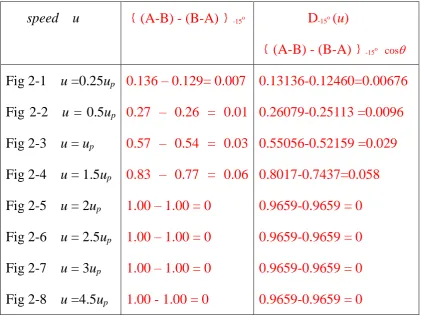
Every 100 + 100 electrons (1.00 = 100% from A, 1.00 = 100% from B)
of exiting angle
= -15
oand of different speeds contribute to the electron
migration between A and B differently, as list in Tab 2 (1) (
cos
-15
o=
0.9659)
,
speed u
﹛
(A-B) - (B-A)
﹜
-15oD
-15o(
u
)
﹛
(A-B) - (B-A)
﹜
-15o cosFig 2-1
u =0.25u
pFig 2-2
u
= 0.5u
pFig 2-3
u = u
pFig 2-4
u = 1.5u
pFig 2-5
u = 2u
pFig 2-6
u = 2.5u
pFig 2-7
u = 3u
pFig 2-8
u =4.5u
p0.136 – 0.129= 0.007
0.27 – 0.26 = 0.01
0.57 – 0.54 = 0.03
0.83 – 0.77 = 0.06
1.00 – 1.00 = 0
1.00 – 1.00 = 0
1.00 – 1.00 = 0
1.00 - 1.00 = 0
0.13136-0.12460=0.00676
0.26079-0.25113 =0.0096
0.55056-0.52159 =0.029
0.8017-0.7437=0.058
0.9659-0.9659 = 0
0.9659-0.9659 = 0
0.9659-0.9659 = 0
0.9659-0.9659 = 0
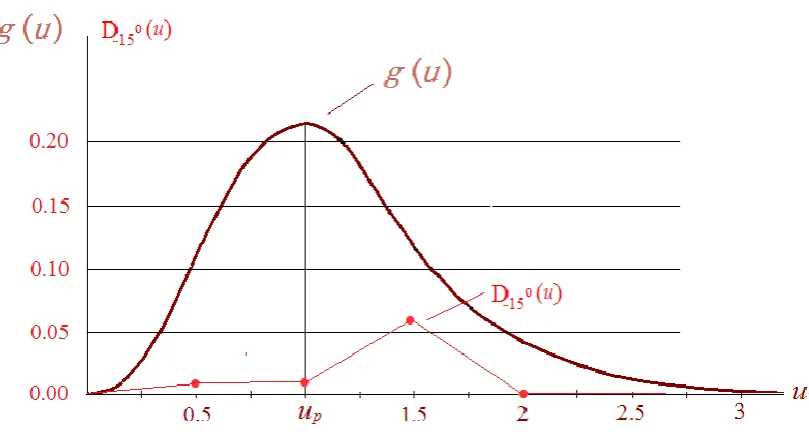
And Fig 2(1) is the corresponding graph.
Take Maxwell speed distribution
g
(u)
into account to derive the actual
contributions of the thermal electrons of
= -15
oand of different speed
ranges, as list in Tab 2 (2),
N N
i i v
v~ ) ( 1
×
D
-15o(
u
)
⊿u
~
u
.
Speed range
⊿
u
N
N
i i u
u ~ )
( 1
D
-15o(
u
)
=﹛
(A-B)-(B-A)
﹜
-15o cosN N
i i u
u~ ) ( 1
×
D
-15o(
u
)
⊿u
0.00~0.25u
p0.25~0.75u
p0.75~1.25u
p1.25~1.75u
p1.75~2.25u
p2.25~2.75u
p2.75~3.25u
p3.25~3.75u
p3.75u
p~
∞
A0
≈ 0.004
A1
= 18.74%
A2
= 39.83%
A3
= 26.71%
A4
= 8.82%
A5
= 1.58%
A6
= 0.16%
A7
=
0.0096%
A8
=
0.0003%
0.1314-0.1246=0.0068
0.26079-0.25113=0.0096
0.55056-0.52159=0.029
0.8017-0.7437=0.058
0.9659-0.9659 = 0
0.9659-0.9659 = 0
0.9659-0.9659 = 0
0.9659-0.9659 = 0
0.9659-0.9659 = 0
.00052-0.000498=0.00002
4.8874-4.7056 = 0.1818
21.9304-20.7753 = 1.1551
21.5576-19.8642 = 1.6934
8.5192 - 8.9152 = 0
1.5261 – 1.5261 = 0
0.1545 – 0.1545 = 0
0.00927 -0.00927 = 0
0.00029-0.00029 = 0
∑
uN N
i i u
u~ ) ( 1
×
D
-15o(
u
)
⊿u
= 58.5852 – 55.9509 = 2.6343
The corresponding graph of
N N
i i u
u~ ) ( 1
×
D
-15o(
u
)
~
u
is shown in Fig
2 (2).
Fig 2 (2) Graph of
N N
i i u
u~ ) ( 1
3. Trajectories of electrons of
= 15
oand different speeds
(1) Fig 3-1
= 15
ou= 0.5u
p
R = 2mm (B =1.34 gauss)
A-directly-A & B-directly-B B-glass-B 2.5/70=0.0357 (grey) (from CD to FV, CD=2.5, OF=70) No electron migration between A and B due to these trajectories.
A-directly-B B-glass-A
(from MO to ON, red, MO=19, EO=70) (from D to H, etc. blue) (DF=16.5, OF=70) 19/70 = 0.271 16.5/70 = 0.235
A-B 27% of the electrons of (15o, 0.5up) emitted from A migrate to B. B-A 23.5% of the electrons of (15o, 0.5up) emitted from B migrate to A.
For all the electrons of (15o, 0.5up), migration A-B exceeds B-A, and their difference is the corresponding contribution to the output current
﹛(A-B) - (B-A)﹜15o 0.5up = 0.271 – 0.235 = 0.036 ≈ 0.04
(2) Fig 3-2
= 15
ou = u
p
R = 4mm (
cos
15
o
A-directly-A & B-directly-B B-glass-B No electron migration between A and B due to these trajectories.
A-directly-B B-glass-A (from PO to OQ, etc., red) (from G to H, etc., blue) PO/EO = 39/70 = 0.56 (PO=39) DF/OF = 33.7/70 = 0.48 (DF=33.7) A-B 56% of the electrons of (15o, up) emitted from A migrate to B.
B-A 48% of the electrons of (15o, up) emitted from B migrate to A.
For all the electrons of (15o, up),migration A-B exceeds B-A, and their difference is
the corresponding contribution to the output current
﹛(A-B) - (B-A)﹜15oup= 0.56 – 0.48 = 0.08
(3)
Fig 3-3
= 15
ou = 1.5u
p
R = 6mm
A-directly-A & B-directly-B
B-Glass-B
No electron migration between A and B due to these trajectories.
A-directly-B B-glass-A
(from PO to OQ, red) (from G to H, D to K, etc., blue) PO/EO = 58/70 = 0.83 (PO=58) DF/OF = 47/70 = 0.67 (DF = 47)
A-B 83% of the electrons of (15o, 1.5up) emitted from A migrate to B. B-A 67% of the electrons of (15o, 1.5up) emitted from B migrate to A.
For all the electrons of (15o, up),migration A-B exceeds B-A, and their difference is
the corresponding contribution to the output current
﹛(A-B) - (B-A)﹜15o1.5up = 0.83 – 0.67 = 0.16
(4)
Fig 3-4
= 15
ou = 2u
p
R = 8mm
A-directly-B 64/70 = 0.91 A-glass-B 6/70 = 0.09 (from E to Q, M to N, P to F, red) (from PO to FS, violet) A-B = A-directly-B + A-glass-B (64 + 6 =70, red + violet) 70/70 = 1.00 A-B 100% of the electrons of (15o, 2up) emitted from A migrate to B.
B-glass-B B-glass-A
(from O to U, D to V, etc., green) (from D to J, G to H, etc., blue) No electron migration DF/OF=59.5/70 = 0.85 B-A 85% of the electrons of (15o, 2up) emitted from B migrate to A.
For all the electrons of (15o, 2up),migration A-B exceeds B-A, and their difference is the corresponding contribution to the output current
﹛(A-B) - (B-A)﹜15o2up= 1.00 – 0.85 = 0.15
(5)
Fig 3-5
= 15
ou = 2.5u
p
R = 10mm
A-directly-B (45/70) (red) A-glass-B (25/70) (violet) A-B (total) 70/70 = 1.00 (red +violet, 45 + 25 = 70 )
A-B 100% of the electrons of (15o, 2.5up) emitted from A migrate to B.
B-glass-B 1/70 = 0.014 B-glass-A (OD = 1, OF = 70) (DF = 69, OF =70) No electron migration between A (from G to H, etc., blue)
and B due to these trajectories. DF/OF = 69/70 = 0.986 B-A 98.6% of the electrons of (15o, 2.5up) emitted from B migrate to A.
For all the electrons of (15o, 2.5up), migration A-B exceeds B-A, and their
difference is the corresponding contribution to the output current
﹛(A-B) - (B-A)﹜15o2.5up = 1.00 – 0.986 = 0.014 D15o (2.5up) =﹛(A-B) - (B-A)﹜15o2.5up cos15
o
(6) Fig 3-6
= 15
ou = 3u
p
R = 12mm
A-directly-B A-glass-B
(from E to Q, M to N, P to F, etc., red) (from P to F, R to S, O to K, etc., violet) A-B (total) 70/70 = 1.00 (EP + PO = 20 + 50 = 70)
A-B 100% of the electrons of (15o, 3up) emitted from A migrate to B.
B-glass-A
(from G to H, O to Q, etc., blue) 70/70 = 1.00
B-A 100% of the electrons of (15o, 3up) emitted from B migrate to A.
For all the electrons of (15o, 3up),migration A-B equals B-A, and their contribution
to the output current cancel each other.
﹛(A-B) - (B-A)﹜15o3up = 1.00 – 1.00 = 0
D15o(3up) = ﹛(A-B) - (B-A)﹜15o3up × cos15
o
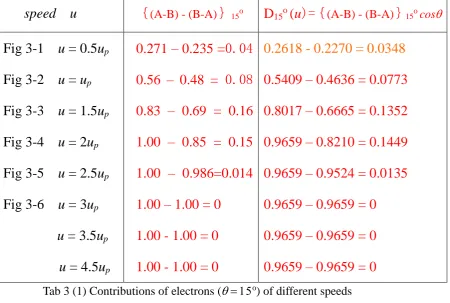
Every 100 + 100 electrons (1.00 = 100% from A, 1.00 = 100% from B)
of exiting angle
= 15
oand of different speeds contribute to the electron
migration between A and B differently, as list in Tab 3 (1) (
cos
15
o=
0.9659)
,
speed u
{
(A-B) - (B-A)}
15oD
15o(
u
)={
(A-B) - (B-A)}
15o cosFig 3-1
u = 0.5u
pFig 3-2
u = u
pFig 3-3
u = 1.5u
pFig 3-4
u = 2u
pFig 3-5
u = 2.5u
pFig 3-6
u = 3u
p
u = 3.5u
pu = 4.5u
p0.271 – 0.235 =
0.04
0.56 – 0.48 =
0.08
0.83 – 0.69 =
0.16
1.00 – 0.85 = 0.15
1.00 – 0.986=0.014
1.00 – 1.00 = 0
1.00 - 1.00 = 0
1.00 - 1.00 = 0
0.2618 - 0.2270 = 0.0348
0.5409 – 0.4636 = 0.0773
0.8017 – 0.6665 = 0.1352
0.9659 – 0.8210 = 0.1449
0.9659 – 0.9524 = 0.0135
0.9659 – 0.9659 = 0
0.9659 – 0.9659 = 0
0.9659 – 0.9659 = 0
Tab 3 (1) Contributions of electrons (o) of different speeds
Fig 3 (1) is the corresponding graph.
Take Maxwell’s speed distribution
g
(
u
)
into account to derive the
actual contributions of the thermal electrons of
= 15
oand of different
speed ranges, i.e.,
N N
i i u
u~ )
( 1
×
D
15o(
u
)
⊿u
~ u, as shown in table 3(2).
Speed range
⊿
u
N N(ui~ui1)
{
(A-B)-(B-A)﹜15o cosN N(ui~ui1)
×
D
15o(
u
)
⊿u
0.00~0.25u
p0.25~0.75u
p0.75~1.25u
p1.25~1.75u
p1.75 ~ 2.25u
p2.25 ~ 2.75u
p2.75 ~ 3.25u
p3.25~3.75u
p3.75u
p~
∞
A0
≈ 0.004
A1
= 18.74%
A2
= 39.83%
A3
= 26.71%
A4
= 8.82%
A5
= 1.58%
A6
= 0.16%
A7
=
0.0096%
A8
=
0.0003%
0.2618-0.2270= 0.0348
0.5409–0.4636=0.0773
0.8017–0.6665=0.1352
0.9659–0.8210=0.1449
0.9659–0.9524=0.0135
0.9659 – 0.9659 = 0
0.9659 – 0.9659 = 0
0.9659 – 0.9659 = 0
0.9659 – 0.9659 = 0
0.0011-0.0009=0.0002
10.1365-8.6879=1.4486
31.9317-26.5466=5.3851
25.7992-21.9289=3.8703
8.5192-8.4002=0.1190
1.5261-1.5261= 0
0.1545-0.1545= 0
0.0093-0.0093=0
0.00029-0.00029=0
∑
u N N i i uu~ )
( 1
×
D
15o(
u
)
⊿u
= 78.0799-67.2541=10.8232
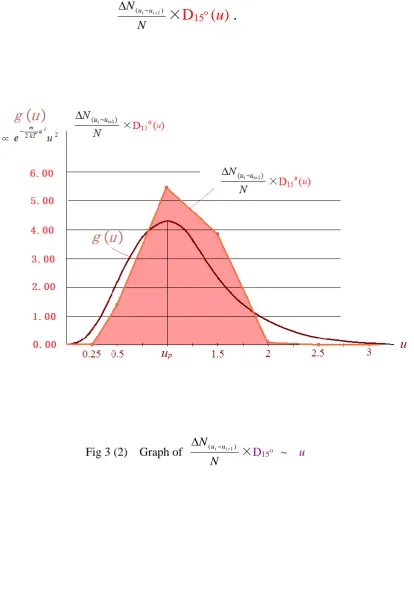
Fig 3 (2) is the corresponding graph
N N
i i u
u~ )
( 1
×
D
15o(
u
)
.
Fig 3 (2) Graph of N N
i i u
u~ )
( 1
×D15o ~ u
4. Trajectories of electrons of
=
- 30
oand different speeds
(1) Fig 4-1 = - 30o u = 0.5up R = 2mm (B = 1.34 gauss)
A-directly-A B-directly-B B-glass-B 1/70 = 0.014 (green) (grey) (CD = 1, OF =70) (from CD to UV) No electron migration between A and B due to these trajectories.
A-directly-B B-Glass-A (from PO to OQ, red) (from G to H, etc., blue)
(PO = 16.5, EO = 70) (DF =18, OF = 70) 16.5/70 = 0.236 18/70 = 0.257 A-B 24% of the electrons of (- 30o, 0.5up) emitted from A migrate to B. B-A 26% of the electrons of (- 30o, 0.5up) emitted from B migrate to A.
For all the electrons of (-30o, 0.5up),migration A-B is less than B-A, and their difference is the corresponding contribution to the output current (negative).
﹛(A-B) - (B-A)﹜-30o0.5up = 0.236 - 0.257 = - 0.021
(2)
Fig 4-2
=
- 30
o u =u
p
R = 4mm (
cos
-30
o
A-glass-A A-directly-A B-directly-B B-glass-B
(violet) (grey) (grey) CD/OF = 1.5/70 = 0.021 (green)
No electron migration between A and B due to these trajectories.
A-directly-B B-Glass-A
(PO =34) (from PO to OQ) (DF = 37) (from G to H, etc., blue) PO/EO = 34/70 = 0.49 DF/OF = 37/70 = 0.53
A-B 49% of the electrons of (- 30o, up) emitted from A migrate to B.
B-A 53% of the electrons of (-30o, up) emitted from B migrate to A.
For all the electrons of (-30o, up), migration A-B is less than B-A, and their difference is the corresponding contribution to the output current (negative).
(A-B) – (B-A)}-30oup = 0.49 - 0.53 = - 0.04
(3)
Fig 4-3
=
- 30
o u =1.5u
p
R = 6mm
(a) A-glass-A (green) + A-directly-A (grey)
(b) B-directly-B (c) B-glass-B (grey) (green)
(d) A-directly-B
(PO = 50, EO =70) (from PO to OQ, red) 50/70 = 0.71
A-B 71% of the electrons of (- 30o, 1.5up) emitted from A migrate to B.
(e) B-glass-A
(from G to H, J to K, etc., blue) (DF = 55, OF = 70) 55/70 = 0.79
B-A 79% of the electrons of (-30o, 1.5up) emitted from B migrate to A.
For all the electrons of (-30o, 1.5up), migration A-B is less than B-A, their difference is the corresponding contribution to the output current (negative).
{(A-B) – (B-A)}-30o 1.5up = 0.71 - 0.79 = - 0.08
(4)
Fig 4-4
=
- 30
o u =2 u
p
R = 8mm
A-glass-B + A-directly-B + A-glass-B violet red violet
70/70 =1.00
A-B 100% of the electrons of (-30o, 2up) emitted from A migrate to B.
B-glass-A
(from G to H, K to L, F to X, etc. blue) 70/70 = 1.00
B-A 100% of the electrons (-30o, 2up) emitted from B migrate to A.
For all the electrons of (-30o, 2up), migration A-B and B-A cancel each other, no contribution to the output current.
{(A-B) – (B-A)}-30o 2up =1.00 -1.00 = 0
(5)
Fig 4-5
=
- 30
o u =2.5u
p
R = 10mm
A-glass-B (red) 70/70 = 1.00
A-B 100% of the electrons of (-30o, 2.5up) emitted from A migrate to B.
B-glass-A (blue) 70/70 = 1.00
B-A 100% of the electrons of (-30o, 2.5up) emitted from B migrate to A.
For all the electrons of (-30o, 2.5up), migration A-B and B-A cancel each other, no contribution to the output current.