Author Profiling from Facebook Corpora
Fernando Chiu Hsieh, Rafael Felipe Sandroni Dias, Ivandr´e Paraboni
University of S˜ao Paulo, School of Arts, Sciences and HumanitiesS˜ao Paulo, Brazil
[email protected] , [email protected], [email protected]
Abstract
Author profiling - the computational task of prediction author’s demographics from text - has been a popular research topic in the NLP field, and also the focus of a number of prominent shared tasks. Author profiling is a problem of growing importance, with applications in forensics, security, sales and many others. In recent years, text available from social networks has become a primary source for computational models of author profiling, but existing studies are still largely focused on age and gender prediction, and are in many cases limited to the use of English text. Other languages, and other author profiling tasks, remain somewhat less popular. As a means to further this issue, in this work we present initial results of a number of author profiling tasks from a Facebook corpus in the Brazilian Portuguese language. As in previous studies, our own work will focus on both standard gender and age prediction tasks but, in addition to these, we will also address two less usual author profiling tasks, namely, predicting an author’s degree of religiosity and IT background status. The tasks are modelled by making use of different knowledge sources, and results of alternative approaches are discussed.
Keywords:Author profiling, Document Classification, Corpus-based approaches
1.
Introduction
Author profiling - the computational task of prediction au-thor’s demographics from text - has been a popular research topic in the NLP field, and also the focus of a number of prominent shared tasks (Pardo et al., 2017). Author profil-ing is a problem of growprofil-ing importance, with applications in forensics, security, sales and many others (Rangel et al., 2015).
In recent years, text available from social networks has be-come a primary source of data for computational author profiling. However, existing studies of this kind are of-ten focused on age and gender prediction, and are in many cases limited to the use of English text and a few others. Other languages, and other author profiling tasks, by con-trast, remain somewhat less popular.
In this work we address the issue of computational au-thor profiling from a Facebook corpus in the Brazilian Por-tuguese language. In doing so, we address standard age and gender prediction tasks, and also two less-known al-ternatives: predicting an author’s degree of religiosity and his/her IT background status. Religiosity prediction may be seen as an extension of personality recognition (Mairesse et al., 2007), and degrees of religiosity are indeed known to correlate with certain personality traits in the Big Five model (de Andrade, 2008). IT background status predic-tion, on the other hand, may be seen as a means to group authors into (e.g., professional) communities.
In order to predict age, gender, religiosity and IT back-ground status, we propose a number of author profile models based on standard document classification meth-ods (from bag of words to word embeddings) and using different knowledge sources (from purely textual to psy-cholinguistic features). In doing so, our goal is to deter-mine which methods are best suited for the four tasks at hand based on Facebook text in the Brazilian Portuguese language.
The rest of this paper is structured as follows. A number of
existing author profiling models are reviewed in Section 2. Our own approach and corpus are described in Section 3. Evaluation and its results are described in Section 4. Final remarks are presented in Section 6.
2.
Background
Studies on gender and age prediction are popular in NLP and related fields, and have in many cases been carried out in the light of the PAN-CLEF Shared task series (Pardo et al., 2017). Outside the scope of shared tasks, however, a direct comparison among existing methods may be compli-cated by the fact that different studies may rely on different problem definitions (e.g., regression versus classification), different datasets, languages (in most cases, English), and evaluation metrics (e.g., accuracy, F-measure etc.). These difficulties notwithstanding, in what follows we briefly dis-cuss a number of recent studies of this kind.
prediction accuracy of 0.83 (age) and 0.82 (gender) for the English language.
The work in ( ´Alvarez-Carmona et al., 2015) proposes gen-der and age recognition models that combine second orgen-der features (already employed in their own previous work at PAN 2013 and 2014) with latent semantic analysis (LSA). The resulting model is the overall winner of the PAN-2015 shared task, ranking among the top three systems in the three languages of the task (English, Dutch and Spanish). The work in (op Vollenbroek et al., 2016) makes use of a SVM model trained on English, Dutch and Spanish Twit-ter data for gender and age prediction from unknown, non-Twitter text. Given the goal of building a cross-genre model for these tasks, the work avoids the use of language-specific features, focusing instead on n-gram counts, capitalisation, punctuation, word and sentence length, out-of-vocabulary words, vocabulary richness, function words, part-of-speech and emoticons. The model also includes second-order fea-tures representing relative values of some of these abso-lute measures. The resulting model in (op Vollenbroek et al., 2016) was the overall winner of the PAN-2016 cross-genre author profiling task (Rosso et al., 2016), obtaining 0.53 joint accuracy (i.e., age and gender prediction put to-gether) when combining results from English, Spanish and Dutch texts. However, the authors pointed out that their present (cross-genre) results were considerably lower than those obtained in previous (single-genre) author profiling tasks at the PAN-CLEF series.
The work in (Basile et al., 2017) presents a model called N-GrAM for gender prediction from Twitter text in English, Spanish, Arabic and European Portuguese. The model makes use of a linear SVM model with word unigrams and character 3- to 5-grams as features. Interestingly, language-and domain-dependent features such as POS tags language-and Twit-ter handles were found to decrease overall accuracy. The proposed model was the best-performing participant in the PAN-CLEF-2017 shared task (Pardo et al., 2017), with 0.83 average accuracy when considering the four languages combined.
Finally, the work in (Guimar˜aes et al., 2017) presents a method for binary age classification from Twitter, and it is one of the few studies to address this task using text in Brazilian Portuguese. The model makes use of Twitter-related features such as punctuation, text length, sharing status, and topic. The study compares a number of classi-fication methods, including MLP, DCNN, Random Forest and SVMs. Among these, best results were obtained by using DCNN, with 0.94 average F-measure.
3.
Current work
We designed an experiment to compare a number of docu-ment classification models applied to four prediction tasks from a Brazilian Portuguese Facebook corpus. These tasks are described individually in the following sections.
3.1.
Author profiling tasks
In the present work we consider both standard gender and age-bracket prediction, and two less usual author profiling tasks, namely, predicting author’s degree of religiosity and
IT background status. The focus on religiosity and IT back-ground is mainly motivated by our choice of corpus (cf. next section), in which both kinds of information are readily available. Both issues however constitute potentially rele-vant research questions on their own right.
Age bracketprediction was modelled as a three-class prob-lem (18-20, 23-25, and 28-61 years-old). As in (Rangel et al., 2015), instances in the intermediate age brackets (i.e., 20-23 and 25-28) were disregarded in order to minimise the possible mismatch between a Facebook user age and the ac-tual time of the publication.
GenderandIT-background statusprediction were modelled as binary classification tasks (male / female and yes / no). Religiosity is represented by self-reported scores ranging from 1 (not religious at all) to 5 (highly religious), and the corresponding prediction task was modelled as a three-class problem (1-2 degrees, 3 degrees, and 4-5 degrees) so as to obtain nearly-balanced groups1.
3.2.
Computational models
In what follows we will consider five author profiling mod-els. First, given that author profiling may be seen as a docu-ment classification task, we will consider models based on both word counts (bag-of-words) and TF-IDF counts. Sec-ond, since char n-gram models have been popular in the related task of author prediction (Tschuggnall et al., 2017) we will also investigate their use in our present tasks. Third, given that other author profiling tasks - in particular, per-sonality prediction as in (Mairesse et al., 2007) - may bene-fit from the use of psycholinguistic lexical information, we will make use of LIWC (Pennebaker et al., 2001) and re-lated features as well. Finally, as in many recent NLP tasks, we will also consider the use of distributed word represen-tations (Mikolov et al., 2013). These models are detailed below.
We will consider three standard text models that do not rely on external knowledge sources: the TF-IDF model, which consists of TF-IDF counts for the 3k most frequent terms; theBoW, which is a Bag-of-words model based on word counts, also keeping the 3k most frequent words; and theCharmodel, which is a standard 3-5 character n-gram model.
In addition to that, we will also consider a lexical model conveying 68 psycholinguistic features obtained from two external knowledge sources: the LIWC psycholinguistic dictionary (Pennebaker et al., 2001) and additional MRC-like (Coltheart, 1981) psycholinguistic properties. This model is presently labelled asLIWC+P.
From the Brazilian Portuguese of the LIWC dictionary (Filho et al., 2013), we computed 64 features represent-ing psycholrepresent-inguistic word categories (e.g., anger, family, wealth etc.). Each feature represents the number of words found in the corresponding category divided by the total number of words in the document. Moreover, from the psycholinguistic properties database in (dos Santos et al.,
1The choice for this scale is similar to (de Andrade, 2008). For
2017a), we computed four features representing concrete-ness, imageability, subjective frequency and age of acqui-sition for Brazilian Portuguese text. Each of these features represents the average score of all document words in the corresponding category.
Finally, we will also consider a model based on word em-beddings hereby calledWord2Vec. This consists of the av-erage word vectors obtained from a skip-gram-600 model (Mikolov et al., 2013) using window size=5, min count=10, built from a 50-million Twitter corpus.
All the above models were built using logistic regression. Language-specific resources in LIWC+P and Word2Vec models (i.e., psycholinguistic dictionaries and Twitter data) concern the Brazilian Portuguese language only.
3.3.
Data
In our experiment we make use of a portion of theb5 cor-pus of texts and accompanying author demographics for the Brazilian Portuguese language (Ramos et al., 2018). The corpus has been applied to a number of NLP/NLG tasks ranging from personality recognition (dos Santos et al., 2017b; Silva and Paraboni, 2018) to personality-dependent content selection (Paraboni et al., 2017) and lexical choice (Lan and Paraboni, 2018).
[image:3.595.113.229.522.584.2]All models were built from the 2.2 million word b5-post subcorpus of Facebook status updates. This dataset conveys up to 1,000 status updates from 1019 users of Brazilian Por-tuguese Facebook. The data is partially labelled with age, gender, degrees of religiosity and IT status information2. Gender, age and IT-background information were generally obtained from Facebook and, in some cases, provided by some of the participants of theb5-postdata collection task upon request. Degrees of religiosity were provided by a small subset of participants upon request.
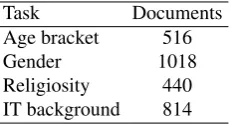
Table 1 summarises the number of documents (i.e., user’s Facebook time lines) to be classified in each of the four prediction tasks.
Task Documents
Age bracket 516
Gender 1018
Religiosity 440 IT background 814
Table 1: Data size for each classification task
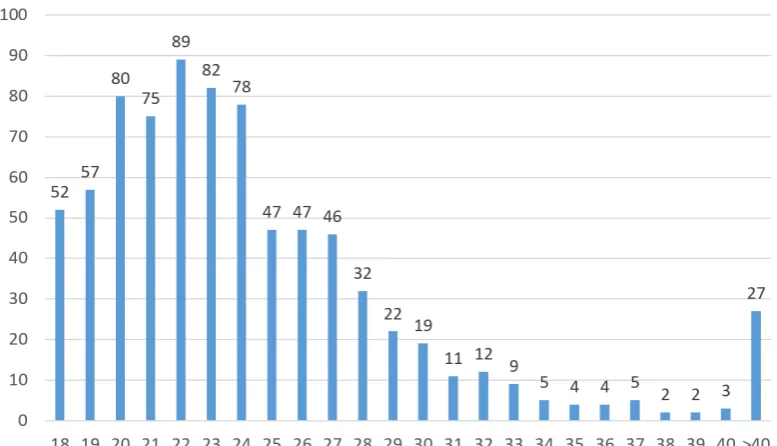
Modelling age prediction as a classification task (as op-posed to, e.g., a regression problem) requires deciding how to define age brackets. Our present choice is influenced by the concentration of individuals in their 20’s (including a large proportion of undergraduate students) in our data. This distribution is illustrated in Figure 1.
4.
Evaluation
After stop words removal using NLTK3, the five models -TF-IDF,Bow,Char,LIWC+PandWord2Vec- were trained
2The latter is a result of having a significant proportion of
Computer Science students among the target participants.
3http://www.nltk.org/
from the entire dataset for each classification problem. Re-sults from 10-fold cross validation logistic regression are summarised as follows: age bracket in Table 2, gender in Table 3, religiosity in Table 4 and IT background status in Table 5.
Class N TF-IDF BoW Char LIWC+P Word2Vec 18-20 182 0.60 0.57 0.56 0.51 0.58 23-25 189 0.56 0.48 0.48 0.40 0.48 28-61 145 0.61 0.55 0.54 0.45 0.59
Table 2: Age bracket F-measure results
Class N TF-IDF BoW Char LIWC+P Word2Vec female 578 0.90 0.86 0.84 0.80 0.88 male 440 0.86 0.81 0.79 0.72 0.85
Table 3: Gender F-measure results
Class N TF-IDF BoW Char LIWC+P Word2Vec 1-2 217 0.67 0.60 0.55 0.61 0.59
3 96 0.17 0.19 0.18 0.22 0.26
4-5 127 0.52 0.40 0.38 0.41 0.43
Table 4: Religiosity F-measure results
5.
Discussion
As expected for a small corpus of this kind, overall re-sults vary across dataset size and class definition. Best results are observed in the case of the two larger binary classes, namely gender classification and IT background status. Age bracket classification was moderately accurate, and degrees of religiosity classification had the lowest ac-curacy of all, with particularly low results for the sparse intermediate (degree 3) class.
Regarding the computational methods under consideration, we notice that theTF-IDFmodel generally outperforms the alternatives, withWord2Vec as a second best (particularly in the case of gender identification). By contrast, the lexi-calLIWC+Pmethod generally produced the lowest results of all, which seems to suggest that psycholinguistic knowl-edge may be more suitable for personality and sentiment recognition than for the present author profiling tasks.
6.
Final remarks
Figure 1: Age distribution in the b5-post corpus.
Class N TF-IDF BoW Char LIWC+P Word2Vec no 491 0.80 0.76 0.73 0.75 0.73 yes 323 0.64 0.60 0.59 0.55 0.59
Table 5: IT background F-measure results
7.
Acknowledgements
This work has been supported by the Brazilian Ministry of Education PET programme, and by grant # 2016/14223-0, S˜ao Paulo Research Foundation (FAPESP).
8.
Bibliographical References
´Alvarez-Carmona, M., L´opez-Monroy, A., y G´omez, M. M., Villase˜nor-Pineda, L., and Escalante, H. (2015). INAOE’s participation at PAN’15: Author Profiling task. InCLEF 2015.
Basile, A., Dwyer, G., Medvedeva, M., Rawee, J., Haagsma, H., and Nissim, M. (2017). N-GrAM: New groningen author-profiling model. In Working Notes of CLEF 2017 - Conference and Labs of the Evaluation Fo-rum, Dublin.
Coltheart, M. (1981). The MRC psycholinguistic database. The Quarterly Journal of Experimental Psychology Sec-tion A: Human Experimental Psychology, 33(4):497– 505.
de Andrade, J. M. (2008). Evidˆencias de validade do invent´ario dos cinco grandes fatores de personalidade para o Brasil. Ph.D. thesis, Universidade de Bras´ılia. de Novais, E. M. and Paraboni, I. (2012). Portuguese text
generation using factored language models. Journal of the Brazilian Computer Society, 19(2):135–146. dos Santos, L. B., Duran, M. S., Hartmann, N. S., Junior,
A. C., Paetzold, G. H., and Alu´ısio, S. M. (2017a). A lightweight regression method to infer psycholinguistic properties for Brazilian Portuguese. InTSD-2017.
dos Santos, V. G., Paraboni, I., and Silva, B. B. C. (2017b). Big five personality recognition from multiple text gen-res. InText, Speech and Dialogue (TSD-2017) Lecture Notes in Artificial Intelligence vol. 10415, pages 29–37, Prague, Czech Republic. Springer-Verlag.
Filho, P. P. B., Alu´ısio, S. M., and Pardo, T. (2013). An evaluation of the Brazilian Portuguese LIWC dictionary for sentiment analysis. In 9th Brazilian Symposium in Information and Human Language Technology - STIL, pages 215–219, Fortaleza, Brazil.
Guimar˜aes, R. G., Rosa, R. L., de Gaetano, D., Rodr´ıguez, D. Z., and Bressan, G. (2017). Age groups classifica-tion in social network using deep learning.IEEE Access, 5:10805–10816.
Koenig, H. G. and Bussing, A. (2010). The duke university religion index (DUREL): a five-item measure for use in epidemiological studies. Religions, 1(1):78–85.
Lan, A. G. J. and Paraboni, I. (2018). Definite descrip-tion lexical choice: taking speaker’s personality into ac-count. In 11th International Conference on Language Resources and Evaluation (LREC-2018) (to appear), Miyasaki, Japan. ELRA.
Mairesse, F., Walker, M., Mehl, M., and Moore, R. (2007). Using linguistic cues for the automatic recognition of personality in conversation and text. Journal of Artificial Intelligence Research (JAIR), 30:457–500.
Mikolov, T., Sutskever, I., Chen, K., Corrado, G. S., and Dean, J. (2013). Distributed representations of words and phrases and their compositionality. In C. J. C. Burges, et al., editors, Advances in Neural Information Processing Systems 26, pages 3111–3119. Curran Asso-ciates, Inc.
for Computational Linguistics.
op Vollenbroek, M. B., Carlotto, T., Kreutz, T., Medvedeva, M., Pool, C., Bjerva, J., Haagsma, H., and Nissim, M. (2016). GronUP: Groningen user profiling: Notebook for PAN at CLEF 2016. InCEUR Workshop Proceed-ings, Netherlands.
Paraboni, I., Monteiro, D. S., and Lan, A. G. J. (2017). Personality-dependent referring expression generation. In Text, Speech and Dialogue (TSD-2017) Lecture Notes in Artificial Intelligence vol. 10415, pages 20–28, Prague, Czech Republic. Springer-Verlag.
Pardo, F. M. R., Rosso, P., Potthast, M., and Stein, B. (2017). Overview of the 5th author profiling task at PAN 2017: Gender and language variety identification in Twitter. InWorking Notes of CLEF 2017 - Conference and Labs of the Evaluation Forum, Dublin.
Pennebaker, J. W., Francis, M. E., and Booth, R. J. (2001). Inquiry and Word Count: LIWC. Lawrence Erlbaum, Mahwah, NJ.
Pereira, D. B. and Paraboni, I. (2007). A language mod-elling tool for statistical NLP. In 5th Workshop on In-formation and Human Language Technology (TIL-2007). Anais do XXVII Congresso da SBC, pages 1679–1688, Rio de Janeiro. Sociedade Brasileira de Computac¸˜ao. Ramos, R. M. S., Neto, G. B. S., Silva, B. B. C., Monteiro,
D. S., Paraboni, I., and Dias, R. F. S. (2018). Building a corpus for personality-dependent natural language un-derstanding and generation. In11th International Con-ference on Language Resources and Evaluation (LREC-2018) (to appear), Miyasaki, Japan. ELRA.
Rangel, F., Celli, F., Rosso, P., Potthast, M., Stein, B., and Daelemans, W. (2015). Overview of the 3rd Author Pro-filing Task at PAN 2015. InCLEF 2015 Evaluation Labs and Workshop.
Rosso, P., Rangel, F., Potthast, M., Stamatatos, E., Tschug-gnall, M., and Stein, B. (2016). Overview of PAN’16— New Challenges for Authorship Analysis: Cross-genre Profiling, Clustering, Diarization, and Obfuscation. In 7th International Conference of the CLEF Initiative (CLEF 16), Berlin Heidelberg New York. Springer. Sap, M., Park, G., Eichstaedt, J., Kern, M., Stillwell, D.,
Kosinski, M., Ungar, L., and Schwartz, H. (2014). De-veloping age and gender predictive lexica over social me-dia. InProceedings of the 2014 Conference on Empiri-cal Methods in Natural Language Processing (EMNLP), pages 1146–1151, Doha, Qatar. Association for Compu-tational Linguistics.
Silva, B. B. C. and Paraboni, I. (2018). Learning person-ality traits from Facebook text. IEEE Latin America (to appear).