103
Automatic Curation and Visualization of Crime Related Information from
Incrementally Crawled Multi-source News Reports
Tirthankar Dasgupta,Abir Naskar,Rupsa SahaandLipika Dey
TCS Innovation Lab, India
(dasgupta.tirthankar, abir.naskar, rupsa.s, lipika.dey)@tcs.com
Abstract
In this paper, we demonstrate a system for the automatic extraction and curation of crime-related information from multi-source digitally published News articles collected over a period of five years. We have leveraged the use of deep convolution recurrent neural network model to analyze crime articles to extract different crime related entities and events. The proposed methods are not restricted to detecting known crimes only but contribute actively towards maintaining an updated crime ontology. We have done experiments with a collection of 5000 crime-reporting News articles span over time, and multiple sources. The end-product of our experiments is a crime-register that contains details of crime committed across geographies and time. This crime-register can be further utilized for analytical and reporting purposes.
1 Introduction
News articles from different sources regularly report crime incidents that contain details of crime, information about accused entities, details of the investigation process and finally details of judg-ment(Westphal, 2008). These details are not all published together, but pour in over time. A curated crime knowledge base with organized information about criminal activities and possible associated crim-inals is beneficial to a wide variety of end-users(Westphal, 2008; Furtado et al., 2010; Hassani et al., 2016; Arulanandam et al., 2014). While law-enforcers of a region have access to details of crime com-mitted within their own jurisdiction, a shared knowledge-base containing information curated from open sources can be used by them to track criminal activities in other regions(Chau et al., 2002). These knowl-edge bases are also in demand by financial organizations who want to make use of these profiles to check on the credit-worthiness of a customer. Regulatory agencies also want to use these knowledge bases to verify legal compliance. Crime and corruption, common scourges of modern societies, top the list of problems cited by public entities in emerging and developing nations.
There are many challenges of such automatic information curation. Ensuring verifiability and reliabil-ity of information sources is a prime concern for curators. Handling factual variations or contradictions needs intelligent methods for disambiguation. Incremental compiling of facts from sources generated over a period of time also needs efficient entity resolution and linking mechanisms to ensure information continuity. While the present work addresses the later challenges, we do not delve deeper into the issue of information reliability but rather assume that News articles collected from reliable agencies supply authentic information.
The salient features of the demonstration are: a) We have leveraged deep convolution recurrent neural network to extract different crime related entities and events from News documents. This includes,
name of the accused, name of the victim, nature of crime, geographic location, date and time, law enforcement, charges bought, and action taken (if any) against the accused. b) The model is trained over a dataset of 5000 documents that spans across time, different sources- containing a multiplicity of reporting on particular topics. c) We have done experiments with a collection of 1000 new News articles. The end-product of our experiments is a crime-register that contains details of crime committed across geographies and time. This register can be further utilized for analytical and reporting purposes.
2 System Architecture 00 00 00 00 00 11 11 11 11 11 000 000 000 000 111 111 111 111 0000 0000 0000 0000 1111 1111 1111 1111 00 00 00 00 11 11 11 11 0000 0000 0000 0000 1111 1111 1111 1111 00 00 00 00 11 11 11 11 000 000 000 111 111 111 000 000 000 000 000 111 111 111 111 111 000 000 000 000 111 111 111 111 00 00 00 00 11 11 11 11 000 000 000 111 111 111 0000 0000 0000 0000 0000 0000 1111 1111 1111 1111 1111 1111 000 000 000 000 111 111 111 111 00000 00000 00000 00000 00000 00000 00000 00000 00000 00000 00000 00000 00000 00000 00000 00000 00000 00000 00000 00000 00000 00000 00000 00000 00000 00000 00000 00000 00000 00000 00000 00000 00000 00000 00000 00000 00000 00000 00000 00000 00000 00000 00000 00000 00000 11111 11111 11111 11111 11111 11111 11111 11111 11111 11111 11111 11111 11111 11111 11111 11111 11111 11111 11111 11111 11111 11111 11111 11111 11111 11111 11111 11111 11111 11111 11111 11111 11111 11111 11111 11111 11111 11111 11111 11111 11111 11111 11111 11111 11111 00 00 11 11 00 00 00 11 11 11 00 00 00 11 11 11 Law enforcement Accused Name Crime type Victim name Crime Location Law enforcement Accused Name Crime type Victim name Crime Location Law enforcement Accused Name Crime type Victim name
Crime Location Law enforcement Accused Name Crime type Victim name Crime Location
N1 N2 N3 N4 Ni
CRNN CRNN CRNN CRNN CRNN
Resolving similar crime entities and reprotings from multiple sources
N1+ N4 N7+N13 N3+ N21 +N6 N32+N61 N48+N23 N97 N984+ N2017+ N1123+...
Date and Time Date and Time
Date and Time Date and Time at time ti
Consolidated Crime reportings Crime register Grouping Similar sources Individual generated from Network Recurrent Neural Convolution Embeddings
at time ti Multi−Source News Murder Kidnap MukherjeeIndrani Peter Mukherjee Laundering Money ChidambKarti Neeraj Grover Mikhail Bora Assult Shyam Rai Shot Stab Bora Sheena Charged with Charged with Charged with Charged with charged with partner partner partner partner
A projection of the entity graph database Word and Character
Addition/ Updation of crime entities
database Crime register (CR)
Timestamp ti=ti+1 in graph W1 W2 W3 Wi S1 S2 S3 Si Convolution Layer Word Embeddings Embeddings Character
Annotated crime news repository across different sources and
timelines
CR1 CR2 CR3 CR4 CRi
ti=ti+1
Accumulation of new News items in the timestamp
[image:2.595.96.522.99.370.2]Recurrent Layer Attention Pooling with with Sigmoid Linear layer Activation y1 y2 yi
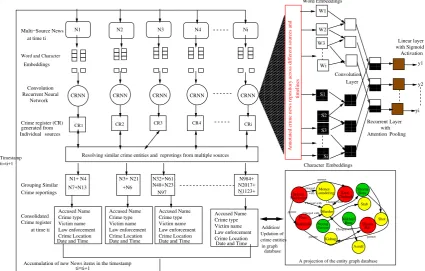
Figure 1: Overview of the crime event and entity extraction architecture.
The overall architecture depicted in Figure 1, consists of seven primary units: a) Multi-source news
accumulation, b) Crime entity extraction using Convolution Recurrent Neural Network(CRNN) c)
Cre-atingtemporary crime registers, d)grouping similar crime reporting, e) Updatedcrime register, and g)
Reinforcement mechanism.
Multi-source news accumulation: The proposed system consists of multiple web crawlers that
con-tinuously crawls crime news events from 10 different sources in a near runtime manner.
Crime entity extraction using Convolution Recurrent Neural Network(CRNN): Output of the
crawlers are passed to the crime entity extraction unit to extract the following crime components: name
of the accused, name of the victim, nature of crime, geographic location, date and time, law enforcement, charges bought, and action taken (if any) against the accused. The input to the CRNN are a sequence of word and characters embeddings. We use the GloVe word vector representations of dimension 300 (Pennington et al., 2014). Both the word and character embeddings are passed to the convolution layer (CNN). CNNs works best in determining local features from texts. The CNN applies a linear
transfor-mation to allKwindows in the given sequence of vectors. Given a word representationsX1, X2, ...Xl,
the convolution layer first concatenates these vectors to form a vectorx¯of lengthl.dLT and then uses
Conv(¯x) =W.¯(x) +bto calculate the output vector of lengthdc. Where,Wandbare the weights that
the network learns. The output of the CNN layer is passed to the RNN layer. We have used bidirec-tional LSTMs (Bi-LSTM) networks that are connected so that both future and past sequence context can be examined. After obtaining the intermediate layers from the Bi-LSTM, we use an attention pooling layer over the sentence representations. The attention pooling helps to acquire the weights of sentence
contribution to final quality of the text. This is represented as: ai = tanh(Wa.hi+ba),αi = Pewα.ai
ewα.ai, O = P
(αi.hi). WhereWa, wα are weight matrix and vector respectively,ba is the bias vector, ai is
attention vector for i-th sentence, andαi is the attention weight of i-th sentence. We apply a sigmoid
function to limit the possible scores to the range[0,1]. The mapping of the linear layer after applying
the sigmoid activation function is given bys(x) =sigmoid(w.x+b). Where,xis the input vector,wis
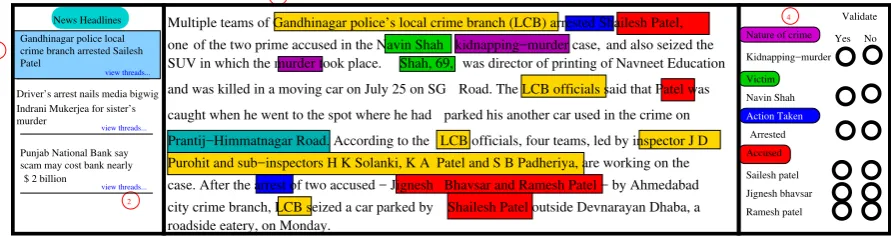
Creating crime register for individual news sources:Once the target components are extracted, we create a temporary crime register of crime entities extracted from each of the individual source news items. Figure 2 and Figure 3 illustrates the basic working of the crime extraction tool. In the left panel of Figure 2, there are series of news headline corresponding to a particular date. Once a headline is selected, the corresponding news details are displayed in the middle panel. Corresponding to the detailed news all the respective crime entities and events were extracted and labeled in different colors. There are number of instances where the same crime event is reported in multiple news sources in different ways. There are also issues related to information richness of one source as compared to other. In particular we have observed that regional news sources cover deeper information rather than nationalized news sources. In addition to this there are severe issues related to entity resolution both within the document as well as
outside the document. For example, “Sailesh Patel” may be referred as “Sailesh” or “Patel” in other
articles. In order to resolve such entities, we have used the BMI measure as discussed in (Lau et al., 2008; Lau et al., 2009). Also, resolution of such named entities help grouping similar crime reporting together. Thus, it is also important to ensemble information across different news sources together and construct a unified knowledge representation.
SUV in which the murder took place. Shah, 69, was director of printing of Navneet Education and was killed in a moving car on July 25 on SG Road. The LCB officials said that Patel was caught when he went to the spot where he had parked his another car used in the crime on Prantij−Himmatnagar Road. According to the LCB officials, four teams, led by inspector J D Purohit and sub−inspectors H K Solanki, K A Patel and S B Padheriya, are working on the case. After the arrest of two accused − Jignesh Bhavsar and Ramesh Patel − by Ahmedabad city crime branch, LCB seized a car parked by Shailesh Patel outside Devnarayan Dhaba, a roadside eatery, on Monday.
of the two prime accused in the Navin Shah kidnapping−murder case, and also seized the one
Multiple teams of Gandhinagar police’s local crime branch (LCB) arrested Shailesh Patel,
Kidnapping−murder Nature of crime
Victim
Navin Shah
Validate
Yes No
Action Taken
Arrested
Accused
Sailesh patel
Ramesh patel Jignesh bhavsar News Headlines
Gandhinagar police local crime branch arrested Sailesh Patel
Driver’s arrest nails media bigwig Indrani Mukerjea for sister’s murder
Punjab National Bank say scam may cost bank nearly
$ 2 billion
view threads...
view threads... view threads... 1
2
3
[image:3.595.78.524.285.403.2]4
Figure 2: Working of the crime extraction module. The extracted labels are marked in color.
Tracking new progress and outcomes: As discussed earlier, all the details of a crime incident are
not published together, but gradually reported over time. This may span between days to months to year. Over the time information regarding the crime incident changes and new outcomes emerges. For example, in Figure 2 our system demonstrates how a particular crime incident about “Sheena Bora mur-der case” changes over time with new accused names, crime type and victims. Therefore, it becomes extremely difficult for a curator to manually keep track of all the records form the past repositories. With respect to this, the present system plays an important role in automatically identifying, tracking, and maintaining crime incidents that last over years. Once the crime entities of similar crime reports are grouped together, the entities along with their relations are then stored in an crime ontological structure. If a new entity arrives, then the corresponding ontology along with its relations will be updated in the repository.
As discussed earlier, the proposed system in mainly developed to assist analysts and knowledge work-ers for exploring, reviewing and visualize textual data. With respect to this an important feature of the proposed system is its ability to adapt based on the users feedback. For example, in Figure 2 the system provides option to the user to change the system predicted outputs. Based on the users output, the system has the capability to retrain its classification and extraction model. This in turn help create new and enriched models.
2.1 Experimentation and Evaluation
1
2 4
6
5 3
murder
Distribution of murder over the time
www.bbc.com
Baltimoresun.com www.cnn.com www.nypost.com
Theguardian.com
[image:4.595.72.526.65.406.2]Figure 3: Working of the visualization tool. (1) display a map view that projects distribution of crime across geographical regions. (2) displays distribution of a particular crime over the years (3) shows dis-tribution of crime over geographic region. (5) shows an illustration of a particular news where how crime information changes over time. (6) displays a projection of crime entity knowledge graph constructed from the raw news documents over the past five years.
Table 1: Comparing the F-measure score of different crime entity extraction models.
Accused Crime type Location Victim law enforcement Action taken Charges
CNN 69 74 68 58 69 59 73
RNN 73 72 63 67 55 62 76
CRNN 77 71 73 67 72 68 81
the CRNN model with respect to other baseline models like, CNN based model, RNN model and our proposed CRNN model. For the sake of space we have reported only the F-measure scores.
References
Rexy Arulanandam, Bastin Tony Roy Savarimuthu, and Maryam A Purvis. 2014. Extracting crime information from online newspaper articles. InProceedings of the Second Australasian Web Conference-Volume 155, pages 31–38. Australian Computer Society, Inc.
Michael Chau, Jennifer J Xu, and Hsinchun Chen. 2002. Extracting meaningful entities from police narrative reports. InProceedings of the 2002 annual national conference on Digital government research, pages 1–5. Digital Government Society of North America.
Hossein Hassani, Xu Huang, Emmanuel S Silva, and Mansi Ghodsi. 2016. A review of data mining applications in crime. Statistical Analysis and Data Mining: The ASA Data Science Journal, 9(3):139–154.
Raymond YK Lau, Peter D Bruza, and Dawei Song. 2008. Towards a belief-revision-based adaptive and context-sensitive information retrieval system. ACM Transactions on Information Systems (TOIS), 26(2):8.
Raymond YK Lau, Dawei Song, Yuefeng Li, Terence CH Cheung, and Jin-Xing Hao. 2009. Toward a fuzzy domain ontology extraction method for adaptive e-learning. IEEE transactions on knowledge and data engi-neering, 21(6):800–813.
Jeffrey Pennington, Richard Socher, and Christopher Manning. 2014. Glove: Global vectors for word representa-tion. InEmpirical Methods in Natural Language Processing (EMNLP).