Constraint Satisfaction Inference:
Non-probabilistic Global Inference for Sequence Labelling
Sander Canisius and Antal van den Bosch ILK / Language and Information Science
Tilburg University Tilburg, The Netherlands
{S.V.M.Canisius,[email protected]}@uvt.nl
Walter Daelemans
CNTS, Department of Linguistics University of Antwerp
Antwerp, Belgium [email protected]
Abstract
We present a new method for performing sequence labelling based on the idea of us-ing a machine-learnus-ing classifier to gen-erate several possible output sequences, and then applying an inference proce-dure to select the best sequence among those. Most sequence labelling methods following a similar approach require the base classifier to make probabilistic pre-dictions. In contrast, our method can be used with virtually any type of clas-sifier. This is illustrated by implement-ing a sequence classifier on top of a (non-probabilistic) memory-based learner. In a series of experiments, this method is shown to outperform two other methods; one naive baseline approach, and another more sophisticated method.
1 Introduction
In machine learning for natural language process-ing, many diverse tasks somehow involve pro-cessing of sequentially-structured data. For ex-ample, syntactic chunking, grapheme-to-phoneme conversion, and named-entity recognition are all usually reformulated as sequence labelling tasks: a task-specific global unit, such as a sentence or a word, is divided into atomic sub-parts, e.g. word or letters, each of which is separately assigned a label. The concatenation of those labels forms the eventual output for the global unit.
More formally, we can define a sequence la-belling task as a tuple(x,y, `). The goal is to map an input vectorx =hx1, x2, . . . , xniof tokens to
an output sequencey=hy1, y2, . . . , yniof labels.
The possible labels for each token are specified by a finite set`, that is,yi ∈`,∀i.
In most real-world sequence labelling tasks, the values of the output labels are sequentially cor-related. For machine learning approaches to se-quence labelling this implies that classifying each token separately without considering the labels as-signed to other tokens in the sequence may lead to sub-optimal performance. Ideally, the complex mapping of the entire input sequence to its corre-sponding output sequence is considered one clas-sification case; the classifier then has access to all information stored in the sequence. In practise, however, both input and output sequences are far too sparse for such classifications to be performed reliably.
A popular approach to circumvent the issues raised above is what we will refer to as the clas-sification and inference approach, covering tech-niques such as hidden markov models and condi-tional random fields (Lafferty et al., 2001). Rather than having a token-level classifier make local de-cisions independently of the rest of the sequence, the approach introduces an inference procedure, operating on the level of the sequence, using class likelihoods estimated by the classifier to optimise the likelihood of the entire output sequence.
not probabilistic. In order to design inference pro-cedures for those techniques, other principles than probabilistic ones have to be used.
In this paper, we propose a non-probabilistic in-ference procedure that improves performance of a memory-based learner on a wide range of natural-language sequence processing tasks. We start from a technique introduced recently by Van den Bosch and Daelemans (2005), and reinterpret it as an instance of the classification and inference ap-proach. Moreover, the token-level inference pro-cedure proposed in the original work is replaced by a new procedure based on principles of con-straint satisfaction that does take into account the entire sequential context.
The remainder of this paper is structured as fol-lows. Section 2 introduces the theoretical back-ground and starting point of the work presented in this paper: the trigram method, and memory-based learning. Next, the new constraint-satisfaction-based inference procedure for class trigrams is presented in Section 3. Experimental comparisons of a non-sequence-aware baseline classifier, the original trigram method, and the new classification and inference approach on a number of sequence labelling tasks are presented in Section 4 and dis-cussed in Section 5. Finally, our work is compared and contrasted with some related approaches in Section 6, and conclusions are drawn in Section 7.
2 Theoretical background
2.1 Class Trigrams
A central weakness of approaches considering each token of a sequence as a separate classifica-tion case is their inability to coordinate labels as-signed to neighbouring tokens. Due to this, invalid label sequences, or ones that are highly unlikely may result. Van den Bosch and Daelemans (2005) propose to resolve parts of this issue by predict-ing trigrams of labels as a spredict-ingle atomic class la-bel, thereby labelling three tokens at once, rather than classifying each token separately. Predict-ing sequences of three labels at once makes sure that at least these short subsequences are known to be syntactically valid sequences according to the training data.
Applying this general idea, Van den Bosch and Daelemans (2005) label each token with a com-plex class label composed of the labels for the pre-ceding token, the token itself, and the one follow-ing it in the sequence. If such class trigrams are
assigned to all tokens in a sequence, the actual la-bel for each of those is effectively predicted three times, since every token but the first and last is covered by three class trigrams. Exploiting this redundancy, a token’s possibly conflicting predic-tions are resolved by voting over them. If two out of three trigrams suggest the same label, this label is selected; in case of three different candidate la-bels, a classifier-specific confidence metric is used to break the tie.
Voting over class trigrams is but one possible approach to taking advantage of the redundancy obtained with predicting overlapping trigrams. A disadvantage of voting is that it discards one of the main benefits of the class trigram method: pre-dicted class trigrams are guaranteed to be syntac-tically correct according to the training data. The voting technique splits up the predicted trigrams, and only refers to their unigram components when deciding on the output label for a token; no attempt is made to keep the trigram sequence intact in the final output sequence. The alternative to voting presented later in this paper does try to retain pre-dicted trigrams as part of the output sequence.
2.2 Memory-based learning
The name memory-based learning refers to a class of methods based on thek-nearest neighbour rule. At training time, all example instances are stored in memory without attempting to induce an ab-stract representation of the concept to be learned. Generalisation is postponed until a test instance is classified. For a given test instance, the class pre-dicted is the one observed most frequently among a number of most-similar instances in the instance base. By only generalising when confronted with the instance to be classified, a memory-based learner behaves as a local model, specifically suited for that part of the instance space that the test instance belongs to. In contrast, learners that abstract at training time can only generalise glob-ally. This distinguishing property makes memory-based learners especially suited for tasks where different parts of the instance space are structured according to different rules, as is often the case in natural-language processing.
score to pairs of values for a given feature, and a set of feature weights, that express the importance of the various features for determining the simi-larity of two instances. Further details on both of these parameters can be found in the TiMBL man-ual. To facilitate the explanation of our inference procedure in Section 3, we will formally define some notions related to memory-based classifica-tion.
The function Ns,w,k(x) maps a given instance
x to the set of its nearest neighbours; here, the parameters s, w, and kare the similarity metric, the feature weights, and the number kof nearest neighbours, respectively. They will be considered given in the following, so we will refer to this specific instantiation simply as N(x). The func-tion wd(c, N(x)) returns the weight assigned to
class c in the given neighbourhood according to the distance metricd; again we will use the nota-tionw(c, N(x))to refer to a specific instantiation of this function. Using these two functions, we can formulate the nearest neighbour rule as follows.
arg max
c
w(c, N(x))
The classcmaximising the above expression is returned as the predicted class for the instancex.
3 Constraint Satisfaction Inference
A strength of the class trigram method is the guar-antee that any trigram that is predicted by the base classifier represents a syntactically valid subse-quence of length three. This does not necessar-ily mean the trigram is a correct label assignment within the context of the current classification, but it does reflect the fact that the trigram has been observed in the training data, and, moreover, is deemed most likely according to the base classi-fier’s model. For this reason, it makes sense to try to retain predicted trigrams in the output label se-quence as much as possible.
The inference method proposed in this section seeks to attain this goal by formulating the class trigram disambiguation task as a weighted con-straint satisfaction problem (W-CSP). Concon-straint satisfaction is a well-studied research area with ap-plications in numerous fields both inside and out-side of computer science. Weighted constraint sat-isfaction extends the traditional constraint satis-faction framework with soft constraints; such con-straints are not required to be satisfied for a so-lution to be valid, but constraints a given soso-lution
does satisfy, are rewarded according to weights as-signed to them.
Formally, a W-CSP is a tuple (X, D, C, W). Here,X ={x1, x2, . . . , xn}is a finite set of
vari-ables. D(x)is a function that maps each variable to its domain, that is, the set of values that variable can take on. C is the set of constraints. While a variable’s domain dictates the values a single variable is allowed to take on, a constraint spec-ifies which simultaneous valuecombinationsover
a number of variables are allowed. For a tradi-tional (non-weighted) constraint satisfaction prob-lem, a valid solution would be an assignment of values to the variables that (1) are a member of the corresponding variable’s domain, and (2) satisfy
all constraints in the setC. Weighted constraint
satisfaction, however, relaxes this requirement to satisfy all constraints. Instead, constraints are as-signed weights that may be interpreted as reflect-ing the importance of satisfyreflect-ing that constraint.
Let a constraint c ∈ C be defined as a func-tion that maps each variable assignment to 1 if the constraint is satisfied, or to 0 if it is not. In addi-tion, letW:C→IR+denote a function that maps each constraint to a positive real value, reflecting the weight of that constraint. Then, the optimal so-lution to a W-CSP is given by the following equa-tion.
x∗= arg max
x
X
c
W(c)c(x)
That is, the assignment of values to its variables that maximises the sum of weights of the con-straints that have been satisfied.
Translating the terminology introduced earlier in this paper to the constraint satisfaction domain, each token of a sequence maps to a variable, the domain of which corresponds to the three candi-date labels for this token suggested by the trigrams covering the token. This provides us with a defini-tion of the funcdefini-tionD, mapping variables to their domain. In the following, yi,j denotes the
candi-date label for token xj predicted by the trigram
assigned to tokenxi.
D(xi) ={yi−1,i, yi,i, yi+1,i}
the trigrams themselves. A predicted trigram de-scribes a subsequence of length three of the entire output sequence; by turning such a trigram into a constraint, we express the wish to have this trigram end up in the final output sequence.
(xi−1, xi, xi+1) = (yi,i−1, yi,i, yi,i+1),∀i
No base classifier is flawless though, and there-fore not all predicted trigrams can be expected to be correct. Nevertheless, even an incorrect trigram may carry some useful information regarding the output sequence: one trigram also covers two bi-grams, and three unigrams. An incorrect trigram may still contain smaller subsequences, of length one or two, that are correct. Therefore, all of these are also mapped to constraints.
(xi−1, xi) = (yi,i−1, yi,i), ∀i
(xi, xi+1) = (yi,i, yi,i+1), ∀i
xi−1=yi,i−1, ∀i
xi=yi,i, ∀i
xi+1=yi,i+1, ∀i
With such an amount of overlapping con-straints, the satisfaction problem obtained eas-ily becomes over-constrained, that is, no vari-able assignment exists that can satisfy all con-straints without breaking another. Only one in-correctly predicted class trigram already leads to two conflicting candidate labels for one of the to-kens at least. Yet, without conflicting candidate labels no inference would be needed to start with. The choice for the weighted constraint satisfaction method always allows a solution to be found, even in the presence of conflicting constraints. Rather than requiring all constraints to be satisfied, each constraint is assigned a certain weight; the optimal solution to the problem is an assignment of values to the variables that optimises the sum of weights of the constraints that are satisfied.
Constraints can directly be traced back to a pre-diction made by the base classifier. If two con-straints are in conflict, the one which the classi-fier was most certain of should preferably be sat-isfied. In the W-CSP framework, this preference can be expressed by weighting constraints accord-ing to the classifier confidence for the originataccord-ing trigram. For the memory-based learner, we define the classifier confidence for a predicted class ci
as the weight assigned to that class in the neigh-bourhood of the test instance, divided by the total weight of all classes.
w(ci, N(x))
P
cw(c, N(x))
Let x denote a test instance, and c∗ its
pre-dicted class. Constraints derived from this class are weighted according to the following rules.
• for a trigram constraint, the weight is simply the base classifier’s confidence value for the classc∗
• for a bigram constraint, the weight is the sum of the confidences for all trigram classes in the nearest-neighbour set ofxthat assign the same label bigram to the tokens spanned by the constraint
• for a unigram constraint, the weight is the sum of the confidences for all trigram classes in the nearest-neighbour set ofx that assign the same label to the token spanned by the constraint
4 Experiments
To thoroughly evaluate our new inference proce-dure, and to show that it performs well over a wide range of natural-language sequence labelling tasks, we composed a benchmark set consisting of six different tasks, covering four areas in natural language processing: syntax (syntactic chunking), morphology (morphological analysis), phonology (grapheme-to-phoneme conversion), and informa-tion extracinforma-tion (general, medical, and biomedical named-entity recognition). Below, the six data sets used for these tasks are introduced briefly.
CHUNK is the task of splitting sentences into
non-overlapping syntactic phrases or constituents. The data set, extracted from the WSJ Penn Tree-bank, and first used in the CoNLL-2000 shared task (Tjong Kim Sang and Buchholz, 2000), con-tains 211,727 training examples and 47,377 test instances.
NER, named-entity recognition, involves
iden-tifying and labelling named entities in text. We employ the English NER shared task data set
articles from the Reuters Corpus, RCV11. The given training set contains 203,621 examples; as test set we use the “testb” evaluation set which contains 46,435 examples.
MEDis a data set extracted from a semantic
an-notation of (parts of) two Dutch-language medi-cal encyclopedias. On the chunk-level of this an-notation, there are labels for various medical con-cepts, such as disease names, body parts, and treat-ments, forming a set of twelve concept types in to-tal. Chunk sizes range from one to a few tokens. The data have been split into training and test sets, resulting in 428,502 training examples and 47,430 test examples.
The GENIAcorpus (Tateisi et al., 2002) is a
col-lection of annotated abstracts taken from the Na-tional Library of Medicine’s MEDLINE database. Apart from part-of-speech tagging information, the corpus annotates a subset of the substances and the biological locations involved in reactions of proteins. Using a 90%–10% split for producing training and test sets, there are 458,593 training examples and 50,916 test examples.
PHONEMErefers to grapheme-to-phoneme
con-version for English. The sequences to be la-belled are words composed of letters (rather than sentences composed of words). We based our-selves on the English part of the CELEX-2 lexi-cal data base (Baayen et al., 1993), from which we extracted 65,467 word-pronunciation pairs. This pair list has been aligned using expectation-maximisation to obtain sensible one-to-one map-pings between letters and phonemes (Daelemans and Van den Bosch, 1996). The classes to pre-dict are 58 different phonemes, including some diphones such as [ks] needed to keep the letter-phoneme alignment one-to-one. The resulting data set has been split into a training set of 515,891 examples, and a test set of 57,279 examples.
MORPHO refers to morphological analysis of
Dutch words. We collected the morphologi-cal analysis of 336,698 Dutch words from the CELEX-2 lexical data base (Baayen et al., 1993), and represented the task such that it captures the three most relevant elements of a morphological analysis: (1) the segmentation of the word into morphemes (stems, derivational morphemes, and inflections), (2) the part-of-speech tagging infor-mation contained by each morpheme; and (3) all
1Reuters Corpus, Volume 1, English language,
1996-08-20 to 1997-08-19.
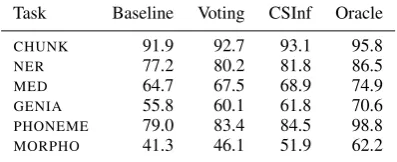
Task Baseline Voting CSInf Oracle
CHUNK 91.9 92.7 93.1 95.8
NE R 77.2 80.2 81.8 86.5
ME D 64.7 67.5 68.9 74.9
GE NIA 55.8 60.1 61.8 70.6
PHONE ME 79.0 83.4 84.5 98.8
[image:5.595.316.515.64.145.2]MORPHO 41.3 46.1 51.9 62.2
Table 1: Performances of the baseline method, and the trigram method combined both with majority voting, and with constraint satisfaction inference. The last column shows the performance of the (hy-pothetical) oracle inference procedure.
spelling changes due to compounding, derivation, or inflection that would enable the reconstruction of the appropriate root forms of the involved mor-phemes.
For CHUNK, and the three information
extrac-tion tasks, instances represent a seven-token win-dow of words and their (predicted) part-of-speech tags. Each token is labelled with a class using the IOB type of segmentation coding as introduced by Ramshaw and Marcus (1995), marking whether the middle word is inside (I), outside (O), or at the beginning (B) of a chunk, or named entity. Per-formance is measured by the F-score on correctly identified and labelled chunks, or named entities.
Instances for PHONEME, and MORPHO consist
of a seven-letter window of letters only. The labels assigned to an instance are task-specific and have been introduced above, together with the tasks themselves. Generalisation performance is mea-sured on the word accuracy level: if the entire phonological transcription of the word is predicted correctly, or if all three aspects of the morpholog-ical analysis are predicted correctly, the word is counted correct.
4.1 Results
For the experiments, memory-based learners were trained and automatically optimised with wrapped progressive sampling (Van den Bosch, 2004) to predict class trigrams for each of the six tasks in-troduced above. Table 1 lists the performances of constraint satisfaction inference, and majority vot-ing applied to the output of the base classifiers, and compares them with the performance of a naive baseline method that treats each token as a sepa-rate classification case without coordinating deci-sions over multiple tokens.
infer-ence outperforms majority voting by a consider-able margin. This shows that, given the same sequence of predicted trigrams, the global con-straint satisfaction inference manages better to re-cover sequential correlation, than majority voting. On the other hand, the error reduction attained by majority voting with respect to the baseline is in all cases more impressive than the one obtained by constraint satisfaction inference with respect to majority voting. However, it should be empha-sised that, while both methods trace back their ori-gins to the work of Van den Bosch and Daelemans (2005), constraint satisfaction inference is not ap-plied after, but instead of majority voting. This means, that the error reduction attained by major-ity voting is also attained, independently by straint satisfaction inference, but in addition con-straint satisfaction inference manages to improve performance on top of that.
5 Discussion
The experiments reported upon in the previous section showed that by globally evaluating the quality of possible output sequences, the con-straint satisfaction inference procedure manages to attain better results than the original majority vot-ing approach. In this section, we attempt to fur-ther analyse the behaviour of the inference pro-cedure. First, we will discuss the effect that the performance of the trigram-predicting base classi-fier has on the maximum performance attainable by any inference procedure. Next, we will con-sider specifically the effect of base classifier accu-racy on the performance of constraint satisfaction inference.
5.1 Base classifier accuracy and inference
procedure upper-bounds
After trigrams have been predicted, for each token, at most three different candidate labels remain. As a result, if the correct label is not among them, the best inference procedure cannot correct that. This suggests that there is an upbound on the per-formance attainable by inference procedures oper-ating on less than perfect class trigram predictions. To illustrate what performance is still possible af-ter a base classifier has predicted the trigrams for a sequence, we devised an oracle inference proce-dure.
An oracle has perfect knowledge about the true label of a token; therefore it is able to select this
la-bel if it is among the three candidate lala-bels. If the correct label is absent among the candidate labels, no inference procedure can possibly predict the correct label for the corresponding token, so the oracle procedure just selects randomly among the candidate labels, which will be incorrect anyway. Table 1 compares the performance of majority vot-ing, constraint satisfaction inference, and the ora-cle after an optimised base classifier has predicted class trigrams.
5.2 Base classifier accuracy and constraint
satisfaction inference performance
There is a subtle balance between the quality of the trigram-predicting base classifier, and the gain that any inference procedure for trigram classes can reach. If the base classifier’s predictions are perfect, all three candidate labels will agree for all tokens in the sequence; consequently the inference procedure can only choose from one potential out-put sequence. On the other extreme, if all three candidate labels disagree for all tokens in the se-quence, the inference procedure’s task is to select the best sequence among 3n possible sequences,
wherendenotes the length of the sequence; it is likely that such a huge amount of candidate label sequences cannot be dealt with appropriately.
Table 2 collects the base classifier accuracies, and the average number of potential output se-quences per sentence resulting from its predic-tions. For all tasks, the number of potential se-quences is manageable; far from the theoretical maximum 3n, even for GENIA, that, compared
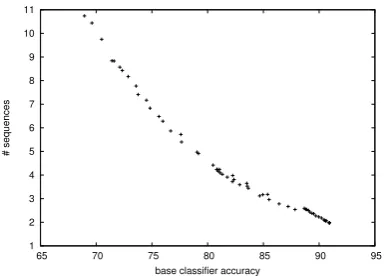
with the other tasks, has a relatively large num-ber of potential output sequences. The factors that have an effect on the number of sequences are rather complex. One important factor is the accu-racy of the trigram predictions made by the base classifier. To illustrate this, Figure 1 shows the number of potential output sequences as a function of the base classifier accuracy for the PHONEME
1 2 3 4 5 6 7 8 9 10 11
65 70 75 80 85 90 95
# sequences
[image:7.595.84.278.64.202.2]base classifier accuracy
Figure 1: Average number of potential output se-quences as a function of base classifier accuracy on thePHONEMEtask.
Task Base acc. Avg. # seq.
CHUNK 88.8 38.4
NE R 91.6 9.0
ME D 77.1 9.3
GE NIA 71.8 1719.3
PHONE ME 91.7 1.8
[image:7.595.302.527.64.227.2]MORPHO 80.9 2.8
Table 2: The average number of potential output sequences that result from class trigram predic-tions made by a memory-based base classifier.
are inherent properties of the task, and cannot be optimised.
While we have shown that improved base clas-sifier accuracy has a positive effect on the num-ber of possible output sequences; we have not yet established a positive relation between the num-ber of possible output sequences and the perfor-mance of constraint satisfaction inference. Fig-ure 2 illustrates, again for thePHONEMEtask, that
there is indeed a positive, even linear relation be-tween the accuracy of the base classifier, and the performance attained by inference. This relation exists for all inference procedures: majority vot-ing, as well as constraint satisfaction inference, and the oracle procedure. It is interesting to see how the curves for those three procedure compare with each other.
The oracle always outperforms the other two procedures by a wide margin. However, its in-crease is less steep. Constraint satisfaction in-ference consistently outperforms majority voting, though the difference between the two decreases as the base classifier’s predictions improve. This is to be expected, since more accurate predictions means more majorities will appear among
45 50 55 60 65 70 75 80 85 90 95
65 70 75 80 85 90 95
sequence accuracy
base classifier accuracy
oracle constraint satisfaction inference majority voting
Figure 2: Performance of majority voting, con-straint satisfaction inference, and the oracle infer-ence procedure as a function of base classifier ac-curacy on thePHONEMEtask.
date labels, and the predictive quality of such ma-jorities improves as well. In the limit –with a per-fect base classifier– all three curves will meet.
6 Related work
Many learning techniques specifically designed for sequentially-structured data exist. Given our goal of developing a method usable with non-probabilistic classifiers, we will not discuss the obvious differences with the many probabilistic methods. In this section, we will contrast our work with two other approaches that also apply prin-ciples of constraint satisfaction to sequentially-structured data.
Constraint Satisfaction with Classifiers (Pun-yakanok and Roth, 2001) performs the somewhat more specific task of identifying phrases in a se-quence. Like our method, the task of coordinating local classifier decisions is formulated as a con-straint satisfaction problem. The variables encode whether or not a certain contiguous span of tokens forms a phrase. Hard constraints enforce that no two phrases in a solution overlap.
Similarly to our method, classifier confidence estimates are used to rank solutions in order of preference. Unlike in our method, however, both the domains of the variables and the constraints are prespecified; the classifier is used only to esti-mate the cost of potential variable assignments. In our approach, the classifier predicts the domains of the variables, the constraints, and the weights of those.
[image:7.595.105.257.268.351.2]algo-rithm for inference in conditional random fields with an integer linear programming formulation. This allows arbitrary global constraints to be in-corporated in the inference procedure. Essentially, the method adds constraint satisfaction function-ality on top of the inference procedure. In our method, constraint satisfaction is the inference
procedure. Nevertheless, arbitrary global con-straints (both hard and soft) can easily be incor-porated in our framework as well.
7 Conclusion
The classification and inference approach is a pop-ular and effective framework for performing se-quence labelling in tasks where there is strong interaction between output labels. Most existing inference procedures expect a base classifier that makes probabilistic predictions, that is, rather than predicting a single class label, a conditional proba-bility distribution over the possible classes is com-puted. The inference procedure presented in this paper is different in the sense that it can be used with any classifier that is able to estimate a confi-dence score for its (non-probabilistic) predictions. Constraint satisfaction inference builds upon the class trigram method introduced by Van den Bosch and Daelemans (2005), but reinterprets it as a strategy for generating multiple potential out-put sequences, from which it selects the sequence that has been found to be most optimal according to a weighted constraint satisfaction formulation of the inference process. In a series of experi-ments involving six sequence labelling task cover-ing several different areas in natural language pro-cessing, constraint satisfaction inference has been shown to improve substantially upon the perfor-mance achieved by a simpler inference procedure based on majority voting, proposed in the original work on the class trigram method.
The work presented in this paper shows there is potential for alternative interpretations of the clas-sification and inference framework that do not rely on probabilistic base classifiers. Future work may well be able to further improve the performance of constraint satisfaction inference, for example, by using more optimised constraint weighting schemes. In addition, alternative ways of formu-lating constraint satisfaction problems from classi-fier predictions may be explored; not only for se-quence labelling, but also for other domains that could benefit from global inference.
References
R. H. Baayen, R. Piepenbrock, and H. van Rijn. 1993. The CELEX lexical data base on CD-ROM. Lin-guistic Data Consortium, Philadelphia, PA.
W. Daelemans and A. Van den Bosch. 1996. Language-independent data-oriented grapheme-to-phoneme conversion. In J. P. H. Van Santen, R. W. Sproat, J. P. Olive, and J. Hirschberg, edi-tors, Progress in Speech Processing, pages 77–89. Springer-Verlag, Berlin.
W. Daelemans, J. Zavrel, K. Van der Sloot, and A. Van den Bosch. 2004. TiMBL: Tilburg memory based learner, version 5.1.0, reference guide. Technical Report ILK 04-02, ILK Research Group, Tilburg University.
J. Lafferty, A. McCallum, and F. Pereira. 2001. Con-ditional random fi elds: Probabilistic models for seg-menting and labeling sequence data. In Proceed-ings of the 18th International Conference on Ma-chine Learning, Williamstown, MA.
V. Punyakanok and D. Roth. 2001. The use of classi-fi ers in sequential inference. InNIPS-13; The 2000 Conference on Advances in Neural Information Pro-cessing Systems, pages 995–1001. The MIT Press. L.A. Ramshaw and M.P. Marcus. 1995. Text
chunk-ing uschunk-ing transformation-based learnchunk-ing. In Pro-ceedings of the 3rd ACL/SIGDAT Workshop on Very Large Corpora, Cambridge, Massachusetts, USA, pages 82–94.
D. Roth and W. Yih. 2005. Integer linear programming inference for conditional random fi elds. InProc. of the International Conference on Machine Learning (ICML), pages 737–744.
Yuka Tateisi, Hideki Mima, Ohta Tomoko, and Junichi Tsujii. 2002. Genia corpus: an annotated research abstract corpus in molecular biology domain. In Hu-man Language Technology Conference (HLT 2002), pages 73–77.
E. Tjong Kim Sang and S. Buchholz. 2000. Introduc-tion to the CoNLL-2000 shared task: Chunking. In Proceedings of CoNLL-2000 and LLL-2000, pages 127–132.
E. Tjong Kim Sang and F. De Meulder. 2003. In-troduction to the conll-2003 shared task: Language-independent named entity recognition. In W. Daele-mans and M. Osborne, editors, Proceedings of CoNLL-2003, pages 142–147. Edmonton, Canada. A. Van den Bosch and W. Daelemans. 2005.
Improv-ing sequence segmentation learnImprov-ing by predictImprov-ing trigrams. In I. Dagan and D. Gildea, editors, Pro-ceedings of the Ninth Conference on Computational Natural Language Learning.