A n U n d e r s p e c i f i e d
H P S G
R e p r e s e n t a t i o n
f o r I n f o r m a t i o n
S t r u c t u r e
Jonas Kuhn
Institut fiir maschinelle Sprachverarbeitung
Azenbergstratte 12
D-70174 Stuttgart, Germany
E m a i h j o n a s ~ i m s , u n i - s t u t t g a r t , d eAbstract
hfformation structure can be of great use in linguistic applications, especially in those involving a speech component. However, fo- cus marking by prosody is often ambiguous. Existing theories capture this by rules that produce alternative focus structures. This disjunction is hard to handle computation- ally. In this paper, a compact, graphically underspecified representation is proposed, along with composition principles and a res- olution routine based on context informa- tion.
1 Introduction
This paper proposes an underspecified represen- tation for information structure (IS) and H P S G 1 principles t h a t build up this representation for German. The representation is designed as a ba- sis for use in applications like text-to-speech and speech translation systems. It is obvious that for a non-tiring, natural output, especially tile prosodic side of IS has to be taken into account. In this section, examples from sentence-based trans- lation with semantic transfer visualize the role of IS in several empirical domains. For one thing, ignoring IS may result in confusing translations: (2) with default accenting, 2 despite being truth- conditionally equivalent, is not a suitable transla- tion for (1B) in tile given context. System users will probably presume that a serious mistransla- tion occured.
(1) A: Zu unsercm Treffen wird also Frau Otto yon der Firma Miiller kommen?
('So, l~-au Otto of Miiller's will participate in our meeting?')
B: Nein, Frau SCHNEIDER wird Firma No, Frau Schneider will company Miiller vertreten.
Miiller represent
(2) No, Frau Schneider will represent MOLLER'S.
1See (Pollard/Sag,
1994).
2SMALL CAPS are used to highlight pitch accents.
Moreover, IS can be exploited to choose be- tween certain translation alternatives on sentence level (of. (Eberle, 1996)). The particle noch has different translations depending on accentuation:
(3) G. Maria sucht noch einen BRIEFKASTEN. Maria looks@~r still a post-bo~ E. Maria is still looking for a post box.
(4) G. Maria sucht NOCll einen Briefkasten. E. Maria is looking for another post box.
Concluding the set of initial examples, (5) shows t h a t focus call play a role in simple ilfferenees drawn from context to resolve lexical ambiguities (or similarly for ellipsis and a n a p h o r a resolution).
(5) ~%au S<:hulze kiindigte an, die Firma im Herbst zu besuchen.
('lS"au Schulze announced to visit tile com- pany in autumn.')
G. Ich nehme an, dab die Managerin ihren I assume that the manager her Besuch ~EGldiSST.
visit/visitors welcomes
E. I assume that the manager will APPI{ECI- ATE her visit.
(6) Ich kann lh'au Miiller nirgends im Geb/iude finden.
('I can't find Frau Miiller anywhere in the building.')
G. Ich nehme an, (lag die Managerin ihren BE- SUCH begriiBt.
E. I assume that tile manager is giving a wel- come to her VISITORS.
Since tile ambiguous B e s u c h in (5) is not focus- marked, it has to be contextually given. Even a simple context model will resolve the reference back to tile besuchen event mentioned in tile pre- ceding sentence, so the noun visit is chosen as a translation.
A sentence-based a c c o u n t of IS faces one prob- lem: in the general case, a certain prosodic m a r k - ing of a sentence does n o t c o r r e s p o n d to a unique IS. These cases of focus ambiguity have been dis- cussed extensiw~ly in t h e literature a n d will be briefly reviewed in see. 2. T h e existing H P S G a c c o u n t of IS by E n g d a h l / V a l l d u v i (1994) gelmr- ales a disjunction of a l t e r n a t i v e sentence analyses for a m b i g u o u s sentences, a Since focus a m b i g u i t y mull;Jiffies with all o t h e r kimts of ambiguity, a dis- j u n c t i v e t r e a t m e n t makes t h e use of IS in c o m p u - t a t i o n a l applications u n a t t r a c t i w ; . Therefore, an underspecified r e p r e s e n t a t i o n of IS is p r o p o s e d in this p a p e r (sec. 3) along with a resolution r o u t i n e on the basis of c o n t e x t i n f o r m a t i o n (see. 4). Fi- nally, t h e linguistic principles t h a t c o m p o s e the r e p r e s e n t a t i o n are worked o u t in H P S G (see. 5). T h e d a t a discussed are Gerlnan, b u t English is very similar.
2
F o c u s m a r k i n g
T h e basic d a t a are well-known. 4 A pitch accent on a direct o b j e c t like, Buch in (7), can serve to m a r k a n u m b e r of c o n s t i t u e n t s as focused: (8). 5 T h e focus D a t u r e is usually a s s u m e d to proje.ct.
(7) Karl hat ein BucII gelesen. Karl has a book read
(8) a. Karl hat [(;in BUCII]F gelesen. b. Karl hat [ein Buclt gelesen.]F c. [Karl hat ein Bucx~ gelesen.]F
A pitch accent on the s u b j e c t Karl however can- not t)roject focus (9), neither do a d j u n c t s t)roject focus (10).
(9) [KanL]~.~ hat ein Buch gelesen
(1{}) Maria
hat [DRAUSSEN]F
geniest. Maria has outside sneezedThese d a t a can be explained by the h)llowing F-Assignment Rules fi-om (Selkirk, 1995):a
(11) Basic F Rule
An accented word is F-marked.
aThe same is true fl)r practically all accounts of focus projection that I am aware o f - of., e.g., (Selkirk, :1995; Schwarzschild, 1995).
4For German, cf., e.g., (tIShle, 1982).
5The standard means to determine the focus of an utterance is the question test, where the tbcus in the answer corresponds to the interrogative constituent in the
question.
However, this test can be misleading in cases where the question comes in a wider context (ef. (16) below and the discussion in (Knhn, 1996)).~Rule (12b) may need some refinement. It is not clear whether it is a syntactic condition that con- strains indirect F-marking of a head. Jacobs (1994) argues that the notion of integration or ir~formational autonomy is resimnsible instead, which is baaed on the complexity in semantic processing. Unibrtunatcly, the formal nature of integration is still ill-understood.
(12) F Projection
a. F-marking of the head of a phrase licenses the F-marking of tile phrase.
b. F-marking of an internal argument of a head licenses the F-marking of the head.
A c c o r d i n g to tiles(; rules, the h e a d itself can p r o j e c t focus, which a p p e a r s to be refuted by (b~ta like the following.
(13) Karl hat ein
Buch
[GEIA!:SI']N.]FHowever, (13)
can have a wider focus if books are contextually given (this effect has been called dcaccenting). N o t e t h e diiference between (14) and (15), b o t h m a r k e d a c c o r d i n g to (11) a n d (12): a l t h o u g h their m a x i m a l focus d o m a i n ix identical, tin Buch is F - m a r k e d only in (15).(14) Karl hat [ein Buch [(;ELESEN.]F]F
(15) Karl hat [[ein Buc:n]l ,, [gelesen.]FJF
This is reflected in Schwarzsehild's (1995) in- terl)retation of the F-feature. All c o n s t i t u e n t s t h a t are not F - m a r k e d need to be given, where givenness is defined an e n t a i h n e n t by prior dis- course. E n t a i h n e n t is e x t e n d e d to expressions of o t h e r t y p e t h a n p r o p o s i t i o n s by existentially bind- ing unfilled a r g u m e n t s . 7 E v e n n o n - F - m a r k e d con- s t i t u e n t s e m b e d d e d in an F - m a r k e d c o n s t i t u e n t , like em Buch in (14) have to pass this givenness filter. So, d e a c c e n t i n g is no longer a special case for t h e theory.
To restrict the optional focus p r o j e c t i o n from (12) fllrther, Schwarzschild assumes an additional p r a g m a t i c filter Avoid F t h a t selects t h e tree with the least F - m a r k i n g . s
N o n - F - m a r k e d c o n s t i t u e n t s t h a t contain F- m a r k e d s u b c o n s t i t u e n t s need to be giwm as well. T h e c o n t e x t has to entail their F-skeleton the
7The exact definition is as tbllows ((Schwarzschild, 1995), pp.
5-6.):
An expression T (for target) is GIVEN iff it ha.s an antecedent, A, such that the existential closure of A entails the result of existentially binding F-variables in the existentially closed F-skeleton of T [where the ex- istential quantifier binding F-w~riablcs quantifies over contextually salient values].
The F-skeleton of an expression is the result of rc- placing F-marked elements witl, variables (working top to bottom).
The existential closure of an expression is the result of existentially binding all unfilled arguments of the expression.
if c~ is type t, ExClo((~) = c,. if c~ is of conjoinable type (a, b),
l~xCl,,(~) = 3x~,[ExOo(,~(x°))].
if c~ is type c, ExClo((t) = 3P(~,t)[P((t)].
result of replacing embedded F-marked elements with variables. 9 This condition allows to explain d a t a like (16) - a puzzle for theories based on the question test for focus (cf. fn. 5 above).
(16) A: Paula hat eine rote Rose fotografiert. Paula has a red rose photographed Was hat sie davor getan?
What has she before done
B: Sie hat eine [WEISSE]F Rose fotografiert. She has a white rose photographed A's question leads to expect focus marking of the complete VP, but intonational marking plus projection rules produce a narrow focus on weifle. Schwarzschild (1995) predicts the indicated F- marking, since the F-skeleton of the NP eine weifle Rose, for instance, (a X rose) is actually entailed by the context.
While non-F-marked constituents have to be given, F-marked constituents need not necessar- ily be new. This is to account for d a t a like the following, where ihn in (17B) is given:
(17) A: Wen hat Peters Mutter gelobt? Whom has Peter's mother praised? B: Sic hat [IHN]F gelobt.
She has him praised
The indicated F-marking follows from the the- ory: there has to be some F-marking, since the meaning of the complete sentence (Peter's mother praised Peter) is not entailed by the context. The F-skeleton variant Peter's mother praised X is ac- tually entailed by the question (17A), thus the F- marking of ihn.
3 A n u n d e r s p e c i f i e d r e p r e s e n t a t i o n
In computational applications, a compact repre- sentation is a prerequisite for any successful treat- ment of IS. Take the following short sentence with two pitch accents.
(18) Die Direktorin der Firma MULLER BEGRUSST
The director of company Miiller welcomes ihren Besuch.
her visit/visitors
Even if functional elements are ignored, the rules in (12) produce nine alternative F-markings t h a t have to be checked against the context for givenness. In order to resolve the lexical ambi- guity of Besueh however (cf. the discussion of (5) above), some partial information about IS suffices. The representation developed here is relatively independent of the underlying semantic theory of focus. Two semantical partitions for focus (FOC) and background (BG) are assumed, each of them a set of semantic conditions. Underspecification is expressed in a graphical way. The interpretation 1°
9There is some affinity to the f-semantic value in Rooth's (1985) alternative semantics, although the specific details are different.
rathe interpretation is given informally in the fol- lowing examples.
of each syntactic constituent forms a node in tile graph, while the directed edges express accessibil- ity relations.
(19) MARIA begrfiBt ihren BESUCH. Maria welcomes her visit~visitors
Maria begriiflt ihren Besuch
v
,, begriiflt ', ihren Besuch
(20) ", begr/iflt
', / i h r e n Maria ', ,'" B e s ~ / /
.~,
BG FOC
The solid line arrows signify obligatory inclu- sion in the respective IS partition, the dashed line arrows defeasible inclusion. The VP can, e.g., ei- ther belong to FOC (via a chain of arrows) or to BG. The graph in (20) represents the amount of information t h a t is encoded on sentence level without reference to context. Additional knowl- edge may introduce further solid arrows. If, e.g., a begriiflen event is contextually given (like in a question Who greets whom?), the arrow from begriiflt to BG will become an obligatory arrow. This arrow again will overrule the dashed arrow from begriiflt to ihren Besuch. Since the latter was the only path to access the FOC partition, the complete graph will collapse into a fully spec- ified representation of IS. Resolution will be dealt with in more detail in sec. 4.
The principles composing the representation are worked out formally in sec. 5. Here is an intuitive overview: the arrows pointing directly to the FOC and BG partition originate from accenting or non- accenting of the single words, respectively. The additional arrows between the constituent nodes are introduced by the grammatical principles of F-projection irrespective of the actual prosodic marking. This becomes clear when we regard the following alternative prosodic marking of (19): (21) MARIA BEGRUSST ihren Besuch.
Maria begr/iBt ihren Besuch
' begrii]]t 'qhren Besuch
( 2 2 ) ', ,
', , begrfii~t
\
', ,, lhren Maria
",', Besuch \ /
B G F O G
phrase ihren Besuch is forced into tile BG parti- tion, thus the utterance is correctly predicted to be restricted to contexts where Besueh is given. As anticipated above in tile discussion of the lex- ical ambiguity involved, this conelusioil can be drawn even if other points remain underspecified.
4 R e s o l u t i o n
An underspecified IS arising from tile prosodic marking of a sentence can be resolved by informa- tion from the context. As noted above, entaihnent by context introduces additional solid line arrows. rlb covet" more than just trivial cases, the (:ounter- part of Schwarzschild's (1995) F-skeleton has to bc kept track of in the underst)ecified representation. At first glance, this seems to be incompatible with the idea of underspeeification, since the F-skeleton t h a t is checked against the context for entailment, requires settlement on what the actual F-marking is. For instance, to check the givenncss of the VP in (23), reads a book about X has to be entailed, whereas on the basis of the marking in (24), reads
Y has to be entailed.
(23) I%anz liest ein Buch filler [S('ml"FE.]F l~'anz reads a book about ships
(24) bYanz liest [ein Buch filler [ScHnq"m]F]F The solution lies in the observation that the lat- ter F-skeleton entails the former. So, when a cer- tain constituent (e.g., again the VP in the abow~ examples) is checked for givenness, it suffices to assume F-marking of the maximal potentially F- marked subconstituents (I call this the maximality assumption). If it turns out t h a t the actual F- marking is more restricted, this will be detected at a lower level. For example, if (23) is the right solution, this will be discovered even if reads a book about X is not checked, since in this case, a book about X will be contextually given as well.
To illustrate resolution in tile graph representa- tion, take the following example in context: (25) a. Amta hat Otto fotografiert.
Anna has Otto photographed
l). HANS hat Otto ein Bv(,n gegeben. Hans has to-Otto a book given Sentence (25t)) produces the following graph: (Hans hat Otto ein Buch gegeben,
(3P, u e C)[P(u)]}
(Ot[o ein Buch gegeben, (3R~ C)(~:~)[n(x,Otto)])
/ / (ein Buch gegeben,
(3Q, z e C)(3x, y)[q(x, y, z)]}
(26)
1
/ ,~-.I ] .."" (gegeben, I i (~zeO)(Sx,y)[geben(x,y,z)])
(Otto,Otto) / / "'" . - J " " ~' (Ilans,u) ""-. '/ . ' " ' - ' - - ' " ' - (ein B ~
BG FOC
The nodes are now labelled by pairs. The first element of a pair is tile semantic wflue of the con- stituent corresponding to the node (here again ex- pressed inforlnally in natural language); the sec- ond eleinent is the F-skeleton based on the max- imality assumption - the F-skeleton is obtained by (i) replacing the maximal F-marked subcon- stituents (or sister constituents, in the case of in- direct F-marking of the head, following (12b)) by a variable, (it) existentially binding unfilled argu- ments, and (iii) existentially quantifying over the variables from the F-skeleton (cf. also fit. 7). The latter quantification is restricted by the set of con- textually salient values C.
In resolving underspecifieation from context, it is checked for each node with access to the BG t)artition ~t whether its F-skeleton is en- tailed by an antecedent in the context. For gegeben and the lowest verb projection ein Buch gcgeben, there is no such antecedent in the context. However, for the VP Otto cin Bueh gegeben the VP from (25a) Otto fo- tografiert is a suitable antecedent: after exis- tential binding, (~x) fotografieren(x,Otto) entails (~R C C)(3x)[R(x,Otto)]. Similarly for the con> plete sentence: fotogrMieren(Anna,Otto) entails ( 3 e , u C C)[P(u)]. So, solid line arrows replace the two dashed arrows pointing to BG (suggested in (26) by tile longer dashes).
The status of tile lower verb projections in (26) is still underspecified. If a wider context was con- sidered, antecedents could possibly be found, so it makes sense to end 1, t) with such a representation after processing the discourse (25). Once we know that all salient context has been considered, a rule of I'bcus Closure is at)plied. This strengthens the arrows pointing towards FO(] for all unresolved constituents, t)redicting eiu Buch .qcgcben as the focus for the example. In an at)plication, heuris- tics may trigger Focus Closure earlier, to aw)id unneecessary inferences.
The representation proposed here comes close to Sehwarzschild's (1995) theory of F-marking in coverage, .2 avoiding the computationally ext)en- sive disjunction of alternative analyses in favour of a single graph reI)resentation t h a t is under- specified when based on sentence internal infer-
n Constraining the givemmss check to nodes with access to the BG partition makes sure that narrow (eontrastive) focus on given entities (like in (17)) is treated correctly. Since all acce.nt on a word intro- duces just an arrow towards FOC, narrow focus on a word survives the check even in cases where the word is given.
m a t i o n only. l~lrthermore, Schwarzschild's prag- m a t i c c o n d i t i o n Avoid F t h a t selects t h e analysis with the least F - m a r k i n g (cf. fn. 8) is no longer needed.
5 H P S G
principles
T h e r e p r e s e n t a t i o n p r o p o s e d in sec. 3 a n d 4 can be i m p l e m e n t e d directly in a sign-based formalism like H P S G . In this section, tile central c o m p o s i t i o n principles for G e r m a n are worked out. A b i n a r y b r a n c h i n g s t r u c t u r e is assumed. Again, the repre- s e n t a t i o n will be fairly o p e n as to which p a r t i c u l a r s e m a n t i c formalism is chosen. This is reflected in tile Semantics Principle I assume, which specifies the s e m a n t i c value of a p h r a s e as the application of a two-place function compose to the s e m a n t i c val- ues of b o t h d a u g h t e r s . T h e function can be spelt o u t in different ways d e p e n d i n g on the choice of a semantic theory, la F u r t h e r m o r e , a function vari- able is a s s u m e d t h a t m a p s a s e m a n t i c o b j e c t to a new variable of the s a m e type.
T h e H P S G t y p e cont (the value of the CONT(ENT) feature) has the following four new features: O-SEM ( ' o r d i n a r y s e m a n t i c s ' ) a n d I,'-SKEL (F-skeleton) of the t y p e of a semantic ob- ject, tile set-valued IS-CSTR (IS constraints) a n d the b i n a r y MAX-F (for p o t e n t i a l m a x i m a l focus).
T h e phonological i n f o r m a t i o n is enriched by a feature PROM (prominence) with values accented
and unaccented.
T h e following principles specify the lS-CSTR set for a sign, i n t r o d u c i n g arrows, or links, between
(i) Der Direktor der SPARKASSE begr/it3te Frau
The director of-the savings-bank greeted Frau
MAIEIt.
Maier
(ii) Der Direktor der [SPARKASSE]F begrfiftte [Frau
MA,E~.] F
(iii) [Der Direktor
der [SPARKASSE]F]F
begrfiflte[Frau MAIER.]F
However, such a context is quite intricate to construct. Here is an example:
(iv) Der Direktor der Firma ABC sat~ im C~f~.
The director of company A B C sat in-the care
Der Kellner begriiflte eine Bekannte.
The waiter greeted a friend
Context (iv) does not entail der Direktor der X begriiflte Y, so (ii) is ruled out according to Schwarzschild's system. The resolution process pro- posed in this paper is based on the maximality as- sumption, and thus checks givenness for the com- plete sentence only once, with the complete subject F-marked. To rescue the difference between (ii) and (iii), it would have to be enforced that resolution of the subject NP takes place before the resolution of the focus projected from the object. This is a conceivable solution - however, declarative perspiguity would be sacrificed for a very moderate benefit, considering the main point of this paper.
lain the example below, simple predicate-argument semantics is used for illustration.
s e m a n t i c objects. (Tim IS p a r t i t i o n s / o c a n d bg
are here also t r e a t e d as s e m a n t i c objects.) T h e
h_link relation c o r r e s p o n d s to the o b l i g a t o r y (solid line) arrows in t h e graphs, s_link reflects defeasi- ble (dashed line) arrows. In t h e following, the link relations are expressed verbally. (27) is the coun- t e r p a r t t o (11); (28) a n d (29) reflect clauses (12a) a n d (12b).
(27) Focus Linking Principle
The O-SEM value of a pitch accented word is
h_linked to foe.
(28) Head F-Projection Principle
The O-SEM value of a phrase is s_linked to the O-SEM value of its head daughter.
(29) Indirect Head F-Marking Principle
In a head-complement-structure, where none of the head daughter's arguments have yet been saturated, 14 the O-SEM of the head daughter is
s_linked to the O-SEM value of the complement daughter.
T h e s e three principles establish direct or indi- rect links t o w a r d s foc. For the c o n s t i t u e n t s t h a t are n o t obligatorily focus m a r k e d , t h e u n d e r s p e c - ified r e p r e s e n t a t i o n requires additional defeasible links to bg:
(30) Background Linking Principle
The O-SEM value of every sign that is not ac- cented is s_linked to bg.
T h e principles just p r e s e n t e d c o m p o s e the rep- r e s e n t a t i o n i n t r o d u c e d in sec. 3, with t h e nodes in t h e g r a p h c o r r e s p o n d i n g to t h e O-SEM values. To provide the i n p u t for t h e resolution routine, t h e r e p r e s e n t a t i o n was enriched in sec. 4 by the F-skeleton. This is kept t r a c k of in the F-SKEL feature (assuming i n d e p e n d e n t existential binding of unfilled a r g m n e n t s a n d free variables).
(31) F-Skeleton Instantiation
The F-SKEL value of a word with
[O-SEM (~]
is (i) the function variable(a), if ~ is h_linked tofoc;
(ii) a, if the word is marked
[MAX-F
__];15 (iii) eomposition(a,fl) (where fl is the F-SKELvalue of the word's complement),
if the word is marked
[MAX-F J-J,
but a is not h_linked to foe.(32) F-Skeleton Principle
The F-SKIn, value of a phrase is the function
compose applied to
(i) the F-SKEL vahm of a daughter with [MAX-F --]; or
(ii) the function variable(a) of a daughter with
[MAX-F J-] and [O-SEM O~];
for both daughters.
14This formulation will be subject to changes once there is a clear concept of integration (cf. fn. 6) - (29) applies to integrated constitnents.
"IS-CSTR [ ] U [~] U
{ s3ink(m, b q),
sdink(N, [])]]
O-S~{M m(=
gab'(Bucl{)(Otto')(Hans'))
]
MAX-F - t -
• I1
U{ s_link([] , b9), sdink([] ,
IN)}/ O-SEM [ ] ( :
gab'(Buch')(Otto'))
/
F-SKELcompi~ ,var(IN))(= R2(Otto'))
MAX-F J-
_tl
/ [ , s - o s ' r R ( ~
= ) ~
u [ m/
I
U{s~ink(~, ~g), s~ink(®, [])}
/
Io-SnM IN(=
gab'(Uueh'))
• 4 3 ',
/
I F-s.~., ~o,,,I,(,,-r([]). ~,a,-(~J))(: Q (z),
-PROM u n a c c
IS-CS'FRIN
{h_link(N, foe)}
Us-cs'r.
[]{s_link(IN, bg)}
: IS-CSTR[~{h_link(IN, foe)}
O-SEM
[~Hans'
/O-SEM• O t t o '
O-SFMINBuch'
~-SK~,L var(~)(= ~)
IF-SKI, n,
[]
F-sK~L van(m)(= ~)
MAX-F J-
LMAX-F
-- MAX-F n t-I I
HANS O t t o
Figure 1: Sainple.
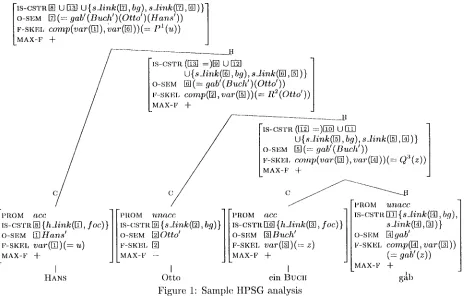
A sample analysis for (33), a slight simplifi('a- tion of (25b), is give.n in fig 1. The graph produced by the linking constrnints is the one in (26).
(an)
(Ich weifi, daft) HANS Otto ein BUCH gab.I
know that Hans to-Otto a book gave
Let us briefly see how the principles interact to produce the phraseein ]3uch gab
(For simplic- ity, the NP is treated as if it was a word). Sincetin Buch
bears a pitch accent, the Focus Linking Principle (27) applies, introducing an obligatory link to FOC(h_link([], foe)).
For the unaccentedgab,
the Background Linking Principle applies, giving rise to a defensible link(s_link(N, bg)).
At phrase level, the Indirect Head F-Marking Prin- ciple (29) and the Head F-Marking Principle ap- ply (introducings_link(g],N) for
the head, ands_link(N,iN)
for the phrase, respectively). In ad- dition, (27) applies again:s_link(iN, bg).
As for the F-Skeleton, subclause (i) of (31) ap- plies at
ein Buch,
subclause (iii) atgab,
causing the functioncompose
to apply togab's
own se- mantic value and to its sister's F-SKEL value. The phrase is covered by (32), where both daughters are marked [MAX-F +] and thus fulfil subclause (ii).6
C o n c l u s i o n
This paper shows that a fully expressive under- specified representation of IS (:an be effectively composed by linguistic principles, circumvening the eoinputational problems that the disjunctive analyses of existing theories pose. Also, a resolu- tion routine was presented. The idea is to leave
I
ein B u c I I HPSG analysis
sJi~k(m,m)}
O-SEM
[]gab'
l,'-SK~I~ eomp(ra, ~r(iN))
(=
g~t,'(~))
MAX-F J-
g~l)
the representation underspecified in applications, unless resolution is required for a specific reason.
R e f e r e n c e s
Eberle, Kurt (1996): "Disambiguation by information structure in DRT," COLING-96 (this conference). Engdahl, Elisabet, Enric VallduW (1994): "Infor-
mation packaging and grammar architecture: A constraint-based approach," in: Engdahl, E. (ed.):
Integrating information structure into constraint-
based and eategorial approaches
(DVANA-2Report
R.1.3.B).
ILLC, Amsterdam. 39 79.HShle, Tilman (1982): "Explikation fiir 'nor- male Betonung' und 'nor•ale Wortstellung'," in: Abraham, W. (ed.):
Satzglieder im Deutsehen.
Tiibingen: Gunther Narr Verlag.Jacobs, Joachim (1994): "Informational Autonomy." In: Bosch, P. and R. van der Sandt (eds.):
Focus
and Natural Language Processing.
Working Paper 6, ILL, IBM Heidelberg.Kuhn, Jonas (1996): "Context effects on.interpreta- tion and intonation". Ms. Institut fib maschinelle Sprachverarbeitung, Universit~t Stuttgart. ( f t p : / / ftp. ims. uni-stuttgart, de/pub/papers/kuhn/) Pollard, Carl, Ivan Sag (1994):
Head-Driven Phrase
Structure Grammar.
University of Chicago Press. Rooth, Mats (1985): "Association with Focus," PhDthesis. University of Massachusetts, Amherst. Selkirk, Elisabeth (1995): "SenteIlce Prosody: In-
tonation, Stress and Phrasing," In: Gold- smith, J. A. (ed.): Itandbook of Phonological The- ory, Basil Blackwell. London.
[image:6.596.49.517.58.354.2]