Parsing Parallel Grammatical Representations
Derrick Higgins
D e p a r t m e n t of LinguisticsUniversity of Chicago 1050 East 59th Street
Chicago, IL 60626
dchiggin (~midway.uchicago.edu
Abstract
~:aditional accounts of quantifier scope em- ploy qualitative constraints or rules to account for scoping preferences. This paper outlines a feature-based parsing algorithm for a gram- mar with multiple simultaneous levels of repre- sentation, one of which corresponds to a par- tial ordering among quantifiers according to scope. The optimal such ordering (as well as the ranking of other orderings) is determined in this grammar not by absolute constraints, but by stochastic heuristics based on the de- gree of alignment among the representational
levels.
A Prolog implementation is described and its accuracy is compared with that of other accounts.1 I n t r o d u c t i o n
It has long been recognized that the possibility and preference rankings of scope readings de- pend to a great degree on the position of scope- taking elements in the surface string (Chomsky, 1975; Hobbs and Shieber, 1987). Yet most tra- ditional accounts of semantic scopal phenomena in natural language have not directly tied these two factors together. Instead, they allow only certain derivations to link the surface structure of a sentence with the representational level at which scope relations are determined, place constraints upon the semantic feature-passing mechanism, or otherwise emulate a constraint which requires some degree of congruence be- tween the surface syntax of a sentence and its preferred scope reading(s).
A simpler and more direct approach is sug- gested by constraint-based, multistratal theo- ries of g r a m m a r (Grimshaw, 1997; Jackendoff, 1997; Sadock, 1991; Van Valin, 1993). In these models, it is possible to posit multiple represen- tational levels for a sentence without according
ontological primacy to any one of them, as in all varieties of transformational grammar. This allows constraints to be formulated which place limits on structural discrepancies between lev- els, yet need not be assimilated into an overrid- ing derivational mechanism.
This paper will examine the model of one of these theories, Autolexical G r a m m a r (Sadock, 1991; Sadock, 1996; Schiller et al., 1996), as it is implemented in a computational scope gen- erator and critic. This left-corner chart parser generates surface syntactic structures for each sentence (as the only level of syntactic represen- tation), as well as Function-Argument seman- tic structures and Quantifier/Operator-Scope structures. These latter two structures together determine the semantic interpretation of a sen- tence.
It will be shown that this model is both categorical enough to handle standard gener- alizations about quantifier scope, such as bans on extraction from certain domains, and fuzzy enough to present reasonable preference rank- ings among scopings and account for lexical differences in quantifier strength (Hobbs and Shieber, 1987; Moran, 1988).
2 A M u l t i d i m e n s i o n a l A p p r o a c h t o
Quantifier Scoping
2.1 T h e A u t o l e x i c a l M o d e l
and Operator Scope Structure.
The surface syntactic hierarchy is a feature- based grammar expressing those generalizations about a sentence which are most clearly syn- tactic in nature, such as agreement, case, and syntactic valency. The function-argument hi- erarchy expresses that (formal) semantic infor- mation about a sentence which does not involve scope resolution, e.g., semantic valency and as- sociation of referential terms with argument po- sitions, as in Park (1995). The operator scope hierarchy, naturally, imposes a scope ordering on the quantifiers and operators found in the expression. Two other, minor hierarchies are employed in this implementation. The linear or- dering of words in the surface string is treated as a hierarchy, and a lexical hierarchy is intro- duced in order to express the differing lexical
"strength" of quantifiers.
Each hierarchy can be represented as a tree in which the terminal nodes are not ordered with respect to one another. This implies that, for example, [John [saw Mary]] and [Mary [saw John]] will both be acceptable syntactic rep- resentations for the surface string Mary saw John. The optimal set of hierarchies for a string consists of the candidate hierarchies for each level of representation which together are most structurally congruous. The structural similar- ity between hierarchies is determined in Au- tolexical G r a m m a r by means of an Alignment Constraint, which in the implementation de- scribed here counts the number of overlapping constituents in the two trees. Thus, while struc- tures similar to [Mary [saw John]] and [John [saw Mary]] will both be acceptable as syntac- tic and function-argument structure representa- tions, the alignment constraint will strongly fa- vor a pairing in which both hierarchies share the same representation. Structural hierarchies are additionally evaluated by means of a Contigu- ity Constraint, which requires that the terminal nodes of each constituent of a hierarchy should be together in the surface string, or at least as close together as possible.
2.2 Quantifier Ordering Heuristics The main constraints which this model places on the relative scope of quantifiers and opera- tors are the alignment of the operator scope hi- erarchy with syntax, function-argument struc- ture, and the lexical hierarchy of quantifier
strength. The first of these constraints reflects "the principle that left-to-right order at the same syntactic level is preserved in the quan- tifier order" 1 and accounts for syntactic extrac- tion restrictions. The second will favor operator scope structures in which scope-taking elements are raised as little as possible from their base ar- gument positions. The last takes account of the scope preferences of individual quantifiers, such as the fact that each tends to have wider scope than all other quantifiers (Hobbs and Shieber, 1987; Moran, 1988).
As an example of the sort of syntactically- based restrictions on quantifier ordering which this model can implement, consider the general- ization listed in Moran (1988), that "a quanti- fier cannot be raised across more than one ma- jor clause boundary." Because the approach pursued here already has a general constraint which penalizes candidate parses according to the degree of discrepancy between their syntax and scope hierarchies, we do not need to accord a privileged theoretical status to "major clause boundaries."
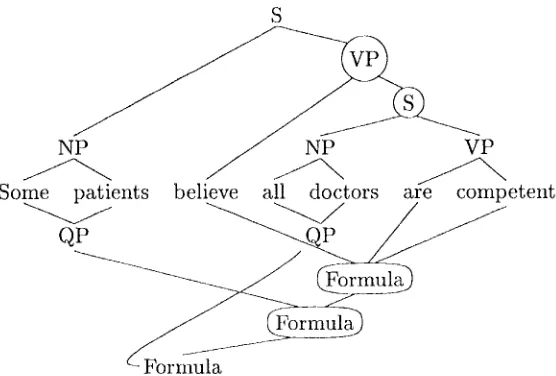
Figure 1 illustrates the approximate optimal structure accorded to the sentence Some pa- tients believe all doctors are competent on the syntactic and scopal hierarchies, in which an extracted quantifier crosses one major clause boundary. It will be given a misalignment index of 4 (considering for the moment only the inter- action of these two levels), because of the four overlapping constituents on the two hierarchies. This example would be misaligned only to de- gree 2 if the other quantifier order were chosen, and depending on the exact sentence type con- sidered, an example with a scope-taking element crossing two major clause boundaries should be misaligned to about degree 8.
The fact that the difference between the pri- mary and secondary scopings of this sentence is 2 degrees of alignment, while the difference between crossing one clause boundary and two clause boundaries is 4 degrees of alignment, cor- responds with generally accepted assumptions about the acceptability of this example. While the reading in which the scope of quantifiers mirrors their order in surface structure is cer- tainly preferred, the other ordering is possible as well. If the extraction crosses another clause
S
N P
Some patients believe all doctors are c o m p e t e n t
~ F o r m u l a
Figure 1: Illustration of the Alignment Constraint. The four highlighted nodes count against this c o m b i n a t i o n of structures, because t h e y overlap with constituents in the other tree.
b o u n d a r y , however, as in Some patients believe Mary thinks all doctors are competent, the re- versed scoping is considerably more unlikely.
2.3 L e x i c a l P r o p e r t i e s o f Q u a n t i f i e r s
In addition to ranking the possible scopings of a sentence based on the surface syntactic posi- tions of its quantifiers and operators, the pars- ing and alignment algorithm employed in this project takes into account the "strength" of dif- ferent scope-taking elements. By introducing a lexical hierarchy of quantifier strength, in which those elements more likely to take wide scope are found higher in the tree, we are able to use the same m e c h a n i s m of the alignment constraint to model the facts which other approaches treat with stipulative heuristics.
For example, in Some patient paid each doc- tor, the preferred reading is the one in which
each takes wide scope, c o n t r a r y to our expecta- tions based on the generalization t h a t the pri- m a r y scoping tends to mirror surface syntactic order. An approach employing some variant of Cooper storage would have to account for this by assigning to each pair of quantifiers a like- lihood t h a t one will be raised past tile other. In this case, it would be highly likely for each
to be raised past some. T h e autolexical ap- proach, however, allows us to achieve the same effect w i t h o u t introducing an additional device. Given a proper weighting of the result of align- ing the scope hierarchy with this lexical hierar-
chy, it is a simple m a t t e r to settle on the correct candidates.
3 T h e A l g o r i t h m 3.1 P a r s i n g S t r a t e g y
This implementation of the Autolexical account of quantifier scoping is w r i t t e n for SWI-Prolog, and inherits much of its feature-based g r a m m a t - ical formalism from tile (:ode listings of Gazdar and Mellish (1989), including d a g u n i f y . p l , by Bob Carpenter. T h e general strategy employed by the program is first to find all parses which each hierarchy's g r a m m a r permits for the string, and then to pass these lists of structures to func- tions which implement the alignment and con- tiguity constraints. These functions perform a pairwise evaluation of the agreement between structures, eventually converging on the opti- mal set of hierarchies.
Tile same parsing engine is used to generate structures for each of the m a j o r hierarchies con- tributing to the representation of a string. It is based on the left-corner parser of p r o _ p a r r , p l in Gazdar and Mellish (1989), a t t r i b u t e d origi- nally to Pereira and Shieber (1987). This parser has been extended to store i n t e r m e d i a t e results for lookup in a hash table.
[image:3.612.163.441.67.255.2]the f u n c t i o n - a r g u m e n t parsing process. Such a development would allow us to express catego- rim p r o t o t y p e s in a natural way. For example, the p r o p o s i t i o n t h a t "syntactic N P s tend to de- note semantic arguments" could be modeled as a default rule for incorporating syntactic edges into a f u n c t i o n - a r g u m e n t s t r u c t u r e parse.
T h e "generate and test" mechanism em- ployed here to maximize the congruity of repre- sentations on different levels is certainly some- what inefficient. Some of the structures which it considers will be bizarre by all accounts. To a certain degree, this profligacy is held in check by heuristic cutoffs which exclude a combina- tion from consideration as soon as it becomes a p p a r e n t t h a t is misaligned to an unacceptable degree. Ultimately, however, the solution may lie in some sort of parallel approach. A develop- ment of this p r o g r a m designed either for parallel Prolog or for a truly parallel architecture could effect a further restriction on the candidate set of representations by implementing constraints on parallel parsing processes, rather than (or in addition to) on the o u t p u t of such processes. 3.2 A l i g n m e n t
The alignment constraint (applied by the a l i g n / 3 predicate here) compares two trees (Prolog lists), returning the total n u m b e r of overlapping constituents in b o t h trees as a mea- sure of their misalignent. Constituents are said to overlap if the sets of terminal nodes which they d o m i n a t e intersect, b u t neither is a subset of the other.
The code fragment below provides a rough outline of the o p e r a t i o n of this predicate. First, b o t h trees being c o m p a r e d are "pruned" so that neither contains any terminal nodes not found in the other. The terminal elements of each of the tree's constituents are then recorded in lists. Once those constituents which occur in b o t h trees are removed, the sum of the length of these two lists is the total n u m b e r of overlap- ping constituents.
align(Li,L2,Num) "-
flatten(Li,Fl), flatten(L2,F2), union(Fi,F2,AllTerms),
intersection(FI,F2,GoodTerms),
subtract(AllTerms,GoodTerms,BadTerms),
Delete constits without correlates rmbad(Li,BadTerms,Goodl),
rmbad(L2,BadTerms,Good2),
% Get list of c o n s t i t s in e a c h t r e e c o n s t i t s ( G o o d l , C L i s t l ) ,
c o n s t i t s ( G o o d 2 , C L i s t 2 ) ,
D e l e t e d u p l i c a t e s
i n t e r s e c t i o n ( C L i s t l , C L i s t 2 , C L i s t 3 ) , s u b t r a c t ( C L i s t l , C L i s t 3 , F i n a l l ) , s u b t r a e t ( C L i s t 2 , C L i s t 3 , F i n a l 2 ) ,
% Count mismatches length(Finall,Sizel), length(Final2,Size2), Num is Sizel + Size2.
3.3 C o n t i g u i t y
While tile alignment constraint evaluates the similarity of two trees, the contiguity constraint ( c o n t i g / 3 in this project) calculates the degree of fit between a hierarchy and a string (in this case, the surface string). The relevant measure of "goodness of fit" is taken here to be the min- imal n u m b e r of crossing branches the s t r u c t u r e entails. It is true that this approach makes the contiguity constraint d e p e n d e n t on the partic- ular grammatical rules of each representational level. However, since an Autolexical model does not a t t e m p t to handle syntax directly in the semantic representation, or morphology in the syntactic representation, there is no real dan- ger of proliferating nonterminal nodes on any particular level.
The definition of the c o n t i g predicate is somewhat more complex than that for a l i g n , because it must find the m i n i m u m n u m b e r of crossing branches in a structure. It works by maintaining a chart (based on the c o n t v a l predicate) of the n u m b e r of branches "covering" each constituent, as it works its way up the tree. The c o n t m i n predicate keeps track of the cur- rent lowest contiguity violation for the struc- ture, so that worse alternatives can be aban- doned as soon as they cross this threshold. c o n t i g ( [ ] , _ , 0 ) .
c o n t i g ( A , _ , 0 ) "- n o t (is_list (A)),
!.
is list(A),
c o n t i g (A, F l a t , Num), !.
contig( [A,B] ,Flat ,Num) "- c o n t i g ( A ,Flat, Numl) , e o n t i g ( B , F l a t ,Num2) ,
contval (A, Left i, Right I, Num3), contval (B, Left2, Right2, Num4), N u m O is Numl + Num2 + Num3 + Num4,
f o r a l l ( c o n t m i n (Min) ,
(NumO >= Min) *-> fail ; true),
N u m is NumO,
f o r a l l (contval (X,L,R,N) , (L > m i n ( L e f t i , L e f t 2 ) ,
R < m a x ( g i g h t i , R i g h t 2 ) ) *->
(retract (contval (X,L,R,N)) ,
a s s e r t a ( c o n t v a l ( X , L , R , N + l ) ) )
; true) , asserta(
contval([h,B] ,min(Leftl,Left2) , m a x (Right I, R i g h t 2), 0 ) ).
c o n t i g ( [B,A] ,Flat,Num) "-
c o n t i g (A, Flat ,Numl),
c o n t i g (B ,Flat, Num2),
e o n t v a l (A,Left i ,Right I, Num3),
c o n t v a l (B, Left2, R i g h t 2, Num4), N u m O is Numl + Num2 + Num3 + Num4,
f o r a l l ( c o n t m i n (Min) ,
(NumO >= Min) *-> fail ; true),
N u m is NumO,
f o r a l i (contval (X, L, R, N) ,
(L > m i n ( L e f t l , L e f t 2 ) ,
R < m a x ( R i g h t l , R i g h t 2 ) ) *-> (retract ( c o n t v a l (X, L, R, N) ) ,
a s s e r t a ( c o n t v a l ( X , L , R , N + l ) ) )
; true) ,
a s s e r t a (
c o n t v a l ( [ A , B ] , m i n ( L e f t l , L e f t 2 ) ,
m a x (Right i ,Right2) ,0) ).
4 C o n c l u s i o n
Multistratal theories of grammar are not often chosen as guidelines for computational linguis- tics, because of performance and manageability concerns. This project, however, should at least demonstrate that even in a high-level language like Prolog a multistratal parsing model can be made to produce consistent results in a reason- able length of time.
Furthermore, the project described here does more than simply emulate the output of a stan- dard, monostratal CF-PSG parser; it yields a
preference ranking of readings for each string, rather than a single right answer. While the Autolexical model may not now be correct for applications in which speed is of primary con~ cern, it has only begun to be iinplemented com- putationally, and any serious attempt at infer- encing from natural language input will have to produce similar, graded output (Moran, 1988). R e f e r e n c e s
Noam Chomsky. 1975. Deep structure, sur- face structure, and semantic interpretation. In Studies on Semantics in Generative Gram- mar, pages 62-119. Mouton.
Gerald Gazdar and Chris Mellish. 1989. Natu- ral Language Processing in PROLOG. Addi- son Wesley.
Jane Grimshaw. 1997. Projection, heads, and optimality. Linguistic Inquiry, 28(3):373- 422.
Jerry R. Hobbs and Stuart M. Shieber. 1987. An algorithm for generating quantifier scop- ings. Computational Linguistics, 13:47- 63. Ray Jackendoff. 1997. The Architecture of the
Language Faculty. Number 28 in Linguistic Inquiry Monographs. The MIT Press.
Douglas B. Moran. 1988. Quantifier scoping in the SRI core language engine, in ACL Pro- ceedings, 26th Annual Meeting, pages 33-40. Jong C. Park. 1995. Quantifier scope and con-
stituency. In A CL Proceedings, 33rd Annual Meeting.
Fernando C.N. Pereira and Stuart M. Shieber. 1987. Prolo9 and Natural-Language Analysis, volume 10 of CSLI Lecture Notes. Center for the Study of Language and Information. Jerrold M. Sadock. 1991. Autolexical Syntax: a
Theory of Parallel Grammatical Representa~ tions. University of Chicago Press.
Jerrold M. Sadock. 1996. Reflexive reference in west greenlandic. Contemporary Linguistics, 1:137- 160.
Eric Schiller, Elisa Steinberg, and Barbara Need, editors. 1 9 9 6 . Autolexical Theory: Ideas and Methods. Mouton de Gruyter. Robert D. Van Valin, editor. 1993. Advances