Large Scale Collocation Data and Their Application
to Japanese Word Processor Technology
Yasuo Koyama, Masako Yasutake, Kenji Yoshimura and Kosho Shudo Institute for Information and Control Systems, Fukuoka University
Nanahm~ Fukuoka, 814-0180 Japan
koymna@~sofeco.jp, [email protected], yosimma@tlsu~fl.fukuoka-u.ac.jp, [email protected]~ka-u.ac.jp
abstract
Word processors or computers used in Japan employ Japanese input method through key- board stroke combined with Kana (phonetic) character to Kanji (ideographic, Chinese) char- acter conversion technology. The key factor of Kana-to-Kanji conversion technology is how to raise the accuracy of the conversion through the homophone processing, since we have so many homophonic Kanjis. In this paper, we report the results of our Kana-to-Kanji conver- sion experiments which embody the homo- phone processing based on large scale colloca- tion data. It is shown that approximately 135,000 collocations yield 9 . 1 % raise of the conversion accuracy compared with the pro- totype system which has no collocation data,
1. Introduction
Word processors or computers used in Japan ordi- narily employ Japanese input method through key- board stroke combined with Kana (phonetic) to Kanji (ideographic, Chinese) character conversion teclmology. The Kana-to-Kanji conversion is per- formed by the morphological analysis on the input Kana string with no space between words. Word- or phrase-segmentation is carried out by the analysis to identify the substring of the input which has to be converted from Kana to Kanji. Kana-Kanji mixed string, which is the ordinary form of Japanese writ- ten text, is obtained as the final result. The major issue of this technology lies in raising the accuracy of the segmentation and the homophone processing to select the correct Kanji among many homophonic candidates.
The conventional methodology for processing ho- mophones have used the function that gives the pri- ority to the word which was used lastly or to the high frequency word. In fact, however, this method sometimes tends to cause inadequate conversion due
to the lack of consideration of the semantic consis- tency of the word concurrence. While it is difficult to employ the syntactic or semantic processing in earnest for the word processor from the cost vs. performance viewpoints, for example, the following trials to improve the conversion accuracy have been reported: Employing the case-frame to check the semantic consistency of combination of words [Oshima, Y. et a1.,1986]. Employing the neural net- work to describe the consistency of the concurrence of words [Kobayashi,T. et al.,1992], Making a con- cun'ence dictionary for the specific topic or field, and giving the priority to the word which is in the dictionary when the topic is identified [Yamamoto, K. et al., 1992]. In any of these studies, however, many problems are left unsolved in realizing its practical system.
Besides these semantic or quasi-semantic gadgets, we think it much more practical and effective to use surface level resources, namely, to use extensively the collocation. But how many collocations contrib- ute to the accuracy of Kana-to-Kanji conversion is not known yet.
In this paper, we present some results of our ex- periments of Kana-to-Kanji conversion, focusing on the usage of large scale collocation data. In chapter 2, descriptions of the collocations used in our sys- tem and their classification are given. In chapter 3, the technological framework of our Kana-to-Kanji conversion systems is outlined. In chapter 4, the method and the results of the experhnents are given along with some discussions. In chapter 5, con- eluding remarks are given.
2. Collocation Data
accuracy of the extraction, namely the necessity and sufficiency of the data set. The collocations which are used in our Kana-to-Kanji conversion system consist of two kinds: (1) idiomatic expressions, whose meanings seem to be difficult to compose fi:om the typical meaning of the individual compo- nent words [Shudo, K. et al., 1988]. (2) stereotypical expressions in which the concurrence of component words is seen in the texts with high frequency. The collocations are also classified into two classes by a grammatical criterion: one is a class of functional collocations, which work as functional words such as particles (postpositionals) or auxiliary verbs, the other is a class of conceptual collocations which work as nouns, verbs, adjectives, adverbs, etc. The latter is further classified into two kinds: uninter- ruptible collocations, whose concurrence relation- ship of words are so strong that they can be dealt with as single words, and interruptible collocations, which are occasionally used separately.
In the following, the parenthesized number is the number of expressions adopted in the system.
2.1 F u n c t i o n a l Collocations (2,174)
We call expressions which work like a particle rela- tional collocation and expressions which work like an auxiliary verb at the end of the predicate auxili- ary predicative collocation [Shudo, K. et al., 1980].
relational collocations (760) ex. J=/'Dg~T2
ni/tuite (about)
attxiliary predicative collocations (1,414) ex ~
I ~ f ~ l t g 6 tg I,~
" naliereba/naranai (must)
2.2 U n i n t e r r u p t i b l e C o n c e p t u a l Col-
locations (54,290)
four-Kanji-compound (2,231)
ex. ~1~t ~.1~.
gqaenmsut
(every miller draws water to his own mill)
adverb + particle type (3,089) ex.
~tz,5,t: ~=
ataJutato (disconcertedly) adverb + sum type (1,043)
ex ~ < t ¢ < - ¢ ~
• aKusekusuru (toil and moil)
noun type (21,128)
ex.
~ 0 ~ / ~ ) ,a ~ n o / t a n m (perfect stranger)
verb type (13,225)
ex. ~ ' 9 Lj ¢ j ~ / ~
o t s u r i g a / ~ r u .
(be enough to make the change)
adjective type (2,394)
ex. t~l,~, L, t,~
uraganasnii (mournful)
adjective verb type (397)
ex. c ' ~ N 0 3
gomgen/naname (in a bad mood) adverb and other type (8,185)
ex. N I : - l ~ , ~ 72
meni/miete (remarkably)
proverb type (2,598)
o~teha/koni/shitagae
(when old, obey your children)
2.3 Interruptible C o n c e p t u a l Colloca-
tions (78,251)
noun type (7,627) ex. ,1~2 03/ttt t,
akugyouno/mukui (fruit of an evil deed)
verb type (64,087) ex. ~ ~ ~?/N175~;h,~
ushirogamiwo/hikareru
(feel as if one's heart were left behind)
adjective type (3,617) ex. ~ 1 ~ / . ~ - ~ L~
taidOgasookii ( act in a lordly manner)
adjective verb type (2,018)
ex. ~ ¢ 0 ~ / &
yaliushaga/ue (be lnore able) others (902)
ex. ~1:/,~ I t-~ga
atoni/hikenu (can not give up)
3. K a n a - t o - K a n j i C o n v e r s i o n Systems
We developed four different Kana-to-Kmlji conver- sion systems, phasing in the collocation data de- scribed in 2. The technological framework of the system is based on extended bunsetsu (e- bunsetsu) model [Shudo, K. et al., 1980] for the unit of the segmentation of the input Kana string, and on minimum cost method [Yoshimura, K. et al., 1987] combined with Viterbi's algorithn~ [Viterbi, A,, J., 19671 for the reduction of the ambi- guity of the segmentation.
phrase which composes Japanese sentences, and an e-bunsetsu, which is a natural extension of the bun- setsu, is defined roughly as follows:
<e-bunsetsu>::= <prefix>* <conceptual word l uninterruptible conceptual collocation> <suffix>* <functional word l
functional collocation>*
The e-bunsetsu which includes no collocation is the bunsetsu. More refined rules are used in the actual segmentation process. The fllterruptible conceptual collocation is not treated as a single unit but as a string ofbunsetsus in the segmentation process. Each collocation in the dictionary which is com- posed of multiple number of bunsetsus is marked with the boundary between bunsetsus. The system first tries to segment the input Kana string into e- bunsetsus. Every possible segmentation is evaluated by its cost. A segmentation which is assigned the least cost is chosen as the solution.
The boundary between e-bunsetsus in examples in this paper is denoted by "/".
ex. two results of e-bunsetsu-segmentation:
. hitolTa lagqtcikumtcositaxoto~aarimasen (there is nothing like being watchful)
h i toha/ki gafkilcun i /k6s i ta/ko toha/arimasen
In the above examples, ~$~/~11 ( kiga/kdku: is uninterruptible conceptual collocation and [7-/i~ 1., 7~z/]~[~,/;~ LJ ~ ' ~ / v nL/kosita/kotoha/arimasen: is a functional collocation. In the first example, these collocations are dealt with a single words. The second example shows the conventional bunsetsu- segmentation.
The cost for the segmentation candidate is the sum of three partial costs: b-cost, c-cost and d-cost shown below.
(1)a segment cost is assigned to each segment. Sum of segment costs of all segments is the basic cost (b-cost) of a segmentation candidate. By this, the collocation tends to have priority over the ordi- nary word. The standard and initial value of each segment cost is 2, and it is increased by 1 for each occurrence of the prefix, suffix, etc. in the seg- ment.
(2)a concatenation cost (c-cost) is assigned to speci- fic e-bunsetsu boundaries to revise the b-cost. The concatenation, such as adnominal-noun, ad- verb-verb, noun-noun, etc. is paid a bonus , namely a negative cost, - 1.
(3)a dependency cost (d-cost), which has a negative value, is assigned to the strong dependency rela- tionship between conceptual words in the candi- date, representing the consistency of concurrence of conceptual words. By this, the segmentation containing the interrupted conceptual collocation tends to have priority. The value of a d-cost varies fi'om -3 to -1, depending on the strength of the concurrence. The interruptible conceptual collo- cation is given the biggest bonus i.e.-3.
The reduction of the homophonic ambiguity, which limits Kanji candidates, is carried out in the course of the segmentation and its evaluation by the cost.
3.1 Prototype System A
We first developed a prototype Kana-to-Kanji con- version system which we call System A, revising Kana-to-Kanji conversion software on the market, WXG Ver2.05 for PC.
System A has no collocation data but conventional texical resources, namely functional words (1,010) and conceptual words (131,661).
3.2 System B, C and D
We reinforced System A to obtain System B, C and D by phasing in the following collocational re- sources. System B is System A equipped addition- ally with functional collocations (2,174) and unin- terruptible conceptual collocations except for four- Kanji-compound and proverb type collocations (49,461). System C is System B equipped addition- ally with four-Kanji-compound (2,231) and proverb type collocations (2,598). Further, System D is Systean C equipped additionally with interruptible conceptual collocations (78,251).
4. Experiments
4.1 Text Data for Evaluation
Prior to the experiments of Kana-to-Kanji conver- sion, we prepared a large volume of text data by hand which is formally a set of triples whose first component a is a Kana string (a sentence) with no space, The second component b is the correct seg- mentation result of a, indicating each boundary between bunsetsus with "/" or ".". "/" and .... means obligatory and optional boundary, respec- tively. The third component e is the correct conver- sion result of a, which is a Kana-Kanji mixed string.
(roses are in bloom in a garden) b: f Z . ~ f Z / l g 6 / 3 ~ / ~ t,~Z'.t,~/-o
niwani/baraga,/saite, iru
e:
I~l:l,~#J*,ll~l,~'~.l,~
}
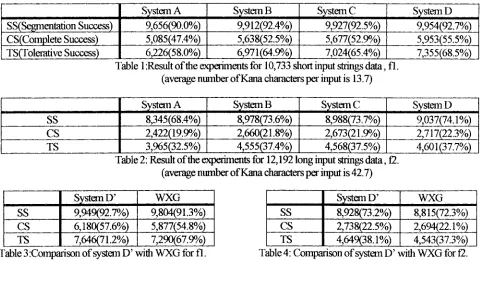
The introduction of the optional boundary assures the flexible evaluation. For example, each ofll~t,~ -C./L~ saite/iru (be in bloom) and I ~ L ~ - C ' L ~ saiteiru is accepted as a correct result. The data file is divided into two sub-files, fl and t2, depending on the number of bunsetsus in the Kana string a. fl has 10,733 triples, whose a has less than five bunsetsus and t2 has 12,192 triples, whose a has more than four bunsetsus.
4.2 Method of Evaluation
Each a in the text data is fed to the conversion sys- tem. The system outputs two forms of the least cost result: b', Kana string segmented to bunsetsus by "/", and c', Kana-Kanji mixed string, corresponding to b and e of the correct data, respectively. Each of the following three cases is counted for the evalua- tion.
SS (Segmentation Success): b TM b
CS (Complete Success): b'-- b and e '= e TS (Tolerative Success): b '= b and c ' - c There are mmly kinds of notational fluctuation in Japanese. For example, the conjugational suffLX of some kind of Japanese verb is not always necessi-
tated, therefore,~tJ_Ir_PJ~,~.l:l~ and ~ 1 - are all acceptable results for input "St, J~[-~ uriage (sales). Besides, a single word has sometimes more than one Kanji notations, e.g. ~ hama (beach) and hama (beach) are both acceptable, and so on. c ' - c in the case of TS means that e' coincides with c completely or excepting the part which is hetero- morphic in the above sense. For this, each of our conversion system has a dictionary which contains approximately 35,000 fluctuated notations of con- ceptual words.
4.3 Results of Experiments
Results of the experhnents are given in Table 1 and Table 2 for input file fl and t2, respectively.
Comparing the statistics of system A with D, we can conclude that the introduction of approximately 135,000 collocation data causes 8 . 1 % and 10.5 % raise of CS and TS rate, respectively, in case of re- latively short input strings (fl). The raise of SS rate for fl is 2.7%. In case of the longer input strings (12) whose average number of bunsetsus is approxi- mately 12.6, the raise ofCS, TS and SS rate is 2.4 %, 5.2 % and 5.7 %, respectively. As a consequence, the raise of CS, TS mid SS rate is 6.2 %, 9 . 1 % and 3.8 % on the average, respectively.
I I
SS(Se~entation Success) CS(Complete Success) TS(Tolerative Success)..
STstem A
S~¢stean B
S~stem C
I I
[image:4.612.70.554.432.720.2]9,656(90.0°/0) 9,9.12(92.4°,4) 9,927(92.5%) 5,085(47.4%) 5,638(52.5%) .. 5,677(52.90/o) 6,2.26(58.0%) 6,971(64.9°/0) 71024(65.4%) Table l:Result of the experiments for 10,733 short input strings data, fl.
(average number of Kana characters per input is 13.7)
STstem D
9,954(92.7%) 5,953(55.5%) 7,355(68.5%)SS CS TS
STstem A
STstern B
STstem
C8,345(68.4%) 8,978(73.6%) 8,988(73.7%) 2,422(19.9°/0) 2,660(2 !. 8%) 2,673 (21.9%) 3,965.(32.5%) 4,555(37.4%) 4,56807.5°/0) Table 2: Result oflhe experiments for 12,192 long input strings data, t2.
(average number of Kana characters per input is 42.7)
S~¢stem D 9,037(74.1%) 2,717(22.3% ) 4,601(37.7% )
System D' WXG
i
SS 9,949(92.7%) 9,804(91.3%) CS 6,180(57.6%) .5,877(54.8°/0) TS 7,646(71.2% ) 7,290(67.9%) Table 3 :Comparison of system D' with WXG for ft.
S:~tc~n D' WXG
4.4 Comparison with a Software on the
Market
We compared System D with a Kana-to-Kanji conver- sion software for PC on the ~ e t , WXG Ver2.05 under the same condition except for the amount of installed collocation dat~ For this, syst~n D was reinforced and renamed D', by equipping with WXG's 10,000 items of word dependency description. Both systems were dis- abled for the learning function. WXG has approximately 60,000 collocations (3,000 uninterruptible and 57,000 intermptible collocations), whereas System D' has ap- proximately 135,000 collocations. The statistical results are given in Table 3 and Table 4 for the corpus fl and t2, respectively.
The tables show that the raise of CS, TS and SS rate, which was obtained by System D' is 2.5 %, 4.5 % and 3.9 % on the average, respectively. No further c o m p s - son with the commercial products has been done, since we judge the performance ofWXG Ver.2.05 to be aver- age among thezn.
4.5 Discussions
Table 1 "-" 4 show that the longer input the system is given, the more difficult for the system to make the cor- rect solution and the difference between accuracy rate of WXG and system D' is less for t2 than for fl. Further investigation clarified that the error of System D is mainly caused by missing words or expressions in the machine dictionary. Specifically, it was clarified that the dictionary does not have the sufficient number of Kata- Kana words and people's names. In addition, the number of fluctuafional variants installed in the dictionary men- fioned in 4.2 tumed out to be insufficient These problems should be remedied in ftm~e.
5. Concluding Remarks
In this paper, the effectiveness of the large scale colloca- tion data for the improvement of the conversion accuracy of Kana-to-Kanji conversion process used in Japanese word processors was clarified, by relatively large scale
experiments.
The extensive collection of the collocations has been carried out manually these ten years by the authors in order to realize not only high precision word processor but also more general Japanese language processing in future. A lot of resources, school textbooks, newspapers, novels, joumals, diction~es, etc. have been investigated by workers for the collection. The candidates for the col- location have been judged one after another by them. Among collocations described in this paper, the idiomatic
expressions are quite burdensome in the development of NLP, since they do not follow the principle of composi- fionality of the meaning Generally speaking, the more extensive collocational data it deals with, the less the "rule systena" of the rule based NLP system is burdened. This means the great importance of the enrichment of collocational dat~ Whereas it is inevitable that the arbi- trariness lies in the hmnan judgment and selection of collocations, we believe that our collocation data is far more refined than the automatically extracted one from corpora which has been recently reported [Church, F,2 W. et al, 1990, lkeli,~a, S. et al, 1996, etc.].
We believe that the approach descnqxxl here is important for the evolution of NLP product in general as well.
References
Shudo, K. et al., 1980. Morphological Aspect of Japanese Language Processing~ in Proc. of 8 th Int~mtcon£ on Computational Linguistics(COLING80)
Oshima, Y. et al., 1986. A Disambiguafion Method in
Kana-to-Kanji Conversion Using Case Frame Gram- n~ar. in Trans. oflPSJ, 27-7. (in Japanese)
Kobayashi, T. et al. ,1986. Realization of Kana-to-Kanji Conversion Using Neural Networks. in Toshiba Review, 47-11. (in Japanese)
Yoshimura, K. et al., 1987. Morphological Analysis of Ja- panese Sentences using the Least Cost Method. in IPSJ SIG NL-60. (in Japanese)
Shudo, K. et al. ,1988. On the Idiomatic Expressions in Japanese Language. in IPSJ SIG NL-66. (in Japanese) Church, K.W. et al, 1990. Word Association Norms, Mutual Information, and Lexicography. in Comput- atiorml Linguistics, 16.
Yamamoto, K. et al. ,1992. Kana-to-Kanji Conversion Using Co-occurrence Groups. in Proc. of 44th Conf. of IPSJ. (in Japanese)
Ikehara, S. et al. ,1996. A Statistical Method for Extracting Uninterrupted and Interrupted Collocations from Very Large Corpora. in Proc. of 16th Intemat. Conf. on Computational Linguistics (COLING 96) Viterbi, A.,J., 1967,Error Bounds for Convolutional Codes