Exploiting Background Knowledge for Relation Extraction
Yee Seng Chan and Dan Roth University of Illinois at Urbana-Champaign
{chanys,danr}@illinois.edu
Abstract
Relation extraction is the task of recog-nizing semantic relations among entities. Given a particular sentence supervised ap-proaches to Relation Extraction employed feature or kernel functions which usu-ally have a single sentence in their scope. The overall aim of this paper is to pro-pose methods for using knowledge and re-sources that are external to the target sen-tence, as a way to improve relation ex-traction. We demonstrate this by exploit-ing background knowledge such as rela-tionships among the target relations, as well as by considering how target rela-tions relate to some existing knowledge resources. Our methods are general and we suggest that some of them could be ap-plied to other NLP tasks.
1 Introduction
Relation extraction (RE) is the task of detecting and characterizing semantic relations expressed between entities in text. For instance, given the sentence “Cone, a Kansas City native, was origi-nally signed by the Royals and broke into the ma-jors with the team.”, one of the relations we might want to extract is theemploymentrelation between the pair of entity mentions “Cone” and “Royals”. RE is important for many NLP applications such as building an ontology of entities, biomedical in-formation extraction, and question answering.
Prior work have employed diverse approaches towards resolving the task. One approach is to build supervised RE systems using sentences an-notated with entity mentions and predefined target
relations. When given a new sentence, the RE sys-tem has to detect and disambiguate the presence of any predefined relations that might exist between each of the mention pairs in the sentence. In build-ing these systems, researchers used a wide variety of features (Kambhatla, 2004; Zhou et al., 2005; Jiang and Zhai, 2007). Some of the common fea-tures used to analyze the target sentence include the words appearing in the sentence, their part-of-speech (POS) tags, the syntactic parse of the sen-tence, and the dependency path between the pair of mentions. In a related line of work, researchers have also proposed various kernel functions based on different structured representations (e.g. de-pendency or syntactic tree parses) of the target sentences (Bunescu and Mooney, 2005; Zhou et al., 2007; Zelenko et al., 2003; Zhang et al., 2006). Additionally, researchers have tried to au-tomatically extract examples for supervised learn-ing from resources such as Wikipedia (Weld et al., 2008) and databases (Mintz et al., 2009), or at-temptedopeninformation extraction (IE) (Banko et al., 2007) to extract all possible relations.
well as how they relate to some existing knowl-edge resources, we improve the performance of RE. Specifically, the contributions of this paper are the following:
• When our relations of interest are clustered or organized in a hierarchical ontology, we show how to use this information to improve performance. By defining appropriate con-straints between the predictions of relations at different levels of the hierarchy, we obtain globally coherent predictions as well as im-proved performance.
• Coreference is a generic relationship that might exists among entity mentions and we show how to exploit this information by as-suming that co-referring mentions have no other interesting relations. We capture this intuition by using coreference information to constraint the predictions of a RE system.
• When characterizing the relationship be-tween a pair of mentions, one can use a large encyclopedia such as Wikipedia to in-fer more knowledge about the two mentions. In this work, after probabilistically map-ping mentions to their respective Wikipedia pages, we check whether the mentions are related. Another generic relationship that might exists between a pair of mentions is whether they have aparent-childrelation and we use this as additional information.
• The sparsity of features (especially lexical features) is a common problem for super-vised systems. In this work, we show that one can make fruitful use of unlabeled data, by using word clusters automatically gath-ered from unlabeled texts as a way of gen-eralizing the lexical features.
• We combine the various relational predic-tions and background knowledge through a global inference procedure, which we for-malize via an Integer Linear Programming (ILP) framework as a constraint optimization problem (Roth and Yih, 2007). This allows us to easily incorporate various constraints that encode the background knowledge.
Roth and Yih (2004) develop a relation extrac-tion approach that exploits constraints among en-tity types and the relations allowed among them. We extend this view significantly, within a simi-lar computational framework, to exploit relations among target relations, background information and world knowledge, as a way to improve rela-tion extracrela-tion and make globally coherent predic-tions.
In the rest of this paper, we first describe the features used in our basic RE system in Section 2. We then describe how we make use of background knowledge in Section 3. In Section 4, we show our experimental results and perform analysis in Section 5. In Section 6, we discuss related work, before concluding in Section 7.
2 Relation Extraction System
In this section, we describe the features used in our basic relation extraction (RE) system. Given a pair of mentions m1 andm2 occurring within
the same sentence, the system predicts whether any of the predefined relation holds between the two mentions. Since relations are usually asym-metric in nature, hence in all of our experi-ments, unless otherwise stated, we distinguish be-tween the argument ordering of the two mentions. For instance, we consider m1:emp-org:m2 and m2:emp-org:m1 to be distinct relation types.
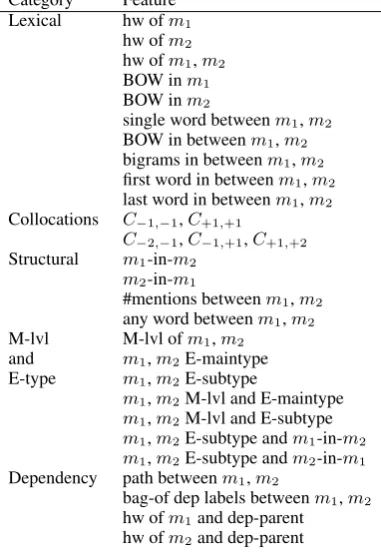
Most of the features used in our system are based on the work in (Zhou et al., 2005). In this paper, we propose some new collocation features inspired by word sense disambiguation (WSD). We give an overview of the features in Table 1. Due to space limitations, we only describe the col-location features and refer the reader to (Zhou et al., 2005) for the rest of the features.
2.1 Collocation Features
Following (Zhou et al., 2005), we use a single word to represent the head word of a mention. Since single words might be ambiguous or poly-semous, we incorporate local collocation features which were found to be very useful for WSD. Given the head word hwm of a mention m, the collocation featureCi,j refers to the sequence of tokens in the immediate context ofhwm. The
Category Feature Lexical hw ofm1
hw ofm2 hw ofm1,m2 BOW inm1 BOW inm2
single word betweenm1,m2 BOW in betweenm1,m2 bigrams in betweenm1,m2 first word in betweenm1,m2 last word in betweenm1,m2 Collocations C−1,−1,C+1,+1
C−2,−1,C−1,+1,C+1,+2 Structural m1-in-m2
m2-in-m1
#mentions betweenm1,m2 any word betweenm1,m2 M-lvl M-lvl ofm1,m2
and m1,m2E-maintype E-type m1,m2E-subtype
m1,m2M-lvl and E-maintype
m1,m2M-lvl and E-subtype
m1,m2E-subtype andm1-in-m2
m1,m2E-subtype andm2-in-m1 Dependency path betweenm1,m2
bag-of dep labels betweenm1,m2 hw ofm1and dep-parent
hw ofm2and dep-parent
Table 1: Features in the basic RE system. The abbreviations are as follows. hw: head word, M-lvl: mention level, E-type: entity type, dep-parent: the word’s parent in the dependency tree.
of the first and last token of the sequence respec-tively. For instance,C−1,+1denotes a sequence of
three tokens, consisting of the single token on the immediate left ofhwm, the tokenhwmitself, and the single token on the immediate right ofhwm.
For each mention, we extract 5 features: C−1,−1, C+1,+1,C−2,−1,C−1,+1, andC+1,+2.
3 Using Background Knowledge
Now we describe how we inject additional knowl-edge into our relation extraction system.
3.1 Hierarchy of Relations
When our relations of interest are arranged in a hierarchical structure, one should leverage this in-formation to learn more accurate relation predic-tors. For instance, assume that our relations are arranged in a two-level hierarchy and we learn two classifiers, one for disambiguating between the first level coarse-grained relations, and an-other for disambiguating between the second level
fine-grainedrelations.
Since there are a lot more fine-grained relation types than coarse-grained relation types, we pro-pose using the coarse-grained predictions which should intuitively be more reliable, to improve the fine-grained predictions. We show how to achieve this through defining appropriate constraints be-tween the coarse-grained and fine-grained rela-tions, which can be enforced through the Con-strained Conditional Models framework (aka ILP) (Roth and Yih, 2007; Chang et al., 2008). Due to space limitations, we refer interested readers to the papers for more information on the CCM framework.
By doing this, not only are the predictions of both classifiers coherent with each other (thus ob-taining better predictions from both classifiers), but more importantly, we are effectively using the (more reliable) predictions of the coarse-grained classifier to constrain the predictions of the fine-grained classifier. To the best of our knowledge, this approach for RE is novel.
In this paper, we work on the NIST Automatic Content Extraction (ACE) 2004 corpus. ACE de-fines several coarse-grained relations such as em-ployment/membership,geo-political entity (GPE) affiliation, etc. Each coarse-grained relation is further refined into several fine-grained relations1
and each fine-grained relation has a unique par-ent coarse-grained relation. For instance, the fine-grained relationsemployed as ordinary staff, em-ployed as an executive, etc. are children relations ofemployment/membership.
Letmiandmj denote a pair of mentionsiand
jdrawn from a document containingNmentions.
LetRi,jdenote a relation betweenmiandmj, and letR={Ri,j}, where1≤i, j≤N;i6=jdenote the set of relations in the document. Also, we denote the set of predefined coarse-grained relation types and fine-grained relation types as LRc and LRf respectively. Since there could possibly be no re-lation between a mention pair, we add thenull la-bel to LRc and LRf, allowing our classifiers to predictnullforRi,j. Finally, for a fine-grained
re-lation typerf, letV(rf)denote its parent
coarse-grained relation type.
1With the exception of theDiscoursecoarse-grained
We learn two classifiers, one for disambiguat-ing between the coarse-grained relations and one for disambiguating between the fine-grained rela-tions. Let θc and θf denote the feature weights learned for predicting coarse-grained and fine-grained relations respectively. Let pR(rc) = logPc(rc|mi, mj;θc) be the log probability that relation R is predicted to be of coarse-grained
relation type rc. Similarly, let pR(rf) = logPf(rf|mi, mj;θf) be the log probability that relation R is predicted to be of fine-grained
re-lation type rf. Let xhR,rci be a binary variable
which takes on the value of 1 if relationR is
la-beled with the coarse-grained labelrc. Similarly,
letyhR,rfibe a binary variable which takes on the
value of 1 if relation R is labeled with the
fine-grained labelrf. Our objective function is then:
maxX R∈R
X
rc∈LRc
pR(rc)·xhR,rci
+X
R∈R
X
rf∈LRf
pR(rf)·yhR,rfi (1)
subject to the following constraints:
X
rc∈LRc
xhR,rci= 1 ∀R∈ R (2)
X
rf∈LRf
yhR,rfi= 1 ∀R∈ R (3)
xhR,rci ∈ {0,1} ∀R∈ R, rc∈ LRc (4)
yhR,rfi ∈ {0,1} ∀R∈ R, rf ∈ LRf (5)
Equations (2) and (3) require that each relation can only be assigned one coarse-grained label and one fine-grained label. Equations (4) and (5) indi-cate that xhR,rciandyhR,rfi are binary variables.
Two more constraints follow:
xhR,rci≤ X
{rf∈LRf|V(rf)=rc}
yhR,rfi
∀R ∈ R, rc∈ LRc (6)
yhR,rfi ≤xhR,V(rf)i ∀R∈ R, rf ∈ LRf (7)
The logical form of Equation (6) can be written as: xhR,rci ⇒ yhR,rf1i ∨yhR,rf2i. . .∨yhR,rfni,
where rf1, rf2, . . . , rfn are (child) fine-grained relations of the coarse-grained relation rc. This
states that if we assign rcto relationR, then we
must also assign to R a fine-grained relation rf
art: Ei∈{gpe, org, per},
Ej∈{fac, gpe, veh, wea}
emp-org: Ei∈{gpe, org, per},
Ej∈{gpe, org, per}
gpe-aff: Ei∈{gpe, org, per},
Ej∈{gpe, loc}
other-aff: Ei∈{gpe, org, per},
Ej∈{gpe, loc}
per-soc: Ei∈{per},Ej∈{per}
Table 2: Entity type constraints.
which is achildofrc. The logical form of
Equa-tion (7) can be written as: yhR,rfi ⇒ xhR,V(rf)i.
This captures the inverse relation and states that if we assignrf toR, then we must also assign to Rthe relation typeV(rf), which is theparentof rf. Together, Equations (6) and (7) constrain the
predictions of the coarse-grained and fine-grained classifiers to be coherent with each other. Finally, we note that one could automatically translate log-ical constraints into linear inequalities (Chang et al., 2008).
This method is general and is applicable to other NLP tasks where a hierarchy exists, such as WSD and question answering. For instance, in WSD, one can predict coarse-grained and fine-grained senses using suitably defined sense inven-tories and then perform inference via ILP to obtain coherent predictions.
3.2 Entity Type Constraints
Each mention in ACE-2004 is annotated with one of seven coarse-grained entity types: person (per), organization (org), location (loc), geo-political en-tity (gpe), facility (fac), vehicle (veh), and weapon (wea).
Roth and Yih (2007) had shown that entity type information is useful for constraining the possible labels that a relationRcan assume. For instance,
22, where E
i (Ej) denotes the allowed set of en-tity types for mentionmi (mj). Applying the en-tity type information improves the predictions of the coarse-grained classifier and this in turn could improve the predictions of the fine-grained classi-fier.
3.3 Using Coreference Information
We can also utilize the coreference relations among entity mentions. Assuming that we know mentions mi and mj are coreferent with each other, then there should be no relation between them3. Letz
hi,jibe a binary variable which takes
on the value of 1 if mentionsmiandmjare coref-erent, and 0 if they are not. Whenzhi,ji=1, we
cap-ture the above intuition with the following con-straints:
zhi,ji≤xhRi,j,nulli (8) zhi,ji≤yhRi,j,nulli (9)
which can be written in logical form as: zhi,ji ⇒ xhRi,j,nulli, andzhi,ji ⇒ yhRi,j,nulli. We add the following to our objective function in Equation (1):
X
mi,mj∈m2
cohi,ji·zhi,ji+ ¯cohi,ji·(1−zhi,ji) (10)
where m is the set of mentions in a document,
cohi,ji andco¯hi,ji are the log probabilities of
pre-dicting that mi and mj are coreferent and not coreferent respectively. In this work, we assume we are given coreference information, which is available from the ACE annotation.
3.4 Using Knowledge from Wikipedia
We propose two ways of using Wikipedia to gather features for relation extraction. Wikipedia is a huge online encyclopedia and mainly contains articles describing entities or concepts.
The first intuition is that if we are able to cor-rectly map a pair of mentionsmiandmj to their corresponding Wikipedia article (assuming they 2We do not impose entity type constraints on the
coarse-grained relationsdiscandphys.
3In this work, we assume that no relations are reflexive.
After the experiments in this paper are performed, we ver-ified that in the ACE corpus we used, less than 1% of the relations are reflexive.
are represented in Wikipedia), we could use the content on their Wikipedia pages to check whether they are related.
In this work, we use a Wiki system (Rati-nov et al., 2010) which performs context-sensitive mapping of mentions to Wikipedia pages. In their work, the authors first identify phrases or mentions that could be mapped. The correct Wikipedia article for each mention is then prob-abilistically predicted using a combination of fea-tures based on Wikipedia hyperlink structure, se-mantic coherence, etc. The authors’ own evalua-tion results indicate that the performance of their system ranges from 70–80%. When given a pair of mentions and the system returns the Wikipedia page for either one of the mentions, we introduce a feature:
w1(mi, mj) =
1, ifAmi(mj) orAmj(mi)
0, otherwise
where Ami(mj) returns true if the head extent of mj is found (via simple string matching) in the predicted Wikipedia article of mi. The in-terpretation ofAmj(mi) is similar. We introduce a new feature into the RE system by combining
w1(mi, mj)withmi, mj E-maintype (defined as in Table 1).
The second feature based on Wikipedia is as follows. It will be useful to check whether there is anyparent-childrelationship between two men-tions. Intuitively, this will be useful for recogniz-ing several relations such asphysical part-whole
(e.g. a city is part of a state),subsidiary(a com-pany is a child-comcom-pany of another), citizenship
(a person is a citizen of a country), etc.
Given a pair of mentionsmiandmj, we use a
Parent-Childsystem (Do and Roth, 2010) to pre-dict whether they have aparent-childrelation. To achieve this, the system first gathers all Wikipedia articles that are related tomiandmj. It then uses the words in these pages and the category ontol-ogy of Wikipedia to make itsparent-child predic-tions, while respecting certain defined constraints. In this work, we use its prediction as follows:
w2(mi, mj) =
½
1, ifparent-child(mi, mj)
Figure 1: An example of Brown word cluster hi-erarchy from (Koo et al., 2008).
where we combine w2(mi, mj) with mi, mj E-maintype, introducing this as a new feature into our RE system.
3.5 Using Word Clusters
An inherent problem faced by supervised systems is that of data sparseness. To mitigate such is-sues in the lexical features, we use word clusters which are automatically generated from unlabeled texts. In this work, we use the Brown clustering algorithm (Brown et al., 1992), which has been shown to improve performance in various NLP applications such as dependency parsing (Koo et al., 2008), named entity recognition (Ratinov and Roth, 2009), and relation extraction (Boschee et al., 2005). The algorithm performs a hierarchical clustering of the words and represents them as a binary tree.
Each word is uniquely identified by its path from the root and every path is represented with a bit string. Figure 1 shows an example clustering where the maximum path length is 3. By using path prefixes of different lengths, one can obtain clusterings at different granularity. For instance, using prefixes of length 2 will putappleandpear
into the same cluster,AppleandIBMinto the same cluster, etc. In our work, we use clusters gener-ated from New York Times text and simply use a path prefix of length 10. When Brown clusters are used in our system, all lexical features consisting of single words will be duplicated. For instance, for the featurehw of m1, one new feature which is the length-10 bit string path representing the orig-inal lexical head word of m1, will be introduced and presented to the classifier as a string feature.
4 Experiments
We used the ACE-2004 dataset (catalog LDC2005T09 from the Linguistic Data Con-sortium) to conduct our experiments. ACE-2004
defines 7 coarse-grained relations and 23 fine-grained relations. In all of our experiments, unless otherwise stated, we explicitly model the argument order (of the mentions) when asked to disambiguate the relation between a pair of mentions. Hence, we built our coarse-grained classifier with 15 relation labels to disambiguate between (two for each coarse-grained relation type and anull label when the two mentions are not related). Likewise, our fine-grained classifier has to disambiguate between 47 relation labels. In the dataset, relations do not cross sentence boundaries.
For our experiments, we trained regularized av-eraged perceptrons (Freund and Schapire, 1999), implemented within the Sparse Network of Win-now framework (Carlson et al., 1999), one for pre-dicting the coarse-grained relations and another for predicting the fine-grained relations. Since the dataset has no split of training, development, and test sets, we followed prior work (Jiang and Zhai, 2007) and performed 5-fold cross validation to ob-tain our performance results. For simplicity, we used 5 rounds of training and a regularization pa-rameter of 1.5 for the perceptrons in all our exper-iments. Finally, we concentrate on the evaluation of fine-grained relations.
4.1 Performance of the Basic RE system As a gauge on the performance of our basic rela-tion extracrela-tion system BasicRE using only the fea-tures described in Section 2, we compare against the state-of-the-art feature-based RE system of Jiang and Zhai (2007). However, we note that in that work, the authors performed their evaluation usingundirectedcoarse-grained relations. That is, they do not distinguish on argument order of men-tions and the classifier has to decide among 8 re-lation labels (7 coarse-grained rere-lation types and a
nulllabel). Performing 5-fold cross validation on the news wire (nwire) and broadcast news (bnews) corpora in the ACE-2004 dataset, they reported a F-measure of 71.5 using a maximum entropy clas-sifier4. Evaluating BasicRE on the same setting,
4After they heuristically performed feature selection and
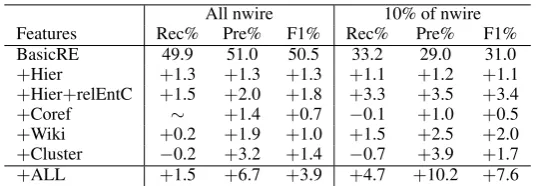
All nwire 10% of nwire
Features Rec% Pre% F1% Rec% Pre% F1%
BasicRE 49.9 51.0 50.5 33.2 29.0 31.0
+Hier +1.3 +1.3 +1.3 +1.1 +1.2 +1.1
+Hier+relEntC +1.5 +2.0 +1.8 +3.3 +3.5 +3.4
+Coref ∼ +1.4 +0.7 −0.1 +1.0 +0.5
+Wiki +0.2 +1.9 +1.0 +1.5 +2.5 +2.0
+Cluster −0.2 +3.2 +1.4 −0.7 +3.9 +1.7
+ALL +1.5 +6.7 +3.9 +4.7 +10.2 +7.6
Table 3: BasicRE gives the performance of our basic RE system on predicting fine-grained relations, obtained by performing 5-fold cross validation on only the news wire corpus of ACE-2004. Each sub-sequent row+Hier,+Hier+relEntC,+Coref, +Wiki, and+Cluster gives theindividualcontribution
from using each knowledge. The bottom row+ALL gives the performance improvements from adding
+Hier+relEntC+Coref+Wiki+Cluster. ∼indicates no change in score.
we obtained a competitive F-measure of 71.25.
4.2 Experimental Settings for Evaluating Fine-grained Relations
Two of our knowledge sources, the Wiki system described in Section 3.4 and the word clusters de-scribed in Section 3.5, assume inputs of mixed-cased text. We note that the bnews corpus of ACE-2004 is entirely in lower-cased text. Hence, we use only the nwire corpus for our experiments here, from which we gathered 28,943 relation in-stances and 2,226 of those have a valid (non-null) relation6.
We also propose the following experimental setting. First, since we made use of coreference information, we made sure that while performing our experiments, all instances from the same doc-ument are either all used as training data or all used as test data. Prior work in RE had not en-sured this, but we argue that this provides a more realistic setting. Our own experiments indicate that this results in a 1-2% lower performance on fine-grained relations.
Secondly, prior work calculate their perfor-mance on relation extraction at the level of men-tions. That is, each mention pair extracted is scored individually. An issue with this way of scoring on the ACE corpus is that ACE
annota-5Using 10 rounds of training and a regularization
param-eter of 2.5 improves the result to 72.2. In general, we found that more rounds of training and a higher regularization value benefits coarse-grained relation classification, but not fine-grained relation classification.
6The number of relation instances in the nwire and bnews
corpora are about the same.
tors rarely duplicate a relation link for coreferent mentions. For instance, assume that mentionsmi, mj, and mk exist in a given sentence, mentions
mi andmj are coreferent, and the annotator es-tablishes a particular relation typer betweenmj andmk. The annotator will not usually duplicate
the same relationr betweenmi andmkand thus the label between these two mentions is thennull. We are not suggesting that this is an incorrect ap-proach, but clearly there is an issue since an im-portant goal of performing RE is to populate or build an ontology of entities and establish the re-lations existing among the entities. Thus, we eval-uate our performance at theentity-level.7 That is,
given a pair of entities, we establish the set of re-lation types existing between them, based on their mention annotations. Then we calculate recall and precision based on these established relations. Of course, performing such an evaluation requires knowledge about the coreference relations and in this work, we assume we are given this informa-tion.
4.3 Knowledge-Enriched System
Evaluating our system BasicRE (trained only on the features described in Section 2) on the nwire corpus, we obtained a F1 score of 50.5, as shown in Table 3. Next, we exploited the relation hier-archy as in Section 3.1 and obtained an improve-ment of 1.3, as shown in the row+Hier. Next,
we added the entity type constraints of Section
7Our experiments indicate that performing the usual
3.2. Remember that these constraints are imposed on the coarse-grained relations. Thus, they would only affect the fine-grained relation predictions if we also exploit the relation hierarchy. In the ta-ble, we show that all the background knowledge helped to improve performance, providing a to-tal improvement of 3.9 to our basic RE system. Though the focus of this work is on fine-grained relations, our approach also improves the perfor-mance of coarse-grained relation predictions. Ba-sicRE obtains a F1 score of 65.3 on coarse-grained relations and exploiting background knowledge gives a total improvement of 2.9.
5 Analysis
We explore the situation where we have very little training data. We assume during each cross val-idation fold, we are given only 10% of the train-ing data we originally had. Previously, when per-forming 5-fold cross validation on 2,226 valid re-lation instances, we had about 1780 as training instances in each fold. Now, we assume we are only given about 178 training instances in each fold. Under this condition, BasicRE gives a F1 score of 31.0 on fine-grained relations. Adding all the background knowledge gives an improvement of 7.6 and this represents an error reduction of 39% when measured against the performance dif-ference of 50.5 (31.0) when we have 1780 train-ing instances vs. 178 traintrain-ing instances. On the coarse-grained relations, BasicRE gives a F1 score of 51.1 and exploiting background knowl-edge gives a total improvement of 5.0.
We also tabulated the list of fine-grained re-lations that improved by more than 1 F1 score when we incorporated+Wiki, on the experiment
using all of nwire data: phys:near (physically near), other-aff:ideology (ideology affiliation),
art:user-or-owner(user or owner of artifact), per-soc:business (business relationship), phys:part-whole (physical part-whole), emp-org:subsidiary
(organization subsidiary), and gpe-aff:citizen-or-resident(citizen or resident). Most of these intu-itively seemed to be information one would find being mentioned in an encyclopedia.
6 Related Work
Few prior work has explored using background knowledge to improve relation extraction perfor-mance. Zhou et al. (2008) took advantage of the hierarchical ontology of relations by propos-ing methods customized for the perceptron learn-ing algorithm and support vector machines. In contrast, we propose a generic way of using the relation hierarchy which at the same time, gives globally coherent predictions and allows for easy injection of knowledge as constraints. Recently, Jiang (2009) proposed using features which are common across all relations. Her method is com-plementary to our approach, as she does not con-sider information such as the relatedness between different relations. On using semantic resources, Zhou et al. (2005) gathered two gazettes, one containing country names and another containing words indicating personal relationships. In relat-ing the tasks of RE and coreference resolution, Ji et al. (2005) used the output of a RE system to rescore coreference hypotheses. In our work, we reverse the setting and explore using coreference to improve RE.
7 Conclusion
In this paper, we proposed a broad range of meth-ods to inject background knowledge into a rela-tion extracrela-tion system. Some of these methods, such as exploiting the relation hierarchy, are gen-eral in nature and could be easily applied to other NLP tasks. To combine the various relation pre-dictions and knowledge, we perform global infer-ence within an ILP framework. Besides allowing for easy injection of knowledge as constraints, this ensures globally coherent models and predictions.
Acknowledgements This research was partly sponsored by Air Force Research Laboratory (AFRL) under prime contract no. FA8750-09-C-0181. We thank Ming-Wei Chang and James Clarke for discussions on this research.
References
Open information extraction from the web. In Pro-ceedings of IJCAI-07, pages 2670–2676.
Boschee, Elizabeth, Ralph Weischedel, and Alex Za-manian. 2005. Automatic information extraction. InProceedings of the International Conference on Intelligence Analysis.
Brown, Peter F., Vincent J. Della Pietra, Peter V. deS-ouza, Jenifer C. Lai, and Robert L. Mercer. 1992. Class-based n-gram models of natural language.
Computational Linguistics, 18(4):467–479.
Bunescu, Razvan C. and Raymond J. Mooney. 2005. A shortest path dependency kernel for relation ex-traction. InProceedings of HLT/EMNLP-05, pages 724–731.
Carlson, Andrew J., Chad M. Cumby, Jeff L. Rosen, and Dan Roth. 1999. The SNoW learning archi-tecture. Technical Report UIUCDCS-R-99-2101, UIUC Computer Science Department, May.
Chang, Ming-Wei, Lev Ratinov, Nicholas Rizzolo, and Dan Roth. 2008. Learning and inference with con-straints. InProceedings of AAAI-08, pages 1513– 1518.
Do, Quang and Dan Roth. 2010. On-the-fly constraint-based taxonomic relation identifica-tion. Technical report, University of Illinois. http://L2R.cs.uiuc.edu/∼danr/Papers/DoRo10.pdf.
Freund, Yoav and Robert E. Schapire. 1999. Large margin classification using the perceptron algo-rithm.Machine Learning, 37(3):277–296.
Ji, Heng, David Westbrook, and Ralph Grishman. 2005. Using semantic relations to refine corefer-ence decisions. InProceedings of HLT/EMNLP-05, pages 17–24.
Jiang, Jing and ChengXiang Zhai. 2007. A system-atic exploration of the feature space for relation ex-traction. InProceedings of HLT-NAACL-07, pages 113–120.
Jiang, Jing. 2009. Multi-task transfer learning for weakly-supervised relation extraction. In Proceed-ings of ACL-IJCNLP-09, pages 1012–1020.
Kambhatla, Nanda. 2004. Combining lexical, syntac-tic, and semantic features with maximum entropy models for information extraction. InProceedings of ACL-04, pages 178–181.
Koo, Terry, Xavier Carreras, and Michael Collins. 2008. Simple semi-supervised dependency parsing. InProceedings of ACL-08:HLT, pages 595–603.
Mintz, Mike, Steven Bills, Rion Snow, and Daniel Ju-rafsky. 2009. Distant supervision for relation ex-traction without labeled data. In Proceedings of ACL-IJCNLP-09, pages 1003–1011.
Ratinov, Lev and Dan Roth. 2009. Design challenges and misconceptions in named entity recognition. In
Proceedings of CoNLL-09, pages 147–155.
Ratinov, Lev, Doug Downey, and Dan Roth. 2010. Wikification for informa-tion retrieval. Technical report, Univer-sity of Illinois. http://L2R.cs.uiuc.edu/∼
danr/Papers/RatinovDoRo10.pdf.
Roth, Dan and Wen Tau Yih. 2004. A linear program-ming formulation for global inference in natural lan-guage tasks. In Proceedings of CoNLL-04, pages 1–8.
Roth, Dan and Wen Tau Yih. 2007. Global infer-ence for entity and relation identification via a lin-ear programming formulation. In Getoor, Lise and Ben Taskar, editors,Introduction to Statistical Rela-tional Learning. MIT Press.
Weld, Daniel S., Raphael Hoffman, and Fei Wu. 2008. Using wikipedia to bootstrap open information ex-traction. ACM SIGMOD Special Issue on Managing Information Extraction, 37(4):62–68.
Zelenko, Dmitry, Chinatsu Aone, and Anthony Richardella. 2003. Kernel methods for relation ex-traction. Journal of Machine Learning Research, 3:1083–1106.
Zhang, Min, Jie Zhang, Jian Su, and GuoDong Zhou. 2006. A composite kernel to extract relations be-tween entities with both flat and structured features. In Proceedings of COLING-ACL-06, pages 825– 832.
Zhou, Guodong, Jian Su, Jie Zhang, and Min Zhang. 2005. Exploring various knowledge in relation ex-traction. InProceedings of ACL-05.
Zhou, GuoDong, Min Zhang, DongHong Ji, and QiaoMing Zhu. 2007. Tree kernel-based re-lation extraction with context-sensitive structured parse tree information. InProceedings of EMNLP-CoNLL-07, pages 728–736.