Multi-Sentence Compression: Finding Shortest Paths in Word Graphs
Katja Filippova
Google Inc.
Abstract
We consider the task of summarizing a cluster of related sentences with a short sentence which we call multi-sentence compression and present a simple ap-proach based on shortest paths in word graphs. The advantage and the novelty of the proposed method is that it is syntax-lean and requires little more than a tok-enizer and a tagger. Despite its simplic-ity, it is capable of generating grammati-cal and informative summaries as our ex-periments with English and Spanish data demonstrate.
1 Introduction
Sentence compression (henceforth SC) is a task where the goal is to produce a summary of a sin-gle sentence which would preserve the important part of the content and be grammatical. Starting from the early work of Jing & McKeown (2000), in the last decade SC has received considerable at-tention in the NLP community. Ubiquitous use of mobile devices is an obvious example of where SC could be applied–a longer text of an email, news or a Wikipedia article can be compressed sentence by sentence to fit into a limited display (Corston-Oliver, 2001). Another reason why SC is so popular is its potential utility for extractive text summarization, single or multi-document (Mani, 2001). There, a standard approach is to rank sen-tences by importance, cluster them by similarity, and select a sentence from the top ranked clusters. Selected sentences almost always require revision
and can be reformulated succinctly as it is often only a part of the sentence which is of interest. It is this multi-document summarization scenario which motivates our work.
Given a cluster of similar, or related, sentences, we aim at summarizing the most salient theme of it in a short single sentence. We refer to this task as multi-sentence compression. Defined this way, it comes close to sentence fusion which was orig-inally introduced as a text-to-text generation tech-nique of expressing content common to most of the input sentences in a single sentence (Barzi-lay & McKeown, 2005). However, since then the technique has been extended so that now fusion also stands for uniting complementary content in a single concise sentence (Filippova & Strube, 2008b; Krahmer et al., 2008). Since our method is not designed for the “union” kind of fusion, we think it is more appropriate to classify it as a sen-tence compression technique.
similar words are likely to be relevant, and this information has been used in earlier SC systems (Hori et al., 2003; Clarke & Lapata, 2007, inter alia). Still, syntactic parsers are assumed to be in-dispensable tools for both sentence compression and fusion because syntactic constraints (hand-crafted or learned from the data) seem to be the only way to control the grammaticality of the out-put. In this paper we are going to question this well-established belief and argue that just like in some cases syntax helps to find important content (e.g., when the input is an isolated sentence), in the multi-sentence case redundancy provides a re-liable way of generating grammatical sentences. In particular, the important and novel points of our work are as follows:
• We present a simple and robust word graph-based method of generating succinct com-pressions which requires as little as a part of speech tagger and a list of stopwords. • To our knowledge, it is the first method
which requires neither a parser, nor hand-crafted rules, nor a language model to gen-erate reasonably grammatical output. • In an extensive evaluation with native
speak-ers we obtain encouraging results for English as well as for Spanish.
In the following section we present our approach to sentence compression (Sec. 2); then we intro-duce the baseline (Sec. 3) and the data (Sec. 4). In Section 5 we report about our experiments and discuss the results. Finally, Section 6 gives an overview of related work.
2 Multi-sentence Compression
A well-known challenge for extractive multi-document summarization systems is to produce non-redundant summaries. There are two stan-dard ways of avoiding redundancy: either one adds sentences to the summary one-by-one and each time checks whether the sentence is signif-icantly different from what is already there (e.g., using MMR), or one clusters related sentences and selects only one from each cluster. In both cases a selected sentence may include irrelevant infor-mation, so one wishes to compress it, usually by
taking syntactic and lexical factors into account. However, we think this approach is suboptimal in this case and explore a different way. Instead of compressing a single sentence, we build a word graph from all the words of the related sentences and compress this graph.
A word graph is a directed graph where an edge from word A to word B represents an adjacency relation. It also contains the start and end nodes. Word graphs have been widely used in natural lan-guage processing for building lanlan-guage models, paraphrasing, alignment, etc. (see Sec. 6). Com-pared with dependency graphs, their use for sen-tence generation has been left largely unexplored, presumably because it seems that almost all the grammatical information is missing from this rep-resentation. Indeed, a link between a finite verb and an article does not correspond to any gram-matical relation between the two. However, the premise for our work is that redundancy should be sufficient to identify not only important words but also salient links between words. In this section we present our approach to word graph compres-sion. We begin by explaining the graph construc-tion process and continue with the details of two compression methods.
2.1 Word Graph Construction
Given a set of related sentences S =
{s1, s2, ...sn}, we build a word graph by
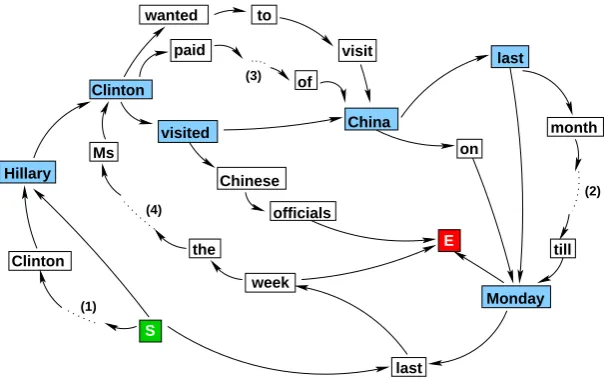
it-eratively adding sentences to it. As an illustration, consider the four sentences below and the graph in Figure 1 obtained from them. Edge weights are omitted and italicized fragments from the sentences are replaced with dots for clarity.
(1) The wife of a former U.S. president Bill Clin-ton Hillary ClinClin-ton visited China last Mon-day.
(2) Hillary Clinton wanted to visit China last month but postponed her plans till Monday last week.
(3) Hillary Clinton paid a visit to the People Re-public of China on Monday.
wanted to
month on
last officials
visit
of
Clinton
Chinese
(1)
E
S
week
last
(4)
(2) (3)
till the
Ms
paid
Hillary
Clinton
visited China
[image:3.595.145.451.69.260.2]Monday
Figure 1: Word graph generated from sentences (1-4) and a possible compression path.
After the first sentence is added the graph is sim-ply a string of word nodes (punctuation is ex-cluded) plus the start and the end symbols (S and E in Fig. 1). A word from the following sentences is mapped onto a node in the graph provided that they have the exact same lowercased word form and the same part of speech1 and that no word from this sentence has already been mapped onto this node. Using part of speech information re-duces chances of merging verbs with nouns (e.g., visit) and generating ungrammatical sequences. If there is no candidate in the graph a new node is created.
Word mapping/creation is done in three steps for the following three groups of words: (1) non-stopwords2 for which no candidate exists in the graph or for which an unambiguous mapping is possible; (2) non-stopwords for which there are either several possible candidates in the graph or which occur more than once in the sentence; (3) stopwords.
This procedure is similar to the one used by Barzilay & Lee (2003) in that we also first iden-tify “backbone nodes” (unambiguous alignments) and then add mappings for which several possi-bilities exist. However, they build lattices, i.e.,
1We use the OpenNLP package for tagging: http://
opennlp.sourceforge.net. 2
We generate a list of about 600 news-specific stopwords for English (including, e.g., said, seems) and took a publicly available list of about 180 stopwords for Spanish fromwww. ranks.nl/stopwords/spanish.html.
directed acyclic graphs, whereas our graphs may contain cycles. For the last two groups of words where mapping is ambiguous we check the imme-diate context (the preceding and following words in the sentence and the neighboring nodes in the graph) and select the candidate which has larger overlap in the context, or the one with a greater frequency (i.e., the one which has more words mapped onto it). For example, in Figure 1 when sentence (4) is to be added, there are two candi-date nodes for last. The one pointing to week is selected as week is the word following last in (4). Stopwords are mapped only if there is some over-lap in non-stopword neighbors, otherwise a new node is created.
Once all the words from the sentence are in place, we connect words adjacent in the sentence with directed edges. For newly created nodes, or nodes which were not connected before, we add an edge with a default weight of one. Edge weights between already connected nodes are in-creased by one. The same is done with the start and end nodes. Nodes store id’s of the sentences their words come from as well as all their offset positions in those sentences.
in one node if there is an overlap in context. The graph may generate a potentially endless amount of incomprehensible sequences connecting start and end. It is also likely to contain paths corre-sponding to good compressions, like the path con-necting the nodes highlighted with blue in Figure 1. In the following we describe two our methods of finding the best path, that is, the best compres-sion for the input sentences.
2.2 Shortest Path as Compression
What properties are characteristic of a good com-pression? It should neither be too long, nor too short. It should go through the nodes which rep-resent important concepts but should not pass the same node several times. It should correspond to a likely word sequence. To satisfy these constraints we invert edge weights, i.e., link frequencies, and search for the shortest path (i.e., lightest in terms of the edge weights) from start to end of a pre-defined minimum length. This path is likely to mention salient words from the input and put to-gether words found next to each other in many sentences. This is the first method we consider. We set a minimum path length (in words) to eight which appeared to be a reasonable threshold on a development set–paths shorter than seven words were often incomplete sentences.
Furthermore, to produce informative sum-maries which report about the main event of the sentence cluster, we filter paths which do not con-tain a verb node. For example, Ozark’s “Win-ter’s Bone” at the 2010 Sundance Film Festival might be a good title indicating what the article is about. However, it is not as informative as “Win-ter’s Bone” earned the grand jury prize at Sun-dance which indeed conveys the gist of the event. Thus, we generate K shortest paths and filter all those which are shorter than eight words or do not contain a verb. The path with the minimum total weight is selected as the summary.
2.3 Improved Scoring and Reranking
The second configuration of our system employs a more sophisticated weighting function. The pur-pose of this function is two-fold: (i) to generate a grammatical compression, it favors strong links, i.e., links between words which appear
signifi-cantly often in this order; (ii) to generate an in-formative compression, it promotes paths passing through salient nodes.
Strong links: Intuitively, we want the compres-sion path to follow edges between words which are strongly associated with each other. Inverted edge frequency is not sufficient for that because it ignores the overall frequency of the nodes the edge connects. For example, edge frequency of three should count more if the edge connects two nodes with frequency of three rather than if their frequencies are much higher. Thus, we redefine edge weight as follows:
w(ei,j) =
freq(i) +freq(j) freq(ei,j)
(1)
Furthermore, we also promote a connection tween two nodes if there are multiple paths be-tween them. For example, if some sentences speak of president Barack Obama or president of the US Barack Obama, and some sentences are about president Obama, we want to add some re-ward to the edge between president and Obama. However, longer paths between words are weak signals of word association. Therefore, the weight of an edge between the nodesiand j is reduced for every possible path between them but reduced proportionally to its length:
w′(ei,j) =
freq(i) +freq(j) P
s∈Sdiff(s, i, j)−1
(2)
where the functiondiff(s, i, j)refers to the dis-tance between the offset positions (pos(s, i)) of wordsiandjin sentence sand is defined as fol-lows:
diff(s, i, j) = (
pos(s, i)−pos(s, j) if pos(s, i)<pos(s, j)
0 otherwise
(3)
to go through most frequent nodes by decreasing edge weight with respect to the frequency of the nodes it connects. Thus, we further redefine edge weight as follows:
w′′(ei,j) = w
′(e
i,j)
freq(i)×freq(j) (4)
We implement the K-shortest paths algorithm to find the fifty shortest paths from start to end using the weighting function in (4). We filter all the paths which are shorter than eight words and which do not pass a verb node. Finally, we rerank the remaining paths by normalizing the total path weight over its length. This way we obtain the path which has the lightest average edge weight.
3 Baseline
As a first baseline we are searching for the most probable string with respect to the sentence clus-ter. In particular, we use the Viterbi algorithm to find the sequence of words of a predefined length nwhich maximizes the bigram probability (MLE-based):
p(w1,n) =p(w1|s)p(w2|w1)...p(e|wn) (5)
Similar to the shortest path implementation, we specify compression length and set it also here to eight tokens. However, the compressions obtained with this method are often unrelated to the main theme. The reason for that is that a token subse-quence encountered in a single sentence is likely to get a high probability–all transition probabili-ties are equal to one–provided that the probability of entering this sequence is not too low. To amend this problem and to promote frequent words (i.e., words which are likely to be related to the main theme) we maximize the following baseline score which takes into account both the bigram proba-bilities and the token likelihood, p(wi), which is
also estimated from the sentence cluster:
b(w1,n) =p(w1|s)p(w2|w1)...p(e|wn)
Y
i
p(wi) (6)
4 Data Sources
As data for our experiments we use news arti-cles presented in clusters on Google News3. The main reason for why we decided to use this ser-vice is that it is freely available and does the job of news classification and clustering with a pro-duction quality. Apart from that, it is a rich source of multilingual data.
We collected news clusters in English and Spanish, 10-30 articles each, 24 articles on aver-age. To get sets of similar sentences we aggre-gated first sentences from every article in the clus-ter, removing duplicates. The article-initial sen-tence is known to provide a good summary of the article and has become a standard competi-tive baseline in summarization4. Hence, given that first sentences summarize the articles they belong to, which are in turn clustered as concerning the same event, those sentences are likely although not necessarily need to be similar.
From the total of 150 English clusters we re-served 70 for development and 80 for testing. For Spanish we collected 40 clusters, all for testing. We stripped off bylines and dates from the begin-ning of every sentence with a handful of regular expressions before feeding them to the baseline and our compression methods.
The data we use has two interesting properties: (i) article-initial sentences are on average longer than other sentences. In our case average sentence lengths for English and Spanish (without bylines) are 28 and 35 tokens, respectively. (ii) such sen-tence clusters are noisier than what one would ex-pect in a summarization pipeline. Both properties make the task realistically hard and pose a chal-lenge for the robustness of a compression method. If we show that reasonable compressions can be generated even from noisy clusters acquired from a publicly available news service, then we have a good reason to believe that the method will per-form at least comparable on more carefully con-structed clusters of shorter sentences.
3http://news.google.com 4
See DUC/TAC competitions: http://www.nist.
5 Evaluation
5.1 Experiment Design
The performance of the systems was assessed in an experiment with human raters, all native speak-ers. They were presented with a list of snippets of the articles from one cluster – first sentence and title linked to the original document. The raters were allowed to look up the articles if they need more background on the matter but this was not obligatory.
The first question concerned the quality of the sentence cluster. The raters were asked whether the cluster contained a single prevailing event, or whether it was too noisy and no theme stood out. Given how simple our sentence grouping proce-dure was, most clusters informed about more than one event. However, to answer the question posi-tively it would be enough to identify one prevail-ing theme.
Below that, a summary and two further ques-tions concerning its quality were displayed. Simi-lar to most preceding work, we were interested in grammaticality and informativity of summaries. With respect to grammaticality, following Barzi-lay & McKeown (2005), we asked the raters to give one of the three possible ratings: perfect if the summary was a complete grammatical sen-tence (2 pts); almost if it required a minor edit-ing, e.g., one mistake in articles or agreement (1 pt); ungrammatical if it was none of above (0 pts). We explicitly asked the raters to ignore lack or excess of capitalization or punctuation. Further-more, based on the feedback from a preliminary evaluation, we provided an example in which we made clear that summaries consisting of a few phrases which cannot be reformulated as a com-plete sentence (e.g., Early Monday a U.S. Navy ship.) should not count as grammatical.
The final question, concerning informativity, had four possible options: n/a if the cluster is too noisy and unsummarizable in the first place; per-fect if it conveys the gist of the main event and is more or less like the summary the person would produce himself (2 pts); related if it is related to the the main theme but misses something impor-tant (1 pt); unrelated if the summary is not related to the main theme (0 pts).
For each of the 80 sentence clusters (40 for Spanish) we generated three summaries with the three systems. Most summaries were rated by four raters, a few got only three ratings; no rater saw the same cluster twice.
5.2 Results
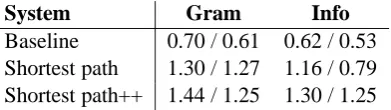
We report average grammaticality and informativ-ity scores in Table 1. However, averaging system ratings over all clusters and raters is not justified in our case. It is important to remember that the score assignments (i.e., 0, 1, 2) are arbitrary and that the score of one with respect to grammatical-ity (i.e., a minor mistake) is in fact closer to two than to zero. One could set the scores differently but even then, strictly speaking, it is not correct to average the scores as ratings do not define a metric space.
System Gram Info
[image:6.595.316.512.354.409.2]Baseline 0.70 / 0.61 0.62 / 0.53 Shortest path 1.30 / 1.27 1.16 / 0.79 Shortest path++ 1.44 / 1.25 1.30 / 1.25
Table 1: Average ratings for English / Spanish.
System Gram-2 Gram-1 Gram-0 Info-2 Info-1 Info-0 Avg. Len.
Baseline (EN) 21% 15% 65% 18% 10% 73% 8
Shortest path (EN) 52% 16% 32% 36% 33% 31% 10
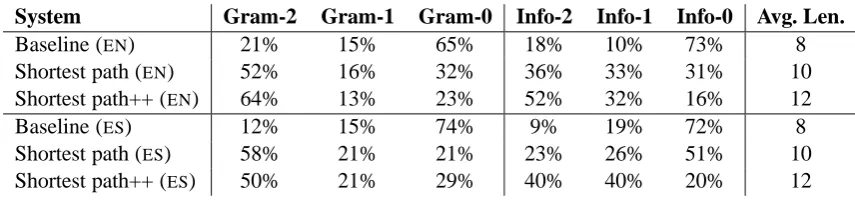
Shortest path++ (EN) 64% 13% 23% 52% 32% 16% 12
Baseline (ES) 12% 15% 74% 9% 19% 72% 8
Shortest path (ES) 58% 21% 21% 23% 26% 51% 10
[image:7.595.81.509.69.171.2]Shortest path++ (ES) 50% 21% 29% 40% 40% 20% 12
Table 2: Distribution over possible ratings and average length for English and Spanish.
5.3 Discussion
The difference between the baseline and our short-est path systems is striking. Although more than 20% of the baseline summaries are perfectly grammatical, the gap to the improved version of shortest paths is significant, about 43%. The same holds for the percentage of informative summaries (18% vs. 52%). Both numbers are likely to be understated as we chose to resolve all ties not in our favor. 84% of the summaries generated by the improved method are related to the main theme of the cluster, and more than 60% of those (52% of the total summaries) convey the very gist of it without missing any important information. Comparing the two configurations we have pro-posed, improved scoring function and reranking we added on top of the shortest path method were both rewarding. Interestingly, even the straight-forward approach of choosing the shortest path of a minimum length already guarantees a grammat-ical summary in more than half of the cases.
An interesting difference in the performance for Spanish and English is that shortest path gen-erates more grammatical sentences than the im-proved version of it. However, the price for higher grammaticality scores is a huge drop in informa-tivity: half of such summaries are not related to the main theme at all, whereas 40% of the sum-maries generated by the improved version got the highest rating. A possible reason for the poorer performance for Spanish is that we used a much smaller list of stopwords which did not include news-specific words like, e.g., dijo (said) which resulted in denser graphs. In the future, we would like to apply the method to more languages and experiment with longer lists of stopwords.
One may notice that the summaries produced
by the baseline are shorter than those generated by the shortest paths which might look like a rea-son for its comparatively poor performance. How-ever, the main source of errors for the baseline was its inability to keep track of the words al-ready present in the summary, so it is unlikely that longer sequences would be of a much higher qual-ity. The sentences generated by the baseline were often repetitive, e.g., The food tax on food tax on food. This is not an issue with the shortest path approaches as they never include loops when edge weights are strictly positive.
The reranking we added to the shortest path method is the reason for why the summaries gen-erated by the improved version of the system are on average slightly longer than those produced by the simpler version. The average lengths for both systems are drastically shorter than the aver-age length of the sentences served as input (10/12 vs. 28 tokens in English or 35 tokens for Span-ish). This corresponds to the compression rate of 36-43% (29-34% for Spanish) which is compar-atively “aggressive” as it usually varies between 50-80% in other systems.
6 Comparison with Related Work
6.1 Sentence Compression
syntac-tic trees are crucial to obtain grammasyntac-tical com-pressions (Galley & McKeown, 2007; Filippova & Strube, 2008a; Cohn & Lapata, 2009). Hand-crafted rules (Dorr et al., 2003) as well as lan-guage models also have been utilized to generate fluent compressions (Hori et al., 2003; Clarke & Lapata, 2008).
6.2 Sentence Generation
To date the work on sentence fusion is com-pletely dependency syntax-based. Input sentences are parsed into trees, from those trees a new de-pendency structure is generated, and this struc-ture is finally converted into a sentence (Barzilay & McKeown, 2005; Filippova & Strube, 2008b; Wan et al., 2009). Parser quality is of crucial importance for such methods, and to our knowl-edge no attempt has been made to generate novel sentences without adhering to dependency repre-sentations. In the future, it would be of interest to compare our method with a syntax-based fu-sion method. Syntax-lean methods have been ex-plored for headline generation (Banko et al., 2000; Dorr et al., 2003; Jin & Hauptmann, 2003). How-ever, they do not aim at generating complete sen-tences or informative summaries but rather to in-dicate what the news is about.
6.3 Word Graphs and Lattices
Perhaps the work of Barzilay & Lee (2003) who align comparable sentences to generate sentence-level paraphrases seems closest to ours in that we both use word graphs for text generation. How-ever, this is a fairly general similarity, as both the goal and the implementation are different. While we search for an optimal weighting func-tion in noisy graphs to identify readable and in-formative compressions, they induce paraphrase patterns from unweighted paths in much smaller DAGs obtained from highly similar sentences. Shen et al. (2006) is another example of using word lattices to find paraphrases. Unlike Barzilay & Lee (2003), they propose to use syntax to obtain accurate alignments. Numerous examples of the utility of word lattices come from the field of finite state automata, language modeling, speech recog-nition, parsing and machine translation (Mohri, 1997, inter alia).
7 Conclusions
We considered the task of generating a short in-formative summary for a set of related sentences, called multi-sentence compression, which arises naturally in the context of multi-document text summarization. We presented a simple but ro-bust method which proceeds by finding shortest paths in word graphs. The novelty of our work is that we demonstrated that reasonable compres-sions can be obtained without any syntactic infor-mation if a good weighting function is defined. This distinguishes our work from earlier research on sentence fusion and compression which re-lies on syntactic representations and/or language models. We provided the details of an extensive evaluation on English and Spanish data and re-ported high grammaticality as well as informativ-ity scores. In the future we would like to experi-ment with other languages and eschew using part-of-speech information.
Acknowledgements: I am thankful to Keith Hall for the discussions on this work and the very helpful feedback on an earlier draft of this paper.
References
Banko, M., V. O. Mittal & M. J. Witbrock (2000). Headline generation based on statistical trans-lation. In Proc. of ACL-00, pp. 318–325.
Barzilay, R. & L. Lee (2003). Learning to para-phrase: An unsupervized approach using multi-sequence alignment. In Proc. of HLT-NAACL-03, pp. 16–23.
Barzilay, R. & K. R. McKeown (2005). Sentence fusion for multidocument news summarization. Computational Linguistics, 31(3):297–327.
Clarke, J. & M. Lapata (2007). Modelling com-pression with discourse constraints. In Proc. of EMNLP-CoNLL-07, pp. 1–11.
Cohn, T. & M. Lapata (2009). Sentence compres-sion as tree transduction. Journal of Artificial Intelligence Research, 34:637–674.
Corston-Oliver, S. H. (2001). Text compaction for display on very small screens. In Proceedings of the NAACL Workshop on Automatic Summa-rization, Pittsburg, PA, 3 June 2001, pp. 89–98.
Dorr, B., D. Zajic & R. Schwartz (2003). Hedge trimmer: A parse-and-trim approach to head-line generation. In Proceedings of the Text Sum-marization Workshop at HLT-NAACL-03, Ed-monton, Alberta, Canada, 2003, pp. 1–8.
Filippova, K. & M. Strube (2008a). Dependency tree based sentence compression. In Proc. of INLG-08, pp. 25–32.
Filippova, K. & M. Strube (2008b). Sentence fusion via dependency graph compression. In Proc. of EMNLP-08, pp. 177–185.
Galley, M. & K. R. McKeown (2007). Lexicalized Markov grammars for sentence compression. In Proc. of NAACL-HLT-07, pp. 180–187.
Hori, C., S. Furui, R. Malkin, H. Yu & A. Waibel (2003). A statistical approach to automatic speech summarization. EURASIP Journal on Applied Signal Processing, 2:128–139.
Jin, R. & A. G. Hauptmann (2003). Automatic title generation for spoken broadcast news. In Proc. of HLT-01, pp. 1–3.
Jing, H. & K. McKeown (2000). Cut and paste based text summarization. In Proc. of NAACL-00, pp. 178–185.
Krahmer, E., E. Marsi & P. van Pelt (2008). Query-based sentence fusion is better defined and leads to more preferred results than generic sentence fusion. In Proc. of ACL-HLT-08, pp. 193–196.
Mani, I. (2001). Automatic Summarization. Ams-terdam, Philadelphia: John Benjamins.
McDonald, R. (2006). Discriminative sentence compression with soft syntactic evidence. In Proc. of EACL-06, pp. 297–304.
Mohri, M. (1997). Finite-state transducers in lan-guage and speech processing. Computational Linguistics, 23(2):269–311.
Shen, S., D. Radev, A. Patel & G. Erkan (2006). Adding syntax to dynamic programming for aligning comparable texts for generation of paraphrases. In Proc. of COLING-ACL-06, pp. 747–754.