Learning Verbs on the Fly
Zornitsa Kozareva
USC Information Sciences Institute 4676 Admiralty Way Marina del Rey, CA 90292-6695
A
BSTRACTTo answer the question“What are the duties of a medical doctor?”, one would require knowledge about verb-based relations. A lot of effort has been invested in developing relation learners, however to our knowledge there is no repository (or system) which can return all verb relations for a given term. This paper describes an automated procedure which can learn and produce such information with minimal effort. To evaluate the performance of our verb harvesting procedure, we have conducted two types of evaluations: (1) in the human based evaluation we found that the accuracy of the described algorithm is .95 at rank 100; (2) in the comparative study with existing relation learner and knowledge bases we found that our approach yields 12 times more verb relations.
1 Introduction
To be able to answer the questions“What causes ebola?”,“What are the duties of a medical
doctor?”,“What are the differences between a terrorist and a victim?”,“Which are the animals
that have wings but cannot fly?”one requires knowledge about verb-based relations. Over the
years, researchers have developed various relation learning algorithms. Some (Ravichandran and Hovy, 2002; Bunescu and Mooney, 2007) targeted specific relations likeBornInYear,
CorporationAcquired, others (Wu and Weld, 2010; Fader et al., 2011) extracted any phrase
denoting a relation in an English sentence. (Banko, 2009) used labeled data to learn relations, (Suchanek et al., 2007) used information encoded in the structured Wikipedia documents, (Riloff and Jones, 1999) bootstrapped patterns. As a result various knowledge bases have been produced like TopicSignatures (Agirre and Lacalle, 2004), ConceptNet (Liu and Singh, 2004), Yago (Suchanek et al., 2007), NELL (Carlson et al., 2009) and ReVerb (Fader et al., 2011). Despite the many efforts to date, yet there is no universal repository (or even a system), which for a given term it can immediately return all verb relations related to the term. However, one would still like to dispose of an automated procedure, which on the fly can accurately and quickly produce such information for any term. If available, such resource can aid different natural language processing tasks such as preposition sense disambiguation (Litkowski and Hargraves, 2007), selectional preferences (Resnik, 1996; Ritter et al., 2010), question answering (Ferrucci et al., 2010) and textual entailment (Szpektor et al., 2004).
The question we address in this paper is:Is it possible to create a procedure which will go beyond existing techniques and learn in a semi-supervised manner for a given term all verb relations associated with it?
The main contributions of the paper are:
• We develop an automatic procedure, which on the fly can learn a diverse set ofverband
verb-prepositionrelations for a given term.
• We establish the effectiveness of our approach through human-based evaluation.
• We conduct a comparative study with the verb-based relation extraction system ReVerb (Fader et al., 2011) and show that our approach accurately extracts more verb-based relations.
• We also compare the verb relations produced by our system with those available in existing knowledge bases, and observe that despite their completeness these repositories lack many verb-based relations.
The rest of the paper is organized as follows. Next, we present related work. Section 3 outlines the verb-based relation learner. Section 4 describes the data collection process. Section 5 reports on the experimental results. Finally, we conclude in Section 6.
2 Related Work
Lots of attention has been payed on learningis-aandpart-ofrelations (Hearst, 1992; Girju et al., 2003; Pasca, 2004; Etzioni et al., 2005; Kozareva et al., 2008; Pantel and Pennacchiotti, 2006; Carlson et al., 2009; Talukdar et al., 2008). Others (Ravichandran and Hovy, 2002; Bunescu and Mooney, 2007) have focused on learning specific relations likeBornInYear,EmployedByand
CorporationAcquired. However to build a system that can learn a richer set of relations is not
However, recently developed OpenIE systems like TextRunner (Banko et al., 2007; Banko, 2009) and ReVerb (Fader et al., 2011) surmount the necessity of labeled data by extracting arbitrary phrases denoting relations in English sentences. (Banko et al., 2007; Banko, 2009) define relation to be any verb-prep, adj-noun construction. While such systems are great at learning general relations, they are not guided but simply gather in an undifferentiated way whatever happens to be contained in their input. In order to be able to extract all verb relations associated with a given term, such systems need to part-of-speech tag and parse a large document collection, then they have to extract all verb constructions and all arguments matching specific sets of patterns which were written by humans (or experts). Finally, they must filter out the information and retrieve only those verb relations that are associated with the specific term. Once compiled the repository is straightforward to query and use, however if a term is not present in the compiled repository, repeating the whole process on a new document collection becomes time consuming and unpractical. The main objective and contribution of our research is the development of a dynamic and flexible knowledge harvesting procedure, which for any given term can learn on the fly verb based relations associated with the term in a very fast and accurate manner.
3 Learning Verb-based Relations
3.1 Problem Formulation
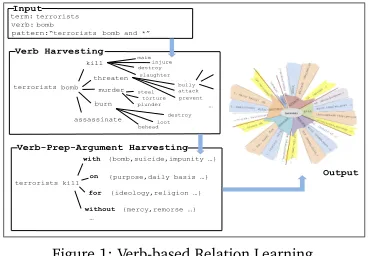
We define our task as given a term, a relation expressed by a verb and a set of prepositions: (1) learn in bootstrapping fashion new relations (i.e.verbs) associated with the initial term and filter out erroneous extractions; (2) form triples of the term, the harvested verbs and the initial set of prepositions to learn additional relations (i.e.verb-prepositions) and their argument fillers.
Input!
term:!terrorists
verb:!bomb
pattern:“terroristsbomb and *” Verb Harvesting!
terrorists bomb kill murder threaten burn assassinate
Verb-Prep-Argument Harvesting!
with for on without … Output! {bomb,suicide,impunity …} {purpose,daily basis …}
[image:3.420.125.309.303.431.2]{ideology,religion …} {mercy,remorse …} terrorists kill maim injure destroy slaughter bully attack prevent destroy loot behead steal torture plunder …
Figure 1: Verb-based Relation Learning.
Figure 1 shows an example for the input termterrorists, the verb relationbomband the recursive pattern “terrorists bomb and *”. The algorithm learns on the*position verbs likekill, murder,
threaten, burn, assassinate. We denote this phase asverbextraction. Then each learned verb is
used to form triples of the typeterm-verb-prepositionto learn new verb-preposition relations and their argument fillers. For instance, “terrorists kill with *" extracts arguments like{bombs,
suicide, impunity}. We denote this phase asverb-prepositionextraction. Finally, the learned
relations and arguments are ranked and arranged by their ranking score. The output of this harvesting procedure is triples of the kind “terrorists kill people", “terrorists kill on purpose",
3.2 Algorithm Description
Because of their fixed nature, pattern-based methods often fail to extract information from small corpus or single document. However, nowadays we dispose of endless amount of data, which is easily accessible and is making it possible for such systems to work successfully by scanning billions of Web pages to extract the necessary information. Many of the existing and most accurate is-a relation learners rely on lexico-syntactic patterns (Hearst, 1992; Pasca, 2004; Etzioni et al., 2005), therefore we decided to use patterns for the verb extraction procedure.
PHASE1: LearningVerbRelations.The first phase of the algorithm focuses on verb extraction. We use (Kozareva et al., 2008) recursive DAP pattern for is-a relation learning and adapted it to verb extraction as follows: “<seed-term> <seed-verb>and *", where<seed-term>is any term (noun) given by the user or taken from an existing knowledge base,<seed-verb>is a seed relation expressed through a verb and*indicates the position on which new verbs will be extracted. The generated patterns are submitted to the search engine as a web query and all retrieved snippets are kept. The algorithm extracts on the position of the∗all verb constructions and if they were not previously explored by the algorithm, they are placed on the<seed-verb> position of DAP and used as seeds in the subsequent verb extraction iteration. The harvesting terminates when there are no more verbs to be explored. Following (Kozareva et al., 2008), we filter out erroneous extractions using graph ranking. We build a directed graphG= (V,E), where each nodev∈Vis an extracted verb candidate and(u,v)∈Eis an edge between two verb nodes indicating that the verbulead to the extraction of the verbv. Each nodeuin the graph is ranked asu=P∀(u,v)∈E(u,v). Confidence inuincreases whenuextracts more verbs. PHASE2: LearningVerb-PrepositionRelations.In the second phase, the learned verbs are paired with an initial set of 17 prepositions to learn new relations and argument fillers. The prepositions were taken from the SemEval 2007 task on preposition disambiguation (Litkowski and Hargraves, 2007). To extract more relations, the algorithm uses the pattern “<seed-term> <verb> <prep>*”, where<seed-term>is the initial term for which we want to learn verb-based relations,<verb>are the leaned verbs from the previous phase and*is the position of the argument fillers. Given the relationkillfor the termterrorists, new relations liketerrorists kill
on,terrorists kill with,terrorists kill forandterrorists kill withoutare instantiated1. Similarly
to the verb extraction phase, we rank terms by building a bipartite graphG0= (V0,E0)with
two types of nodes. One set represents the verbs and verb-prepositionsV, and the other set represents the argumentsA. An edgee0(v,a)∈E0betweenv∈Vanda∈Ashows that the verb
(or verb-prep)vextracted the argumenta. Each argument is ranked asa=P∀(v,a)∈E0(v,a). Confidence inaincreases whenais extracted multiple times by different verbs.
4 Data Collection
It is impossible to collect and report results forallterms in the world. Still to evaluate the effectiveness of our verb-based relation learner, we have randomly selected 36 terms, which capture daily activities like going to a restaurant to unpleasant events like bombing. For the purpose of visualization, we have organized the terms into the following groups (topics):
Bombing,Diseases,Elections,Restaurants, andAnimals.
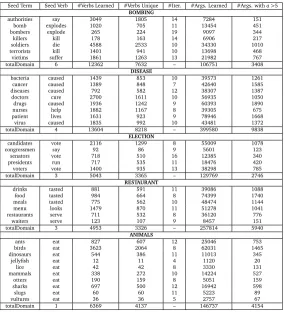
Table 1 shows the terms and seed verbs used to initiate the verb-based relation learning process, and summarizes the obtained results and the total number of iterations which were run to extract the verbs.#Verbs Uniqueshows the number of unique verbs after merging expressions
Seed Term Seed Verb #Verbs Learned #Verbs Unique #Iter. #Args. Learned #Args. witha>5 BOMBING
authorities say 3049 1805 14 7284 151
bomb explodes 1020 705 11 13454 451
bombers explode 265 224 19 9097 344
killers kill 178 163 14 6906 217
soldiers die 4588 2533 10 34330 1010
terrorists kill 1401 941 10 13698 468
victims suffer 1861 1263 13 21982 767
totalDomain 6 12362 7632 – 106751 3408
DISEASE
bacteria caused 1439 853 10 39573 1261
cancer caused 1389 848 7 42640 1585
diseases caused 792 582 12 38307 1387
doctors cure 2700 1611 10 56935 1050
drugs caused 1936 1242 9 60393 1890
nurses help 1882 1167 8 39305 675
patient lives 1631 923 9 78946 1668
virus caused 1835 992 10 43481 1372
totalDomain 4 13604 8218 – 399580 9838
ELECTION
candidates vote 2116 1299 8 55009 1078
congressmen say 92 86 9 5601 123
senators vote 718 510 16 12385 340
presidents run 717 535 11 18476 420
voters vote 1400 935 13 38298 785
totalDomain 3 5043 3365 – 129769 2746
RESTAURANT
drinks tasted 881 591 11 39086 1088
food tasted 984 664 8 74399 1740
meals tasted 775 562 10 48474 1144
menu looks 1479 870 11 51278 1041
restaurants serve 711 532 8 36120 776
waiters serve 123 107 9 8457 151
totalDomain 3 4953 3326 – 257814 5940
ANIMALS
ants eat 827 607 12 25046 753
birds eat 3623 2064 8 62031 1465
dinosaurs eat 544 386 11 11013 345
jellyfish eat 12 11 4 1120 20
lice eat 42 42 8 3330 131
mammals eat 338 272 10 14224 527
otters eat 190 159 8 5051 159
sharks eat 697 500 12 16942 598
slugs eat 60 60 11 5223 89
vultures eat 36 36 5 2757 67
[image:5.420.76.361.140.452.2]totalDomain 1 6369 4137 – 146737 4154
like (were killed,are killed,killed). For each domain, we also show the total number of verbs used to initiate the harvesting process and the total number of learned information. In total, we have submitted∼101, 559 queries and we have collected 10.3GB snippets, which were cleaned, part-of-speech tagged (Schmid, 1994) and used for the extraction of the verb-based relations and arguments. In total for all terms the algorithm extracted 26, 678 candidate relations and 1, 040, 651 candidate arguments of which 26, 086 have ranka>5.
5 Evaluation and Results
In this section, we evaluate the results of the verb-based relation learning procedure, which is extremely challenging because there is no universal knowledge repository against which one can compare performance in terms of precision and recall. To the extend to which it is possible, we conduct a human-based evaluation and we compare results to knowledge bases that have been extracted in a similar way (i.e., through pattern application over unstructured text).
5.1 Human-based Evaluation
Among the most common approaches on evaluating the correctness of the harvested information is by using human annotators (Pantel and Pennacchiotti, 2006; Navigli et al., 2011). Conducting such evaluations is very important, because the harvested information is often used by QA, machine reading and IE systems (Ferrucci et al., 2010; Freedman et al., 2011).
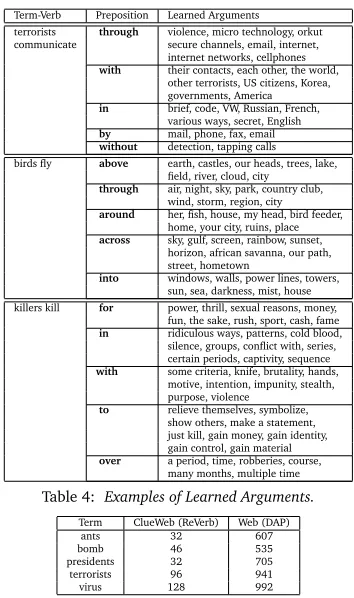
Since the evaluation of all 1, 067, 329 harvested terms is time consuming and costly, we decided to annotate for each term 100 verb relations and argument fillers. We conducted two separate annotations for the verbs and arguments, which resulted in 7200 annotations. We used two annotators who were instructed to mark as incorrect verbs (and argument fillers) that do not correspond to the term. For instance, “drugs affect” is marked as correct, while “drugs discuss” is marked as incorrect. We computeAccuracyas the number ofCorrectterms, divided by the total number of terms used in the annotation. Table 2 shows the accuracy of each domain at different ranks. The overall performance of our relation learner is .95 at rank 100 for the learned verbs and argument fillers. Tables 3 and 4 show examples of the harvested information.
5.2 Comparison with Existing Knowledge Bases
In this evaluation, we measure the ability of our system to learn verb-based relations of a term with respect to already existing knowledge bases, which have been created in a similar way. However, such comparative evaluations are not always possible to perform, because researchers have not fully explored the same terms and relations we have studied. When we compared results against existing knowledge bases, we noticed that Yago (Suchanek et al., 2007) has more detailed information for the arguments of the verb relations rather than the verb relations themselves. Repositories like ConceptNet2(Liu and Singh, 2004) contain 1.6 million assertions, however they only belong to twenty relation types such asis-a,part-of,made-of,effect-ofamong others. The only repository that we found with a diverse set of verb relations is the never-ending language learner NELL3(Carlson et al., 2009). However, there were only 11 verb relations forbomband 2 verb relations forvirus. This analysis shows that despite their completeness and richness, existing knowledge repositories can be further enriched with verb-based relations produced by our learning procedure.
2http://web.media.mit.edu/˜hugo/conceptnet/#overview 3Comparison done in March 2012 with http:
Term Accuracy Verbs Accuracy Arguments @10 @50 @100 @10 @50 @100
BOMBING
authorities 1 1 1 1 1 .90
soldiers 1 1 1 1 1 .97
killers 1 .98 .99 1 1 .96
Av.Domain 1 .98 .98 1 1 .97
DISEASE
diseases 1 .98 .95 1 1 .94
virus 1 .94 .93 1 1 .93
drugs 1 .92 .94 1 1 .93
Av.Domain .99 .97 .96 1 1 .93
ELECTION
candidates 1 1 1 1 1 1
voters 1 1 1 1 1 1
senators 1 1 .95 1 1 .97
Av.Domain 1 .99 .95 1 1 .96
RESTAURANT
food 1 1 .93 1 1 .94
restaurants 1 .94 .89 1 1 .98
menu 1 .92 .89 1 1 .95
Av.Domain 1 .94 .89 1 1 .95
ANIMALS
otters 1 1 .96 1 1 .94
mammals 1 1 .95 1 1 .95
sharks 1 1 .98 1 1 1
[image:7.420.76.365.65.326.2]Av.Domain 1 .99 .96 1 1 .92
Table 2: Accuracy of the Harvested Information.
Term Learned Verbs
diseases spread, develop, treat, come, kill, mutate, diagnose, evolve, are caught, survive, grow, occur, carry, cause, are cured, affect, are identified, start, prevent, propagate, are transmitted, thrive, sicken, change, flourish meals are prepared, are served, are cooked, are delivered, are planned, are eaten, are tasted, are provided, look,
are made, are consumed, are offered, are created, are frozen, are bought, are packed, are paid, smell, are designed, are purchased, are sold, are produced, are prepped, are shared, are catered
soldiers kill, shoot, beat, fought, fell, destroyed, fired, attacked, are trained, died, took, said, laughed, kicked, die, were humiliating, cheered, mocked, raised, drummed, captured, looted, ran, arrested, buried, defended
Table 3: Examples of Learned Verbs.
5.3 Comparison with Existing Relation Learner
For our comparative study with existing systems, we used ReVerb4(Fader et al., 2011), which similarly to our approach was specifically designed to learn verb-based relations from unstruc-tured texts. Currently, ReVerb has extracted relations from ClueWeb095and Wikipedia, which have been freely distributed to the public. ReVerb learns relations by taking as input any document and applies POS-tagging, NP-chunking and a set of rules over all sentences in the document to generate triples containing the verbs and the arguments associated with them. According to (Fader et al., 2011) ReVerb outperforms TextRunner (Banko et al., 2007) and the open Wikipedia extractor WOE (Wu and Weld, 2010) in terms of the quantity and quality of the learned relations. For comparison, we took five terms from our experiment:ant, bomb, president,
terrorists, virusand collected all verbs found by ReVerb in the ClueWeb09 and Wikipedia triples.
Table 5 summarizes the total number of unique verb extractions found by ReVerb in ClueWeb09 since the Wikipedia ones had low coverage. We have also manually validated the correctness of the verbs found by ReVerb and have seen that their accuracy is 100%. With respect to our extractions ReVerb has lower recall.
4http://reverb.cs.washington.edu/ 5http:
Term-Verb Preposition Learned Arguments terrorists through violence, micro technology, orkut communicate secure channels, email, internet,
internet networks, cellphones with their contacts, each other, the world,
other terrorists, US citizens, Korea, governments, America in brief, code, VW, Russian, French,
various ways, secret, English by mail, phone, fax, email without detection, tapping calls birds fly above earth, castles, our heads, trees, lake,
field, river, cloud, city through air, night, sky, park, country club,
wind, storm, region, city around her, fish, house, my head, bird feeder,
home, your city, ruins, place across sky, gulf, screen, rainbow, sunset,
horizon, african savanna, our path, street, hometown
into windows, walls, power lines, towers, sun, sea, darkness, mist, house killers kill for power, thrill, sexual reasons, money,
fun, the sake, rush, sport, cash, fame in ridiculous ways, patterns, cold blood, silence, groups, conflict with, series, certain periods, captivity, sequence with some criteria, knife, brutality, hands,
motive, intention, impunity, stealth, purpose, violence
to relieve themselves, symbolize, show others, make a statement, just kill, gain money, gain identity, gain control, gain material over a period, time, robberies, course,
[image:8.420.114.291.67.366.2]many months, multiple time Table 4: Examples of Learned Arguments.
Term ClueWeb (ReVerb) Web (DAP)
ants 32 607
bomb 46 535
presidents 32 705
terrorists 96 941
virus 128 992
Table 5: Comparison of Verb-based Relation Learners.
6 Conclusion
Our key contribution is the development of a semi-supervised procedure, which starts with a term and a verb to learn from Web documents a large and diverse set of verb relations. We have conducted an experimental evaluation with 36 terms and have collected 26, 678 unique candidate verbs and 1, 040, 651 candidate argument fillers. We have evaluated the accuracy of our approach using human based evaluation and have compared results against the ReVerb (Fader et al., 2011) system and existing knowledge bases like NELL (Carlson et al., 2009), Yago (Suchanek et al., 2007) and ConceptNet (Liu and Singh, 2004). Our study showed that despite their completeness these resources lack verb-based information and there is plenty of room for improvement since they can be further enriched with verbs using our harvesting procedure. In the future, we would like to test the usefulness of the generated resources in NLP applications.
Acknowledgements
References
Agirre, E. and Lacalle, O. L. D. (2004). Publicly available topic signatures for all wordnet nominal senses.
Alfonseca, E., Pasca, M., and Robledo-Arnuncio, E. (2010). Acquisition of instance attributes via labeled and related instances. InProceedings of the 33rd international ACM SIGIR conference
on Research and development in information retrieval, SIGIR ’10, pages 58–65.
Banko, M. (2009). Open information extraction from the web. InPh.D. Dissertation from
University of Washington.
Banko, M., Cafarella, M. J., Soderl, S., Broadhead, M., and Etzioni, O. (2007). Open informa-tion extracinforma-tion from the web. InIn IJCAI, pages 2670–2676.
Buitelaar, P., Cimiano, P., and Magnini, B., editors (2005). Ontology Learning from Text:
Methods, Evaluation and Applications, volume 123 ofFrontiers in Artificial Intelligence and
Applications. IOS Press, Amsterdam.
Bunescu, R. and Mooney, R. (2007). Learning to extract relations from the web using minimal supervision. InProceedings of the 45th Annual Meeting of the Association of Computational
Linguistics, pages 576–583.
Carlson, A., Betteridge, J., Jr., E. R. H., and Mitchell, T. M. (2009). Coupling semi-supervised learning of categories and relations. InProceedings of the NAACL HLT 2009 Workskop on
Semi-supervised Learning for Natural Language Processing.
Cuadros, M. and Rigau, G. (2008). KnowNet: A Proposal for Building Highly Connected and Dense Knowledge Bases from the Web. InSemantics in Text Processing. STEP 2008 Conference
Proceedings, volume 1 ofResearch in Computational Semantics, pages 71–84.
Etzioni, O., Cafarella, M., Downey, D., Popescu, A.-M., Shaked, T., Soderland, S., Weld, D. S., and Yates, A. (2005). Unsupervised named-entity extraction from the web: an experimental study.Artificial Intelligence, 165(1):91–134.
Fader, A., Soderland, S., and Etzioni, O. (2011). Identifying relations for open information extraction. InProceedings of the 2011 Conference on Empirical Methods in Natural Language
Processing, EMNLP 2011, pages 1535–1545.
Ferrucci, D., Brown, E., Chu-Carroll, J., Fan, J., Gondek, D., Kalyanpur, A. A., Lally, A., Murdock, J. W., Nyberg, E., Prager, J., Schlaefer, N., and Welty, C. (2010). Building watson: An overview of the deepqa project.AI Magazine, 31(3):59–79.
Freedman, M., Ramshaw, L. A., Boschee, E., Gabbard, R., Kratkiewicz, G., Ward, N., and Weischedel, R. M. (2011). Extreme extraction - machine reading in a week. InProceedings of
the 2011 Conference on Empirical Methods in Natural Language Processing, EMNLP 2011, pages
1437–1446.
Girju, R., Badulescu, A., and Moldovan, D. (2003). Learning semantic constraints for the automatic discovery of part-whole relations. InProceedings of the 2003 Conference of the North American Chapter of the Association for Computational Linguistics on Human Language
Girju, R., Nakov, P., Nastaste, V., Szpakowicz, S., Turney, P., and Yuret, D. (2007). SemEval-2007 task 04: Classification of semantic relations between nominals. InSemEval 2007.
Hearst, M. (1992). Automatic acquisition of hyponyms from large text corpora. InProceedings
of the 14th conference on Computational linguistics, pages 539–545.
Igo, S. and Riloff, E. (2009). Corpus-based semantic lexicon induction with web-based corroboration. InProceedings of the Workshop on Unsupervised and Minimally Supervised
Learning of Lexical Semantics.
Jain, A. and Pantel, P. (2010). Factrank: Random walks on a web of facts. InProceedings of the
23rd International Conference on Computational Linguistics (Coling 2010), pages 501–509.
Katz, B. and Lin, J. (2003). Selectively using relations to improve precision in question answering. InIn Proceedings of the EACL-2003 Workshop on Natural Language Processing for
Question Answering, pages 43–50.
Kim, J. and Moldovan, D. (1993). Acquisition of semantic patterns for information extraction from corpora. InProceedings of Ninth IEEE Conference on Artificial Intelligence for Applications, page 17176.
Kozareva, Z. and Hovy, E. (2010). Learning arguments and supertypes of semantic relations using recursive patterns. InProceedings of the 48th Annual Meeting of the Association for
Computational Linguistics, ACL ’10, pages 1482–1491.
Kozareva, Z., Riloff, E., and Hovy, E. (2008). Semantic class learning from the web with hyponym pattern linkage graphs. InProceedings of ACL-08: HLT, pages 1048–1056.
Lin, C.-Y. and Hovy, E. (2000). The automated acquisition of topic signatures for text summa-rization. InProceedings of the 18th conference on Computational linguistics - Volume 1, COLING ’00, pages 495–501.
Lin, D. and Pantel, P. (2002). Concept discovery from text. InProceedings of the 19th
international conference on Computational linguistics, pages 1–7.
Litkowski, K. C. and Hargraves, O. (2007). Semeval-2007 task 06: Word-sense disambiguation of prepositions. InProceedings of the Fourth International Workshop on Semantic Evaluations
(SemEval-2007), pages 24–29.
Liu, H. and Singh, P. (2004). Focusing on ConceptNet’s natural language knowledge repre-sentation. InCommonsense Reasoning in and over Natural Language Proceedings of the 8th International Conference on Knowledge-Based Intelligent Information and Engineering Systems
(KES 2004), pages 71–84.
Navigli, R., Velardi, P., and Faralli, S. (2011). A graph-based algorithm for inducing lexical taxonomies from scratch. InIJCAI 2011, Proceedings of the 22nd International Joint Conference
on Artificial Intelligence, pages 1872–1877.
Pantel, P. and Pennacchiotti, M. (2006). Espresso: Leveraging generic patterns for automatically harvesting semantic relations. InProceedings of 21st International Conference on Computational
Pasca, M. (2004). Acquisition of categorized named entities for web search. InProceedings of
the thirteenth ACM international conference on Information and knowledge management, pages
137–145.
Ravichandran, D. and Hovy, E. (2002). Learning surface text patterns for a question answering system. InProceedings of the 40th Annual Meeting on Association for Computational Linguistics, pages 41–47.
Resnik, P. (1996). Selectional constraints: an information-theoretic model and its computa-tional realization.
Riloff, E. (1996). Automatically generating extraction patterns from untagged text. In
Proceedings of the thirteenth national conference on Artificial intelligence - Volume 2, AAAI’96,
pages 1044–1049.
Riloff, E. and Jones, R. (1999). Learning dictionaries for information extraction by multi-level bootstrapping. InAAAI ’99/IAAI ’99: Proceedings of the sixteenth national conference on Artificial intelligence and the eleventh Innovative applications of artificial intelligence conference innovative
applications of artificial intelligence.
Ritter, A., Mausam, and Etzioni, O. (2010). A latent dirichlet allocation method for selectional preferences. InProceedings of the 48th Annual Meeting of the Association for Computational
Linguistics, ACL 2010, pages 424–434.
Schmid, H. (1994). Probabilistic part-of-speech tagging using decision trees.
Sekine, S. (2006). On-demand information extraction. InProceedings of the COLING/ACL on
Main conference poster sessions, COLING-ACL ’06, pages 731–738.
Snow, R., Jurafsky, D., and Ng, A. Y. (2006). Semantic taxonomy induction from heterogenous evidence. InProceedings of 21st International Conference on Computational Linguistics and 44th
Annual Meeting of the Association for Computational Linguistics, ACL.
Soderland, S., Cardie, C., and Mooney, R. (1999). Learning information extraction rules for semi-structured and free text. InMachine Learning, pages 233–272.
Suchanek, F. M., Kasneci, G., and Weikum, G. (2007). Yago: a core of semantic knowledge. In
WWW ’07: Proceedings of the 16th international conference on World Wide Web, pages 697–706.
Szpektor, I., Tanev, H., Dagan, I., and Coppola, B. (2004). Scaling web-based acquisition of entailment relations. InProc. Empirical Methods in Natural Language Processing (EMNLP). Talukdar, P. P., Reisinger, J., Pasca, M., Ravichandran, D., Bhagat, R., and Pereira, F. (2008). Weakly-supervised acquisition of labeled class instances using graph random walks. In
Pro-ceedings of the Conference on Empirical Methods in Natural Language Processing, EMNLP 2008,
pages 582–590.
Widdows, D. (2003). Unsupervised methods for developing taxonomies by combining syntactic and statistical information. InProceedings of HLT-NAACL.
Wu, F. and Weld, D. S. (2010). Open information extraction using wikipedia. InProceedings
of the 48th Annual Meeting of the Association for Computational Linguistics, ACL ’10, pages