Acquiring German Prepositional
Subcategorization Frames from Corpora
E r i k a F . d e L i m a
G1VID - G e r m a n N a t i o n a l R e s e a r c h C e n t e r f o r I n f o r m a t i o n T e c h n o l o g y
D o H v o s t r a s s e 15 64293 D a r m s t a d t , G e r m a n y
delima@darmsCadt, gmd. de July 7, 1997
Abstract
This paper presents a procedure to automaticafly learn German prepositional subcategofization frames fzom text corpora. It is based on shallow parsing techniques employed to identify high-accuracy cues for prepositional frames, the EM algorithm to solve the PP attachment problem implicit in the task, and a method to rank the evidence for subcategorization provided by the collected data.
1
Introduction
The description of lexical forms in both computation and hun~-oriented lexica include prepositional subcategoriza~ion information. For instance in German, the verb arbeiten ('to work') subcategorizes for a PP headed by the preposition an ('on'), and the verb erinnern ('to remind'), for an accusative NP and a PP headed by an:
(1) Mary arbeitet an der Frage P .~ N P . Mary works on the question
(2) M a r y exinnert ihren Freund an den Terrain. M a r y reminds her friend on the deadline 'Mary reminds her friend of the deadline.'
Subcategorization information is usually compiled by hand. A procedure to automatically learn prepositional subcategorization would enable the acqui-
sition of broad-coverage lexica which reflect evolving usage and which are less subject to lexical gaps.
Learning prepositional subcategorization automatically is not a trivial t~LSk; it entails a PP attachment decision problem, and requires being able to distinguish complement from adjunct prepositional cues. For instance in (2) above, it is (syntactically) possible to attach the prepositional phrase [pp an den Termini (to the noun phrase object as well as to the verb phrase. Sentence (2) cannot be considered conclusive evidence of a verbal frame based on syntactical information alone.
In (3) the prepositional phrase [pp in der Nacht] ('at night') is an adjunct P P which may occur with any (aspectuaUy compatible) verb. It is not specific of the verb arbeiten ('to work') and should not be considered evidence of subcategorization.
(3) Mary arbeitete in der Nacht. Mary worked in the night
'Mary worked at night.'
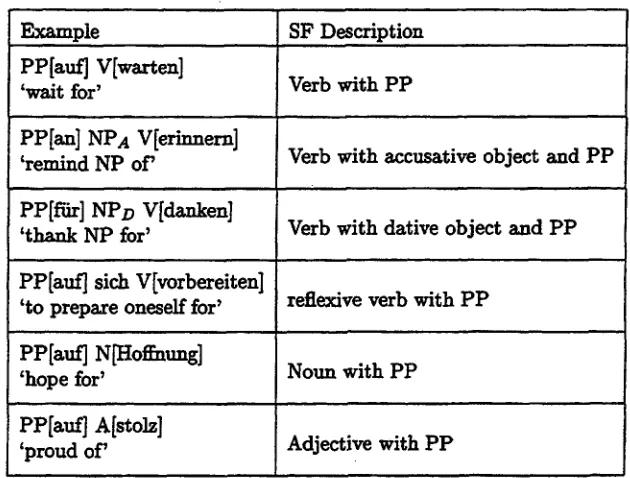
This paper proposes a method to automatically acquire German preposi- tional subcategorization frames (SFs) fzom text corpora. It is based on shal- low parsing techniques employed to identify high-accuracy cues for prepo- sitional SFs, and a method to rank the evidence for subcategorization pro- vided by the collected data. The PP attachment problem implicit in the task is dealt with by using the E M algorithm to rank alternative frames. T h e subcategorization frames considered are shown in figure 1.
2
M e t h o d
The automatic extraction of German prepositional SFs is based on the ob- servation that certain constructs involving so-called pronominal adverbs are high-accuracy cues for prepositional subcategorization. Pronominal adverbs are compounds in German consisting of the adverbs da(r)- and wo(r)- and certain prepositions. For instance in (4c), the pronominal adverb daran ('about it') is used as a pro-form for the personal pronoun es ('it') as the object of the preposition an ('about'). (Note that the usage of the pronoun (4b) is ungrammatical.) In (4d), the pronominal adverb daran occurs in a correlative construct with a subordinate daft ('that') clause immediately following it.
Example SF Description PP[auf] V[warten]
'wait for' Verb with PP
PP[an]
NPA V[erlnnern]'remind NP of' Verb with accusative object and PP PP[fiir] NPD V[danken]
'thauk NP for' Verb with dative object and PP PP[auf] sich V[vorbereiten]
'to prepare oneself for' reflexive verb with P P PP[auf] N[Hoffmtmg]
'hope for' Noun with PP
PP[auf] A[stolz]
'proud of" Adjective with P P
Figure 1: Subcategorization flames learned by the system
b. *Mary denkt an es. Mary thinks on it c. Mary denkt daran. Mary thinks on it 'Mary thlulcs about it.'
d. Mary denkt damn, da6 John bald aukommt. Mary thinks on it that John soon arrives
'Mary thinks about the fact that John will arrive soon.'
Unlike prepositional phrases, pronominal adverb correlative constructs pro- vide reliable cues for prepositional subcategorization. For instance the oc- currence of the pronominal adverb damn in the correlative construct in (4d) can be used to infer that the verb denken ('to think') subcategorizes for a PP headed by the preposition an (~about').
In the next section, a learning procedure is described which makes use of pronomln~.1 adverb correlative constructs to infer prepositional subcate- gorization. It consists of four components: SF detection, mapping, disam- biguation, and ranldng.
[image:3.612.159.474.124.363.2]2.1 S F D e t e c t i o n
This component makes use of shallow parsing tte,,hn~ques to detect possible prepositional SF ~ructures; a standard C F G parser is used with a hand- written grammar d~qn~ng pairs of main and subordinate clauses in correla- tive constructs such as (4d). Main clauses covered by the grammar include copular constructs as well as active and passive verb-second and verb-final constructs. Subordinate clauses considered include those headed by
daft
('that'), indirect interrogative clauses, and infinitival clauses.
The internal structure of the clause pair consists of phrase-like con- stituents; these include nominative (NC)~ prepositional (PC), adjectival (AC), verbal (VC), and clausal constituents. Their deiq-ltion is non-standard; for instance, all prepositional phrases, whether complement or not, are left unattached. As an example, the shallow parse structure for the sentence fragment in (5) is shown in (5') below.
(5) Er lobte die Reaktion der 5ffentlichen Meinung in RuBland he praised the reaction the public opinion in Russia als Beweis dafiir, daB...
as proof for it that
'He praised the reaction of the public opinion in Russia as proof of the fact that . . . '
(e) Is
Sr]
[vc
lobte][NC die R ktion]
[A'c der 5~ent]ichen Meinung] [PC in Ru.Bland]
[PC Ms
Beweis] [ P c[sc
d a S . . . ]2.2 S F M a p p i n g
I
I
I
I,
I
I
I
i
I
I
I
I
in a correlative construct main clause, VC the main verbal constituent in the clause; v in VC[v] denotes the head Iemm~ of the verbal constituent, analogously for NC[n].)
VC[v]/NC[n]. An active verb-second or verb-final clause with one NC is m~tpped to {PP[p] V[v]} if the NC precedes the finite verb/auxi~ary in the clause, otherwise to {PP[p] V[v], PP[p] N[n]}.
For instance, sentence (6) is a verb-second clause with an adverbial in the first position in the clause and one NC following the verb. In this construct, the PP headed by the pronominal adverb may potentially be attached to the verb phrase or to the nominal phrase immediately preceding it. According to this rule, this sentence is mapped to {PP[an] V[arbeiten], PP[anl N[Student]}.
(6) Jetzt arbeitet der Student daran, ... Now works the student on it 'The student is now working on ... '
VC[v]/NCl[nl]/NC2[n2]. An active verb-second or verb-final clause with two nominal constituents NC1 and NC~ such that NC,2 follows NC1 in the clause is mapped to {PP[p] NPA V[v], PP[p] N[n2]}, if the head of NC2 is a noun, and to {PP[p] NPA V[v]} otherwise.
Sentences (Ta,b) are examples to which this rule applies. In (Ta) the verb erinnern ('to remind') subcategorizes for an accusative NP and a PP headed by the preposition an ('on'), while in (To), the verb nehmen ('to take') is a support verb and Racksicht ('consideration') a noun which sub- categorizes for a PP headed by the preposition auf. Since their shallow structure is ambiguous, they are each mapped to a SF set reflecting both attar hment alternatives; (Ta) is mapped to the set {PP[an] NPA V[erirmern], PP[an] N[Freund]}, and (Tb) to the set {PP[auf] NPA V[nehmen], PP[auf] N[R~eksicht]}.
(7) a. Mary erinnert ihren Freund daran, daB... Mary reminds her friend on it that 'Mary reminds her friend of the fact that ... ' b. Mary nimmt keine Rficksicht darauf, daft...
Mary takes no consideration on it that 'Mary shows no consideration for the fact that ... '
Copula/NCl[nl]/NC2[n2]. A copula clause with two nominal constituents NCt[nl] and NC2[n2] such that NC2 follows NC1 and n2 is a noun is mapped to {PP[p] N[n2]}. For instance (8) is mapped with this rule to {PP[auf]
[nin is]}.
(8) Weft dies ein Hinweis darauf ist, da6... because this an indication on in is that
'Because this is an indication (of the fact) that . . . '
Copula/NC[n]/AC[a].
A copula clause with one nominal and one ad- jectival constituent is mapped to {PP[p] N[n], PP[p] A[a],}. For instance, with this rule the clause in (9) is mapped to {PP[auf] A[stolz], PP[auf]N[Student]}
(9) Stolz ist der Student darauf, da6... proud is the student on it that 'The student is proud of the fact that . . . '
P C s . Any clause in wt~ch a PC immediately precedes the prronomlna] adverb is mapped as in the appropriate rule with the additional element 'PP[p] N[n]' in the set, where n is the head of the NC within the prepositional constituent. For instance, (10) is mapped to {PP[an] V[arbeiten], PP[an] N[Woche]} with the VC/NC and PC rules.
(10) Mary arbeitet seit zwei Wochen daran, ... Mary works since two weeks on it 'Mary has been working for two weeks on . . . '
Morphology. Any clause in wldch a possible locus of attachment is mor- phologicaUy ambiguous is mapped with the appropriate rule applied to all morphology alternatives. For instance, (11) is mapped with the VC/NC and Morphology rules to {PP[an] V[denken], PP[an] V[gedenken]}, since
g~acht
is the past participle of both the verbs•nken
('to think') andg~enken
('toconsider').
(11) Er hat daran gedacht, dat3 ... he has on it thought/considered that 'He thought o f . . . '
Passive/VC[v]/NC[n].
This rule is applied to 'werden ('to be') passive verb-second or verb-final clause with one NC. In case n is not the pronoun es ('it'), the clause is mapped to (PP[p] NPA V[v]} ifNC precedes the verb, and to {PP[p] NPA V[v], PP[p] N[n]} otherwise. In case n is the pronoun ~ , the clause is mapped to {PP[p] NPA V[v], PP[p] V[v]}. For instance, (12) is mapped to {PP[an] NPA V[erinnern]}.(12) Mary wird daran erinnert, da6... Mary is on it reminded that
I
I
i
!
2.3 S F D i s ~ r n b i g u a t i o n
The dis~rnhiguation component uses the expectation-maTirni~tion (EM) algorithm to assign probabilities to each frame in an SF alternative, given all SF sets obtained for a given corpus. The EM algorithm (Dempster, Laird, and Rubin, 1977) is a general iterative method to obtain maximum likelihood estimators in incomplete data situations. See (Vardi and Lee, 1993) for a general description of the algorithms as well as numerous examples of its application. The EM algorithm has been used to induce valence information in (Carrol and Rooth, 1997).
In the current setting, the algorithm is employed to rank the frames in a given SF set by using the relative evidence obtained for each frame in the set. The algorithm is shown below.
Algorithm. Let F be a set o f frames. Further, let ~q be a finite set of nonempty subsets of ~(F), and let F0 = I.J X.
XE8 Initialization step: for each frame z in F0:
c0C~) = E
(I(z,x). go(X))
XE8
Step k + 1 (k > = 0):
Ck+l(Z) = ek(Z) "t- E
(Pk(z,X) "ge(X))
x E $
Where ge is a ftmetion from S to the natural n-tubers mapping a set X to the number of times it was produced by the SF mapping for a given corpus C. Fm-ther, I, Pk, and Pk are r u n . i o n s defined as follows:
x : e × [0,1]
{ l ~ i f z E X
(z,X)
~
0
else
F × [0,1]
l ...e~l_. if z e X and lX[ > l
(z,X)
~
~Ex2"
p~C~)
0 else
pk : F --r [0,1]
x~EFO
Definition. A frame z is best in the set X at the iteration k if z E X and p~(z) is an absolute maximum in U Pk(~)-
~EX
In the algorithm above, 8 denotes the set of SF sets produced by the SF mapping for a given corpus C. In the initialization step, co assigns an initial "weight" to each frame, depending on its relative frequency of occurrence, and on whether the structures in which it occurred are ambiguous. The weight ck(x) of a frame x is used t o estimate its probability pk(x). In each iteration of the algoritBrn, the weight of a frame ¢ is calculated by considering t h e totality of alternatives in which ~c occurs (i.e., the sets for which z E X and IX[ > 1), and its probability within each alternative. The best frames in a set are the most probable frames given the evidence provided by the data. In the experiment described in section 3~ the 6n~:l number of iterations was set empirically.
2.4 S F
l ~ k l n g
This component ranks the SFs obtained by the previous component of the
system. Let £ c be the set of head lemmata (verbs, nouns and adjectives) in the subcategorization cues (i.e., best frames in the SF sets) for a given corpus C. Let .~" be the set {NPA V[-], NPD V[-], V[-], PP[an] V[.], PP[an] NPA V[-], ...} of SF structures. (Roughly, an SF structure is an SF with- out its head lernm~) The analysis of SF cues is performed by creating a contingency table cont~inlng the following counts for each lemma L E £c and prepositional structure S E yr: k(L S) (k(L S)) is the count of lemm~ L with (without) structure S, and k(L S) (k(L S)) is the count of all ]~mm~ta in £c except L with (without) structure S.If a lemma L occurs independently of a structure S, then one would expect that the distribution of L given that S is present and that of L given that S is not present have the same underlying parameter. The log likelihood statistic is used to test this hypothesis. This statistic is given by - 2 log A =
2(log L(p1, kl, hi) ÷log L(p2, k2, n2)-log L(p, kl,
R1)--log
L(p, k2, n2)), where
log LCo, k, n) = k logp + (n - k)log(1 -- p), and Pl = ~ , P2 = ~ , P = ,~',~;3
R e s u l t s
The method described in the previous section was applied to 1 year of the newspaper FFrankfu~er Allgemeine Zeitung containing approximately 36 mil- lion word-like tokens. A total of 16795 sentences matched the pronominal adverb correlative construct grammar described in section 2.1.
3.1 S F D i s a m b i g u a t i o n
Of the 16795 sets produced by the SF mapping, 5581 contained more than one SF, i.e., reflected some form of ambiguity in the original sentence, of which 4365 were unique. A random set of 400 sets was obtained from these unique ambiguous sets. The disambiguation component produced a decision for 359 of these 400 sets. These results were compared to the blind judge- ments of a single judge; 305 were found to be correct, 23 incorrect. The rem~inlng 31 sets were considered to contain incorrect SFs solely. Although an error rate of over 15% is not negligible, it is comparable to other P P attachment experiments (Collins and Brooks, 1995).
3.2 A c q u i r e d D i c t i o n a r y
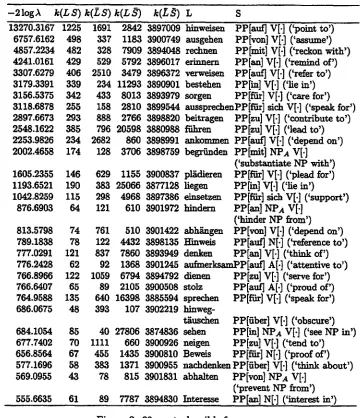
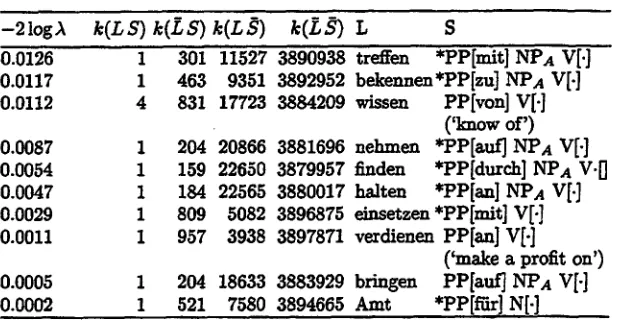
The system acquired a dictionary of 1663 unique subcategorization frames. Figure 2 and 3 show the 30 most and 10 least plausible frames according to the system. Starred structures are considered to be errors.
Examination of the r~n~ed SF table shows that frames with a low - 2 log value consist mostly of errors. The cues produced by the system are not perfect predictors of subcategorization. False cues stem from incorrect de- cisions in the disambiguation component as well as parsing and mapping errors, spurious adjuncts, or actual errors in the original text.
In figures 3, two errors are due to the disambiguation component (nehmen,
AmO; three errors stem from mistaking reflexive verbs for verbs t~ki~g any accusative object (sich treffen mit ('to meet with'), sich bekennen zu ('de- clare oneself for'), sich halten an ('to comply with')). These stem from the g~arnm~.r specification, and can be avoided with further development of the detection component.
By far the most frequent type of error was the inclusion of an accusative or dative NP in a verbal frame when the verb in fact only takes a PP. For instance of the errors in the 31 sets (out of the 400 ambiguous sets exam- ined) containing incorrect SFs only, about 42% were due to the fact that an additional accusative/dative NP was incorrectly included in a verbal frame,
-21ogA
k(LS)
k(ZS)
k(L.~)
k(Z~) L
S
13270.3167 1225 1691 284.2 3897009 hinweisen PP[atLf]V[-] ('pointto')
6757.6162 498 337 1183 39007494857.2234 482 328 7909 3894048
4241.0161 429
529
5792 38960173307.6279 406 2510 3479 3896372
3179.3391
339
234 11293 38909013156.5375 342 433 8013 3893979 3118.6878 255 158 2810 389954,4
2897.6673 293 888 2766 3898820
254.8.1622 385
796
20598 3880988 2253.9826 234 2682 860 3898991 2002.4658 174 128 3706 3898759 1605.2355 146 629 1155 3900837 1193.6521 190 383 25066 38771281042.8259 115
298
49683897386
876.6903 64 121 610 3901972
813.5798 74 761 510 3901422 789.1838 78 122 4432 3898135 777.0291 121 837 7860 3893949 776.2428 62 92 1368 3901245
766.8966 122 1059 6794 3894792
766.6407 65 89 2105 3900508
764.9588
135
640
163983885594
686.0675 48 393 107 3902219
684.1054 85 40 27806 3874836 677.7402 70 1111 660 3900926 656.856,1 67 455 1435 3900810 577.1696 58 383 1371 3900955 569.0955 43 78 815 3901831
555.6635
61
89 7787 3894830
Figure 2:
aus~e.hell
rechnen erinnern verweisen bestehen sorrgenPP[von] V[-] ('assume') PP[mit] V[- l ('reckon with') PP[an] V[-] ('remind of')
PP[auf] V[-] ('refer to')
PP[in] V[.] ('lie in')
PP[fftr] V[.] ('care for')
aussprechenPP[fiir] sich V[.] ('speak for') beitragen PP[zu] V[-] ('contribute to') fdhren PP[zu] V[.] ('lead to') an~ommen PP[auf] V[-] ('depend on')begrfmden PP[mit] NPA
V[-]('substantiate NP with')
pl~dieren PP[fiir] V[-] ('plead for')
liegen PP[in]V[-] ('lie in')
einsetzen PP[fdr] sich V[.] ('support') hindern PP[an] N P A V[.]
('hinder NP from')
PP[von] V[-] ('depend on')
PP[auf] N[-] ('reference to')PP[an] V[-] ('think of')
a-fimerk.~mPP[auf]
A[.]('attentive to')
PP[zu] V[-] ('serve for')
PP[auf]
A[.]('proud of')
PP[ffir] V[-] ('speak for')abh~agen
Hinweis
denken
dienen stolz sprechen hinweg- t~uschen sehen neigen BeweisPP[fiber] V[-] ('obscure')
PP[in] NPA V[-] ('see NP in')
PP[zu] v[.] ('tend to')
PP[fiir] N[-] ('proof of')
nachdenken PP[fiber] V[.] ('thlnk about')
abhalten
PP[von] NPA V[.]
[image:10.612.148.510.163.581.2]-21og~
k(LS) k(LS) lc(L,~) I~(L,~)
LS
0.0126 1 301 11527 0.0117 1 463 9351 0.0112 4 831 17723
0.0087 1 204 20866 0.0054 1 159 22650 0.0047 1 184 22565 0.0029 1 809 5082 0.0011 1 957 3938
0.0005 1 204 18633
0.0002 1 521 7580
3890938 treffen *PP[mit] NPA V[.] 3892952 bekennen*PP[zu] NPA V[-] 3884209 wissen PP[von] V[-]
('know of')
3881696 nehmen *PP[auiJ NPA V[-]
3879957 fmden *PP[durch] NPA V.D
3880017 halten
*PP[an]
NPA V[.] 3896875 einsetzen *PP[mit] V[.] 3897871 verdienen PP[an] V[-]('make a profit on') 3883929 bringen PP[auf~ NPA V[-] 3894665 Amt *PP[fSr] N[-]
Figure 3 : 1 0 least plausible frames
although the prepos/tion in the frame was subcategorized for. These stem from erroneous alternatives in the segmentation of nornin~! constituents as defined by the grammar and could be eliminated with further developed of the detection component.
Yet another type of error stems from pronominal adverbs which are con- junction/adverb homographs, or which are used anaphorically, while the verb in the main clause subcategorizes for a daj~ ('that') clause, so the sen- tence is erroneously considered to be a correlative construct. This is the source of most errors for flames involving the preposition gegen ('against'),
bei ('by') and nach ('to'), and cannot be avoided given the learning strategy. Given the fact that the cues produced by the system are not perfect predictors of subcategorization, a test of significance could be introduced in order to filter out potentially erroneous cues. However, it was observed that truly "new" prepositional frames--frames not listed in broad coverage pub- lished dictionaries, or even considered to be erroneous by a native speaker until confronted with examples from the corpus--behaved with respect to their rank;ngs very much like errors. So the current version of the learn- ing procedure relies on manual post-editing assisted by the SF ranking and examples from the corpus in order to discard f~!se frames.
3 . 3 P r e c i s i o n a n d R e c a l l
Evaluating the acqui~d dictionary is not straightfoward; linguists often dis- agree on the criteria for the complement/adjunct distinction. Instead of
[image:11.612.164.474.116.277.2]attempting a definition, the acquired dictionary was compared to a broad coverage published dictionary cont~iniug explicit information on preposi- tional subcategorization.
A random set of 300 verbs occurring more than 1000 times in the corpus was obtained, z The prepositional SFs for these verbs which were listed in (W~brig, Kraemer, and Zimmerman, 1980) and in t h e acquired lexicon were noted. There was a total of 307 verbal prepositional frames listed in either dictionary. Of these, 136 were listed only in the published dictionary, and 121 only in the acquired dictionary.
These prepositional SFs were used to calculate a lower bound for t h e precision and recall rates of the system; A SF is considered correct if and only if it is listed in the published dictionary. 2 A lower bound for the recall rate of the system is given by the number of learned correct frames divided by the number of frames listed in the published dictionary, or 52/173. This recall rate is a lower-bound for the actual rate with respect to the corpus, since there are prepositional SFs listed in the published dictionary with no instance in the corpus.
A lower bound for the precision of t h e system is given by the number of learned correct frames divided by the number of learned frames, or 52/188. This rate is a lower-bound for the actual precision rate of the system, since it does not take the fact into account t h a t the system did learn true SFs not listed in the published dictionary, so the precision rate of the system is actually higher. Further, not all prepositions contributed equally to the precision and recall rates. For instance the precision and recall for the prepositions a u s ('out') was 60% and 42%, that of t~on ('off) 50% and 53%, while t h a t of geeger~ ('against') 6% and 11%, respectively.
4
R e l a t e d W o r k
T h e automatic extraction of English subcategorization frames has been con- sidered in (Brent, 1991; Brent, 1993), where a procedure is presented t h a t takes u n t a m e d text as input and generates a list of verbal subcategorization frames. The procedure uses a very simple heuristics to identify verbs; the s y n t ~ t i c types of nearby phrases are identified by relying on local morpho- syntactic cues. Once potential verbs and SFs are identifled, a final com-
1There was a total of 15178 unique verbs (known to the morphology) occurring in the corpus, of which 913 occurred more than 1000 times.
portent attempts to determine when a lexical form occurs with a cue often enough so that it is unlikely to be due to errors; an automatically computed error rate is used to filter out potentially erroneous cues. Prepositional frames are not considered, since, according to the author, "it is not clear how a machine learning system could do this [determine which PPs are arguments and which are adjuncts]."
In (Manning, 1991) another method is introduced for producing a dictio- nary of English verbal subcategorization frames. This method makes use of a stochastic tagger to determine part of speech, and a Finite state parser which r~m.~ on the output of the t a ~ e r , identifying auxiliary sequences, noting pu- tative complements after verbs and collecting histogram-type frequencies of possible SFs. The final component assesses the frames encountered by the parser by using the same model as (Brent, 1993), with the error rate set em- pirically. Prepositional verbal frames are learned by the system by relying on P P s as cues for subcategorization; since the system cannot differenti- ate between complement and adjunct prepositional cues, it learns frequent prepositional adjuncts as well.
In order to evaluate the acquired dictionary, M~nn~ng compares the frames obtained for 40 random verbs to those in a published dictionary, yielding for these verbs an overall precision and recall rates of 90~ and 43% respectively. However, if only the prepositional frames listed for these verbs are considered, the rates drop to appro~mately 84% and 25%, respectively. In the experiment described, the error bounds for the filtering procedure were chosen with the aim of "get[ing] a highly accurate dictionary at the ex- pense of recall." His system did not consider nomlnal and adjectival frames. (Carrol and Rooth, 1997) present a learnln~ procedure for English sub- categorization information. Unlike previous approaches, it is based on a probabilistic context free grammar. The system uses expected frequencies of head words and frames--calculated using a hand-written grammar and occurrences in a text corpuswto iteratively estimate probability parameters for a PCFG using the expectation maximi~.ation algorithm. These parame- ters are used to rh~racterize verbal, nominal and adjectival SFs. The model does not distinguish between complements and adjunct prepositional cues.
5
C o n c l u s i o n
This paper presents a method for learning German prepositional subcatego- rization frames. Although other attempts have been made to learn English verbal/prepositional SFs from text corpora, no previous work considered a
i
partially free word-order language such as German, nor differentiated be- tween complement and adjunct prepositional cues.
T h e overall precision rate for the system described in this paper is lower than that of similar systems developed for English, since no test of signif- icance was used to filter out possibly erroneous cues. In the experiment described in the previous section, truly new prepositional frames behaved with respect to frequency of occu~ence very much like errors, and would possibly have been discarded by a filtering mechanism.
A problem in the current version of the system was the fact that segmen- tation of nominal constituents was not optimally handled by the detection component, leading to a large mlmher of verbal frames with correct preposi- tions, but with an additional erroneous accusative/dative NC in the frame. So the precision of the system can be significantly improved with further development of the detection component.
Further, the system should be extended to handle other types of pronom- inal adverb cues, such as pro-forms for interrogative, personal and relative pronouns; possibly PPs headed by prepositions should also be considered. Finally, the method-low-level parsing together with a procedure to ranlc alternatives obtained-should be extended to other frames as well.
References
Brent, Michael R. 1991. Automatic acquisition of subcategofization frames ~ o m u n t a m e d text. In
Proceedings of the ~ h Annual Meeding of the
AGL,
pages 209-214.Brent, Michael R. 1993. From grammar to lexicon: Unsupervised learning of lexical syntax.
Computational Linguistics,
19(2):243-262.Carrol, Glenn and Mats Rooth. 1997. Valence induction with a head- lexiccMiz~ed PCPG. http://www2.1ras.uni-stuttgart.de/,,,mats.
Collins, Michael and James Brooks. 1995. Prepositional phrase attachment through a backed-off model. In
Proceeding8 of the Third Wor~hop on
Very Large
Corpora.
Dempster, A.P., N.M. Laird, and D.B. Rubin. 1977. Maximuln likelihood from inclomplete data via the em algorithm.
J.R.Sta~s. Soc. B,
39:1-38.Mauling, Christopher D. 1991. Automatic acquisition of a large subcate- gorization dictionary from corpora. In Proceedings of the ~9th Annual Meeding of the ACL, pages 235-242.
Vardi, Y. and D. Lee. 1993. From image deblurring to optimal invest- ments: Maximum likelihood solutions for positive linear inverse prob- lems. Y.R.Statis. Soc. B, 55(3):569--612.
Wahrig, Gerhard, Hildegard Kraemer, and Harald Zimmerman. 1980. Brockhaus Wahrig Deutsches W~irterbuch in secl~ B~nden. F.A. Brock- haus und Deutsche Verlags-Anstalt GmbH, Wiesbaden.