I
I
l
I
I
i
I
I
i
I
I
II
I
I
I
I
I
I
On Parsing Binary Dependency Structures Deterministically in
Linear Time
Hard ARNOLA I Kielikone Oy
P.O. Box 126, 00211 Helsinki, Finland [email protected]
and
Helsinld University o f Technology Computer Science Laboratory
Espoo, Finland
Abstract
In this paper we demonstrate that it is possible to parse dependency structures deterministically in linear time using syntactic heuristic choices. We in'st prove theoretically that deterministic, linear parsing of dependency structures is possible under certain conditions. We then discuss a fully implemented parser and argue that those conditions hold for at least one natural language. Empirical data demonstrates that the parsing time is indeed linear. The present quality o f the parser in terms o f finding the right dependency structure for sentences is about 85%.
Introduction
Natural language sentences have ambiguities at many levels of abstraction. Since present computational algorithms can handle only partial structures, one after another, these ambiguities cause problems for parsing. A common solution is to create ahemative structures in parallel, and explore a forest of possible trees in hope that the right parse tree will appear among them. This solution for processing ambiguities in parsing creates two new problems. Which tree is the right one among many in a forest.'? Furthermore, in the process o f creating alternative structures, the number o f partial trees tends to grow exponentially or at least polynomially with the
number o f words of a sentence. That in turn implies similar growth in the processing time.
If a parsing algorithm were able to make confidently only the right local structural choices for a sentence, it would deterministically produce only a single, correct tree. The benefits would be obvious: there would be no search for the right tree in a forest, and the processing time could be benign. However, to our best knowledge, no one has yet been able to produce a deterministic parser for a constituent analysis o f sentences.
A dependency theory o f syntactic structure indicates syntactic relations directly between the words o f a sentence (e.g., Hays, 1964; Hudson, 1976, Hellwig, 1986; Mel'chuk, 1988; Robinson, 1970; Schubert, 1986; Starosta, 1988). We have studied the parsing o f dependency structures over several years (Nelimarkka et al. 1984, Jiippinen et al, 1986, Valkonen et al., 1987). In this paper we discuss the final version of our fully implementod dependency parser and show that h is possible to design a heuristic deterministic dependency parser that parses sentences in linear time. The parser chooses heuristically only one direct governor among alternatives for each word in a sentence. Such a deterministic parser runs a great potential risk that at some point a wrong choice is made and the right parse tree is missed. We demonslrate empirically that the quality o f the deterministic
l Formerly Hard Jfippinen
Current address: Ganesa Oy, It. Teatterik. 1 D 22, 00100 Helsinki, Finland. E-mail: [email protected]
parser can be maintained on a satisfactory level. We first discuss deterministic parsing theoretically and then proceed to discuss the implemented parser.
1 Strings and G o v e r n m e n t s
I.I
Direct governments andgoverned
strings
Let x be a node that has certain formal properties. Let S = {xl. x2, x3 .. . . } be a well- ordered set or a string o f such nodes. (We do not discuss the formal properties o f nodes here. Later on, when nodes are interpreted as word forms, their formal properties will be morpho- syntactic attributes.) Let R be a binary, asymmetric, and antireflexive relation between the nodes o f S:
(0
R = { <xi, xi> ]xi, x i ~ S, xi Rxi, and i# j }
We say that xi directly governs xj or is a direct
governor or a regent o f xj. Correspondingly, xj
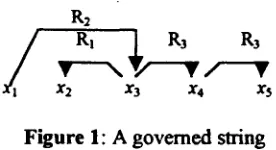
is directly governed by or a d e p e n d a n t o f xi. Graphic representation indicates direct govermnents by arrows (Figure 1).
Rather than using just one direct government relation we admit several annotated binary relations, distinguished with integer subscripts. Let R = {Rb R2, R3, ...} be a set o f such binary relations.
We stipulate the following tree constraint for the direct government: a directly governed node has a unique direct governor.
R2
R, I R3 R3
[image:2.612.108.246.537.612.2]X2 X3 X4 X5
Figure 1: A governed string
We say that a node xi governs xj (i#j) iff either xi directly governs xj, or xi governs Xk (k#i,j) and xk governs or directly governs xj. If all nodes o f a string except one are governed by the same governor, we say that the string is totally
governed (by that common governor). Figure 1 shows a totally governed string that is governed by node xl.
Due to the tree constraint, governed strings are topologically trees. We distinguish different kinds o f ambiguities in strings. A string S is
unambiguous with respect to a set o f relations
R if each node has only one possible direct governor and governing relation. S is locally
ambiguous but globally unambiguous, if S has
only one unique totally governed string but at least one node has more than one possible direct governor or governing relation. S is (globally)
ambiguous, if there are more than one
topologically different (or differently annotated) totally governed strings for it.
We stipulate another topological constraint. The projectivity constraint states that ifxi Rk xj, for any i, j, k and i>j, there exists no Rp such that Xm Rp x, for any m and n such that m>j and i<n<j or m<i and i<n<j. (The projectivity constraint prohibits "crossing" direct governments.)
1.2 G o v e r n m e n t M a p s
It is convenient to study governed strings using two-dimensional government maps (GM). A GM(S,R) is a matrix whose rows represent the nodes o f a string S and the columns represent the relations o f R. The ordering o f the rows corresponds to the ordering o f the nodes in S, while the ordering o f the columns (relations) is arbitrary. The direct governor of a node is marked at the intersection o f the governing relation and the governed node. For example, if R = {Rb R2, R3, R4} and S = {XL X2, X3, X4, XS} Table 1 shows the GM(S,R) o f the governed string in Figure 1. Formally, GM(S,R) c S x R x S. (Henceforth we often simply write GM rather than GM(S,R).)
Node/Relation RI R2 R3 R4
XI
X2
X4 X5
X3
XI x3 X4
Two GM's are called equidimensional if they represent identical strings and identical sets o f relations and the relations occupy the same columns in both maps.
We borrow a few operations from the set theory. A direct government xi R~- x i belongs to a GM (marked ~) iffxi and xj are nodes in the GM and xi Rk x i is marked in GM. A government map GMI includes another equidimensional map GM2 (GM2 c_ GM1) i f all direct governors in GM2 are also in GMI, GMI properly includes an equidimensional map GM2 (GM2 c GMI) if GM2 c_ GM1 and GMI ¢: GM2. Any given two equidimensional maps are identical, if they include one another. We also admit unions ( u ) and intersections (c~) o f two equidimensional GM's in the obvious manner.
A GM may exhibit just those direct governers which constitute a totally governed string, it may show any subset o f the direct governors o f the nodes, or it may exhibit all possible direct governors o f the nodes. We say that a resolved GM (GM') is a map that shows only the direct governors o f a totally governed string. A
complete and unresolved GM (GM c~) is a map
that indicates all possible direct governors o f the nodes. A (partially) unresolved GM (GM u) indicates some but not necessarily all direct governors o f the nodes. For each GM, GM' _c GM cu and GM" c GM cu.
Let GMr(S,R) and GM~"(S,R) represent a resolved and the complete and unresolved equidimensional maps, respectively. If S is unambiguous, GM r = GM% If S is locally ambiguous but globally unambiguous, there exists only one GM ' and the GM r c GM ~'~. I f S is globally ambiguous, there exists more than one different GM r and for each GM' c GM ~. Finally, if there exists no GM ' such that GM ~ _c GM ¢'', we say that the string is ungrammatical (with respect to R).
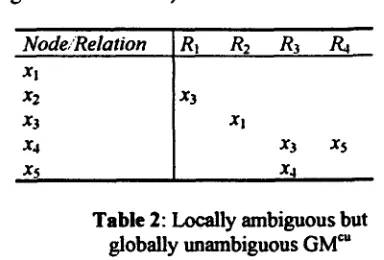
Table 2 shows the GM ~ o f a locally ambiguous but globally unambiguous string. Node x4 cannot be directly governed by both x3 and xs, hence the string is locally ambiguous. Only the former
choice results in a totally governed string (Figure 1 and Table 1).
Node/Relation Ri R2 R3 R4 Xl
x~ x3 x4 x5
x3
XI
[image:3.612.337.529.97.227.2]X3 X5 X4
Table 2: Locally ambiguous but
globally unambiguous GM ~''
Table 3 shows the GM c° o f a both locally and globally ambiguous string. Figure 1 shows one and Figure 2 shows another governed string corresponding to this GM ¢~. If a string is ambiguous, at least one row has multiple entries in the GM%
Node.Relation Ri 17,2 R3 R4 Xi
X2
X5
X3 X!
X1 X3
X4
Table 3: Locally and globally ambiguous GM ¢"
R2
X3 X4 XS
Figure 2: Another governed string
1.3 Deterministic parsing
An GM r carries all necessary information about the structure o f a governed string. If the process o f uncovering the structure o f a string is called parsing, a parsing process equals to the finding o f the GM r for a given string (or all resolved maps if the string is globally ambiguous), and the found GM ) represents the parse tree o f the string.
The nodes and relations in a GM generate an abstract search space for governed strings.
process begins with an empty map and makes progresssively more and more direct governors known. The process should end with a GM u such that GM' c_ GM ~. If G1Vf c GM ~ there remains a residual problem o f finding GM ", GM" c GM", such that GM'" = GM ~.
Let us assume that for each globally ambiguous string there is single fight parse tree, called the preferred tree. We call a parsing process
deterministic,
if it begins with an empty map and marks direct governors in the map in such an order that when the process ends GM u = GM r, where GM" is the explored map and GM r represents the parse tree or the preferred parse tree if the string is globally ambiguous.Theorem 1: Unambiguous strings can be parsed deterministically.
A proof is trivial. Any algorithm which finds all possible direct governors o f the nodes by iterating through all the relations and all the nodes creates the GM c'' by definition. And with unambiguous strings, GM r = GM ~u.
The following OS algorithm (for Open Search), among others, parses unambiguous strings deterministically.Let nR denote the number o f available relations and ns stand for the number o f nodes in an input string.
OS algorithm:
1. Assign the available relations as columns in a GM in random order.
2. Assign the nodes o f an input string as rows in the GM in their precedence order.
3. Mark each cell in the GM empty and each row open.
4. For each column k (k=l .... , nR) test each xi (i=l ... n~) and each open xj (j--i-l, i-2 ... 1, i+ 1, i+2 ... n~) for xi R xj, where R is the relation assigned in the column k. Mark each found direct governor xi in the GMJj,k] and mark the r o w j closed.
Let us call the number o f open nodes (plus 1) between a direct governor and the governed node at the moment o f a test the distance o f the relation test.
Distance lt.vpothesis: It is possible to order linguistic dependency relations as columns in a GM in such a way that the maximum distance remains within a fixed boundary when the OS algorithm parses natural language sentences. (We return to this hypothesis later on in this
paper.)
Theorem 2: If the distance hypothesis holds, unambiguous strings can be parsed in linear time.
Let us assume that the distance hypothesis holds and let d stand for the maximum distance. The iteration statement in the OS algorithm is then limited as follows:
. , ,
(j=i-l, j-2, ..., i-d, i+l, i+2, ..., i+d);
Let C denote the most expensive relation test. The OS algorithm consumes in the worst case at most C * nR * nN * 2 * d = O(nN).
Next we show that even ambiguous natural language sentences can be parsed deterministically in linear time if a certain additional condition holds.
Best-First Conjecture: It is possible to order the linguistic relations as columns in a GM in such a way that (without violating the Distance Hypothesis) the OS algorithm produces for natural language sentences the right or the preferred GM r most o f the time.
Due to its heuristic flavor, we call the thus modified OS algorithm the BF algorithm.
B F algorithm:
1. Assign the available linguistic relations as columns in a GM in such an order that both the Best-First Conjecture and the Distance Hypothesis hold.
2. (steps 2.-4. are as in the OS-algorithm)
I
I
I
I
i
I
!
!
I
i
I
I
I
I
I
I
ones for a word, the alternative local governors will be rejected forever. Therefore, there is no guarantee that the right parse trees will be always produced, hence the phrase "most o f the time".
Claim: The BF algorithm parses natural language sentences detenninistically in linear
computational cost o f the most expensive relation test).
2.2 Decomposition
The theoretical model assumes that sentences are parsed in one pass. The DCParser divides sentences into segments, using conjunctions and delimiters as separators. The BF-algorithm is time so that the right or the preferred parse t r e e s ,. applied to each segment separately, and the final are p r o d u c e d m o s t o f t h e t i m e , phase unites the structures built in those segments applying the algorithm again. This claim is an unprecise empirical statement Decomposition greatly strengthens the Distance that can be supported only by empirical means. Hypothesis, but it does not alter the linearity That will be done next. proof, since the sum o f linear elements is linear:
2 The Practical P a r s e r
From now on we assume that strings o f nodes are natural language sentences and discuss a fully implemented parser (DCParser) that parses Finnish sentences. The DCParser differs from the simple theoretical model described above, but, as v~ll be shown below, the differences do not alter the theory.
2.1 Contexts
The formal part introduced binary relations as context-free ordered pairs (1). Dependency relations in the implemented parser use contexts. Formally, they could be expressed as context- sensitive ordered pairs as in (2), but the DCParser uses different rule syntax as discussed in 2.5.
(2)
Ri = { < [ c x l ] x [ c x r ] , i c y ~ ] y [ c y , ] > l x, y are morphosyntactic representationso f the direct governor and the governed word form,
cx~, cxr, cyi, cy, are morpho-syntaetie representations o f the left and the right contexts o f x and y, respectively,
and x R i y }.
The use of contexts in relations adds another heuristic component to the BF-algorithm, and one dependency relation may require quite a few but fixed number o f such context sensitive definitions. Contexts do not alter, however, the linear time behavior o f Theorem 2. They only increase the value o f the constant C (the
(3) O(ni) + O(nj) + ... + O(nk) = O(nl~), ni, nj, ..., m. <__ns
where n~ is the number of the words in a sentence.
2.3 Homographic disambiguation
The theoretical model did not discuss ambiguous nodes. In practice a word form can have several alternative morphotactic interpretations. The DCParser has a separate morphological analysis phase which produces all possible morphotactic interpretations for the word forms of input sentences. A separate preprosessing phase explicitly disambiguates most o f the lexical and homographic ambiguities of Finnish word forms using context sensitive rules designed for the purpose (Nyl~nen, 1986). The remaining ambiguities are resolved implicitly by the DCParser as follows. When an interpretation o f an ambiguous word form qualifies as a governed node the alternative interpretations will be rejected. This strategy implements yet another heuristic component for the parser, but the strategy does not alter the linearity argument presented earfier.
2.4 T h e d e p e n d e n c y relations
stipulation, the finite verb o f the main clause is the head o f a grammatical sentence.
Relation name Dependant Resent IntensAttr Adverb Adverb/Adj. ModAttr Adverb Noun/Adj.
AdjAttr Adjective Noun
GenAttr Noun Noun
QuantAttr Num/Adv./Pron. Noun
NomAttr Noun Noun
MaterAttr Noun Noun
InfAttr Verb Noun
RelAttr Verb Noun
ClauseAttr Verb Noun PostpComp Noun Postposition PrepComp Noun Preposition
NegComp Verb NegVerb
AuxComp Verb Copula
Subject Noun Verb
Object Noun Verb
Adverbial Noun/Adverb Verb Complement Noun/Adjective Copula Connector Delimiter Verb/Noun Separator Delimiter Verb
Head Verb none
Table 4: Common relations
2.5 C o o r d i n a t i o n s
ConjPreComp ConjPreComp Subject
John v, Bill a~nd hfdry laughed
Subject
Object
ConjPostComp ConjPostCompI s~v John ; Bill and Mary
Figure 3: Coordinations
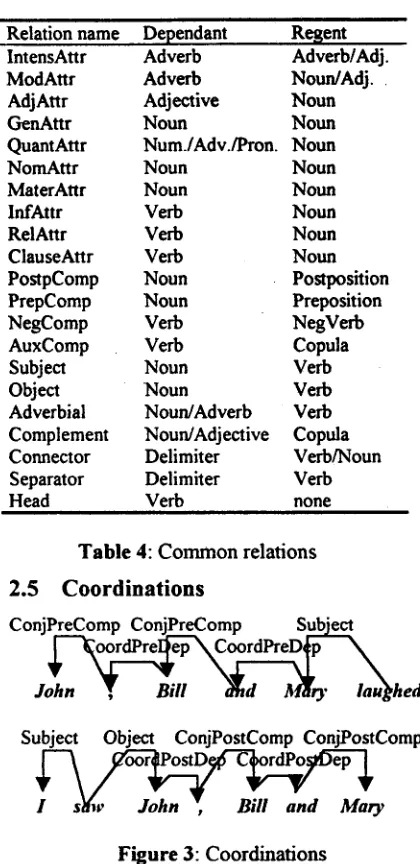
Coordinations are one o f the main sources o f syntactic ambiguity in natural language sentences. For us they cause also a notational problem, since coordinations do not seem to be prima facie binary relations. The DCParser treats a coordination as two coexisting binary relations. One word governs the coordinator which governs the other word. By stipulation, that word among coordinated words which is closest to the regent becomes the head o f the coordination. For example, the coordinated subject in the sentence John, Bill and Mary
laughed is ascending, while the coordinated object in the sentence I sin,, John, Bill and Mary
is descending as Figure 3 illustrates.
2.6 S u b o r d i n a t e c l a u s e s
The DCParser treats finite subordinate clauses so that the subordinating conjunction serves as a linking word between the heads o f the main and the subordinate clauses. The conjunction is in the relation in question, and the head o f the subordinate clause is in the ConjPostComp- relation with the conjunction. Below there is a Finnish example sentence from the corpus, its rough word-for-word translation and the parse tree produced by the DCParser (4). This sentence exemplifies both subordinate clauses and coordinations. In this output mode the DCParser displays word forms as triplets:
surface form, Relation, base form. Hierarchy is indicated using indentation: the regent of a given dependant is the first word below that is indented one step less.
Riittda, kmt puolueetja niidenj~rjesti~t
[It is enough], [when] [the parties and their organiz.]
velvoitetacai : lainsaadt~mtn m'ullajulkaisemaan
[are compelled] [using legislation] [to publish]
[image:6.612.67.277.92.524.2]tarkasti tililq~aattkset, budjettinsaja
[accurately] [financial statements, their budgets and
lahjoituksensa.
their donations].
(4)
-,, Connector, _COMMA
I-puolueet, ConjPreComp, puolue
[-ja, CoordPreDep, ja
I-niiden, GenAttr, ne
I-ji~rjesltt, Object, jarjestO
I-lains~l~mOn, GenAttr, lainsaadant6 -m~//a, Adverbial, apu
I-/ahjoituksensa, ConjPostComp, lab...
I-ja, CoordPostDep, ja
~-budjettinsa, ConjPostComp, budjetti I-,, CoordPostDep, _COMMA
~.tifinpadtOkset, Object, tilinp~tts
I-tarkasti, Adverbial, tarkasti
{-julkaisemctan, Adverbial, julkaista
I-veivoitetacm, ConjPostComp, velvoittaa ./am, Adverbial, kun
I--, Separator, _PERIOD
Another sentence from the corpus and its parse tree are as follows:
Kysymys askarntttaa koko maaJlmaa tlyt,
[The question][puzzles] [the whole wodd][now,] hm Yhdysvalta#! retmblikacmit
[when] [the republicans of the U.S.]
mat pit/nleet /molnekokmtkSensa
[have held] [their party congress]
ja nimomeet presidentti Bushin
[and] [nominated] [president Bush]
ja varapresidemti Da71Quaylen
[and] [vice-president Dan Quayle]
taisteluparikseen,
[as their fighting couple,]
/mten neljd aruotta sittetL
[like] [four years ago.]
(5)
I-Kys)vnys, Subject, Kysymys
l-koko, AdjAttr, koko
.maailmaa, Object, maailma 1-,, Connector, _COMMA
]-Yhdysvaltam, GenAttr, Yhdysvallat
I-republikawlit, Subject, republikaani
I-puoluekokouksensa, Object, puoluekokous
]-presidentti, NomPreAttr, presidentti
[ [-varapresidentti, NomPreAttr, ..
I [-Dan, NomPreAttr, Dan
I I'Quay len, ConjPostComp, Quayle
]-ja,
C o o r d P o s t D e p , ja[oBnshin, Object, Bush
I I-,, Connector, _COMMA
]°mistehtparikseen, Adverbial, taistelu...
I ]-neljd, QuantAttr, nelj~i
I [-vuotta, PostpComp, vuosi
[
[-sitten, ConjPostComp, sit, ten[-kuten, Apposition, kuten
[-nimemwet, ConjPostComp, nimeta
I-ja, CoordPostDep, ja
[-pitaneet, AuxComp, pit~
I-ovat, ConjPostComp, olla -/ran, ClauseAttr, kun I-nyt, Adverbial, nyt I--, Separator, PERIOD
I-askarruttaa, Head, askarruttaa 2.7 T h e g r a m m a r
In the DCParser word forms are represented as objects o f morpho-syntactie attributes. For example, the word form jdrjest~t (organizations) appears as [Form="jarjestOt", Lex="jiirjest6", Cat=Noun, Case=Nom, Number=PL]
For efficiency reasons binary relations are expressed as active rules. The testing o f a relation, then, corresponds to the activation o f the respective rule or a set o f alternative rules. For example, a simplified rule for AdjAttr (adjectival attribute o f nouns) reads as:
(6)
- Rule for adjectival attributes
Redo AdjAttr
Node Focus [ Cat=Noun, Cs:=Case, Nm:=Number ] DI := DepCand Left(l) [ Cat=Adjective,
Case--Cs, Number=Nm ] -> MakeDep D1 [ Rel:=AdjAttr ]
A rule has two main parts: the condition part and
the action part. The condition part searches and tests qualifying dependants and possible contextual words. A word qualifies in a test if its attribute object satisfies the description given in the rule. Variables can be used for passing attribute values. C: =" assings a value; "=" tests a value) The action part binds and names dependants and assigns values to attributes. The rule above iteratively (Redo) binds immediately preceeding adjectives as attributes if they agree in the case and number with the head noun.
Rules are classified into generic rules (grammar proper) and lexical rules. Their expressive power is identical. The former are activated by syntactic categories. (6) visualizes a simple generic rule. Lexical rules are activated by specific lexemes. For example, (7) describes a part o f a complex rule for Finnish verb pitdd.
(7)
LexBlock "pitaa" -- pitim tehdit Once pitaa !
DI "= DepCand Right(4) [ Modal=Iinf ] -> MakeDep D1 [ Rel:=Subject ]
Focus [ SubCat'--InfSubj ]
- pitM jostakin Once pitaa I 0
D1 := DepCand Right(4) [ Cat=Noun+Proper+ Pronoun, Case=El ]
Not Node From DI Right(l) [ Modal=IpartiO- llpartic ] -> MakeDep D1 [ Rel:=Adverbial ]
Pit#ti has several senses and subcatagories in
Finnish. (7) shows two of them. The first
alternative treats the verb as a m o d a l verb as in
Minun p i t ~ menn~ saunaan (I must go to the
sauna). (In our linguistic analysis we treat the
infinitive menna (to go) as the subject o f the
modal verb pitOO and the genitive minun (?I) as
the subject o f the infinitive.) The second
alternative handles the idiomatic usage Mind
pidOn hanest~ (I like her) where a surface elative
adverbial represents a deep semantic object o f
pitaO. The rule binds an elative as adverbial, but
does not bind it if the elative is followed by a
participle as in Min~ piclOn hOnestO l~htev~std
tuoksusta (?1 like the ~agrance coming from
her).
The grmnmar (Arnola, 1998) consists of about 950 generic rules and of about 12 500 lexical
rules. An algorithm, which implements the Best- First strategy, controls the activation o f the rules.
3. Empirical Results
3.1 B e n c h m a r k test suite
The parser has been under development for years. It is an integral part o f a commercial machine translation system called TranSmart®. A benchmark test suite o f correctly parsed sentences (source sentences and their correct parse trees) has been accumulated during this period. Only sentences that have revealed grammatical errors in the parser have been added to the test suite after the errors were corrected. Otherwise the test suite sentence have been randomly selected. The test suite sentences are periodically parsed to guarantee monotonous improvement o f the grammar.
200 T =_
"°I
,50
,,o+ / 1
e° T ~
60 z
O 10 20 30 40 50 60
Figure 4: Distribution o f the sentence lengths o f the benchmark test suite
As of this writing, the benchmark test suite comprises over 3000 sentences. The distribution of the sentence lengths (including delimiters) is shown in Figure 4. The average sentence length is 12.1 words.
3.2 Linearity a r g u m e n t
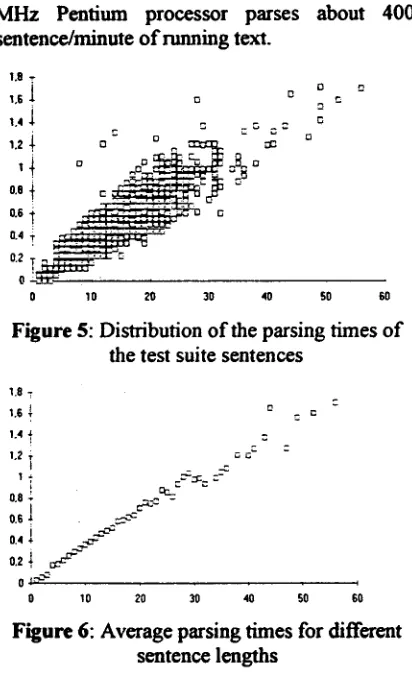
We used the benchmark test suite sentences to test the linearity claim. Figure 5 shows the distribution o f the parsing times in seconds. The processor is an old Intel 486, 66 MHz. A 150 MHz Pentium processor parses about 400 sentence/minute o f running text.
1.9
1.6 i ~ 0
0.6 ~ C:
0.2
0 -~:::~:~ , •
D
[image:8.612.306.512.214.552.2]0 10 20 30 40 SO 60
Figure 5: Distribution of the parsing times of the test suite sentences
1.8 7
;.6 ,~
1.4
L2 ,~
t
0.8 ~-
0.6 J 0.4 1 0.2 i 0 t ~ ~
0
---"2t2_
=.-~--
I 0 2O 30
G 7 - 7-
40 50 60
Figure 6: Average parsing times for diffe~er, t sentence lengths
Figure 6 plots the average parsing times for each sentence length. Sentences whose length is between 5 and 20 words form statistically meaningful sets. Their average parsing times form a clear linear function. Longer sentences do not support a contrary view.
3.3 Quality
I
I
I
I
I
I
I
I
I
I
I
correctly if the sentence is grammatical and t h e produced dependency structure completely complies with the structure a competent human judge would assign to it. Otherwise the parse tree is judged incorrect. Hence, a single, local structural error in an o t h e r w i s e c o r r e c t parse trc¢ disqualifies the st~cture. If a sentence is globally ambiguous but it is clear for a human reader which structure is meant, the structure is judged correct only if it is in agreement with the human decision. If a human reader cannot make the right choice for an ambiguous sentence without textual context, the structure is deemed correct if it is one o f the possible correct s t r u c t u r e s .
4
5 6 7 8
9 10 11 12 13 14
181 148/82% 19/10°/0 6/3% 8/4%
253 207/82% 26/10°/o 11/4% 9/4%
380 331187°/0 38110°/0 4/1% 7/2%
216 174/81% 27/13% 8/4% 7/3%
297 249/84% 33/11% 8/3% 7/2%
387 334/86% 34/90/0 11/3% 8/2%
196 166/85% 16/8% 8/4% 6/3%
267 224/84% 25/9% 8/3% 10/4% 118 97/82% 16/14% 2/2% 3/3%
2680 2271/85% 252/90/0 83/3% 74/3%
[image:9.612.339.544.64.178.2]391 337/86% 36/9*/0 1 i/3% 7/2%
Table 5: Parsing quality o f the test samples
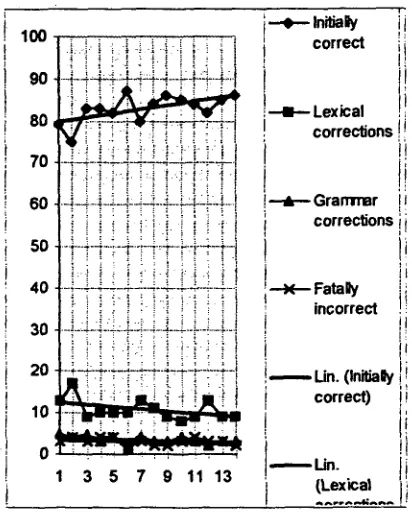
Figure 7 shows the percentage numbers o f each column in a graphic form. Lines are fitted to the d a t a t o indicate possible tendencies o f the series.
Presently the DQParser is fully developed in the sense that it is in practical use in commercial machine translation systems. However, the tuning
of
the parser still continues. The parser has been subjected to tens o f thousands o f genuine unedited sentences from different sources over the years. Each parse tree has been carefully studied and all indicated errors or gaps that could be systematically corrected were corrected in the grammar and in the lexicons. About once a week the benchmark test suite was processed and possible errors found in the test suite w e r e c o r r e c t e d .Occasionally (about oncein a month o r t w o ) a fresh piece o f text was randomly selected. The total number o f sentences in the text and the I number o f sentences parsed correctly right away were recorded. The incorrectly parsed sentences were classified into three classes: the ones I parsed correctly after (only) lexical
corrections,
the ones parsed correctly after grammatical corrections (and possible lexical corrections), and the ones whose parsing errors could not be I corrected in a systematic fashion. These e r r o r s
exhibit a fundamental drawback o f the Best-First strategy. Table 5 shows the data o f these test I samples. Each column presents both absolute
and relative numbers: absolute/percentage%.
I
I
[image:9.612.340.546.264.522.2]Text No. Parsed Rcq. Req. Fatally o f correctly Icxical gramm, in. ... ,,s~_t._ .. . . c ~ r ¢ c t = concc:t. _coF_.cct .
1 375 294178% 50/13% 19/5% 12/3%
2 196 148/76% 34/17% 8/4% 8/4%
3 196 162/83% 18/90/0 10/5% 613%
100
90
80
70
60
50
40
30
20
10
0
~ i ~ ~ " " " ~1
' i i i..; '.~ i . b [ : ~ :.~
-! d-i-~-!-ddd-~'t't
i i i ! i i:! !.! ! . ~ .-.! ... ~-.: --T-..;--T~ :~--.~:F..T-T-
_~_.¢_~._4 ~ ~.~_~.~..~_-~_
iii.ii !. i:i !i i
1 3 5 7 9 11 13
correct
ii
il
!-.--,oxen,
i!
corre ons
!!
II
= Jl. Gra,~',mr I1 corrections i i
ii
X Fatally =; incorrect i! il
I!
Un. ('n~a=y I!
correct) I!
Ii
!
ti
Figure 7: Parsing quality o f the 14 last samples
Table 5 and Figure 7 show that the parser seems to embody a stable 2-4% error ratio due to fundamental problems in the Best-First strategy. Approximately the same number o f sentences (2-5%) have revealed grammatical deficiencies in the parser. This figure may have a slow, although not clear declining trend. 9-17% of the sentences have revealed lexical deficiencies, and this figure seems to have a slow declining trend. 76-87% o f the sentences were parsed correctly right away, and this figure seems to show a clear
if slow upward trend. (The test samples cover almost two years o f rather intense tuning.)
C o n c l u s i o n
In this paper we have argued that it is possible to
parse binary dependency structures o f natural language sentences deterministically and in linear time, and to keep parsing quality within acceptable limits, if syntactic heuristics is applied appropriately. A possibility for linear parsing has been proved theoretically and demonstrated empirically. The quality issue was discussed using empirical data. Determinism was accomplished with a Best-First search algorithm which implements syntactic heuristics in three ways: 1) in a permanent ordering o f the testing of dependency relations, 2) in the implicit disambiguation o f homographic word form interpretations, and 3) in the contexts of dependency relation rules.
Linear behavior is strongly supported by the empirical data. It is difficult to be precise about the quality issue. Empirical data shows that the upper limit o f the quality o f this deterministic strategy is 96-98%. The inherent error rate is due to the use o f heuristics. Nondeterministie parsers do not have such theoretical barriers. But this inherent error ratio should be contrasted with the fact that a deterministic parser produces the fight parse tree, while a nondeterministic parser produces usually only a forest o f candidate parse trees accurately.
At the moment of this writing this deterministic parser seems to have reached about 85% correctness rate (the average o f the last five samples). Current errors are mainly lexical errors or gaps (about 9%) which usually can be easily corrected but the corrections improve the quality only slightly. Some 3% o f the current errors are errors and gaps in the grammar. One should be cautious, however, o f giving any precise numbers for parsing quality, since our exprerience shows that quality numbers vary markedly from one text to another.
An interactive demonstration o f the parser is available to the public for testing purposes at http://www'kielik°ne'fddcparser'fi'dem°" and
the machine translation system (from Finnish into English) at http://www.kielikone.fi/fealcee.
A c k n o w l e d g e m e n t s
My thanks go to the whole personnel o f Kielikone Ltd. and, in particular, to Kaarina Hyvtnen, Jukka-Pekka Jnntunen, the late Tim Linnanvirta, and Asko Nyk~inen, who have contributed to the paper. I also want to thank the anonymous referees o f this article. The Sirra Foundation and The Technology Development Centre have tinancially supported the work reported in this article.
R e f e r e n c e s
Areola, H. (1998) The functional dependency structure of Finnish. (manuscript)
Hays, D. (1964) Dependeno' theory: a formalism and some observations. Language, 40, pp. 511-525. Hellwig, P. (1986) Dependency md.fication grammar.
Prof. COLING-86, Bonn.
Hudson, R. (1976) Arguments for a Non- transformational Grammar. The University of Chicago Press.
Jappinen, H., Lehtola, A., and Valkonen, K. (1986) Fzmctional structures for parsing dependency constraints. Prof. COLING-86, Bonn, pp. 461-463. Mel'chuk, I. (1988) Dependeno' Sj ~ltar : Theory cmd
Practice. State University of New York Press. Nelimarkka, E., Jappinen, H., and Lehtola, A. (1984)
Two-we 9, automata cmd dependeno, grammar: a parsing method for #lflectional free word-order iwtguages. Prec. COLING-84 and 22th ACL Meeting, Stanford, pp. 389-392.
Nykanen, A (1996). Design and Implementation of ms Em, ironment for Parsing Finnish. M.Se. (Eng.) Thesis, Helsinki University of Technology, Department of Computer Science (in Finnish)
Robinson, J. (1970) Dependency structure and trmlsformational ndes. Language, 2/46.
Schubert, K. (1986) Linguistic cmd extra-linguistic lmow/edge. Computers and Translation, 1, pp. 125-
152.
Starosta, S. (1986) The Case for Lexicase. Pinter Publisher.