Development of a Corpus for Evidence Based Medicine Summarisation
Diego Molla
Department of Computing
Macquarie University
Sydney, Australia
Maria Elena Santiago-Martinez
Department of Computing
Macquarie University
Sydney, Australia
Abstract
In this paper we introduce some of the key NLP-related problems related to the practice of Evidence Based Medicine and propose the task of multi-document query-focused sum-marisation as a key approach to solve these problems. We have completed a corpus for the development of such multi-document query-focused summarisation task. The process to build the corpus combined the use of auto-mated extraction of text, manual annotation, and crowdsourcing to find the reference IDs. We perform a statistical analysis of the corpus for the particular use of single-document sum-marisation and show that there is still a lot of room for improvement from the current base-lines.
1
Introduction
An important form of medical practice is based on Evidence Based Medicine (EBM). (Sackett et al., 1996; Sackett et al., 2000). Within the EBM paradigm, the physician is urged to consider the best available evidence that is relevant to the patient at point of care. However, the physician is currently overwhelmed with the large volumes of published text available. For example, the US National Library of Medicine offers PubMed1, a database of medical publications that comprises more than 19 million ab-stracts. The median time spent to conduct a clinical systematic review is 1,139 hours (Allen and Olkin, 1999). In contrast, the average time that a physician spends searching for a topic is two minutes (Ely et
1http://www.ncbi.nlm.nih.gov/pubmed
al., 1999). In practice, the physician would typically try to keep up to date by reading systematic reviews. However, systematic reviews are generic studies that may or may not be applicable to the particular case that the physician is concerned with. When there are no appropriate systematic reviews, the physician will need to search over the research literature, find the relevant information, and appraise it in terms of quality of the results and applicability to the patient (Sackett et al., 2000).
There is a range of NLP tasks that have been attempted on this area, but so far not much work has been done on multi-document query-based sum-marisation. We argue that this task would greatly help the physician but the lack of appropriate cor-pora has hindered the development and testing of such query-based summarisers for this domain. In this paper we present such a corpus, show some characteristics of the corpus, and advance some spe-cific tasks that the corpus is suited for.
Section 2 introduces EBM and its connection with tasks related to multi-document query-based sum-marisation. Section 3 describes the corpus. Sec-tion 4 details how the corpus was built. SecSec-tion 5 gives an indication of the use of the corpus for the specific task of single-document summarisation. Fi-nally, Section 6 concludes the paper.
2
Evidence Based Medicine and
Summarisation
2.1 Evidence Based Medicine
There are two key components in EBM: clinical ex-pertise and external clinical evidence (Sackett et al., 1996). Clinical expertise is gained through clini-cal experience and cliniclini-cal practice, whereas exter-nal clinical evidence needs to be obtained by con-sulting external sources. Systematic reviews enable physicians to quickly acquire the best evidence for a selection of topics. Such reviews are written by do-main experts and are found at libraries such as the Cochrane Library2and UpToDate3, to name two of the better known ones. However, EBM guides are quick to point out that there is not always a system-atic review that addresses the specific topic at hand (Sackett et al., 2000) and then a search on the pri-mary literature becomes necessary.
Elyet al. (Ely et al., 2002) highlight the follow-ing six obstacles for investigators and physicians to search and find the evidence: (1) the excessive time required to find information; (2) difficulty to mod-ify the original question; (3) difficulty selecting an optimal strategy to search for information; (4) fail-ure of a seemingly appropriate resource to cover the topic; (5) uncertainty about how to know when all the relevant evidence has been found; and (6) inad-equate synthesis of multiple bits of evidence into a clinically useful statement. In this paper we will ad-dress the specific NLP technologies that can be used to overcome these obstacles, with special emphasis on summarisation technology.
The standard recommendation within EBM is to search the literature by determining specific infor-mation according to the PICO mnemonic (Arm-strong, 1999). PICO highlights four components that reflect key aspects of patient care: primary Problem or population, mainIntervention, main in-tervention Comparison, and Outcome of interven-tion.
PICO helps determining what terms are important in a query and therefore it helps building the query, which is sent to the search repositories. Once the documents are found, they need to be read by a per-son who eliminates irrelevant documents.
The retrieved documents need then to be ap-praised according to the strength of the evidence
2http://www.thecochranelibrary.com/ 3http://www.uptodateonline.com/
of the information reported in them. A num-ber of guidelines for appraisal have been estab-lished. The Strength of Recommendation Taxon-omy (SORT) (Ebell et al., 2004) is one of the better known ones and it specifies a scale of three grades based on the quality and type of evidence:
A Grade Consistent and good-quality patient-oriented evidence.
B Grade Inconsistent or limited-quality patient-oriented evidence.
C Grade Consensus, usual practice, opinion, disease-oriented evidence, or case series for studies of diagnosis, treatment, prevention, or screening.
Patient-oriented evidence relates to the impact in the patient (e.g. effect in mortality or in their qual-ity of life), as opposed to disease-oriented evidence (e.g. lowering of blood pressure or blood sugar). Quality of evidence is assessed by the type of study (diagnosis, treatment, prevention, prognosis) and relevant variables for assessing the quality of evi-dence are the size and randomisation of the subjects and the consistency of the results.
As a final step, the physician still needs to lo-cate the specific information presented in the doc-uments. Current resources offer an array of presen-tation methods ranging from a list of bibliographic data (title, authors, publication details) sorted by date in PubMed to the clustering of information ac-cording to fields such as treatments, causes of con-dition, complications of concon-dition, and pros & cons of treatment in HealthBase.4
2.2 Summarisation for Evidence Based Medicine
An important amount of research has been carried out on many aspects of medical support systems (Demner-Fushman et al., 2009; Zweigenbaum et al., 2007). In this section we present some of the NLP research that is relevant to EBM, with special em-phasis on tasks that are related to multi-document query-based summarisation.
Much of the current work in NLP for EBM can be categorised as aiming to retrieve the evidence.
Recent studies aiming at increasing recall show that both Boolean and ranked retrieval have their limi-tations (Karimi et al., 2009). Using the Cochrane systematic reviews and their queries as sample data, Karimi et al. (Karimi et al., 2009) show that a combination of Boolean and ranked retrieval meth-ods outperforms each of them individually but re-call is still under 80% and precision is as low as 2.7% (Karimi et al., 2009).
The evidence found needs to be ranked by order of importance. A problem of PubMed is that the re-sults are not presented in order of relevance or of importance. It is telling that, for example, generic search engines often find and present the correct in-formation in a more prominent rank than specialised search engines like PubMed do, though the source of the information from where the answer is found is often questionable (Berkowitz, 2002; Tutos and Moll´a, 2010). This has been addressed by PubFo-cus, which incorporates ranking functionality based on bibliometric data (Plikus et al., 2006).
Judging the quality of the evidence is one of the principal steps in EBM practice, and we advance that a good EBM summariser should provide in-formation about the quality of the evidence sum-marised. Berkowitz (2002) mentioned that Google did “surprisingly well [in his study], but [it showed] low validity overall.” If the information given is not from a reliable source it is not usable. PubMed ab-stracts contain meta-data information including the study type (e.g. “meta-analysis”, “review”) that can be used to filter the search results. This information is used by published search strategies (e.g. (Shojania and Bero, 2001; Haynes et al., 1994; Haynes et al., 2005)). Current implementations incorporating ap-praisal of the quality use information based on word co-occurrences (Goetz and von der Lieth, 2005) and bibliometrics (Plikus et al., 2006). More closely re-lated to EBM are attempts to grade papers according to SORT or similar taxonomies (Tang et al., 2009; Sarker et al., 2011).
Question Answering (QA) technology is naturally suitable for the task of finding the required informa-tion, and in fact Zweigenbaum (2003) has argued for the use of the resources available in the medical do-main to implement QA systems. However, the ques-tions addressed by current QA technology seek sim-ple answers. Whereas QA technology has
tradition-ally focused on seeking names, lists, and definitions, EBM seeks more complex information that includes the type and quality of evidence.
Some QA systems for clinical answers are based on the PICO information. Those question-answering systems presume a preliminary process-ing stage that clearly identifies each component of PICO so that it can be processed by the computer, such as EPoCare’s QA system (Niu et al., 2003) and CQA-1.0 (Demner-Fushman and Lin, 2007). Both EPoCare and CQA-1.0 follow specialised strategies to identify information addressing each field of the PICO query.
Some QA systems focus on specific kinds of questions. MedQA5(Yu et al., 2007) focuses on def-initional questions. It accepts unstructured questions and integrates technology including question anal-ysis, information retrieval, answer extraction and summarisation techniques (Lee et al., 2006). The work by Leonhard (2009), in contrast, focuses on comparison questions.
It has been shown that physicians want help to lo-cate the information quickly by using lists, tables, bolded subheadings and by avoiding lengthy, unin-terrupted prose (Ely et al., 2005). One of the find-ings by Ely et al. (2002) is the difficulty to syn-thesise the multiple bits of evidence into a clini-cally useful statement, which is the task of sum-marisation technology. The survey by Afantenos et al. (2005) presents various approaches to sum-marisation, including multi-document summarisa-tion, from medical documents. Of particular interest are the context-based multi-document summarisa-tion approaches such as CENTRIFUSER (Elhadad et al., 2005), which builds structured representations of the documents as source for the summaries.
SemRep (Fiszman et al., 2004) provides abstrac-tive summarisation of biomedical research literature by producing a semantic representation based on the UMLS concepts and their relations as found in the text. The semantic representation is a set of predica-tions (concept)-relation-(concept) that is presented graphically to the user.
Clustering methods can also help present the in-formation. The Trip database,6 for example,
clus-5This system is integrated in AskHERMES,
http://www.askhermes.org/
ters the search results by publication type and in-corporates a sliding control to filter out publication types associated with lesser quality. The system by Demner-Fushman and Lin (2006) clusters the re-sults by the intervention component of PICO. Us-ing UMLS as a resource, interventions mentioned in the text are grouped into common categories and the clusters are presented labelled with the intervention type. The resulting system outperformed PubMed in their evaluations.
All of the techniques mentioned above are related to summarisation technology in one or another form, or are actual summarisation systems. By working on query-based multi-document summarisation for EBM we are contributing to some of the above re-search areas, and we are aiming at helping the physi-cian practice EBM efficiently.
3
Source and Structure of the Corpus
Moll´a (2010) argues that there is no corpus avail-able for the development and testing of summarisa-tion techniques in the EBM domain. We are pro-viding such a corpus. The corpus is sourced from the Journal of Family Practice (JFP)7 and uses the “Clinical Inquiries” section. A key advantage of us-ing the “Clinical Inquiries” section of JFP instead of full systematic reviews such as the Cochrane Re-views8is that the text in each inquiry is much more
compact but it still has the links to the references in case the physician needs more information. In other words, the text looks very much like what a sum-mariser should deliver.
For each question, the corpus contains the follow-ing information:
1. The URL of the clinical inquiry from which the information has been sourced.
2. The question, e.g. What is the most effective treatment for tinea pedis athlete’s foot?
3. The evidence-based answer. The answer may contain several parts, since a question may be answered according to distinct pieces of evi-dence. For each part, the corpus includes a short description of the answer, the Strength of
7http://jfponline.com/
8http://www.cochrane.org/cochrane-reviews
Recommendation (SOR) grade of the evidence related to the answer, and a short description that explains the reasoning behind allocating such a SOR grade.
4. The answer justifications. For each of the parts of the evidence-based answer there is one or more justifications describing the actual find-ings reported in the research papers supporting the answer.
5. The references. Each answer justification in-cludes one or more references to the source research paper. Each reference includes the PubMed ID and the full abstract information as encoded in PubMed, if available.
4
Creation of the Corpus
The conversion of the corpus from the original text in JFP to the machine-processable form followed several steps involving automatic extraction and conversion of text, manual annotation, and crowd-sourcing annotation.
4.1 Extracting Questions and Answers
The process to extract the questions and answers was relatively straightforward. We obtained permis-sion from the publishers to download all the freely available clinical inquiries. All of the inquiries were downloaded in their original HTML format, and a Python script was used to take advantage of the relatively uniform format that marks up the ques-tions and answers in the source. We found that the markup had changed several times (the documents date from 2001 to 2010), so we had to accommodate all changes of format. The resulting information was stored in a local database.
The question corresponds with the title of the clin-ical inquiry, which is formulated as a question.
The answer parts are clearly marked in the origi-nal text. Each part (called “snip” in the corpus) con-tains the text, SOR grade, and criteria for the SOR grade.
4.2 Annotating Answer Justifications
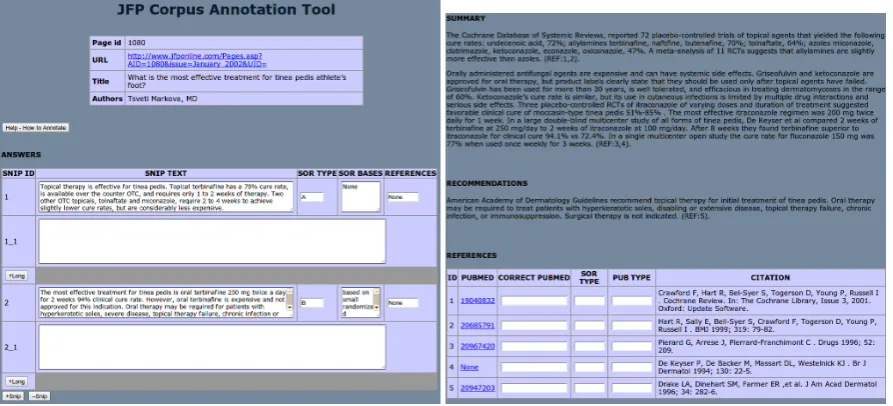
Figure 1: Screen shots of the annotation tool
justification to the specific answer snip. We there-fore had to do the matching manually.
We created a web-based annotation tool that dis-plays the question and each of the answer parts. Each answer part has associated empty slots where the annotator could copy and paste the answer justi-fication. Figure 1 shows screen-shots of the annota-tion tool.
The total number of pages to annotate was dis-tributed among three annotators. The annotators were members of the research team. A small per-centage of the pages was annotated by all annotators (the annotators did not know beforehand which of the pages were annotated by all), to check for in-consistencies. The annotation process was done in several stages, with periodic checks on the common pages to detect and solve systematic inconsistencies in the annotation criteria. During those checks the annotators agreed on a set of criteria, an extract of which is:
1. Remove phrases connecting to text outside the answer justification and modify anaphora to make the text self-contained. For example, change In another study to In a study or The second studytoA study.
2. Remove all general, introductory text.
3. If a justification has several references, split
it into separate justifications whenever possi-ble. In the process, some of the text may need to be copied so that each justification is self-contained.
4. If a paragraph does not have any references, check if it can be added to the previous or the next paragraph.
These criteria mostly addressed the need for each answer justification to be self-contained, and to match an answer justification to one reference only whenever possible. After inspection of a random sample of the common pages, the annotators agreed that the variations in the annotations are acceptable.
4.3 Crowdsourcing for Extracting Reference Information
Text formatting in the source text allowed the easy detection of references. To improve the usefulness of these references, we added the PubMed ID of those references found in PubMed.
respectively. We also noted that authors and pagi-nation are easy to find and ignore: authors contain initials and capital case surnames; while pagination always contains numbers and punctuation such as semi-colon, colon or hyphen.
Publication names such as the names of journals and books were more difficult to detect and to nor-malise. We decided, instead of trying to detect them, to run a list of searches containing all combinations of remaining sentences. For example, if after remov-ing author and pagination information there are three sentences S1, S2, S3, the following searches were made: S1-S2-S3, S1-S2, S1-S3, S2-S3, S1,S2, S3. These individual searches were sent to PubMed via its “Entrez Utilities” interface. The ID of the search whose returned title had the largest substring overlap with the original string was selected. As a last resort, if no searches returned an ID, a final search was made with the complete reference text.
Manual inspection of a small random sample re-vealed, however, that this method often did not find the correct ID. We therefore created a crowdsourc-ing task uscrowdsourc-ing Amazon Mechanical Turk.
An initial pilot experiment was made with 30 ref-erences grouped in sets (“hits”) of 10 refref-erences. Each hit was allocated to three Turkers. The Turk-ers were asked to check the ID using PubMed, and correct it if necessary. If no ID was available, the Turkers were asked to enter “nf”. We later checked the Turkers’ annotations by searching PubMed using the provided IDs and found an error rate of 18% (17 out of the total of 90 were incorrect). We examined the errors and concluded that:
1. Most workers got straight to work without reading the instructions provided. For exam-ple, they typically used the ID code “0” instead of “nf” when they could not find an ID.
2. We needed an automatic (or semi-automatic) way of judging whether the workers were cheating: manual checks were too time con-suming.
3. There should be a threshold for approval of work. We decided to set the threshold to 2/10 wrong annotations per page to reject cheaters.
With these findings we performed the final Me-chanical Turk task. Each hit had 10 references and
was sent to five Turkers. The Turkers were asked to read the instructions and were asked to do an auto-mated test with three references. After they passed the test they were given a passcode that was required to submit the work. Each hit included two “trick” questions with known answers. The following auto-mated tests were done on each hit:
1. Did the user answer the known references cor-rectly?
2. Is the ID valid? A script sent each ID to PubMed and checked whether it existed.
3. Is the ID correct? The automated test checked whether the percentage of matching between the reference title and the title returned by ID was beyond a threshold of 50%.
4. Did the Turker agree with the majority? Ma-jority was 3 or more Turkers. This test was cancelled if the ID of majority was wrong or invalid (as determined by the other tests), or in the specific case that three Turkers agreed on one ID and two Turkers agreed on another ID (we just thought that this was too a close call).
The output of the automated test was visually in-spected, and those Turker jobs with two or more errors were rejected. This was done by scrolling through the errors reported by the automatic tests, finding the disputed PubMed ids, manually checking the PubMed database to decide which one is “cor-rect” and which one is “wrong” and then changing the tags if necessary.
The final accuracy of the annotation task was manually checked on a random sample of 100 ref-erences and double-checking them. No errors were detected.
Finally, once all IDs were found, the abstracts were automatically downloaded from PubMed and added to the corpus. We chose to download the XML format, which contains useful metadata that markups the bibliography details, the abstract text, and additional annotations such as classification tags and MeSH terms.
5
Utility of the Corpus
(called “snip”), 3,036 answer justifications (called “long”), and 2,908 references. There is an average of 3.06 answer parts per question, 2.17 answer jus-tifications per answer part, and 1.22 references per answer justification. There is an average of 6.57 ref-erences per question.
The distribution of SOR grades is: 345 for A, 535 for B, 330 for C, 15 for D,9and 171 without grade.
We envisage the use of this corpus for the follow-ing tasks:
Evidence-based summarisation. This is the main use of the corpus. It can be used to develop and test single-document summarisation by using the questions and original abstracts as the input source, and the answer justifications as the tar-get summaries. Alternatively, it can be used to develop and test multiple-document summari-sation by using the answer parts as the target summaries. Parts of the corpus have already been used for this purpose (Moll´a, 2010).
Appraisal. The SOR grades can be used to test the ability to appraise the quality of the system. Appraisal can be done in the ranking compo-nent of a retrieval system, or as a separate clas-sification task. Parts of the corpus have already been used for this purpose (Sarker et al., 2011).
Clustering. Given the natural grouping of refer-ences to form parts of the answer, the corpus can be used to develop query-focused cluster-ing of the retrieved references.
Retrieval. The corpus references can be used as the target results of an information retrieval sys-tem. The usefulness of this corpus for assess-ing retrieval, however, is likely to be limited, given the findings by Dickersin et al. (1994) that between 20% and 30% of relevant litera-ture present in MEDLINE is not present in sys-tematic reviews.
In the remainder of this section we focus on the task of query-focused single-document summarisa-tion, where the task is to summarise the abstract of a paper within the context of the question. The target
9SORT has only grades A, B, and C, but apparently some authors used one more level D to indicate very poor evidence.
summary is the answer justification, and the evalua-tion metric is ROUGE-L with stemming (Lin, 2004), a very popular metric used in the evaluation of sum-marisation systems.
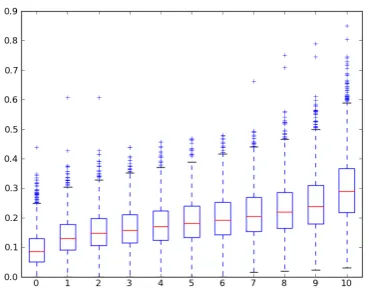
For every answer justification/reference pair, we extracted all combinations of three sentences from the abstract and computed their ROUGE-L scores against their answer justification. With this informa-tion we computed the ROUGE-L boundary points of the document deciles. For example, the bound-ary points of the first decile of a document indicate the minimum and maximum values of the 10% pro-portion of combinations of 3-sentences with lowest ROUGE-L scores. Then we aggregated the decile boundaries of all documents to create the set of doc-ument decile boundaries according to the formula
Boundary[i] ={boundary[i](x)|x∈D}
where boundary[0](x) is the minimum ROUGE-L score of the first decile of document x,
boundary[1](x) is the maximum ROUGE-L score of the first decile of document x, and so on. The resulting boxplot is shown in Figure 2. The means and standard deviations are listed in Table 1. This information shows that, in order to perform better than simple random choice of sentences, we need to obtain a ROUGE-L score of at least 0.188. For ref-erence, a simple baseline that returns the last three sentences obtains a ROUGE-L score of 0.193, and the best system configuration that uses information of the abstract structure of those described by Moll´a (2010)10achieves a ROUGE-L score of 0.196 when applied to our corpus. We can see that these base-lines are in the range between 50% and 60% per-centiles.
6
Conclusions
We have presented a corpus for the development of research in NLP in medical texts. The corpus was sourced from the Clinical Inquiries section of the Journal of Family Practice, and the process involved a set of manual and automatic methods for the ex-traction and annotation of information. We also de-scribe a process of crowdsourcing that was used to find the PubMed IDs of the references.
Boundary 0 1 2 3 4 5 6 7 8 9 10
Mean 0.094 0.136 0.153 0.164 0.176 0.188 0.200 0.213 0.229 0.249 0.299
[image:8.595.87.272.205.353.2]Std Dev 0.060 0.062 0.065 0.067 0.070 0.073 0.076 0.081 0.087 0.094 0.112
Table 1: Statistics of the decile boundaries of ROUGE-L data
Figure 2: ROUGE-L boxplots for all decile boundaries
The emphasis of this corpus is the development and testing of query-focused multi-document sum-marisation systems for Evidence Based Medicine, but we envisage its use in other tasks such as text classification, and clustering.
We have shown a set of statistics of the ROUGE-L scores of the abstracts within the context of doc-ument summarisation. The data show that current baselines do not perform much better than simple random choice and there is still much room for im-provement. The challenge is up for researchers to take.
Further work includes the use of this corpus for some of the tasks described above. We are also studying the possibility of including additional an-notation of the specific abstract sentences that are found to be most relevant to the answer justifica-tions. This information could be used to perform pyramidal-style evaluation such as the one described by Dang and Lin (2007).
References
Stergos Afantenos, Vangelis Karkaletsis, and
Panagi-otis Stamatopoulos. 2005. Summarization from
medical documents: a survey. Artificial
Intelli-gence in Medicine, 33(2):157–177, February. PMID: 15811783.
I. Elaine Allen and Ingram Olkin. 1999. Estimating time to conduct a meta-analysis from number of citations
retrieved. JAMA: The Journal of the American
Med-ical Association, 282(7):634–635, August. PMID: 10517715.
E. C. Armstrong. 1999. The well-built clinical question: the key to finding the best evidence efficiently. WMJ, 98(2):25–28.
Lyle Berkowitz. 2002. Review and evaluation of
internet-based clinical reference tools for physicians. Technical report, UpToDate.
Hoa Dang and Jimmy Lin. 2007. Different structures for evaluating answers to complex questions: Pyra-mids won’t topple, and neither will human assessors. InProceedings ACL.
Dina Demner-Fushman and Jimmy Lin. 2006. Answer extraction, semantic clustering, and extractive summa-rization for clinical question answering. In Proceed-ings ACL. The Association for Computer Linguistics. Dina Demner-Fushman and Jimmy J. Lin. 2007.
An-swering clinical questions with knowledge-based and statistical techniques. Computational Linguistics, 33(1):63–103.
Dina Demner-Fushman, Wendy W. Chapman, and Clement J. McDonald. 2009. What can natural lan-guage processing do for clinical decision support?
Journal of Biomedical Informatics. Online uncor-rected proof.
K. Dickersin, R. Scherer, and C. Lefebvre. 1994.
Identifying relevant studies for systematic reviews.
BMJ (Clinical Research Ed.), 309(6964):1286–1291, November. PMID: 7718048.
Mark H. Ebell, Jay Siwek, Barry D. Weiss, Steven H. Woolf, Jeffrey Susman, Bernard Ewigman, and
Mar-jorie Bowman. 2004. Strength of
recommenda-tion taxonomy (SORT): a patient-centered approach to
grading evidence in the medical literature. Am Fam
Physician, 69(3):548–556, Feb.
John W. Ely, Jerome A. Osheroff, Mark H. Ebell, George R. Bergus, Barcey T. Levy, M. Lee Chamb-liss, and Eric R. Evans. 1999. Analysis of questions asked by family doctors regarding patient care. BMJ, 319(7206):358–361, Aug.
John Ely, Jerome A Osheroff, Mark H Ebell, M. Lee Chambliss, DC Vinson, James J. Stevermer, and Eric A. Pifer. 2002. Obstacles to answering doctors’ questions about patient care with evidence: Qualitative study.BMJ, 324(7339):710.
John W. Ely, Jerome A. Osheroff, M. Lee Chambliss, Mark H Ebell, and Marcy E. Rosenbaum. 2005. Answering physicians’ clinical questions: Obstacles and potential solutions. J Am Med Inform Assoc., 12(2):217–224.
Marcelo Fiszman, Thomas C. Rindflesch, and Halil Kil-icoglu. 2004. Abstraction summarization for manag-ing the biomedical research literature. InProcs. HLT-NAACL Workshop on Computational Lexical Seman-tics, pages 76–83.
T. Goetz and C.-W. von der Lieth. 2005. Pub-Finder: a tool for improving retrieval rate of relevant PubMed abstracts. Nucleic Acids Research, 33(Web Server):W774–W778.
R. Brian Haynes, Nancy L. Wilczynski, K. Ann McKib-bon, Cynthia J. Walker, and John C. Sinclair. 1994. Developing optimal search strategies for detecting clinically sound studies in MEDLINE. Journal of the
American Medical Informatics Association: JAMIA,
1(6):447–458, December. PMID: 7850570.
R. Brian Haynes, K. Ann McKibbon, Nancy L. Wilczyn-ski, Stephen D. Walter, and Stephen R. Werre. 2005. Optimal search strategies for retrieving sci-entifically strong studies of treatment from medline: analytical survey. BMJ (Clinical Research Ed.), 330(7501):1179, May. PMID: 15894554.
Sarvnaz Karimi, Justin Zobel, Stefan Pohl, and Falk Sc-holer. 2009. The challenge of high recall in biomed-ical systematic search. InProc. DTMBIO, pages 89– 92, Honk Kong.
Minsuk Lee, James Cimino, Hai Ran Zhu, Carl Sable, Vijay Shanker, John Ely, and Hong Yu. 2006. Beyond information retrieval — medical question answering. InProc. AMIA 2006.
Annette Leonhard. 2009. Towards retrieving relevant information for answering clinical comparison ques-tions. InProceddings BioNLP 2009, pages 153–161. Chin-Yew Lin. 2004. Rouge: A package for automatic
evaluation of summaries. InProc. ACL workshop on Text Summarization Branches Out, page 10.
Diego Moll´a. 2010. A corpus for evidence based medicine summarisation. InProceedings of the
Aus-tralasian Language Technology Workshop, volume 8,
pages 76–80.
Yun Niu, Graeme Hirst, Gregory McArthur, and Patricia Rodriguez-Gianolli. 2003. Answering clinical ques-tions with role identification. InProc. ACL, Workshop on Natural Language Processing in Biomedicine. Maksim Plikus, Zina Zhang, and Cheng M. Chuong.
2006. PubFocus: Semantic MEDLINE/PubMed citations analysis through integration of controlled biomedical dictionaries and ranking algorithm. BMC Bioinformatics, 7(1):424.
David L. Sackett, William M. Rosenberg, Jamuir Gray, R. Brian Haynes, and W. Scott Richardson. 1996. Ev-idence based medicine: What it is and what it isn’t.
BMJ, 312(7023):71–72.
David L. Sackett, Sharon E. Straus, W. Scott Richard-son, William Rosenberg, and R. Brian Haynes. 2000.
Evidence-Based Medicine: How to Practice and Teach EBM. Churchill Livingstone, 2 edition.
Abeed Sarker, Diego Moll´a, and C´ecile Paris. 2011. To-wards automatic grading of evidence. InProceedings of the Third International Workshop on Health Doc-ument Text Mining and Information Analysis (LOUHI 2011), pages 51–58, Bled, Slovenia.
Kaveh G. Shojania and Lisa A. Bero. 2001. Taking ad-vantage of the explosion of systematic reviews: an efficient MEDLINE search strategy. Effective
Clin-ical Practice: ECP, 4(4):157–162, August. PMID:
11525102.
Thanh Tang, David Hawking, Ramesh Sankaranarayana, Kathleen M. Griffiths, and Nick Craswell. 2009. Quality-oriented search for depression portals. In
ECIR ’09 Proceedings of the 31th European Confer-ence on IR Research on Advances in Information Re-trieval, Berlin, Heidelberg. Springer.
Andreea Tutos and Diego Moll´a. 2010. A study on the use of search engines for answering clinical questions.
InProceedings HIKM 2010.
Hong Yu, Minsuk Lee, David Kaufman, John W. Ely, Jerome A. Osheroff, George Hripcsak, and James J. Cimino. 2007. Development, implementation, and a cognitive evaluation of a definitional question answer-ing system for physicians. Journal of Biomedical In-formatics, 40(3):236–251.
Pierre Zweigenbaum, Dina Demner-Fushman, Hong Yu, and Kevin B. Cohen. 2007. Frontiers of biomedical text mining: current progress. Briefings in Bioinfor-matics, 8(5):358–375.