Comparison of Visual and Logical Character Segmentation in
Tesseract OCR Language Data for Indic Writing Scripts
Jennifer Biggs
National Security & Intelligence, Surveillance & Reconnaissance Division
Defence Science and Technology Group
Edinburgh, South Australia
{[email protected]}
Abstract
Language data for the Tesseract OCR system currently supports recognition of a number of languages written in Indic writing scripts. An initial study is de-scribed to create comparable data for Tesseract training and evaluation based on two approaches to character segmen-tation of Indic scripts; logical vs. visual. Results indicate further investigation of visual based character segmentation lan-guage data for Tesseract may be warrant-ed.
1
Introduction
The Tesseract Optical Character Recognition (OCR) engine originally developed by Hewlett-Packard between 1984 and 1994 was one of the top 3 engines in the 1995 UNLV Accuracy test as “HP Labs OCR” (Rice et al 1995). Between 1995 and 2005 there was little activity in Tesser-act, until it was open sourced by HP and UNLV. It was re-released to the open source community in August of 2006 by Google (Vincent, 2006), hosted under Google code and GitHub under the
tesseract-ocr project.1 More recent evaluations have found Tesseract to perform well in compar-isons with other commercial and open source OCR systems (Dhiman and Singh. 2013; Chatto-padhyay et al. 2011; Heliński et al. 2012; Patel et al. 2012; Vijayarani and Sakila. 2015). A wide range of external tools, wrappers and add-on pro-jects are also available including Tesseract user
1
The tesseract-ocr project repository was archived in Au-gust 2015. The main repository has moved from
https://code.google.com/p/tesseract-ocr/ to
https://github.com/tesseract-ocr
interfaces, online services, training and training data preparation, and additional language data.
Originally developed for recognition of Eng-lish text, Smith (2007), Smith et al (2009) and Smith (2014) provide overviews of the Tesseract system during the process of development and internationalization. Currently, Tesseract v3.02 release, v3.03 candidate release and v3.04 devel-opment versions are available, and the tesseract-ocr project supports recognition of over 60 lan-guages.
Languages that use Indic scripts are found throughout South Asia, Southeast Asia, and parts of Central and East Asia. Indic scripts descend from the Brāhmī script of ancient India, and are broadly divided into North and South. With some exceptions, South Indic scripts are very rounded, while North Indic scripts are less rounded. North Indic scripts typically incorporate a horizontal bar grouping letters.
This paper describes an initial study investi-gating alternate approaches to segmenting char-acters in preparing language data for Indic writ-ing scripts for Tesseract; logical and a visual segmentation. Algorithmic methods for character segmentation in image processing are outside of the scope of this paper.
2
Background
As discussed in relation to several Indian lan-guages by Govandaraju and Stelur (2009), OCR of Indic scripts presents challenges which are different to those of Latin or Oriental scripts. Recently there has been significantly more pro-gress, particularly in Indian languages (Krishnan et al 2014; Govandaraju and Stelur. 2009; Yadav et al. 2013). Sok and Taing (2014) describe re-cent research in OCR system development for Khmer, Pujari and Majhi (2015) provide a survey
of Odia character recognition, as do Nishad and Bindu (2013) for Malayalam.
Except in cases such as Krishnan et al. (2014), where OCR systems are trained for whole word recognition in several Indian lan-guages, character segmentation must accommo-date inherent characteristics such as non-causal (bidirectional) dependencies when encoded in Unicode.2
2.1 Indic scripts and Unicode encoding
Indic scripts are a family of abugida writing tems. Abugida, or alphasyllabary, writing sys-tems are partly syllabic, partly alphabetic writing systems in which consonant-vowel sequences may be combined and written as a unit. Two general characteristics of most Indic scripts that are significant for the purposes of this study are that:
Diacritics and dependent signs might be added above, below, left, right, around, sur-rounding or within a base consonant. Combination of consonants without
inter-vening vowels in ligatures or noted by spe-cial marks, known as consonant clusters. The typical approach for Unicode encoding of Indic scripts is to encode the consonant followed by any vowels or dependent forms in a specified order. Consonant clusters are typically encoded by using a specific letter between two conso-nants, which might also then include further vowels or dependent signs. Therefore the visual order of graphemes may differ from the logical order of the character encoding. Exceptions to this are Thai, Lao (Unicode v1.0, 1991) and Tai Viet (Unicode v5.2, 2009), which use visual in-stead of logical order. New Tai Lue has also been changed to a visual encoding model in Unicode v8.0 (2015, Chapter 16). Complex text rendering may also contextually shape characters or create ligatures. Therefore a Unicode character may not have a visual representation within a glyph, or may differ from its visual representation within another glyph.
2.2 Tesseract
As noted by White (2013), Tesseract has no in-ternal representations for diacritic marks. A typi-cal OCR approach for Tesseract is therefore to train for recognition of the combination of char-acters including diacritic marks. White (2013) also notes that diacritic marks are often a com-mon source of errors due to their small size and
2
Except in Thai, Lao, Tai Viet, and New Tai Lue
distance from the main character, and that train-ing in a combined approach also greatly expands the larger OCR character set. This in turn may also increase the number of similar symbols, as each set of diacritic marks is applied to each con-sonant.
As described by Smith (2014), lexical re-sources are utilised by Tesseract during two-pass classification, and de Does and Depuydt (2012) found that word recall was improved for a Dutch historical recognition task by simply substituting the default Dutch Tesseract v3.01 word list for a corpus specific word list. As noted by White (2013), while language data was available from the tesseract-ocr project, the associated training files were previously available. However, the Tesseract project now hosts related files from which training data may be created.
Tesseract is flexible and supports a large num-ber of control parameters, which may be speci-fied via a configuration file, by the command line interface, or within a language data file3. Although documentation of control parameters by the tesseract-ocr project is limited4, a full list of parameters for v3.02 is available5. White (2012) and Ibrahim (2014) describe effects of a limited number of control parameters.
2.2.1 Tesseract and Indic scripts
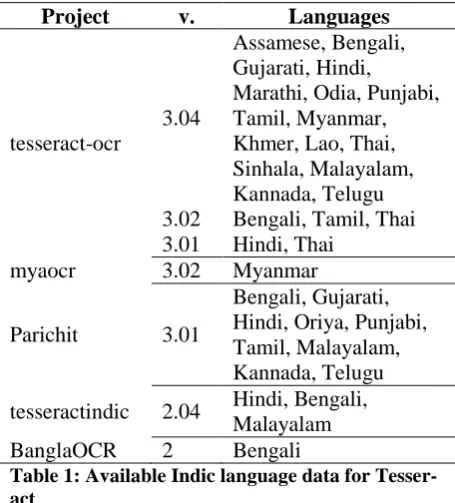
Training Tesseract has been described for a number of languages and purposes (White, 2013; Mishra et al. 2012; Ibrahim, 2014; Heliński et al. 2012). At the time of writing, we are aware of a number of publically available sources for Tes-seract language data supporting Indic scripts in addition to the tesseract-ocr project. These in-clude Parichit6, BanglaOCR7 (Hasnat et al. 2009a and 2009b; Omee et al. 2011) with train-ing files released in 2013, tesseractindic8, and
myaocr9. Their Tesseract version and recognition languages are summarised in Table 1. These ex-ternal projects also provide Tesseract training data in the form of TIFF image and associated coordinate ‘box’ files. For version 3.04, the tes-seract-ocr project provides data from which Tes-seract can generate training data.
3
Sets of Tesseract language data for a given language may differ significantly in parameters including coverage of the writing script, fonts, number of training examples, or dictionary data.
Project v. Languages
tesseract-ocr
3.04
Assamese, Bengali, Gujarati, Hindi, Marathi, Odia, Punjabi, Tamil, Myanmar, Khmer, Lao, Thai, Sinhala, Malayalam, Kannada, Telugu 3.02 Bengali, Tamil, Thai 3.01 Hindi, Thai
myaocr 3.02 Myanmar
Parichit 3.01
Bengali, Gujarati, Hindi, Oriya, Punjabi, Tamil, Malayalam, Kannada, Telugu
tesseractindic 2.04 Hindi, Bengali, Malayalam
BanglaOCR 2 Bengali
Table 1: Available Indic language data for Tesser-act
Smith (2014)10 and Smith et al (2009)11 pro-vides results for Tesseract for two Indic scripts; Hindi12 and Thai. Table 2 compares these error rates to those found by Krishnan et al. (2014)13. Additionally, the Khmer OCR project reports initial accuracy rates of 50-60% for Khmer OS Battambang font, 26pt (Tan, 2014), and the Khmer OCR project14 beta website provides a Khmer OCR web service based on the Tesseract OCR system that incorporates user feedback training. Hasnat et al. (2009a; 2009b) report on development of Bengali language data for Bang-laOCR, with 70-93% accuracy depending on im-age type. Omee et al. (2011) report up to 98% accuracy in limited contexts for BanglaOCR. Nayak and Nayak (2014) report on development
10
Tesseract v3.03 or v3.04 11 Tesseract v3.00
12
Hindi and Arabic language data for Tesseract v3.02 used a standard conventional neural network character classifier in a ‘cube’ model. Although, Smith (2014) states that this model achieves ~50% reduction in errors on Hindi when run together with Tesseract’s word recognizer, the training code is unmaintained and unutilised, and will be removed from future tesseract-ocr versions.
13
Tesseract v3.02 14
The Khmer OCR project led by Mr. Danh Hong begun in 2012 is described by Mr. Ly Sovannra in Tan (2014) and at
http://www.khmertype.org
of Odia language data with 98-100% recognition accuracy for isolated characters.
Language Ground truth (million)
Error rate (%) char words char word
Hindi * - 0.39 26.67 42.53
Telugu * - 0.2 32.95 72.11
Hindi ** 2.1 0.41 6.43 28.62
Thai ** 0.19 0.01 21.31 80.53
Hindi *** 1.4 0.33 15.41 69.44
Table 2: Tesseract error rates * from Krishnan et al. (2014) ** from Smith (2014) *** from Smith et al (2009)
2.2.2 Visual and logical character segmenta-tion for Tesseract
As noted by White (2013) the approach of the
tesseract-ocr project is to train Tesseract for recognition of combinations of characters includ-ing diacritics. For languages with Indic writinclud-ing scripts, this approach may also include conso-nant-vowel combinations and consonant clusters with other dependent signs, and relies on charac-ter segmentation to occur in line with Unicode logical ordering segmentation points for a given segment of text. An advantage of this approach is that Unicode standard encoding is output by the OCR system.
An alternate approach in developing a train-ing set for Tesseract is to determine visual seg-mentation points within the writing script. This approach has been described and implemented in several external language data projects for Tes-seract, including Parichit, BanglaOCR, and my-aocr. Examples of logical and two possible ap-proaches to visual segmentation for selected con-sonant groupings are shown in Figure 1. A dis-advantage of visual segmentation is that OCR text outputs may require re-ordering processing to output Unicode encoded text.
Mishra et al. (2012) describe creating language data for Hindi written in Devanagari script that implemented a visual segmentation approach in which single touching conjunct characters are excluded from the training set. Therefore, Tes-seract language data could be created that in-cluded only two or more touching conjunct char-acters, basic characters and isolated half charac-ters. This had the effect of reducing the Tesseract training set15 and language data size, and increas-ing recognition accuracy on a test set of 94 char-acters compared with the tesseract-ocr (Google) and Parichit language data as shown in Table 3.16
Language data Training set size
Accuracy (%)
tesseract-ocr v3.01 1729 45.2
Parichit 2173 22.3
Mishra et al. (2012) 786 90.9
Table 3: Comparison of training set, language data and accuracy from Mishra et al. (2012)
The implementation also included language-specific image pre-processing to ‘chop’ the Shi-rorekha horizontal bar connecting characters within words. This was intended to increase the likelihood of Tesseract system segmentation oc-curring at these points. Examples of words in-cluding Shirorekha are shown in Figure 2.
Figure 2: Examples of Shirorekha in Devanagari and Gurmukhi scripts
3
Comparison of visual and logical
segmentation for Tesseract
An initial study was conducted to determine the potential of implementing a visual segmentation approach, compared to the logical segmentation approach in Tesseract for languages with Indic scripts. Languages written with Indic scripts that do not use the Shirorekha horizontal bar were
15 Defined in Tesseract the *.unicharset file within language data
16
It is not stated if text output re-ordering processing for Parichit recognition output was applied before accuracy was measured.
considered. Re-ordering of OCR text outputs for visual segmentation methods is outside the scope of this study. The term glyph is used in this sec-tion to describe a symbol that represents an OCR recognition character, whether by logical or vis-ual segmentation.
3.1 Method
This section describes ground truth and evalua-tion tools used, and the collecevalua-tion and prepara-tion of glyph, Tesseract training, and OCR ground truth data. Three Indic languages were selected to estimate the potential for applying visual segmentation to further languages. Firstly, corpora were collected and analysed to compare glyphs found by each segmentation approach. Secondly, Tesseract recognition and layout accu-racy was evaluated based on the coverage of those glyphs in the corpus. The accuracy of tes-seract-ocr project v3.04 language data is also measured against the same ground truth data for a wider selection of Indic languages.
3.1.1 Glyph data
In order to estimate the number and distribution of glyphs in selected Indic languages, language specific corpora were sought. A web crawler was implemented using the crawler4j library17, which restricted the crawl domain to the seed URL. The
boilerpipe library 18 was then used to extract tex-tual content from each web page. For each lan-guage, a corpus was then collected by using the relevant Wikipedia local language top page as the seed for the crawler.
The Lucene library19 was used to index corpus documents. Language specific processing was implemented supporting grouping of consonant-vowel combinations, consonant clusters and de-pendent signs into logical order glyphs. Addi-tional processing to separate those groupings in line with the visual segmentation approach was also implemented.
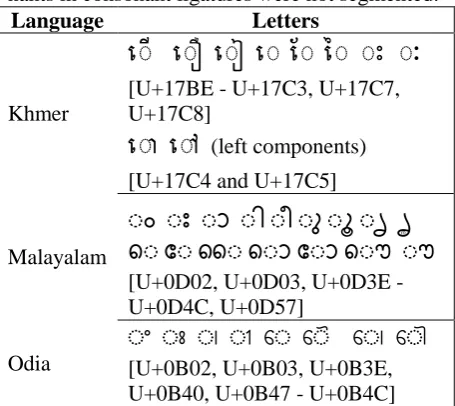
Letters affected by visual segmentation in each language are shown in Table 4. In Khmer, there could theoretically be up to three coeng
(U+17D2) in a syllable; two before and one after a vowel. Clusters with coeng after a vowel were not additionally segmented in this implementa-tion. The number of glyphs according to each segmentation approach was then extracted from the index for each language. Similarly, in
17
https://github.com/yasserg/crawler4j 18
https://github.com/kohlschutter/boilerpipe
19
yalam dependent vowels found between conso-nants in consonant ligatures were not segmented.
Language Letters
Khmer
ើ
ើ
ើ
ើ
ែ
ៃ
[U+17BE - U+17C3, U+17C7, U+17C8]
ើ
ើ
(left components) [U+17C4 and U+17C5]Malayalam
ം ം ം ം ം ം ം ം ൄ
െംേംൈംെം േം െം ം [U+0D02, U+0D03, U+0D3E - U+0D4C, U+0D57]
Odia
ଂ ଂ ଂ ଂ େଂ େଂ େଂ େଂ
[U+0B02, U+0B03, U+0B3E, U+0B40, U+0B47 - U+0B4C]
Table 4: Letters and consonant clusters affected by visual segmentation processing per language
The size of corpus and number of glyphs ac-cording to logical segmentation is given in Table 5.
Language Text corpus (Mb)
Logical glyphs (million)
Khmer 252 137.0
Malayalam 307 134.8
Odia 68.9 96.6
Table 5: Text corpus size and occurrences of logi-cal glyphs per language
3.1.2 Tesseract training data
Tesseract training data was prepared for each language using the paired sets of glyph data de-scribed in section 3.1. An application was im-plemented to automatically create Tesseract training data from each glyph data set, with the ability to automatically delete dotted consonant outlines displayed when a Unicode dependent letter or sign is rendered separately. The imple-mented application outputs multi-page TIFF format images and corresponding bounding box coordinates in the Tesseract training data for-mat.20
Tesseract training was completed using most recent release v3.02 according to the documented training process for Tesseract v3, excluding shapeclustering. The number of examples of each glyph, between 5 and 40 in each training set, was determined by relative frequency in the
20
Description of the training format and requirements can be found at
https://github.com/tesseract-ocr/tesseract/wiki/TrainingTesseract
corpus. A limited set of punctuation and symbols were also added to each set of glyph data, equal to those included in tesseract-ocr project lan-guage data. However, training text was not rep-resentative as recommended in documentation, with glyphs and punctuation randomly sorted.
3.1.3 Dictionary data
As dictionary data is utilised during Tesseract segmentation processing, word lists were pre-pared for each segmentation approach. As the separated character approach introduced a visual ordering to some consonant-vowel combinations and consonant clusters, word lists to be used in this approach were re-ordered, in line with the segmentation processing used for each language described in section 3.1. Word lists were extract-ed from the tesseract-ocr project v3.04 language data.
3.1.4 Ground truth data
OCR ground truth data was prepared in a single font size for each language in the PAGE XML format (Pletschacher and Antonacopoulos. 2010) using the application also described in section 3.1.2. The implementation segments text accord-ing to logical or visual orderaccord-ing described in sec-tion 3.1.1, and uses the Java PAGE libraries21 to output PAGE XML documents.
Text was randomly selected from documents within the web corpora described in section 3.1. Text segments written in Latin script were re-moved. Paired ground truth data were then gen-erated. For each document image, two corre-sponding ground truth PAGE XML files were created according to logical and visual segmenta-tion methods.
3.1.5 Evaluation
Tesseract v3.04 was used via the Aletheia v3 tool for production of PAGE XML ground truth de-scribed by Clausner et al. (2014). Evaluation was completed using the layout evaluation frame-work for evaluating PAGE XML format OCR outputs and ground truth described by Clausner et al. (2011). Output evaluations were completed using the described Layout Evaluation tool and stored in XML format.
21
The PAGE XML format and related tools have been de-veloped by the PRImA Research Lab at the University of Salford, and are available from
3.2 Results
Results are presented in three sections; for tes-seract-ocr language data, for web corpora glyph data per segmentation method, and for the com-parable Tesseract language data per segmenta-tion method.
Measured layout success is a region corre-spondence determination. Results are given for glyph based count and area weighted arithmetic and harmonic mean layout success as calculated by the Layout Evaluation tool. Weighted area measures are based on the assumption that bigger areas regions are more important than smaller ones, while the weighted count only takes into account the error quantity.
3.2.1 Tesseract-ocr language data
Recognition accuracy for selected tesseract-ocr
project language data with Indic scripts is given in Table 6. All glyphs are segmented in line with Unicode logical encoding standards; using a log-ical segmentation approach, except for Thai and Lao which are encoded with visual segmentation in Unicode.
Measured Thai recognition accuracy is in line with the 79.7% accuracy reported by Smith (2014). While Hindi accuracy is far less than the 93.6% reported by Smith (2014), it is higher than the 73.3% found by Krishnan et al. (2014). Measured recognition accuracy for Telugu is also higher than the 67.1% found by Krishnan et al. (2014), although this may be expected for higher quality evaluation images. Measured Khmer recognition accuracy is in line with the 50-60% reported in Tan (2014). Bengali results are within the 70-93% range reported by Hasnat et al. (2009a), but are not directly comparable with the training approach used in BanglaOCR.
3.2.2 Web corpora glyphs by logical and visual segmentation
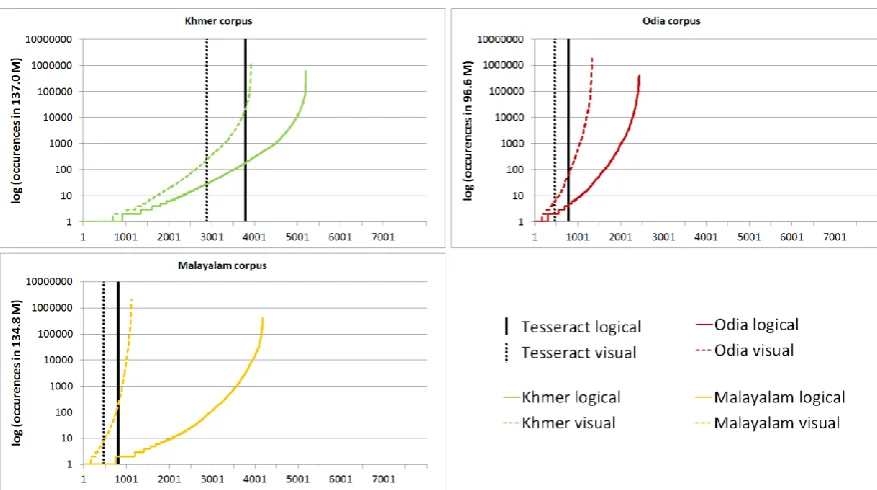
The number of glyphs and their occurrences in the collected language specific Wikipedia cor-pora are shown in Figure 4. These are compared to the number of glyphs in the tesseract-ocr pro-ject language data recognition character set22, and the number of glyphs when visual order segmentation processing is applied to that char-acter set. Visual segmentation can be seen to sig-nificantly reduce the number of glyphs for the same language coverage in each case. The
22
Glyphs not within the local language Unicode range(s) are not included.
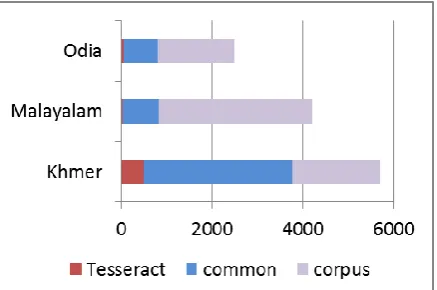
cal glyphs in common and unique to tesseract-ocr and corpus based language data may be seen in Figure 3.
Figure 3: Coverage of logical glyphs between tes-seract-ocr and corpus based language data
3.2.3 Comparable data for logical and visu-al segmentation
The total number of examples in the training data and size of the resulting Tesseract language data file with each approach (without dictionary data) is given in Table 7. The tesseract-ocr lan-guage data sizes are not directly comparable as the training sets and fonts differ.
OCR recognition accuracy is given for each segmentation method in Table 7. Recognition accuracy was found to be higher for visual seg-mentation in each language; by 3.5% for Khmer, 16.1% for Malayalam, and by 4.6% for Odia.
Logical segmentation accuracy shown in Ta-ble 7 was measured against the same ground truth data reported in section 3.2.1. However, as illustrated in Figure 4, the coverage of glyphs in each set of language data differed greatly. In each case, the number of glyphs found in the col-lected corpus was significantly greater than in the tesseract-ocr recognition set.
Recognition accuracy for tesseract-ocr lan-guage data for Khmer and Malayalam was 12.2% and 13% higher respectively than for the corpus based logical segmentation language data when measured against the same ground truth. Howev-er the corpus based logical segmentation data for Odia achieved 12.2% higher recognition accura-cy than tesseract-ocr language data.
Language Recognition accuracy
(%)
Mean overall layout success (%) Ground truth Recognition glyphs Area
weighted
Count weighted
Glyphs (logical)
Char
Arith. Har. Arith. Har.
Assamese 26.1 65.3 49.6 59.5 47.2 1080 1795 1506
Bengali 71.8 92.7 91.9 66.8 63.5 1064 1932 1451
Khmer 52.2 92.6 92.1 82.9 81.0 556 1099 3865
Lao * 77.1 96.6 96.5 85.6 84.1 1139 1445 1586
Gujarati 1.8 69.6 64.2 57.6 53.1 974 1729 1073
Hindi 81.9 89.1 87.4 58.2 49.4 952 1703 1729
Malayalam 62.7 90.6 89.2 82.5 78.1 552 1153 855
Myanmar 25.6 86.8 84.4 67.2 59.2 598 1251 7625
Odia 63.7 96.3 96.1 90.0 88.7 864 1514 834
Punjabi ** 0.1 61.4 41.6 65.4 52.3 916 1569 1029
Tamil 89.2 95.5 95.0 93.1 92.4 798 1290 295
Telugu 75.3 78.0 72.6 55.1 44.2 877 1674 2845
Thai * 79.7 95.1 94.7 86.7 85.7 1416 1727 864
Table 6: Glyph recognition and layout accuracy for tesseract-ocr project v3.04 language data for selected Indic languages *languages encoded in visual segmentation in Unicode ** written in Gurmukhi script
Figure 4: Comparison of logical vs. visual segmentation of glyphs in corpora
Language
Seg- menta-tion
Recogni-tion
accu-racy (%)
Mean overall layout success (%) Ground truth glyphs
Recognition glyphs Area
weighted
Count weighted Arith. Har
.
Arith. Har.
Khmer Logical 41.0 92.8 91.9 83.6 80.5 556 5205
Visual 44.5 92.9 92.3 86.9 85.8 677 3965
Malayalam Logical 54.2 90.2 88.4 80.4 74.3 552 4237
Visual 70.3 90.8 89.7 80.5 77.6 851 1171
Odia Logical 75.9 94.8 94.4 88.2 86.4 864 2491
Visual 80.5 95.1 94.7 91.5 90.8 1130 1387
4
Discussion
Analysis of the collected glyph corpora and tes-seract-ocr project language data has shown the visual segmentation significantly reduces the number of glyphs required for a Tesseract train-ing set in each of the languages considered. When using comparative training and ground truth data, visual segmentation was also shown to reduce the size of Tesseract language data and increase recognition accuracy. The use of dic-tionary data was not found to significantly affect results.
The implementation for visual segmentation of glyphs led to inconsistencies between similar visual components. For example, in Khmer it was observed that the visual representation of
coeng (U+17D2) was commonly segmented by Tesseract as a separate glyph using tesseract-ocr
and created language data, as illustrated for Khmer in Figure 5. Further opportunities for vis-ual segmentation were also not implemented, such as components of consonant clusters. A consistent and more sophisticated implementa-tion of visual segmentaimplementa-tion may further improve results.
Figure 5: Visual glyphs for Khmer as implemented
The Tesseract training data prepared from corpus based glyphs was intended to be compa-rable, but was not in line with recommendations for training Tesseract. Preparation of training data in line with recommendations may improve results. The effects of Tesseract configuration parameters were not investigated during this study and should also be explored per language. Further, while glyph recognition accuracy achieved for the visual segmentation language data for Khmer was lower than that of the tesser-act-ocr project language data, the coverage of glyphs was far greater. A significant percentage of the glyphs in each training set were rare. Fu-ture work may examine the relationship between coverage of rare glyphs in language data and recognition accuracy.
While effort was made to estimate coverage of modern glyphs for each segmentation ap-proach in each language, the web corpora col-lected may not be representative. In preparing training data for the proposed segmentation method, care must be taken to determine that isolated or combined characters in the training sets are rendered in the predicted way when combined with other characters. A further con-sideration when creating multi-font training data is that characters may be rendered significantly differently between fonts. Further, some scripts have changed over time. For example, Malaya-lam has undergone formal revision in the 1970s, and informal changes with computer-aided type-setting in the 1980s, and Devanagari has also modified specific characters during the last three decades.
5
Conclusion
Developing high accuracy, multi-font language data for robust, end-to-end processing for Tes-seract was not within the scope of this study. Ra-ther, the aim was an initial investigation of alter-nate approaches for logical compared to visual character segmentation in a selection of Indic writing scripts. Results in the limited evaluation domain indicate that the proposed visual segmen-tation method improved results in three lan-guages. The described technique may potentially be applied to further Indic writing scripts. While recognition accuracy achieved for the reported languages remains relatively low, outcomes indi-cate that effort to implement language specific training data preparation and OCR output re-ordering may be warranted.
Acknowledgements
We would like to acknowledge Google and the work of Mr. Ray Smith and contributors to the
tesseract-ocr project.
We would also like to acknowledge the PRImA Lab of the University of Salford for their work in developing the PAGE XML format and related software tools and applications.
References
and Communication Networks (CICN), 2011, pp. 606-610, Oct 2011
Clausner, C., Pletschacher, S. and Antonacopoulos, A. 2014. Scenario Driven In-Depth Performance Evaluation of Document Layout Analysis Methods. In proc. of the 11th International Conference on Document Analysis and Recognition (ICDAR2011), Beijing, China, September 2011, pp. 1404-1408
Clausner, C., Pletschacher, S. and Antonacopoulos, A. 2014. Efficient OCR Training Data Generation with Aletheia. Short paper booklet of the 11th In-ternational Association for Pattern Recognition Workshop on Document Analysis Systems (DAS2014), Tours, France, April 2014, pp. 19-20 de Does, Jesse. and Depuydt, Katrien. 2012.
Lexicon-supported OCR of eighteenth century Dutch books: a case study. In proc. SPIE 8658, Document Recognition and Retrieval XX, 86580L (February 4, 2013); doi:10.1117/12.2008423
Dhiman and Singh. 2013. Tesseract Vs Gocr A Com-parative Study. International Journal of Recent Technology and Engineering (IJRTE): Vol 2, Issue 4, September 2013
Govindaraju, Venugopal, and Srirangaraj Setlur. 2009. Guide to OCR for Indic scripts: document recognition and retrieval. London: Springer. Hasnat, Abul., Chowdhury, Muttakinur Rahman. and
Khan, Mumit. 2009a. An open source Tesseract based Optical Character Recognizer for Bangla script. In proc. Tenth International Conference on Document Analysis and Recognition (ICDAR2009), Catalina, Spain, July 26-29, 2009 Hasnat, Abul., Chowdhury, Muttakinur Rahman. and
Khan, Mumit. 2009b. Integrating Bangla script recognition support in Tesseract OCR. In proc. Conference on Language Technology 2009 (CLT09), Lahore, Pakistan, January 22-24, 2009 Heliński, Marcin., Kmieciak, Miłosz. and Parkoła, Recognition of Thaana Script using Machine Gen-erated Text and Tesseract OCR Engine, Edith Cowan University, Australia.
http://www.villacollege.edu.mv/iri/images/thaana2. pdf, Last accessed 3/9/2015
Krishnan, Praveen., Sankaran, Naveen., Singh, and Ajeet Kumar. 2014. Towards a Robust OCR Sys-tem for Indic Scripts, 11th IAPR International
Workshop on Document Analysis Systems (DAS2014), Tours, France, 7th – 10th April 2014. Mishra, Nitin; Patvardhan, C.; Lakshimi, Vasantha C.;
and Singh, Sarika. 2012. Shirorekha Chopping In-tegrated Tesseract OCR Engine for Enhanced Hin-di Language Recognition, International Journal of Computer Applications, Vol. 39, No. 6, February 2012, pp. 19-23
Nishad, A; and Bindu, K. 2013. Malayalam OCR Sys-tems – A Survey. International Journal of Computer Technology and Electronics Engineering, Vol. 3, No. 6, December 2013
Nayak, Mamata. and Nayak, Ajit Kumar. 2014. Odia Characters Recognition by Training Tesseract OCR Engine. In proc. International Conference in Distributed Computing and Internet Technology 2014 (ICDCIT-2014)
Omee, Farjana Yeasmin., Himel, Shiam Shabbir. and Bikas, Md. Abu Naser. 2011. A Complete Work-flow for Development of Bangla OCR. Internation-al JournInternation-al of Computer Applications, Vol. 21, No. 9, May 2011
Patel, Chirag., Patel, Atul and Patel, Dharmendra. 2012. Optical Character Recognition by Open Source OCR Tool Tesseract: A Case Study, Inter-national Journal of Computer Applications, Vol. 55, No. 10
Pletschacher, S. and Antonacopoulos, A. 2010. The PAGE (Page Analysis and Ground-Truth Ele-ments) Format Framework. In proc. of the 20th In-ternational Conference on Pattern Recognition (ICPR2010), Istanbul, Turkey, August 23-26, 2010, IEEE-CS Press, pp. 257-260
Pujari, Pushpalata; and Majhi, Babita. 2015. A Survey on Odia Character Recognition. International Journal of Emerging Science and Engineering (IJESE), Vol. 3, No. 4, February 2015
Rice, S.V., Jenkins, F.R. and Nartker, T.A. 1995. The Fourth Annual Test of OCR Accuracy, Technical Report 95-03, Information Science Research Insti-tute, University of Nevada, Las Vegas
Smith, Ray D. Antonova and D. Lee. 2009 Adapting the Tesseract Open Source OCR Engine for Multi-lingual OCR, in proc. International Workshop on Multilingual OCR 2009, Barcelona, Spain, July 25, 2009
Smith, Ray. 2007. An overview of the Tesseract OCR Engine, in proc. Of the 9thInternational Conference on Document Analysis and Recognition (ICR-DAR2007), Curitiba, Paraná, Brazil, 2007
https://drive.google.com/file/d/0B7l10Bj_LprhbUlI UFlCdGtDYkE/view?pli=1 Last visited 11/9/2015 Sok, Pongsametry. and Taing, Nguonly. 2014. Sup-port Vector Machine (SVM) Based Classifier For Khmer Printed Character-set Recognition, Asia Pacific Signal and Information Processing Associa-tion, 2014, Annual Summit and Conference (APSIPA), 9-12 December, 2014, Siem Reap, city of Ankor Wat, Cambodia
Tan, Germaine. 2014. Khmer OCR: Convert Hard-Copy Khmer Text To Digital. Geeks in Cambodia, November 18, 2014.
http://geeksincambodia.com/khmer-ocr-convert-hard-copy-khmer-text-to-digital/ Last visited 13/9/2015
Vijayarani and Sakila. 2015. Performance Compari-son of OCR Tools. International Journal of UbiComp (IJU), Vol. 6, No. 3, July 2015
Vincent, Luc. 2006. Announcing Tesseract OCR,
Google Code,
http://googlecode.blogspot.com.au/2006/08/announ cing-tesseract-ocr.html Last accessed 1/9/2015
White, Nick. 2013. Training Tesseract for Ancient Greek OCR. The Eutypon, No. 28-29, October 2013, pp. 1-11. http://ancientgreekocr.org/e29-a01.pdf Last visited 18/9/2015