Imagination Improves Multimodal Translation
Desmond Elliott? and ´Akos K´ad´ar† ?ILLC, University of Amsterdam
School of Informatics, University of Edinburgh †TiCC, Tilburg University
[email protected],[email protected]
Abstract
We decompose multimodal translation into two sub-tasks: learning to translate and learning visually grounded representa-tions. In a multitask learning framework, translations are learned in an attention-based encoder-decoder, and grounded rep-resentations are learned through image representation prediction. Our approach improves translation performance com-pared to the state of the art on the Multi30K dataset. Furthermore, it is equally effective if we train the image pre-diction task on the external MS COCO dataset, and we find improvements if we train the translation model on the external News Commentary parallel text.
1 Introduction
Multimodal machine translation is the task of translating sentences in context, such as images paired with a parallel text (Specia et al., 2016). This is an emerging task in the area of multilingual multimodal natural language processing. Progress on this task may prove useful for translating the captions of the images illustrating online news ar-ticles, and for multilingual closed captioning in in-ternational television and cinema.
Initial efforts have not convincingly demon-strated that visual context can improve translation quality. In the results of the First Multimodal Translation Shared Task, only three systems out-performed an off-the-shelf text-only phrase-based machine translation model, and the best perform-ing system was equally effective with or without the visual features (Specia et al., 2016). There remains an open question about how translation models should take advantage of visual context.
A girl eats a pancake
Shared Encoder Attention
Average Pool
IMAGINET Decoder
Image
Ein M¨adchen
Translation Decoder
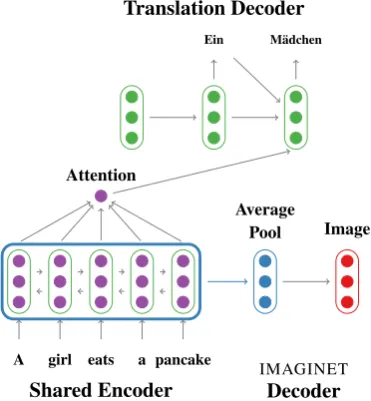
Figure 1: The Imagination model learns visually-grounded representations by sharing the encoder network between the Translation Decoder with image prediction in theIMAGINETDecoder.
We present a multitask learning model that de-composes multimodal translation into learning a translation model and learning visually grounded representations. This decomposition means that our model can be trained over external datasets of parallel text or described images, making it possi-ble to take advantage of existing resources. Fig-ure1presents an overview of our model, Imagina-tion, in which source language representations are shared between tasks through the Shared Encoder. The translation decoder is an attention-based neu-ral machine translation model (Bahdanau et al.,
2015), and the image prediction decoder is trained to predict a global feature vector of an image that is associated with a sentence (Chrupała et al.,
2015, IMAGINET). This decomposition
encour-ages grounded learning in the shared encoder be-cause theIMAGINETdecoder is trained to imagine
the image associated with a sentence. It has been shown that grounded representations are qualita-tively different from their text-only counterparts (K´ad´ar et al.,2016) and correlate better with hu-man similarity judgements (Chrupała et al.,2015). We assess the success of the grounded learning by evaluating the image prediction model on an image–sentence ranking task to determine if the shared representations are useful for image re-trieval (Hodosh et al.,2013). In contrast with most previous work, our model does not take images as input at translation time, rather it learns grounded representations in the shared encoder.
We evaluate Imagination on the Multi30K dataset (Elliott et al., 2016) using a combination of domain and out-of-domain data. In the in-domain experiments, we find that multitasking translation with image prediction is competitive with the state of the art. Our model achieves 55.8 Meteor as a single model trained on multimodal in-domain data, and 57.6 Meteor as an ensemble.
In the experiments with out-of-domain re-sources, we find that the improvement in trans-lation quality holds when training the IMAGINET
decoder on the MS COCO dataset of described images (Chen et al., 2015). Furthermore, if we significantly improve our text-only baseline us-ing out-of-domain parallel text from the News Commentary corpus (Tiedemann, 2012), we still find improvements in translation quality from the auxiliary image prediction task. Finally, we re-port a state-of-the-art result of 59.3 Meteor on the Multi30K corpus when ensembling models trained on in- and out-of-domain resources.
The main contributions of this paper are: • We show how to apply multitask learning to
multimodal translation. This makes it possi-ble to train models for this task using exter-nal resources alongside the expensive triple-aligned source-target-image data.
• We decompose multimodal translation into two tasks: learning to translate and learning grounded representations. We show that each task can be trained on large-scale external re-sources, e.g. parallel news text or images de-scribed in a single language.
• We present a model that achieves state of the art results without using images as an input. Instead, our model learns visually grounded source language representations using an
auxiliary image prediction objective. Our model does not need any additional param-eters to translate unseen sentences.
2 Problem Formulation
Multimodal translation is the task of producing target language translationy, given the source lan-guage sentencex and additional context, such as an imagev(Specia et al.,2016). Letxbe a source language sentence consisting ofN tokens: x1, x2,
. . ., xnand letybe a target language sentence
con-sisting ofM tokens: y1, y2,. . ., ym. The training
data consists of tuplesD ∈(x, y, v), wherexis a description of imagev, andyis a translation ofx. Multimodal translation has previously been framed as minimising the negative log-likelihood of a translation model that is additionally conditioned on the image, i.e. J(θ) =
−Pjlog p(yj|y<j, x, v). Here, we decompose
the problem into learning to translate and learning visually grounded representations. The decompo-sition is based on sharing parameters θ between these two tasks, and learning task-specific param-eters φ. We learn the parameters in a multitask model with shared parameters in the source lan-guage encoder. The translation model has task-specific parameters φt in the attention-based
de-coder, which are optimized through the trans-lation loss JT(θ, φt). Grounded representations
are learned through an image prediction model with task-specific parameters φg in the
image-prediction decoder by minimizingJG(θ, φg). The
joint objective is given by mixing the translation and image prediction tasks with the parameterw:
J(θ, φ) =wJT(θ, φt) + (1−w)JG(θ, φg) (1)
Our decomposition of the problem makes it straightforward to optimise this objective without paired tuples, e.g. where we have an external dataset of described images Dimage ∈ (x, v) or
an external parallel corpusDtext∈(x, y).
3 Imagination Model
3.1 Shared Encoder
The encoder network of our model learns a rep-resentation of a sequence of N tokens x1...n in
the source language with a bidirectional recur-rent neural network (Schuster and Paliwal,1997). This representation is shared between the differ-ent tasks. Each token is represdiffer-ented by a one-hot vectorxi, which is mapped into an embeddingei through a learned matrixE:
ei =xi·E (2)
A sentence is processed by a pair of recurrent neural networks, where one captures the sequence left-to-right (forward), and the other captures the sequence right-to-left (backward). The initial state of the encoderh−1is a learned parameter:
− →h
i =−−→RNN(−−→hi−1,ei) (3) ←h−
i =←−−RNN(←−−hi−1,ei) (4)
Each token in the source language input sequence is represented by a concatenation of the forward and backward hidden state vectors:
hi= [−→hi;←h−i] (5)
3.2 Neural Machine Translation Decoder
The translation model decoder is an attention-based recurrent neural network (Bahdanau et al.,
2015). Tokens in the decoder are represented by a one-hot vectoryj, which is mapped into an em-beddingej through a learned matrixEy:
ej =yj·Ey (6)
The inputs to the decoder are the previously pre-dicted token yj−1, the previous decoder state
dj−1, and a timestep-dependent context vectorcj calculated over the encoder hidden states:
dj =RNN(dj−1,yj−1,ej) (7)
The initial state of the decoder d-1 is a nonlinear transform of the mean of the encoder states, where
Winitis a learned parameter:
d-1 =tanh(Winit·N1
N
X
i
hi) (8)
The context vectorcj is a weighted sum over the
encoder hidden states, whereNdenotes the length of the source sentence:
cj =
N
X
i=1
αjihi (9)
Theαjivalues are the proportion of which the
en-coder hidden state vectorsh1...n contribute to the decoder hidden state when producing the jth to-ken in the translation. They are computed by a feed-forward neural network, whereva,Wa and
Uaare learned parameters:
αji= PNexp(eji)
l=1exp(eli) (10)
eji=va·tanh(Wa·dj−1+Ua·hi) (11)
From the hidden statedjthe network predicts the conditional distribution of the next tokenyj, given
a target language embeddingej−1 of the previous token, the current hidden statedj, and the calcu-lated context vectorcj. Note that at training time,
yj−1 is the true observed token; whereas for
un-seen data we use the inferred tokenyˆj−1 sampled
from the output of the softmax:
p(yj|y<j, c) =softmax(tanh(ej−1+dj+cj)) (12)
The translation model is trained to minimise the negative log likelihood of predicting the target lan-guage output:
JNLL(θ, φt) =−
X
j
log p(yj|y<j, x) (13)
3.3 Imaginet Decoder
The image prediction decoder is trained to predict the visual feature vector of the image associated with a sentence (Chrupała et al.,2015). It encour-ages the shared encoder to learn grounded repre-sentations for the source language.
Size Tokens Types Images Multi30K: parallel text with images En
31K 377K 10K 31K
De 368K 16K
MS COCO: external described images
En 414K 4.3M 24K 83K
News Commentary: external parallel text En
240K 8.31M 17K –
De 8.95M –
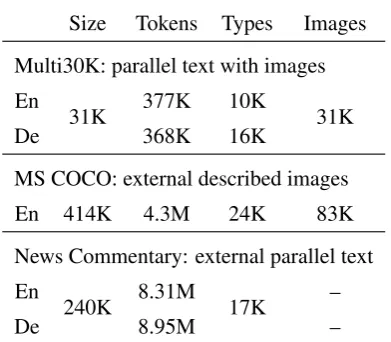
Table 1: The datasets used in our experiments.
sentence with parametersWvis:
ˆv=tanh(Wvis·N1
N
X
i
hi) (14)
This decoder is trained to predict the true im-age vector v with a margin-based objective, pa-rameterised by the minimum margin α, and the cosine distanced(·,·). A margin-based objective has previously been used in grounded representa-tion learning (Vendrov et al.,2016;Chrupała et al.,
2017). The contrastive examples v0 are drawn
from the other instances in a minibatch:
JMAR(θ, φt) =
X
v06=v
max{0, α−d(ˆv,v) +d(ˆv,v0)} (15)
4 Data
We evaluate our model using the benchmark Multi30K dataset (Elliott et al., 2016), which is the largest collection of images paired with sen-tences in multiple languages. This dataset con-tains 31,014 images paired with an English lan-guage sentence and a German lanlan-guage transla-tion: 29,000 instances are reserved for training, 1,014 for development, and 1,000 for evaluation.1 The English and German sentences are pre-processed by normalising the punctuation, low-ercasing and tokenizing the text using the Moses toolkit. We additionally decompound the German text using Zmorge (Sennrich and Kunz, 2014). 1The Multi30K dataset also contains 155K independently
collected descriptions in German and English. In order to make our experiments more comparable with previous work, we do not make use of this data.
This results in vocabulary sizes of 10,214 types for English and 16,022 for German.
We also use two external datasets to evaluate our model: the MS COCO dataset of English described images (Chen et al., 2015), and the English-German News Commentary parallel cor-pus (Tiedemann, 2012). When we perform ex-periments with the News Commentary corpus, we first calculate a 17,597 sub-word vocabulary us-ing SentencePiece (Schuster and Nakajima,2012) over the concatentation of the Multi30K and News Commentary datasets. This gives us a shared vocabulary for the external data that reduces the number of out-of-vocabulary tokens.
Images are represented by 2048D vectors ex-tracted from the ‘pool5/7x7 s1’ layer of the GoogLeNet v3 CNN (Szegedy et al.,2015).
5 Experiments
We evaluate our multitasking approach with in-and out-of-domain resources. We start by re-porting results of models trained using only the Multi30K dataset. We also report the results of training the IMAGINET decoder with the COCO
dataset. Finally, we report results on incorporating the external News Commentary parallel text into our model. Throughout, we report performance of the En→De translation using Meteor (Denkowski and Lavie,2014) and BLEU (Papineni et al.,2002) against lowercased tokenized references.
5.1 Hyperparameters
The encoder is a 1000D Gated Recurrent Unit bidirectional recurrent neural network (Cho et al.,
2014, GRU) with 620D embeddings. We share all of the encoder parameters between the pri-mary and auxiliary task. The translation decoder is a 1000D GRU recurrent neural network, with a 2000D context vector over the encoder states, and 620D word embeddings (Sennrich et al.,
ex-Meteor BLEU
NMT 54.0±0.6 35.5±0.8
Calixto et al.(2017) 55.0 36.5
Calixto and Liu(2017) 55.1 37.3
Imagination 55.8±0.4 36.8±0.8
Toyama et al.(2016) 56.0 36.5
Hitschler et al.(2016) 56.1 34.3
Moses 56.9 36.9
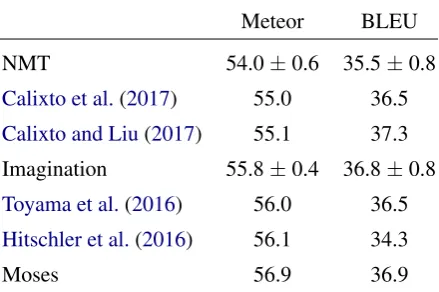
Table 2: En→De translation results on the Multi30K dataset. Our Imagination model is com-petitive with the state of the art when it is trained on in-domain data. We report the mean and stan-dard deviation of three random initialisations.
ceeds 1.0. Dropout is set to 0.2 for the embed-dings and the recurrent connections in both tasks (Gal and Ghahramani,2016). Translations are de-coded using beam search with 12 hypotheses.
5.2 In-domain experiments
We start by presenting the results of our multitask model trained using only the Multi30K dataset. We compare against state-of-the-art approaches and text-only baselines. Moses is the phrase-based machine translation model (Koehn et al.,2007) re-ported in (Specia et al.,2016). NMT is a text-only neural machine translation model. Calixto et al.
(2017) is a double-attention model over the source language and the image.Calixto and Liu(2017) is a multimodal translation model that conditions the decoder on semantic image vector extracted from the VGG-19 CNN.Hitschler et al.(2016) uses vi-sual features in a target-side retrieval model for translation.Toyama et al.(2016) is most compara-ble to our approach: it is a multimodal variational NMT model that infers latent variables to repre-sent the source language semantics from the image and linguistic data.
Table2shows the results of this experiment. We can see that the combination of the attention-based translation model and the image prediction model is a 1.8 Meteor point improvement over the NMT baseline, but it is 1.1 Meteor points worse than the strong Moses baseline. Our approach is com-petitive with previous approaches that use visual features as inputs to the decoder and the target-side reranking model. It also competitive with
Meteor BLEU
Imagination 55.8±0.4 36.8±0.8
Imagination (COCO) 55.6±0.5 36.4±1.2
Table 3: Translation results when using out-of-domain described images. Our approach is still ef-fective when the image prediction model is trained over the COCO dataset.
Meteor BLEU
NMT 52.8±0.6 33.4±0.6
+ NC 56.7±0.3 37.2±0.7
+ Imagination 56.7±0.1 37.4±0.3
+ Imagination (COCO) 57.1±0.2 37.8±0.7
Calixto et al.(2017) 56.8 39.0
Table 4: Translation results with out-of-domain parallel text and described images. We find further improvements when we multitask with the News Commentary (NC) and COCO datasets.
Toyama et al.(2016), which also only uses images for training. These results confirm that our multi-tasking approach uses the image prediction task to improve the encoder of the translation model.
5.3 External described image data
Recall from Section2that we are interested in sce-narios wherex,y, andvare drawn from different sources. We now experiment with separating the translation data from the described image data us-ingDimage: MS COCO dataset of 83K described
images2andD
text: Multi30K parallel text.
Table3shows the results of this experiment. We find that there is no significant difference between training the IMAGINET decoder on in-domain
(Multi30K) or out-of-domain data (COCO). This result confirms that we can separate the parallel text from the described images.
5.4 External parallel text data
We now experiment with training our model on a combination of the Multi30K and the News Com-mentary English-German data. In these experi-ments, we concatenate the Multi30K and News 2Due to differences in the vocabularies of the respective
Parallel text Described images
Multi30K News Commentary Multi30K COCO Meteor BLEU
Zmor
ge 56.2 37.8
57.6 39.0
Sub-w
ord 54.458.6 35.039.4
59.0 39.5
59.3 40.2
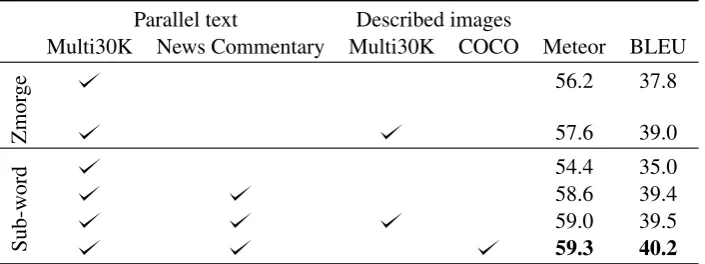
Table 5: Ensemble decoding results. Zmorge denotes models trained with decompounded German words; Sub-word denotes joint SentencePiece word splitting (see Section4for more details).
Commentary datasets into a single Dtext
train-ing dataset, similar to Freitag and Al-Onaizan
(2016). We compare our model against Calixto et al. (2017), who pre-train their model on the WMT’15 English-German parallel text and back-translate (Sennrich et al., 2016) additional sen-tences from the bilingual independent descriptions in the Multi30K dataset (Footnote 2).
Table4presents the results. The text-only NMT model using sub-words is 1.2 Meteor points lower than decompounding the German text. Neverthe-less, the model trained over a concatenation of the parallel texts is a 2.7 Meteor point improvement over this baseline (+ NC) and matches the perfor-mance of our Multitasking model that uses only in-domain data (Section 5.2). We do not see an additive improvement for the multitasking model with the concatenated parallel text and the in-domain data (+ Imagination) using a training ob-jective interpolation ofw = 0.89(the ratio of the training dataset sizes). This may be because we are essentially learning a translation model and the updates from theIMAGINETdecoder are forgotten.
Therefore, we experiment with multitasking the concatenated parallel text and the COCO dataset (w = 0.5). We find that balancing the datasets improves over the concatenated text model by 0.4 Meteor (+ Imagination (COCO)). Our multitask-ing approach improves upon Calixto et al. by 0.3 Meteor points. Our model can be trained in 48 hours using 240K parallel sentences and 414K de-scribed images from out-of-domain datasets. Fur-thermore, recall that our model does not use im-ages as an input for translating unseen data, which results in 6.2% fewer parameters compared to us-ing the 2048D Inception-V3 visual features to ini-tialise the hidden state of the decoder.
5.5 Ensemble results
Table5 presents the results of ensembling differ-ent randomly initialised models. We achieve a start-of-the-art result of 57.6 Meteor for a model trained on only in-domain data. The improve-ments are more pronounced for the models trained using sub-words and out-of-domain data. An en-semble of baselines trained on sub-words is ini-tially worse than an ensemble trained on Zmorge decompounded words. However, we always see an improvement from ensembling models trained on in- and out-of-domain data. Our best ensemble is trained on Multi30K parallel text, the News Com-mentary parallel text, and the COCO descriptions to set a new state-of-the-art result of 59.3 Meteor.
5.6 Multi30K 2017 results
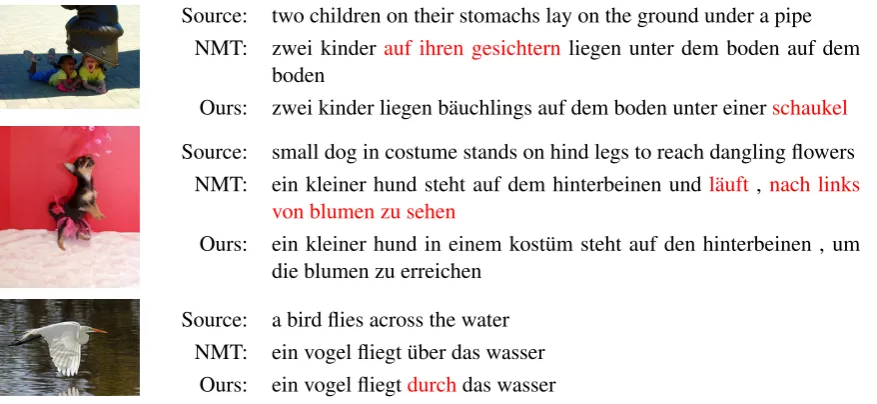
Source: two children on their stomachs lay on the ground under a pipe NMT: zwei kinder auf ihren gesichternliegen unter dem boden auf dem
boden
Ours: zwei kinder liegen b¨auchlings auf dem boden unter einerschaukel
Source: small dog in costume stands on hind legs to reach dangling flowers NMT: ein kleiner hund steht auf dem hinterbeinen undl¨auft, nach links
von blumen zu sehen
Ours: ein kleiner hund in einem kost¨um steht auf den hinterbeinen , um die blumen zu erreichen
Source: a bird flies across the water NMT: ein vogel fliegt ¨uber das wasser
Ours: ein vogel fliegtdurchdas wasser
Table 6: Examples where our model improves or worsens the translation compared to the NMT baseline. Top: NMT translates the wrong body part; both models skip “pipe”. Middle: NMT incorrectly translates the verb and misses several nouns. Bottom: Our model incorrectly translates the preposition.
53.5, and 2nd place in the human assessment.
5.7 Qualitative examples
Table 6 shows examples of where the multitask-ing model improves or worsens translation perfor-mance compared to the baseline model3. The first example shows that the baseline model makes a significant error in translating the pose of the chil-dren, translating “on their stomachs” as “on their faces”). The middle example demonstrates that the baseline model translates the dog as walking (“l¨auft”) and then makes grammatical and sense errors after the clause marker. Both models ne-glect to translate the word “dangling”, which is a low-frequency word in the training data. There are instances where the baseline produces better trans-lations than the multitask model: In the bottom ex-ample, our model translates a bird flying through the water (“durch”) instead of “over” the water.
6 Discussion
6.1 Does the model learn grounded representations?
A natural question to ask if whether the multitask model is actually learning representations that are relevant for the images. We answer this question by evaluating the Imaginet decoder in an image– sentence ranking task. Here the input is a source language sentence, from which we predict its
im-3We used MT-ComparEval (Klejch et al.,2015)
age vectorˆv. The predicted vectorˆvcan be com-pared against the true image vectorsvin the eval-uation data using the cosine distance to produce a ranked order of the images. Our model returns a median rank of 11.0 for the true image compared to the predicted image vector. Figure2shows ex-amples of the nearest neighbours of the images predicted by our multitask model. We can see that the combination of the multitask source language representations and IMAGINET decoder leads to
the prediction of relevant images. This confirms that the shared encoder is indeed learning visually grounded representations.
6.2 The effect of visual feature vectors
We now study the effect of varying the Convolu-tional Neural Network used to extract the visual features used in the Imaginet decoder. It has previ-ously been shown that the choice of visual features can affect the performance of vision and language models (Jabri et al.,2016;Kiela et al.,2016). We compare the effect of training the IMAGINET
(a) Nearest neighbours for “a native woman is working on a craft project .”
(b) Nearest neighbours for “there is a cafe on the street corner with an oval painting on the side of the building .”
Figure 2: We can interpret theIMAGINETDecoder by visualising the predictions made by our model.
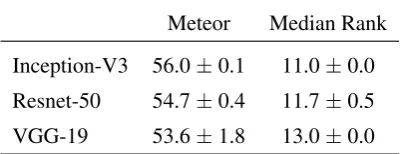
Meteor Median Rank
Inception-V3 56.0±0.1 11.0±0.0
Resnet-50 54.7±0.4 11.7±0.5
VGG-19 53.6±1.8 13.0±0.0
Table 7: The type of visual features predicted by theIMAGINETDecoder has a strong impact on the
Multitask model performance.
vectors (Inception-V3 and ResNet-50) compared to the 4096D vector from VGG-19). This dif-ference is reflected in both the translation Meteor score and the Median rank of the images in the val-idation dataset. This is likely because it is easier to learn the parameters of the image prediction model that has fewer parameters (8.192 million for VGG-19 vs. 4.096 million for Inception-V3 and ResNet-50). However, it is not clear why there is such a pronounced difference between the Inception-V3 and ResNet-50 models4.
7 Related work
Initial work on multimodal translation used se-mantic or spatially-preserving image features as inputs to a translation model. Semantic im-age features are typically extracted from the fi-nal layer of a pre-trained object recognition CNN, e.g. ‘pool5/7x7 s1’ in GoogLeNet (Szegedy et al.,
2015). This type of vector has been used as in-put to the encoder (Elliott et al., 2015; Huang
4We used pre-trained CNNs (https://github.com/
fchollet/deep-learning-models), which claim
equal ILSVRC object recognition performance for both mod-els: 7.8% top-5 error with a single-model and single-crop.
et al., 2016), the decoder (Libovick´y et al.,
2016), or as features in a phrase-based translation model (Shah et al.,2016;Hitschler et al., 2016). Spatially-preserving image features are extracted from deeper inside a CNN, where the position of a feature is related to its position in the image. These features have been used in “double-attention mod-els”, which calculate independent context vectors for the source language and a convolutional im-age features (Calixto et al.,2016;Caglayan et al.,
2016;Calixto et al., 2017). We use an attention-based translation model but our multitask model does not use images for translation.
More related to our work is an extension of Variational Neural Machine Translation to infer la-tent variables toexplicitlymodel the semantics of source sentences from visual and linguistic infor-mation (Toyama et al., 2016). They report im-provements on the Multi30K data set but their model needs additional parameters in the “neural inferrer” modules. In our model, the grounded se-mantics are representedimplicitlyin the shared en-coder. They assume Source-Target-Image training data, whereas our approach achieves equally good results if we train on separate Source-Image and Source-Target datasets. Saha et al.(2016) study cross-lingual image description where the task is to generate a sentence in language L1 given the
image, using only Image-L2 and L1-L2 training
corpora. They propose a Correlational Encoder-Decoder to model the Image-L2 andL1-L2 data,
which learns correlated representations for paired Image-L2 data and decodesL1from the joint
cross-entropy loss.Nakayama and Nishida(2017) consider a zero-resource problem, where the task is to translate fromL1 toL2 with only Image-L1
and Image-L2 corpora. Their model embeds the
image, L1, and L2 in a joint multimodal space
learned by minimizing a multi-task ranking loss between both pairs of examples. In this paper, we focus on enrichingsource language represen-tations with visual information instead of zero-resource learning.
Multitask Learning improves the generalisabil-ity of a model by requiring it to be useful for more than one task (Caruana,1997). This approach has recently been used to improve the performance of sentence compression using eye gaze as an auxil-iary task (Klerke et al.,2016), and to improve shal-low parsing accuracy through the auxiliary task of predicting keystrokes in an out-of-domain corpus (Plank,2016). More recently,Bingel and Søgaard
(2017) analysed the beneficial relationships be-tween primary and auxiliary sequential prediction tasks. In the translation literature, multitask learn-ing has been used to learn a one-to-many lan-guages translation model (Dong et al., 2015), a multi-lingual translation model with a single atten-tion mechanism shared across multiple languages (Firat et al., 2016), and in multitask sequence-to-sequence learning without an attention-based de-coder (Luong et al.,2016). We explore the benefits of grounded learning in the specific case of mul-timodal translation. We combine sequence pre-diction with continuous (image) vector prepre-diction, compared to previous work which multitasks dif-ferent sequence prediction tasks.
Visual representation prediction has been stud-ied using static images or videos. Lin and Parikh
(2015) use a conditional random field to imag-ine the composition of a clip-art scene for visual paraphrasing and fill-in-the-blank tasks.Chrupała et al. (2015) predict the image vector associated with a sentence using an L2 loss; they found this improves multi-modal word similarity compared to text-only baselines. Gelderloos and Chrupała
(2016) predict the image vector associated with a sequence of phonemes using a max-margin loss, similar to our image prediction objective. Col-lell et al.(2017) learn to predict the visual feature vector associated with a word for word similar-ity and relatedness tasks. As a video reconstruc-tion problem, Srivastava et al. (2015) propose an LSTM Autoencoder to predict video frames as a
reconstruction task or as a future prediction task.
Pasunuru and Bansal (2017) propose a multitask model for video description that combines unsu-pervised video reconstruction, lexical entailment, and video description. They find improvements from using out-of-domain resources for entailment and video prediction, similar to the improvements we find from using out-of-domain parallel text and described images.
8 Conclusion
We decompose multimodal translation into two sub-problems: learning to translate and learning visually grounded representations. In a multi-task learning framework, we show how these sub-problems can be addressed by sharing an encoder between a translation model and an image predic-tion model5. Our approach achieves state-of-the-art results on the Multi30K dataset without using images for translation. We show that training on separate parallel text and described image datasets does not hurt performance, encouraging future re-search on multitasking with diverse sources of data. Furthermore, we still find improvements from image prediction when we improve our text-only baseline with the out-of-domain parallel text. Future work includes adapting our decomposition to other NLP tasks that may benefit from out-of-domain resources, such as semantic role labelling, dependency parsing, and question-answering; ex-ploring methods for inputting the (predicted) im-age into the translation model; experimenting with different image prediction architectures; multi-tasking different translation languages into a sin-gle shared encoder; and multitasking in both the encoder and decoder(s).
Acknowledgments
We are grateful to the anonymous reviewers for their feedback. We thank Joost Bastings for shar-ing his multitaskshar-ing Nematus model, Wilker Aziz for discussions about formulating the problem, Stella Frank for finding and explaining the quali-tative examples to us, and Afra Alishahi, Grzegorz Chrupała, and Philip Schulz for feedback on ear-lier drafts of the paper. DE acknowledges the sup-port of an Amazon Research Award, NWO Vici grant nr. 277-89-002 awarded to K. Sima’an, and a hardware grant from the NVIDIA Corporation.
References
Dzmitry Bahdanau, Kyunghyun Cho, and Yoshua Ben-gio. 2015. Neural machine translation by jointly learning to align and translate. InInternational Con-ference on Learning Representations.
J. Bingel and A. Søgaard. 2017. Identifying beneficial task relations for multi-task learning in deep neural networks. InProceedings of the 15th Conference of the European Chapter of the Association for Com-putational Linguistics, pages 164–169.
Ozan Caglayan, Lo¨ıc Barrault, and Fethi Bougares. 2016. Multimodal attention for neural machine translation. CoRR, abs/1609.03976.
Iacer Calixto, Desmond Elliott, and Stella Frank. 2016. DCU-UvA Multimodal MT System Report. In Pro-ceedings of the First Conference on Machine Trans-lation, pages 634–638.
Iacer Calixto and Qun Liu. 2017. Incorporating global visual features into attention-based neural machine translation. InProceedings of the 2017 Conference on Empirical Methods in Natural Language Pro-cessing, pages 1003–1014.
Iacer Calixto, Qun Liu, and Nick Campbell. 2017. Doubly-Attentive Decoder for Multi-modal Neural Machine Translation. InProceedings of the 55th An-nual Meeting of the Association for Computational Linguistics (Volume 1: Long Papers), pages 1913– 1924.
Rich Caruana. 1997. Multitask learning. Machine Learning, 28(1):41–75.
Xinlei Chen, Hao Fang, Tsung-Yi Lin, Ramakr-ishna Vedantam, Saurabh Gupta, Piotr Doll´ar, and C. Lawrence Zitnick. 2015. Microsoft COCO cap-tions: Data collection and evaluation server. CoRR, abs/1504.00325.
K. Cho, B. Van Merri¨enboer, C. Gulcehre, D. Bah-danau, F. Bougares, H. Schwenk, and Y. Bengio. 2014. Learning phrase representations using RNN encoder-decoder for statistical machine translation. pages 1724–1734.
Grzegorz Chrupała, Lieke Gelderloos, and Afra Al-ishahi. 2017. Representations of language in a model of visually grounded speech signal. In Pro-ceedings of the 55th Annual Meeting of the Associa-tion for ComputaAssocia-tional Linguistics (Volume 1: Long Papers), pages 613–622.
Grzegorz Chrupała, ´Akos K´ad´ar, and Afra Alishahi. 2015. Learning language through pictures. In Pro-ceedings of the 53rd Annual Meeting of the Associ-ation for ComputAssoci-ational Linguistics and the 7th In-ternational Joint Conference on Natural Language Processing, pages 112–118.
Guillem Collell, Teddy Zhang, and Marie-Francine Moens. 2017. Imagined visual representations as multimodal embeddings. In Proceedings of the Thirty-First AAAI Conference on Artificial Intelli-gence (AAAI-17), pages 4378–4384.
Michael Denkowski and Alon Lavie. 2014. Meteor universal: Language specific translation evaluation for any target language. InProceedings of the EACL 2014 Workshop on Statistical Machine Translation.
D. Dong, H. Wu, W. He, D. Yu, and H. Wang. 2015. Multi-task learning for multiple language transla-tion. InProceedings of the 53rd Annual Meeting of the Association for Computational Linguistics and the 7th International Joint Conference on Natural Language Processing, pages 1723–1732.
Desmond Elliott, Stella Frank, Lo¨ıc Barrault, Fethi Bougares, and Lucia Specia. 2017. Findings of the second shared task on multimodal machine transla-tion and multilingual image descriptransla-tion. In Proceed-ings of the Second Conference on Machine Trans-lation, Volume 2: Shared Task Papers, pages 215– 233, Copenhagen, Denmark. Association for Com-putational Linguistics.
Desmond Elliott, Stella Frank, and Eva Hasler. 2015. Multi-language image description with neural se-quence models. CoRR, abs/1510.04709.
Desmond Elliott, Stella Frank, Khalil. Sima’an, and Lucia Specia. 2016. Multi30K: Multilingual English-German Image Descriptions. In Proceed-ings of the 5th Workshop on Vision and Language.
O. Firat, K. Cho, and Y. Bengio. 2016. Multi-way, mul-tilingual neural machine translation with a shared attention mechanism. In Proceedings of the 2016 Conference of the North American Chapter of the Association for Computational Linguistics: Human Language Technologies, pages 866–875.
Markus Freitag and Yaser Al-Onaizan. 2016. Fast domain adaptation for neural machine translation.
CoRR, abs/1612.06897.
Yarin Gal and Zoubin Ghahramani. 2016. A theoret-ically grounded application of dropout in recurrent neural networks. InAdvances in Neural Information Processing Systems 29, pages 1019–1027.
Lieke Gelderloos and Grzegorz Chrupała. 2016. From phonemes to images: levels of representation in a recurrent neural model of visually-grounded lan-guage learning. In Proceedings of COLING 2016, the 26th International Conference on Computational Linguistics, pages 1309–1319.
Kaiming He, Xiangyu Zhang, Shaoqing Ren, and Jian Sun. 2016. Deep residual learning for image recog-nition. InThe IEEE Conference on Computer Vision and Pattern Recognition (CVPR), pages 770–778.
Julian Hitschler, Shigehiko Schamoni, and Stefan Rie-zler. 2016. Multimodal Pivots for Image Caption Translation. In Proceedings of the 54th Annual Meeting of the Association for Computational Lin-guistics, pages 2399–2409.
Micah Hodosh, Peter Young, and Julia Hockenmaier. 2013. Framing image description as a ranking task: Data, models and evaluation metrics. Journal of Ar-tificial Intelligence Research, 47:853–899.
Po-Yao Huang, Frederick Liu, Sz-Rung Shiang, Jean Oh, and Chris Dyer. 2016. Attention-based multi-modal neural machine translation. InProceedings of the First Conference on Machine Translation, pages 639–645.
Allan Jabri, Armand Joulin, and Laurens van der Maaten. 2016. Revisiting visual question answer-ing baselines. InEuropean conference on computer vision, pages 727–739.
Akos K´ad´ar, Grzegorz Chrupała, and Afra Alishahi. 2016. Representation of linguistic form and func-tion in recurrent neural networks. arXiv preprint arXiv:1602.08952.
Douwe Kiela, Anita L. Ver˝o, and Stephen Clark. 2016. Comparing Data Sources and Architectures for Deep Visual Representation Learning in Semantics. In
Proceedings of the Conference on Empirical Meth-ods in Natural Language Processing (EMNLP-16), pages 447–456.
Diederik P. Kingma and Jimmy Ba. 2015. Adam: A method for stochastic optimization. International Conference on Learning Representations.
Ondˇrej Klejch, Eleftherios Avramidis, Aljoscha Bur-chardt, and Martin Popel. 2015. Mt-compareval: Graphical evaluation interface for machine transla-tion development. The Prague Bulletin of Mathe-matical Linguistics, 104(1):63–74.
Sigrid Klerke, Yoav Goldberg, and Anders Søgaard. 2016. Improving sentence compression by learning to predict gaze. InProceedings of the 2016 Confer-ence of the North American Chapter of the Associ-ation for ComputAssoci-ational Linguistics: Human Lan-guage Technologies, pages 1528–1533.
Philipp Koehn, Hieu Hoang, Alexandra Birch, Chris Callison-Burch, Marcello Federico, Nicola Bertoldi, Brooke Cowan, Wade Shen, Christine Moran, Richard Zens, et al. 2007. Moses: Open source toolkit for statistical machine translation. In Pro-ceedings of the 45th Annual meeting of Association for Computational Linguistics, pages 177–180.
Jindˇrich Libovick´y, Jindˇrich Helcl, Marek Tlust´y, Ondˇrej Bojar, and Pavel Pecina. 2016. Cuni system for wmt16 automatic post-editing and multimodal translation tasks. InProceedings of the First Con-ference on Machine Translation, pages 646–654. Xiao Lin and Devi Parikh. 2015. Don’t just listen, use
your imagination: Leveraging visual common sense for non-visual tasks. In Proceedings of the IEEE Conference on Computer Vision and Pattern Recog-nition, pages 2984–2993.
Minh-Thang Luong, Quoc V. Le, Ilya Sutskever, Oriol Vinyals, and Lukasz Kaiser. 2016. Multi-task se-quence to sese-quence learning. InICLR.
Hideki Nakayama and Noriki Nishida. 2017. Zero-resource machine translation by multimodal encoder-decoder network with multimedia pivot.
Machine Translation, 31(1-2):49–64.
Kishore Papineni, Salim Roukos, Todd Ward, and Wei-Jing Zhu. 2002. Bleu: A method for automatic eval-uation of machine translation. InProceedings of the 40th Annual Meeting on Association for Computa-tional Linguistics, pages 311–318.
R. Pasunuru and M. Bansal. 2017. Multi-Task Video Captioning with Video and Entailment Generation. In Proceedings of the 55th Annual Meeting of the Association for Computational Linguistics (Volume 1: Long Papers), pages 1273–1283.
Barbara Plank. 2016. Keystroke dynamics as sig-nal for shallow syntactic parsing. In 26th Inter-national Conference on Computational Linguistics, pages 609–619.
Amrita Saha, Mitesh M. Khapra, Sarath Chandar, Ja-narthanan Rajendran, and Kyunghyun Cho. 2016. A correlational encoder decoder architecture for pivot based sequence generation. In 26th International Conference on Computational Linguistics: Techni-cal Papers, pages 109–118.
Mike Schuster and Kaisuke Nakajima. 2012. Japanese and korean voice search. In 2012 IEEE Interna-tional Conference on Acoustics, Speech and Signal Processing (ICASSP), pages 5149–5152.
Mike Schuster and Kuldip K Paliwal. 1997. Bidirec-tional recurrent neural networks. IEEE Transactions on Signal Processing, 45(11):2673–2681.
R. Sennrich, O. Firat, K. Cho, A. Birch, B. Haddow, J. Hitschler, M. Junczys-Dowmunt, S. L¨aubli, A. Va-lerio Miceli Barone, J. Mokry, and M. N˘adejde. 2017. Nematus: a Toolkit for Neural Machine Translation. pages 65–68.
Rico Sennrich and Beat Kunz. 2014. Zmorge: A german morphological lexicon extracted from wik-tionary. In Language Resources and Evaluation Conference, pages 1063–1067.
Kashif Shah, Josiah Wang, and Lucia Specia. 2016. Shef-multimodal: Grounding machine translation on images. InProceedings of the First Conference on Machine Translation, pages 660–665.
Karen Simonyan and Andrew Zisserman. 2015. Very deep convolutional networks for large-scale image recognition. In Proceedings of the International Conference on Learning Representations.
Lucia Specia, Stella Frank, Khalil Sima’an, and Desmond Elliott. 2016. A shared task on multi-modal machine translation and crosslingual image description. InProceedings of the First Conference on Machine Translation, pages 543–553.
Nitish Srivastava, Elman Mansimov, and Ruslan Salakhudinov. 2015. Unsupervised learning of video representations using LSTMs. In Interna-tional Conference on Machine Learning, pages 843– 852.
Christian Szegedy, Vincent Vanhoucke, Sergey Ioffe, Jonathon Shlens, and Zbigniew Wojna. 2015. Re-thinking the inception architecture for computer vi-sion.CoRR, abs/1512.00567.
J¨org Tiedemann. 2012. Parallel data, tools and inter-faces in opus. InEight International Conference on Language Resources and Evaluation (LREC’12). Joji Toyama, Masanori Misono, Masahiro Suzuki,
Ko-taro Nakayama, and Yutaka Matsuo. 2016. Neural machine translation with latent semantic of image and text. CoRR, abs/1611.08459.