Constructing High Quality Sense-Specific Corpus and Word Embedding
via Unsupervised Elimination of Pseudo Multi-sense
Haoyue Shi
1,2
, Xihao Wang
1,3, Yuqi Sun
1,3, Junfeng Hu
1,41School of Electronics Engineering and Computer Science 2Department of Machine Intelligence
3Department of Computer Science and Technology
4Key Laboratory of Computational Linguistics, Ministry of Education
No 5. Yiheyuan Road, Beijing China, 100871 {hyshi, victorwonder, sun yq, hujf}@pku.edu.cn
Abstract
Multi-sense word embedding is an important extension of neural word embeddings. By leveraging context of each word instance, multi-prototype version of word embeddings were accomplished to represent the multi-senses. Unfortunately, this kind of context based approach inevitably produces multiple senses which should actually be a single one, suffering from the various context of a word. (Shi et al., 2016) used WordNet to evaluate the neighborhood similarity of each sense pair to detect such pseudo multi-senses. In this paper, a novel framework for unsupervised corpus sense tagging is presented, which mainly contains four steps: (a) train multi-sense word embeddings on the given corpus, using existing multi-sense word embedding frameworks; (b) detect pseudo multi-senses in the obtained embeddings, without requirement to any extra language resources; (c) label each word in the corpus with a specific sense tag, with respect to the result of pseudo multi-sense detection; (d) re-train multi-sense word embeddings with the pre-selected sense tags. We evaluate our framework by training word embeddings with the obtained sense specific corpus. On the tasks of word similarity, word analogy as well as sentence understanding, the embeddings trained on sense-specific corpus obtain better results than the basic strategy which is applied in step (a).
Keywords:multi-sense word embedding, word sense discovery, pseudo multi-sense
1.
Introduction
Distributional word representations (Bengio et al., 2003; Collobert and Weston, 2008; Mnih and Hinton, 2009; Mikolov et al., 2013b) embed words into a high dimen-sional space, where the cosine value (or Euclidean distance) between two vectors can somehow represent the similarity of two words. Multi-sense word embedding is an intuitive extension of distributional representations of words. Most of existing works distinguish different senses of words by their contexts (Sch¨utze, 1998; Huang et al., 2012; Pina and Johansson, 2015; Neelakantan et al., 2014; Li and Jurafsky, 2015; Cheng and Kartsaklis, 2015). Be-sides proposing a Chinese Restaurant Process (CRP) model for multi-sense word embeddings, Li and Jurafsky (2015) also discussed how helpful the multi-sense word em-bedding methods are to improve natural language understanding, and proved that they do help on some tasks. However, these methods have a common defect. Exist-ing multi-sense word embeddExist-ing models generate large amount of pseudo multi-senses (Shi et al., 2016). This phenomenon leads to the vagueness of such distributional word representations. It also has an intuitive explanation. Here shows three appearances of the word “cat(s)” from Wikipedia:
• In many countries, cats are believed to have nine lives, but in Italy, Germany, Greece, Brazil and some Spanish-speaking regions, they are said to have seven lives, while in Turkish and Arabic traditions, the num-ber of lives is six.
• Femalecatsare seasonally polyestrous, which means they may have many periods of heat over the course
of a year, the season beginning in spring and ending in late autumn.
• Catshunt small prey, primarily birds and rodents, and are often used as a form of pest control.
The sentences present large topic shift, but we human be-ings can still easily determine the three “cat”s have exactly the same meaning, which is the kind of animal. In con-trast, it is too easy for a context-based method to view them as different senses and learn a separate vector for each, if there is not an explicit constraint to penalize such behav-ior. Shi et al. (2016) detected pseudo multi-sense with the help of WordNet (Miller, 1995), and then trained a linear transformation which aims to maximize the similarity of detected pseudo multi-senses. On the transformed word-embedding space, they successfully observed improved performance on both word similarity and analogy tasks. Considering the probable large cost obtaining external knowledge like WordNet for rare languages, we design a novel unsupervised pseudo multi-sense detection method, which evaluates neighborhood similarity of two sense us-ing global (one-word-one-sense) word vectors. We then present a framework for sense tagging, which combines multi-sense word embedding and pseudo multi-sense de-tection. For tokenized corpus, our framework contains the following steps:
1. Train multi-sense word embeddings on corpus, using a specific basic (multi-sense word embedding) model.
2. Detect pseudo multi-sense in the embeddings.
4. Re-train multi-sense word embeddings on corpus, with pre-selected sense tags in step 3.
5. Repeat step 2-4 until no pseudo multi-sense is de-tected.
To the best of our knowledge, we are the first to cre-ate a framework for unsupervised sense-tagging regarding elimination of pseudo multi-sense. Our framework is able to accept any context-based multi-sense word embedding method as a basic model. Moreover, for those word-based languages which are lack of studies, our framework would also shed light on automatic sense discovery, which has less redundancy than the basic multi-sense word embed-ding model.
2.
Related Work
Multi-Sense Word Embedding Neural multi-sense word embedding is a well-studied problem after the emer-gence of neural word embeddings (Huang et al., 2012; Pina and Johansson, 2015; Neelakantan et al., 2014; Li and Jurafsky, 2015; Cheng and Kartsaklis, 2015; Liu et al., 2015; Qiu et al., 2016). Most of them select sense for word instances with respect to their context. The producing of multi-sense word embeddings is also the procedure of word-sense discovery. In our framework, all of the models mentioned above could be applied as the basic model, which would be improved after re-training with pseudo multi-sense detection and tagging.
Different from those global word embedding mod-els (Pennington et al., 2014; Mikolov et al., 2013b), most of the existing multi-sense word embeddings contain three types of vectors:
• global vector. Each word in vocabulary is embedded into a high dimensional space, aka, one word one vec-tor.
• context vector.For each instance of a word in the cor-pus, we can compute its instance context vector by averaging theglobal vector of its context words. By applying SoftMax to the dot production between in-stance context vectorand all given context vector of senses, we could obtain the probability for the word instance to be classified to each sense.
• sense vector. Each sense of word is embedded to the sense vector space, which is the main part of multi-sense word embeddings.
Another type of multi-sense word embeddings in-troduce external knowledge base for accurate sense generation (Iacobacci et al., 2015; Chen et al., 2014; Pelevina et al., 2017). However, they are somehow limited as such external knowledge may be lack for languages other than English.
From the perspective of sense definition, Flekova and Gurevych (2016) proposed a model to learn representations for supersenses of words, which performs well on the evaluation tasks.
Sense Discovery Another related work is word sense dis-covery (Rapp, 2003), which used co-occurrence to evalu-ate semantic similarity. In our work, we not only indicevalu-ate senses with the method which is based on similar knowl-edge (Levy and Goldberg, 2014), but also improve the as-sociate distributional word representations.
Self-Paced Learning Self-paced learning is an adaptive weight adjust technique introduced by Kumar et al. (2010). Varieties of strategies of self-paced learning have been proved efficient on matrix factor-ization (Jiang et al., 2015), multimedia event detection (Jiang et al., 2014; Jiang et al., 2015), multimedia search (Jiang et al., 2014), place recognition (Shi et al., 2017) and object detection (Tang et al., 2012). As far as we know, this is the first work that adapts self-paced strategy to learn word embeddings.
3.
Proposed Framework
Our proposed framework contains the following five steps:
1. Train multi-sense word embeddings on corpus, uti-lizing a specific basic (multi-sense word embedding) model.
2. Detect pseudo multi-sense in the embeddings. Sup-pose we have two sense vectorsvw,iandvw,j of the
same wordw. We evaluate the neighborhood similar-ity by
Ppse(vw,i,vw,j)∝
X
vni∈kN N(vw,i), v
mj∈kN N(vw,j)
cos(vg(vn
i),vg(vmj)) (1)
wherekN N(v)indicates the k nearest neighbors set
of vectorvin the same space,vw,i,vw,j,vn
i,vmjare
allsense vectors,vg(vl)is the correspondingglobal
vector of the sense vector vl (multiple sense
vec-torsmay have the sameglobal vector). To determine whether two sensesvw,iandvw,j of the wordware
pseudo multi-sense, we choose an arbitrary threshold
θ. IfPpse(vw,i,vw,j)> θ, thenvw,iandvw,j should
be treated as one sense rather than the separated two.
In practice, we determine θ by the following proce-dure. We collect the set of pairs S = {(wi, wj)},
of which the neighborhood ofwi has prototype-level
overlap with that of wj. For example, if cat0 has dog0 in its nearest neighbors, while cat1 has dog1,
(cat0, cat1)should be inS. We sortPpse(vw,i,vw,j)
for each pair of (wi, wj) ∈ S in descending order,
and choose the value at 90% point asθto avoid noise. This is similar to the spy technique introduced by Liu et al. (2003). We evaluate the 20 nearest neigh-bors for each sense.
sense. We compute the context vector of each instance
wiby
vC(w i)=
1
|C(wi)|
X
t∈C(wi)
vg(t) (2)
where C(wi) is the context set of word instance wi
which contains prototype of words, and vg(t)is the
global vector of wordt.
Therefore, we have
P(Sense(wi) =k|C(wi))∝vC(w
i)·vc(wi, k) (3)
wherevc(wi, k)is thecontext vectorof thekthsense
of wordw(prototype ofwi). This would depend on
different settings of different models: in CRP model (Li and Jurafsky, 2015), the right side should be ac-tivated by sigmoid function and then multiplied by
P rob(w), which represents the probability of wordw
to appear in the corpus.
There often exists some instances we are not confi-dent to determine which sense it should belong to, e.g. ∃j, k,(j 6= k), P(Sense(wi) = k|C(wi))
is similar to P(Sense(wi) = j|C(wi)). To solve
this problem, we apply self-paced learning strategy (Kumar et al., 2010). During each iteration, we only tag the instances with high level confidence. We re-formulate the problem as the following one:
min a
LSP L(Emb;λ) =
n
X
i=1
ai(1−max
k P(Sense(wi) =k|C(wi))) +f(
a;λ)
(4) where Emb is the learned multi-sense word embed-ding,nis the number of word instances,a={0,1}n
is the weight for each instance, f(a;λ) is the
self-paced learning function. Here we apply a typical bi-nary self-paced function (Kumar et al., 2010)
f(a;λ) =−λ||a||1=−λ
n
X
i=1
ai (5)
for the self-paced learning schema. At each time, we only tag those instances withai = 1. Therefore, by
gradually increaseλ, we can fetch more less-confident instances for our sense tagging.
4. Re-train multi-sense word embeddings on corpus, with pre-selected sense tags in step 3.
5. Repeat step 2-4 until no pseudo multi-sense is de-tected.
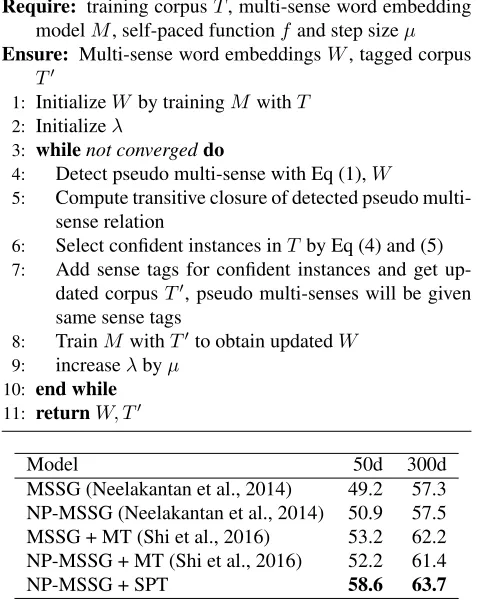
Our algorithm is summarized in Algorithm 1.
4.
Evaluation
We apply Non-parametric Multi-sense Skip Gram (Neelakantan et al., 2014) as the basic model to train multi-sense word embeddings on Wikipedia Corpus (Soriano-Morales et al., 2017).
Algorithm 1Enhanced pipeline for multi-sense word em-bedding
Require: training corpusT, multi-sense word embedding modelM, self-paced functionf and step sizeµ
Ensure: Multi-sense word embeddingsW, tagged corpus
T′
1: InitializeWby trainingM withT
2: Initializeλ
3: whilenot convergeddo
4: Detect pseudo multi-sense with Eq (1),W
5: Compute transitive closure of detected pseudo multi-sense relation
6: Select confident instances inT by Eq (4) and (5)
7: Add sense tags for confident instances and get up-dated corpusT′
, pseudo multi-senses will be given same sense tags
8: TrainM withT′
to obtain updatedW
9: increaseλbyµ
10: end while
11: returnW, T′
Model 50d 300d
MSSG (Neelakantan et al., 2014) 49.2 57.3 NP-MSSG (Neelakantan et al., 2014) 50.9 57.5 MSSG + MT (Shi et al., 2016) 53.2 62.2 NP-MSSG + MT (Shi et al., 2016) 52.2 61.4
[image:3.595.304.544.98.398.2]NP-MSSG + SPT 58.6 63.7
Table 1: Spearman rank correlation on SCWS dataset. For baselines, we evaluate the models of multi-sense skip-gram (MSSG) and non-parametric multi-sense skip-gram (NP-MSSG), as well as the combination of those with super-vised pseudo multi-sense detection and matrix transforma-tion (MT). NP-MSSG + SPT refers to our self-paced tag-ging model.
4.1.
Word Similarity
Stanford Contextual Word Similarity (SCWS) dataset (Huang et al., 2012) is a reliable and professional dataset to estimate the performance of word embeddings, especially multi-sense word embeddings. It contains 2,003 pairs of words together with the context.
In our experiments, we follow Neelakantan et al. (2014) to define the similarity of two instancesw1andw2by
localSim(w1, w2) =
cos(vw
1,Sense(C(w1)),vw2,Sense(C(w2)))
(6)
where
Sense(C(wi)) = argmax k
P(Sense(wi) =k|C(wi)) (7)
is the sense index chosen by C(wi) and Eq (3). Table 1
shows that our framework outperforms not only the basic model, but also the linear (matrix) transformation one pro-posed by Shi et al. (2016).
4.2.
Word Analogy
task, which contains 19,544 quadruples in total. Each quadruple contains four wordsA, B, C, D, where wordA
is similar to wordBin the same way as wordCis similar to
D, for instance, (Berlin, Germany, Paris, France). Among all, there are 5 classes of semantic quadruples and 9 classes of syntactic ones.
For the evaluation of multi-sense word embeddings, we follow the method proposed by Shi et al. (2016): for given multi-sense word embeddings, if there is a index quadruple(i, j, k, l) for word quadruple(A, B, C, D)s.t.
vA,i−vB,j+vD,l is most similar tovC,k, then we treat
(A, B, C, D)is a correct case for the model. In addition, considering the symmetric property of the quadruples, there are totally four linear combinations for each quadruple to be evaluated, and we treat the quadruple as a positive case if one of them is satisfied.
Model Semantic Syntactic
MSSG (50d) 75.8 85.2
NP-MSSG (50d) 74.6 80.7
MSSG + MT (50d) 77.5 88.0
NP-MSSG + MT (50d) 75.6 82.3 NP-MSSG + SPT (50d) 76.2 86.1
NP-MSSG (300d) 83.9 89.0
NP-MSSG + MT (300d) 85.9 90.2
[image:4.595.324.521.68.116.2]NP-MSSG + SPT (300d) 85.3 89.0
Table 2: Accuracy on word analogy task.
According to Table 2, we see our self-paced tagging frame-work ensures that the learned word embeddings keeps the semantic and syntactic relations well, although it per-forms not as well as the one with matrix transformation (Shi et al., 2016).
4.3.
Sentence Understanding
We evaluate the quality of word embeddings with the Sen-tEval system (Conneau et al., 2017; Kiela et al., 2017). In the evaluation, bag of words (BoW) is fed to the system as sentence features. We report the accuracies of two mod-els on three different tasks in Table 3. The tasks are para-phrase detection (MSRP; Dolan et al. (2004)), subjectivity detection (SUBJ; Pang and Lee (2004)), and question clas-sification (TREC; Voorhees and Buckland (2003)). On the tasks of MSRP and TREC, self-paced tagging with respect to elimination of pseudo multi-sense improves word em-beddings at a non-trivial level.
4.4.
Case Study
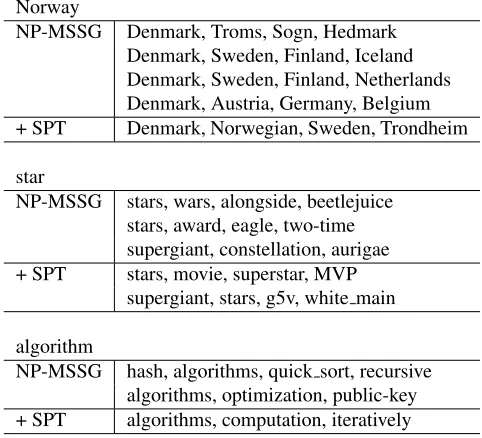
We show the k-nearest neighbors of some words in Table 4. We clearly see that the self-paced tagging model can not only eliminate the pseudo multi-senses (Norway, star, algorithm), but also keep the real multi-senses (star).
5.
Conclusion
In this work, we present a novel framework for corpus sense tagging with unsupervised elimination of pseudo multi-sense, utilizing any multi-sense word embedding model as the basic model. By applying the proposed self-paced tag-ging strategy, we could improve the quality of multi-sense
Model MSRP SUBJ TREC
NP-MSSG 70.03 90.96 78.4
NP-MSSG + MT 70.55 91.20 83.2 NP-MSSG + SPT 71.01 90.97 84.2
Table 3: Evaluation result on transfer learning tasks.
Norway
NP-MSSG Denmark, Troms, Sogn, Hedmark Denmark, Sweden, Finland, Iceland Denmark, Sweden, Finland, Netherlands Denmark, Austria, Germany, Belgium + SPT Denmark, Norwegian, Sweden, Trondheim
star
NP-MSSG stars, wars, alongside, beetlejuice stars, award, eagle, two-time supergiant, constellation, aurigae + SPT stars, movie, superstar, MVP
supergiant, stars, g5v, white main
algorithm
NP-MSSG hash, algorithms, quick sort, recursive algorithms, optimization, public-key + SPT algorithms, computation, iteratively
Table 4: Case study of k nearest neighbors. Each row refers to a learned “sense”.
word embeddings. Experiments have shown the efficiency of our framework.
6.
Acknowledgements
This work is supported by the National Natural Science Foundation of China (grant No.61472017, M1752015). The authors would like to thank Xian Wu for his help on experimental environment.
7.
Bibliographical References
Bengio, Y., Ducharme, R., Vincent, P., and Jauvin, C. (2003). A neural probabilistic language model. JMLR, 3(Feb).
Chen, X., Liu, Z., and Sun, M. (2014). A unified model for word sense representation and disambiguation. In EMNLP.
Cheng, J. and Kartsaklis, D. (2015). Syntax-aware multi-sense word embeddings for deep compositional models of meaning. InProc. EMNLP.
Collobert, R. and Weston, J. (2008). A unified architecture for natural language processing: Deep neural networks with multitask learning. InProc. ICML.
Conneau, A., Kiela, D., Schwenk, H., Barrault, L., and Bordes, A. (2017). Supervised learning of universal sentence representations from natural language inference data. InProc. EMNLP.
[image:4.595.303.544.162.381.2]Flekova, L. and Gurevych, I. (2016). Supersense embed-dings: A unified model for supersense interpretation, prediction, and utilization. InProc. ACL.
Huang, E. H., Socher, R., Manning, C. D., and Ng, A. Y. (2012). Improving word representations via global con-text and multiple word prototypes. InProc. ACL. Iacobacci, I., Pilehvar, M. T., and Navigli, R. (2015).
Sensembed: Learning sense embeddings for word and relational similarity. InProc. ACL.
Jiang, L., Meng, D., Mitamura, T., and Hauptmann, A. G. (2014). Easy samples first: Self-paced reranking for zero-example multimedia search. In Proceedings of the 22nd ACM international conference on Multimedia. ACM.
Jiang, L., Meng, D., Zhao, Q., Shan, S., and Hauptmann, A. G. (2015). Self-paced curriculum learning. InAAAI, volume 2.
Kiela, D., Conneau, A., Jabri, A., and Nickel, M. (2017). Learning visually grounded sentence representations. arXiv preprint arXiv:1707.06320.
Kumar, M. P., Packer, B., and Koller, D. (2010). Self-paced learning for latent variable models. InNIPS. Levy, O. and Goldberg, Y. (2014). Neural word embedding
as implicit matrix factorization. InNIPS.
Li, J. and Jurafsky, D. (2015). Do multi-sense embed-dings improve natural language understanding? InProc. EMNLP.
Liu, B., Dai, Y., Li, X., Lee, W. S., and Yu, P. S. (2003). Building text classifiers using positive and unlabeled ex-amples. InICDM.
Liu, Y., Liu, Z., Chua, T.-S., and Sun, M. (2015). Topical word embeddings. InAAAI.
Mikolov, T., Chen, K., Corrado, G., and Dean, J. (2013a). Efficient estimation of word representations in vector space.arXiv preprint arXiv:1301.3781.
Mikolov, T., Sutskever, I., Chen, K., Corrado, G. S., and Dean, J. (2013b). Distributed representations of words and phrases and their compositionality. InNIPS. Miller, G. A. (1995). WordNet: a lexical database for
En-glish.Communications of the ACM, 38(11):39–41. Mnih, A. and Hinton, G. E. (2009). A scalable hierarchical
distributed language model. InNIPS.
Neelakantan, A., Shankar, J., Passos, A., and McCallum, A. (2014). Efficient non-parametric estimation of multiple embeddings per word in vector space. InProc. EMNLP. Pang, B. and Lee, L. (2004). A sentimental educa-tion: Sentiment analysis using subjectivity summariza-tion based on minimum cuts. InProc. ACL.
Pelevina, M., Arefyev, N., Biemann, C., and Panchenko, A. (2017). Making sense of word embeddings. arXiv preprint arXiv:1708.03390.
Pennington, J., Socher, R., and Manning, C. (2014). Glove: Global vectors for word representation. InProc. EMNLP.
Pina, L. N. and Johansson, R. (2015). A simple and ef-ficient method to generate word sense representations. InProceedings of Recent Advances in Natural Language Processing.
Qiu, L., Tu, K., and Yu, Y. (2016). Context-dependent sense embedding. InProc. EMNLP.
Rapp, R. (2003). Word sense discovery based on sense de-scriptor dissimilarity. In Proceedings of the ninth ma-chine translation summit.
Sch¨utze, H. (1998). Automatic word sense discrimination. Computational linguistics, 24(1).
Shi, H., Li, C., and Hu, J. (2016). Real multi-sense or pseudo multi-sense: An approach to improve word rep-resentation. Proceedings of the Workshop on Computa-tional Linguistics for Linguistic Complexity.
Shi, H., Chen, J., and Hauptmann, A. G. (2017). Joint saliency estimation and matching using image regions for geo-localization of online video. In Proceedings of the 2017 ACM on International Conference on Multime-dia Retrieval.
Tang, K., Ramanathan, V., Fei-Fei, L., and Koller, D. (2012). Shifting weights: Adapting object detectors from image to video. InAdvances in Neural Information Processing Systems.
Voorhees, E. M. and Buckland, L. (2003). Overview of the trec 2003 question answering track. In TREC, volume 2003.