Dependency Structure Analysis and Sentence Boundary
Detection in Spontaneous Japanese
Kazuya Shitaoka† Kiyotaka Uchimoto‡ Tatsuya Kawahara† Hitoshi Isahara‡
†School of Informatics, Kyoto University Yoshida-honmachi, Sakyo-ku,
Kyoto 606-8501, Japan,
{shitaoka,kawahara}@ar.media.kyoto-u.ac.jp
‡National Institute of Information and Communications Technology 3-5 Hikari-dai, Seika-cho, Soraku-gun,
Kyoto 619-0289, Japan, {uchimoto,isahara}@nict.go.jp
Abstract
This paper describes a project to detect
dependen-cies between Japanese phrasal units calledbunsetsus,
and sentence boundaries in a spontaneous speech corpus. In monologues, the biggest problem with de-pendency structure analysis is that sentence
bound-aries are ambiguous. In this paper, we propose
two methods for improving the accuracy of sentence boundary detection in spontaneous Japanese speech: One is based on statistical machine translation us-ing dependency information and the other is based on text chunking using SVM. An F-measure of 84.9 was achieved for the accuracy of sentence bound-ary detection by using the proposed methods. The accuracy of dependency structure analysis was also improved from 75.2% to 77.2% by using automat-ically detected sentence boundaries. The accuracy of dependency structure analysis and that of sen-tence boundary detection were also improved by in-teractively using both automatically detected depen-dency structures and sentence boundaries.
1 Introduction
The “Spontaneous Speech: Corpus and Pro-cessing Technology” project has been sponsor-ing the construction of a large spontaneous Japanese speech corpus,Corpus of Spontaneous Japanese (CSJ) (Maekawa et al., 2000). The CSJ is the biggest spontaneous speech corpus in the world, and it is a collection of monologues and dialogues, the majority being monologues such as academic presentations. The CSJ in-cludes transcriptions of speeches as well as audio recordings. Approximately one tenth of the CSJ has been manually annotated with information about morphemes, sentence boundaries, depen-dency structures, discourse structures, and so on. The remaining nine tenths of the CSJ have been annotated semi-automatically. A fu-ture goal of the project is to extract sentence boundaries, dependency structures, and dis-course structures from the remaining transcrip-tions. This paper focuses on methods for au-tomatically detecting sentence boundaries and dependency structures in Japanese spoken text. In many cases, Japanese dependency struc-tures are defined in terms of the dependency
relationships between Japanese phrasal units called bunsetsus. To define dependency rela-tionships between all bunsetsus in spontaneous speech, we need to define not only the depen-dency structures in all sentences but also the inter-sentential relationships, or, discourse re-lationships, between the sentences, as depen-dency relationships between bunsetsus. How-ever, it is difficult to define and detect discourse relationships between sentences because of sig-nificant inconsistencies in human annotations of discourse structures, especially with regard to spontaneous speech. We also need to know intra-sentential dependency structures in order to use the results of dependency structure anal-ysis for sentence compaction in automatic text summarization or case frame acquisition. Be-cause it is difficult to define discourse relation-ships between sentences, depending on the ac-tual application, it is usually enough to define and detect the dependency structure of each sentence. Therefore, the CSJ was annotated with intra-sentential dependency structures for sentences in the same way this is usually done for a written text corpus. However, there is a big difference between a written text corpus and a spontaneous speech corpus: In sponta-neous speech, especially when it is long, sen-tence boundaries are often ambiguous. In the CSJ, therefore, sentence boundaries were de-fined based on clauses whose boundaries were automatically detected by using surface infor-mation (Maruyama et al., 2003), and they were detected manually (Takanashi et al., 2003). Our definition of sentence boundaries follows the definition used in the CSJ.
data. In contrast, we investigated dependency structures in spontaneous and long speeches in the CSJ. The biggest problem in dependency structure analysis with spontaneous and long speeches is that sentence boundaries are am-biguous. Therefore, sentence boundaries should be detected before or during dependency struc-ture analysis in order to obtain the dependency structure of each sentence.
In this paper, we first describe the problems with dependency structure analysis of sponta-neous speech. Because the biggest problem is ambiguous sentence boundaries, we focus on sentence boundary detection and propose two methods for improving the accuracy of detec-tion.
2 Dependency Structure Analysis
and Sentence Boundary Detection in Spontaneous Japanese
First, let us briefly describe how dependency structures can be represented in a Japanese sen-tence. In Japanese sentences, word order is rather free, and subjects and objects are often omitted. In languages having such characteris-tics, the syntactic structure of a sentence is gen-erally represented by the relationship between phrasal units, or bunsetsus, based on a depen-dency grammar. Phrasal units, or bunsetsus, are minimal linguistic units obtained by seg-menting a sentence naturally in terms of seman-tics and phoneseman-tics. Each bunsetsu consists of one or more morphemes. For example, the
sen-tence “ (kare-wa yukkuri
aruite-iru, He is walking slowly)” can be divided into threebunsetsus, “ (kare-wa, he)”, “
(yukkuri, slowly)” and “ ( aruite-iru, is walking)”. In this sentence, the first and second bunsetsus depend on the third one.
There are many differences between writ-ten text and spontaneous speech, and there are problems peculiar to spontaneous speech in dependency structure analysis and sentence boundary detection. The following sections de-scribe some typical problems and our solutions.
2.1 Problems with Dependency Structure Analysis
Ambiguous sentence boundaries
As described in Section 1, in this study, we assumed that ambiguous sentence bound-aries is the biggest problem in dependency structure analysis of spontaneous speech. So in this paper, we mainly focus on this problem and describe our solution to it.
Independent bunsetsus
In spontaneous speech, we sometimes find that modifiees are missing because utter-ance planning changes in the middle of the speech. Also, we sometimes findbunsetsus
whose dependency relationships are useless for understanding the utterance. These in-clude fillers such as “ (anoh, well)” and “ (sonoh, well)”, adverbs that behave like fillers such as “ (mou)”, responses such as “ (hai, yes)” and “
(un, yes)”, conjunctions such as “ (de, and)”, and disfluencies. In these cases, bunsetsus are assumed to be independent, and as a result, they have no modifiees in the CSJ. For example, 14,988 bunsetsus in 188 talks in the CSJ are independent. We cannot ignore fillers, responses, and disfluencies because they frequently ap-pear in spontaneous speech. However, we can easily detect them by using the method proposed by Asahara and Mat-sumoto (Asahara and MatMat-sumoto, 2003). In this paper, fillers, responses, and disflu-encies were eliminated before dependency structure analysis and sentence boundary detection by using morphological informa-tion and labels. In the CSJ, fillers and re-sponses are interjections, and almost all of them are marked with label (F). Disfluen-cies are marked with label (D).
In this paper, every independent bunsetsu was assumed to depend on the next one. However, practically speaking, indepen-dentbunsetsus should be correctly detected as “independent”. This detection is one of our future goals.
Crossed dependency
In general, dependencies in Japanese writ-ten text do not cross. In contrast, de-pendencies in spontaneous speech some-times do. For example, “ (kore-ga, this)” depends on “ (tadashii-to, is right)” and “ (watashi-wa, I)” depends on “ (omou, think)” in the sentence “
”, where “ ” denotes a bunsetsu boundary. Therefore, the two dependencies cross.
However, there are few number of crossed dependencies in the CSJ: In 188 talks, we found 689 such dependencies for total of 170,760 bunsetsus. In our experiments, therefore, we assumed that dependencies did not cross. Correctly detecting crossed dependencies is one of our future goals.
Self-correction
assigned to them, respectively. The defi-nitions of coordination and appositives fol-low those of the Kyoto University text cor-pus (Kurohashi and Nagao, 1997). Both the labels and the dependencies should be detected for applications such as au-tomatic text summarization. However, in this study, we detected only the dependen-cies betweenbunsetsus, and we did it in the same manner as in previous studies using written text.
Inversion
Inversion occurs more frequently in spon-taneous speech than in written text. For example, in the 188 talks in the CSJ there were 172 inversions. In the CSJ, inver-sions are represented as dependency rela-tionships going in the direction from right to left. In this study, we thought it impor-tant to detect dependencies, and we man-ually changed their direction to that from left to right. The direction of dependency has been changed to that from left to right.
2.2 Problems with Sentence Boundary Detection
In spontaneous Japanese speech, sentence boundaries are ambiguous. In the CSJ, there-fore, sentence boundaries were defined based on clauses whose boundaries were automatically detected using surface information (Maruyama et al., 2003), and they were detected manually (Takanashi et al., 2003). Clause boundaries can be classified into the following three groups.
Absolute boundaries , or sentence aries in their usual meaning. Such bound-aries are often indicated by verbs in their basic form.
Strong boundaries , or points that can be re-garded as major breaks in utterances and that can be used for segmentation. Such boundaries are often indicated by clauses whose rightmost words are “ (ga, but)”, or “ (shi, and)”.
Weak boundaries , or points that can be used for segmentation because they strongly depend on other clauses. Such boundaries are often indicated by clauses whose rightmost words are “ (node, be-cause)”, or “ (tara, if)”.
These three types of boundary differ in the degree of their syntactic and semantic com-pleteness and the dependence of their sub-sequent clauses. Absolute boundaries and strong boundaries are usually defined as sen-tence boundaries. However, sentence bound-aries in the CSJ are different from these two types of clause boundaries, and the accuracy
of rule-based automatic sentence boundary de-tection in the 188 talks in the CSJ has an F-measure of approximately 81, which is the ac-curacy for a closed test. Therefore, we need a more accurate sentence boundary detection sys-tem.
Shitaoka et al. (Shitaoka et al., 2002) pro-posed a method for detecting sentence bound-aries in spontaneous Japanese speech. Their definition of sentence boundaries is approxi-mately the same as that of absolute bound-aries described above. In this method, sen-tence boundary candidates are extracted by character-based pattern matching using pause duration. However, it is difficult to extract appropriate candidates by this method be-cause there is a low correlation between pauses and the strong and weak boundaries described above. It is also hard to detect noun-final clauses by character-based pattern matching.
One method based on machine learning, a method based on maximum entropy models, has been proposed by Reynar and Ratnaparkhi (Reynar and Ratnaparkhi, 2000). However, the target in their study was written text. This method cannot readily used for spontaneous speech because in speech, there are no punc-tuation marks such as periods. Other features of utterances should be used to detect sentence boundaries in spontaneous speech.
3 Approach of Dependency
Structure Analysis and Sentence Boundary Detection
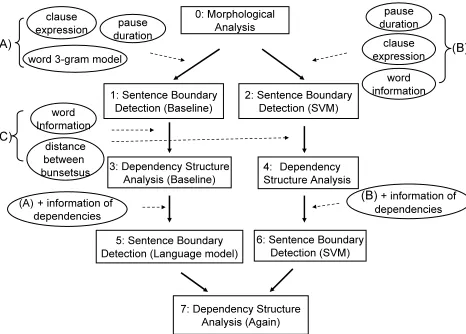
The outline of the processes is shown in Fig-ure 1.
0: Morphological Analysis
1: Sentence Boundary Detection (Baseline)
3: Dependency Structure Analysis (Baseline)
2: Sentence Boundary Detection (SVM)
5: Sentence Boundary
Detection (Language model) 6: Sentence BoundaryDetection (SVM)
7: Dependency Structure Analysis (Again) clause
expression durationpause word 3-gram model
pause duration
clause expression
word information
(A) (B)
word Information
distance between bunsetsus
(C)
(A) + information of dependencies
(B) + information of dependencies 4: Dependency
Structure Analysis
Figure 1: Outline of dependency structure anal-ysis and sentence boundary detection.
3.1 Dependency Structure Analysis
is represented by a probability estimated by a dependency probability model.
Given sentence S, let us assume that it is uniquely divided into n bunsetsus, b1, . . . , bn,
and that it is represented as an ordered set of bunsetsus, B = {b1, . . . , bn}. Let D be an
or-dered set of dependencies in the sentence and let
Di be a dependency whose modifier isbunsetsu bi(i = 1, . . . , n−1). Let us also assume that D = {D1, . . . , Dn−1}. Statistical dependency
structure analysis finds dependencies that max-imize probabilityP(D|S) given sentence S.
The conventional statistical model (Collins, 1996; Fujio and Matsumoto, 1998; Haruno et al., 1998; Uchimoto et al., 1999) uses only the relationship between two bunsetsus to es-timate the probability of dependency, whereas the model in this study (Uchimoto et al., 2000) takes into account not only the relationship be-tween two bunsetsus but also the relationship between the left bunsetsuand all thebunsetsus to its right. This model uses more information than the conventional model.
We implemented this model within a max-imum entropy modeling framework. The fea-tures used in the model were basically attributes of bunsetsus, such as character strings, parts of speech, and types of inflections, as well as those that describe the relationships between bunsetsus, such as the distance between bun-setsus. Combinations of these features were also used. To find Dbest, we analyzed the sentences backwards (from right to left). In the backward analysis, we can limit the search space effec-tively by using a beam search. Sentences can also be analyzed deterministically without great loss of accuracy (Uchimoto et al., 1999). So we analyzed a sentence backwards and determinis-tically.
3.2 Sentence Boundary Detection Based on Statistical Machine Translation (Conventional method (Shitaoka et al., 2002))
The framework for statistical machine trans-lation is formulated as follows. Given in-put sequence X, the goal of statistical ma-chine translation is to find the best output se-quence, Y, that maximizes conditional proba-bility P(Y|X):
max
Y P(Y|X) = maxY P(Y)P(X|Y) (1)
The problem of sentence boundary detection can be reduced to the problem of translat-ing a sequence of words, X, that does not in-clude periods but instead inin-cludes pauses into a sequence of words, Y, that includes peri-ods. Specifically, in places where a pause might be converted into a period, which means
P(X|Y) = 1, the decision whether a period
should be inserted or not is made by comparing language model scoresP(Y) andP(Y). Here, the difference betweenY and Y is in that one includes a period in a particular place and the other one does not.
We used a model that uses pause duration and surface expressions around pauses as trans-lation model P(X|Y). We used expressions around absolute and strong boundaries as de-scribed in Section 2.2 as surface expressions around pauses. A pause preceding or follow-ing surface expressions can be converted into a period. Specifically, pauses following expres-sions “ (to)”, “ (nai)”, and “ (ta)”, and pauses preceding expression “ (de)”, can be converted into a period when these pauses are longer than average. A pause preceding or fol-lowing other surface expressions can be con-verted into a period even if its duration is short. To calculate P(Y), we used a word 3-gram model trained with transcriptions in the CSJ.
3.3 Sentence Boundary Detection Using Dependency Information (Method 1)
There are three assumptions that should be sat-isfied by the rightmost bunsetsu in every sen-tence. In the following, thisbunsetsuis referred to as the targetbunsetsu.
(1) One or morebunsetsus depend on the targetbunsetsu. (Figure 2)
Since everybunsetsudepends on another bun-setsuin the same sentence, the second rightmost bunsetsualways depends on the rightmost bun-setsu in any sentence, except in inverted sen-tences. In inverted sentences in this study, we changed the direction of all dependencies to that from left to right.
One or more Bunsetsus depend
Figure 2: One or more bunsetsus depend on the target bunsetsu. (“|” represents a sentence boundary.)
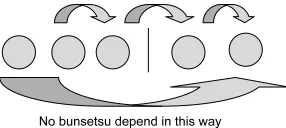
(2) There is no bunsetsu that depends on a bunsetsu beyond the target bunsetsu. (Figure 3)
Eachbunsetsuin a sentence depends on a bun-setsuin the same sentence.
(3) The probability of the target bun-setsu is low. (Figure 4)
No bunsetsu depend in this way
Figure 3: There is nobunsetsuthat depends on a bunsetsubeyond the targetbunsetsu.
This probability should be low
Figure 4: Probability of the target bunsetsu is low.
Bunsetsus that satisfy assumptions (1)-(3) are extracted as rightmost bunsetsucandidates in a sentence. Then, for every point follow-ing the extracted bunsetsus and for every pause preceding or following the expressions described in Section 3.2, a decision is made regarding whether a period should be inserted or not. In assumption (2), bunsetsus that depend on a bunsetsu beyond 50 bunsetsus are ignored be-cause no such long-distance dependencies were found in the 188 talks in the CSJ used in our ex-periments. Bunsetsus whose dependency prob-ability is very low are also ignored because there is a high possibility that thesebunsetsus’ depen-dencies are incorrect. Let this threshold proba-bility bep, and let the threshold probability in assumption (3) beq. The optimal parametersp and q are determined by using held-out data.
In this approach, about one third of all bunsetsu boundaries are extracted as sentence boundary candidates. So, an output sequence is selected from all possible conversion patterns generated using two words to the left and two words to the right of each sentence boundary candidate. To perform this operation, we used a beam search with a width of 10 because a number of conversion patterns can be generated with such a search.
3.4 Sentence Boundary Detection Based on Machine Learning (Method 2)
We use Support Vector Machine (SVM) as a machine learning model and we approached the problem of sentence boundary detection as a text chunking task. We used YamCha (Kudo and Matsumoto, 2001) as a text chunker, which is based on SVM and uses polynomial kernel functions. To determine the appropriate chunk label for a target word, YamCha uses two words to the right and two words to the left of the
target word as statistical features, and it uses chunk labels that are dynamically assigned to the two preceding or the two following words as dynamic features, depending on the analysis direction. To solve the multi-class problem, we used pairwise classification. This method gen-erates N ∗(N −1)/2 classifiers for all pairs of classes, N, and makes a final decision by their weighted voting.
The features used in our experiments are the following:
1. Morphological information of the three words to the right and three words to the left of the target word, such as character strings, pronun-ciation, part of speech, type of inflection, and inflection form
2. Pause duration normalized in terms of Maha-lanobis distance
3. Clause boundaries
4. Dependency probability of the targetbunsetsu
5. The number of bunsetsus that depend on the
target bunsetsu and their dependency
proba-bilities
We used the IOE labeling scheme for proper chunking, and the following parameters for YamCha.
• Degree of polynomial kernel: 3rd
• Analysis direction: Left to right
• Multi-class method: Pairwise
4 Experiments and Discussion
In our experiments, we used the transcriptions of 188 talks in the CSJ. We used 10 talks for testing. Dependency structure analysis results were evaluated for closed- and open-test data in terms of accuracy, which was defined as the per-centage of correct dependencies out of all depen-dencies. In Tables 1 to 3, we use words “closed” and “open” to describe the results obtained for closed- and open-test data, respectively. Sen-tence boundary detection results were evaluated in terms of F-measure.
The dependency probability of the rightmost bunsetsus in a given sentence was not calculated in our model. So, we assumed that the right-most bunsetsus depended on the next bunsetsu and that the dependency probability was 0.5 when we used dependency information in the experiments described in the following sections.
4.1 Sentence Boundary Detection Results Obtained by Method 1
We evaluated the results obtained by the method described in Section 3.3. The results of baseline dependency structure analysis were used as dependency information (Process 5 in Figure 1).
First, we investigated the optimal values of parameters p and q described in Section 3.3 by using held-out data, which differed from the test data and consisted of 15 talks. The optimal val-ues of p and q were, respectively, 0 and 0.9 for the open-test data, and 0 and 0.8 for the closed-test data. These values were used in the follow-ing experiments. The value ofpwas 0, and these results show thatbunsetsus that depended on a bunsetsu beyond 50 bunsetsus were ignored as described in assumption (2) in Section 3.3.
The obtained results are shown in Table 1. When dependency information was used, the F-measure increased by approximately 1.4 for the open-test data and by 2.0 for the closed test data, respectively. Although the accuracy of de-pendency structure analysis for closed test data was about 5.5% higher than that for the open-test data, the difference between the accuracies of sentence boundary detection for the closed-and open-test data was only about 0.6%. These results indicate that equivalent accuracies can be obtained for both open- and closed-test data in detecting dependencies related to sentence boundaries.
When all the extracted candidates were con-sidered as sentence boundaries without us-ing language models, the accuracy of sentence boundary detection obtained by using the base-line method was 68.2%(769/1,127) in recall and 81.5%(769/943) in precision, and that obtained by using Method 1 was 87.2%(983/1,127) in call and 27.7%(983/3,544) in precision. The re-sults show that additional 214 sentence bound-ary candidates were correctly extracted by us-ing dependency information. However, only 108 sentence boundaries were chosen out of the 214 candidates when language models were used. We investigated in detail the points that were not chosen and found errors in noun-final clauses, clauses where the rightmost con-stituents were adjectives or verbs such as “
(it to-omou, think)” or “ (it wa-muzukashii, difficult)”, and clauses where the rightmost constituents were “ (it
to-Table 1: Sentence boundary detection results obtained by using dependency information.
recall precision F
With dependency 74.1% 82.5% 78.0
information (open) (835/1,127) (835/1,012)
With dependency 74.2% 83.5% 78.6
information (closed) (836/1,127) (836/1,001)
baseline 64.5% 94.2% 76.6
(727/1,127) (727/772)
iu-no-wa, because)” and “ (it to-si-te-wa, as)”, and so on. Some errors, except for those in noun-final clauses, could have been cor-rectly detected if we had had more training data.
We also found that periods were sometimes erroneously inserted when preceding expres-sions were “ (ga, but)”, “ (mashite, and)”, and “ (keredomo, but)”, which are typically the rightmost constituents of a sen-tence, as weel as “ (te, and)”, which is not, typically, the rightmost constituent of a sen-tence. The language models were not good at discriminating between subtle differences.
4.2 Sentence Boundary Detection Results Obtained by Method 2
We evaluated the results obtained by the method described in Section 3.4 (Process 6 in Figure 1). For training, we used 178 talks ex-cluding test data.
Table 2: Sentence boundary detection results obtained by using SVM.
recall precision F
With dependency 80.0% 90.3% 84.9
information (open) (902/1,127) (902/999)
With dependency 79.7% 90.5% 84.9
information (closed) (900/1,127) (900/994)
Without 79.3% 90.1% 84.4
dependency information (894/1,127) (894/992)
Table 3: Dependency structure analysis results obtained with automatically detected sentence boundaries.
open closed
With results in Section 4.1 75.8% 81.2% With results in Section 4.2 77.2% 82.5%
Baseline 75.2% 80.7%
4.3 Dependency Structure Analysis Results
We evaluated the results of dependency struc-ture analysis obtained when sentence bound-aries detected automatically by the two meth-ods described above were used as inputs (Pro-cess 7 in Figure 1). The results are shown in Table 3. The accuracy of dependency structure analysis improved by about 2% when the most accurate and automatically detected sentence boundaries were used as inputs. This is be-cause more sentence boundaries were detected correctly, and the number ofbunsetsus that de-pended on those in other sentences decreased.
We investigated the accuracy of dependency structure analysis when 100% accurate sentence boundaries were used as inputs. The accuracy was 80.1% for the open-test data, and 86.1% for the closed-test data. Even when the sen-tence boundary detection was perfect, the er-ror rate was approximately 14% even for the closed-test data. The accuracy of dependency structure analysis for spoken text was about 8% lower than that for written text (newspapers). We speculate that this is because spoken text has no punctuation marks and manybunsetsus depend on others far from them because of in-sertion structures. These problems need to be addressed in future studies.
5 Conclusion
This paper described a project to detect depen-dencies between bunsetsus and sentence bound-aries in a spontaneous speech corpus. It is more difficult to detect dependency structures in spontaneous spoken speech than in written text. The biggest problem is that sentence boundaries are ambiguous. We proposed two methods for improving the accuracy of sentence boundary detection in spontaneous Japanese speech. Using these methods, we obtained an F-measure of 84.9 for the accuracy of sentence
boundary detection. The accuracy of depen-dency structure analysis was also improved from 75.2% to 77.2% by using automatically detected sentence boundaries. The accuracy of depen-dency structure analysis and that of sentence boundary detection were improved by interac-tively using automatically detected dependency information and sentence boundaries.
There are several future directions. In the fu-ture, we would like to solve the problems that we found in our experiments. In particular, we want to reduce the number of errors due to in-serted structures and solve other problems de-scribed in Section 2.1.
References
Masayuki Asahara and Yuji Matsumoto. 2003. Filler and Disfluency Identification Based on Morphological Analysis and Chunking. InProceedings of the ISCA & IEEE Work-shop on Spontaneous Speech Processing and Recognition, pages 163–166.
Michael Collins. 1996. A New Statistical Parser Based on Bigram Lexical Dependencies. InProceedings of the ACL, pages 184–191.
Masakazu Fujio and Yuji Matsumoto. 1998. Japanese Depen-dency Structure Analysis based on Lexicalized Statistics. InProceedings of the EMNLP, pages 87–96.
Masahiko Haruno, Satoshi Shirai, and Yoshifumi Ooyama. 1998. Using Decision Trees to Construct a Practical Parser. InProceedings of the COLING-ACL, pages 505– 511.
Taku Kudo and Yuji Matsumoto. 2000. Japanese Depen-dency Structure Analysis Based on Support Vector Ma-chines. InProceedings of the EMLNP, pages 18–25. Taku Kudo and Yuji Matsumoto. 2001. Chunking with
sup-port vector machines. InProceedings of the NAACL. Sadao Kurohashi and Makoto Nagao. 1997. Building a
Japanese Parsed Corpus while Improving the Parsing Sys-tem. InProceedings of the NLPRS, pages 451–456. Kikuo Maekawa, Hanae Koiso, Sadaoki Furui, and Hitoshi
Isahara. 2000. Spontaneous Speech Corpus of Japanese. InProceedings of the LREC2000, pages 947–952. Takehiko Maruyama, Hideki Kashioka, Tadashi Kumano, and
Hideki tanaka. 2003. Rules for Automatic Clause Bound-ary Detection and Their Evaluation. In Proceedings of the Nineth Annual Meeting of the Association for Natural Language proceeding, pages 517–520. (in Japanese). Shigeki Matsubara, Takahisa Murase, Nobuo Kawaguchi, and
Yasuyoshi Inagaki. 2002. Stochastic Dependency Parsing of Spontaneous Japanese Spoken Language. InProceedings of the COLING2002, pages 640–645.
Jeffrey C. Reynar and Adwait Ratnaparkhi. 2000. A Max-imum Entropy Approach to Identifying Sentence Bound-aries. InProceedings of the ANLP, pages 16–19.
Kazuya Shitaoka, Tatsuya Kawahara, and Hiroshi G. Okuno. 2002. Automatic Transformation of Lecture Transcrip-tion into Document Style using Statistical Framework. In
IPSJ–WGSLP SLP-41-3, pages 17–24. (in Japanese). Katsuya Takanashi, Takehiko Maruyama, Kiyotaka
Uchi-moto, and Hitoshi Isahara. 2003. Identification of “Sen-tences” in Spontaneous Japanese — Detection and Mod-ification of Clause Boundaries —. In Proceedings of the ISCA & IEEE Workshop on Spontaneous Speech Process-ing and Recognition, pages 183–186.
Kiyotaka Uchimoto, Satoshi Sekine, and Hitoshi Isahara. 1999. Japanese Dependency Structure Analysis Based on Maximum Entropy Models. InProceedings of the EACL, pages 196–203.