LTAG Semantics with Semantic Unification
Laura Kallmeyer
TALaNa-Lattice
UFRL, University Paris 7
2 place Jussieu, Case 7003,
75251 Paris Cedex 05
France
[email protected]
Maribel Romero
Department of Linguistics
610, Williams Hall
University of Pennsylvania
Philadelphia, PA, 19104-6305
U.S.A.
[email protected]
Abstract
This paper sets up a framework for LTAG (Lex-icalized Tree Adjoining Grammar) semantics that brings together ideas from different recent approaches addressing some shortcomings of TAG semantics based on the derivation tree. Within this framework, several sample analyses are proposed, and it is shown that the frame-work allows to analyze data that have been claimed to be problematic for derivation tree based LTAG semantics approaches.
1
Introduction
An LTAG (Joshi and Schabes, 1997) consists of a fi-nite set of elementary trees associated with lexical items. From these trees, larger trees are derived by substitution (replacing a leaf with a new tree, a so-called initial tree) and adjunction (replacing an internal node with a new tree, a so-called auxiliary tree).
The elementary trees of an LTAG represent extended projections of lexical items and encapsulate all syntac-tic/semantic arguments of the lexical anchor. They are minimal in the sense that only the arguments of the an-chor are encapsulated, all recursion is factored away. These linguistic properties of elementary trees are for-mulated in the Condition on Elementary Tree Minimality
(CETM) from (Frank, 1992).
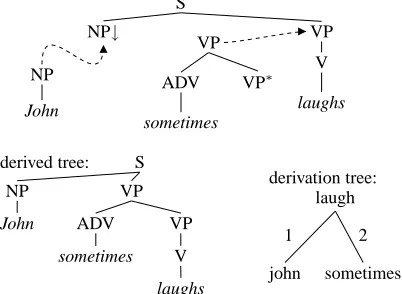
LTAG derivations are represented by derivation trees that record the history of how the elementary trees are put together. A derived tree is the result of carrying out the substitutions and adjunctions. Each edge in the derivation tree stands for an adjunction or a substitution. The edges are equipped with Gorn addresses of the nodes where the substitutions/adjunctions take place.1 See for example
1
The root has the address 0, the jth child of the root has addressjand for all other nodes: thejth child of the node with addressphas addressp·j.
NP
John
S
NP↓ VP
VP
V
ADV VP∗
laughs sometimes
derived tree: S
NP VP
John ADV VP
sometimes V
laughs
derivation tree: laugh
1 2
john sometimes
Figure 1: TAG derivation for (1)
the derivation of (1) in Fig. 1.
(1) John sometimes laughs
Taking into account the minimality of elementary trees and the fact that derivation steps in TAG correspond to predicate-argument applications, it seems appropriate to base LTAG semantics on the derivation tree (Candito and Kahane, 1998; Joshi and Vijay-Shanker, 1999; Kallmeyer and Joshi, 2003). However, it has been observed that in some cases this is problematic since the derivation tree does not provide enough information to correctly con-struct the desired semantic dependencies.
The goal of this paper is to bring together ideas from several recent approaches in order to develop a general framework for LTAG semantics that allows us to compute semantic representations on the derivation tree, overcom-ing some otherwise problematic cases. Within this frame-work we then sketch several sample analyses.
2
Previous approaches to LTAG semantics
Derivation tree for (2):
like
wh s
who say
s think
Desired semantics (simplified):
who(x,think(p,say(j,like(b, x))))
Derivation tree for (3):
love
s vp
claim seem
Desired semantics (simplified):
claim(p,(seem(love(m, j))))
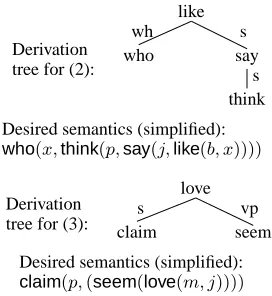
Figure 2: Problematic derivation trees for semantics
al., 1995; Dras et al., 2004; Frank and van Genabith, 2001; Gardent and Kallmeyer, 2003)) are long-distance wh-movements as in (2) and interactions of attitude verbs and raising verbs or adverbs as in (3).
(2) Who does Paul think John said Bill liked?
(3) a. Mary, Paul claims John seems to love b. Paul claims Mary apparently loves John
The problem of (2) is that in the LTAG analysis, who is substituted into the wh-NP node of like, say is adjoined to the lower S node of like and think adjoins to say. Conse-quently, in the derivation tree (see Fig. 2), there is neither a link between who and think nor a link between like and
think.2 But in the semantics, we want the think propo-sition to be the scopal argument of the wh-operator, i.e., a link between who and think must be established. This can be done via the semantics of like but at least some possibility to link like to think is necessary. In (3), claim and seem (or apparently resp.) adjoin to different nodes in the love tree, i.e., they are not linked in the derivation tree. But the propositional argument of claim is the seems (apparently resp.) proposition. This case however is less hard than (2) since one can choose the semantics of like in such a way that the desired scope orders are obtained without a direct link between the embedding attitude verb and the embedded raising verb (adverb resp.). A seman-tics in the (Kallmeyer and Joshi, 2003) framework is pos-sible here. Example (2) however poses a serious problem for derivation tree based approaches.
Several proposals have been made to avoid the prob-lems that arise when doing semantics based on the deriva-tion tree:
Instead of using the derivation tree for semantics, one could try to compute semantics based on the derived tree.
2
For the sake of readability, we use names np, vp, r for root, f for foot, ... for the node positions instead of the usual Gorn adresses.
Such an approach is pursued in (Frank and van Genabith, 2001). However, their approach makes use not only of the information available in the derived tree but also of information about how the elementary trees were put to-gether, i.e., of information available in the derivation tree. Therefore, in a sense, their semantics is based on both, derived and derivation tree. Considering that one of the guiding linguistic principles of LTAG is semantic mini-mality of elementary tree, i.e. that the semantics of ele-mentary trees is non-decomposable, it is more appropri-ate to link semantic representations to whole elementary trees and to abstract away (at least to a certain degree) from the concrete shape of the elementary trees. This amounts to linking semantic representations to nodes in the derivation tree.
An alternative proposal for computing semantics only on the derivation tree is to enrich the derivation tree with additional links as in (Kallmeyer, 2002a; Kallmeyer, 2002b). In this approach, the derived tree needs not be considered for computing semantics. The problem with this proposal is that sometimes it is not clear which link one has to follow in order to find the value for some se-mantic variable. Therefore additional rules for ordering the links for semantic computation are needed. The re-sult is a rather complex machinery in order to obtain the dependencies needed for semantics.
More recently, (Gardent and Kallmeyer, 2003) propose to use the feature unification mechanism in the syntax, i.e., in the derived tree, in order to determine the val-ues of semantic arguments. The underlying observation is that whenever a semantic link in the derivation tree is missing, it is either a) a link between trees attaching to different nodes in the same tree (see(3)), i.e., attaching to nodes that can share features inside an elementary tree, or b) a link between treesγ1andγ2such thatγ2adjoins
to the root of a tree that (adjoins to the root of a tree that ...) attaches to some nodeµinγ1(see (2)). In this case,
indirectly, the top ofµand the top of the root ofγ2unify
semantic features.3
In order to separate more neatly between syntax with feature structures linked to nodes in the derived tree and semantics where semantic representations are linked to nodes in the derivation tree, we propose in the following to incorporate semantic feature structures in the deriva-tion tree. Formally, this means just extracting the seman-tic features used in (Gardent and Kallmeyer, 2003) from the derived trees and putting them in a semantic feature structure linked to the semantic representation of the tree in question. Of course one still has to link semantic fea-tures to specific node positions in the elementary tree, e.g., in order to make sure that syntactic argument po-sitions get correctly linked to the corresponding semantic arguments.
3
LTAG semantics with semantic
unification
3.1 Semantic feature structures
Semantic representations are as defined in (Kallmeyer and Joshi, 2003) except that they do not have argument variables: they consist of a set of formulas (typed λ-expressions with labels) and a set of scope constraints. A scope constraint is an expressionx≥ywherexandyare propositional labels or propositional variables (these last correspond to the holes in (Kallmeyer and Joshi, 2003)). Each semantic representation is linked to a semantic ture structure. Semantic feature structures are typed fea-ture strucfea-tures, the type of the whole feafea-ture strucfea-ture is sem. The definition of the feature structures is as follows:
• a feature structure of typesemconsists of features 0 (the root position), 1, 2, ..., 11, 12, ... for all node positions that can occur in elementary trees (finite for each TAG), the values of these features are of typetb (for ‘top-bottom’)
• a feature structure of type tb consists of a T and a
Bfeature (top and bottom) whose values are feature structures of typebindings
• a feature structure of typebindingsconsists of a fea-tureIwhose values are individual variables, a feature
Pwhose values are propositional labels, etc.
3.2 Semantic unification
Semantic composition consists only of feature unifica-tion. It corresponds to the feature unifications in the syn-tax that are performed during substitutions and
adjunc-3
A similar approach is (Stone and Doran, 1997) where, as in (Gardent and Kallmeyer, 2003), each elementary tree has a flat semantic representation, the semantic representations are con-joined when combining them and variable assignments are done by unification in the feature structures on the derived tree. But there is no underspecification, and the approach is less explicit than (Gardent and Kallmeyer, 2003).
l1:laugh(1)
NP h
T I 1 i
VP "
T P 2
B P l1
#
np vp
john(x) l2:sometimes(3), 3 ≥ 4
R
h
T I xi
R
h
B P l2 i
F h
T P 4i
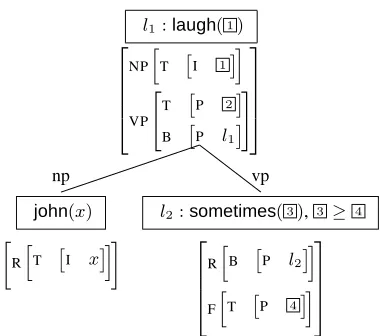
Figure 3: Semantic representations for (1) John
some-times laughs
tions and the final top-bottom unifications in the derived tree. In the derivation tree, elementary trees are replaced by their semantic representations plus the corresponding semantic feature structures. Then, for each edge in the derivation tree fromγ1toγ2with positionp:
• The top feature of positionpinγ1and the top feature
of the root position inγ2, i.e., the feature structures
γ1.p.Tandγ2.0.Tare identified,
• and ifγ2is an auxiliary tree, then the bottom feature
of the foot node ofγ2and the bottom feature of
posi-tionpinγ1, i.e., (iffis the position of the foot node in
γ2) the feature structuresγ1.p.Bandγ2.f.Bare
iden-tified.
Furthermore, for allγin the derivation tree and for all positionspinγsuch that there is no edge fromγto some other tree with positionp: theTandBfeatures ofγ.pare identified.
By these unifications, some of the variables in the se-mantic representations get values. In the end, after having performed these unifications, the union of all semantic representations is built. The result is an underspecified representation.4
3.3 A sample derivation
As an example consider the analysis of (1): Fig. 3 shows the semantic representations and the semantic fea-ture strucfea-tures of the three elementary trees involved in the derivation.
4For combining feature structure, we adopt an operational
NP h
T 10I 1 i
VP "
T 11P 2
B 12P l1 #
np vp
R "
T 10I x
B 10
#
R
" T 11
B 11P l2 #
F "
T 12P 4
B 12 #
Figure 4: Semantic unification for (1)
The different unifications lead to the feature value identities in Fig. 4. This gives the identities 1 = x, 2 = l2, and 4 = l1, which results in the following
se-mantic representation:
(4) l1:laugh(x),john(x), l2:sometimes(3), 3 ≥l1
In the end, appropriate disambiguations must be found. These are assignments for the remaining variables, i.e., functions that assign propositional labels to propositional variables, respecting the scope constraints (Kallmeyer and Joshi, 2003). The disambiguated representation is then interpreted conjunctively. (4) has only one disam-biguation, namely 3 → l1. This leads to john(x)∧
sometimes(laugh(x)).
4
Alternative ways of obtaining scope
constraints
Instead of stating explicit scope constraints of the form x≥y, one could imagine two other possibilities: either i) not using any scope constraints at all and obtaining scope by identifying propositional variables and propositional labels by unification during the derivation, or ii) obtaining scope constraints from the final top-bottom unification in-stead of stating them explicitely, i.e., not doing real top-bottom unification but adding instead a constraint top≥
bottom whenever a node has not been used for attaching other elementary trees. These alternatives are illustrated in Fig. 5 and 6.
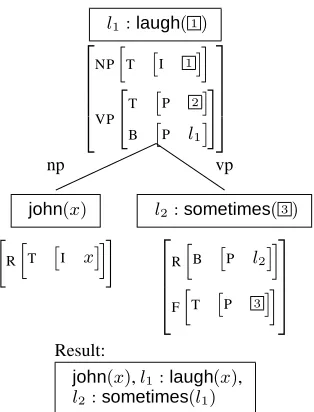
Possibility i) has the obvious problem that is does not allow for underspecified representations, which means that in cases of scope ambiguities the number of repre-sentations one would have to generate would explode. Possibility ii) looks more interesting. In Fig. 5 for ex-ample, theBfeature of position 2 in laugh is unified with the (empty)Bfeature of position 2 in sometimes so that in the result, there is a node withT [P 3] andB [Pl1].
From this node, the desired scope constraint 3 ≥l1can
l1:laugh(1)
NP h
T I 1 i
VP "
T P 2
B P l1
#
np vp
john(x) l2:sometimes(3)
R
h
T I xi R
h
B P l2 i
F h
T P 3i
Result:
john(x),l1:laugh(x), l2:sometimes(l1)
Figure 5: Alternative i): Analysis of (1) without scope constraints
be obtained. One problem with ii) is that in some cases one might need the original final top-bottom unification, so one would have to distinguish between cases where a scope constraint has to be added (these are perhaps the cases ofPfeatures) and cases where usual unification is done. But even more problematic is that in some cases, it is not possible to obtain all scope constraints one needs by the final top-bottom mechanism. Examples are cases where two quantifier scope parts attach to the same node as in (5).
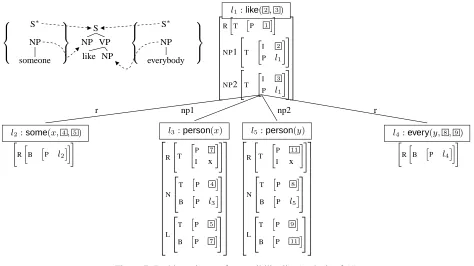
(5) someone likes everybody
Following (Kallmeyer and Joshi, 2003), we suppose that the contribution of a quantifier consists of an NP initial tree (the predicate argument part) and a separate auxiliary tree with just one S node (the scope part). The analysis of (5) with possibility ii) is sketched in Fig. 7. The scope constraints one wants to obtain are 1) those that place the proposition coming with the noun in the restriction of the quantifiers, i.e., 4 ≥l3and 8 ≥l5, 2) those that place
the like proposition in the nuclear scope of the quantifiers, i.e., 5 ≥l1and 9 ≥l1, and 3) those that limit the scope
of the quantifier inside the sentence the quantifier attaches to, i.e.,1 ≥l2and 1 ≥l4.5For 1) and 2), corresponding
top and bottom feature have to be put on some node, in Fig. 7 they are on positionsNandL (for the lexical an-chor) of the NP tree. However, this is very arbitrary, they are not really related to these nodes. Therefore, it is much more appropriate to state the constraints in a general way
5
Figure 7: Problematic case for possibility ii): Analysis of (5)
l1:laugh(1)
Figure 6: Alternative ii): scope constraints from top-bottom unification
and to link them only to the semantic representation with-out linking them to any node. The constraints 3) have to come from the scope tree, i.e., they have to be linked to its root since this is the only node in these trees. But this is not possible since in the course of the derivation, the bottom parts of all scope parts attaching to the same node unify because of the unifications done during adjunction. In Fig. 6 for example this means that [Pl2] and [Pl4] are
unified, which leads to a failure.
Because of these considerations we decided not to choose possibilities i) or ii) but to state scope constraints
explicitely in the semantic representations and use se-mantic unification with final top-bottom unification as de-scribed above.
5
Comparison to Gardent & Kallmeyer
Among the approaches to LTAG semantics mentioned in the beginning of this section, (Gardent and Kallmeyer, 2003) is the closest to our framework.
Obviously, everything one can do in the approach pro-posed in (Gardent and Kallmeyer, 2003) can be directly transformed into the approach presented here. An advan-tage of our approach is that semantic feature structures are linked to whole elementary trees and therefore they offer the possibility to define global features for eleme-nary trees. So far we have not exploited this in this pa-per but it obviously might be useful, for example for the
MAXSandMINPfeatures in section 6.
link them to whole semantic representations (i.e., to link them to whole elementary trees). This is what the ap-proach described above does: instead of increasing the formal power of the syntactic formalism, the extra power needed for semantics is added to the semantic represen-tations, i.e., to nodes in the derivation tree.
A further important difference is that we do not use ex-plicit holesh1, h2, . . .besides propositional variables.
In-stead, the propositional variables that remain after having performed all unifications are understood as being holes in the sense of previous LTAG semantics approaches. This simplifies the formal framework considerably.
6
Sample analyses
6.1 Quantifiers
(6) everybody laughs
For quantificational NPs as in (6) we propose the anal-ysis shown in Fig. 8. This allows us to obtain the scope constraints mentioned above: the NP proposition is in the restriction of the quantifier because of 4 ≥l3.
Further-more, the following must be guaranteed: 1. the proposi-tion to which a quantifier attaches must be in its nuclear scope and 2. a quantifier cannot scope higher than the next finite clause. The first constraint must result from the combination of the lower part of the quantifier (the NP tree) and the tree to which it attaches.6 We
intro-duce a featureMINPto pass the proposition of a tree to an embedded quantifier. The second constraint must result from the adjunction of the scope part of the quantifier. We use a feature MAXS (‘maximal scope’) that passes an upper limit for scope from a verb tree to an adjoin-ing scope tree. E.g., see Fig. 8 for the analysis of (6). It leads to the following unifications: 6 = 2 (adjunction of
the scope part), 1 = x and 7 = l1 (substitution of the
predicate-argument part, and 3 = l1 (final top-bottom
unification). The result is (7) which has just one disam-biguation: 2 →l2,4 →l3,5 →l1.
(7)
l1:laugh(x),
l2:every(x,4,5),l3:person(x) 2 ≥l1,2 ≥l2,4 ≥l3,5 ≥l1
Note that this analysis of quantifiers differs crucially form what is proposed in (Gardent and Kallmeyer, 2003) where quantifiers do not have a separate scope part. This separate scope part allows us to account for various con-straints for quantifier scope.7
6
This is particularly clear in examples with quantificational NPs that are embedded in other quantificational NPs as consid-ered in (Joshi et al., 2003). Here, the minimal nuclear scope of the embedded NP depends on the embedding NP and not on the verb tree.
7
(Joshi et al., 2003) derive for example constraints for rela-tive quantifier scope in so-called inverse linking configurations from the way the scope parts combine.
S∗
NP
everybody
S
NP VP
laughs
l1:laugh(1),2 ≥ 3
S
"
B
P 3
MAXS 2 #
VP "
T P 3
B P l1 #
NP "
T
I 1
MINP l1 #
s np
l2:every(x,4,5), 6 ≥l2
l3:person(x), 4 ≥l3,5 ≥ 7
R
h
B MAXS 6i
R "
T
MINP 7
I x
#
Figure 8: Analysis of (6)
6.2 Attitude verbs
(8) Mary thinks John laughs
The analysis of attitude verbs such as thinks in (8) is shown in Fig. 9. The propositional argument of think (variable 3) is the MAXS value of the embedded verb
(MAXSof the top of the foot node). This means that quan-tifiers or adverbs attaching to the lower verb cannot scope over thinks.8 The adjunction leads to 3 = 1.
(9) Mary thinks John likes everybody
In (9), wide scope of everybody over thinks should be disallowed. If its scope part attaches to the S node of
likes, then the scope is blocked by theMAXS value of
likes. Consequently, everybody cannot have scope over thinks because thinks takes theMAXSproposition of likes as its argument. However, we have to make sure that the scope part of everybody cannot attach higher, i.e., to
thinks.
In general, we allow scope parts to adjoin higher. But, following (Joshi et al., 2003), the compositions must be such that one or more already derived trees or tree sets attach (by substitution or adjunction) to one single ele-mentary tree. If only the NP tree of everybody attaches to
like, there are only two possible continuations and both
lead to an incorrect derivation for (9). The first possible
8
S
Figure 9: Analysis of (8)
continuation is to adjoin the scope part of everybody to
thinks. Then the derived like tree also must be added to thinks since it is part of the same derived tree set, i.e., thinks would have a substitution node instead of a foot
node. This however is problematic for the analysis of long-distance dependencies in LTAG. The second possi-ble continuation is that thinks attaches to like simultane-ously with the lower everybody part. But then the scope part has to find some other node than the S node of thinks in order to attach to it. There is no other S node be-sides those coming from thinks or like, so this possibility does not work either. Consequently, one has to adjoin the scope part to the like S node.
6.3 Problems for derivation based semantics
Now let us come back to the examples (2) and (3) men-tioned in the beginning, repeated here as (10) and (11):
(10) Who does Paul think John said Bill liked?
(11) a. Mary, Paul claims John seems to love b. Paul claims Mary apparently loves John
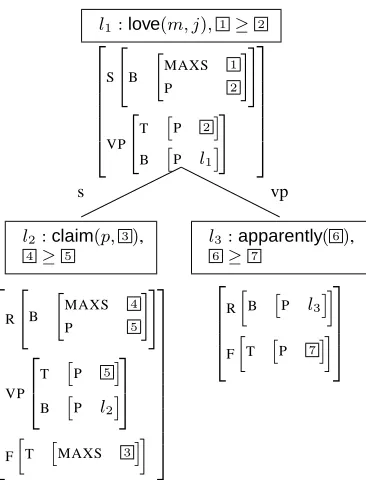
For an analysis of (10) we refer to (Romero et al., 2004) in this volume. An analysis of (11b) is shown in Fig. 10, (11a) is analyzed in the same way. We analyze raising verbs similar to adverbs (see sometimes in Fig. 3). They are in a sense inserted between the top and bottom
l1:love(m, j),1 ≥ 2
Figure 10: Analysis of (11b)
Pvalues of the node to which they adjoin. They scope over the lower proposition. By unification, the proposi-tion introduced by the topmost adverb/raising verb is the
P value of the root of the verb tree which is below the MAXSproposition. Therefore, in (11b), the attitude verb
claim takes scope over the adverb.
Furthermore, the problem of multiple modifiers as in (12) is also often discussed as an example where the TAG derivation tree does not give the semantic dependencies one needs (see, e.g., (Schabes and Shieber, 1994; Rogers, 2002)). These cases are difficult for a derivation tree based semantics because only the adjective that is closest to the modified noun attaches to the noun, all adjectives that are further to the left attach to the adjective on their right. However, all adjectives equally take the variable provided by the noun as their argument.
(12) roasted red pepper
As shown in Fig. 11, in our approach the arguments of the three predicates, pepper, red and roasted can be easily unified such that they all refer to the same individual.
7
Conclusion
N l1 :pepper(1)
pepper
R h
B I 1i
r
N l2:red(2)
red N∗
R
h
B I 2i
F h
T I 2i
r
N l2:roasted(3)
roasted N∗
R
h
B I 3i
F h
T I 3i
Figure 11: Analysis of (12)
we can analyze the examples considered in the literature as problematic for derivation tree based LTAG semantics approaches.
Acknowledgments
For many fruitful discussions of the framework and the analyses presented here we would like to thank Aravind K. Joshi and all members of the XTAG Group at the Uni-versity of Pennsylvania. Furthermore, we are grateful to two anonymous reviewers for their useful comments.
References
Marie-H´el`ene Candito and Sylvain Kahane. 1998. Can the TAG Derivation Tree represent a Semantic Graph? an Answer in the Light of Meaning-Text Theory. In Fourth International Workshop on Tree Adjoining
Grammars and Related Frameworks, IRCS Report 98– 12, pages 25–28, University of Pennsylvania,
Philadel-phia.
Mark Dras, David Chiang, and William Schuler. 2004. On Relations of Constituency and Dependency Gram-mars. Journal of Language and Computation,
2(2):281–305.
Danny Fox and Uli Sauerland. 1996. Illusive Scope of Universal Quantifiers. In Proceedings of NELS 26, Amherst.
Anette Frank and Josef van Genabith. 2001. GlueTag. Linear Logic based Semantics for LTAG – and what it teaches us about LFG and LTAG. In Miriam Butt and Tracy Holloway King, editors, Proceedings of the
LFG01 Conference, Hong Kong.
Robert Frank. 1992. Syntactic Locality and Tree
Adjoin-ing Grammar: Grammatical, Acquisition and Process-ing Perspectives. Ph.D. thesis, University of
Pennsyl-vania.
Claire Gardent and Laura Kallmeyer. 2003. Semantic Construction in FTAG. In Proceedings of EACL 2003, Budapest.
Mark Johnson. 1994. Computing with Features and For-mulae. Computational Linguistics, 20(1).
Aravind K. Joshi and Yves Schabes. 1997. Tree-Adjoning Grammars. In G. Rozenberg and A. Salo-maa, editors, Handbook of Formal Languages, pages 69–123. Springer, Berlin.
Aravind K. Joshi and K. Vijay-Shanker. 1999. Com-positional Semantics with Lexicalized Tree-Adjoining Grammar (LTAG): How Much Underspecification is Necessary? In H. C. Blunt and E. G. C. Thijsse, edi-tors, Proceedings ot the Third International Workshop
on Computational Semantics (IWCS-3), pages 131–
145, Tilburg.
Aravind K. Joshi, Laura Kallmeyer, and Maribel Romero. 2003. Flexible Composition in LTAG: Quantifier Scope and Inverse Linking. In Harry Bunt, Ielka van der Sluis, and Roser Morante, editors, Proceedings
of the Fifth International Workshop on Computational Semantics IWCS-5, pages 179–194, Tilburg.
Laura Kallmeyer and Aravind K. Joshi. 2003. Factoring Predicate Argument and Scope Semantics: Underspec-ified Semantics with LTAG. Research on Language
and Computation, 1(1–2):3–58.
Laura Kallmeyer. 2002a. Enriching the tag derivation tree for semantics. In Proceedings of KONVENS 2002, pages 67 – 74, Saarbr¨ucken, October.
Laura Kallmeyer. 2002b. Using an Enriched TAG Derivation Structure as Basis for Semantics. In
Pro-ceedings of TAG+6 Workshop, pages 127 – 136,
Venice, May.
Owen Rambow, K. Vijay-Shanker, and David Weir. 1995. D-Tree Grammars. In Proceedings of ACL.
James Rogers. 2002. One More Perspective on Semantic Relations in TAG. In Proceedings of TAG+6
Work-shop, pages 118 – 126, Venice, May.
Maribel Romero, Laura Kallmeyer, and Olga Babko-Malaya. 2004. LTAG Semantics for Questions. In
Proceedings of TAG+7, Vancouver.
Yves Schabes and Stuart M. Shieber. 1994. An Alterna-tive Conception of Tree-Adjoining Derivation.
Com-putational Linguistics, 20(1):91–124, March.
Matthew Stone and Christine Doran. 1997. Sentence Planning as Description Using Tree-Adjoining Gram-mar. In Proceedings of ACL, pages 192–205.
K. Vijay-Shanker and Aravind K. Joshi. 1988. Feature structures based tree adjoining grammar. In