Towards a Framework for Learning Structured Shape Models from
Text-Annotated Images
Sven Wachsmuth
, Suzanne Stevenson , Sven Dickinson
Bielefeld University, Faculty of Technology, 33594 Bielefeld, Germany
University of Toronto, Dept. of Computer Science, Toronto, ON, Canada
swachsmu,suzanne,sven
@cs.toronto.edu
Abstract
We present on-going work on the topic of learn-ing translation models between image data and text (English) captions. Most approaches to this problem assume a to-one or a flat, one-to-many mapping between a segmented image region and a word. However, this assump-tion is very restrictive from the computer vi-sion standpoint, and fails to account for two important properties of image segmentation: 1) objects often consist of multiple parts, each captured by an individual region; and 2) indi-vidual regions are often over-segmented into multiple subregions. Moreover, this assump-tion also fails to capture the structural rela-tions among words, e.g., part/whole relarela-tions. We outline a general framework that accommo-dates a many-to-many mapping between im-age regions and words, allowing for struc-tured descriptions on both sides. In this paper, we describe our extensions to the probabilis-tic translation model of Brown et al. (1993) (as in Duygulu et al. (2002)) that enable the cre-ation of structured models of image objects. We demonstrate our work in progress, in which a set of annotated images is used to derive a set of labeled, structured descriptions in the pres-ence of oversegmentation.
1
Introduction
Researchers in computer vision and computational lin-guistics have similar goals in their desire to automati-cally associate semantic information with the visual or linguistic representations they extract from an image or text. Given paired image and text data, one approach
0Wachsmuth is supported by the German Research
Founda-tion (DFG). Stevenson and Dickinson gratefully acknowledge the support of NSERC of Canada.
is to use the visual and linguistic representations as im-plicit semantics for each other—that is, using the words as names for the visual features, and using the image ob-jects as referents for the words in the text (cf. Roy, 2002). The goal of our work is to automatically acquire struc-tured object models from image data associated with text, at the same time learning an assignment of text labels for objects as well as for their subparts (and, in the long run, also for collections of objects).
Multimodal datasets that contain both images and text are ubiquitous, including annotated medical images and the Corel dataset, not to mention the World Wide Web, allowing the possibility of associating textual and visual information in this way. For example, if a web crawler encountered many images containing a particular shape, and also found that the word chair was contained in the captions of those images, it might associate the shape with the word chair, simultaneously indicating a name for the shape and a visual “definition” for the word. Such a framework could then learn the class names for a set of shape classes, effectively yielding a translation model between image shapes (or more generally, features) and words (Duygulu et al., 2002). This translation model could then be used to answer many types of queries, in-cluding labeling a new image in terms of its visible ob-jects, or generating a visual prototype for a given class name. Furthermore, since figure captions (or, in general, image annotations) may contain words for entire objects, as well as words for their component parts, a natural se-mantic hierarchy may emerge from the words. For exam-ple, just as tables in the image may be composed of “leg” image parts, the word leg can be associated with the word
table in a part-whole relation.
object model. On the vision side, each segmented region is mapped one-to-one or one-to-many to words. Concep-tually, associating a word with only one region prevents an appropriate treatment of objects with parts, since such objects may consistently be region-segmented into a collection of regions corresponding to those components. Practically, even putting aside the goal of part-whole processing, any given region may be (incorrectly) oversegmented into a set of subregions (that are not component parts) in real images. Barnard et al. (2003) propose a ranking scheme for potential merges of regions based on a model of word-region association, but do not address the creation of a structured object model from sequences of merges. To address these issues, we propose a more elaborate translation/association model in which we use the text of the image captions to guide us in structuring the regions.
On the language side of this task, words have typi-cally been treated individually with no semantic struc-ture among them (though see Roy, 2002, which induces syntactic structure among the words). Multiple words may be assigned as the label to a region, but there’s no knowledge of the relations among the words (and in fact they may be treated as interchangeable labels, Duygulu et al., 2002). The more restrictive goal of image labeling has put the focus on the image as the (structured) object. But we take an approach in principle of build-ing a structured hierarchy for both the image objects and their text labels. In this way, we aim not only to use the words to help guide us in how to interpret image regions, but also to use the image structure to help us induce a part/whole hierarchy among the words. For example, as-sume we find consistently associated leg and top regions together referred to as a table. Then instead of treating
leg and table, e.g., as two labels for the same object, we
could capture the image part-whole structure as word re-lations in our lexicon.
Our goal of inducing associated structured hierarchies of visual and linguistic descriptions is a long-term one, and this paper reports on our work thus far. We start with the probabilistic translation model of Brown et al. (1993) (as in Duygulu et al., 2002), and extend it to structured shape descriptions of visual data. As alluded to earlier, we distinguish between two types of structured shape de-scriptions: collections of regions that should be merged due to oversegmentation versus collections of regions that represent components of an object. To handle both types, we incorporate into our algorithm several region merge operations that iteratively evaluate potential merges in terms of their improvement to the translation model. These operations can exploit probabilities over region adjacency, thus constraining the potential combinatorial explosion of possible region merges. We also permit a many-to-many mapping between regions and words, in
support of our goal of inducing structured text as well, although here we report only on the structured image model, assuming similar mechanisms will be useful on the text side.
We are currently developing a system to demonstrate our proposal. The input to the system is a set of images segmented into regions organized into a region adjacency graph. Nodes in the graph encode the qualitative shape of a region using a shock graph (Siddiqi et al., 1999), while undirected edges represent region adjacency (used to con-strain possible merges). On the text side, each image has an associated caption which is processed by a part-of-speech tagger (Brill, 1994) and chunker (Abney, 1991). The result is a set of noun phrases (nouns with associated modifiers) which may or may not pertain to image con-tent. The output of the system is a set of many-to-many (possibly structured) associations between image regions and text words.
This paper represents work in progress, and not all the components have been fully integrated. Initially, we have focused on the issues of building the structured image models. We demonstrate the ideas on a set of annotated synthetic scenes with both multi-part objects and over-segmented objects/parts. The results show that at least on simple scenes, the model can cope with oversegmen-tation and converge to a set of meaningful many-to-many (regions to words) mappings.
2
Visual Shape Description
In order to learn structured visual representations, we must be able to make meaningful generalizations over image regions that are sufficiently similar to be treated as equivalent. The key lies in determining categorical shape classes whose definitions are invariant to within-class shape deformation, color, texture, and part articula-tion. In previous work, we have explored various generic shape representations, and their application to generic ob-ject recognition (Siddiqi et al., 1999; Shokoufandeh et al., 2002) and content-based image retrieval (Dickinson et al., 1998). Here we draw on our previous work, and adopt a view-based 3-D shape representation, called a shock graph, that is invariant to minor shape deformation, part articulation, translation, rotation, and scale, along with minor rotation in depth.
The vision component consists of a number of steps. First, the image is segmented into regions, us-ing the mean-shift region segmentation algorithm of Comaniciu and Meer (1997).1 The result is a region ad-jacency graph, in which nodes represent homogeneous
1The results presented in Section 4.2 are based on a
Type 3
Type 1 Type 2
Type 4
(a) (b)
#
3
Φ
3
3 3
001
002
003 004
1 001 1 1 1 1
1 1 1
002 003 004 005
007 008 009
Φ Φ
Φ Φ
[image:3.612.322.536.73.180.2](c)
Figure 1: The Shock Graph Qualitative Shape Represen-tation: (a) the taxonomy of qualitative shape parts; (b) the computed shock points of a 2-D closed contour; and (c) the resulting shock graph.
regions, and edges capture region adjacency. The param-eters of the segmentation algorithm can be set so that it typically errs on the side of oversegmentation (regions may be broken into fragments), although undersegmen-tation is still possible (regions may be merged incorrectly with their neighbors). Next, the qualitative shape of each region is encoded by its shock graph (Siddiqi et al., 1999), in which nodes represent clusters of skeleton points that share the same qualitative radius function, and edges rep-resent adjacent clusters (directed from larger to smaller average radii). As shown in Figure 1(a), the radius func-tion may be: 1) monotonically increasing, reflecting a bump or protrusion; 2) a local minimum, monotonically increasing on either side of the minimum, reflecting a neck-like structure; 3) constant, reflecting an elongated structure; or 4) a local maximum, reflecting a disk-like or blob-like structure. An example of a 2-D shape, along with its corresponding shock graph, is shown in Fig-ures 1(b) and (c).
[image:3.612.75.300.73.326.2]The set of all regions from all training images are clus-tered according to a distance function that measures the similarity of two shock graphs in terms of their structure and their node attributes. As mentioned above, the key requirement of our shape representation and distance is that it be invariant to both within-class shape deforma-tion as well as image transformadeforma-tion. We have developed
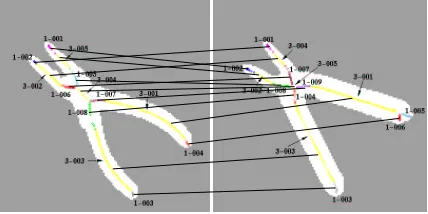
Figure 2: Generic Shape Matching
a matching algorithm for 2-D shape recognition. As illus-trated in Figure 2, the matcher can compute shock graph correspondence between different exemplars belonging to the same class.
During training, regions are compared to region (shape) class prototypes. If the distance to a prototype is small, the region is added to the class, and the prototype recomputed as that region whose sum distance to all other class members is minimum. However, if the distance to the nearest prototype is large, a new class and prototype are created from the region. Using the region adjacency graph, we can also calculate the probability that two pro-totypes are adjacent in an image. This is typically a very large, yet sparse, matrix.
3
Learning of Translation Models
The learning of translation models from a corpus of bilin-gual text has been extensively studied in computational linguistics. Probabilistic translation models generally seek to find the translation string e that maximizes the probability Pref, given the source string f (where f
re-ferred to French and e to English in the original work, Brown et al., 1993). Using Bayes rule and maximizing the numerator, the following equation is obtained:
ˆe argmax e
PrfePre (1)
The application of Bayes rule incorporates Pre into the
formula, which takes into account the probability that ˆe is a correct English string.
Prfe is known as the translation model (prediction
of f from e), and Pre as the language model
(probabil-ities over e independent of f). Like others (Duygulu et al., 2002), we will concentrate on the translation model; taking f as the words in the text and e as the regions in the images, we thus predict words from image regions. How-ever, we see the omission of the language model compo-nent, Pre (in our case, probabilities over the “language”
formulation, i.e. using the region adjacency graph to re-strict possible merges, and using the a priori probability of a region Prr if translating from words to regions. In
future work, we plan to elaborate the Pre component
more thoroughly.
Data sparseness prevents the direct estimation of
Prfe (which predicts one complete sequence of
sym-bols from another), so practical translation models must make independence assumptions to reduce the number of parameters needed to be estimated. The first model of Brown et al. (1993), which will be used and expanded in our initial formulation, uses the following approximation to Prfe:
Prfe
∑
aPrM
∏
j 1M
PrajLPr fjaj eaj
(2)
where M is the number of French words in f, L is the number of English words in e, and a is an alignment that maps each French word to one of the English words, or to the “null” word e0. PrM ε is constant and PrajL 1L 1 depends only on the number of
En-glish words. The conditional probability of fj depends
only on its own alignment to an English word, and not on the translation of other words fi. These assumptions lead
to the following formulation, in which t fjea
j defines a
translation table from English words to French words:
Prfe ε
L 1
M
∏
j 1M
∑
aj 0L t fjea
j (3)
To learn such a translation between image objects and text passages, it is necessary to: 1) Define the vocabu-lary of image objects; 2) Extract this vocabuvocabu-lary from an image; 3) Extract text that describes an image ject; 4) Deal with multiple word descriptions of ob-jects; and 5) Deal with compound objects consisting of parts. Duygulu et al. (2002) assume that all words (more specifically, all nouns) are possible names of objects. Each segmented region in an image is characterized by a 33-dimensional feature vector. The vocabulary of im-age objects is defined by a vector quantization of this feature space. In the translation model of Brown et al., Duygulu et al. (2002) substitute the French string f by the sequence w of caption words, and the English string e by the sequence r of regions extracted from the image (which they refer to as blobs, b). They do not consider multiple word sequences describing an image object, nor image objects that consist of multiple regions (overseg-mentations or component parts).
In section 2 we argued that many object categories are better characterized by generic shape descriptions rather than finite sets of appearance-based features. However, in moving to a shape-based representation, we need to deal with image objects consisting of multiple regions
(cf. Barnard et al., 2003). We distinguish three different types of multiple region sets:
1. Type A (accidental): Region over-segmentation due to illumination effects or exemplar-specific mark-ings on the object that results in a collection of sub-regions that is not generic to the object’s class.
2. Type P (parts): Region over-segmentation common to many exemplars of a given class that results in a collection of subregions that may represent mean-ingful parts of the object class. In this case, it is assumed that on some occasions, the object is seen as a silhouette, with no over-segmentation into parts.
3. Type C (compound): Objects that are always seg-mented into their parts (e.g., due to differently col-ored or textured parts). This type is similar to Type P, except that these objects never appear as a whole silhouette. (Our mechanism for dealing with these objects will also allow us, in the future, to handle conventional collections of objects, such as a set of chairs with a table.)
We can extend the one-to-one translation model in Eqn. (3) above by grouping or merging symbols (in this case, regions) and then treating the group as a new sym-bol to be aligned. Theoretically, then, multiple regions can be handled in the same translation framework, by adding to the sequence of regions in each image, the re-gions resulting from all possible merges of image rere-gions:
Prwr ε
˜L 1
M
∏
j 1M
∑
aj 0˜L twjra
j (4)
where ˜L denotes the total number of segmented and merged regions in an image. However, in practice this causes complexity and stability problems; the number of possible merges may be intractable, while the number of semantically meaningful merges is quite small.
Motivated by the three types of multiple region sets described above, we have instead developed an iterative bootstrapping strategy that filters hypothetically mean-ingful merges and adds these to the data set. Our method proceeds as follows:
1. As in Dyugulu et al., we calculate a translation model t0wr between words and regions, using a
data set of N image/caption pairs Dwd rd
d
1 N . rdinitially includes a region for each
seg-mented region in image d.
2. We next account for accidental over-segmentations (Type A above) by adding all merges to the data set that increase the score based on the old translation model:
scoreD
i 1
∏
wr! D
i" 1 Pwr;t
i
That is, we use the current translation model to de-termine whether to merge any two adjacent regions into a new region. If the quality of the translation is improved by the merge, we add the new region to r. If the dataset was extended by any number of new regions, the algorithm starts again with step 1 and recalculates the translation model.
3. We then account for regular over-segmentation (Type P above) by extending the number of regions merged for adjacent region sets—i.e., merges are no longer restricted to be pairwise. In this step, though, only sets of regions that frequently appear together in images are candidates for merging. Again, those that increase the score are iteratively added to the data set until the data set is stable.
4. For compound objects (Type C above), the score cri-terion does not apply because the silhouette of the merged structure does not appear in the rest of the data set. Since the current translation model has no information about the whole object, merging the component regions cannot increase the quality of the translation model.
Instead, we develop a new scoring criterion, based on Melamed (1997). First, the current translation model is used to induce translation links between words and regions, and the mutual information of words and regions is calculated, using the link counts for the joint distribution. Next, the increase in mutual information is estimated for a hypotheti-cal data set D# in which the regions of potential
com-pounds are merged. If a compound contributes to an increase in mutual information in D#, then the merge
is added to our data set.
5. The sequence of steps above is repeated until no new regions are added to the data set.
In our algorithm above, we mapped our three ap-proaches to dealing with region merges to the three types of multiple regions sets identified earlier (Types A, P, C). Indeed, each step in the algorithm is inspired by the cor-responding type of region set; however, each step may apply to other types. For example, in a given data set, the legs of a table may only infrequently be segmented into separate regions, so that a merge to form a table may oc-cur in step 2 (Type A) instead of step 3 (Type P). Thus, the actual application of steps 2–4 depends on the precise make-up of regions and their frequencies in the data set.
In our demonstration system reported next, step 3 of the algorithm is currently applied without considering how frequent a region pair appears. It iteratively gen-erates three pairwise merges, with the output restricted to those that yield a shape seen before. We expect
that considering only frequent shape pairs will stabilize merging effects and reduce computational complexity for more expensive merge operations than on the synthetic dataset. Our implementation of step 4 is in the early stage and currently considers combinations of any two regions, whether adjacent or not. This causes problems for im-ages with more than one object or additional background shapes.
4
Demonstration
4.1 Scene Generation
As this paper represents work in progress, we have only tested our model on synthetic scenes with captions. Scenes contain objects composed of parts drawn from a small vocabulary of eight shapes, numbered 1–8, in Fig-ure 3. (Our shapes are specified in terms of qualitative re-lationships over lines and curves; precise angle measure-ment is not important, Dickinson et al., 1992.) To simu-late undersegmentation, primitive parts may be grouped into larger regions; for example, an object composed of three parts may appear as a single silhouette, represent-ing the union of the three constituent parts. To simulate oversegmentation, four of the shape primitives (1, 5, 6, 8) can appear according to a finite set of oversegmentation models, as shown in Figure 3. To add ambiguity, over-segmentation may yield a subshape matching one of the shape categories (e.g., primitive shape 5, the trapezoidal shape, can be decomposed into shapes 1 and 4) or, al-ternatively, matching a subshape arising from a different oversegmentation. For example, the shape in the bottom right of Figure 3 is decomposed into two parts, one of which (25, representing two parallel lines bridged at one end by a concave curve and at the other end by a line) oc-curs in a different oversegmentation model (in this case, the oversegmentation shown immediately above it).
Scenes are generated containing one or two objects, drawn from a database of six objects (two chairs, two ta-bles, and two lamps, differing in their primitive decom-positions), shown in Figure 4. Given an object model, a decomposition grammar (i.e., a set of rewrite rules) is automatically generated that takes the silhouette of the shape and decomposes it into pieces that are either: 1) unions of the object’s primitive parts, representing an un-dersegmentation of the object; 2) the object’s primitive parts; or 3) oversegmentations of the object’s primitive parts. In addition, the scene can contain up to four back-ground shapes, drawn from Figure 3. These shapes in-troduce ambiguity in the mapping from words to objects in the scene, and can participate in merges of regions in our algorithm. Finally, each scene has an associated text caption that contains one word for each database object, which specifies either the name of the whole object
ob-1
3
2 4
5 6 7 8
9 10
4 4
4 5
11 12
13 14
5
5
4 1
15 16
17 4
18 18
3 20
6 21
22 23
3 2
4 24
8 8
18 25
[image:6.612.366.491.68.204.2]26 25 Possible oversegmentations for shapes 1, 5, 6, and 8:
Figure 3: Top: The eight primitive shapes used to con-struct objects in the scene. Below: The various ways in which four of the shapes (1, 5, 6, 8) can be overseg-mented.
ject (base or leg). Just as the scene contains background shapes, the caption may contain up to four “background” words that have nothing to do with the objects (or primi-tive parts) in the database.
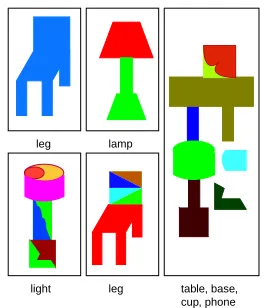
We have developed a parameterized, synthetic scene generator that uses the derived rules to automatically gen-erate scenes with varying degrees of undersegmentation, oversegmentation, ambiguous background objects, and extraneous caption words. Although no substitute for testing the model on real images, it has the advantage of allowing us to analyze the behavior of the framework as a function of these underlying parameters. Examples of input scenes it produces are shown in Figure 5.
4.2 Experimental Results
The first experiment we report here (Exp. 1) tests our abil-ity to learn a translation model in the presence of Type A and Type P segmentation errors. We generated 1000 scenes with the following parameters: 1 or 2 objects per image, forced oversegmentation to a depth of 4, maxi-mum 4 background shapes, one relevant word (part or whole descriptor), and maximum 2 meaningless random words per image. Table 1 shows the translation tables (Prwr) for this dataset, stopping the algorithm after
step 1 (no merging) and after step 3. For all of the ob-jects, the merging step increased the probability of one word, and decreased the probability of the others, creat-ing a stronger word-shape association. For 5 of the ob-jects, the highest probability word is a correct identifier of the object (stand, chair, stool, light, lamp), and for the
6
1
5
1
1
1 1
1 8 6
1
5
5
1
5
6
8
1
1 1
1 1
table; leg table, stand; base
chair; leg chair, stool; base
lamp; base
light, lamp; base 1
Figure 4: The database of six objects and associated words from which scenes are generated. Shape parts are labeled according to Figure 3.
leg lamp
light leg table, base,
cup, phone
Figure 5: Examples of scenes input to our system.
other object, a word indicating a part of the object has high probability (leg for the first table object).
Although increasing the strength of one probability has an advantage, we need to explore ways to allow associa-tion of more than one “whole object” word (such as lamp and light) with a single object (cf. Duygulu et al., 2002). Since we maintain the component regions of a merged region, having both a part and a whole word, such as leg and table, associated with the same image is not a prob-lem. Incorporating these into a structured word hierarchy should help to focus associations appropriately.
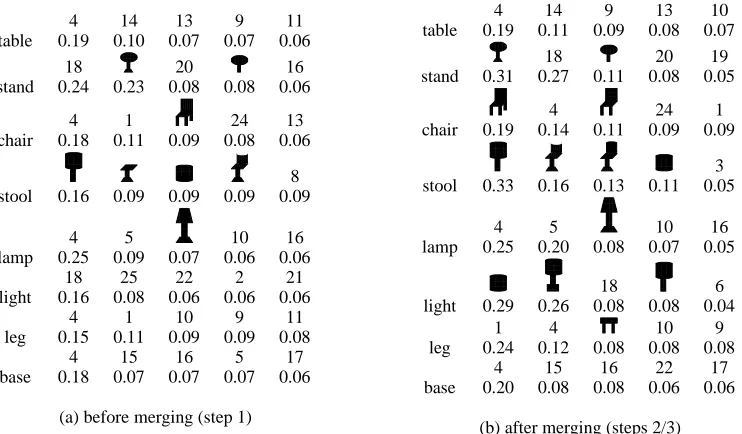
Another way to view the data is to see which shapes are most consistently associated with the meaningful words in the captions. Here we calculate Prw by PrwrPrr, with the latter normalized over all shapes.
A problem with this formulation is that, due to the Prr
[image:6.612.113.261.71.278.2] [image:6.612.361.493.260.414.2]Sev-$$$ $$$ $$$ $$$ $$$ $$$ %% %% %% %%%% %% &&&&&&&&&&&&&& &&&&&&&&&&&&&& &&&&&&&&&&&&&& '''''''''''''' '''''''''''''' '''''''''''''' ((( ((( ((( ((( ((( ((( )) )) )) )))) )) ************ ************ ************ ************ ++++++++++++ ++++++++++++ ++++++++++++ ++++++++++++ ,, ,, ,, --... ////// 000000
000000 000000 000000 111111 111111 111111 111111 222222222 222222222 333333333 333333333 44 44 44 55 55 5566
66 66 77 77 7788
88 88 99 99 99 ::::::
;;;;;; <<<<<< ====== >>>??>>??>>??
@@ @@ @@ AA AA AA BBBBBBBBB BBBBBBBBB CCCCCCCCC CCCCCCCCC DDDDDD DDDDDD DDDDDD EEEEEE EEEEEE EEEEEE FFFFFFF
GGGGGGG HHHHHHH IIIIIII JJJJJJ JJJJJJ KKKKK KKKKK LLL LLL LLL LLL MM MM MM MM NNNNNNNN NNNNNNNN NNNNNNNN OOOOOOO OOOOOOO OOOOOOO PPPPPPP
QQQQQQ RRR RRR RRR SS SS SS TTTTTTT TTTTTTT UUUUUU UUUUUU
- 0.00 0.00 0.00 0.00 0.00 0.00 table 0.07 0.01 0.00 0.00 0.00 0.00 stand 0.00 0.98 0.00 0.00 0.00 0.00 chair 0.01 0.00 0.65 0.01 0.00 0.00 stool 0.00 0.00 0.00 0.13 0.00 0.00 lamp 0.00 0.00 0.00 0.00 0.41 0.80 light 0.00 0.00 0.00 0.00 0.33 0.00 leg 0.81 0.00 0.30 0.00 0.01 0.00 base 0.00 0.01 0.00 0.28 0.03 0.10
(a) before merging (step 1)
VVV VVV VVV VVV VVV VVV WW WW WW WWWW WW XXXXXXXXXXXXXXX XXXXXXXXXXXXXXX XXXXXXXXXXXXXXX YYYYYYYYYYYYYYY YYYYYYYYYYYYYYY YYYYYYYYYYYYYYY ZZZ ZZZ ZZZ ZZZ ZZZ ZZZ [[ [[ [[ [[[[ [[ \\\\\\\\\\\\ \\\\\\\\\\\\ \\\\\\\\\\\\ \\\\\\\\\\\\ ]]]]]]]]]]]] ]]]]]]]]]]]] ]]]]]]]]]]]] ]]]]]]]]]]]] ^^ ^^ ^^ __ __ __ `````` aaaaaa bbbbbbb
bbbbbbb bbbbbbb bbcbbccbbccbc cccccc cccccc cccccc ddddddddd ddddddddd eeeeeeeee eeeeeeeee ff ff ff gg gg gghh
hh hh ii ii iijjj
jjj jjj kk kk kk llllll
mmmmmm nnnnnn oooooo pppqqppqqppqq
rr rr rr ss ss ss ttttttttt ttttttttt uuuuuuuuu uuuuuuuuu vvvvvv vvvvvv vvvvvv wwwwww wwwwww wwwwww xxxxxxx
yyyyyyy zzzzzzz {{{{{{{ |||||| |||||| }}}}} }}}}} ~~~ ~~~ ~~~ ~~~
- 0.00 0.00 0.00 0.00 0.00 0.00 table 0.00 0.00 0.00 0.00 0.00 0.00 stand 0.00 1.00 0.00 0.00 0.00 0.00 chair 0.00 0.00 0.98 0.00 0.00 0.00 stool 0.00 0.00 0.00 0.41 0.00 0.00 lamp 0.00 0.00 0.00 0.00 0.03 0.99 light 0.00 0.00 0.00 0.00 0.97 0.00 leg 1.00 0.00 0.01 0.00 0.00 0.00 base 0.00 0.00 0.00 0.00 0.00 0.00
[image:7.612.97.500.80.209.2](b) after merging (steps 2/3)
Table 1: Exp. 1: Translation tables from shapes to words Pwr for the 6 object silhouettes.
6 1
table 0.70 0.14 0.09 0.04 0.03
6 ¡¡ ¡¡ ¡¡ ¡¡ ¢¢¢¢¢¢¢ ¢¢¢¢¢¢¢ ££££££ ££££££ 1 stand 0.55 0.33 0.13 0.00 0.00
¤¤¤¤¤¤¤ ¤¤¤¤¤¤¤ ¥¥¥¥¥¥ ¥¥¥¥¥¥ ¦¦ ¦¦ ¦¦ §§ §§ §§ ¨¨¨¨¨¨¨¨¨ ¨¨¨¨¨¨¨¨¨ ©©©©©©©©© ©©©©©©©©© ªªªªªªªªªªªªªªª
ªªªªªªªªªªªªªªª ªªªªªªªªªªªªªªª ªªªªªªªªªªªªªªª ««««««««««««««« ««««««««««««««« ««««««««««««««« ««««««««««««««« ¬¬¬ ¬¬¬ ¬¬¬ ¬¬¬ ¬¬¬ ¬¬¬ ®® ®® ®® ¯¯ ¯¯ ¯¯°° °° °° ±± ±± ±± ²²²²²²²²² ²²²²²²²²² ³³³³³³³³³ ³³³³³³³³³ ´´´´´´ ´´´´´´ ´´´´´´ ´´´´´´ ´´´´´´ µµµµµµ µµµµµµ µµµµµµ µµµµµµ µµµµµµ ¶¶¶¶¶¶¶
¶¶¶¶¶¶¶ ¶¶¶¶¶¶¶ ¶¶¶¶¶¶¶ ··· ··· ··· ··· ¸¸¸¸¸¸¸¸¸ ¸¸¸¸¸¸¸¸¸ ¹¹¹¹¹¹¹¹¹ ¹¹¹¹¹¹¹¹¹ ºº ºº ºº »» »» »»¼¼
¼¼ ¼¼ ½½ ½½ ½½¾¾
¾¾ ¾¾ ¿¿ ¿¿ ¿¿ 1 chair 0.44 0.27 0.21 0.07 0.02
ÀÀÀÀÀÀ ÁÁÁÁÁÁ ÂÂÂÂÂÂ ÃÃÃÃÃÃ ÄÄÄÅÅÄÄÅÅÄÄÅÅ
ÆÆ ÆÆ ÆÆ ÆÆ ÇÇ ÇÇ ÇÇ ÇÇ ÈÈÈÈÈÈÈÈÈ ÈÈÈÈÈÈÈÈÈ ÉÉÉÉÉÉÉÉÉ ÉÉÉÉÉÉÉÉÉ ÊÊÊÊÊÊ ÊÊÊÊÊÊ ÊÊÊÊÊÊ ËËËËËË ËËËËËË ËËËËËË ÌÌÌÌÌÌÌ
ÍÍÍÍÍÍ ÎÎ ÎÎ ÎÎ ÏÏ ÏÏ ÏÏ ÐÐÐÐÐÐÐÐÐ ÐÐÐÐÐÐÐÐÐ ÑÑÑÑÑÑÑÑÑ ÑÑÑÑÑÑÑÑÑ
8 ÒÒÒÒÒÒÒ ÓÓÓÓÓÓÓ ÔÔÔÔÔÔÔÔ ÔÔÔÔÔÔÔÔ ÔÔÔÔÔÔÔÔ ÕÕÕÕÕÕÕ ÕÕÕÕÕÕÕ ÕÕÕÕÕÕÕ ÖÖÖ ÖÖÖ ÖÖÖ ÖÖÖ ×× ×× ×× ×× ØØØØØØØ
ÙÙÙÙÙÙÙ ÚÚÚÚÚÚÚ ÛÛÛÛÛÛÛ ÜÜÜÜÜÜÜÜ ÜÜÜÜÜÜÜÜ ÜÜÜÜÜÜÜÜ ÜÜÜÜÜÜÜÜ ÝÝÝÝÝÝÝ ÝÝÝÝÝÝÝ ÝÝÝÝÝÝÝ ÝÝÝÝÝÝÝ
stool 0.32 0.31 0.24 0.06 0.06
5 ÞÞÞÞÞÞÞ ßßßßßßß ààààààà ááááááá ââââââ ââââââ ããããã ããããã äää äää äää äää åå åå åå åå ææææææææ ææææææææ ææææææææ ççççççç ççççççç ççççççç èèèèèèè
ééééééé êêêêêêê ëëëëëëë ìììììììì ìììììììì ìììììììì ííííííí ííííííí ííííííí îîî îîî îîî îîî ïï ïï ïï ïï ððððððð
ñññññññ òòòòòòòò òòòòòòòò òòòòòòòò óóóóóóó óóóóóóó óóóóóóó ôôô ôôô ôôô ôôô õõ õõ õõ õõ ööööööö
÷÷÷÷÷÷÷ øøøøøøø ùùùùùùù úúúúúúúú úúúúúúúú úúúúúúúú úúúúúúúú ûûûûûûû ûûûûûûû ûûûûûûû ûûûûûûû
lamp 0.64 0.10 0.08 0.07 0.07
üüüüüüü ýýýýýýý þþþþþþþ ÿÿÿÿÿÿÿ 8 light 0.28 0.23 0.20 0.20 0.09
1 !!!!!!!!!!!!!!! !!!!!!!!!!!!!!! !!!!!!!!!!!!!!! """ """ """ """ """ """ #### ## ## ## ## $$$$$$$ $$$$$$$ $$$$$$$ $$$$$$$ %%%%%% %%%%%% %%%%%% %%%%%% &&&&&&&&& &&&&&&&&& &&&&&&&&& ''''''''' ''''''''' ''''''''' (( (( (( )) )) )) ** ** ** ++ ++ ++,, ,, ,, ,, --.. .. .. .. // // // // 00 00 00 00 11 11 11 11 222222222 222222222 333333333 333333333 4444444 4444444 4444444 4444444 555555 555555 555555 555555
leg 0.84 0.15 0.01 0.00 0.00
666 666 666 666 77 77 77 77 8888888 8888888 999999 999999 ::::::::::::
:::::::::::: :::::::::::: :::::::::::: ;;;;;;;;;;;; ;;;;;;;;;;;; ;;;;;;;;;;;; ;;;;;;;;;;;; << << << == == ==
>>>>>>> ??????? @@@@@@@@ @@@@@@@@ @@@@@@@@ AAAAAAA AAAAAAA AAAAAAA BBB BBB BBB BBB CC CC CC CC DDDDDDD
EEEEEEE FFFFFFF GGGGGGG HHHHHHHH HHHHHHHH HHHHHHHH HHHHHHHH IIIIIII IIIIIII IIIIIII IIIIIII JKJKKJJKKJKJJK
LLLLLLL MMMMMMM NNNNNN NNNNNN NNNNNN OOOOO OOOOO OOOOO PPP PPP PPP QQ QQ QQ RRRRRRRR RRRRRRRR RRRRRRRR RRRRRRRR SSSSSSS SSSSSSS SSSSSSS SSSSSSS
base 0.28 0.23 0.11 0.11 0.09
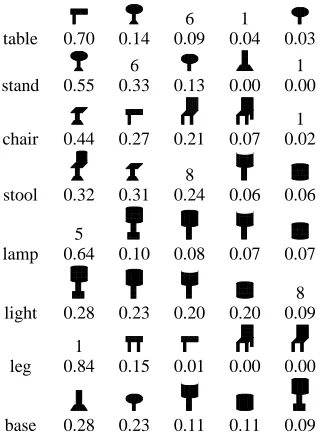
Table 3: Exp. 2: The five shapes with highest Prrw
for the meaningful words, after step 4. Shape icons (for merged regions) or primitive shapes (indicated by num-ber) have the probability for that word listed below.
eral complex shapes increase in probability after merging, and a number of new complex shapes appear in the lists.
We report on one other experiment (Exp. 2) which was designed to test our approach to handling oversegmenta-tions of Type C in step 4 of our algorithm. Our dataset again had 1000 images; here there was only one object per image, but every object was oversegmented into its primitive parts (that is, an object never appeared as a complete silhouette). (We did not allow oversegmenta-tion of the primitives here, nor did we include irrelevant words in the captions.) Because our 6 objects never pear “whole,” steps 2 and 3 of our algorithm cannot ap-ply; before step 4, words are associated with primitive
shapes only. After step 4, the highest probability word (Prwr) for 4 of the objects is a correct identifier of the
object (stand, chair, stool, light); for one object, a word indicating a part of the object had high probability (leg for the rectangular table). (One object silhouette—the sec-ond lamp—was not fully reconstructed.) Table 3 shows the five shapes with the highest Prrw values for each
meaningful word, after step 4. For 3 of the whole ob-ject words (stand, stool, light), and both part words (leg,
base), the best shape is a correct one. For the
remain-ing whole object words (table, chair, lamp), a correct full silhouette is one of the top five. Step 4 clearly has high potential for reconstructing objects that are consistently oversegmented into their parts.
5
Conclusions
We have outlined a framework for the creation of asso-ciated visual and linguistic structured models, from im-ages annotated with textual captions. Thus far, we have focused on the important open problem of dealing with oversegmentation in images. We have developed a set of extensions to a probabilistic translation model (Brown et al., 1993) that enable us to successfully merge overseg-mented regions into coherent objects. Our initial exper-iments on synthetic data demonstrate that our algorithm can learn a useful translation model between image ob-jects and words, even in the presence of substantial over-segmentation. We are currently experimenting with vari-ous parameters in our synthetic scene generator to guide further development of the algorithm, as well as experi-menting on real data from the Web.
References
Steven Abney. 1991. Parsing by Chunks. In Robert Berwick, Steven Abney, and Carol Tenny, editors,
[image:7.612.106.267.260.479.2]4 14 13 9 11 table 0.19 0.10 0.07 0.07 0.06
18 TTTTTTTTTTTT TTTTTTTTTTTT TTTTTTTTTTTT TTTTTTTTTTTT UUUUUUUUUUUU UUUUUUUUUUUU UUUUUUUUUUUU UUUUUUUUUUUU VV VV VV VV WW WW WW WW XXXXXX XXXXXX YYYYYY YYYYYY
20 ZZZZZZZZZZZZ ZZZZZZZZZZZZ ZZZZZZZZZZZZ ZZZZZZZZZZZZ [[[[[[[[[[[[ [[[[[[[[[[[[ [[[[[[[[[[[[ [[[[[[[[[[[[ \\ \\ \\ ]] ]] ]] 16 stand 0.24 0.23 0.08 0.08 0.06
4 1 ^^^^^^^ ^^^^^^^ ^^^^^^^ ^^^^^^^ ______ ______ ______ ______ ````````` ````````` aaaaaaaaa aaaaaaaaa bb bb bb cc cc ccdd
dd dd ee ee eeff ff ff gg gg gg 24 13 chair 0.18 0.11 0.09 0.08 0.06
hhhhhhh iiiiiii jjjjjjj kkkkkkk llllllll llllllll llllllll llllllll mmmmmmm mmmmmmm mmmmmmm mmmmmmm nnn nnn nnn oo oo oo
ppppppp qqqqqq rr rr rr ss ss ss ttttttttt ttttttttt uuuuuuuuu uuuuuuuuu vwvwwvvwwvwvvw
xxxxxxx yyyyyyy zzzzzzzz zzzzzzzz zzzzzzzz {{{{{{{ {{{{{{{ {{{{{{{ |||||| }}}}}} ~~~~~~~ 8 stool 0.16 0.09 0.09 0.09 0.09
4 5 10 16 lamp 0.25 0.09 0.07 0.06 0.06
18 25 22 2 21 light 0.16 0.08 0.06 0.06 0.06
4 1 10 9 11
leg 0.15 0.11 0.09 0.09 0.08 4 15 16 5 17 base 0.18 0.07 0.07 0.07 0.06
(a) before merging (step 1)
4 14 9 13 10 table 0.19 0.11 0.09 0.08 0.07
18 20 19 stand 0.31 0.27 0.11 0.08 0.05
4 ¡¡ ¡¡ ¡¡¢¢ ¢¢ ¢¢ ££ ££ ££ ¤¤¤¤¤¤¤¤¤ ¤¤¤¤¤¤¤¤¤ ¥¥¥¥¥¥¥¥¥ ¥¥¥¦¥¥¦¦¥¥¦¦¥¥¦ ¦¦¦¦¦¦ ¦¦¦¦¦¦ ¦¦¦¦¦¦ ¦¦¦¦¦¦ §§§§§§ §§§§§§ §§§§§§ §§§§§§ §§§§§§ 24 1 chair 0.19 0.14 0.11 0.09 0.09
¨¨¨¨¨¨¨ ©©©©©©© ªªªªªªª ««««««« ¬¬¬¬¬¬¬¬ ¬¬¬¬¬¬¬¬ ¬¬¬¬¬¬¬¬ ¬¬¬¬¬¬¬¬ ®®® ®®® ®®® ®®® ¯¯ ¯¯ ¯¯ ¯¯ °°°°°° ±±±±±± ²²²²²²² ²²²²²²² ³³³³³³ ³³³³³³ ´´ ´´ ´´ µµ µµ µµ ¶¶¶¶¶¶¶¶¶ ¶¶¶¶¶¶¶¶¶ ··· ··· ¸¸¸¸¸¸ ¸¸¸¸¸¸ ¸¸¸¸¸¸ ¹¹¹¹¹¹ ¹¹¹¹¹¹ ¹¹¹¹¹¹ ºººººº
»»»»»» ¼¼¼¼¼¼ ½½½½½½ ¾¾¾¾¾¾¾ ¿¿¿¿¿¿ ÀÀ ÀÀ ÀÀ ÀÀ ÁÁ ÁÁ ÁÁ ÁÁ ÂÂÂÂÂÂÂÂÂ ÂÂÂÂÂÂÂÂÂ ÃÃÃÃÃÃÃÃÃ ÃÃÃÃÃÃÃÃÃ ÄÄÄÄÄÄ ÄÄÄÄÄÄ ÄÄÄÄÄÄ ÅÅÅÅÅÅ ÅÅÅÅÅÅ ÅÅÅÅÅÅ
ÆÆÆÆÆÆÆ ÇÇÇÇÇÇÇ ÈÈÈÈÈÈÈ ÉÉÉÉÉÉÉ ÊÊÊÊÊÊÊÊ ÊÊÊÊÊÊÊÊ ÊÊÊÊÊÊÊÊ ÊÊÊÊÊÊÊÊ ËËËËËËË ËËËËËËË ËËËËËËË ËËËËËËË
3 stool 0.33 0.16 0.13 0.11 0.05
4 5 ÌÌÌÌÌÌÌ ÍÍÍÍÍÍ ÎÎÎ ÎÎÎ ÎÎÎ ÏÏ ÏÏ ÏÏ ÐÐÐÐÐÐÐ ÐÐÐÐÐÐÐ ÐÐÐÐÐÐÐ ÑÑÑÑÑÑ ÑÑÑÑÑÑ ÑÑÑÑÑÑ
10 16 lamp 0.25 0.20 0.08 0.07 0.05
ÒÒÒÒÒÒÒ ÓÓÓÓÓÓÓ ÔÔÔÔÔÔÔ ÕÕÕÕÕÕÕ ÖÖÖÖÖÖÖÖ ÖÖÖÖÖÖÖÖ ÖÖÖÖÖÖÖÖ ÖÖÖÖÖÖÖÖ ××××××× ××××××× ××××××× ××××××× ØÙØÙÙØØÙÙØÙØØÙ
ÚÚÚÚÚÚÚ ÛÛÛÛÛÛÛ ÜÜÜÜÜÜ ÜÜÜÜÜÜ ÝÝÝÝÝ ÝÝÝÝÝ ÞÞÞ ÞÞÞ ÞÞÞ ÞÞÞ ßß ßß ßß ßß àààààààà àààààààà àààààààà ááááááá ááááááá ááááááá
18
âââââââ ããããããã äääääää ååååååå ææææææææ ææææææææ ææææææææ ççççççç ççççççç ççççççç èèè èèè èèè èèè éé éé éé éé
6 light 0.29 0.26 0.08 0.08 0.04
1 4 êêêê êê êê êê êê ëë ëë ëëëë ëë ëë ìììììììììììììììì ìììììììììììììììì ìììììììììììììììì ìììììììììììììììì ííííííííííííííí ííííííííííííííí ííííííííííííííí ííííííííííííííí îîî îîî îîî îîî îîî îîî ïï ïï ïïïï ïï ïï 10 9 leg 0.24 0.12 0.08 0.08 0.08
4 15 16 22 17 base 0.20 0.08 0.08 0.06 0.06
[image:8.612.122.493.81.298.2](b) after merging (steps 2/3)
Table 2: Exp. 1: The five shapes with highest Prrw for the meaningful words. Shape icons (for merged regions) or
primitive shapes (indicated by number) have the probability for that word listed below.
Kobus Barnard and David Forsyth. 2001. Learning the Semantics of Words and Pictures. In Proc. of Int. Conf.
on Computer Vision (ICCV-2001), pages 408–415.
Kobus Barnard, Pinar Duygulu, Raghavendra Guru, Prasad Gabbur, and David Forsythi. 2003. The ef-fects of segmentation and feature choice in a transla-tion model of object recognitransla-tion. In Proc. of Computer
Vision and Pattern Recognition, page to appear.
David M. Blei and Michael I. Jordan. 2002. Modeling Annotated Data. Technical report, Computer Science Division, University of California, Berkeley, USA.
Eric Brill. 1994. Some advances in transformation-based part of speech tagging. In Proceedings of the 12th
Na-tional Conference on Artificial Intelligence, volume 1,
pages 722–727, Menlo Park, CA, USA. AAAI Press.
P. Brown, S.A. Della Pietra, V.J. Della Pietra, and R.L. Mercer. 1993. The mathematics of statistical machine translation: Parameter estimation. Computational
Lin-guistics, 32(2):263–311.
Marco La Cascia, Saratendu Sethi, and Stan Sclaroff. 1998. Combining Textual and Visual Cues for Content-based Image Retrieval on the World Wide Web. In Proc. of IEEE Workshop on Content-based
Access of Image and Video Libraries, June.
D. Comaniciu and P. Meer. 1997. Robust analysis of feature spaces: Color image segmentation. In IEEE
Computer Society Conference on Computer Vision and Pattern Recognition, pages 750–755.
S. Dickinson, A. Pentland, and A. Rosenfeld. 1992. 3-D shape recovery using distributed aspect matching.
IEEE Transactions on Pattern Analysis and Machine Intelligence, 14(2):174–198.
S. Dickinson, A. Pentland, and S. Stevenson. 1998. Viewpoint-invariant indexing for content-based image retrieval. In IEEE International Workshop on
Content-based Access of Image and Video Databases, Bombay.
P. Duygulu, Kobus Barnard, J.F.G. de Freitas, and D.A. Forsyth. 2002. Object Recognition as Machine Trans-lation: Learning a Lexicon for a Fixed Image Vocab-ulary. In Proc. of European Conference on Computer
Vision (ECCV-2002), volume 4, pages 97–112.
I. Dan Melamed. 1997. Automatic Discovery of Non-Compositional Compounds in Parallel Data. In 2nd
Conference on Empirical Methods in Natural Lan-guage Processing (EMNLP’97), Providence, RI.
Deb Roy. 2002. Learning visually grounded words and syntax of natural spoken language. Evolution of
Com-munication, 4(1).
A. Shokoufandeh, S. Dickinson, C. Jonsson, L. Bret-zner, and T. Lindeberg. 2002. The representation and matching of qualitative shape at multiple scales. In
Proceedings, ECCV, pages 759–775, Copenhagen.
K. Siddiqi, A. Shokoufandeh, S. Dickinson, and S. Zucker. 1999. Shock graphs and shape matching.