CODE ALLTAG
— A German-Language E-Mail Corpus
Ulrike Krieg-Holz,
1Christian Schuschnig,
1Franz Matthies,
2Benjamin Redling,
2Udo Hahn
21 Alpen-Adria-Universit¨at Klagenfurt, Universit¨atsstraße 65-67, A-9020 Klagenfurt, Austria 2 Friedrich-Schiller-Universit¨at Jena, F¨urstengraben 30, D-07743 Jena, Germany
corresponding author:[email protected]
Abstract
We introduce CODE ALLTAG, a text corpus composed of German-language e-mails. It is divided into two partitions: the first of these portions, CODE ALLTAGXL, consists of a bulk-size collection drawn from an openly accessible e-mail archive (roughly 1.5M e-mails),
whereas the second portion, CODE ALLTAGS+d, is much smaller in size (less than thousand e-mails), yet excels with demographic
data from each author of an e-mail. CODE ALLTAG, thus, currently constitutes the largest e-mail corpus ever built. In this paper, we describe, for both parts, the solicitation process for gathering e-mails, present descriptive statistical properties of the corpus, and, for
CODE ALLTAGS+d, reveal a compilation of demographic features of the donors of e-mails.
Keywords:text corpus, German language, e-mails
1.
Introduction
Much of the success of modern human language technol-ogy can be attributed to the provision of large amounts of linguistic data in terms of corpora of written or spoken lan-guage. With respect to written language, we observe two major streams of work. The first of these aims at build-ing large-sized national reference corporaas a ‘represen-tative’ mirror of authoritative, canonical language use for one national idiom. For the English language, e.g., an American (ANC) (Ide, 2009) and a British (BNC) (As-ton and Burnard, 1997) variant has been assembled, for the German language, currently two synchronous resources exist, DEREKO(Kupietz et al., 2010) and DWDS CORE
(Geyken, 2007); as a diachronic extension going back un-til 950 AD, the DTA (Deutsches Text-Archiv) (Geyken and Gloning, 2015) is currently going to be set up as an historic complement. These reference corpora originally started as raw data collections aiming at high coverage, while in the meantime they have been continuously enriched by linguis-tic metadata, such as part-of-speech tags, lemma informa-tion and even parsing data (cf., e.g., Andersen et al. (2008)). The second stream of work is dominated by computational concerns in terms of (meta)language banking. NLP re-searchers took mainly newspaper/newswire material as a basis for in-depth annotation efforts, on a much smaller scale than the national reference corpora though, and built up value-added resources containing, e.g., extensive syn-tactic or semantic metadata associated with linguistic raw data. This approach is most prominently featured in the seminal work on the English PENN TREEBANK (Marcus et al., 1993) and PROPBANK(Palmer et al., 2005), respec-tively. For German, there are currently two major compet-ing syntactic annotation efforts, namely the TIGER(Brants et al., 2004) and the T ¨UBA-D/Z Treebank (Telljohann et al., 2004), whereas propositional information is primarily featured in the SALSAcorpus which builds on the syntactic annotations of TIGER(Burchardt et al., 2006).
In basically all these efforts related to national reference corpora or metadata banks, for German and other
lan-guages, a preference for documents from skilled profes-sional, educated writers can be observed since newspaper/ journal articles, books (including both literary works as well as non-fiction material), technical papers and manuals constitute the vast majority of input texts to both types of re-sources. As a consequence, proper language use from high-end language performers usually exhibiting a maximum of conformance with formal language rules and a profound repertoire of communication habits is overrepresented in these collections.
With the rapidly emerging interest of (computational) lin-guists in the communication patterns of the World Wide Web, this high-performance bias is going to be replaced by the opposite extreme. We currently witness many activities directed at the investigation of computer-mediated natural language communication in social media, such as blogs, chats or tweets (Atefeh and Inkpen, 2015). These sources cover a heterogeneous variety of language performers and thus incorporate very diverse socio-economic backgrounds and different degrees of writing proficiency. Rather than the monologic format favored in national reference and lan-guage banking corpora, communication on these platforms is usually dialogue-oriented (often, occurring asn-party di-alogues, n2), with evident preference for highly infor-mal, colloquial language usage, often a written surrogate for sloppy spoken language behavior.
reference corpora. On the other hand, writers of e-mails may face formal communication requirements much more often than authors of blogs, chats or tweets. Hence, the mixture of discourse constraints and contexts, formality re-quirements and levels of professionalism as writers make e-mails a unique text genre worth being studied in more depth than has been done, up until now.
Accordingly, we started to set up CODE ALLTAG, a mixed corpus of everyday German-language use embodied in e-mail discourse (CorpusdeutschsprachigerE-Mails der All-tagskommunikation). This corpus currently consists of two partitions—one contains a bulk collection of e-mails pub-licly available from an e-mail archive, the other not only supplies e-mails as raw data but, in addition, each collected e-mail is accompanied by demographic data of its writer. Only very few written language corpora currently dispose of such author-specific information which may be crucial for explaining language use patterns. One of these rare examples is the study by Schwartz et al. (2013) who in-vestigate the language in social media for the purpose of identifying personality traits of subjects by exploring their wording in a sample of 14.3M FACEBOOKmessages using standard personality questionnaires, including reports for age and gender, for approximately 75,000 volunteers.
2.
Related Work
There is currently an enormous interest in the automatic analysis of computer-mediated natural language communi-cation, such as blogs, chats or tweets, most notably for ap-plications such as sentiment analysis (Balahur, 2013), opin-ion mining (Sokolova and Lapalme, 2011), forensic lin-guistics, with focus on authorship identification (MacLeod and Grant, 2012), and cyber intelligence (Iqbal et al., 2012). Besides the rapid development of dedicated text analytics software, numerous efforts have been undertaken in build-ing up corpus resources backbuild-ing up the evaluation and, if needed, training and development of this type of software. Whereas an abundance of (even annotated) linguistic data have been assembled from blogs, chats or tweets (cf., e.g., Saur´ı et al. (2014), Song et al. (2014), Scheffler (2014), Uthus and Aha (2013), Beißwenger et al. (2013), Pak and Paroubek (2010)), e-mail corpora are still quite rare. Perhaps the most famous and, so far, largest among those few e-mail text corpora is the ENRONcorpus (Klimt and Yang, 2004), which contains almost 620,000 English-language messages with more than 30,000 threads; it be-came publically available as a consequence of US court de-cisions. Second in size to the ENRON corpus, the W3C corpus1was generated by Web crawlers from mailing lists and public Web pages from the World Wide Web Con-sortium (W3C)2 and is composed of 200,000 documents with more than 50,000 threads. For TREC2007, another large-sized corpus comprising approximately 237,000 En-glish documents was assembled for a spam filtering task using Web crawlers (Cormack, 2007). The fourth major English-language e-mail corpus is theAustralian National
1
http://research.microsoft.com/enus/um/people/nickcr/w3c-summary.html 2
http://www.w3c.org
Corpus (Lampert, 2009) which emerged as the result of a nationally spread request for submitting e-mails (E-Mail Australia) based on an 8-category content scheme; it com-prises 10,000 e-mails.3
Within TREC2006, a bilingual e-mail corpus was assem-bled by Web crawlers for a spam/non-spam classification task for the English (roughly 99,000 documents) and the Chinese language (almost 65,000 documents) (Cormack, 2006). Another bilingual corpus collected for the TAT au-thor profiling system contains about 9,800 and 8,000 docu-ments of English and Arabic e-mails, respectively (Estival et al., 2007). Two Chinese e-mail corpora (amounting to 10,000 and 74,300 sentences) are accessible from the King-Line Data Center4(last accessed on March 10, 2016).
For the German language, two e-mail corpora have been developed, up until now. The largest one, the FLAG cor-pus, contains approximately 120,000 sentences from the Internet Usenet Newsgroup(Becker et al., 2003), whereas Declerck and Klein (1997) earlier assembled a small-sized
e-mail corpus (COSMA) made of 160 e-mails. CODE
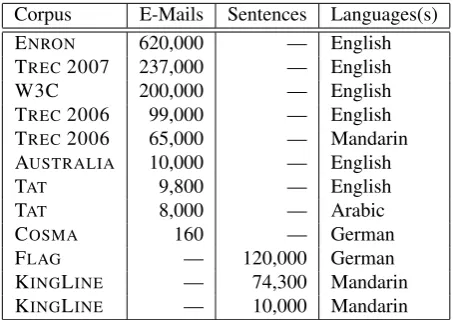
ALLTAG not only differs in size by orders of magnitude from both corpora but also in qualitative terms—its broader stylistic and linguistic variability, avoiding the focus on colloquial, typically erroneous language use only (char-acteristic of the FLAGcorpus), and its thematically much more general scope (COSMAe-mails focus on appointment scheduling, only, and thus incorporate a severe thematic bias). Unlike previous efforts, we additionally supply de-mographic information associated with each e-mail author in order to lay the foundation for a deeper explanatory study of discourse characteristics of e-mails in the future. A sum-mary of currently available e-mail corpora, including basic quantitative parameters, is provided in Table 1.
Corpus E-Mails Sentences Languages(s)
ENRON 620,000 — English
TREC2007 237,000 — English
W3C 200,000 — English
TREC2006 99,000 — English
TREC2006 65,000 — Mandarin
AUSTRALIA 10,000 — English
TAT 9,800 — English
TAT 8,000 — Arabic
COSMA 160 — German
FLAG — 120,000 German
KINGLINE — 74,300 Mandarin
KINGLINE — 10,000 Mandarin
Table 1: Data Sheet for Currently Available E-Mail Cor-pora by Number of E-Mails, Sentences, and Languages Be-ing Covered
3In the Anglo-American language world, only theAustralian
National Corpus(other than theBNCand theANC) already in-cludes e-mail-documents as a contemporary alternative to com-mon written letters and memoranda.
4The 10,000 sentence collection (KING-NLP-L-001) can be
3.
Corpus Design, Corpus Construction and
First Results
In this section, we present the design principles underly-ing CODE ALLTAG, the hybrid data elicitation strategy we pursued and sketch first statistical results. The data acqui-sition procedure for CODE ALLTAGis best described as a hybrid pull-push process. As far as the design principles are concerned, we were interested, on the one hand, in get-ting a large corpus to study structural and linguistic patterns of e-mails. In order to maximize coverage, we created a pull process by drawing e-mails from a super-large, pub-lically accessible e-mail archive. The CODE ALLTAGXL
segment resulting from this approach comes with roughly 1.5M e-mails. On the other hand, exploring in depth stylis-tic and variational patterns in e-mails, we believe that more background knowledge about the individual authors of e-mails could be valuable. Hence, we created apushprocess where we asked our addressees not only to donate one of their e-mails, but also to provide additional author-specific demographic information. This is realized by the CODE ALLTAGS+d segment which comes with a much smaller
size, almost one thousand e-mails. We conclude this sec-tion with first statistical corpus data, as well as an overview of aggregated demographic data of the donors of CODE ALLTAGS+d.
3.1.
Elicitation Process for Gathering E-Mails
for C
ODE A
LLTAGXLThe most common way to assemble corpora from
electronically mediated communication—chats, blogs,
tweets, SMS messages, or e-mail—is to harvest digital archives or ad-hoc collections, such as tweets with spe-cial hashtags. Following the archive-based elicitation strategy of the FLAG corpus (Becker et al., 2003), we also made use of the German part of archived e-mails from various Internet Usenet Newsgroups, accessible via
https://archive.org/details/usenet-de. This is a huge collection comprising more than 35M e-mails from 841 thematic categories (roughly 78GB of storage, raw data only). Fortunately, e-mails stored in this archive are not only publically accessible but there is also no legal entity which is in possession of the IPRs for these e-mails. Hence, the data are open for scientific exploitation. We, finally, selected seven categories from the whole collection of 841 categories:
• de.etc.finanz.boerse(FINANCE) is a collec-tion about financial issues, including stock exchange news,
• de.etc.sprache.deutsch (GERMAN) gathers topics related to the German language,
• de.rec.film.misc(MOVIES) contains informa-tion and discussions about movies,
• de.rec.reisen.misc (TRAVELS) deals with travel reports and tourism,
• de.sci.philosophie (PHILOSOPHY) covers philosophical issues,
• de.talk.jugend (TEENS) contains topics of in-terest for young people, such as teenagers,
• de.talk.tagesgeschehen(EVENTS) relates to events of the day.
In general, the archival material constitutes a ‘dirty’ docu-ment collection containing spam and fake mails on the one hand, and posing lots of character encoding problems (due to non-UTF-8-compliance), on the other hand. A notorious problem, e.g., relates to improperly representing the Ger-mans umlauts (e.g., ‘¨a’ vs. ‘ae’ vs. ‘a’ vs. some garbage se-quence of symbols resulting from arbitrary mappings from the original encoding scheme to some unintended target code), not to mention an excessive level of erroneous lan-guage use (Becker et al., 2003).
By splitting the selected categories into single e-mails us-ing MBOXSPLIT from the APACHE SPAMASSASSINTM
project,5we gathered roughly 1.5M e-mails. The resulting documents’ new line delimiters were unified via TOFRO
-DOSand the first header was removed (we removed all line-up, too, including the first empty line) with the GNU stream editorSED6).7
3.2.
Elicitation Process for Gathering E-Mails
for C
ODE A
LLTAGS+dOne of the major hurdles in assembling and, later on, pub-lically distributing e-mail corpora are privacy regulations related to the sender and recipient(s) of an e-mail. From a legal perspective, each sender of an e-mail is the owner of the text embodied in an e-mail. The ENRONcorpus can clearly be considered an exception, since public accessi-bility was enforced by a U.S. court decision, whereas the privacy statuses of the e-mails collected for the W3C and the TRECcorpora remain undecided. Privacy concerns re-lated to material extracted from publicly accessible e-mail archives (as with FLAGor CODE ALLTAGXL) are hard to
substantiate since legal entities which are in possession of the IPRs of the e-mails can hardly be traced.
In order to avoid such legal issues, several e-mail corpus construction campaigns (E-Mail Australia, TAT, etc.), in-cluding ours for the second segment of CODE ALLTAG, as an alternative, rely on a proactive data elicitation strategy. They follow the push-based donor modelwhere personal e-mails are requested from individual e-mail authors on the basis of a volunteer act and each donation can thus be con-sidered as an act of free will to contribute to the corpus
5
http://svn.apache.org/repos/asf/spamassassin/trunk/tools/mboxsplit 6https://www.gnu.org/software/sed/manual/sed.html
7
We are fully aware that this crude procedure can be sig-nifiantly improved by more sophisticated parsing of the mail body. TheUsenet Historical Collectionsite (https://archive.org/ details/usenethistorical) states that “This historical collection of Usenet spans more than 30 years and was given to us by a gen-erous donor.” A fully adequate parser would thus have to adhere to the plethora of RFCs starting with RFC822 (Standard for the Format for ARPA Internet Text Messages, 1982) and following all its successors to RFC6854 (2013) for basic e-mail, orthogo-nally tracking RFC1341 (Multipurpose Internet Mail Extensions MIME, 1992) and all its successors and updates, among others RFC6532 (Internationalized Email Headers, 2012). Regarding
CODE ALLTAGXL, we neither analyzed the time frame of the
(still, the explicit consent from the donor has to be gained and was implemented in our questionnaire).
As far as CODE ALLTAGS+dis concerned, two elicitation
rounds can be distinguished. We started our project at the University of Leipzig (Germany) and asked students in the introductory undergraduate courses for German linguistics to provide us with one of their personal e-mails, without any changes of the original e-mail body. We then spread our request over the university’s e-mail system and so ex-tended the range of addressees to all other institutes and administrative units of the University of Leipzig. In order to go beyond a purely academic audience, we asked every-body from our addressees to invite their families, friends, colleagues from sport clubs, etc. to contribute an e-mail, as well. The selection of a particular e-mail was not biased at all (although we assume that thematic considerations and private concerns played a decisive role for the final choice) and occurred at the free will of each donor. In particular, we did not articulate any content or formal preferences. In the corpus, we distinguish the original single donated e-mail from the thread it is (sometimes) linked to. In gen-eral, it is not our goal to collect threads (for an analysis of the thread structures of e-mails, cf. Sharaff and Nagwani (2016)), mainly because of the ownership issues discussed above—note that quoted (parts of) e-mails are owned by the original author, not by the quoter.
This ‘Leipzig segment’ is currently going to be comple-mented by the ‘Klagenfurt segment’. At the Alpen-Adria-Universit¨at Klagenfurt (Austria) a similar campaign as in Leipzig has been started and is still running at the time of this writing. Unlike Leipzig, much more public activities have been planned and executed by student staff (e.g., us-ing flyers in public places, personally addressus-ing people in the urban environment at cultural and sports events, involv-ing the public media for advertisinvolv-ing the project, etc.).
3.3.
Pseudonymization of E-Mails
As already mentioned in the previous section, privacy preservation is a crucial issue for handling donated e-mails in a trustworthy manner. Especially, the donor model we have implemented for CODE ALLTAGS+drequires that
pri-vacy concerns have to be obeyed in a strict way to protect the right to informational self-determination of each indi-vidual author. This requirement, in principle, also holds for archival material from which CODE ALLTAGXL was
de-rived.
A standard procedure to get around with this challenge is to either anonymize or pseudonymize raw linguistic data, preferably automatically (Medlock, 2006).8 This
prob-lem resembles requirements imposed on the accessibility and subsequent processing of clinical reports in the med-ical domain (Meystre et al., 2010). The 2007 I2B2 de-identification challenge yielded promising results for auto-matic anonymization in the range of 98% F-score (Uzuner et al., 2007). As far as CODE ALLTAGis concerned, despite its undisputable relevance, we leave this topic for future re-search.
8
Efforts relying on self-anonymization by the donors in the
Australian National Corpus were doomed to failure (Lampert, 2009).
3.4.
Descriptive Properties of C
ODE A
LLTAGIn this section, we briefly introduce some descriptive prop-erties of CODE ALLTAG. We start with an overview of basic statistics of CODE ALLTAGXL(cf. Table 2. A+B).
The number of e-mails (E-MAIL) we identified in the seven categories varies around 200,000 documents per cat-egory and amounts to a total of roughly 1.5M. We fur-ther counted the number of sentences (SENTENCE) and of text tokens in all e-mails (TOKEN counts all running to-kens, whereas TOKEN– is a filtered set, with stop words9
and punctuation marks removed). We, furthermore, deter-mined the number of different text tokens (TYPE–) with reference to TOKEN–, and normalized morphological vari-ants in TYPE– which yielded all lemmata (LEMMA–). The reduction to TOKEN– typically halved the number of TOKENs, whereas the reduction rate from TOKEN– to TYPES– varies roughly between 95% to 97%.
For these basic computations, we used the sentence split-ter and tokenizer from OPENNLP (with German models)10 and a JAVAwrapper for the lemmatization function of the TREETAGGERsoftware.11
From these basic parameters, we determined the average length of sentences (M SENT) measured by the number of text tokens in a sentence (together with their standard deviation), as well as the average length of text tokens (M TOKEN) measured by the number of characters (to-gether with their standard deviation)—both including stop words and excluding punctuation marks. The number of to-kens in sentences varies between 10 to 16 (with large stan-dard deviations), whereas the average token length is quite stable (around 5 characters).
The latter two parameters focus on general corpus proper-ties, whereas the following two parameters emphasize spe-cific properties of e-mails. We distinguish here the aver-age number of sentences per e-mail (M SENT E) from the average number of text tokens per e-mail (M TOKEN E), again including stop words and excluding punctuation marks. E-mails contain typically between 9 to 14 sentences (again, with large standard deviations), the PHILOSOPHY
category being somewhat an outlier, with more than 20 sentences. The number of text tokens per e-mail typically ranges from 180 to 100. There are two deviant categories— on the low end, we find the TEENS category with 72 text tokens on average, whereas at the high end, the PHILOS
-OPHYcategory peaks (again) with more than 280 tokens. The standard deviations are quite large, so there is a lot of variance in the data.
Finally, two common lexico-statistical metrics are applied. Lexical diversity in CODE ALLTAG can be quantified by the type-token ratio
T T R:= T Y P E− T OKEN−
(1)
9
We used the German stop word list available from http:// snowball.tartarus.org/algorithms/german/stop.txt which contains 232 entries.
10https://opennlp.apache.org/ 11
TREETAGGER is available from
Parameter FINANCEXL GERMANXL MOVIESXL TRAVELSXL
E-MAIL 174,375 240,780 205,960 154,184
SENTENCE 2,462,152 2,359,301 2,098,171 1,401,026
TOKEN 36,349,694 30,235,557 34,533,372 21,150,739
TOKEN– 20,453,407 14,507,782 17,914,162 11,144,957
TYPE– 915,970 597,385 691,578 505,832
LEMMA– 730,627 520,619 610,428 446,392
M SENT 12.56 (+/- 15.92) 10.64 (+/- 4.45) 16.35 (+/- 143.36) 15.88 (+/- 137.68)
M TOKEN 5.68 (+/- 2.86) 5.47 (+/- 0.98) 5.35 (+/- 1.12) 5.55 (+/- 1.43)
M SENT E 14.12 (+/- 43.52) 9.8 (+/- 13.52) 10.19 (+/- 18.39) 9.09 (+/- 9.62)
M TOKEN E 178.03 (+/- 527.79) 103.3 (+/- 145.76) 141.81 (+/- 441.76) 116.85 (+/- 350.64)
TTR 0.045 0.041 0.039 0.045
LTR 0.036 0.036 0.034 0.040
Table 2: A: Breakdown of Basic Descriptive Statistical Data of Seven Segments for CODE ALLTAGXL, standard deviation
in rounded brackets
Parameter PHILOSOPHYXL TEENSXL EVENTSXL Σ: CODE ALLTAGXL
E-MAIL 209,558 239,008 246,556 1,470,421
SENTENCE 4,244,784 2,141,299 3,097,027 17,803,760
TOKEN 70,347,007 21,566,493 43,694,803 257,877,665
TOKEN– 31,407,208 10,370,899 20,963,113 126,761,528
TYPE– 918,106 316,511 699,116 3,097,518
LEMMA– 830,521 266,987 605,470 2,779,125
M SENT 13.68 (+/- 45.10) 8.45 (+/- 4.16) 11.36 (+/- 9.00) 12.41 (+/- 72.20)
M TOKEN 5.61 (+/- 1.06) 5.26 (+/- 0.66) 5.77 (+/- 1.97) 5.52 (+/- 1.56)
M SENT E 20.26 (+/- 31.67) 8.96 (+/- 8.30) 12.56 (+/- 16.17) 12.11 (+/- 22.88)
M TOKEN E 281.64 (+/- 479.51) 72.3 (+/- 108.95) 150.05 (+/- 222.51) 147.19 (+/- 351.79)
TTR 0.029 0.030 0.033 0.024
LTR 0.026 0.026 0.029 0.022
Table 2: B: Breakdown of Basic Descriptive Statistical Data of Seven Segments for CODE ALLTAGXL, standard deviation
in rounded brackets
and the lemma-token ratio
LT R:= LEM M A− T OKEN−
(2)
There is a division into two clusters for TTR. Four from seven categories (FINANCE, GERMAN, MOVIESand TRAVELS) vary around 0.04, whereas three from seven cat-egories (PHILOSOPHY, TEENS and EVENTS) are below 0.03. Similar observations are made for the LTR values. Table 3 renders statistical counts for CODE ALLTAGS+d.
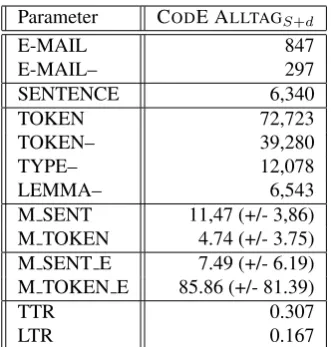
This corpus is considerably smaller and less varied than CODE ALLTAGXL. Altogether, we have 847 e-mails,
ex-cluding threaded e-mails (E-MAIL–), we end up with 297 items. Token, type and lemma counts are based on the sentence splitting, tokenization and stemming option from the TREETAGGER. Yet, it is almost impossible to reason-ably compare both portions because of the low numbers in CODE ALLTAGS+d. Still, M SENT and M TOKEN lie
within the ranges we determined for CODE ALLTAGXL.
Not so surprisingly given the majority of our subjects, the M SENT E and M TOKEN E values are closest to those from the TEENScategory in CODE ALLTAGXL. TTR and
Parameter CODE ALLTAGS+d
E-MAIL 847
E-MAIL– 297
SENTENCE 6,340
TOKEN 72,723
TOKEN– 39,280
TYPE– 12,078
LEMMA– 6,543
M SENT 11,47 (+/- 3,86)
M TOKEN 4.74 (+/- 3.75)
M SENT E 7.49 (+/- 6.19)
M TOKEN E 85.86 (+/- 81.39)
TTR 0.307
LTR 0.167
Table 3: Breakdown of Basic Descriptive Statistical Data for CODE ALLTAGS+d, standard deviation in rounded
brackets
LTR values in CODE ALLTAGS+d deviate markedly from
those in CODE ALLTAGXLdue to the limited size of the
3.5.
Demographic Features of E-Mail Donors in
C
ODE A
LLTAGS+dWhen subjects submitted their e-mail donation to CODE ALLTAGS+d, as a follow-up, a questionnaire was
imme-diately sent to each donor asking for eight demographic variables and self-assessments of the donor, including gen-der, age, regional provenance, educational and professional background, language provenance and preferences, profi-ciency of writing and frequency of e-mailing. Finally, each donor was requested to explicitly grant permission to use the donated e-mail for scientific purposes (if the donor re-frained from giving that permission, the donated e-mail was excluded from CODE ALLTAGS+d).
In our study, the number of females clearly dominates the number of males by a factor of 4:1 (see Table 4). That table also reveals that CODE ALLTAGS+ddonors are almost only
native speakers of German, yet they speak predominantly German dialect(s) rather than high-standard German.
Gender Male Female no answer
% n % n % n
21.2 63 77.1 229 1.7 5
German Native Foreign no answer
% n % n % n
94,3 281 5,2 15 0,4 1
Standard German Dialect no answer
% n % n % n
39.4 117 60.3 179 0,3 1
Table 4: Fundamental Demographic Data for the CODE ALLTAGS+d Corpus; the number of subjects equals
E-MAIL– (= 297) from Table 3
The age distribution (see Figure 1) reveals that more than two thirds of our subjects are between 18 and 34 years old. Due to the university context in which our study took place, this result is not really surprising.
0-17 18-24 25-34 35-49 50-64 >64 no answer
percentage
0
10
20
30
40
50
0.7 (n = 2)
45.1 (n = 134)
25.9 (n = 77)
13.5 (n = 40) 11.4
(n = 34)
2.4 (n = 7) 1.0
(n = 3)
Figure 1: Age Distribution of E-Mail Authors in CODE ALLTAGS+d
The vast majority of our subjects are currently either work-ing (employed) or studywork-ing (students, pupils), at a level of almost 85% (see Figure 2). The level of work being per-formed is biased towards the top level segment (usually as-sociated with academic degrees); almost 76% of our sub-jects are assigned to this group (see Figure 3).
working not working studying no answer
percentage
0
10
20
30
40
50 (n = 140)47.1
13.5 (n = 40)
38 (n = 113)
1.3 (n = 4)
Figure 2: Distribution of Working Statuses of E-Mail Au-thors in CODE ALLTAGS+d
Top Level Mid Level Low Level no answer
percentage
0
20
40
60
80 (n = 225)75.8
11.8
(n = 35) 5.7
(n = 17) (n = 20)6.7
Figure 3: Distribution of Employment Levels of E-Mail Authors in CODE ALLTAGS+d
As far as exposure to e-mail activities is concerned, roughly 93% of the subjects in our sample (see Figure 4) have a long-standing experience in using e-mail (more than 5 years, at least). Also the frequency of e-mail use is high: 50% are active daily e-mailers, 35% active on a weekly ba-sis, at least (see Figure 5).
less than 5 years 5-10 years more than 10 years no answer
percentage
0
10
20
30
40
50
60
70
5.7 (n = 17)
46.5
(n = 138) (n = 139)46.8
1.0 (n = 3)
several times
per day several times per week almost neverrarely or no answer
percentage
0
10
20
30
40
50
60
50.2
(n = 128) (n = 127)34.9
12.7 (n = 37)
2.2 (n = 5)
Figure 5: Distribution of E-Mailing Frequency of E-Mail Authors in CODE ALLTAGS+d
4.
Conclusions
We here presented the first overview of CODE ALLTAG, a text corpus of everyday German language use as embodied in private and semi-formal e-mails. CODE ALLTAG is a hybrid corpus composed of two different parts:
• CODE ALLTAGXLextracted from a publicly
accessi-ble e-mail archive is by far the largest portion, with ap-proximately 1.5M e-mails. With these size numbers, CODE ALLTAG ranks on the top position among the largest e-mail corpora available worldwide.
• CODE ALLTAGS+d, with less than 1,000 e-mails
con-siderably smaller than CODE ALLTAGXL, was newly
generated from scratch on the basis of volunteer e-mail donations, together with demographic data from each e-mail donor.
Both elicitations campaigns are on-going. CODE ALL
-TAGXL should grow up to 35M e-mails, the total number
of e-mails accessible in the German partition of theUsenet archive. However, these data are inherently ‘dirty’ and need a lot of curation prior to further processing and distribution. For the full version of CODE ALLTAGS+d, we plan to elicit
around 3,000 to 5,000 e-mails, plus demographic data of their donors.
Prior to public distribution, both partitions will undergo safe pseudonymization procedures. Once this is done, we hope to supply the community with a balanced corpus that should cover the language in e-mails in many different communication contexts, from (more or less) formal to in-formal language use. This balance seems currently not given in other corpus building and maintenance initiatives, for German, as well as for other natural languages. Furthermore, in the future, we will extend CODE ALLTAG
by syntactic metadata (such as POS tags, chunks, parsing structures, predicate argument structures), as well as se-mantic metadata (e.g., for named entity recognition, emo-tional language use, etc.).(Lawson et al., 2010) The for-mer will lay the foundations for an even deeper compar-ison with structural and statistical properties of German-language newspaper (TIGER(Brants et al., 2004), T ¨UBA -D/Z (Telljohann et al., 2004)) and national reference cor-pora (DEREKO (Kupietz et al., 2010) and DWDS CORE
(Geyken, 2007)).
In summary, we not only envisage a multitude of studies in-vestigating the text genre specificity of e-mails, their com-parison with other text corpora and their inherent sampling biases in order to create more balanced corpora. We also believe that the availability of complementary demographic data, such as those contained in CODE ALLTAGS+d, will
spur future investigations focusing on language style and different language varieties by exploiting heterogeneous and large corpora, such as CODE ALLTAGXL.
5.
Bibliographical References
Andersen, O., Nioche, J., Briscoe, E. J., and Carroll,
J. A. (2008). The BNC parsed with RASP4UIMA. In
LREC 2008 — Proceedings of the 6th International Con-ference on Language Resources and Evaluation. Mar-rakech, Morocco, 26 May - June 1, 2008, pages 865–869.
Aston, G. and Burnard, L. (1997). The BNC Handbook.
Exploring the British National Corpus withSARA. Ed-inburgh University Press.
Atefeh, F. and Inkpen, D. Z. (2015). Natural Language Processing for Social Media. Morgan & Claypool. Balahur, A. (2013). Sentiment analysis in social media
texts. InWASSA 2013 — Proceedings of the 4th Work-shop on Computational Approaches to Subjectivity, Sen-timent and Social Media Analysis @ NAACL-HLT 2013. Atlanta, Georgia, USA, 14 June 2013, pages 120–128. Becker, M., Bredenkamp, A., Crysmann, B., and Klein, J.
(2003). Annotation of error types for German newsgroup corpus. In Anne Abeill´e, editor,Treebanks. Building and Using Parsed Corpora, pages 89–100. Springer. Beißwenger, M., Ermakova, M., Geyken, A., Lemnitzer,
L., and Storrer, A. (2013). DERIK: A German reference corpus of computer-mediated communication. Literary and Linguistic Computing, 28(4):531–537.
Brants, S., Dipper, S., Eisenberg, P., Hansen-Schirra, S., K¨onig, E., Lezius, W., Rohrer, C., Smith, G., and Uszko-reit, H. (2004). TIGER: Linguistic interpretation of a
German corpus. Research on Language and
Computa-tion, 2(4):597–620.
Burchardt, A., Erk, K., Frank, A., Kowalski, A., Pad´o, S., and Pinkal, M. (2006). The SALSA corpus: A German corpus resource for lexical semantics. InLREC 2006 – Proceedings of the 5th International Conference on Lan-guage Resources and Evaluation. Genoa, Italy, 22-28 May, 2006, pages 969–974.
Cormack, G. V. (2006). TREC2006 Spam Track overview. InTREC 2006 – Proceedings of the 15th Text REtrieval Conference. Gaithersburg, Maryland, November 14-17, 2006, pages 117–127.
Cormack, G. V. (2007). TREC2007 Spam Track overview. In TREC 2007 – Proceedings of the 16th Text RE-trieval Conference. Gaithersburg, Maryland, November 5-9, 2007.
Estival, D., Gaustad, T., Pham, S., Radford, W., and Hutchinson, B. (2007). TAT: An author profiling tool
with application to Arabic emails. In Proceedings of the Australasian Language Technology Workshop 2007. Melbourne, Australia, 10-11 Dec. 2007, pages 21–30. Geyken, A. and Gloning, T. (2015). A living text archive
of 15th-19th-century German: Corpus strategies, tech-nology, organization. InHistorical Corpora: Challenges and Perspectives. Proceedings of the Conference. Frank-furt a. Main, Germany, December 6-8, 2012, pages 165– 180. Gunter Narr, T¨ubingen.
Geyken, A. (2007). The DWDS corpus: A reference cor-pus for the German language of the 20th century. In C. Fellbaum, editor,Idioms and Collocations, pages 23– 40. Continuum.
Ide, N. (2009). The American National Corpus: Then, now, and tomorrow. InSelected Proceedings of the 2008 HCSNet Workshop on Designing the Australian National Corpus: Mustering Languages, pages 108–113.
Iqbal, F., Fung, B., and Debbabi, M. (2012). Mining crimi-nal networks from chat log. InWI-IAT 2012 — Proceed-ings of the 2012 IEEE/WIC/ACM International Confer-ences on Web Intelligence and Intelligent Agent Technol-ogy. Macau, China, Dec. 4-7, 2012, pages 332–337.
Klimt, B. and Yang, Y. (2004). The ENRON corpus: A
new dataset for email classification research. InMachine Learning. Proceedings of the 15th European Conference on Machine Learning – ECML 2004. Pisa, Italy, Septem-ber 20-24, 2004, number 3201 in Lecture Notes in Com-puter Science, pages 217–226, Berlin. Springer.
Kupietz, M., Belica, C., Keibel, H., and Witt, A. (2010). The German reference corpus DEREKO: A primordial sample for linguistic research. In LREC 2010 — Pro-ceedings of the 7th International Conference on Lan-guage Resources and Evaluation. La Valletta, Malta, May 17-23, 2010, pages 1848–1854.
Lampert, A. (2009). Email in the Australian National Corpus. In Selected Proceedings of the 2008 HCSNet Workshop on Designing the Australian National Corpus: Mustering Languages, pages 55–60.
Lawson, N., Eustice, K., Perkowitz, M., and Yetisgen-Yildiz, M. (2010). Annotating large email datasets for named entity recognition with Mechanical Turk. In Pro-ceedings of the Workshop on Creating Speech and Lan-guage Data with Amazon’s Mechanical Turk @ NAACL-HLT 2010. Los Angeles, CA, June 6, 2010, pages 71–79. MacLeod, N. and Grant, T. D. (2012). Whose tweet? Au-thorship analysis of micro-blogs and other short-form. In Proceedings of the International Association of Forensic Linguists’ 10th Biennial Conference. Aston University, Birmingham, July 2012, pages 210–224.
Marcus, M. P., Santorini, B., and Marcinkiewicz, M. A. (1993). Building a large annotated corpus of English: The PENN TREEBANK. Computational Linguistics, 19(2):313–330.
Medlock, B. (2006). An introduction to NLP-based
tex-tual anonymisation. In LREC 2006 — Proceedings of
the 5th International Conference on Language Resources and Evaluation. Genoa, Italy, 22-28 May, 2006, pages
1051–1056.
Meystre, S. M., Friedlin, F. J., South, B. R., Shen, S., and Samore, M. H. (2010). Automatic de-identification of textual documents in the electronic health record:
A review of recent research. BMC Medical Research
Methodology, 10:#70.
Pak, A. and Paroubek, P. (2010). Twitter as a corpus for sentiment analysis and opinion mining. InLREC 2010 — Proceedings of the 7th International Conference on Language Resources and Evaluation. La Valletta, Malta, May 17-23, 2010, pages 1320–1326.
Palmer, M. S., Gildea, D., and Kingsbury, P. (2005). The PROPOSITIONBANK: An annotated corpus of semantic roles.Computational Linguistics, 31(1):71–106. Saur´ı R., Domingo, J., and Badia, T. (2014). The NEW
-SOME corpus: A unifying opinion annotation frame-work across genres and in multiple languages. InLREC 2014 — Proceedings of the 9th International Conference on Language Resources and Evaluation. Reykjavik, Ice-land, May 26-31, 2014, pages 2229–2236.
Scheffler, T. (2014). A German Twitter snapshot. InLREC 2014 — Proceedings of the 9th International Conference on Language Resources and Evaluation. Reykjavik, Ice-land, May 26-31, 2014, pages 2284–2289.
Schwartz, H. A., Eichstaedt, J. C., Dziurzynski, L., Kern, M. L., Seligman, M. E. P., Ungar, L. H., Blanco, E., Kosinski, M., and Stillwell, D. (2013). Toward person-ality insights from language exploration in social me-dia. InAnalyzing Microtext: Papers from the 2013 AAAI Spring Symposium, pages 72–79. AAAI Press.
Sharaff, A. and Nagwani, N. K. (2016). Email thread identification using latent Dirichlet allocation and non-negative matrix factorization based clustering tech-niques.Journal of Information Science, 42(2):200–212. Sokolova, M. and Lapalme, G. (2011). Learning opinions
in user-generated Web content.Natural Language Engi-neering, 17(4):541–567.
Song, Z., Strassel, S., Lee, H., Walker, K., Wright, J., Gar-land, J., Fore, D., Gainor, B., Cabe, P., Thomas, T., Calla-han, B., and Sawyer, A. (2014). Collecting natural SMS and chat conversations in multiple languages: The BOLT
phase 2 corpus. InLREC 2014 — Proceedings of the 9th International Conference on Language Resources and Evaluation. Reykjavik, Iceland, May 26-31, 2014, pages 1699–1704.
Telljohann, H., Hinrichs, E. W., and K¨ubler, S. (2004). The T ¨UBA-D/Z TREEBANK: Annotating German with a context-free backbone. InLREC 2004 — Proceedings of the 4th International Conference on Language Re-sources and Evaluation. Lisbon, Portugal, 24-30 May, 2004, pages 2229–2235.
Uthus, D. C. and Aha, D. W. (2013). The UBUNTU chat corpus for multi-participant chat analysis. InAnalyzing Microtext: Papers from the 2013 AAAI Spring Sympo-sium, pages 99–102. AAAI Press.