Universal Dependencies for Norwegian
Lilja Øvrelid, Petter Hohle
Department of Informatics,University of Oslo
{liljao,pettehoh}@ifi.uio.no
Abstract
This article describes the conversion of the Norwegian Dependency Treebank to the Universal Dependencies scheme. This paper details the mapping of PoS tags, morphological features and dependency relations and provides a description of the structural changes made to NDT analyses in order to make it compliant with the UD guidelines. We further present PoS tagging and dependency parsing experiments which report first results for the processing of the converted treebank. The full converted treebank was made available with the 1.2 release of the UD treebanks.
Keywords:Dependency treebanks, Universal Dependencies, dependency parsing
1.
Introduction
With the increasing popularity of dependency-based repre-sentations of syntactic structure in recent years, a wealth of different dependency annotation schemes have surfaced. It has been shown that the choice of dependency scheme influences parsing results (Schwartz et al., 2012) as well as downstream applications (Elming et al., 2013) and even though attempts have been made to contrast differ-ent schemes theoretically (Ivanova et al., 2012), it is clear that the diversity of representation makes comparisons dif-ficult. Cross-linguistically even more so, and it can often be difficult to tease apart aspects of annotation scheme from typological differences in cross-lingual learning (Søgaard, 2011; Skjærholt and Øvrelid, 2012).
Universal Dependencies (UD) (de Marneffe et al., 2014; Nivre, 2015) is a recent community-driven effort to cre-ate cross-linguistically consistent syntactic annotation. UD is based on the Stanford dependency scheme (de Marneffe et al., 2006) which has become a widely used dependency scheme for English in recent years. A number of existing dependency treebanks have been converted to UD (Pyysalo et al., 2015; Nivre, 2014) and new data has also been an-notated from scratch in order to enable multilingual parser development, cross-lingual learning and typological stud-ies of syntactic structure. Treebanks involved in this effort represent a diverse range of languages such as English, Ger-man, Swedish, Spanish, Italian, Persian, Japanese, and the UD release 1.2 contains treebanks for as many as 33 differ-ent languages of varying sizes.
This paper describes a fully automatic conversion proce-dure for the Norwegian Dependency Treebank (NDT) to UD. Due to differences both in the tag set, as well as struc-tural analyses, the conversion requires non-trivial transfor-mations of the dependency trees, in addition to mappings of tags and labels that make reference to a combination of various kinds of linguistic information. This paper details the mapping of PoS tags, morphological features and de-pendency relations and provides a description of the struc-tural changes made to NDT analyses in order to make it compliant with the UD guidelines. We further present PoS-tagging and dependency parsing experiments which con-trast the performance of a state-of-the-art PoS-tagger and dependency parser on the original and converted treebank.
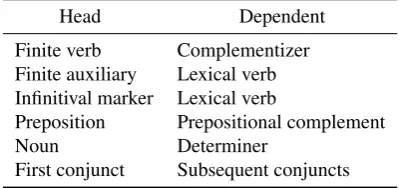
Head Dependent
Finite verb Complementizer Finite auxiliary Lexical verb Infinitival marker Lexical verb
Preposition Prepositional complement Noun Determiner
[image:1.595.322.522.274.368.2]First conjunct Subsequent conjuncts
Table 1: Annotation choices in the NDT
The full converted treebank was made available with the 1.2 release of the UD treebanks (Nivre et al., 2016), which contains 37 treebanks for a total of 33 different languages.
2.
NDT and UD
The Norwegian Dependency Treebank (NDT) (Solberg et al., 2014) contains morphological and syntactic depen-dency annotation for both varieties of written Norwegian (Bokmål and Nynorsk).1 The morphological annotation follows the Oslo-Bergen Tagger scheme (Hagen et al., 2000). The syntactic annotation scheme is, to a large ex-tent, based on the Norwegian Reference Grammar (Faar-lund et al., 1997) and the dependency representations are inspired by choices made in comparable treebanks, in par-ticular the Swedish treebank Talbanken (Nivre et al., 2006). Skjærholt (2014) quantified inter-annotator agreement us-ing a chance-corrected metric derived from Krippendorff’s
αand showed that agreement on the NDT data is high: scor-ing an αof about 98%, among the highest of all the data sets studied. The annotation guidelines (Kinn et al., 2013) describe the annotation scheme in some detail and Table 1 summarizes the main annotation choices in NDT (Solberg et al., 2014).
Universal Dependencies (UD) builds on several previous initiatives for universally common morphological (Zeman, 2008; Petrov et al., 2012) and syntactic dependency (Mc-Donald et al., 2013; Rosa et al., 2014) annotation. Among
1
NDT UD
adj ADJ
adv ADV
clb PUNCT,SYM
det DET,NUM
konj CONJ
interj INTJ
inf-merke PART
prep ADP,ADV
pron PRON
<komma> PUNCT
sbu SCONJ
<strek> PUNCT
subst NOUN,PROPN
<anf> PUNCT <parentes-slutt> PUNCT <parentes-beg> PUNCT
symb SYM
ukjent X
[image:2.595.314.529.70.343.2]verb AUX,VERB
Table 2: Mapping between NDT and UD parts-of-speech
its main tenets are the primacy of content-words, i.e. con-tent words, as opposed to function words, are syntactic heads wherever possible. It is intended to be a universal an-notation scheme, i.e. applicable to any language, however also offers some possibilities for language-specific infor-mation. With reference to the NDT annotation choices in Table 1, the UD scheme adopts the reverse attachment for auxiliaries, infinitival markers and prepositions.
3.
Parts-of-speech
The part-of-speech tag set used in the UD scheme is based on the Universal PoS tag set of Petrov et al. (2012) and contains 17 tags. The NDT tag set contains 19 tags. The conversion of the part-of-speech information in NDT to the UD PoS tag set is fairly straightforward and largely relies on a direct mapping presented in Table 2. A few parts-of-speech require conversion rules which make reference to additional information in the treebank, represented by dis-junction in the mapping. Below we will discuss a few of these cases.
The universal scheme makes a distinction between proper and common nouns at the part-of-speech level. This infor-mation can be found among the morphological features in NDT (prop), hence the mapping is straightforward. For verbs, UD distinguishes auxiliaries (AUX) from main verbs (VERB). This distinction is not explicitly made in NDT, hence our conversion procedure must make use of the syntactic structure of the verbs in order to implement this distinction. Verbs that have a direct, non-finite dependent (a dependent with the NDT dependency relation INF) are marked as auxiliaries and all other verbs as regular verbs. The relative pronounsom’who/that’ is analyzed as a sub-junction in NDT, whereas the universal scheme, and thus our conversion, uses the pronominal tag PRON for these words.
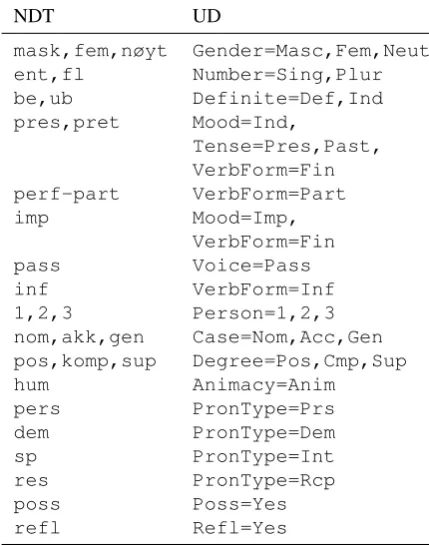
NDT UD
mask,fem,nøyt Gender=Masc,Fem,Neut ent,fl Number=Sing,Plur
be,ub Definite=Def,Ind
pres,pret Mood=Ind,
Tense=Pres,Past, VerbForm=Fin perf-part VerbForm=Part
imp Mood=Imp,
VerbForm=Fin
pass Voice=Pass
inf VerbForm=Inf
1,2,3 Person=1,2,3
nom,akk,gen Case=Nom,Acc,Gen pos,komp,sup Degree=Pos,Cmp,Sup
hum Animacy=Anim
pers PronType=Prs
dem PronType=Dem
sp PronType=Int
res PronType=Rcp
poss Poss=Yes
[image:2.595.83.257.73.320.2]refl Refl=Yes
Table 3: Mapping between NDT and UD morphologi-cal features
NDT explicitly marks headings using the|symbol, tagged as a clause boundary (clb) along with information in the morphological features (<overskrift>). These are con-verted to the UD symbol tagSYM.
Numerical expressions, e.g.to’two’ or45are tagged as de-terminers in NDT, also when they do not explicitly mod-ify a nominal, e.g. de to gjorde en imponerende innsats
’the two did an impressive job’. These are however marked askvant(quantificational) in the morphological features, hence the conversion mapping makes reference to this prop-erty in order to distinguishNUMfromDET.
NDT implements a somewhat broader definition of preposi-tions than the UD scheme and includes several cases which are counted as adverbs in the universal schemes. In par-ticular, this is the case for demonstrative adverbs such as
her’here’ andder’there’. These are followingly converted to adverbs (ADV) in the PoS conversion, whereas all other prepositions are converted toADP.
4.
Morphological information
5.
Structural conversion
The NDT annotation scheme differs structurally from the UD scheme in a number of important ways. The conver-sion is therefore non-trivial and requires a set of structural rules which operate on the dependency graphs in addition to a mapping procedure over the dependency labels. The conversion is implemented as a cascade of structural rules followed by a relation conversion procedure over the mod-ified graph structures. The structural rules employ a small set of graph operations that reverse, reattach, delete and add arcs.
5.1.
Root
In NDT, there is no designated root label. Rather, the root of the dependency graph may have different labels, e.g.FINV
(finite verb) or FRAG(fragment), depending on the struc-ture of the sentence. In the conversion, every node with the dummy node (0) as head receives therootrelation.
5.2.
Verbal groups
NDT consistently marks the finite verb as head of a clause, with other non-finite verbs as dependents (INFV), see ex-ample (1a). In a parallel manner, infinitival markers are also annotated as heads with the infinitival verb as its depen-dent, see (2a). UD on the other hand annotates the lexical, main verb as head of the verbal group and various finite and non-finite auxiliaries receive an auxiliary relation (aux, auxpass) , see (1b) and (2b) below. The conversion rule locates the main verb within the chain of nonfinite depen-dents of the finite verb and makes this node the head of the other verbs in the chain.
(1) a)
skal ha sett
shall have seen
INFV INFV
b)
skal ha sett
shall have seen aux
aux
(2) a)
å ha sett
to have seen
INFV INFV
b)
å ha sett
to have seen mark
aux
5.3.
Copula constructions
The treatment of copula constructions within the UD scheme differs markedly from that of the NDT by appoint-ing the predicative element as head of the entire construc-tion and attaching the copula verb with a special relaconstruc-tion
cop, see (3b). Our conversion thus reverses the arc between the copula and its complement and reattaches all its depen-dents to the predicative element.
(3) a)
de er fattige
they are poor
SUBJ SPRED FINV
b)
de er fattige
they are poor nsubj
cop root
5.4.
Prepositions and their complements
In NDT, prepositions are heads of their prepositional complements which receive the PUTFYLL label, see (4a). Seeing that languages differ greatly in their use of pre/postpositions, the UD scheme annotates the preposi-tional complement as head and attaches the preposition us-ing the caserelation, see (4b). In the conversion, this is once again a matter of reversing the arc and reattaching de-pendents to the new head.
(4) a)
på menyen
on menu-the
PUTFYLL
b)
på menyen
on menu-the case
5.5.
Predicatives
NDT distinguishes several types of predicatives, both pred-icatives that are arguments of verbs (subject predicative
SPREDand object predicativeOPRED) and “free predica-tives” which are not arguments of the verb, but nonetheless characterize either a subject or an object in the preceding context (free subject predicative FSPREDand free object predicativeFOPRED). Both of these are attached to the fi-nite verb in NDT, as we can see in (5a). In a similar manner, UD distinguishes between obligatory and optional predica-tives, where the former are analyzed using thexcomp re-lation and attached to the main predicate, whereas the op-tional predicatives are attached as adverbial clauses (acl) modifying the argument they characterize, see (5b). Our conversion thus attaches theFSPREDargument to its sib-ling subject argument,FOPREDto an object sibling.
(5) (a)
taler Solstad uredd
speaks Solstad unscared
SUBJ FSPRED
(b)
taler Solstad uredd
speaks Solstad unscared nsubj acl
5.6.
Coordination
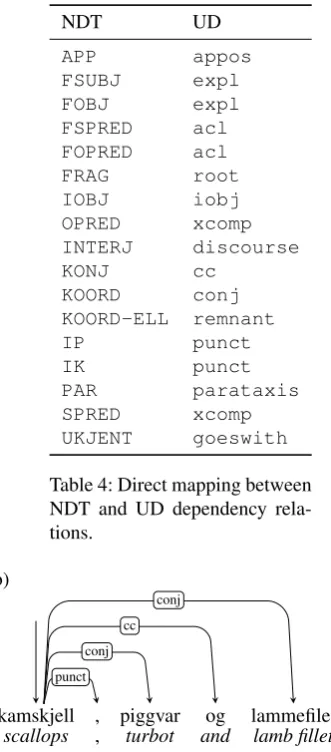
Coordination is a phenomenon which exhibits considerable variation in terms of dependency representation across var-ious annotation schemes (Popel et al., 2013). As we can see in example in (6), the analyses in the NDT and UD schemes are fairly similar in their choice of the first conjunct as head of the coordinate structure. They differ mainly in the attach-ment of the conjunction and the relation names.
(6) (a)
kamskjell , piggvar og lammefilet
scallops , turbot and lamb fillet
IK KOORD
KOORD
NDT UD
APP appos
FSUBJ expl
FOBJ expl
FSPRED acl FOPRED acl
FRAG root
IOBJ iobj
OPRED xcomp
INTERJ discourse
KONJ cc
KOORD conj
KOORD-ELL remnant
IP punct
IK punct
PAR parataxis
SPRED xcomp
[image:4.595.79.245.67.444.2]UKJENT goeswith
Table 4: Direct mapping between NDT and UD dependency rela-tions.
(b)
kamskjell , piggvar og lammefilet
scallops , turbot and lamb fillet punct
conj cc
conj
6.
Conversion of dependency relations
A minority of the dependency relations in NDT may be converted directly, based on the mapping described in Table 4, the rest require the formulation of mapping constraints which make reference to information in addition to the de-pendency relation itself, i.e. part-of-speech tag, morpholog-ical features, dependency structure or even a combination of these. An overview of the non-direct mapping of depen-dency relations that require additional information from the linguistic context is provided in Table 5. These mappings often also require heuristics which approximate some syn-tactic property which is not explicitly annotated in NDT. Below we will present these heuristics and their usage in the conversion.Active/Passive There are two ways of expressing passive voice in Norwegian: a morphological passive expressed by an addition of a-sto the verb, e.g.danses’to be danced’ or a periphrastic passive which is composed of the auxiliary
bli’to become’ and a participle form, e.g.danset’danced’. Only the morphological passive is marked explicitly as be-ing in the passive voice. We therefore define a heuristic which counts a lexical main verb as passive, if it is (i) a morphological passive, or (ii) is a participle headed by a form of the auxiliarybli. This heuristic is used in the con-version of passive auxiliariesauxpassand passive sub-jectsnsubjpass, csubjpass.
Nominal/Clausal Several of the UD relations assume a distinction between nominal and clausal elements. This dis-tinction is complicated somewhat by the fact that in cop-ula constructions, as described above, the complement of the copula is head of the construction as a whole. This means that adjectives or even nouns may be counted as clausal in contexts where they have a copula dependent, as in (3b). In the conversion we introduce a notion of a
predicate, which may be either verbal (AUX, VERB) or the complement in a copula construction. This notion is used to distinguish nominal and clausal subjects (nsubj, nsubjpassvs.csubj, csubjpass), objects (dobj
vs.ccomp, xcomp), various modifiers (nmodvs.acl) and adverbials (nmodvs.advcl).
Control UD is inspired by the syntactic framework of Lexical Functional Grammar (Kaplan and Bresnan, 1982) and adopts its distinction between complement clauses with obligatory subject control (xcomp) and those without (ccomp). The notion of control is not native to NDT, hence we approximate it by requiring the presence of an explicit subject dependent of the head verb of the clause.
Negation UD distinguishes negation modifiers which modify either a noun (no problem) or a predicate (in the aforementioned sense) (is not a problem, doesn’t argue). Our conversion explicitly marks the negative determiner (ingen ’no’) and the negative adverb (ikke’not’) in Nor-wegian.
Particles NDT distinguishes between transitive and in-transitive prepositions, or so-called particles, in the anno-tation. In order to account for the relation between the verb and its particle we introduce the language-specific relation
compound:prt, for prepositions which are attached to a verb and furthermore does not have an explicit preposi-tional complement, e.g.si opp’discontinue’ (lit. ’say up’). On manual inspection of the converted data, we find that this conversion also gives us the preposition in fixed ex-pressions which require the combination of a verb, direct object and a preposition, such assnu ryggen til’turn (one’s) back to’ as well as certain fixed combinations of preposi-tions which function as a whole syntactically, e.g.til og med
’even (lit. to and with)’. Without any existing annotation, distinguishing these from the regular particle constructions automatically is difficult.
Relative clauses The analyses of relative clauses differ notably between the two annotation schemes. Both schemes treat the relative clause as a clausal modifier of a nominal element (ATRvsacl), however, the treatment of the rela-tive marker/pronoun differs. NDT treats relarela-tive markers as subordinating conjunctions which depend on the finite verb of the relative clause,2while UD treats the relative marker as a pronoun which occupies an argument relation in the relative clause. In our conversion, we introduce a language-specific variant of the clausal relationacl,acl:relcl
which signals that this is a relative clause. The relative
2
NDT UD
ADV advcl, advmod,
compound:prt, neg, nmod
ATR acl:relcl, amod,
nmod
DET nmod, nummod, det
FINV aux, auxpass, root
FLAT foreign, name
OBJ, POBJ dobj, ccomp, xcomp
SBU nsubj, nsubjpass,
dobj, iobj, mark SUBJ, PSUBJ nsubj, nsubjpass,
[image:5.595.336.508.70.157.2]csubj, csubjpass
Table 5: Non-direct mapping between NDT and UD dependency relations; requires additional con-straints with reference to PoS, morphological fea-tures or dependency context.
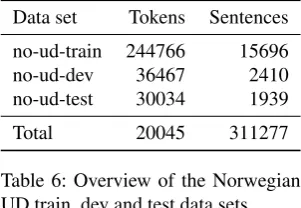
Data set Tokens Sentences
no-ud-train 244766 15696 no-ud-dev 36467 2410 no-ud-test 30034 1939
[image:5.595.68.268.73.248.2]Total 20045 311277
Table 6: Overview of the Norwegian UD train, dev and test data sets.
marker som ’that’ receives an argument role based on a heuristic which checks for the presence or absence of other argument siblings.
7.
The converted treebank
Following the conversion of the Norwegian Dependency Treebank to Universal Dependencies scheme, 51.5% of the tokens in the original treebank were reattached. The result-ing treebank contains 17 PoS tags and 35 different morpho-logical features for 311,277 tokens of Norwegian Bokmål. All UD treebanks consist of three data sets: a training, de-velopment and test set. In creating these data splits for Nor-wegian, care has been taken to preserve contiguous texts in the different splits and also to keep a balance of genres in each of the splits. Table 6 shows an overview of the Norwe-gian UD data sets in terms of tokens and sentences.
8.
Tagging and parsing into UD
Without a gold standard for Norwegian UD dependen-cies, it is difficult to evaluate our conversion directly. We may however, evaluate PoS-tagging and dependency pars-ing performance for the converted treebank. In the follow-ing, we report on a set of experiments which investigate the performance of a state-of-the-art PoS-tagger and parser trained and evaluated on the converted Norwegian UD tree-bank. Even though the data sets are not strictly comparable, we contrast the performance of the taggers and parsers with the results for the original NDT scheme. We further investi-gate the effect of using the automatically assigned PoS-tagsAccuracy
Data set Tag set NDT UD
[image:5.595.94.245.317.421.2]Dev Coarse 97.90% 96.96% Dev Fine 93.74% 94.59% Test Coarse 97.82% 96.82% Test Fine 93.19% 94.15%
Table 7: Overview of the results from tag-ging NDT and UD with the various data sets and tag set.
during parsing in order to achieve a maximally realistic set-ting.
8.1.
PoS-tagging
For PoS-tagging, we experiment with two different tag sets: a coarse tag set, consisting of the simple PoS-tags in the two schemes (NDT and UD), and a fine-grained set, which rep-resents the concatenation of the PoS-tag and the morpho-logical features. The original tag set of NDT comprises 19 tags, 12 of which are morphosyntactic tags3, while its fine-grained counterpart totals 368 tags. For UD, the coarse-grained tag set consists of 17 tags and the corresponding fine-grained tag set of UD comprises 169 tags.
The PoS-tagging was performed by SVMTool4 (Giménez and Màrquez, 2004), employing strategy 1, which proved to be optimal for tagging NDT in previous work (Hohle, 2016). All experiments are performed on the data splits de-tailed in Table 6.
The results for PoS-tagging are presented in Table 7. The PoS-tagger obtains an accuracy of 96.96% on the dev set and 96.82% on the test set. For the fine-grained UD set, the performance drops to 94.59% (dev) and 94.15% (test). In general, we observe that tagging accuracy is higher on NDT with the original tag set, while UD surpasses NDT when using the fine-grained tag set. This is as expected, as the fine-grained tag set of NDT contains almost 200 more tags than that of UD, which markedly complicates the tag-ging.
An error analysis reveals that for both schemes, the recognition of interjections (interj, INTJ) and un-known/foreign words (ukjent, X) are difficult. We fur-ther note that the UD distinction between auxiliaries and main verbs seems difficult to make. For the NDT-tagger, the
verbtag has an F-score of 97%, whereas the UD VERB
and AUXtags receive F-scores of 94% and 91%, respec-tively.
8.2.
Dependency parsing
We perform a set of parse experiments in order to evaluate the UD scheme for Norwegian, and further compare these results to those obtained using the original NDT schemes. In our experiments, we further contrast the use of gold vs. automatically assigned PoS-tags during training and test-ing. For the experiments using automatically assigned PoS-tags, the parser was both trained and tested on automatically
3The remaining tags describe various types of punctuation,
such as commas, dashes, etc.
LAS UAS
Data Tags NDT UD NDT UD
Dev Gold 90.15% 88.50% 92.51% 91.13% Dev Auto 86.73% 83.91% 89.99% 87.16% Test Gold 90.55% 88.54% 92.76% 91.21% Test Auto 86.76% 83.86% 90.13% 87.16%
Table 8: Overview of the results from parsing NDT and UD with the various data sets and tag setups.
assigned tags, as this proved to give slightly better results on the development set.
All experiments are performed on the data splits detailed in Table 6. For the experiments, we employ the Mate parser5 (Bohnet, 2010), as it proved best in previous work on pars-ing of NDT (Solberg et al., 2014). It was run on dev and test sets in separate experiments, with either gold or automatic tags (i.e., the coarse-grained tags as predicted by SVMTool as described above). When using automatic tags, the mor-phological features are excluded from the data set, for the most realistic comparison.
The parsing results are presented in Table 8. We find that the UD-parser obtains a labeled accuracy score (LAS) of 88.5% on both the dev and test sets using gold standard PoS-tags. The corresponding results for the NDT-parser are 90.15% (dev) and 90.55% (test).
The drop in results compared to the NDT scheme is not surprising. As noted in previous work (de Marneffe et al., 2014), several of the design choices of the UD scheme, such as the attachment of auxiliaries and prepositions to content words, are known to be more difficult to parse than their re-verse counterparts (Schwartz et al., 2012). The UD scheme is not primarily designed to give optimal parse results and is further designed to be cross-lingually applicable. A sim-ilar trend was observed for Danish UD parsing (Johannsen et al., 2015). They observed a drop in results from the orig-inal 84.38% LAS to 81.56 % LAS for UD. For Bulgarian, Osenova and Simov (2015) observed a drop from 89.14% to 83.5% for a preliminary version of their UD conversion. In the experiments using automatically assigned tags (Auto), we combine the output of the taggers described in the previous section with the NDT and UD parsers. As ex-pected, we observe a drop in parse results when we switch to automatically assigned PoS-tags. For the UD-parser, we observe a drop of 4.6 percentage points, whereas the corre-sponding figure for the NDT-parser is 3.4 percentage points (on the dev sets). It is clear that the somewhat lower tagging accuracy for the UD treebank influences parsing results. An error analysis in terms of dependency relation assign-ment and attachassign-ment, shows that the distinction of various clausal dependency relations (acl, advcl, csubj, xcomp, ccomp) are challenging for the parser. Also, the assignment of the expletive relation explis challenging for the UD parser. Since the neuter pronoundet’it’ may be both referential and non-referential in Norwegian and has the same PoS-tag regardless of referentiality, this clearly constitutes a complex distinction.
5code.google.com/archive/p/mate-tools
9.
Conclusion
This article has presented a fully automatic conversion of the Norwegian Dependency Treebank to Universal Depen-dencies. The conversion consists of a set of mappings for PoS tags, morphological features and dependency relations as well as structural rewrite rules that transform the NDT analyses to Universal Dependencies. In order to evaluate the conversion we employ the treebank in a set of tagging and parsing experiments which show that even though the results are lower than for the original scheme, the UD ver-sion is still as viable option for processing of Norwegian text. The results are shown to be in line with those observed for several other UD converted treebanks.
This article has presented the first release of the Norwegian UD treebank. The conversion is still under development, and we plan to release new versions along with the com-ing releases of the UD treebank. An important line of work in the time to come is to increase the consistency of the UD treebanks, and efforts are being made to make the Nor-wegian data set more consistent with the other Germanic treebanks in particular. We also plan to include the data for the other written variant of Norwegian (Nynorsk) from the original NDT treebank in one of the next releases.
10.
References
Bohnet, B. (2010). Very High Accuracy and Fast Depen-dency Parsing is not a Contradiction. In Proceedings of the 23rd International Conference on Computational Linguistics, pages 89–97, Beijing, China.
de Marneffe, M.-C., MacCartney, B., and Manning, C. D. (2006). Generating typed dependency parses from phrase structure parses. In Proceedings of the Interna-tional Conference on Language Resources and Evalua-tion (LREC), pages 449–454.
de Marneffe, M.-C., Dozat, T., Silveira, N., Haverinen, K., Ginter, F., Nivre, J., and Manning, C. D. (2014). Univer-sal Stanford dependencies. A cross-linguistic typology. InProceedings of the International Conference on Lan-guage Resources and Evaluation (LREC), pages 4585– 4592.
Elming, J., Johannsen, A., Klerke, S., Lapponi, E., Mar-tinez, H., and Søgaard, A. (2013). Down-stream effects of tree-to-dependency conversions. In Proceedings of the 2013 Conference of the North American Chapter of the Association for Computational Linguistics: Human Language Technologies, pages 617–626, Atlanta, Geor-gia, USA.
Faarlund, J. T., Lie, S., and Vannebo, K. I. (1997). Norsk referansegrammatikk. Universitetsforlaget, Oslo, Nor-way.
Giménez, J. and Màrquez, L. (2004). SVMTool: A Gen-eral POS Tagger Generator Based on Support Vector Ma-chines. InProceedings of the Fourth International Con-ference on Language Resources and Evaluation, pages 43–46, Lisbon, Portugal.
Hohle, P. (2016). The effect of tag set granularity on pars-ing performance in Norwegian. Master’s thesis, Dept. of Informatics, University of Oslo.
Ivanova, A., Oepen, S., Øvrelid, L., and Flickinger, D. (2012). Who Did What to Whom? A contrastive study of syntacto-semantic dependencies. InProceedings of the Sixth Linguistic Annotation Workshop, pages 2–11, Jeju, Republic of Korea.
Johannsen, A., Alonso, H. M., and Plank, B. (2015). Uni-versal dependencies for Danish. InProceedings of Tree-banks and Linguistic Theories (TLT14).
Kaplan, R. and Bresnan, J. (1982). Lexical Functional Grammar. A formal system for grammatical representa-tion. In Joan Bresnan, editor,The Mental Representation of Grammatical Relations, pages 173–281. MIT Press, Cambridge, MA, USA.
Kinn, K., Eriksen, P. K., and Solberg, P. E. (2013). Ret-ningslinjer for morfologisk og syntaktisk annotasjon i språkbankens gullkorpus. Technical report, National Li-brary of Norway.
McDonald, R., Nivre, J., Quirmbach-Brundage, Y., Gold-berg, Y., Das, D., Ganchev, K., Hall, K., Petrov, S., Zhang, H., and Täckström, O. (2013). Universal depen-dency annotation for multilingual parsing. In Proceed-ings of Association for Computational Linguistics (ACL), pages 92–97.
Nivre, J., Nilsson, J., and Hall, J. (2006). Talbanken05: A Swedish treebank with phrase structure and depen-dency annotation. InProceedings of the Fifth Interna-tional Conference on Language Resources and Evalua-tion (LREC), Genoa, Italy.
Nivre, J., de Marneffe, M.-C., Ginter, F., Goldberg, Y., Hajiˇc, J., Manning, C. D., McDonald, R., Petrov, S., Pyysalo, S., Silveira, N., Tsarfaty, R., and Zeman, D. (2016). Universal dependencies v1: A multilingual tree-bank collection. In Proceedings of the International Conference on Language Resources and Evaluation (LREC).
Nivre, J. (2014). Universal Dependencies for Swedish. In
Proceedings of the Swedish Language Technology Con-ference (SLTC).
Nivre, J. (2015). Towards a universal grammar of natural language processing. InProceedings of the International Conference on Intelligent Text Processing and Computa-tional Linguistics (CICLING).
Osenova, P. and Simov, K. (2015). Universalizing Bul-TreeBank: a linguistic tale about glocalization. In Pro-ceedings of the 5th Workshop on Balto-Slavic Natural Language Processing.
Petrov, S., Das, D., and McDonald, R. (2012). A univer-sal part-of-speech tagset. InProceedings of the Interna-tional Conference on Language Resources and Evalua-tion (LREC), pages 2089–2096.
Popel, M., Mareˇcek, D., Štˇepánek, J., Zeman, D., and Žabokrtský, Z. (2013). Coordination Structures in De-pendency Treebanks. InProceedings of Association for Computational Linguistics (ACL), pages 517–527. Pyysalo, S., Kanerva, J., Missilä, A., Laippala, V., and
Gin-ter, F. (2015). Universal Dependencies for Finnish. In
Proceedings of the Nordic Conference of Computational Linguistics (NODALIDA).
Rosa, R., Mašek, J., Mareˇcek, D., Popel, M., Zeman, D., and Žabokrtsk`y, Z. (2014). Hamledt 2.0: Thirty depen-dency treebanks stanfordized. InProceedings of the 9th International Conference on Language Resources and Evaluation (LREC 2014), pages 2334–2341.
Schwartz, R., Abend, O., and Rappoport, A. (2012). Learnability-based syntactic annotation design. In Pro-ceedings of the International Conference on Computa-tional Linguistics COLING, Mumbai, India.
Skjærholt, A. and Øvrelid, L. (2012). Impact of tree-bank characteristics on cross-lingual parser adaptation. In Proceedings of Treebanks and Linguistic Theories (TLT11).
Skjærholt, A. (2014). A chance-corrected measure of inter-annotator agreement for syntax. InProceedings of the 52nd Annual Meeting of the Association for Compu-tational Linguistics. Association for Computational Lin-guistics.
Søgaard, A. (2011). Data point selection for cross-language adaptation of dependency parsers. In Procced-ings of the meeting of the Association for Computational Linguistics.
Solberg, P. E., Skjærholt, A., Øvrelid, L., Hagen, K., and Johannessen, J. B. (2014). The Norwegian Dependency Treebank. InProceedings of the International Confer-ence on Language Resources and Evaluation (LREC). Zeman, D. (2008). Reusable tagset conversion using tagset