PreMOn: a Lemon Extension for Exposing Predicate Models as Linked Data
Francesco Corcoglioniti, Marco Rospocher, Alessio Palmero Aprosio, Sara Tonelli
Fondazione Bruno Kessler – IRSTVia Sommarive 18, Trento, I-38123, Italy
{corcoglio,rospocher,aprosio,satonelli}@fbk.eu
Abstract
We introduce PreMOn (predicatemodel forontologies), a linguistic resource for exposing predicate models (PropBank, NomBank, VerbNet, and FrameNet) and mappings between them (e.g, SemLink) as Linked Open Data. It consists of two components: (i) the
PreMOn Ontology, an extension of thelemonmodel by the W3C Ontology-Lexica Community Group, that enables to homogeneously represent data from the various predicate models; and, (ii) thePreMOn Dataset, a collection of RDF datasets integrating various versions of the aforementioned predicate models and mapping resources. PreMOn is freely available and accessible online in different ways, including through a dedicated SPARQL endpoint.
Keywords:Predicate Models; Predicate Model Mappings; Lemon; Semantic Web; Linguistic Linked Open Data.
1.
Introduction
Predicate models such as PropBank (herafter, PB) (Palmer et al., 2005), NomBank (NB) (Meyers et al., 2004), Verb-Net (VN) (Schuler, 2005), and FrameVerb-Net (FN) (Baker et al., 1998) provide rich descriptions of predicatesemantic classes— i.e., rolesets in NB and PB, verb classes in VN, and frames in FN (e.g., “Commerce Sell”) — and their se-mantic roles(e.g., “Seller” and “Buyer”), abstracting from a number of linguistic phenomena related to their realiza-tion in text. Thanks to the mappings of different predicate models, such as SemLink (Palmer, 2009) and the Predi-cate Matrix (Lacalle et al., 2014), and to their integration in Semantic Role Labeling (SRL) tools, they have become central to a number of tasks such as information extrac-tion, question answering and natural language generation. In particular, due to their laying at the syntactic-semantics interface, predicate models are increasingly used within the Semantic Web (SW) community, for knowledge extraction in tools such as NewsReader (Rospocher et al., 2016) and PIKES (Corcoglioniti et al., 2016), or as the starting point for deriving general-domain ontologies grounded in natural language, such as FrameBase (Rouces et al., 2015) and the ESO ontology (Segers et al., 2015) derived from FN. Compared to the current situation where each predicate model has its own terminology, structure and proprietary XML format, the availability of a single RDF/OWL on-tological model covering the main predicate models with their common aspects, specificities, and mappings would be beneficial to all the applications mentioned above, within and outside the SW area. Indeed, the use of SW tech-nologies and the adoption of the Linked Open Data (LOD) paradigm have already been recognized as particularly ben-eficial to linguistic resources (see, e.g., Chiarcos et al. (2013)), leading to the creation of the Linguistic Linked Open Data cloud curated by the Open Linguistic subgroup of the Open Knowledge Foundation.1 In that context, the lemon (lexicalmodel forontologies) model by McCrae et al. (2012), recently revised by the W3C Ontology Lexicon Community Group (2015), already sets the basis for model-ing the lexical entries referenced in predicate models (e.g.,
1http://linguistics.okfn.org/
the verb ‘sell’), together with their links (lexical senses) to corresponding ontological concepts.
Building on lemon, in this paper we present PreMOn
(predicatemodel forontologies),2a linguistic resource for exposing predicate models and mappings between them. It consists of two components: thePreMOn Ontology, an OWL 2 ontology that extendslemon for modeling seman-tic classes and semanseman-tic roles, the relations among them, their annotations in text, and the mappings between seman-tic classes and roles in different resources; and (ii), the Pre-MOn Dataset, a freely-available, interlinked RDF dataset for PB, NB, VN, FN, and the associated mapping resources, published online as Linked Open Data according to the con-ceptual schema defined by thePreMOn Ontology.PreMOn
brings several benefits to users of predicate models:
1. ease of access and reuse of predicate model data, due to the adoption of a common RDF format, stable URIs, and LOD best practices;
2. possibility to abstract and capture the aspects common to different predicate models, while at the same time keeping track of the peculiarities of each model (using RDFS/OWL subclass/subproperty primitives); 3. possibility to apply SW technologies to
predi-cate model data, such as automated reasoning and SPARQL querying, e.g., for retrieving the semantic classes of a lexical entry and the associated mappings; 4. possibility to combine PreMOn with other linguis-tic ontologies, e.g., for providing the SRL annota-tions of a text according to the NLP Interchange For-mat (NIF) (Hellmann et al., 2013);
5. possibility for third parties to publish and interlink their datasets with PreMOn, extending it in a decen-tralized way (e.g., with new mappings).
The paper is structured as follows. Section 2 provides an overview of the predicate models considered in PreMOn
and of related prior works in the SW. Sections 3 and 4 il-lustrate the PreMOn Ontology with its core concepts and specialized modules for each predicate model, while Sec-tion 5 describes thePreMOn Dataset. Section 6 discusses possible applications, while Section 7 concludes.
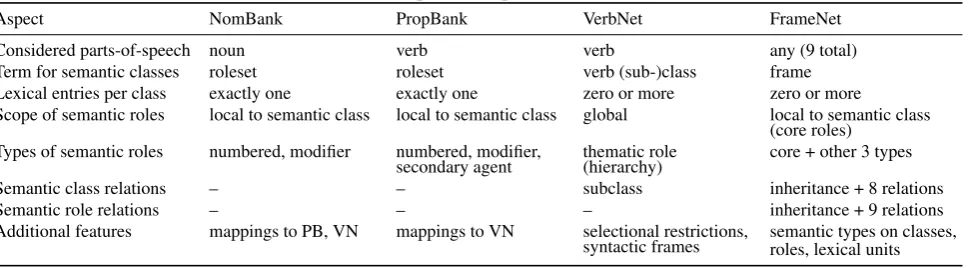
Table 1: Comparison of predicate models.
Aspect NomBank PropBank VerbNet FrameNet
Considered parts-of-speech noun verb verb any (9 total)
Term for semantic classes roleset roleset verb (sub-)class frame Lexical entries per class exactly one exactly one zero or more zero or more
Scope of semantic roles local to semantic class local to semantic class global local to semantic class (core roles)
Types of semantic roles numbered, modifier numbered, modifier,
secondary agent thematic role(hierarchy) core + other 3 types Semantic class relations – – subclass inheritance + 8 relations
Semantic role relations – – – inheritance + 9 relations
Additional features mappings to PB, VN mappings to VN selectional restrictions,
syntactic frames semantic types on classes,roles, lexical units
2.
Background
PropBank PropBank (PB)3by Palmer et al. (2005) is a
predicate model for verbs, later extended to other parts-of-speech in OntoNotes (Hovy et al., 2006). PB associates a lexical entry to one or more semantic classes calledrolesets
that are not shared in general with other entries. Semantic roles are defined locally to each semantic class and catego-rized asnumbered arguments(e.g., Arg0 and Arg1, usually the proto-agent and proto-patient), modifiers (ArgM plus a function tag, such as LOC for location), andsecondary agent(ArgA in OntoNotes). Annotated examples are pro-vided for each semantic class. A summary of PB features, compared to other predicate models, is reported in Table 1.
NomBank NomBank (NB)4by Meyers et al. (2004) is a model for noun predicates that closely mirrors PB, in that it associates nouns to (noun-specific) semantic classes also calledrolesets, and defines semantic roles locally to seman-tic classes, categorizing them asnumbered argumentsand
modifiers. Examples are provided for each semantic class.
VerbNet VerbNet (VN)5 by Schuler (2005) is a predi-cate model for verbs inspired by Levin classes. Semantic classes in VN are organized in a hierarchy ofverb classes. A verb class is associated to multiple verb lexical entries and to multiple globally definedthematic roles(e.g., agent, patient), which describe the semantic roles for that class (with possible selectional restrictions) and form themselves a role hierarchy. Verb classes are also associated to syntac-tic frames. They define how semantic roles can be realized syntactically (e.g., “Agent V Theme”) and are associated to a specification of the conveyed semantics based on logical-like predicates applied to thematic role and event variables (e.g., “cause(Agent, E)”) . Both thematic roles and syntactic frames are inherited by subclasses. An example sentence is provided for each frame of a verb class.
FrameNet FrameNet (FN)6by Baker et al. (1998) builds on the theory of frame semantics to provide semantic classes called frames that define prototypical situations
evokedby lexical entries of different parts-of-speech. The pair hframe, lexical entryiis called lexical unit. The se-mantic roles of a frame are called frame elements (FEs):
3http://verbs.colorado.edu/∼mpalmer/projects/ace.html
4http://nlp.cs.nyu.edu/meyers/NomBank.html
5http://verbs.colorado.edu/∼mpalmer/projects/verbnet.html
6http://framenet.icsi.berkeley.edu/fndrupal/
core and core unexpressed FEs classify mandatory argu-ments and characterize a frame, differently fromperipheral
FEs, whileextra-thematicFEs (e.g., “Iteration”) situate the frame in a larger context. A set of typically co-expressed FEs form aCoreSet. Several Frames and FE relations are defined, starting from frame inheritance, along which Core FEs (but not unexpressed ones) are propagated. A small subset of frames and FEs is annotated withsemantic types, that for FEs are used to express selectional constraints. An-notated examples are provided for each lexical unit.
SemLink SemLink7by Palmer (2009) is a resource pro-viding a mapping between the hlexical entry, semantic classipairs of (i) VN and PB and (ii) VN and FN, as well as between the semantic roles of these resources.
Predicate models in RDF/OWL Despite the advantages mentioned in Section 1 and the availability of ontologies such as lemon, few attempts have been made for repre-senting predicate models in RDF. To the best of our knowl-edge, no RDF version of PB and NB exists. An ontological model of VN is presented in Gangemi (2010) but no RDF data is available. An RDF version of FN 1.5 is available,8 but its schema is not aligned tolemon and instead closely mirrors the structure and naming used in FN frame files. Finally, VN and FN have been exposed in RDF/lemon as part of lemonUby (Eckle-Kohler et al., 2015), alemon ver-sion of Uby, but several modeling deciver-sions9are no more aligned with the latest developments oflemonby the W3C Ontology-Lexica Community Group (besides, only RDF data for an old FN version is available).
3.
The PreMOn Ontology – Core Module
Namespace: http://premon.fbk.eu/ontology/core# Prefix:pmo
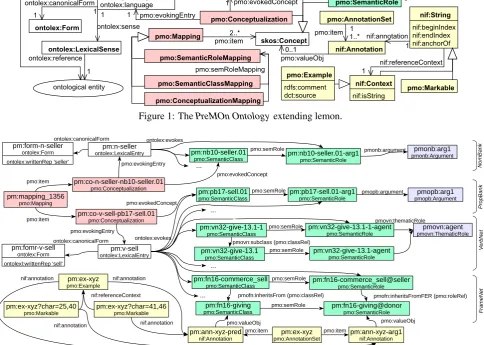
The PreMOn Ontology is an extension of lemon (W3C Ontology Lexicon Community Group, 2015) for represent-ing predicate models and their mapprepresent-ings. An overview of the PreMOn Ontology core module, and its relation with
lemon, is shown in Figure 1 using a UML-like notation. To guide the exposition, we will also refer to Figure 2, showing an example of instantiation of semantic classes and roles for
7http://verbs.colorado.edu/semlink/
8http://ontologydesignpatterns.org/ont/framenet/html/ 9E.g., modeling of semantic classes asontolex:LexicalSenses
pmo:SemanticRole
pmo:Mapping pmo:item2..* skos:Concept
pmo:AnnotationSet
Figure 1: ThePreMOn Ontologyextending lemon.
pm:fn16-giving@donor
pmofn:inheritsFrom (pmo:classRel) pmofn:inheritsFromFER (pmo:roleRel) pmo:semRole
Figure 2: Example of predicate model data represented according to thePreMOn Ontology.
the predicate models here considered, as well as an example of mapping between resources from different models.
3.1.
Semantic Classes and Roles
lemon represents lexical entries (class ontolex:LexicalEn-try) with their associated lexical forms, and allows relat-ing entries to the ontological entities they denote (classes, properties, individuals) using theontolex:LexicalSense rei-fied relation. Besides mapping to an ontology, which pro-vides the extensional (formal) interpretation of lexical en-tries, lemon supports mapping entries to ontolex:Lexical-Concepts (subclassskos:Concept), each denoting an inten-sional (∼informal) meaning evoked by a set of lexical
en-tries. Example of lexical concepts are WordNet synsets, whose semantics is not formally encoded in an ontology. We extend lemon by introducing classes pmo:Semantic-Classandpmo:SemanticRole(filled in light green in Fig-ure 1). pmo:SemanticClasshomogeneously represents the semantic classes from the various predicate models. That is, individuals of this class correspond to rolesets in PB and NB (e.g., pm:nb10-seller.01andpm:pb17-sell.0110 in Figure 2), verb classes in VN (e.g.,pm:vn32-give-13.1-1),
10pm: http://premon.fbk.eu/resource/ is the namespace of Pre-MOn Dataset (Section 5); the fragmentsnb10,pb17, and so on
and frames in FN (e.g., pm:fn15-commerce sell). An in-stance of pmo:SemanticClass typically has (via property pmo:semRole) a number ofpmo:SemanticRoles, represent-ing, from a semantic point of view, the roles the arguments of thatpmo:SemanticClasscan play. For instance, the triple pm:pb17-sell.01 pmo:semRole pm:pb17-sell.01-arg1 states that pm:nb10-seller.01 has the semantic role pm:nb10-seller.01-arg1. Importantly, semantic roles are de-fined locally to semantic classes, so VN ‘agent’ is repre-sented as multiple semantic roles, one for each verb class it occurs in, and with each semantic role linked to its spe-cific selectional restrictions (if any). Note that pmo:Se-manticClass is defined as subclass of ontolex:LexicalCon-cept, as we seepmo:SemanticClasses as essentially infor-mal concepts rather than well defined concepts of a forinfor-mal ontology (although an ontology can be derived from them, cf., FrameBase and ESO). Beingontolex:LexicalConcepts, pmo:SemanticClasses inherit the link to lexical entries as well as the link (viaontolex:isConceptOf) to the ontological entities formalizing them, typically event classes.
Properties pmo:classRel and pmo:roleRel, and their re-source-specific subproperties, are introduced to express the
relations between elements at each level, such as subtyping, and predicate and role inheritance (e.g.,pmofn:inheritsFrom andpmofn:inheritsFromFERfor FN). Additional resource-specific classes (e.g., pmovn:ThematicRole, filled in light blue in Figure 1) and properties (e.g.,pmovn:thematicRole) further characterize important aspects of each predicate model, like commonalities between semantic roles.
3.2.
Mappings
Mappings between different predicate models are prac-tically relevant but cannot be expressed using only the classes above, as they are often defined (e.g., in Sem-Link and PredicateMatrix) in terms of h pmo:Semantic-Class, ontolex:LexicalEntryipairs. To model these pairs, one could reuse the notion ofontolex:LexicalSense. How-ever, its formalization inlemon as reified relation depends on the existence of (exactly) one ontological entity for eachhontolex:LexicalConcept,ontolex:LexicalEntryipair, a strong constraint that we do not necessarily need for our purposes. Therefore, we introduce the pmo:Conceptualiza-tionclass (filled in light red in Figure 1, together with other mapping related classes). Structurally, a pmo:Conceptuali-zationcan be seen as the reification of theontolex:evokes relation between ontolex:LexicalEntry and ontolex:Lexical-Concept. Semantically, it can be seen as a very specific intensional concept (among many, in case of polysemy) evoked by a singleontolex:LexicalEntry, which can be gen-eralized to aontolex:LexicalConceptwhen multiple entries are considered but with a possible loss of information that prevents precise alignments to be represented.
Mappings are explicitly represented as individuals of class pmo:Mapping, and can be seen as sets of (or n-ary relations between) either (i) pmo:Conceptualizations, (ii) pmo:SemanticClasses, and (iii) pmo:SemanticRoles, with role mappings anchored to conceptualization or class mappings via property pmo:semRoleMapping. Figure 2 shows an example of mapping (pm:mapping 1356) be-tween twopmo:Conceptualizations, one from NB ( pm:co-n-seller-nb10-seller.01) and one from PB ( pm:co-v-sell-pb17-sell.01). We rely on this set-like modeling, since mappings are not necessarily represented as binary relations in pred-icate mapping resources: e.g., in the Predpred-icateMatrix, each row represents the mapping of a semantic role / lexical en-try pair over the different resources (e.g., h13.1-1-agent, dealiin VN, hsell.01-arg0, selli in PB, hCommerce Sell-seller, selliin FN) as well as the corresponding WordNet verb sense. Reifying the n-ary mapping relation also al-lows us, if needed, to further characterize each single map-ping, asserting additional information such as confidence and reliability. Moreover, it is possible to further special-ize mappings (e.g., to model mappings holding only in one direction, from a resource to another one, or to represent different types of relationships among the members of the mapping) by subtyping thepmo:Mappingclass or the prop-erty (pmo:item) relating apmo:Mappingto its members.
3.3.
Annotations
Predicate models are typically complemented by examples showing concrete occurrences of semantic classes and roles in text. More generally, a text can be annotated with
seman-tic classes and roles as a result of manual or automaseman-tic SRL. ThePreMOn Ontologyprovides some common primitives (filled in light yellow in Figure 1), based on the NLP Inter-change Format (NIF) by Hellmann et al. (2013), which aim at properly modeling the heterogeneous annotations of a text for different predicate models. NIF introduces the gen-eral notion ofnif:String to represent arbitrary text strings. nif:Contextis a particular subclass ofnif:String, represent-ing a whole strrepresent-ing of text. Any substrrepresent-ing (itself anif:String) has a nif:referenceContextrelation to thenif:Context indi-vidual representing the whole text containing it.
To specifically model the aforementioned examples com-plementing predicate models, we introducepmo:Example, subclass of nif:Context, to represent the string associated with the example. The occurrence of a ontolex:LexicalEn-try,pmo:SemanticClass, orpmo:SemanticRolein a nif:Con-text is denoted by an instance of nif:Annotation, related to the given ontolex:LexicalEntry, pmo:SemanticClass, or pmo:SemanticRole via property pmo:valueObj (the value attached to the annotation), and to the nif:Context in-stance via property nif:annotation. If detailed information on the specific span of text (i.e., substring) denoting the ontolex:LexicalEntry,pmo:SemanticClass, or pmo:Seman-ticRole is available (e.g., FN provides the specific offsets of lexical units, frames, and frame elements, in the exam-ple text) an additional instance ofpmo:Markable, subclass ofnif:String, is created and linked to the specific nif:Annota-tionandnif:Contextvia propertiesnif:annotationand nif:ref-erenceContext, respectively. As the samenif:Contextmay contain multiple nif:Annotations referring to one or more semantic classes and their corresponding roles, an addi-tionalpmo:AnnotationSetinstance is created to cluster an-notations from the same predicate structure.
4.
Specializing the PreMOn Ontology
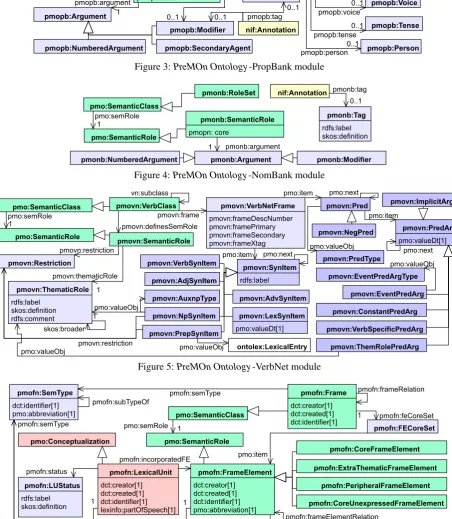
While thePreMOn OntologyCore Module provides an ho-mogeneous abstraction over heterogeneous predicate mod-els, additional ontology modules, specializing or extend-ing thePreMOn Ontologycore elements, can be defined to properly capture and model resource-specific aspects (in-cluding terminology) in a way compatible with the under-lyingPreMOn Ontology assumptions. We developed four ontology modules, one for each predicate model: Prop-Bank, NomProp-Bank, VerbNet, and FrameNet. An overview of the main additional classes (filled in light blue) and proper-ties defined is shown in Figures 3, 4, 5, and 6.4.1.
PreMOn Ontology – PropBank
Namespace: http://premon.fbk.eu/ontology/pb# Prefix:pmopbWe define classes pmopb:Roleset and pmopb:Semantic-Role11 as subclasses of pmo:SemanticClass and pmo:Se-manticRole, respectively. Each pmopb:SemanticRole in-stance is related (via propertypmopb:argument) to exactly onepmopb:Argument, which is defined as the disjoint union
pmo:Example
Figure 3:PreMOn Ontology-PropBank module
pmonb:RoleSet
Figure 4:PreMOn Ontology-NomBank module
pmovn:VerbClass
Figure 5:PreMOn Ontology-VerbNet module
pmofn:Frame
Figure 6:PreMOn Ontology-FrameNet module
of three subclasses: pmopb:NumberedArgument, contain-ing the individuals correspondcontain-ing to numbered arguments (e.g., Arg0, Arg1);pmopb:Modifier, containing the individ-uals corresponding to modifiers (e.g., LOC, ArgM-TMP); and, pmopb:SecondaryAgent, containing the sin-gle individual annotating secondary agents (ArgA). While PB annotation guidelines define a single modifier (ArgM) with multiple function tags (e.g., LOC, TMP), we opt to specialize the modifier for each function tag, similarly to
4.2.
PreMOn Ontology – NomBank
Namespace: http://premon.fbk.eu/ontology/nb# Prefix:pmonbSimilarly to PB, we definepmonb:Rolesetand pmonb:Se-manticRole as subclasses of pmo:SemanticClass and pmo:SemanticRole, respectively. Each pmonb:Semantic-Roleinstance is related (via propertypmonb:argument) to exactly onepmonb:Argument, which is defined as the dis-joint union of two subclasses:pmonb:NumberedArgument, containing the individuals corresponding to numbered ar-gument (e.g., Arg0, Arg1), and pmonb:Modifier, contain-ing the individuals correspondcontain-ing to modifiers (e.g., ArgM-LOC, ArgM-TMP). We also define classpmonb:Tagto cap-ture (via propertypmonb:tag) some specific annotations of markables (e.g., PRD, REF, SUPPORT) in the examples.
4.3.
PreMOn Ontology – VerbNet
Namespace: http://premon.fbk.eu/ontology/vn# Prefix:pmovnWe define classespmovn:VerbClassand pmovn:Semantic-Roleas subclasses ofpmo:SemanticClassand pmo:Seman-ticRole, respectively. Class members are modeled as in-stances ofontolex:LexicalEntry, connected to their class via propertyontolex:evokes. The VN class hierarchy is mod-eled via the pmovn:subclassOf property (subproperty of skos:broader), that relates a verb class (e.g., 13.1-1) with its parent class (e.g., 13.1). Given the propagation of se-mantic roles along the class hierarchy, we introduce prop-ertypmovn:definesSemRoleto differentiate the pmovn:Se-manticRoleinstances defined on a class from the ones in-herited from its ancestor classes. Each pmovn:Seman-ticRole instance is related (via property pmovn:thematic-Role) to exactly onepmovn:ThematicRole, which contains all the thematic roles defined in VB. These thematic roles are organized in a hierarchy, which is formalized via the skos:broaderproperty. For instance,
pmovn:agent skos:broader pmovn:actor
states thatpmovn:agentis more specific thanpmovn:actor. VN selectional restrictions onpmovn:SemanticRoles (e.g., restricting “theme” to something not animate) are formal-ized using propertypmovn:restrictionand class pmovn:Re-striction.12A verb class may have one or more pmovn:Verb-NetFrames (via property pmovn:frame, or its subproperty pmovn:definesFrame, to distinguish frames defined on the class or inherited from ancestors), which have one or more ordered13 pmo:SynItems, modeling a syntactic construc-tion (e.g., “Agent V Theme [-sentential]”) shared by all members of the class, and one or more ordered seman-ticpmo:Preds, modeling the meaning of the event, and its participants, expressed by the verb class for that syntactic construction (e.g., “approve(during(E), Agent, Theme)”). pmo:SynItems are specialized according to their syntac-tical function (e.g., pmovn:NpSynItem for noun phrases). A pmovn:NpSynItem can point (via pmo:valueObj) to a
12A detailed presentation of the formalization of selectional /
syntactic restrictions is omitted in the paper due to lack of space. More details are provided onPreMOnwebsite.
13We relied on the standard first/next/item pattern for lists.
pmovn:SemanticRole, and define, via pmovn:restriction, (i) a selectional restriction holding for the pmovn:Seman-ticRole in that frame (e.g., “animate”), or (ii) some other syntactic restriction (e.g., “np to inf”). Similarly, selec-tional restrictions can be modelled onpmovn:PrepSynItem (e.g., “spatial”). Predicates in pmovn:Pred have a type (pmovn:PredType, e.g., “approve”) and can be further de-composed inpmovn:PredArg(e.g., “during(E)”) of various types (e.g., pmovn:EventPredArg). Negation of a predi-cate is expressed by typing the corresponding instance as pmovn:NegPred, while implicitpmovn:PredArgs are typed aspmovn:ImplicitArg.
4.4.
PreMOn Ontology – FrameNet
Namespace: http://premon.fbk.eu/ontology/fn# Prefix:pmofnWe define classespmofn:Frameandpmofn:FrameElement as subclasses of pmo:SemanticClass and pmo:Semantic-Role, respectively. pmofn:FrameElement is further spe-cialized in four subclasses, denoting the four typologies of FN frame elements (e.g.,pmofn:CoreFrameElement). Be-ing pmo:SemanticRoles, in PreMOn Ontology frame el-ements are always specific to the frame where they are defined, even for extra thematic frame elements that are typically shared across frames in FN (e.g., the “Circum-stances” extra thematic frame element corresponds to mul-tiple individuals of type pmofn:ExtraThematicFrameEle-ment, one for each frame where it is defined). Frame el-ement core sets of apmofn:Frameare represented as reified objects of typepmofn:FECoreSet, having as members some pmofn:FrameElements. Relations between pmofn:Frames are modeled using the subproperties of pmofn:frameRela-tion (e.g., pmofn:inheritsFrom). Similarly, mappings be-tweenpmofn:FrameElements ofpmofn:Frames related via some pmofn:frameRelation are represented using frame relation-specific subproperties of pmofn:frameElementRe-lation (e.g., pmofn:inheritsFromFER). Within a frame, a frame element may exclude/require the presence of another frame element (pmofn:excludesFrameElement/pmofn:re-quiresFrameElement). pmofn:LexicalUnit, associating a lexical entry with a frame, is defined as subclass of pmo:Conceptualization. A pmofn:LexicalUnit may have a development status (pmofn:LUStatus) and can incorpo-rate apmofn:FrameElement(e.g., “microvawe.v’, besides evoking frame “Apply heat”, also incorporates the frame element “Heating instrument”). Finally, pmofn:Frames, pmofn:FrameElements andpmofn:LexicalUnits can be con-strained according to some semantic types, defined in pmofn:SemType, and organized in a hierarchy according to pmofn:subTypeOfrelations between them.
5.
The PreMOn Dataset
Namespace: http://premon.fbk.eu/resource/ Prefix:pm
To populate PreMOn with content from the various re-sources (predicate models, mappings), we developed an open-source Java command-line tool available onPreMOn
to thePreMOn Ontology. If available, mappings to addi-tional resources (e.g., WordNet synsets, OntoNotes group-ings) are also extracted. OWL 2 RL inference, statis-tics extraction and some cross-resource cleanup (e.g., for dropping inconsistent mappings) are applied to extracted triples, leveraging RDFpro (Corcoglioniti et al., 2015) for RDF processing. The resulting triples are placed in distinct
named graphs identified by the resource name and version (e.g., pm:fn15 for FN v1.5), so to track provenance at a coarse-grained level and allow querying only data of spe-cific predicate models using SPARQL clauses FROM and FROM NAMED. Examples, and related triples, are placed in further separated named graphs (e.g., pm:fn15-ex), and their extraction can be enabled/disabled at runtime. Specific conversion strategies had to be implemented for each predicate model. E.g., in VN, semantic roles (with selectional constraints) and frames have to be propagated from a class to its subclasses, unless redefined in the lat-ter. In PB (and NB), the instantiation of pmopb:Semantic-Roles requires creating an individual for eachh pmopb:Role-set,pmopb:Argumentipair, as no information is provided on which arguments a predicate may have (besides explicit occurrence in frame files, in which case semantic role at-tributespmopb:core/pmonb:coreare set to “true”).
We applied the conversion suite on a large collection of resources, producing a comprehensive dataset, namely the
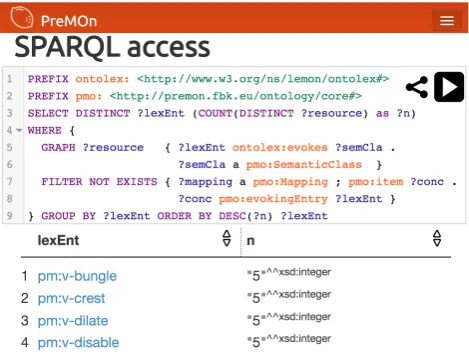
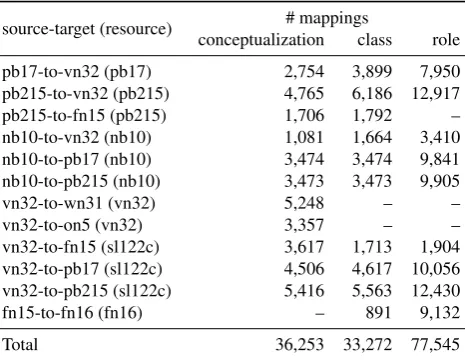
PreMOn Dataset, containing: PB v1.7 (pb17), PB v2.1.5 released with OntoNotes v5 (pb215), NB v1.0 (nb10), VN v3.2 (vn32), FN v1.5 (fn15), FN v1.6 (16), and SemLink 1.2.2c (sl122c). The PreMOn Dataset contains the map-pings between semantic classes and roles provided by each predicate model and SemLink, as well as the mappings be-tween VN classes and lexical senses in WordNet 3.1 (wn31) and OntoNotes 5 groupings. Table 2 reports the num-ber of individuals (e.g., ofpmo:SemanticClasses), relations (e.g., pmo:classRel), and triples for the considered predi-cate models and their versions. Table 3 reports the num-bers of mappings, which may be lower than the ones in the original resources as we drop mappings involving non-existing semantic classes, roles, or conceptualizations (e.g., because removed/reorganized in the newer versions of the resources, released after the mapping was defined). All the datasets generated (as well as thePreMOn Ontol-ogy) are documented and published online as Linked Open Data on PreMOn website. Data can be accessed in three ways: URI dereferencing with content negotiation (RDF and HTML formats supported); SPARQL querying on our endpoint (see Figure 7); and bulk dataset download.
6.
Leveraging PreMOn
By adopting an homogeneous schema for heterogeneous predicate models,PreMOn facilitates the joint querying of content from different resources. Figure 7 shows an exam-ple of query, run through the SPARQL endpoint on Pre-MOnwebsite, that looks for lexical entries (?lexEnt) evok-ing semantic classes in different resources (?resource), for which no mappings are defined. Results are ordered by decreasing number of resources defining the lexical entry. This query hints a way to exploitPreMOn to investigate, and possibly extend, mappings between predicate models.
Figure 7: SPARQL queryingPreMOndata.
Other interesting queries can be answered givenPreMOn
data (see website) as, e.g., to map a semantic class or role (for a lexical entry) from a resource to another, possibly navigating chains of mappings via SPARQL property paths, or, together with WordNet RDF data, to find synonymous lexical entries that can extend a resource lexicon.
The use of a single RDF model for multiple resources, amenable to the use of reasoning, querying and other SW data processing techniques, opens up new opportunities for analyzing, validating, and possibly cleaning up predicate model data. We already implemented a simple technique for identifying inconsistent mappings, which we currently remove, and we plan to further pursue this direction. By exploitingPreMOndata and ontology, NLP and knowl-edge extraction tools can now express SRL annotations in RDF in a way compatible with the increasingly used NIF. Indeed, thePreMOn formalization of the usage examples released with predicate models shows a concrete case of SRL annotation data exposed according to NIF principles. We are currently working on adapting the PIKES system to produce annotation of SRL according to this formalization. By extending lemon, PreMOn endorses the latter’s goal to provide proper linguistic grounding for ontologies. In particular,PreMOnenables to ground event and frame on-tologies, such as FrameBase and ESO, on a proper repre-sentation of the linguistic information for predicates, thus supporting the development of a comprehensive catalogue, from the linguistic to the knowledge level, of event and event participant types.
7.
Conclusions
PreMOn is both an ontology extending lemon for repre-senting predicate models and their mappings, and a LOD dataset based on that ontology that contains interlinked predicate data for several predicate models.
Table 2:PreMOn Dataset General Statistics.
nb10 pb17 pb215 vn32 fn15 fn16 Total
pmo:SemanticClass 5,576 6,181 8,751 484 1,018 1,204 23,214
pmo:SemanticRole 76,241 145,586 206,701 1,396 9,633 11,251 450,808
pmo:Conceptualization 5,576 6,196 9,208 6,338 11,887 13,247 52,452
ontolex:LexicalEntry 4,704 5,187 7,671 4,402 9,413 10,107 17,195
pmo:Example 9,583 10,221 15,832 1,396 153,589 174,425 365,046
nif:AnnotationSet 9,583 10,221 15,832 1,396 154,573 196,610 388,215
pmo:classRel – – – 212 1,643 1,968 3,823
pmo:roleRel – – – – 8,807 10,599 19,406
Core triples 517,495 629,932 926,466 236,526 332,386 411,554 3,035,670 Example triples 339,496 429,953 653,266 22,404 5,752,132 7,122,995 14,320,246 Inferred triples 252,738 371,586 539,087 69,202 548,291 632,890 2,414,220 Total 1,109,729 1,431,471 2,118,819 328,132 6,632,809 8,167,439 19,770,136
Table 3:PreMOn DatasetMapping Statistics.
source-target (resource) # mappings
conceptualization class role
pb17-to-vn32 (pb17) 2,754 3,899 7,950 pb215-to-vn32 (pb215) 4,765 6,186 12,917 pb215-to-fn15 (pb215) 1,706 1,792 – nb10-to-vn32 (nb10) 1,081 1,664 3,410 nb10-to-pb17 (nb10) 3,474 3,474 9,841 nb10-to-pb215 (nb10) 3,473 3,473 9,905
vn32-to-wn31 (vn32) 5,248 – –
vn32-to-on5 (vn32) 3,357 – –
vn32-to-fn15 (sl122c) 3,617 1,713 1,904 vn32-to-pb17 (sl122c) 4,506 4,617 10,056 vn32-to-pb215 (sl122c) 5,416 5,563 12,430 fn15-to-fn16 (fn16) – 891 9,132
Total 36,253 33,272 77,545
common ontology (e.g., Yago), possibly propagating these constraints to PB and NB. All these lines of work are part of a larger effort to create a coherent resource for knowl-edge extraction that maps predicate models used by avail-able SRL tools to FrameBase and other SW ontologies.
Acknowledgements Partially funded by the European Union’s FP7 via the NewsReader Project (ICT-316404).
8.
References
Baker, C. F., Fillmore, C. J., and Lowe, J. B. (1998). The Berkeley FrameNet project. InProc. COLING-ACL ’98. Bryl, V., Tonelli, S., Giuliano, C., and Serafini, L. (2012). A novel FrameNet-based resource for the Semantic Web. InProc. of ACM SAC 2012, pages 360–365.
Chiarcos, C., McCrae, J., Cimiano, P., and Fellbaum, C. (2013). Towards open data for linguistics: Linguistic Linked Data. InNew Trends of Research in Ontologies and Lexical Resources.
Corcoglioniti, F., Rospocher, M., Mostarda, M., and Amadori, M. (2015). Processing billions of RDF triples on a single machine using streaming and sorting. In
Proc. of ACM SAC 2015, pages 368–375.
Corcoglioniti, F., Rospocher, M., and Palmero Aprosio, A. (2016). A 2-phase frame-based knowledge extraction framework. InProc. of ACM SAC 2016. to appear.
Eckle-Kohler, J., McCrae, J. P., and Chiarcos, C. (2015). lemonUby - A large, interlinked, syntactically-rich lexi-cal resource for ontologies.Sem. Web. J., 6(4):371–378. Gangemi, A. (2010). What’s in a schema? In Ontology and the Lexicon, pages 144–182. Cambridge Uni. Press. Hellmann, S., Lehmann, J., Auer, S., and Br¨ummer, M. (2013). Integrating NLP using Linked Data. InProc. of ISWC 2013, pages 98–113.
Hovy, E., Marcus, M., Palmer, M., Ramshaw, L., and Weischedel, R. (2006). OntoNotes: The 90% solution. InProc. of HLT-NAACL (Short Papers), pages 57–60. Lacalle, M. L. D., Laparra, E., and Rigau, G. (2014).
Pred-icate Matrix: extending SemLink through WordNet map-pings. InProc. of LREC 2014.
McCrae, J., Aguado-De-Cea, G., Buitelaar, P., Cimiano, P., Declerck, T., G´omez-P´erez, A., Gracia, J., Hollink, L., Montiel-Ponsoda, E., Spohr, D., and Wunner, T. (2012). Interchanging lexical resources on the Semantic Web.
Lang. Resour. Eval., 46(4):701–719.
Meyers, A., Reeves, R., Macleod, C., Szekely, R., Zielin-ska, V., Young, B., and Grishman, R. (2004). The Nom-Bank project: An interim report. InHLT-NAACL 2004 Workshop: Frontiers in Corpus Annotation.
Palmer, M., Gildea, D., and Kingsbury, P. (2005). The Proposition Bank: An annotated corpus of semantic roles.Comput. Linguist., 31(1):71–106.
Palmer, M. (2009). SemLink: Linking PropBank, VerbNet and FrameNet. InProc. of GenLex 2009.
Rospocher, M., van Erp, M., Vossen, P., Fokkens, A., Ald-abe, I., Rigau, G., Soroa, A., Ploeger, T., and Bogaard, T. (2016). Building event-centric knowledge graphs from news. Journal of Web Semantics. to appear.
Rouces, J., de Melo, G., and Hose, K. (2015). FrameBase: Representing n-ary relations using semantic frames. In
Proc. of ESWC 2015.
Schuler, K. K. (2005). Verbnet: A Broad-coverage, Com-prehensive Verb Lexicon. Ph.D. thesis.
Segers, R., Vossen, P., Rospocher, M., Serafini, L., Laparra, E., and Rigau, G. (2015). ESO: a frame based ontology for events and implied situations. InMAPLEX 2015. W3C Ontology Lexicon Community Group. (2015).