Parallel Entity and Treebank Annotation
Ann Bies
Linguistic Data Consortium 3600 Market Street, 810
Philadelphia, PA 19104 [email protected]
Seth Kulick Institute for Research
in Cognitive Science 3401 Walnut Street
Suite 400A Philadelphia, PA 19104
Mark Mandel Linguistic Data Consortium
3600 Market Street, 810 Philadelphia, PA 19104 [email protected]
Abstract
We describe a parallel annotation ap-proach for PubMed abstracts. It includes both entity/relation annotation and a tree-bank containing syntactic structure, with a goal of mapping entities to constituents in the treebank. Crucial to this approach is a modification of the Penn Treebank guide-lines and the characterization of entities as relation components, which allows the in-tegration of the entity annotation with the syntactic structure while retaining the ca-pacity to annotate and extract more com-plex events.
1 Introduction
A great deal of annotation effort for many different corpora has been devoted to annotation for entities and syntactic structure (treebanks). However, pre-vious efforts at treebanking have largely been inde-pendent of the constituency of entities, and previous efforts at entity annotation have likewise been inde-pendent of corresponding layers of syntactic struc-ture. We describe here a corpus being developed for biomedical information extraction with levels of both entity annotation and treebank annotation, with a goal that entities can be mapped to constituents in the treebank.
We are collaborating with researchers in the Di-vision of Oncology at The Children’s Hospital of Philadelphia, for the purpose of automatically min-ing the corpus of cancer literature for those
as-sociations that link specified variations in individ-ual genes with known malignancies. In particular, we are interested in extracting three entities (Gene, Variation event, and Malignancy) in the following relationship: Gene X with genomic Variation event Y is correlated with Malignancy Z. For example, WT1 is deleted in Wilms Tumor #5. In addition, Vari-ation events are themselves relVari-ations, consisting of entities representing different aspects of a Variation event.
Mapping entities to treebank constituents is a de-sirable goal since the entities can then be viewed as semantic types associated with syntactic con-stituents, and we expect that automated analyses of these related levels will interact in a mutually rein-forcing and beneficial way for development of sta-tistical taggers.
In this paper we describe aspects of the entity and treebank annotation that allow this mapping to be largely successful. Potentially large enti-ties that would otherwise cut across syntactic con-stituents are decomposed into components of a re-lation. While this is worthwhile by itself on con-ceptual grounds for entity definition, and was in fact not done for reasons of mapping to syntactic con-stituents, it makes such a mapping easier. The tree-bank annotation has been modified from the Penn Treebank guidelines in various ways, such as greater structure for prenominal modifiers. Again, while this would have been done regardless of the map-ping of entities, it does make such a mapmap-ping more successful.
Previous work on integrating syntactic structure with entity information, as well as relation
mation, is described in (Miller et al., 2000). Our work is in much the same spirit, although we do not integrate relation annotation into the syntactic trees. PubMed abstracts are quite different from the newswire sources used in that earlier work, with sev-eral consequences discussed throughout, such as the use of discontinuous entities.
Section 2 discusses some of the main issues around the development of the guidelines for en-tity annotation, and Section 3 discusses some of the changes that have been made for the treebank guide-lines. Section 4 describes the annotation workflow and the resulting merged representation. Section 5 evaluates the mapping between entities and con-stituents, and Section 6 is the conclusion.
2 Guidelines for Entity Annotation
Here we give a summary of the main features of our annotation guidelines. We have been influenced in this by the annotation guidelines for the Auto-matic Content Extraction (ACE) project (Consor-tium, 2004).1 However, our source materials are medical abstracts from PubMed2, and important dif-ferences between the domains have required sig-nificant changes and additions to many definitions, guidelines, and procedures.
Most obviously, the vocabulary is very different. Many of the tokens in our source texts are chemical terms with a complex productive morphology, and a certain number are unique in PubMed. Many oth-ers are strings of notation, like S37F, often contain-ing relevant entity references that must be isolated (S, 37, and F). And even apart from these, we are looking at a very different dialect of English from that used by the Wall Street Journal and the Asso-ciated Press. Annotation of English newswire re-quires native English competency; entity annotation of biomedical English requires a background in bi-ology as well.
The entity instances in the text are also qualita-tively different. Instead of individual pieces of the physical or social universe – Emanuel Sosa, the Eif-fel Tower, the man in the yellow hat – we have
ab-1Another source of influence is previous work in
annota-tion for biomedical informaannota-tion extracannota-tion, such as (Ohta et al., 2002). Space prevents adequate discussion of here of the differ-ences.
2http://www.ncbi.nlm.nih.gov/entrez/
stractions, categories that are not to be confused with their instantiations: neuroblastoma, K-ras (a gene), codon 42.3We are not currently annotating
pronom-inal or other forms of coreference.
2.1 Entities Annotated
2.1.1 Gene Entity
For the sake of this project the definition for “Gene Entity” has two significant characteristics. First, as just mentioned, “Gene” refers to a concep-tual entity as opposed to the specific manifestation of a gene (e.g., not the “K-ras” in some specific cell in some individual, but an abstraction that cannot be pointed to).
Second, “Gene” refers to a composite entity as op-posed to the strict biological definition. There are often ambiguities in the usage of the entity names. I is sometimes unclear as to whether the gene or pro-tein is being referenced, and the same name can refer to the gene or the protein at different locations in the same document. In a similar way as the ACE project allows “geopolitical” entities to have different roles, such as “location” or “organization”, we consider a “Gene” to be a composite entity that can have differ-ent roles throughout a documdiffer-ent. Therefore, Gene entity mentions can have types generic, Gene-protein, and Gene-RNA.
2.1.2 Variation Events as Relations
As mentioned in the introduction, Variation events are relations between entities representing different aspects of a Variation; specifically, a Vari-ation is a relVari-ationship between two or more of the following entities: Type (e.g., point mutation, translocation, or inversion), Location (e.g., codon 14, 1p36.1, or base pair 278), Original-State and Altered-State (e.g., Thymine).
The entities as such are independent and uncon-nected. We add a level of relation to annotate the associations between them: For example, the text fragment a single nucleotide substitution at codon 249, predicting a serine to cysteine amino acid sub-stitution (S249C) contains the entities:
Variation-type substitution
Variation-location codon 249
3This domain shows no such clear distinction between Name
Variation-state-original serine Variation-state-altered cysteine
These entities are annotated individually but are also collected into a single Variation relation.
It is also possible for a Variation relation to arise from a more compact collection of entities. For ex-ample, the text S249C consists of three entities col-lected into a Variation relation:
Variation-location 249 Variation-state-original S Variation-state-altered C
These four components represent the key ele-ments necessary to describe any genomic variation event. Variations are often underspecified in the lit-erature. For example, the first relation above has all four components while the second is missing the Variation-type. Characterizing individual Varia-tions as relaVaria-tions among such components provides us with a great deal of flexibility.
The “Gene” entities are analogous to the ACE geopolitical entity, in that the second part of the en-tity names (“-RNA”, “-generic”,”-protein”) disam-biguates the metonymy of the “Gene”. The subtypes of the Variation entities, in contrast, indicate differ-ent kinds of differ-entities in their own right, which can also function as components of a Variation relation.
2.1.3 Malignancy
The Malignancy annotation guidelines were un-der development during the annotation of the corpus described here. While they have since been more completely defined, they are not included as part of the annotated files discussed here, and so are not fur-ther discussed in this paper.
2.2 Discontinuous Entities
We have introduced a mechanism we call “chain-ing” to annotate discontinuous entities, which may be more common in abstracts than in full text be-cause of the pressure to reduce word count. For ex-ample, in K- and N-ras there are two entities, K-ras and N-ras, of which only the second is a solid block of text. Our entity annotators are allowed to change the tokenization if necessary to isolate the compo-nents of K-ras:
text K- and N-ras
original tokenization [K-][and][N-ras]
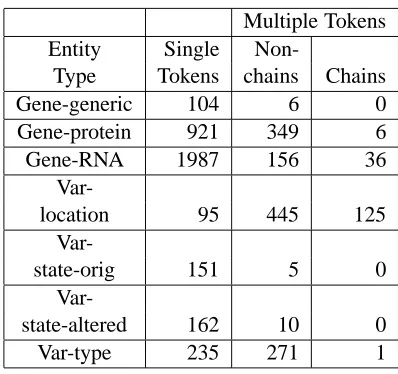
Multiple Tokens Entity Single
Non-Type Tokens chains Chains
Gene-generic 104 6 0
Gene-protein 921 349 6
Gene-RNA 1987 156 36
Var-location 95 445 125
Var-state-orig 151 5 0
Var-state-altered 162 10 0
[image:3.612.326.525.51.238.2]Var-type 235 271 1
Table 1: Entity Instances
modified tokenization
[K][-][and][N][-][ras]
entity annotation
1. K- ... ras(chain with separated to-kens)
2. N-ras(contiguous tokens)
2.3 Entity Frequencies
Table 1 shows the number of instances of each of the entity types in the 318 abstracts, discussed further in Section 4, that have been both entity annotated and treebanked. We separate the entities into single-token and multiple-single-token categories since it is only the multiple-token categories that raise an issue for mapping constituents.
3 Treebank Annotation
3.1 Tokenization/Part-of-Speech
We have also adopted several changes in word-level tokenization, leading to a number of part-of-speech and structural differences as well. Many hyphenated words are now treated as separate tokens (New York - based would be four tokens, for example). These hyphens now have the part-of-speech tag HYPH. If the separated prefix is a morphological unit that does not exist as a free-standing word, it has the part-of-speech tag AFX. With chemical names and scien-tific notation in the biomedical corpus in particular, spaces and punctuation may occur within a single “token”, which will have a single POS tag.
3.2 Right-Branching Default
We assume a default binary right-branching struc-ture under any NP and NML node. Each daughter of the phrase (whether a single token or itself a con-stituent node) is assumed to have scope over every-thing to its right. This means that every daughter also forms a constituent with everything to its right. This assumption makes the annotation process for multi-token nominals less complex and the resulting trees more legible, but still allows us to readily de-rive constituent nodes not explicitly represented. For example, in
(NP (JJ primary) (NN liver) (NN cancer))
we assume that “liver cancer” is a constituent, and that “primary” has scope over it.
So, although we do not show the intermediate nodes explicitly in our annotation, our assumed structure for this NP could be derived as
(NP (JJ primary)
(newnode (NN liver)
(newnode (NN cancer))))
As discussed in Section 5, entities sometimes map to such implicit constituents, and a node needs to be added to make the constituent explicit so the the entity can be mapped to it.
3.3 New Node Level for Non-Right-Branching: NML
We use the NML node label to mark nominal sub-constituents that do not follow the default binary
right-branching structure. Any two or more non-final elements that form a constituent are bound to-gether by NML.
(NP (NML (NN human) (NN liver) (NN tumor)) (NN analysis))
3.4 New Empty Category for Distributed Readings within NP: *P*
As discussed in Section 2.2, discontinuous enti-ties are annotated using the “chaining” mechanism. Analogously, we have introduced a placeholder, *P*, for distributed material in the treebank. It is used exclusively in coordinated nominal structures, placed in coordinated elements that are missing ei-ther a distributed head or a distributed premodifier. In K- and N-ras, the coordinated premodifier K- is missing the distributed head ras, so the placeholder *P* is inserted after K- and coindexed with ras:
(NP (NP (NN K) (HYPH -)
(NML-1 (-NONE- *P*))) (CC and)
(NP (NN N) (HYPH - ) (NML-1 (NN ras))))
This creates constituent nodes K-ras and N-ras that align with the entities being represented by chaining.4
4 Annotation Process
The annotation process comprises the following steps: Paragraph and sentence annotation (includ-ing the delimitation of irrelevant text such as au-thor names); tokenization; entity annotation; part-of-speech (POS) annotation; treebanking; merged representation.
Entity annotation precedes POS annotation, since the entity annotators often have to correct the tok-enization, which affects the POS labels. For exam-ple, nephro- and hepatocarcinoma refers to two en-tities, nephrocarcinoma and hepatocarcinoma, and so the entity annotator would split hepatocarcinoma into two tokens, for chaining nephro and carcinoma
4
(see Section 2.2). Since the entity annotators are not qualified for POS annotation, doing POS annotation after entity annotation allows the POS annotators to annotate any such tokenization changes.
Treebank annotation uses the same tokenization as for the corresponding entity file. Continuing the above example, the treebank file would have sepa-rate tokens for hepato and carcinoma. Note that this would be the case even if we did not have the goal of mapping entities to constituents. It arises from the more minimal requirement of maintaining identical tokenization in the treebank and entity files, and so leads to changes in treebank annotation such as dis-cussed in Section 3.4.
All of the annotation steps except entity annota-tion use automated taggers (or a parser in the case of treebanking),5 producing annotation that then gets hand-corrected.
The use of the parser for producing a parse for correction by the treebankers include a somewhat unusual feature that arises from our parallel entity and treebank annotation. The parser that we are us-ing, (Bikel, 2004),6 allows prebracketing of parts of the parser input, so that the parser will respect the prebracketing. We use this ability to prebracket entities, which can also help to disambiguate the constituencies for prenominal modifiers, which can often be unclear for annotators without a medical background. For example, the input to the parser might contain something like:
...(NN activation) (IN of)
(PRP$ its)
(* (NN tyrosine) (NN kinase) ) (NN activity)...
indicating by the (* )that tyrosine kinase should be a constituent. (It is a Gene-protein.)
Our first release of data, PennBioIE Release 0.9 (http://bioie.ldc.upenn.edu/
publications), contains 1157 oncology PubMed abstracts, all annotated for entities and POS, of which 318 have also been treebanked. The website also contains full documentation for the
5Entity taggers have been developed (McDonald et al.,
2004) but have not yet been integrated into the project. 6Available athttp://www.cis.upenn.edu/
~dbikel
/software.html#stat-parser
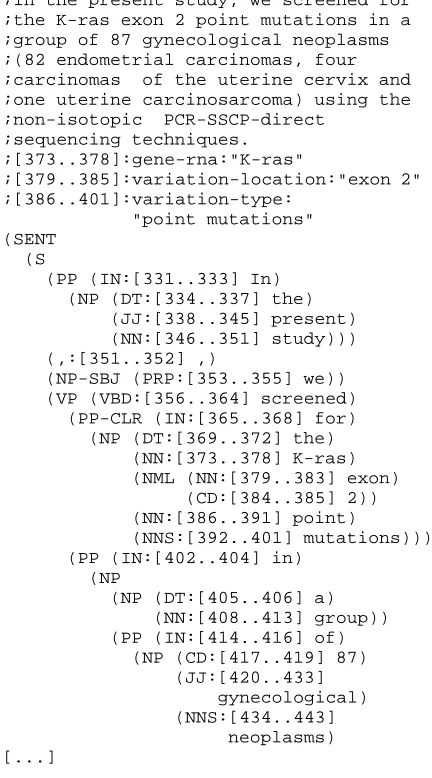
;sentence 4 Span:331..605
;In the present study, we screened for ;the K-ras exon 2 point mutations in a ;group of 87 gynecological neoplasms ;(82 endometrial carcinomas, four
;carcinomas of the uterine cervix and
;one uterine carcinosarcoma) using the
;non-isotopic PCR-SSCP-direct
;sequencing techniques. ;[373..378]:gene-rna:"K-ras"
;[379..385]:variation-location:"exon 2" ;[386..401]:variation-type:
"point mutations" (SENT
(S
(PP (IN:[331..333] In) (NP (DT:[334..337] the)
(JJ:[338..345] present) (NN:[346..351] study))) (,:[351..352] ,)
(NP-SBJ (PRP:[353..355] we)) (VP (VBD:[356..364] screened)
(PP-CLR (IN:[365..368] for) (NP (DT:[369..372] the)
(NN:[373..378] K-ras) (NML (NN:[379..383] exon)
(CD:[384..385] 2)) (NN:[386..391] point)
(NNS:[392..401] mutations))) (PP (IN:[402..404] in)
(NP
(NP (DT:[405..406] a) (NN:[408..413] group)) (PP (IN:[414..416] of)
(NP (CD:[417..419] 87) (JJ:[420..433]
gynecological) (NNS:[434..443]
[image:5.612.312.528.68.457.2]neoplasms) [...]
Figure 1: Example .mrg file
various annotation guidelines mentioned in this paper.
4.1 Example of Merged Output
The 318 files that have been both treebanked and en-tity annotated are also available in a merged “.mrg” format. The treebank and entity annotations are both stand-off, referring to character spans in the same source file, and we take advantage of this so that the merged representation relates the entities and con-stituents by these spans. Figure 1 shows a fragment of one such.mrgfile.
in-clude several tokens), entity type, and the text of the entity. The treebank part is the same basic format as the.mrgfiles from the Penn Treebank, except that each terminal has the format
(POSTag:[from..to] terminal)
where [from..to]is that terminal’s span in the source file.
The first entity listed, K-ras, is a Gene-RNA entity with span[373..378], which corresponds to the single token:
(NN:[373..378] K-ras)
The second entity, exon 2, is a Variation-location with span[379..385], which corresponds to the two tokens:
(NN:[379..383] exon) (CD:[384..385] 2)
The third entity, point mutations, is a Variation-type with span[386..401], which corresponds to the two tokens:
(NN:[386..391] point) (NNS:[392..401] mutations)
By including the terminal span information in the treebank, we make explicit how the tokens that make up the entities are treated in the treebank representa-tion.
5 Entity-Constituent Mapping
One of our goals for the release of the corpus is to allow users to choose how they wish to handle the integration of the entity and treebank information. By providing the corresponding spans for both as-pects of the annotation, we provide the raw material for any integrated approach.
We therefore do not attempt to force the entities and constituents to line up perfectly. However, given the parallel annotation just illustrated, we can an-alyze how close we come to the ideal of the en-tities behaving as semantic types on syntactic con-stituents.
5.1 Mapping Categories
Leaving aside chains for the moment, we categorize each entity/treebank mapping in one of three ways:
Exact match There is a node in the tree that yields exactly the entity. For example, the entity exon 2 in Figure 1
;[379..385]:variation-location: "exon 2"
corresponds exactly to theNMLnode in Figure 1
(NML (NN:[379..383] exon) (CD:[384..385] 2))
Missing node There is no node in the tree that yields exactly that entity, but it is possible to add a node to the tree that would yield the entity. A com-mon reason for this is that the default right branch-ing treebank annotation (Section 3.2) does not make explicit the required node.
For example, the entity point mutations in Figure 1
;[386..401]:variation-type: "point mutations"
does not correspond to a node in the relevant part of the tree:
(NP (DT:[369..372] the) (NN:[373..378] K-ras) (NML (NN:[379..383] exon)
(CD:[384..385] 2)) (NN:[386..391] point)
(NNS:[392..401] mutations))
However, it is possible to insert a node into the tree to yield exactly the entity:
(NP (DT:[369..372] the) (NN:[373..378] K-ras) (NML (NN:[379..383] exon)
(CD:[384..385] 2))
(newnode (NN:[386..391] point) (NNS:[392..401]
mutations)))
Note that this node corresponds exactly to the im-plicit constituency assumed by the right branching rule. For our own internal research purposes we have generated a version of the treebank with such nodes added, although they are not in the current release.
Exact Miss- Cross-Entity Type Total Match ing ing
Gene-generic 6 4 1 1
Gene-protein 349 236 103 10
Gene-RNA 156 115 35 6
Var-location 445 348 68 29
Var-state-orig 5 3 1 1
Var-state-altered 10 8 0 2
Var-type 271 123 142 6
[image:7.612.326.528.51.237.2]Total 1242 837 350 55
Table 2: Matching Status of Non-Chained Multiple Token Instances
is due to an entity containing text corresponding to a prepositional phrase. For example, the sentence
One ER showed a G-to-T mutation in the second position of codon 12
[image:7.612.75.298.54.235.2]has the entity
[1280..1307]:variation-location: "second position
of codon 12"
The relevant part of the corresponding tree is
(PP-LOC (IN:[1272..1274] in) (NP
(NP (DT:[1276..1279] the) (JJ:[1280..1286] second) (NN:[1287..1295] position)) (PP (IN:[1296..1298] of)
(NP (NN:[1299..1304] codon) (CD:[1305..1307] 12)))))
Due to the inclusion of the determiner in the NP the second position, while it is absent from the en-tity definition which does include the following PP, it is not possible to add a node to the tree yielding exactly second position of codon 12.7 It is possible
7
The inclusion of the PP in an entity can be a problem for the constituent mapping even aside from the determiner issue. It is possible for the PP, such as of codon 12, to be followed by another PP, such as in K-ras. Since all PPs are attached at the same level, of codon 12 and in K-ras are sisters, and so, even if the determiner was included in the entity name, there is no constituent consisting of just the second position of codon 12. However, in that case it is then possible to add a node yield-ing the NP and first PP. A similar issue sometimes arises when attempting to relate Propbank arguments to tree constituents.
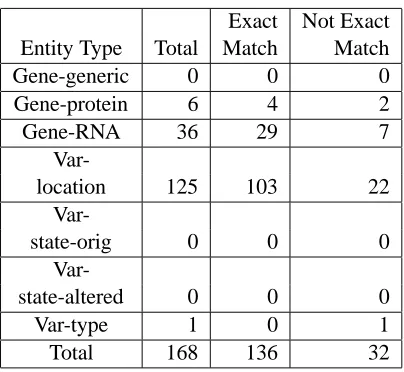
Exact Not Exact Entity Type Total Match Match
Gene-generic 0 0 0
Gene-protein 6 4 2
Gene-RNA 36 29 7
Var-location 125 103 22
Var-state-orig 0 0 0
Var-state-altered 0 0 0
Var-type 1 0 1
Total 168 136 32
Table 3: Matching Status of Chained Multiple Token Instances
to relax the requirements on exact match to include the determiner.8
However, one of our initial goals in this investi-gation was to determine whether this sort of limited crossing is indeed a major source of the mapping mismatches.
5.2 Overall Mapping Results
Table 2 is a breakdown of how well the (non-chain) entities can be mapped to constituents. Here we are concerned only with entities that consist of multiple tokens, since single-token entities can of course map directly to the relevant token.
The number of crossing cases is relatively small. One reason for this is the use of relations for break-ing potentially large entities into component parts, since the component entities either already map to an entity or can easily be made to do so by mak-ing implicit constituents explicit to disambiguate the tree structure. The crossing cases tend to be ones in which the entities are in a sense a bit too “big”, such as including a prepositional phrase.9
8Another alternative would be to modify the treatment of
noun phrases and determiners in the treebank annotation to be more akin to DPs. However, this has proved to be an impractical addition to the annotation process.
9
in-5.3 Chained Entities
Table 3 shows the matching status of multiple token instances that are also chains (and so were not in-cluded in Table 2). The presence of chains is mostly localized to certain entity types, and the mapping is mostly successful. Variation-location contains many of the chains due to the occurrences of phrases such as codon 12 or 13, which map exactly to the corre-sponding use of the*P*placeholder, such as:
(NP (NP
(NML-1 (NN codon)) (CD 12))
(CC or) (NP
(NML-1 (-NONE- *P*)) (CD 13)))
Cases that do not map exactly are ones in which the syntactic context does not permit the use of the placeholder *P*. For example, the text spe-cific codons (12, 13, and 61), has three discontin-uous entities (codons..12, codons..13, codons..61), but the parenthetical context does not permit using the placeholder*P*:
(NP (JJ specific) (NNS codons) (PRN (-LRB- -LRB-)
(NP (NP (CD 12)) (, ,)
(NP (CD 13)) (, ,) (CC and) (NP (CD 61))) (-RRB- -RRB-)))
and so this example contains three mismatches.
6 Conclusion
We have described here parallel syntactic and entity annotation and how changes in the guidelines facil-itate a mapping between entities and syntactic con-stituents. Our main purpose in this paper has been to investigate the success of this mapping. As Tables 2 and 3 show, once we make explicit the implicit right-branching binary structure, only 6.2%10of the enti-ties cannot be mapped directly to a node in the tree. It also appears likely that a significant percentage of even the non-matching cases can match as well, with a slight relaxation of the matching requirement (e.g., allowing entities to have an optional determiner).
deed done, but the treebank annotator could not abide by the resulting tree and modified the parser output accordingly.
10
1410 total multiple token entities, both chained and non-chained, with 87 cases that cannot be mapped (55 crossing, 32 chained non-exact match).
We view this in part as a successful experiment illustrating how both linguistic content and entity annotation can be enhanced by their interaction. We expect this enhancement to be useful both for biomedical information extraction in particular and more generally for the development of statistical systems that can take into account different levels of annotation in a mutually beneficial way.
Acknowledgements
The project described in this paper is based at the In-stitute for Research in Cognitive Science at the Uni-versity of Pennsylvania and is supported by grant EIA-0205448 from the National Science Founda-tion’s Information Technology Research (ITR) pro-gram. We would like to thank Yang Jin, Mark Liber-man, Eric Pancoast, Colin Warner, Peter White, and Scott Winters for their comments and assistance, as well as the invaluable feedback of all the annotators listed at http://bioie.ldc.upenn.edu/ index.jsp?page=aboutus.html.
References
Ann Bies, Mark Ferguson, Karen Katz, and Robert Mac-Intyre. 1995. Bracketing guidelines for Treebank II Style, Penn Treebank Project. Tech report MS-CIS-95-06, University of Pennsylvania, Philadelphia, PA.
Daniel M. Bikel. 2004. On the Parameter Space of
Lex-icalized Statistical Parsing Models. Ph.D. thesis,
De-partment of Computer and Information Sciences, Uni-versity of Pennsylvania.
Linguistic Data Consortium. 2004. Anno-tation guidelines for entity detection and tracking (edt), version 4.2.6 200400401. http://www.ldc.upenn.edu/Projects/ACE/docs/ EnglishEDTV4-2-6.PDF.
Ryan McDonald, Scott Winters, Mark Mandel, Yang Jin, Pete White, and Fernando Pereira. 2004. An entity tagger for recognizing acquired genomic variations in cancer literature. Bioinformatics, 22(20):3249–3251.
Scott Miller, Heidi Fox, Lance Ramshaw, and Ralph Weischedel. 2000. A novel use of statistical parsing to extract information from text. In 6th Applied Natural
Language Processing Conference.
Tomoko Ohta, Yuka Tateisi, Jin-Dong Kim, and Jun’ici Tsuji. 2002. The GENIA corpus: An annotated cor-pus in molecular biology domain. In Proceedings of