A Local Alignment Kernel in the Context of NLP
Sophia Katrenko
Informatics Institute University of Amsterdam
the Netherlands
Pieter Adriaans
Informatics Institute University of Amsterdam
the Netherlands
Abstract
This paper discusses local alignment ker-nels in the context of the relation extrac-tion task. We define a local alignment kernel based on the Smith-Waterman mea-sure as a sequence similarity metric and proceed with a range of possibilities for computing a similarity between elements of sequences. We propose to use distri-butional similarity measures on elements and by doing so we are able to incorporate extra information from the unlabeled data into a learning task. Our experiments sug-gest that a LA kernel provides promising results on some biomedical corpora largely outperforming a baseline.
1 Introduction
Relation extraction is one of the tasks in the natural language processing which is constantly revisited. To date, there are many methods which have been proposed to tackle it. Such ap-proaches often benefit from using syntactic infor-mation (Bunescu and Mooney, 2006) and back-ground knowledge (Sekimizu et al., 1998). How-ever, it would be interesting to employ additional information not necessarily contained in the train-ing set. This paper presents a contribution to the work on relation extraction by combining statisti-cal information with string distance measures. In particular, we propose to use a local alignment ker-nel to detect relations.
The paper is organized as follows. We start with the definition of a local alignment kernel and show
c
°2008. Licensed under the Creative Commons Attribution-Noncommercial-Share Alike 3.0 Unported
li-cense (http://creativecommons.org/licenses/by-nc-sa/3.0/). Some rights reserved.
how it is defined on the Smith-Waterman measure. We proceed by discussing how a substitution ma-trix can be constructed in the context of natural language processing tasks. Once a method is de-scribed, we turn to the task of relation extraction and present an experimental part. We conclude by mentioning possible future directions.
2 A Local Aligment Kernel
Kernel methods are widely used for a variety of natural language processing task, starting from PoS tagging to information extraction. Many of the approaches employ the idea of combining ker-nels together which leads to a convolution kernel (Haussler, 1999). The examples of convolution methods being successfully used in NLP are ker-nels based on dependency trees and shallow pars-ing (Moschitti, 2006; Zelenko et al., 2003). Local alignment (LA) kernels also belong to the family of convolution kernels but have not yet been ap-plied to NLP problems.
Although the approaches listed above proved to be accurate, they only use kernels which are de-signed by computing inner products between vec-tors of sequences. Intuitively, methods using more elaborate measures of similarity could provide bet-ter results but kernels defined on such measures are not necessarily positive semi-definite. Recent work in the biomedical field shows that it is pos-sible to design valid kernels based on a similarity measure by solving the diagonal dominance prob-lem to ensure the semi-definiteness (Saigo et al., 2006). To illustrate it, Saigo et al. (2004) con-sider the Smith-Waterman (SW) similarity mea-sure (Smith and Waterman, 1981) which has of-ten been used to compare two sequences of amino acids. The original Smith-Waterman score is cal-culated to achieve the best local alignment
ing gaps.
The Smith-Waterman measure belongs to the string distance metrics which can be divided into term-based, edit-distance and HMM based metrics (Cohen et al., 2003). Term-based distances such as metrics based on TF-IDF score, consider a pair of word sequences as two sets of words neglecting their order. In contrast, edit string distances treat the entire sequences and, by comparing them, cal-culate the minimal number of the transformation operations converting a sequencexinto a sequence y. Examples of string edit distances are Leven-shtein, Needleman-Wunsch and Smith-Waterman metrics. Levenshtein distance has been used in natural language processing field as a component in the variety of tasks, including semantic role la-beling (Tjong Kim Sang et al., 2005), construc-tion of the paraphrase corpora (Dolan et al., 2004), evaluation of machine translation output (Leusch et al., 2003), and others. Smith-Waterman distance is mostly used in the biological domain, there are, however, some applications of a modified Smith-Waterman distance to the text data as well (Monge and Elkan, 1996), (Cohen et al., 2003). HMM based measures present probabilistic extensions of edit distances.
According to the definition of a LA kernel, two strings (sequences) are considered similar if they have many local alignments with high scores (Saigo et al., 2006). Given two sequences x =
x1x2. . . xnandy=y1y2. . . ymof lengthnandm
respectively, Smith-Waterman distance is defined as the local alignment score of their best align-ment:
SW(x, y) = max
π∈A(x,y)s(x, y, π) (1)
In the equation above,s(x, y, π)is a score of a local alignmentπ of sequencexandy andA de-notes the set of all possible alignments. This defi-nition can be rewritten by means of dynamic pro-gramming as follows:
SW(i, j) =max 8 > < > :
0
SW(i−1, j−1) +d(xi, yj) SW(i−1, j)−G
SW(i, j−1)−G
(2)
In Equation 2, d(xi, yj) denotes a substitution
score between two elements xi and yj and G
stands for a gap penalty.
Unfortunately, the direct application of the Smith-Waterman score will not result in the valid kernel. A valid kernel based on the Smith-Waterman distance can be defined by summing up the contribution of all possible alignments as fol-lows (Saigo et al., 2004):
KLA=
X
π∈A(x,y)
²β·s(x,y,π) (3)
It is shown that in the limit a LA kernel ap-proaches the Smith-Waterman score:
lim β→∞ln
³1
βKLA(x, y)
´
=SW(x, y) (4)
The results in the biological domain suggest that kernels based on the Smith-Waterman distance are more relevant for the comparison of amino acids than string kernels. It is not clear whether this holds when applied to natural language process-ing tasks. In our view, it depends on the param-eters which are used, such as a substitution ma-trix and the penalty gaps. It has been shown by Saigo (2006) that given a substitution matrix which is equal to the identity matrix and no penalty gap, the Smith-Waterman score is a string kernel.
2.1 How to define a substitution matrix d(·,·)?
comparison if additional evidence is present. Such evidence can be provided by the distributional sim-ilarity metrics.
There are a number of measures proposed over the years, including such metrics as cosine, dice coefficient, and Jaccard distance. Distributional similarity measures have been extensively studied in (Lee, 1999; Weeds et al., 2004).
We have chosen the following metrics:dice, co-sineandl2 (euclidean)whose definitions are given
in Table 1. Here,xi andyj denote two words and
c stands for a context. Similarly to (Lee, 1999), we use unsmoothed relative frequencies to derive probability estimates P. In the definition of the
dice coefficient, F(xi) = {c : P(c|xi) > 0}.
We are mainly interested in the symmetric mea-sures (d(xi, yj) =d(yj, xi)) because of a
symmet-ric positive semi-definite matrix required by ker-nel methods. Consequently, such measures as the skew divergence were excluded from the consider-ation (Lee, 1999).
The Euclidean measure as defined in Table 1 does not necessarily vary from 0 to 1. It was there-fore normalized by dividing anl2score in Table 1
by a maximum score and retracting it from 1.
Measure Formula cosine d(xi, yj) =
P
cP(c|xi)·P(c|yj)
√P
cP(c|xi)2PcP(c|yj)2
dice d(xi, yj) = 2F·F((xxii))∪∩FF((yyjj))
l2 d(xi, yj) =pPc(P(c|xi)−P(c|yj))2
Table 1: Distributional similarity measures.
3 A relation extraction task
Many approaches to relation extraction consider syntactic information. In this paper we focus on dependency parsing. The experiments in the past have already shown syntactic analysis to be useful for relation learning. Like other work we extract a path between two nodes which correspond to the arguments of a binary relation. We also assume that each analysis results in a tree and since it is an acyclic graph, there exists only one path between each pair of nodes. We do not consider, however, the other structures that might be derived from the full syntactic analysis as in, for example, subtree kernels (Moschitti, 2006).
Consider, for instance, an example of interac-tion among proteins (5) whose syntactic analysis is given in Fig. 1. Here, there is a relation between
Cbf3and three proteins,Cbf3a, Cbf3bandCbf3c
expressed by a verbcontain. We believe that this
partial information extracted from the dependency trees should be sufficient for relation learning and can be used as a representation for the learning method.
(5) Cbf3 contains three proteins, Cbf3a, Cbf3b and Cbf3c.
contains
nsubj dobj
Cbf3 proteins
conj and num
conj and conj and
Cbf3a three Cbf3b Cbf3c
Figure 1: Stanford parser output
Representation: dependency paths
Cfb3nsubj→ containsdobj← proteinsconj and← Cbf3a Cfb3nsubj→ containsdobj← proteinsconj and← Cbf3b Cfb3nsubj→ containsdobj← proteinsconj and← Cbf3c
4 Experiments
4.1 Set-up
DataWe use two corpora which both come from the biomedical field and contain annotations of either interacting proteins BC-PPI (1,000
sen-tences)1 or the interactions among proteins and genes LLL2 (77 sentences in the training set and
87 in the test set) (N´edellec, 2005). TheBC-PPI
corpus was created by sampling sentences from the BioCreAtive challenge, theLLLcorpus was
com-posed by querying Medline with the termBacillus subtilis. The difference between the two corpora
lies in the directionality of interactions. The for-mer corpus contains both symmetric and asymmet-ric interactions while in the latter they are stasymmet-rictly asymmetric. We analyzed theBCcorpus with the
Stanford parser. 3 The LLL corpus has already been preprocessed by the Link parser.
To estimate distributional similarity, we use
TREC 2006 Genomics collection (Hersch,
2006) which contains 162,259 documents from
1available from http://www2.informatik.
hu-berlin.de/˜hakenber/
2available from http://genome.jouy.inra.fr/
texte/LLLchallenge/
3available from http://nlp.stanford.edu/
49 journals. All documents have been prepro-cessed by removing HTML-tags, citations in the text and reference sections and stemmed by the Porter stemmer (van Rijsbergen et al., 1980). Furthermore, the query-likelihood approach with Dirichlet smoothing (Chen, 1996) is used to retrieve document passages given a query. All words occurring in the set of input sequences are fed as queries. Immediate context surrounding each pair of words is used as features to calculate distributional similarity of these words. We set the context window to±2 (2 tokens to the right and 2 tokens to the left of a word in focus) and do not perform any kind of further preprocessing such as PoS tagging.
Recall that in Section 2.1 we defined a substi-tution matrix solely based on the words. How-ever, the representation we employ also contains information on syntactic functions and directions (Fig. 1). To take this into account, we revise the definition of d(·,·). We assume sequences x = x1x2. . . xn andy = y1y2. . . ym to contain
words (xi ∈W) and syntactic functions
accompa-nied by direction (xi ∈/ W). Then,
d0(x
i, yj) = 8 > > > < > > > :
d(xi, yj) xi, yj∈W
1 xi, yj∈/W &xi=yj 0 xi, yj∈/W &xi6=yj 0 xi∈W &yj∈/W 0 xi∈/W &yj∈W
(6)
BaselineTo test how well local alignment ker-nels perform compared to the kerker-nels proposed in the past, we implemented a method described in (Bunescu and Mooney, 2005) as a baseline. Here, similarly to our approach, the shortest path be-tween relation arguments is extracted and a ker-nel between two sequences (paths)xandyis com-puted as follows:
K(x, y) =
½
0 m6=n
Qn
i=1f(xi, yi) m=n (7)
In Eq. 7, f(xi, yi) is the number of
com-mon features shared by xi and yi. Bunescu and
Mooney (2005) use several features such as word (protesters), part of speech tag (NNS), gener-alized part of speech tag (Noun), and entity type (e.g.,P ERSON) if applicable. In addition, a di-rection feature (→or←) is employed. In our ex-periments we also use lemma, part of speech tag
and direction but we do not consider an entity type or negative polarity of items.
Kernels that we compute are used together with LibSVM (Chang and Lin, 2001) to detect hyper-planes separating positive examples from the neg-ative ones. Before plugging all kernel matrices into LibSVM, they were normalized as in Eq. 8.
K(x0, y0) = p K(x, y)
K(x, x)K(y, y) + 1 (8)
To compute LA matrices we use the distributed ASCI supercomputer 3 (DAS-3)4which allows us to speed up the process of sequence comparison. In particular, because of symmetricity of the result-ing matrices fornsequences we need to carry out n(n−1)/2comparisons to build a matrix. Compu-tations are done in parallel by reserving a number of nodes of DAS-3 and concatenating the outputs later on.
4.2 Experiment I: Distributional measures and their impact on the final performance Distributional similarity measures have been used for various tasks in the past. For instance, (Lee, 1999) employs them to detect similar nouns based on the verb-object cooccurrence pairs. The results suggest the Jaccard’scoefficient to be one of the
best performing measures followed by some others includingcosine. Euclidean distance fell into the
group with the largest error rates. It is of consider-able interest to test whether these metrics have an impact on the performance of a LA kernel. We do not employJaccard’smeasure but thedice
coeffi-cient is monotonic in it.
While computing a distributional similarity, it may happen that a given word x does not occur in the corpus. To handle such cases, we always set d(x, x) = 1. To estimate distributional similarity, a number of hits returned by querying the TREC collection is set to 500. Gaps are defined through the gaps opening and extension costs. In our ex-periments, the gap opening cost is set to 1.2, the extension cost to0.2and the scaling parameterβ to 1.
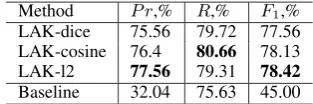
The 10-fold cross-validation results on the
BC-PPI corpus are presented in Table 2 and on
theLLLtraining data set in Table 3. The LA kernel
based on the distributional similarity measures per-forms significantly better than the baseline. In con-trast to the baseline, it is able to handle sequences of different lengths including gaps. According to the Eq. 7, a comparison of any two sequences of different lengths results in the 0-score. Neverthe-less it still yields high recall while precision is much lower. Interestingly, the results of the short-est path approach on the ACE corpus (Bunescu and Mooney, 2005) were reversed by boosting preci-sion while decreasing recall.
Method P r,% R,% F1,% LAK-dice 75.56 79.72 77.56 LAK-cosine 76.4 80.66 78.13 LAK-l2 77.56 79.31 78.42 Baseline 32.04 75.63 45.00
Table 2: Results on theBC-PPIdata set
At first glance, the LA kernel based on the distri-butional similarity measures that we selected pro-vides similar performance. We can notice that the l2metric seems to be the best performing measure. On theBC-PPIdata, the method based on thel2
measure outperforms the methods based on dice and on cosinebut the differences are not signifi-cant.
On theLLLdata set, the LA method using
distri-butional similarity measures significantly outper-forms both baselines and also yields better results than an approach based on shallow linguistic in-formation (Giuliano et al., 2006). Giuliano et al. (2006) use no syntactic information. Recent work reported in (Fundel, 2007) also uses dependency information but in contrast to our method, it serves as representation on which extraction rules are de-fined.
The choice of the distributional measure does not seem to affect the overall performance very much. But in contrast to theBC-PPIdata set, the
kernels which use diceandcosinemeasures sig-nificantly outperform the one based onl2(paired t-test,α= 0.01).
Method P r,% R,% F1,% LAK-dice 74.25 87.94 80.51 LAK-cosine 73.99 88.23 80.48 LAK-l2 69.28 87.6 77.37 (Fundel, 2007) 68 83 75 (Giuliano et al., 2006) 62.10 61.30 61.70 Baseline 39.02 100.00 56.13
Table 3: Results on theLLLdata set
coreferences P r,% R,% F1,% with (LAK-dice) 60.00 31.00 40.90 w/o (LAK-dice) 71.00 50.00 58.60 with (Giuliano et al., 2006) 29.00 31.00 30.00 w/o (Giuliano et al., 2006) 54.80 62.90 58.60
Table 4: Results on theLLLtest data set
We also verified how well our method performs on the LLL test data. Surpisingly, precision is
still high (for both subsets, with co-references and without them) while recall suffers. We hypothesize that it is due to the fact that for some sentences only incomplete parses are provided and, conse-quently, no dependency paths between the entities are found. For 91 out of 567 possible interaction pairs generated on the test data, there is no depen-dency path extracted. In contrast, work reported in (Giuliano et al., 2006) does not make use of syn-tactic information which on the data without coref-erences yields higher recall.
4.2.1 Experiment Ia: Impact of distributional measures estimation
We believe that accuracy of LA kernel crucially depends on the substitution matrix, i.e. an accu-rate estimate of distributional similarity. In most cases, to obtain accurate estimates it is needed to use a large corpus. However, it is unclear whether differences in the estimates derived from corpora of different sizes would affect the overall perfor-mance of the LA kernel. To investigate it, we con-ducted several experiments by varying a number of retrieved passages.
Table 5 contains the most similar words to ad-here, expression and sigF detected by the dice
measure in descending order (by varying the num-ber of passages retrieved per query). While the or-der of the most similar words for sigF does not
change very much from one setting to another, es-timates foradhereandexpressiondepend more on
the number of passages retrieved. Moreover, not only the actual ordering changes, but also the num-ber of similar words does. For instance, while there are only four words similar toadherefound
when 100 passages per each query are used, al-ready 12 similar words to adhere are detected
when the count of extracted documents is set to 1,000 passages per query.
adhere expression sigF dice@100 contribute, belong, bind, map processing, overlap, production, cotC, tagA,
localization, sequestration rocG, tagF, whiG dice@500 contribute, belong, bind, end, localization, presence, sigE, comK,
occur, result processing, absence cotC, sigG, tagA
dice@1,000 contribute, bind, convert, presence, assembly, localization, sigE, comK, occur, belong processing, activation cotC, sigG, tagA dice@1,500 bind, contribute, convert, localization, assembly, presence, sigE, comK,
correspond, belong activation, processing cotC, sigG, tagA
Table 5: Top 5 similar words (LLLdata set)
sigFare all named entities. Even thoughsigFdoes
not occur in the training data, we can still hypoth-esize that it is likely to be a target of the relation because ofsigE,cotCandtagA. These three genes
can be found in the training set and they are usually targets (second argument) of the interaction rela-tion.
Table 6 shows results on the LLL data set by varying the size of the data used for estimation of distributional similarity (dice measure). We ob-serve the decrease in precision and in recall when increasing the number of hits to 1,500. Changing the number of hits from 500 to 1,000 results in a subtle increase in recall.
Size P r,% R,% F1,% dice@500 74.25 87.94 80.51 dice@1,000 74.38 88.02 80.62 dice@1,500 69.87 86.85 77.43
Table 6: Estimation settings for theLLLdata set
Size P r,% R,% F1,% dice@100 75.56 79.72 77.58 dice@500 76.72 81.01 78.8 dice@1,000 76.56 80.78 78.61
Table 7: Estimation settings for theBC-PPIdata
set
The results on theBC-PPIdata set show a
simi-lar tendency. However the observed differences are not statistically significant in the latter case. These subtle changes in recall and precision can be at-tributed to the relatively low absolute values of the similarity scores. For instance, even though an or-der of similar words in Table 5 changes while in-creasing the data used for estimation, a difference between the absolute values can be quite small.
4.2.2 Experiment Ib: Impact of the scaling parameterβ
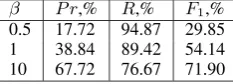
Saigo et al. (2004) have already shown that the parameter β has the significant impact on the re-sults accuracy. We have also carried out some pre-liminary experiments by setting the opening gap to 12, the extension gap to 2 and by varying the pa-rameter β. The kernel matrices were normalized as in Eq. 8. The results on the BC-PPIdata set
(dice500) are given in Table 8.
β P r,% R,% F1,% 0.5 17.72 94.87 29.85 1 38.84 89.42 54.14 10 67.72 76.67 71.90
Table 8: Impact of β on the performance on the
BC-PPIdata set
The results indicate that decreasing β leads to the decrease in the overall performance. However, if the values of gap penalties are lower andβis set to 1, the results are better. This suggests that the final performance of the LA kernel is influenced by a combination of parameters and their choice is crucial for obtaining the good performance.
5 Related Work
We have already mentioned some relevant work on relation extraction while introducing the local alignment kernel. Most work done for relation extraction considers binary relations in sentential context (McDonald, 2005). Current techniques for relation extraction include hand-written patterns (Sekimizu et al., 1998), kernel methods (Zelenko et al., 2003), pattern induction methods (Snow et al., 2005), and finite-state automata (Pustejovsky et al., 2002).
for learning relations, in particular (Culotta and Sorensen, 2004). There are many kernels defined for the text data. For instance, string kernels are special kernels which consider inner products of all subsequences from the given sequences of el-ements (Lodhi et al., 2002). They can be further extended to syllable kernels which proved to per-form well for text categorization (Saunders et al., 2002).
For relation learning, Zelenko et al.(2003) use shallow parsing in conjunction with contiguous and non-contiguous kernels to learn relations. Bunescu et al.(2006) define several kernels to ac-complish the same task. First, they introduce the sequential kernels and show that such method out-performs the longest match approach. Next, Bunescu et al. (2006) propose kernels for the paths in dependency trees (which is referred to as a short-est path between two arguments of a given rela-tion). In this paper we used their method based on dependency parsing as one of the baselines. Giu-liano (2006) takes this approach further by defin-ing several kernels usdefin-ing local context and senten-tial context. An advantage of Giuliano’s method (2006) lies in the simpler representation which does not use syntactic structure. In this case, even if parsing fails on certain sentences, it is still pos-sible to handle them.
6 Conclusions
We presented a novel approach to relation extrac-tion which is based on the local alignments of se-quences. To compare two sequences, additional information is used which is not necessarily con-tained in the training data. By employing distribu-tional measures we obtain a considerable improve-ment over two baselines and work reported before. The choice of a distributional similarity measure does not seem to affect the overall performance very much. Based on the experiments we have conducted, we conclude that the LA kernel using
diceandcosinemeasures perform similarly on the
LLLdata set and theBC-PPIcorpus. On theLLL
corpus, the LA kernel employing l2shows a
sig-nificant decrease in performance. But concerning statistical significance, the method usingdice
sig-nificantly outperforms the one based l2 measure
only on LLL corpus while there is no significant
improvement on theBC-PPIdata set noticed.
We use contextual information to measure dis-tributional similarity. In this setting any two words
can be compared no matter which parts of speech they belong to. As dependency paths contain vari-ous words along with nouns and verbs, other meth-ods often mentioned in the literature would be more difficult to use. However, in the future we are going to extend this approach by using syntac-tically analyzed corpora and by estimating distri-butional similarity from it. It would allow us to use more accurate estimates and to discriminate be-tween lexically ambiguous words. Similarity mea-sures on the words that belong to other parts of speech can be still estimated using the local con-text only.
Acknowledgments
The authors thank Vera Hollink, Victor de Boer and anonymous reviewers for their valuable com-ments. This work was carried out in the con-text of the Virtual Laboratory for e-Science project
(www.vl-e.nl). This project is supported by a
BSIK grant from the Dutch Ministry of Education, Culture and Science (OC&W) and is part of the ICT innovation program of the Ministry of Eco-nomic Affairs (EZ).
References
Yevgeny (Eugene) Agichtein. 2005. Extracting
Re-lations from Large Text Collections. Ph.D. Thesis,
Columbia University.
Razvan C. Bunescu and Raymond J.Mooney. 2006. Extracting Relations from Text. From Word
Se-quences to Dependency Paths. In book ”Text Mining
and Natural Language Processing”, Anne Kao and Steve Poteet (Eds).
Razvan C. Bunescu and Raymond J.Mooney. 2005. A Shortest Path Dependency Kernel for Relation
Ex-traction. In Proceedings of the Joint Conference
on Human Language Technology / Empirical Meth-ods in Natural Language Processing (HLT/EMNLP), Vancouver, BC.
Chih-Chung Chang and Chih-Jen Lin. 2001. LIB-SVM: a library for support vector machines. Software available athttp://www.csie.ntu. edu.tw/˜cjlin/libsvm
Stanley F. Chen and Joshua Goodman. 1996. An Em-pirical Study of Smoothing Techniques for Language
Modeling. In ACL’96.
William W. Cohen, Pradeep Ravikumar and Stephen Fienberg. 2003. A Comparison of String Distance
Metrics for Name-Matching Tasks. In IIWeb 2003,
Aron Culotta and Jeffrey Sorensen. 2003. Dependency Tree Kernels for Relation Extraction.In ACL 2003. William B. Dolan, Chris Quirk and Chris Brockett.
2004. Unsupervised Construction of Large Para-phrase Corpora: Exploiting Massively Parallel News
Sources. In Proceedings of COLING 2004, Geneva,
Switzerland.
Katrin Fundel, Robert K¨uffner, and Ralf Zimmer. 2007. RelEx - Relation Extraction using dependency parse trees.In Bioinformatics, vol. 23, no. 3.
Claudio Giuliano, Alberto Lavelli, and Lorenza Ro-mano. 2006. Exploiting Shallow Linguistic Infor-mation for Relation Extraction from Biomedical Lit-erature.In EACL 2006.
David Haussler. 1999. Convolution Kernels on
Dis-crete Structures. UC Santa Cruz Technical Report
UCS-CRL-99-10.
William Hersch, Aaron M. Cohen, Phoebe Roberts and Hari K. Rakapalli. 2006. TREC 2006 Genomics Track Overview.In Proceedings of the 15th Text Re-trieval Conference.
Lillian Lee. 1999. Measures of distributional similar-ity.In Proceedings of the 37th annual meeting of the Association for Computational Linguistics on Com-putational Linguistics, pages 25-32.
G. Leusch, N. Ueffing and H. Ney. 2003. A Novel String-to-String Distance Measure with Applications
to Machine Translation Evaluation. In Machine
Translation Summit IX, New Orleans, LO, pages 240-247.
Huma Lodhi, Craig Saunders, John Shawe-Taylor, Nello Christianini, and Chris Watkins. 2002. Text
Classification using String Kernels. In Journal of
Machine Learning Research, 2, pages 419-444.
Ryan McDonald. 2005. Extracting Relations from
Un-structured Text.Technical Report: MS-CIS-05-06.
Alvaro E. Monge and Charles Elkan. 1996. The Field
Matching Problem: Algorithms and Applications.In
KDD 1996, pages 267-270.
Alessandro Moschitti. Efficient Convolution Kernels
for Dependency and Constituent Syntactic Trees. In
ECML 2006, pages 318-329.
Cl. N´edellec. 2005. Learning Language in Logic -Genic Interaction Extraction Challenge.In Proceed-ings of the Learning Language in Logic workshop. J. Pustejovsky, J. Castano, J. Zhang, B. Cochran, M.
Kotecki. 2002. Robust Relational Parsing over Biomedical Literature: Extracting Inhibit Relations. Pacific Symposium on Biocomputing.
Fabio Rinaldi, Gerold Schneider, Kaarel Kaljurand, James Dowdall, Christos Andronis, Andreas Per-sidis, and Ourania Konstanti. 2004. Mining
re-lations in the GENIA corpus. In ”Second
Euro-pean Workshop on Data Mining and Text Mining for Bioinformatics”, in conjunction with ECML/PKDD 2004, September.
Hiroto Saigo, Jean-Philippe Vert, Nobuhisa Ueda and Tatsuya Akutsu. 2004. Protein homology detection using string alignment kernels.In ”Bioinformatics”, vol. 20 no. 11, pages 1682-1689.
Hiroto Saigo, Jean-Philippe Vert, and Tatsuya Akutsu. 2006. Optimizing amino acid substitution matrices
with a local alignment kernel. In ”BMC
Bioinfor-matics”, 7:246.
C. Saunders, H. Tschach, and J. Shawe-Taylor. 2002.
Syllables and other String Kernel Extensions. In
Proceesings of the Nineteenth International Confer-ence on Machine Learning (ICML’02).
T. Sekimizu, H. Park, and J. Tsujii. 1998. Identify-ing the interaction between genes and gene products based on frequently seen verbs in medline abstracts. In Genome Informatics.
T. F. Smith and M. S. Waterman. 1987.
Identifica-tion of Common Molecular Subsequences. In J. Mol.
Biol. 147, 195–197.
Rion Snow, Daniel Jurafsky, and Andrew Y. Ng. 2005. Learning syntactic patterns for automatic hypernym discovery. NIPS 17.
Erik Tjong Kim Sang, Sander Canisius, Antal van den Bosch and Toine Bogers. 2005. Applying spelling error correction techniques for improving semantic
role labeling. In Proceedings of the Ninth
Confer-ence on Natural Language Learning, CoNLL-2005, June 29-30, 2005, Ann Arbor, MI.
Lonneke van der Plas and J¨org Tiedemann. 2006. Find-ing Synonyms UsFind-ing Automatic Word Alignment
and Measures of Distributional Similarity. In
Pro-ceedings of ACL/Coling.
C. J. van Rijsbergen, S. E. Robertson and M. F. Porter. 1980. New models in probabilistic information
re-trieval. London: British Library. (British Library
Research and Development Report, no. 5587). Julie Weeds, David Weir and Diana McCarthy. 2004.
Characterising measures of lexical distributional similarity. In Proceedings of CoLing 2004.
Dmitry Zelenko, Ch. Aone, and A. Richardella. 2003.
Kernel Methods for Relation Extraction. Journal of