Instance Sense Induction from Attribute Sets
Ricardo Martin-Brualla
Google Inc [email protected]
Enrique Alfonseca
Google Inc [email protected]
Marius Pasca
Google Inc [email protected]
Keith Hall
Google Inc [email protected]
Enrique Robledo-Arnuncio
Google Inc [email protected]
Massimiliano Ciaramita
Google Inc [email protected]
Abstract
This paper investigates the new problem of automatic sense induction for instance names using automatically extracted at-tribute sets. Several clustering strategies and data sources are described and eval-uated. We also discuss the drawbacks of the evaluation metrics commonly used in similar clustering tasks. The results show improvements in most metrics with re-spect to the baselines, especially for pol-ysemous instances.
1 Introduction
Recent work on information extraction increas-ingly turns its attention to the automatic acqui-sition of open-domain information from large text collections (Etzioni et al., 2008). The ac-quired information typically includes instances (e.g. barack obama or hillary clinton), class la-bels (e.g. politician or presidential candidate) and relations and attributes of the instances (e.g.
president-countryordate-of-birth) (Sekine, 2006; Banko et al., 2007).
Within the larger area of relation extraction, the acquisition of instance attributes (e.g. pres-ident for instances of countries, or side effects
for instances of drugs) plays an important role, since attributes may serve as building blocks in any knowledge base constructed around open-domain classes of instances. Thus, a variety of attribute extraction methods mine textual data sources ranging from unstructured (Tokunaga et al., 2005) or structured (Cafarella et al., 2008) text within Web documents, to human-compiled ency-clopedia (Wu et al., 2008; Cui et al., 2009) and
Web search query logs (Pas¸ca and Van Durme, 2007), attempting to extract, for a given class, a ranked list of attributes that is as comprehensive and accurate as possible.
Previous work on attribute extraction, however, does not capture or address attributes of polyse-mous instances. An instance may have differ-ent meanings, and the extracted attributes may
not apply to all of them. For example, the
most salient meanings ofdarwinare the scientist
Charles Darwin, an Australian city, and an op-erating system, plus many less-known meanings. For these ambiguous instances, it is common for the existing procedures to extract mixed lists of attributes that belong to incompatible meanings, e.g.{biography, population, hotels, books}.
This paper explores the problem of automati-cally inducing instance senses from the learned attribute lists, and describes several clustering so-lutions based on a variety of data sources. For that, it brings together research on attribute acqui-sition and on word sense induction. Results show that we can generate meaninful groupings of at-tributes for polysemous instance names, while not harming much the monosemous instance names by generating unwanted clusters for them. The results are much better than for a random base-line, and are superior to the one-in-all and the all-singleton baselines.
2 Previous Work
ex-tract patterns and clues around attributes (Yoshi-naga and Torisawa, 2007; Wong and Lam, 2009; Ravi and Pas¸ca, 2008), or the use of articles within online encyclopedia as sources of struc-tured text for attribute extraction (Suchanek et al., 2007; Nastase and Strube, 2008; Wu and Weld, 2008). Regarding unstructured text in Web docu-ments, the method described in (Tokunaga et al., 2005) takes various class labels as input, and ap-plies manually-created lexico-syntactic patterns to document sentences to extract candidate attributes ranked using several frequency statistics. In (Bel-lare et al., 2007), the extraction is guided by a set of seed instances and attributes rather than hand-crafted patterns, with the purpose of generating training data and extract new instance-attribute pairs from text.
Web search queries have also been used as a data source for attribute extraction, using lexico-syntactic patterns (Pas¸ca and Van Durme, 2007) or seed attributes (Pas¸ca, 2007) to guide the extrac-tion, and leading to attributes of higher accuracy than those extracted with equivalent techniques from Web documents (Pas¸ca et al., 2007).
Another related area to this work is the field of
word sense induction: the task of identifying the possible senses of a word in a corpus using unsu-pervised methods (Yarowsky, 1995), as opposed to traditional disambiguation methods which rely on the availability of a finite and static list of pos-sible meanings. In (Agirre and Soroa, 2007) a framework is proposed for evaluating such sys-tems. Word sense induction can be naturally for-mulated as a clustering task. This introduces the complication of choosing the right number of possible senses, hence a Bayesian approach to WSI was proposed which deals with this problem within a principled generative framework (Brody and Lapata, 2009). Another related line of work
Turkey Attributes Darwin Attributes
maps1 capital1 maps1 definition1,3
recipes2 culture1 awards2 jobs1
pictures1,2 history1 shoes1 tourism1
calories2 tourism1 evolution3 biography3
facts1,2 nutrition facts2 theory3 attractions1
nutrition2 beaches1 weather1 hotels1
cooking time2 brands2 pictures1,3 ports4
[image:2.595.82.282.611.687.2]religion1 language1 quotes3 population1
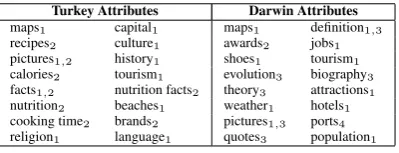
Table 1: Attributes extracted for the instances
TurkeyandDarwin.
is the disambiguation of people names (Mann and Yarowsky, 2003). In SEMEVAL-1, a shared task was introduced dedicated to this problem, the Web People Search task (Artiles et al., 2007; Artiles et al., 2009). Disambiguating names is also often ap-proached as a clustering problem. One challenge shared by word sense induction and name disam-biguation (and most unsupervised settings), is the evaluation. In both tasks, simple baselines such as predicting one single cluster tend to outperform more sophisticated approaches (Agirre and Soroa, 2007; Artiles et al., 2007).
3 Instance Sense Induction
3.1 Problem description
This paper assumes the existence of an attribute extraction procedure. Using those attributes, our aim is to identify the coarse-grained meanings with which each attribute is associated. As an example, Table 1 shows the top 16 attributes ex-tracted using the procedure described in (Pas¸ca and Van Durme, 2007). Salient meanings for
turkey are the country name (labeled as 1 in the table), and the bird name (labeled as 2). Some at-tributes are applicable to both meanings (pictures
andfacts). The second example, darwin, can re-fer to a city (sense 1), the Darwin Awards (sense 2), the person (sense 3), and an operating system (sense 4).
Examples of applications that need to dis-criminate between the several meanings of in-stances are user-facing applications requiring the attributes to be organized logically and informa-tion extracinforma-tion pipelines that depend on the ex-tracted attributes to find values in documents.
3.2 Instance and attributes input data
The input data of instances and attributes has been obtained, in a fully automated way, following the method described in (Pas¸ca and Van Durme, 2007). The input dataset is a set of fully anony-mized set of English queries submitted to a popu-lar (anonymized) search engine. The set contains millions of unique isolated, individual queries that are independent from one another. Each query is accompanied by its frequency of occurrence in the query logs. The sum of frequencies of all queries in the dataset is hundreds of millions. Other sources of similar data are available pub-licly for research purposes (Gao et al., 2007). This extraction method applies a few patterns (e.g.,the
A of I, orI’s A, or A of I) to queries within query logs, where an instanceIis one of the most frequent 5 million queries from the repository of isolated queries, and A is a candidate attribute.
For each instance, the method extracts ranked lists containing zero, one or more attributes, along with frequency-based scores. For this work, only the top 32 attributes of each instance were used, in or-der to have an input set for the clustering with a reasonable size, but to keep precision at high lev-els.
3.3 Per-attribute clustering information
For each (instance, attribute) pair, the following information is collected:
Search results: The top 20 search results (in-cluding titles and snippets) returned by a popular search engine for a query created by concatenat-ing the instance and the attribute. The motivation for this data source is that the attributes that re-fer to the same meaning of the instance should help the search engine in selecting web pages that refer to that meaning. The titles and snippets of these search results are expected to contain other terms related to that meaning. For example, for the queries[turkey maps]and[turkey culture]the search results will contain information related to the country, whereas[turkey recipes]and[turkey nutritional value]should share many terms about the poultry.
Query sessions: A query session is a series of queries submitted by a single user within a small range of time (Silverstein et al., 1999). Informa-tion stored in the session logs may include the text
For each (instance, attribute) pair:
• Retrieve all the sessions that contained the query [in-stance attribute].
• Collect the set of all the queries that appeared in the same session and which are a superstring ofinstance.
• Removeinstancefrom each of those queries, and out-put the resulting set of query words.
Figure 1: Algorithm to collect session phrases as-sociated to attributes.
of the queries and metadata, such as the time, the type of query (e.g., using the normal or the ad-vance form), and user settings such as the Web browser used (Silverstein et al., 1999).
Users often search for related queries within a session: queries on the culture of the coun-try Turkey will tend to be surrounded by queries about topics related to the country; similarly, queries about turkeyrecipes will tend to be sur-rounded by other queries on recipes. Therefore, if two attributes refer to the same meaning of the instance, the distributions of terms that co-occur with them in the same search sessions is expected to be similar. To ensure that the user did not change intent during the session, we also require the queries from which we extract phrases to con-tain the instance of interest. The pseudocode of the procedure is shown in Figure 1.
Class labels: As described in (Pas¸ca and Van Durme, 2008), we collect for each instance (e.g.,
turkey), a ranked list of class labels (e.g.,country, location, poultry, food). The procedure uses a col-lection of Web documents and applies some IsA extraction patterns selected from (Hearst, 1992). Using the (instance, ranked-attributes) and the (in-stance, ranked-class labels) lists, it is possible to aggregate the two datasets to obtain, for each at-tribute, the class labels that are most strongly as-sociated to it (Figure 2).
3.4 EM clustering
We run a set of EM clusterings separately for the attributes of each instance. The model imple-mented is the following: given an instance, let
A = {a1, a2, ..., an} be the set of attributes
For each attribute:
• Collect all the instances that contain that attribute.
• For each class label, average its ranks for those in-stances. If an instance does not contain a particular class label, use as rank the size of the longest list of class labels plus one.
[image:4.595.115.244.344.411.2]• Rank the class labels from smaller to larger average rank.
Figure 2: Algorithm to collect class labels associ-ated to attributes.
the attribute, andC be the set of all the possible class labels. LetK be the cluster function which assigns cluster indexes to the attributes.
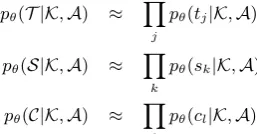
We assume that the distributions for snippet terms, session terms and class labels are condi-tionally independent given the clustering. Further-more, we assume that the distribution of terms for queries in a cluster are also conditionally indepen-dent given the cluster assignments:
pθ(T |K,A) ≈ Y
j
pθ(tj|K,A)
pθ(S|K,A) ≈ Y
k
pθ(sk|K,A)
pθ(C|K,A) ≈ Y
l
pθ(cl|K,A)
The clustering model for each instance (the ex-pectation step) is, therefore:
pθ(KT SC|A,Θ) = N
Y
i
pθ(K|A)pθ(T |K,A)pθ(S|K,A)pθ(C|K,A)
To estimate the parameters of the model, we must be able to estimate the following distributions dur-ing the maximization step:
• pθ(tj|K,A) = EEθθ(t(jK|A,K|A))
• pθ(sk|K,A) = EEθ(θs(kK|A,K|A))
• pθ(cl|K,A) =EEθ(θc(lK|A,K|A))
One advantage of this approach is that it allows using a subset of the available data sources to eval-uate their relative influence on the clustering qual-ity. In the experiments we have tried all possible combinations of the three data sources to find the settings that give the best results.
3.5 Initialization strategies
The initial assignment of attributes to clusters is important, since a bad seed clustering can lead
EM to local optima. We have tried the following two strategies:
Random assignment: the attributes are assigned to clusters randomly. To make the results repeat-able, for each instance we use the instance name as the seed for the random number generator.
K-means: the initial assignments of attributes to clusters is performed using K-means. In this model, we use a simple vector-space-model in the following way:
1. Each attribute is represented with a bag-of-words of the snippets of the search results for a concatenation of the instance name and the attribute. This is the same data already col-lected for EM.
2. Each of the snippet terms in these bag-of-words is weighted using thetf ×idf score,
with inverse document frequencies estimated from an English web corpus with hundreds of millions of documents.
3. The cosine of the angle of the vectors is used as the similarity metric between each pair of attributes.
Several values ofK have been tried in our
exper-iments, as mentioned in Section 4.
3.6 Post-processing
EM works with a fixed set of clusters. In order to decide which is the optimal number of clusters, we have run all the experiments with a number of clustersK that is large enough to accommodate
most of the queries in our dataset, and we run a post-processing step that merges clusters for in-stances that have less thanKmeanings.
Since we have, for each attribute, a distribution of the most likely class labels (Section 3.3), the post-processing performs as follows:
1. Generate a list of class labels per cluster, by combining the ranked lists of per-attribute class labels as was done in Section 3.3. 2. Merge together all the clusters such that their
sets of topkclass labels are the same.
The values ofKandkare chosen by doing several
4 Evaluation and Results
4.1 Evaluation metrics
There does not exist a fully agreed evaluation metric for clustering tasks in NLP (Geiss, 2009; Amig´o et al., 2009). Each metric has its own idiosyncrasies, so we have chosen to compute six different evaluation metrics as described in (Amig´o et al., 2009). Empirical results show they are highly correlated, i.e., tuning a parameter by hill-climbing on F-score typically also improves theB3 F-score.
Purity (Zhao and Karypis, 2002): Let C be
the clusters to evaluate, L the set of
cate-gories (the clusters in the gold-standard), and
N the number of clustered items. Purity is
the average of the precision values: Purity =
P
i | Ci|
N maxjPrec(Ci, Lj), where the precision
for cluster Ci with respect to category Lj is
Prec(Ci, Lj) = |Ci∩Lj|
|Ci| . Purity is a precision met-ric. Inverting the roles of the categoriesLand the
clusters C gives a recall metric, inverse purity,
which rewards grouping items together. The two metrics can be combined in an F-score.
B3 Precision (Bagga and Baldwin, 1998): Let
L(e)andC(e)denote the gold-standard-category
and the cluster of an iteme. The correctness of the
relation betweeneand other elemente0is defined
as
Correctness(e, e0) =
1 iffL(e) =L(e0)
⇔C(e) =C(e0)
0 otherwise
The B3 Precision of an item is the proportion
of items in its cluster which belong to its cat-egory, including itself. The total precision is the average of the item precisions: B3Prec =
avge[avge0:C(e)=C(e0)Correctness(e, e0)]
B3Recall: is calculated in a similar way, inverting
the roles of clusters and categories. The B3 F-scoreis obtained by combining B3 precision and
B3recall.
4.2 Gold standards
We have built two annotated sets, one to be used as a development set for adjusting the parame-ters, and a second one as a test set. The evalu-ation settings were chosen without knowledge of
Purity Inv. F-score B3
B3
B3
Purity Precision Recall F-score
0.94 0.95 0.92 0.90 0.92 0.91
Table 2: Inter-judge agreement scores.
Polysemous Main meanings
airplane machine, movie
apple fruit, company
armstrong unit, company, person
chain reaction company, film, band, chemistry chf airport, currency, heart attack
darwin person, city
david copperfield book, performer, movie delta letter, airways
Table 3: Examples of polysemous instances.
the test set. Each of the two sets contains 75 in-stances chosen randomly from the complete set of instances with ranked attributes (Section 3.2 de-scribed the input data). For the random sampling, the instances were weighted with their frequency in the query logs as full queries, so that more frequent instances have higher chance to be cho-sen. This ensures that uncommon instances are not overrepresented in the gold-standard.
The annotators contributed 50 additional in-stances (25 for development and 25 for testing) that they considered interesting to study, e.g., be-cause of having several salient meanings.
Five human annotators were shown the top 32 attributes for each instance, and they were asked to cluster them. We decided to start with a sim-plified version of the problem by considering it a hard clustering task.
Table 2 shows that the average agreement scores between judge pairs, measured with the same evaluation metrics used for the system out-put, are quite high. In the first three metrics, the F-score is not an average of precision and recall, but a weighted average calculated separately for each cluster, so it may have a value that is not be-tween the values of precision and recall.
Exam-All instances polysemous instances
Weights Purity Inv. F B3 B3 B3F Purity Inv. F B3 B3 B3F
Purity score Prec. Recall score Purity score Prec. Recall score
[image:6.595.73.525.71.232.2]All-in-one 0.797 1.000 0.766 0.700 1.000 0.797 0.558 1.000 0.540 0.410 1.000 0.573 All-singletons 1.000 0.145 0.187 1.000 0.145 0.242 1.000 0.205 0.266 1.000 0.205 0.333 Random 0.888 0.322 0.451 0.851 0.246 0.373 0.685 0.362 0.447 0.595 0.276 0.373 Random Only snippets 0.809 0.374 0.417 0.737 0.311 0.410 0.596 0.430 0.401 0.483 0.361 0.399 Init. Only sessions 0.797 0.948 0.728 0.700 0.944 0.753 0.558 1.000 0.540 0.410 1.000 0.573 Only class labels 0.798 0.983 0.760 0.701 0.969 0.785 0.561 0.990 0.541 0.415 0.981 0.574 No snippets 0.798 0.934 0.723 0.702 0.918 0.744 0.561 0.990 0.541 0.415 0.981 0.574 No sessions 0.809 0.374 0.417 0.737 0.311 0.410 0.596 0.430 0.401 0.483 0.361 0.399 No class labels 0.809 0.374 0.417 0.737 0.311 0.410 0.596 0.430 0.401 0.483 0.361 0.399 All 0.809 0.380 0.420 0.736 0.316 0.414 0.596 0.430 0.400 0.483 0.361 0.399 K-Means Only snippets 0.844 0.765 0.700 0.771 0.654 0.675 0.671 0.806 0.587 0.556 0.719 0.611 Init. Only sessions 0.798 0.957 0.736 0.702 0.949 0.759 0.558 1.000 0.540 0.410 1.000 0.573 Only class labels 0.824 0.656 0.622 0.747 0.568 0.604 0.641 0.768 0.565 0.519 0.699 0.575 No snippets 0.824 0.655 0.622 0.748 0.562 0.598 0.640 0.768 0.565 0.518 0.698 0.574 No sessions 0.843 0.770 0.701 0.769 0.661 0.677 0.671 0.806 0.587 0.556 0.719 0.611 No class labels 0.844 0.762 0.698 0.771 0.651 0.673 0.671 0.806 0.587 0.556 0.719 0.611 All 0.843 0.767 0.699 0.770 0.657 0.675 0.671 0.806 0.587 0.556 0.719 0.611
Table 4: Scores over all instances and over polysemous instances.
ples of monosemous instances areactivision, am-ctheaters, american airlines,ask.com,bebo, dis-neyoreinstein. 22% of the instances in the devel-opment set and 13% of the instances in the test set are polysemous.
4.3 Parameter tuning
We tuned the different parameters of the algorithm using the development set. We performed several EM runs including all three data sources, modi-fying the following parameters: the smoothing
added to the cluster soft-assignment in the Maxi-mization step (Manning et al., 2008), the number
Kof clusters for K-Means and EM, and the
num-berk of top ranked class labels that two clusters
need to have in common in order to be merged at the post-processing step. The best results were obtained with= 0.4,K = 5andk= 1. These
are the values used in the experiments mentioned from now on.
4.4 EM initialization and data sources
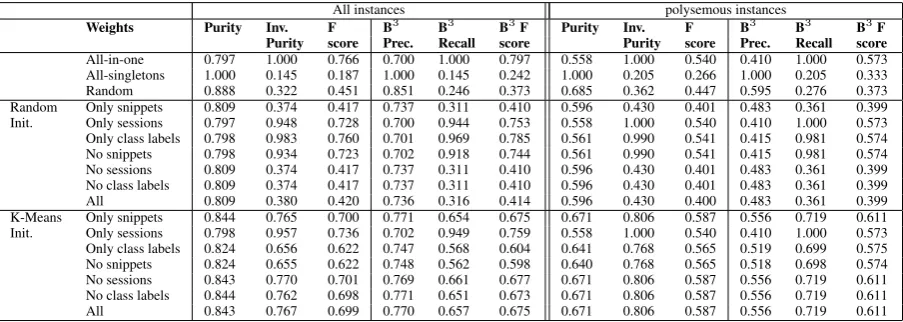
Table 4 shows the results after running EM over the development set, using every possible combi-nation of data sources, and the two initialization strategies (random and K-Means). Several obser-vations can be drawn from this table:
First, as mentioned in Section 2, the evalua-tion metrics are biased towards the all-in-one solu-tion. This is worsened by the fact that the majority of the instances in our dataset are monosemous. Therefore, the highest F-scores and B3 F-scores
are obtained by the all-in-one baseline, although
it is not the most useful clustering.
When using only class labels, EM tends to pro-duce results similar to the all-in-one baseline This can be explained by the limited class vocabulary which makes most of the attributes share class la-bels. The bad results when using only sessions are caused by the presence of attributes with no ses-sion terms, due to insufficient data.
The random clustering baseline (third line in Table 4) tends to give smaller clusters than EM, because it distributes instances uniformly across the clusters. This leads to better precision scores, and much worse recall and F-score metrics.
From these results, we conclude that snippet terms are the most useful resource for clustering. The other data sources do not provide a signifi-cant improvement over it. The best results overall for the polysemous instances, and the highest re-sults for the whole dataset (excluding the outliers that are too similar to the all-in-one baseline) are obtained using snippet terms. For these configura-tions, as we expected, the K-Means initialization does a better job in avoiding local optima during EM than the random one.
4.5 Post-processing
Table 5 includes the results on the development set after post-processing, using the best configu-ration for EM (K-Means initialization and snippet terms for EM). Post-processing slightly hurts the B3F-score for polysemous terms, but it improves
Data Method Purity Inv. Purity F-score B3
Prec. B3
Recall B3
F-score
[image:7.595.90.503.71.145.2]All instances All-in-one 0.797 1.000 0.766 0.700 1.000 0.797 All-singletons 1.000 0.145 0.187 1.000 0.145 0.242 K-Means + EM (snippets) 0.844 0.765 0.700 0.771 0.654 0.675 K-Means + EM (snippets) + postprocessing 0.825 0.837 0.728 0.743 0.761 0.722 Polysemous All-in-one 0.558 1.000 0.540 0.410 1.000 0.573 All-singletons 1.000 0.205 0.266 1.000 0.205 0.333 K-Means + EM (snippets) 0.671 0.806 0.587 0.556 0.719 0.611 K-Means + EM (snippets) + postprocessing 0.644 0.846 0.592 0.518 0.777 0.607
Table 5: Scores only over all and polysemous instances, without and with postprocessing.
K-Means output EM output Post-processing
pictures, family, logo, biography pictures, biography, inauguration pictures, biography, inauguration inauguration, song, lyrics, foods, song, lyrics, foods, timeline, song, lyrics, goods, timeline, quotes, timeline, shoes, health care camping, shoes, maps, art, history, camping, shoes, maps, art, history maps, art, kids, history, speeches official website, facts, speeches official website, facts, speeches official website, facts, scandal scandal, blog, music scandal, blog, music, family, kids economy, blog, music, flag, camping approval rating, health care, daughters
approval rating economy approval rating, health care,
daughters family, kids, daughters economy
symbol logo, quotes, symbol, flag logo, quotes, symbol, definition
[image:7.595.90.505.178.302.2]definition, religion, definition, religion, slogan, books religion, slogan, books, flag slogan, books
Table 6: Attributes extracted for the monosemous instanceobama, using snippet terms for EM.
4.6 Clustering examples
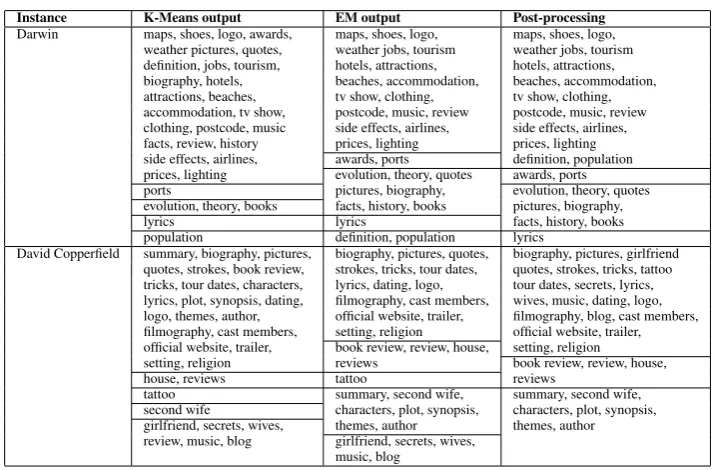
Tables 6 and 7 show examples of clustering results for three instances chosen as representatives of the monosemous and the polysemous subsets. These show that the output of the K-Means initialization can uncover some meaningful clusters, but tends to generate a dominant cluster and a few small or singleton clusters. EM distributes the attributes more evenly across clusters, combining attributes that are closely related.
For monosemous instances like obama, EM
generates small clusters of highly related at-tributes (e.g, family, kids and daughters). Post-processing merges some of the clusters together, but it fails to merge all into a single cluster.
For darwin, two of the small clusters given by K-Means are actually good, asportsis the only at-tribute of the operating system, andlyricsis one of the two attributes referring to a song titled Darwin. EM again redistributes the attributes, creating two large and mostly correct clusters.
For david copperfield, EM creates two clusters for the performer, one for the book, one for the movie, and one for tattoo (off-topic for this in-stance). The two clusters referring to the per-former are merged in the post-processing, with some errors remaining, e.g, trailer and second wifeare in the wrong cluster.
4.7 Results on the test set
Table 8 show the results of the EM clustering and the postprocessing step when executed on the test set. The settings are those that produced the best results on the development set: using EM initial-ized with K-Means, and using only snippet terms for the generative model.
As mentioned above, the test set has a higher proportion of monosemous queries than the de-velopment set, so the all-in-one baseline pro-duces better results than before. Still, we can see the same trend happening: for the whole dataset the F-score metrics are somewhat worse than the best baseline, given that the evaluation metrics all overvalue the all-in-one baseline, but this can be considered an artifact of the metrics. As with the development set, using EM produces the best pre-cision scores (except for the all-singletons base-line), and the postprocessing improves precision and F-score over the all-in-one baseline. The whole system improves considerably the F-score for the polysemous terms.
5 Conclusions
differ-Instance K-Means output EM output Post-processing
Darwin maps, shoes, logo, awards, maps, shoes, logo, maps, shoes, logo, weather pictures, quotes, weather jobs, tourism weather jobs, tourism definition, jobs, tourism, hotels, attractions, hotels, attractions, biography, hotels, beaches, accommodation, beaches, accommodation, attractions, beaches, tv show, clothing, tv show, clothing, accommodation, tv show, postcode, music, review postcode, music, review clothing, postcode, music side effects, airlines, side effects, airlines, facts, review, history prices, lighting prices, lighting side effects, airlines, awards, ports definition, population prices, lighting evolution, theory, quotes awards, ports ports pictures, biography, evolution, theory, quotes evolution, theory, books facts, history, books pictures, biography, lyrics lyrics facts, history, books population definition, population lyrics
David Copperfield summary, biography, pictures, biography, pictures, quotes, biography, pictures, girlfriend quotes, strokes, book review, strokes, tricks, tour dates, quotes, strokes, tricks, tattoo tricks, tour dates, characters, lyrics, dating, logo, tour dates, secrets, lyrics, lyrics, plot, synopsis, dating, filmography, cast members, wives, music, dating, logo, logo, themes, author, official website, trailer, filmography, blog, cast members, filmography, cast members, setting, religion official website, trailer, official website, trailer, book review, review, house, setting, religion setting, religion reviews book review, review, house, house, reviews tattoo reviews
tattoo summary, second wife, summary, second wife, second wife characters, plot, synopsis, characters, plot, synopsis, girlfriend, secrets, wives, themes, author themes, author review, music, blog girlfriend, secrets, wives,
music, blog
Table 7: Attributes extracted for three polysemous instances, using snippet terms for EM.
Set Solution Purity Inverse Purity F-score B3Precision B3Recall B3F-score
[image:8.595.117.475.66.301.2]All All-in-one 0.907 1.000 0.892 0.858 1.000 0.908 All-singletons 1.000 0.076 0.114 1.000 0.076 0.136 Random 0.936 0.325 0.463 0.914 0.243 0.377 EM 0.927 0.577 0.664 0.896 0.426 0.561 EM+postprocessing 0.919 0.806 0.804 0.878 0.717 0.764 Polysemous All-in-one 0.588 1.000 0.586 0.457 1.000 0.613 All-singletons 1.000 0.141 0.210 1.000 0.141 0.239 Random 0.643 0.382 0.441 0.549 0.288 0.369 EM 0.706 0.631 0.556 0.626 0.515 0.547 EM+postprocessing 0.675 0.894 0.650 0.564 0.842 0.661
Table 8: Scores in the test set.
ent data sources, and explores cluster initializa-tion and post-processing strategies. The evalu-ation shows that the most important of the con-sidered data sources is the snippet terms obtained from search engine results to queries made by concatenating the instance and the attribute. A simple post-processing that merges attribute clus-ters that have common class labels can improve recall for monosemous queries. The results show improvements across most metrics with respect to a random baseline, and F-score improvements for polysemous instances.
Future work includes extending the generative model to be applied across the board, linking the clustering models of different instances with each other. We also intend to explore applications of the clustered attributes in order to perform extrin-sic evaluations on these data.
References
Agirre, Eneko and Aitor Soroa. 2007. Semeval-2007 task 02: Evaluating word sense induction and discrimination systems. InProceedings of SemEval-2007, pages 7–12. Association for Computational Linguistics.
Amig´o, E., J. Gonzalo, J. Artiles, and F. Verdejo. 2009. A comparison of extrinsic clustering evaluation met-rics based on formal constraints. Information Retrieval, 12(4):461–486.
Artiles, Javier, Julio Gonzalo, and Satoshi Sekine. 2007. The semeval-2007 WePS evaluation: Establishing a benchmark for the web people search task. In Proceed-ings of SemEval-2007, pages 64–69.
Artiles, J., J. Gonzalo, and S. Sekine. 2009. Weps 2 evalua-tion campaign: overview of the web people search cluster-ing task. In2nd Web People Search Evaluation Workshop (WePS 2009), 18th WWW Conference.
Banko, M., Michael J Cafarella, S. Soderland, M. Broad-head, and O. Etzioni. 2007. Open information extraction from the Web. InProceedings of IJCAI-07, pages 2670– 2676, Hyderabad, India.
Bellare, K., P.P. Talukdar, G. Kumaran, F. Pereira, M. Liber-man, A. McCallum, and M. Dredze. 2007. Lightly-Supervised Attribute Extraction. InNIPS 2007 Workshop on Machine Learning for Web Search.
Brody, Samuel and Mirella Lapata. 2009. Bayesian word sense induction. InProceedings of EACL ’09, pages 103– 111.
Cafarella, M.J., A. Halevy, D.Z. Wang, and Y. Zhang. 2008. Webtables: Exploring the Power of Tables on the Eeb.
Proceedings of the VLDB Endowment archive, 1(1):538– 549.
Cui, G., Q. Lu, W. Li, and Y. Chen. 2009. Automatic Acqui-sition of Attributes for Ontology Construction. In Pro-ceedings of the 22nd International Conference on Com-puter Processing of Oriental Languages, pages 248–259. Springer.
Dempster, A.P., N.M. Laird, D.B. Rubin, et al. 1977. Max-imum likelihood from incomplete data via the EM algo-rithm. Journal of the Royal Statistical Society. Series B (Methodological), 39(1):1–38.
Etzioni, O., M. Banko, S. Soderland, and S. Weld. 2008. Open Information Extraction from the Web. Communica-tions of the ACM, 51(12), December.
Gao, W., C. Niu, J. Nie, M. Zhou, J. Hu, K. Wong, and H. Hon. 2007. Cross-lingual query suggestion using query logs of different languages. In Proceedings of SIGIR-07, pages 463–470, Amsterdam, The Netherlands. Geiss, J. 2009. Creating a Gold Standard for Sentence Clus-tering in Multi-Document Summarization. ACL-IJCNLP 2009.
Hearst, M. 1992. Automatic acquisition of hyponyms from large text corpora. InProceedings of COLING-92, pages 539–545, Nantes, France.
Mann, Gideon S. and David Yarowsky. 2003. Unsuper-vised personal name disambiguation. InProceedings of HLT-NAACL 2003, pages 33–40. Association for Compu-tational Linguistics.
Manning, C.D., P. Raghavan, and H. Schtze. 2008. Intro-duction to Information Retrieval. Cambridge University Press New York, NY, USA.
Nastase, V. and M. Strube. 2008. Decoding wikipedia categories for knowledge acquisition. InProceedings of AAAI-08, pages 1219–1224, Chicago, Illinois.
Pas¸ca, M. and B. Van Durme. 2007. What you seek is what you get: Extraction of class attributes from query logs. In
Proceedings of IJCAI-07, pages 2832–2837, Hyderabad, India.
Pas¸ca, M. and B. Van Durme. 2008. Weakly-supervised ac-quisition of open-domain classes and class attributes from web documents and query logs. InProceedings of ACL-08, pages 19–27, Columbus, Ohio.
Pas¸ca, M., B. Van Durme, and N. Garera. 2007. The role of documents vs. queries in extracting class attributes from text. InProceedings of CIKM-07, pages 485–494, Lis-bon, Portugal.
Pas¸ca, M. 2007. Organizing and searching the World Wide Web of facts - step two: Harnessing the wisdom of the crowds. In Proceedings of WWW-07, pages 101–110, Banff, Canada.
Ravi, S. and M. Pas¸ca. 2008. Using Structured Text for Large-Scale Attribute Extraction. InCIKM. ACM New York, NY, USA.
Sekine, S. 2006. On-Demand Information Extraction. In
Proceedings of the COLING/ACL on Main conference poster sessions, pages 731–738. Association for Compu-tational Linguistics Morristown, NJ, USA.
Silverstein, C., H. Marais, M. Henzinger, and M. Moricz. 1999. Analysis of a very large web search engine query log. InACM SIGIR Forum, pages 6–12. ACM New York, NY, USA.
Suchanek, F., G. Kasneci, and G. Weikum. 2007. Yago: a core of semantic knowledge unifying WordNet and Wikipedia. InProceedings of WWW-07, pages 697–706, Banff, Canada.
Tokunaga, K., J. Kazama, and K. Torisawa. 2005. Au-tomatic discovery of attribute words from Web docu-ments. InProceedings of the 2nd International Joint Con-ference on Natural Language Processing (IJCNLP-05), pages 106–118, Jeju Island, Korea.
Wong, T.L. and W. Lam. 2009. An Unsupervised Method for Joint Information Extraction and Feature Mining Across Different Web Sites. Data & Knowledge Engi-neering, 68(1):107–125.
Wu, F. and D. Weld. 2008. Automatically refining the Wikipedia infobox ontology. InProceedings of WWW-08, pages 635–644, Beijing, China.
Wu, F., R. Hoffmann, and D. Weld. 2008. Information extraction from Wikipedia: Moving down the long tail. InProceedings of KDD-08, pages 731–739, Las Vegas, Nevada.
Yarowsky, David. 1995. Unsupervised word sense disam-biguation rivaling supervised methods. InProceedings of ACL-95, pages 189–196. Association for Computational Linguistics.