Experiments with Reasoning for Temporal Relations between Events
Marta Tatu and Munirathnam Srikanth
Lymba Corporation Richardson, Texas, United States marta,[email protected]
Abstract
Few attempts have been made to inves-tigate the utility of temporal reasoning within machine learning frameworks for temporal relation classification between events in news articles. This paper presents three settings where temporal reasoning aids machine learned classifiers of tempo-ral relations: (1) expansion of the dataset used for learning; (2) detection of inconsis-tencies among the automatically identified relations; and (3) selection among multiple temporal relations. Feature engineering is another effort in our work to improve clas-sification accuracy.
1 Introduction
In recent years, there has been a growing inter-est in temporal information extraction, as more and more operational natural language processing (NLP) systems demand dealing with time-related issues in natural language texts. Machine learning-based temporal relation identification has been ex-plored by only a few researchers, including Bogu-raev and Ando (2005), Mani et al. (2006), Cham-bers et al. (2007), and the TempEval 2007 partici-pants (Verhagen et al., 2007).
For a given ordered pair of elements (x1, x2), wherex1 andx2are events or times, temporal re-lation resolution is the task of automatic identifi-cation of the relation ri ∈ T empRel that tem-porally links x1 and x2. For example, given the statement Mr. Antar was chargede137 last montht237 in a civil suite138 filede140 in federal
c
Lymba Corporation 2008. Licensed under the Cre-ative Commons Attribution-Noncommercial-Share Alike 3.0 Unported license (http://creativecommons.org/licenses/by-nc-sa/3.0/). Some rights reserved.
court in Newark by the Securities and Exchange Commission(wsj 07781) and the pairs (e137, t137), (e137, e138), and (e138, e140), the task is to automat-ically label the given pairs with the is included,
is included, and simultaneous relations, respec-tively. We note that the granularity of the temporal relations (T empRel) varies from TimeML’s 14 re-lations to TempEval’s three coarse-grain rere-lations. While machine learning approaches attempt to improve classification accuracy through feature engineering, Mani et al. (2006) introduced a tem-poral reasoning component to greatly expand the training data. By computing the temporal closure of the training data relations, they increased the training set by a factor of 10. They reported en-couraging accuracy of classification on event-event and event-time relations. According to their ex-periments, the event-event relation accuracy goes from 62.5% to 94.95% and the event-time rela-tion accuracy ranges from 73.68% to 90.16%. Re-cently, extensions of Mani et al. (2006)’s research is briefly described in (Mani et al., 2007). This technical report addresses two problems found in (Mani et al., 2006): (1) feature vector dupli-cation caused by the data normalization process (once fixed, the accuracy drops to 76.56% and 83.23%) and (2) a somewhat unrealistic evaluation scheme (we describe Mani et al. (2007)’s results in Section 4.1).
TempEval 2007 is the first standard evaluation arena that consists of three temporal relation clas-sification tasks (Verhagen et al., 2007). The par-ticipants reported F-measure scores ranging from 42% to 55% for event-event relations, and 73% to 80% for event-time relations.
Because of their different experimental settings,
1
All examples shown here are taken from TimeBank 1.2.
the results reported in (Mani et al., 2007) cannot be directly compared with those of TempEval 2007 participants. Among others, the three major differ-ences are:
1. significantly different training and testing data. Although the datasets used Time-Bank 1.2 (Pustejovsky et al., 2003), Mani et al. (2007) added the AQUAINT Corpus (www.timeml.org) to their experimental data;
2. different sets of temporal relations. Mani et al. (2006; 2007) target six normalized rela-tions (before, immediately before (ibefore),
includes, ends,beginsandsimultaneous). In TempEval 2007, a set of three coarse-grain temporal relations was used (before, after, andoverlap).
3. different relation scope. In (Mani et al., 2006; Mani et al., 2007), event-event temporal re-lations are discourse-wide, i.e. any pair of events can be temporally linked. For Tem-pEval 2007, the event-event relations are re-stricted to events within two consecutive sen-tences.
These two modeling frameworks for solving the problem of temporal relation classification pro-duce highly dissimilar results. With this in mind, we are interested in two issues in this paper: (1)
How might temporal reasoning assist in tempo-ral relation identification? (2)What other features might be used to improve the performance of clas-sification? As a byproduct of our exploration to these two questions, we hope to find some insights on why the same problem explored under different environment produces highly divergent results.
In this paper, we investigate several interactions between temporal reasoning and a machine learn-ing approach for temporal orderlearn-ing of events in natural language texts. We continue by describing the data used for our experiments. In Section 3, we briefly describe the set of features we currently use to build Support Vector Machine (SVM) (Chang and Lin, 2001) and Maximum Entropy (ME) mod-els for temporal relation resolution. The three in-teractions we envision between temporal reasoning and the learned models are presented in Section 4. In conclusion, we present a discussion of our ex-perimental results and future research directions.
2 Data Preparation and Analysis
2.1 TimeBank 1.2
In this paper, we use the TimeBank 1.2 data (Puste-jovsky et al., 2003). This is the first attempt to create a corpus with human annotated temporal re-lations. It contains 183 news documents collected from several news agencies.
2.2 Data normalization
Similar to (Mani et al., 2006; Mani et al., 2007), we use a normalized version of the 14 tempo-ral relations annotated in TimeBank where the inverse relations are removed and simultaneous
and identity are collapsed as well as during and
is included. The distribution of the normalized event-event temporal relations annotated in the data we used for training our temporal resolution models is shown in Table 2.
2.3 Experimental data
For the experiments described in this paper, we used a random 80-20 percent split of the TimeBank data to train and test the learned classifiers (36 ran-domly selected documents for testing and the re-maining 147 for training the models) and 5-fold-cross-validation of the training data for parame-ter tuning. We note that our experimental setup is closer to the one used in (Mani et al., 2006; Mani et al., 2007). Noting that we do not use the AQUAINT Corpus in our experiments, our results can be compared with theirs, but not with the Tem-pEval system performances.
3 Feature Engineering
As reported by participants in TempEval 2007 (Verhagen et al., 2007), (Boguraev and Ando, 2005), (Chambers et al., 2007), and (Mani et al., 2007), most of the features used for learning are syntactic attributes extracted for single event terms. In our work, we have experimented with
semantic features and attributes which take the
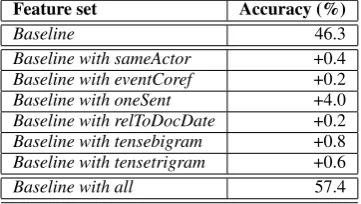
event’s linguistic context into consideration (Min et al., 2007). Our experiments show that only few features are critical and impact the classifier’s accuracy (Table 1). These include the basic features available in TimeBank, e.g. event-class,
Feature set Accuracy (%)
Baseline 46.3
Baseline with sameActor +0.4
Baseline with eventCoref +0.2
Baseline with oneSent +4.0
Baseline with relToDocDate +0.2
Baseline with tensebigram +0.8
Baseline with tensetrigram +0.6
Baseline with all 57.4
Table 1: New features impact
1. sameActor. This binary feature indicates whether the two events share the same se-mantic role AGENT. The motivation behind
this feature is that two event terms, especially, verbs, which have the same agent, have a closer semantic relationship and, accordingly, are temporally related.
2. eventCoref. This binary attribute captures the event co-reference information. If two events co-refer, even though they have different sur-face forms, they must take place simultane-ously. For instance, theofferanddealevents, mentioned in the following sentences, refer to the sametransactionand, therefore, must be linked by asimultaneousrelation.
a) Sony Corp. completed its tenderofferfor Columbia Pictures Entertainment Inc., with Columbia sharehold-ers tendering 99.3% of all common shares outstanding by the Tuesday deadline.
b) Sony Columbia Acquisition Corp., formed for the Columbia deal, will formally take ownership of the movie studio later this month, a spokesman said.
3. oneSent. This binary feature is true if the two events are part of the same sentence. Cham-bers et al.(2007) introduced this feature in their experiments, and our analysis shows that this attribute has a relatively larger contribu-tion to the overall performance. The intu-ition behind this feature is that the closer two events get, the closer their temporal relation-ship is.
4. relToDocDate. This feature encodes the tem-poral relation between each event and the Document Date. This was one of the sub-tasks of TempEval 2007 and we used this re-lationship as a feature. Our motivation is that we might be able to infer the relationship be-tween two events e1 and e2 from the tem-poral relations they have with the Document Date. For example, ifbefore(e1, DocDate)
and after(e2, DocDate) are true, then before(e1, e2). There may be two reasons for the low impact of this feature: (1) an accu-rate computation of the temporal relation be-tween an event and the Document Date is not easy, as demonstrated in TempEval 2007 and (2) if two events have the same relation with the Document Date, there is no way to deter-mine the event-event relation.
5. tenseBigram and tenseTrigram. Going be-yond using thetenseattribute for single event terms, we extract bigrams and trigrams with the tense values of the current event and im-mediately preceding and following events. This feature is intended to reflect the tense shifts of sequential events as part of a larger context of the current event.
All these features have a positive impact on the performance of the learned classifiers (Table 1). Further improvement is desired and we use tem-poral reasoning in three different settings in an at-tempt to obtain more accurate temporal relations.
4 Temporal Reasoning
Following our feature set improvements for ma-chine learned models of temporal relations, we turned totemporal reasoningand explored differ-ent ways in which it can aid the resolution of tem-poral relations. We experimented with three dif-ferent interactions between our temporal reasoning and temporal relation resolution modules.
Our natural language reasoning engine (Tatu and Moldovan, 2005; Tatu and Moldovan, 2007) makes use of (1) a first-order logical representation of the input document which captures the concepts mentioned in the text, their attributes including named entity class values, event class or normal-ized values (for times) and the syntactic as well as the semantic dependencies between concepts2; (2) a rich set of axioms which encode the knowledge needed to derive meaningful information from a document; (3) a logic prover which operates in a proof by contradiction manner (a hypothesisH is entailed by a text T assumed to be true, denoted byT ⊢H, if and only if(T ∧ ¬H)⊢ ⊥, where⊥ isfalse). Given the logical transformation of a text T, the prover uses the knowledge encoded in the
2
axioms (Bk) to derive new information (T⋆) about T3 and scores the best mapping of the hypothesis HtoT⋆.
For the temporal relation resolution experiments presented in this paper, we are interested in de-riving additional temporal information from an in-put document without checking the entailment be-tween this document and a hypothesis. There-fore, for the following tasks, the text T is a TimeBank 1.2 document and the set of axioms Bk used by the prover contains 94 temporal axioms which link each temporal relation with its inverse (R−1(x, y) ↔ R(y, x), for example before(x, y) → after(y, x)) and define the tem-poral relation resulting from the combination of two relations (R1(x, y) ∧R2(y, z) → R3(x, z), for example, before(x, y) ∧ before(y, z) → before(x, z)). These axioms were derived from Allen’s interval algebra (Allen, 1983).
We note that the prover computes and uses tem-poral relations between any two temtem-poral expres-sions mentioned in an input TimeBank document4 (e.g. now [19891101] and last year [1988] are linked by abeforetemporal relation inwsj 0324).
Within this reasoning setup, the information de-rived by the prover (T⋆) will include thetemporal closureof the input text’s relations. We note that the temporal closure includes event, event-time and event-time-event-time temporal relations. We also note that the temporal axioms are considered 100% accurate (if the temporal relations given as input are correct, then the temporal relations derived us-ing the axioms are also correct).
4.1 Training data expansion
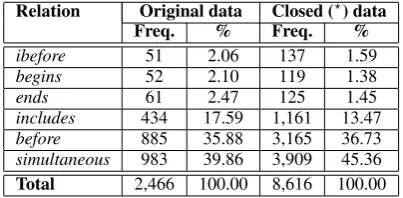
Our first effort to create more accurate temporal re-lation resolution classifiers given our temporal rea-soning engine is toaugmentthe gold training data with new relations from the temporal closure of the relations identified by human annotators. There-fore, given the 3,527 temporal relations annotated in the TimeBank data used to train our initial tem-poral resolution models, we derived 12,270 new relations (an increase of 3.47 times). We show in Table 2 statistics of the normalized event-event re-lations for both the original and the closed train-ing data. We note that the temporal inconsisten-cies identified in the original training data (by the
3T⋆ containsall the information the prover can derive
fromTgiven the axiomsBk.
4
We restricted the time-time relations to onlybefore, si-multaneous, andafter.
Relation Original data Closed (⋆) data
Freq. % Freq. %
ibefore 51 2.06 137 1.59
begins 52 2.10 119 1.38
ends 61 2.47 125 1.45
includes 434 17.59 1,161 13.47
before 885 35.88 3,165 36.73
simultaneous 983 39.86 3,909 45.36
Total 2,466 100.00 8,616 100.00
Table 2: Normalized training data (event-event re-lations)
procedure described in Section 4.2) were resolved manually by one of the authors of this paper.
We built SVM and ME models from the total of 8,616 normalized temporal relations using the set of 15 features described in Section 3. Table 3 shows the performance of the learned models on the test data (original data as well as closed test data). Unlike (Mani et al., 2006), the accuracy of
Accuracy for event-event relations
Training data Original test Closed test Train
(845) (4,189)
ME models
Original(2,466) 50.4 46.1 83.3
Closed(8,616) 47.0 41.0 76.1
SVM models
Original(2,466) 56.9 45.8 74.2
Closed(8,616) 52.4 52.0 77.5
Table 3: Event-event temporal resolution
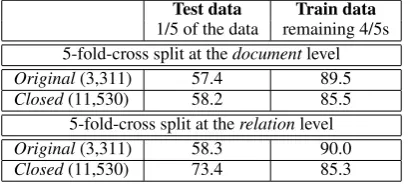
the learned classifiers drops when they are trained on the closed training dataset. By analyzing the re-sults from Table 3, one cannot help but notice the high accuracy on the data used for training and the significant difference between the performance on the training and testing datasets. This may suggest that (1) the machine learnersoverfitthe models on the training data and they are not able to gener-alize and resolve the relations in the test data5 or (2) the two datasets are very different (in terms of feature values) and the data split happened to create a training data which is not (fully) charac-teristic to the problem we are trying to solve (the two datasets have different distributions). There-fore, we measured the accuracy of ME models for event-event relation resolution using 5-fold-cross-validation of the entire TimeBank data (Table 4). For these experiments, each TimeBank document (with all its temporal relations) was used as part
5
Test data Train data
1/5 of the data remaining 4/5s 5-fold-cross split at thedocumentlevel
Original(3,311) 57.4 89.5
Closed(11,530) 58.2 85.5
5-fold-cross split at therelationlevel
Original(3,311) 58.3 90.0
Closed(11,530) 73.4 85.3
Table 4: Average ME accuracy for event-event re-lations using 5-fold-cross-validation on the entire TimeBank data
of either the training or the testing dataset. Our re-sults for the random 5-fold-cross split of the dataat the document levelare similar to the ones obtained for the models learned on the pre-established train-ing data (top two rows in Table 4). Thus, our ini-tial split of the data was not an ’unfortunate’ divi-sion. The same significant difference between the performance on the unseen data and the training set can be seen. This suggests that some overfit-ting occurs. Features, such as the event termstem, with a large number of possible values mislead the machine learning algorithms and the models they create are not able to correctly classify event pairs with unseen values for these high-valued features. For instance, showdownis part of a single Time-Bank document (AP900816-0139) and the mod-els learned using other documents will misclassify
showdown’s temporal relations. We note that, by expanding the training data using its temporal clo-sure, no new events are added to the training set, only new temporal relations between thesameset of events are added. Long-term solutions include (1) the expansion of the annotated data or (2) the reduction in the number of values for certain fea-tures (for example, by generalizing the event term stem to its WordNet hypernym). In an attempt to homogenize the feature values for the training and the testing datasets, we split the set of normalized event-event temporal relations annotated in Time-Bank into training and testingwithoutconsidering the document boundaries. The performance of the learned classifiers increases by 1% when trained on unclosed data and by more than 15% when the closed data is used (Table 4).
In their most recent technical paper, Mani et al. (2007) revise their evaluation method and report performance values for classifiers learned by par-titioning the data at the document level (accuracy drops from 59.68% to 51.14% when closed train-ing data is used). These results are consistent with
our findings. In the near future, we shall experi-ment with the second solution we propose above.
4.2 Testing data validation
Given that almost half of the temporal relations automatically identified for the testing data are incorrect when compared to the gold annotation, we decided, as our second experiment, to use temporal reasoning to find temporal inconsisten-cies and replace some of the relations contribut-ing to the inconsistency by the immediate lower confidence relation returned by the learned classi-fiers. For this purpose, we use an additional set of 77 temporal axioms which encode the irreflex-ivity of temporal relations (¬R(x, x), for exam-ple, ¬before(x, x)) and theirempty intersections
(R1(x, y) → ¬R2(x, y)when R1 6= R2, for ex-amplebefore(x, y)→ ¬simultaneous(x, y)).
Our process of testing data validation is itera-tive. Once a temporal inconsistency is identified in the test data, it is resolved and the procedure which computes the temporal closure is re-started. A temporal inconsistency in a TimeBank docu-ment (T) is detected every time ⊥ ∈ T⋆. The automatically identified temporal relations (part of the textT) which contributed to the derivation of
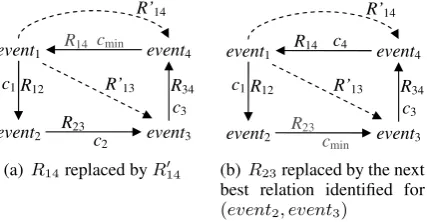
⊥become candidates for the resolution of the in-consistency6. These candidates are sorted based on the confidence assigned by the machine learn-ing algorithm7 and the lowest confidence relation is replaced either by the temporal relation found by the prover which directly contradicted the auto-matically identified relation8 (Figure 1(a)) or, for the cases where such a relation does not exist, by the immediate lower confidence relation identified by the learned models (Figure 1(b)).
If, for example, for the statement The US is bolstering its military presence in the gulf, as President Clinton discussede1 the Iraq crisis with the one ally who has backede2 his threate3 of force, British prime minister Tony Blair, the ME classifier built in Section 3 identifies the tempo-ral relations before(e2, e1) (confidence: 0.53), before(e3, e2)(0.47) andincludes(e3, e1)(0.42), the prover identifies the temporal inconsistency
6
The temporal closure axioms are accurate and do not ‘in-troduce’ incorrect temporal relations.
7
For all experiments which exploit the confidence as-signed by the machine learning algorithm, we use the learned ME models (SVM models do not provide a confidence for their decision).
8
event1
(b)R23replaced by the next best relation identified for
(event2, event3)
Figure 1: Temporal inconsistency resolution
generated by these three relations and replaces the lowest confidence relation (includes(e3, e1)) with the relation it derives from the closure of the other two relations (before(e3, e1), confidence: 0.50).
We note that, during the inconsistency checking process, all types of temporal relations are used (event-event, event-time and time-time). For this inconsistency resolution process, we make the as-sumption that only one of the temporal relations which generated the inconsistency is incorrect and should be replaced.
For the testing dataset described in Section 2.3, the validation algorithm found inconsistencies in only 25% of the test documents. This is not very encouraging, given that the accuracy of the tem-poral relations identified in the other 75% of the documents is 50.4%. The documents marked as inconsistent include, on average, 3.66 temporal in-consistencies (with a maximum of 8 in a single document). For each pair of events, we consid-ered only the top three temporal relations (in terms of confidence) identified by the learned classifiers. When the third relation identified for a given pair of events had to be removed by the inconsistency resolution algorithm, no other temporal relation was added to replace it. Table 5 shows the impact of the validation step on the unclosed test data.
Precision Recall F-measure
Baseline 50.4 50.4 50.4
With test validation 50.1 49.7 49.9
Table 5: Performance change after the testing data validation step. The baseline is the ME model learned on the original (unclosed) training data.
Our error analysis shows that, for each discov-ered temporal inconsistency, more than one incor-rect relation lead to an inconsistent temporal clo-sure. Frequently enough, replacing the lowest con-fidence relation does not resolve the inconsistency
and the temporal relations used to replace it are, in turn, replaced in the next iterations (the confi-dence of the replacing relation is lower than the confidence of the replaced relation). The ME clas-sifier’s numerous errors and the low applicability of this process make its contribution to the overall temporal relation resolution process negative. Our future work will focus on (1) experimenting with less erroneous data for which our one-incorrect-relation-per-inconsistency assumption holds ((per-haps) the models learned from closed training data using a data split at the relation level) and (2) test-ing the existence of a consistent temporal closure in the absence of the lowest confidence relation. If none of the six temporal relations that we use to la-bel an event-event relation can replace the lowest confidence relation and lead to a consistent tempo-ral closure, then our candidate incorrect relation is among the other higher confidence relations. We also note that we rely heavily on the confidences automatically assigned by the ME classifiers.
Mani et al. (2007) briefly describe a Greedy method for ensuring global consistency of auto-matically labeled testing data. No evaluation re-sults are reported. As far as we can tell, Mani at el. (2007) use this algorithm to decide whether or not to assign the top 1 relation automatically iden-tified by ME classifiers to a given pair of events. No attempts are made to replace this relation. Our validation algorithm uses lower confidence rela-tions found by the learned models for the same pair of events to replace the lowest confidence relation that leads to a temporal inconsistency.
4.3 Temporal relation alignment
In the previous section, we used temporal reason-ing to replace certain relations automatically iden-tified by the learned temporal relation resolution models with the next best relation (in terms of the confidence) found for the same pair of events. For our third experiment, we use the top n re-lations automatically identified for a single pair of events. Across a document, these relation-ships can be grouped to form different tempo-ral orderings of the events mentioned in the doc-ument. For instance, for four pairs of events, 81 different temporal settings can be created us-ing the top 3 temporal relations. Figure 2 shows two of these 81 facets ({R12, R′23, R′34, R41} and
pro-R12,c1
(event1,event2) (event2,event3) (event3,event4) (event4,event1)
R’12,c’1
R”12,c”1
R23,c2
R’23,c’2
R”23,c”2
R34,c3
R’34,c’3
R”34,c”3
R41,c4
R’41,c’4
R”41,c”4
Figure 2: Two possible relation alignments
pose to use our temporal reasoning module to de-rive, score, and rank their temporal closures. We make the assumption that the correct document-level event ordering, the document’s temporal co-hesion can be identified by measuring the closure of the document’s temporal relations and that or-derings that use incorrect relations do not gener-ate good closures. Thus, the relations that genergener-ate the best temporal closure will be considered final and will be used to label the test document’s event-event and event-event-time pairs.
For the example shown in Figure 2, 81 different temporal closures are generated depending on the set of relations used to derive them from. In order to find the final four temporal relations between events e1, . . . , e4, we score and order the derived temporal closures. The best closure decides, for each pair of events, which relation among the top 3 should be selected as final.
Our first step is to identify the best value for n. Table 6 shows the maximum gain in perfor-mance when multiple relations are considered for the same pair of events (an instance is considered correct if the gold annotation is among the top n relations returned by the system).
Topnrelations Accuracy (%)
1 57.40
2 80.66
3 94.49
4 97.38
5 99.12
6 100.00
Table 6: Top noracle performance using 5-fold-cross-validation on the TimeBank data
Because there is substantial improvement in the top 3 relation set, we use for our experiments the first three relations identified by the ME classi-fiers. But, if we consider the top 3 relations for each pair of events in a document, we end up with
3N possible alignments, whereN is the number of
event-event and event-time pairs9 and the scoring
9
For each time-time pair, there is a single temporal relation with confidence equal to 1.
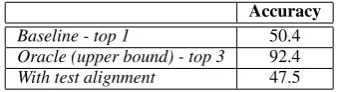
Accuracy
Baseline - top 1 50.4
Oracle (upper bound) - top 3 92.4
With test alignment 47.5
Table 7: Test dataset performance change after the testing data alignment step. The top 1 and top 3 baselines were generated using the ME model learned on the original (unclosed) training data.
and ranking of all 3N temporal closures becomes hardly possible. Therefore, we use a moreGreedy
approach. Iteratively, we score and rank temporal closures derived from a small set of top 3 relations betweenN′ event-event pairs (N′ < N) and any final temporal relations. The best closure is used to decide onN′ temporal relations which will be added to the best partial alignment and will be used to compute all the following temporal closures.
Secondly, we must identify the temporal clo-sure scoring function. For our experiments, this function takes into account the size of the tempo-ral closure (|T⋆|) as well as the confidence val-ues of the relations identified by the ME classi-fiers in the test set (not derived by the tempo-ral closure algorithm) (only{c12, c′23, c′34, c41}and
{c”12, c23, c”34, c”41} for the example shown in Figure 2). The correlation between these param-eters and the scoring function is not straightfor-ward. A preference for the confidence values fa-vors closures which use only the top relations (in terms of confidence). However, weighing the size of the temporal closure leads to a result dominated by relations that close very well10, such as simulta-neousorbefore(which are also very frequent in the dataset). In the settings which produced the results shown in Table 7, we used thescore1function: for T ={(R1, c1), . . . ,(Rk, ck)},
score1(T⋆) = lg(|T⋆|)×
k
X
i=1 ci.
The temporal relation accuracy drops by 3% after the relation selection among the top 3 best tem-poral relations for the testing documents. Posibile explanation: score1 does not promote the close-to-gold temporal closures. The difinition of a good scoring function is not an easy process. Machine learning approaches might give us better coefi-cients for the parameters we consider. Alternativ-elly, our main assumption might prove incorrect:
10
temporal closure is not a good indicator of a docu-ment’s event ordering. The information conveyed by a document need not disclose a rich total order-ing of its events.
5 Conclusion
In this paper, we briefly described our feature en-gineering efforts for temporal relation resolution and we analyzed three methods that exploit tem-poral reasoning and, more specifically, the closure of temporal relations, for the purpose of improving the performance of machine learned classifiers of temporal relations between events in text.
Based on our experiments, we find that feature engineering helps improve the classification prob-lem, when compared with several baseline perfor-mances. However, given our current NLP capabil-ities, it is clear that we are faced with the perfor-mance bottleneck problem (accuracy below 60%). Any attempt to derive more advanced features de-mands more sophisticated methodologies of mod-eling temporal expressions, events and their re-lationships as well as advanced discourse under-standing capabilities. For instance, the temporal duration or the start/end time points of events are highly useful for learning temporal relations. But, this introduces an even more challenging problem. In terms of the utility of temporal reasoning in classifying temporal relation, the idea of using temporal reasoning to boost training data is cer-tainly sound. But in order for the boosted train-ing data to really take effect, more advanced fea-tures need to be investigated. Certainly, the pro-cess of dividing the data into training and testing has its impact on the system’s performance and we are faced with the data sparseness problem. Tem-poral inconsistencies in our automatically labeled test dataset occurred in just a few test documents and the resolution process did not impact the sys-tem’s performance. Improvements are needed in the process of selection of the to-be-replaced re-lations. Temporal data alignment largely depends on the function used to score the temporal closures and we plan to analyze the temporal closure of the training data and to explore other scoring func-tions.
References
Allen, J. F. 1983. Maintaining Knowledge about
Temporal Intervals. Communications of the ACM,
26(11):832–843.
Boguraev, B. and R. K. Ando. 2005.
TimeML-Compliant Text Analysis for Temporal Reasoning. In Proceedings of Nineteenth International Joint Conference on Artificial Intelligence (IJCAI-05), pages 997–1003, Edinburgh, Scotland, August.
Chambers, N., S. Wang, and D. Jurafsky. 2007.
Clas-sifying Temporal Relations Between Events. In
Pro-ceedings of the ACL 2007 Demo and Poster Sessions, pages 173–176, Prague, Czech Republic, June.
Chang, C. and C. Lin, 2001. LIBSVM: a library
for support vector machines. Software available at
www.csie.ntu.edu.tw/˜cjlin/libsvm.
Mani, I., M. Verhagen, B. Wellner, C. Min Lee, and J. Pustejovsky. 2006. Machine Learning of
Tem-poral Relations. InProceedings of the 21st
Interna-tional Conference on ComputaInterna-tional Linguistics and 44th Annual Meeting of the ACL, pages 753–760, Sydney, Australia, July.
Mani, I., B. Wellner, M. Verhagen, and J. Pustejovsky.
2007. Three Approaches to Learning TLINKs in
TimeML. Technical Report CS-07-268, Computer Science Department, Brandeis University, Waltham, USA.
Min, Congmin, Munirathnam Srikanth, and Abraham
Fowler. 2007. LCC-TE: A Hybrid Approach to
Temporal Relation Identification in News Text. In
Proceedings of the Fourth International Workshop on Semantic Evaluations (SemEval-2007), pages 219–222, Prague, Czech Republic, June.
Pustejovsky, J., P. Hanks, R. Sauri, A. See,
R. Gaizauskas, A. Setzer, D. Radev, B. Sundheim, D. Day, L. Ferro, and M. Lazo. 2003. The
TIME-BANK Corpus. In Proceedings of Corpus
Lin-guistics, pages 647–656, Lancaster University (UK), March.
Tatu, Marta and Dan Moldovan. 2005. A Semantic
Ap-proach to Recognizing Textual Entailment. In
Pro-ceedings of the HTL-EMNLP 2005, pages 371–378, Vancouver, BC Canada, October.
Tatu, Marta and Dan Moldovan. 2007. COGEX at
RTE3. In Proceedings of the ACL-PASCAL
Work-shop on Textual Entailment and Paraphrasing, pages 22–27, Prague, Czech Republic, June.
Verhagen, M., R. Gaizauskas, F. Schilder, M. Hep-ple, G. Katz, and J. Pustejovsky. 2007. SemEval-2007 Task 15: TempEval Temporal Relation
Identi-fication. InProceedings of the Fourth International