What’s the Date?
High Accuracy Interpretation of Weekday Names
Paweł Mazur1,2
1Institute of Applied Informatics, Wrocław University of Technology
Wyb. Wyspia´nskiego 27, 50-370 Wrocław, Poland [email protected]
Robert Dale2
2Centre for Language Technology, Macquarie University, NSW 2109, Sydney, Australia
{mpawel,rdale}@ics.mq.edu.au
Abstract
In this paper we present a study on the interpretation of weekday names in texts. Our algorithm for assigning a date to a weekday name achieves 95.91% accuracy on a test data set based on the ACE 2005 Training Corpus, outperforming pre-viously reported techniques run against this same data. We also provide the first detailed comparison of various approaches to the problem using this test data set, em-ploying re-implementations of key tech-niques from the literature and a range of additional heuristic-based approaches.
1 Introduction
Many temporal expressions in text are underspeci-fied, requiring contextually-sourced information in order to determine their correct interpretation. In some cases, it is sufficient to determine what is sometimes called thetemporal focus, so that the precise location of a relative temporal expression on a timeline can be determined with respect to this ‘time of speaking’. Consider, for example, ex-pressions like the following:
(1) three days ago (2) last Monday (3) in two weeks time
Once we know the temporal focus, calculation of the temporal location referred to in each of these cases is straightforward, since the temporal ex-pressions themselves explicitly indicate what we
c
2008. Licensed under the Creative Commons Attribution-Noncommercial-Share Alike 3.0 Unported li-cense (http://creativecommons.org/licenses/by-nc-sa/3.0/). Some rights reserved.
will callthe direction of offset(here, respectively, past, past and future). However, in other cases there is no explicit indication of the direction of offset from the temporal focus. This is most ob-viously the case when bare expressions based on calendar cycles—i.e., weekday names and month names—are used, as in the following example: (4) Jones met with Defense Minister Paulo Portas
on Tuesdayand will meet Foreign Minis-ter Antonio Martins da Cruz before leav-ing PortugalWednesday.
Here, the proper interpretation of the references toTuesdayand Wednesdayrequires at the least a correct syntactic analysis of the sentence, in order to locate the controlling verb for each weekday name. The tense of this verb can then be used to determine the direction—either in the past or in the future—in which we need to look to establish the fully specified date referred to. In the case of example (4), this means determining thatTuesday is in the scope of the verb met, and that Wednes-day is in the scope of the verb group will meet. As we note below, it turns out that there are cases where even the controlling verb does not provide sufficient information to determine the direction of offset. But even in those cases where the tense of the verbdoesprovide the relevant information, there are two problems. First, especially when the sentences considered are complex, there is a non-negligible likelihood that the analysis returned by a parser may not be correct, and this is especially the case when the sentences in question contain struc-tures such as prepositional phrases: the attachment of these is notoriously a source of ambiguity, and they just happen to often be the hosts to temporal expressions. Second, even if a parser provides the correct analysis, parsing technology is still
tationally expensive to use when processing very large bodies of text; if we are interested in time-stamping events described in significant volumes of data, we would prefer to have a faster, more heuristic-based approach.
In this paper, we explore the development of a fast and high accuracy algorithm for the interpre-tation of weekday names, in particular with regard to determining the direction of offset to be used in the temporal interpretation of these expressions: in essence, how can we determine whether the day referred to is in the past or in the future?
The rest of the paper is structured as follows. In Section 2 we present some general observations on the interpretation of weekday names in text. tion 3 provides a review of related work. In Sec-tion 4 we describe the corpus used for evaluaSec-tion, and in Section 5 we describe in detail the various algorithms we evaluated. Section 6 compares the results of the various algorithms when applied to the corpus, and Section 7 provides an error anal-ysis. Finally, in Section 8 we draw some conclu-sions and point to future work.
2 The Problem
The interpretation of relative temporal expres-sions1can be seen as a two step process: (1) first we have to determine a reference point for the in-terpretation of the expression;2(2) then we have to calculate the actual position of the referred-to time on the timeline.
Once we have the reference point determined, the interpretation of the offset from this reference point requires us to determine the magnitude and direction of offset. As noted above, in some cases the tense of the controlling verb will indicate the direction of offset; but prepositional attachment ambiguity can easily damage the reliability of such an approach, as demonstrated by the following minimal pair:
(5) We can show you some pictures onMonday. (6) We can show you some pictures fromMonday.
In example (5), the correct PP attachment is re-quired in order to determine thatMondayis in the
1In the literature, a variety of different terms are used:
(Schilder and Habel, 2001) call these expressionsindexicals, and (Han et al., 2006b) uses the termrelativefor what we callanaphoricreferences: in our terminology, both deictic and anaphorical expressions are relative.
2This reference point is often referred to as thetemporal
focusortemporal anchor.
scope of the verb groupcan show, allowing us to infer that the Monday in question is in the future. Example (6), on the other hand, is quite ambigu-ous and requires world knowledge in order to de-termine the correct attachment.
We are interested, therefore, in determining whether some heuristic method might provide good results. In the rest of this paper, we focus on the determination of the direction of offset. We will not explicitly address the question of deter-mining the temporal focus: although this is clearly a key ingredient, we have found that using the doc-ument creation date performs well for the kinds of documents (typically newswire stories and similar document types) we are working with. More so-phisticated strategies for temporal focus tracking would likely be required in other genres.
3 Related Work
The literature contains a number of approaches to the interpretation of weekday names, although we are not aware of any pre-existing direct compari-son of these approaches.3
Filatova and Hovy (2001) assign time stamps to clauses in which an event is mentioned. As part of the overall process, they use a heuristic for the interpretation of weekday names: if the day name in a clause is the same as that of the temporal focus, then the temporal focus is used;4 otherwise, they look for any ‘signal words’ or check the tense of the verb in the clause. An analogous approach is taken for the interpretation of month names.
Negri and Marseglia (2005), in their rule-based system for temporal expression recognition and normalisation, use what they call ‘context words’, such asfollowingorlater, to decide on the inter-pretation of a weekday name. Consider the fol-lowing example:
(7) He started studying on March 30 2004, and passed the exam the followingFriday.
Here, having identified the date March 30 2004 (which happens to be a Tuesday), they then recog-nise the structure ‘following+ trigger’ and reason that theFridayis three days later.
3Although Ahn et al. (2007) compared their results with
those presented by Mani and Wilson (2000), they went on to point out that, for a variety of reasons, the numbers they provided were not really comparable.
4Filatova and Hovy use the termreference pointfor what
There have also been machine-learning ap-proaches to the interpretation of temporal expres-sions. Ahn et al. (2005) describes a system de-veloped and tested on the ACE 2004 TERN test corpus. Using lexical features, such as the oc-currence of last or earlier in a context window of three words, their maximum entropy classifier picked the correct direction (‘backward’, ‘same’, or ‘forward’) with an accuracy of 59%; the addi-tion of features encoding informaaddi-tion about tense increased the result to 61%.
Ahn et al. (2007) go on to describe a system us-ing a classifier based on support vector machines and an extended set of features over a larger subset of the data. This algorithm was used to determine the direction of all relative temporal expressions, not just the names of weekdays. They used three sets of features:
1. Character type patterns, lexical features such as weekday name and numeric year, a con-text window of two words to the left, and sev-eral parse-based features: the phrase type, the phrase head and initial word (and POS tag), and the dependency parent (and correspond-ing relation) of the head.
2. The tense of the closest verb (w.r.t. depen-dency path), the POS tag of the verb, and the POS tags of any verbal elements directly re-lated to this verb.
3. Features comparing year, month name and day name of a temporal expression to those of the document creation date.
Their experiments demonstrated that the third set was the most useful.
Han et al. (2006a) report on the development of the Time Calculus for Natural Language (TCNL), a compact formalism designed to capture the meaning of temporal expressions in natural lan-guage, which is built on top of their constraint-based calendar model (see (Han and Lavie, 2004)). In this formalism each temporal expression is con-verted to a formula in TCNL, which then can be processed to calculate the value of a temporal ex-pression. Interpretation of weekday names uses the tense of the nearest verb chunk and the pres-ence of lexical items such as next. Their tempo-ral focus tracking mechanism allows correct inter-pretation of cases like ‘I am freenext week. How aboutFriday?’, where the TCNL formula for Fri-day, being+{fri}, reflects the occurrence ofnextin
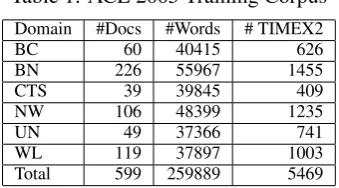
Table 1: ACE 2005 Training Corpus Domain #Docs #Words # TIMEX2
BC 60 40415 626
BN 226 55967 1455
CTS 39 39845 409
NW 106 48399 1235
UN 49 37366 741
WL 119 37897 1003
Total 599 259889 5469
Table 2: Weekdays in ACE 2005 Training Corpus Domain #Docs # TIMEX2 # per doc
BC 4 7 (1.91%) 1.75
BN 25 31 (8.47%) 1.24
CTS 2 2 (0.54%) 1.00
NW 102 292 (79.56%) 2.86
UN 3 3 (0.81%) 1.00
WL 19 32 (8.72%) 1.68
Total 155 367 (100%) 2.37
the preceding sentence.
Most closely relevant to the work described in the present paper are the approaches described in (Baldwin, 2002), (Jang et al., 2004) and (Mani and Wilson, 2000). Since we have re-implemented ver-sions of these algorithms for the present paper, we leave description of these to Section 5.
4 Corpus and Experimental Setup
For this work we used the ACE 2005 Training Cor-pus, which is publicly available and distributed by the Linguistic Data Consortium (LDC).5It has al-ready become the gold standard in the information extraction community, especially for the temporal expression recognition and normalisation (TERN) task, and currently it provides the largest avail-able corpus of annotated temporal expressions. Ta-ble 1 presents some relevant statistics, and TaTa-ble 2 shows the distribution of bare weekday names (as TIMEX2 counts) in the corpus across the various genres represented.6
For the work described here, we used only those documents in the corpus that contained at least one weekday name; all subsequent analysis makes use only of the gold standard annotations of the bare weekday names in these documents, thus signifi-cantly reducing corpus processing time. This re-sults in a total of 367 instances, once errors (of which there are quite a few) in the gold standard
5The corpus’s catalogue number is LDC2006T06. 6BC = Broadcast Conversations; BN = Broadcast News;
annotations have been repaired. We made the fol-lowing changes to the gold standard data:
• One day name had been missed by the anno-tators; we added this.
• Some 40 values were corrected from the for-mat YYYY-Wnn-m to YYYY-MM-DD: al-though both are correct in some sense, the ACE guidelines indicate that the second is the preferred form.
• Eight cases where the incorrect value had been provided by the annotators were cor-rected.
Specific details of these corrections, and the com-plete data set used, are available on the web.7
5 Evaluated Approaches
We implemented and evaluated a number of both simple and more complex approaches to determin-ing what date is meant in a text when a bare week-day name is used. These methods, described be-low, can be divided into two main classes: (a) 7-day window based, and (b) tense analysis based. Our new algorithm is a hybrid solution that incor-porates ideas from both of these approaches.
5.1 Baselines
Our baselines are motivated by the observation that days referred to by bare weekday names are typi-cally temporally close to the temporal focus.8 Past
7-day Window (inclusive): This baseline looks for the specified day in a 7-day window whose last day is the temporal focus. In other words, day names are always assumed to refer to days in the last week, including the ‘day of speaking’.
Past 7-day window (exclusive): This is the same as the approach just described, except that we look for the referred-to day in the week leading up to but not including the ‘day of speaking’.
Future 7-day window (inclusive): This is the future-oriented version of the first approach de-scribed above: we look for the specified day in a 7-day window whose first day is the temporal fo-cus. This assumes that all day name references are to the present or future.9
7Visithttp://TimexPortal.info.
8Recall that in the present work we take the temporal focus
to be the document creation date.
9An informal check of email data drove Han et al. (2005)
to use the simple strategy of always assuming that weekday names refer to days in the future.
Future 7-day window (exclusive): In this case the 7-day window starts on the day following the ‘day of speaking’.
5.2 Algorithms
5.2.1 Baldwin’s 7-Day Window
This algorithm was presented in (Baldwin, 2002; Jang et al., 2004). It is similar to our window-based baselines, but in this case the temporal focus is the middle day of the 7-day window. This ap-proach was used in their research after observing that 96.97% of weekday name expressions in their English corpus referred to dates within such a win-dow. Suppose we have the following sentence in a document with creation date 2003-06-16 (a Mon-day):
(8) Police arrested her in Abilene, Texas,Saturday where she had moved with a friend June 2.
The 7-day window then spans from Friday (June 13) to Thursday (June 19). The reference toSaturdayis assigned (correctly) the value of the second day in the window, i.e. 2003-06-14. Note that this method will deliver the wrong result when the referred-to day actually falls further than three days either side of the temporal focus. Suppose, for example, we have the following sentence in a document written on 2005-01-01 (a Saturday):
(9) We got into Heathrow onMondaymorning. Here the 7-day window spans from Wednesday to Tuesday, and so the reference to Mondaywill be assigned the incorrect interpretation 2005-01-03.
5.2.2 Mani and Wilson’s Tense Estimation
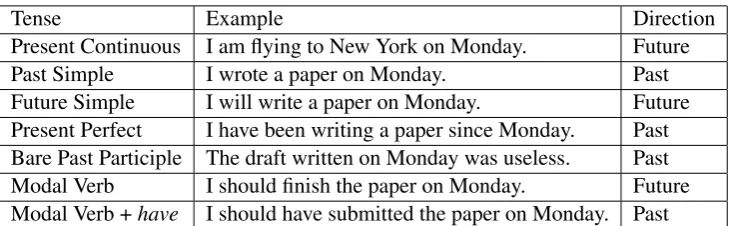
Table 3: Interpretation rules
Tense Example Direction
Present Continuous I am flying to New York on Monday. Future
Past Simple I wrote a paper on Monday. Past
Future Simple I will write a paper on Monday. Future
Present Perfect I have been writing a paper since Monday. Past Bare Past Participle The draft written on Monday was useless. Past
Modal Verb I should finish the paper on Monday. Future
Modal Verb +have I should have submitted the paper on Monday. Past
backwards; if the tense is future, then the forward direction is used. If the verb found is in present tense, then the temporal expression is passed to a further set of interpretation rules, which check for things like the occurrence of lexical markers such assinceor until.10 For example, in example (4), repeated below, the algorithm would correctly pick metforTuesdayandwill meetforWednesday, in-terpreting Tuesday as a day in a past and Wednes-day as a Wednes-day in future.
(4) Jones met with Defense Minister Paulo Portas onTuesdayand will meet Foreign Minis-ter Antonio Martins da Cruz before leav-ing PortugalWednesday.
However, this approach will not correctly interpret example (10):
(10) Still a decision has to made on what, if any, punishment he will face in the wake of that incidentTuesdaynight.
In this case, the wrong verb will be identified, and the direction of offset will be incorrect.
5.2.3 Simple Tense Estimation
As an alternative to Mani and Wilson’s approach, we also implemented a much simpler tense estima-tion heuristic. This checks whether the sentence contains any tokens with the VBD (i.e., past tense) part of speech tag;11if one is found, then the direc-tion of offset is assumed to be backwards, and if not, then we use the forward direction. In the case of example (4), this will assign the correct value to Tuesday, but the wrong value toWednesday.
10We have reimplemented this algorithm based on the
de-scription given in the cited paper, but some details are unclear, so we acknowledge that the original implementation might produce slightly different results.
11Where POS tags are required in our algorithms, we
used Mark Hepple’s part of speech tagger, an implementa-tion of which is available as a plugin for the GATE platform (http://gate.ac.uk).
5.2.4 Dependency-based Tense Determination
The two previous algorithms attempt to determine the controlling verb using very simple heuristics. Of course, a more reliable way of determining the controlling verb is to use a parser. We used the Stanford parser’s dependency information output (see (de Marneffe et al., 2006)) to find the con-trolling verb of a weekday name in a sentence. This algorithm does this by traversing the result-ing dependency tree from the node containresult-ing the weekday name to its root until a verb is found, and then following further dependencies to identify the whole verbal sequence.
5.2.5 A Hybrid Algorithm
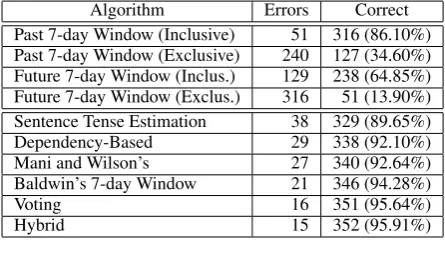
Table 4: Results
Algorithm Errors Correct
Past 7-day Window (Inclusive) 51 316 (86.10%) Past 7-day Window (Exclusive) 240 127 (34.60%) Future 7-day Window (Inclus.) 129 238 (64.85%) Future 7-day Window (Exclus.) 316 51 (13.90%) Sentence Tense Estimation 38 329 (89.65%)
Dependency-Based 29 338 (92.10%)
Mani and Wilson’s 27 340 (92.64%)
Baldwin’s 7-day Window 21 346 (94.28%)
Voting 16 351 (95.64%)
Hybrid 15 352 (95.91%)
Table 5: Processing times
Algorithm Time [seconds]
Past 7-day Window (inclusive) 79.9 Past 7-day Window (exclusive) 79.7 Future 7-day Window (inclus.) 79.2 Future 7-day Window (exclus.) 79.4 Sentence Tense Estimation 80.6
Dependency-Based 616.5
Mani and Wilson’s 80.9
Baldwin’s 7-day Window 79.4
Voting 636.1
Hybrid 80.2
5.2.6 Voting
This algorithm uses a voting mechanism over the output of Baldwin’s, Mani and Wilson’s, and the Dependency-based Tense Determination algo-rithms. If all values are different (no majority) then Baldwin’s result is used.
5.3 Tense Interpretation Rules
Once the verb group is found by any particular al-gorithm, it needs to be analysed to determine what its tense is; this information is then used to de-termine the direction of offset. The interpretation rules are summarized in Table 3.
6 Results
Table 4 presents the results achieved with each of the algorithms.
The 51% difference between the inclusive and exclusive baselines is indicative of the fact that, in this data, in over 50% of cases the correct date was in fact the document creation date. This phenomenon is due to the large proportion of newswire data in the corpus; in this genre, it is common to use the weekday name even when re-porting on events that happen on the same day as the reporting takes place. Also of note is that the best performing baseline, ‘Past 7-day window
(in-clusive)’, achieves 86.10% accuracy despite its be-ing an extremely naive approach.
All the algorithms tested here performed bet-ter than the baselines. The best performing algo-rithm was the Hybrid method, which made 15 er-rors, resulting in an accuracy of 95.91%; the Vot-ing method came second with 16 errors. Bald-win’s 7-day window algorithm correctly inter-preted 94.28% of weekday names. The big advan-tage of this algorithm, along with all the baselines, is their complete resource independence: they do not use any parsers or POS taggers.
Perhaps surprisingly, Mani and Wilson’s tense estimation heuristic was more effective than tense determination based on a dependency parse tree; this reinforces our earlier point about the risks of using parsers. It is also important to note that there are huge differences in execution time for parser-based approaches. Table 5 presents times for processing the entire corpus for temporal ex-pression recognition and interpretation; the parser-based algorithm required 616 seconds, in contrast to around 80 seconds for each of the other algo-rithms.12
There were 296 cases (80.65%) that were cor-rectly interpreted by all of the following algo-rithms: Sentence Tense Estimation, Mani and Wil-son’s, Dependency-based Tense Determination, Baldwin’s 7-day Window, and Hybrid. There are also three cases where all these algorithms pro-vided an incorrect value:13
(11) reporter: friday nightin the gaza strip and a journalist is about to lose his life.
(12) president bush head to the g-8 summit in france onfridaywith victory over saddam hussein and in his pocket and a soaring ap-proval rating by the american public, but do europeans share the same enthusiasm for the president?
(13) I will return this piece of shit on Fri-day, only to rent another vehicle Monday morning while we take the wife’s car to the shop to get her 1400 bucks worth of damage repaired.
12Note that the parser was only called for those sentences
that contained bare weekday names, and not for other sen-tences in these documents.
13We present these examples with their original spelling
In example (11), the algorithms interpreted Fri-day night as a day in future. However, this text is a case of what is sometimes called the histori-cal present, where for rhetorical effect the author speaks in present tense from a past point in time; it is not obvious how any algorithm would determine the correct answer here. Example (12) is ungram-matical as a consequence of a missing ‘s’ inhead; consequently, the POS tagger did not annotate this word as a verb, and the algorithms identified do orbushas a verb, leading to the decision that the referred-tofridayis in the future; however, the gold standard interpretation puts this in the past (note that, even with the correct verb form ofheads, all the algorithms would still get the wrong date). It so happens the correct date here is also outside the 7-day window. In example (13), because the weekday name used is the same as the day name of the document creation date, all the algorithms assigned the document creation date instead of a date seven days later.
7 Error Analysis
The Hybrid Algorithm achieved the best accuracy of 95.91%, which corresponds to 15 error cases. These were as follows:
• Eight cases where there was no verb found in the three-token neighbourhood of the tempo-ral expression; in these cases the 7-day win-dow method was used, but this did not find the correct value.
• Three cases where the algorithm identified a verb that was not the controlling verb; for ex-ample, it picked will meet instead of met to interpretTuesdayin the sentence given in ex-ample (4).
• Two cases where the document creation date was very misleading (see below).
• Two cases where past tense was used to talk about plans for the future which were sub-sequently cancelled, as in discussions were scheduled to end Friday, when Kelly was to fly. . ..
In 204 cases the algorithm interpreted the week-day name based on a verb found in the three-token neighbourhood; and in 163 cases it used the fall-back 7-day window strategy. Since the Hybrid Algorithm was built as an extension of Baldwin’s method, it is worth knowing whether there were
any cases where the original 7-day window method got the correct value and the Hybrid Algorithm got it wrong. There were six such cases:
• Two of them occurred for documents with a misleading document creation date. In a typical example, a document with the times-tamp 17-04-2004 (a Thursday) contained the sentence ‘Malaysia’s Appeal CourtFriday re-fused to overturn the conviction . . . ’. As the document timestamp was used as the tempo-ral focus,Fridaywas interpreted as a day in the past, when in fact it was the day after the timestamp.
• The other two cases demonstrate a weakness in our approach, exemplified by the sentence given in example (4): here the algorithm in-correctly uses the verb groupwill meetwhen interpretingTuesday.
• The remaining two cases were cases where the verb groups were scheduled to end and scheduled to beginwere used to talk about fu-ture events.
In these last cases, the controlling verb is an in-finitive, and there is no way, in the absence of ei-ther world knowledge or a much more sophisti-cated analysis of the text, of determining whether the scheduled event is in the past or the future. Sentences like these are a particular problem for Mani and Wilson’s algorithm, where a signif-icant number of misinterpretations involve sen-tences in which the past tense is used to talk about subsequently-changed plans for future, as in the following:
(14) A summit between Sharon and his Pales-tinian counterpart, Mahmoud Abbas, had been planned forWednesdaybut was post-poned . . .
Here, this utterance could be legitimately produced both before and after the Wednesday in question, so no simple algorithm will be able to determine the direction of offset.
8 Conclusions and Future Work
best performing algorithm, achieving an accuracy of 95.91% with 15 errors out of 367 instances. The algorithm is implemented within our DANTE sys-tem for sys-temporal expression interpretation (Dale and Mazur, 2006; Mazur and Dale, 2007).
It seems quite possible that our heuristics take advantage of phenomena that are specific to newswire texts and other similar types of re-portage. Although these are precisely the kinds of texts where, in our own work, we need to provide fast processing of large volumes of text, it remains to be seen how these heuristics fare when faced with a broader range of text types. In particular, other text types are likely to require more sophis-ticated approaches to temporal focus tracking than we have used here.
Also, we have not attempted to replicate here the machine learning approaches described in (Ahn et al., 2005) and (Ahn et al., 2007), nor Han’s use of constraint satisfaction problem methods (see (Han et al., 2006a)). The comparative evaluation of these is left for future work.
References
Ahn, D., S. F. Adafre, and M. de Rijke. 2005. Recog-nizing and interpreting temporal expressions in open domain texts. In We Will Show Them: Essays in
Honour of Dov Gabbay, Vol 1, pages 31–50.
Ahn, D., Joris van Rantwijk, and Maarten de Rijke. 2007. A Cascaded Machine Learning Approach to Interpreting Temporal Expressions. In Proc. of HLT: The Annual Conference of the North American
Chapter of the ACL (NAACL-HLT 2007).
Baldwin, J. 2002. Learning Temporal Annotation of French News. Master’s thesis, Dept. of Linguistics, Georgetown University, April.
Dale, R. and P. Mazur. 2006. Local Semantics in the Interpretation of Temporal Expressions. In Proceed-ings of the Workshop on Annotating and Reasoning
about Time and Events, pages 9–16, Sydney,
Aus-tralia, July.
de Marneffe, M.-C., B. MacCartney, and Ch. D. Man-ning. 2006. Generating Typed Dependency Parses from Phrase Structure Parses. InProceedings of the IEEE / ACL 2006 Workshop on Spoken Language Technology.
Filatova, E. and E. Hovy. 2001. Assigning Time-Stamps to Event-Clauses. In Harper, L., I. Mani, and B. Sundheim, editors,Proceedings of the Work-shop on Temporal and Spatial Information Process-ing, pages 1–8, Morristown, NJ, USA.
Han, B. and A. Lavie. 2004. A Framework for Res-olution of Time in Natural Language. ACM Trans-actions on Asian Language Information Processing (TALIP), 3(1):11–32.
Han, B., D. Gates, and L. Levin. 2005. Anchoring Temporal Expressions in Scheduling-related Emails. In Katz, Graham, James Pustejovsky, and Frank Schilder, editors, Annotating, Extracting and
Rea-soning about Time and Events, Dagstuhl Seminar
Proceedings.
Han, B., D. Gates, and L. Levin. 2006a. From Lan-guage to Time: A Temporal Expression Anchorer. InProceedings of the Thirteenth International
Sym-posium on Temporal Representation and Reasoning,
pages 196–203.
Han, B., D. Gates, and L. Levin. 2006b. Understanding Temporal Expressions in Emails. InProceedings of the Human Language Technology Conference of the North American Chapter of the Association of Com-putational Linguistics, pages 136–143, Morristown, NJ, USA.
Jang, S. B., J. Baldwin, and I. Mani. 2004. Automatic TIMEX2 Tagging of Korean News. ACM Trans-actions on Asian Language Information Processing (TALIP), 3(1):51–65.
Mani, I. and G. Wilson. 2000. Robust Temporal Pro-cessing of News. InProceedings of the 38th Annual Meeting of the Association for Computational Lin-guistics, pages 69–76, Morristown, NJ, USA. Mazur, P. and R. Dale. 2007. The DANTE
Tempo-ral Expression Tagger. In Vetulani, Zygmunt, edi-tor,Proceedings of the 3rd Language & Technology
Conference (LTC).
Negri, M. and L. Marseglia. 2005. Recognition and Normalization of Time Expressions: ITC-IRST at TERN 2004. Technical Report WP3.7, Information Society Technologies, February.