Improving Name Origin Recognition with Context Features and
Unlabelled Data
Vladimir Pervouchine, Min Zhang, Ming Liu and Haizhou Li
Institute for Infocomm Research, A-STAR
[email protected],{mzhang,mliu,hli}@i2r.a-star.edu.sg
Abstract
We demonstrate the use of context fea-tures, namely, names of places, and un-labelled data for the detection of per-sonal name language of origin.
While some early work used either rule-based methods or n-gram statisti-cal models to determine the name lan-guage of origin, we use the discrimi-native classification maximum entropy model and view the task as a classifica-tion task. We perform bootstrapping of the learning using list of names out of context but with known origin and then using expectation-maximisation algo-rithm to further train the model on a large corpus of names of unknown origin but with context features. Us-ing a relatively small unlabelled cor-pus we improve the accuracy of name origin recognition for names written in Chinese from 82.7% to 85.8%, a significant reduction in the error rate. The improvement inF-score for
infre-quent Japanese names is even greater: from 77.4% without context features to 82.8% with context features.
1 Introduction
Transliteration is a process of rewriting a word from a source language to a target
lan-guage in a different writing system using the word’s phonological equivalent. Many techni-cal terms and proper nouns, such as personal names, names of places and organisations are transliterated during translation of a text from one language to another. A process reverse to the transliteration, which is recovering a word in its native language from its translit-eration in a foreign language, is called back-transliteration (Knight and Graehl, 1998). In many natural language processing (NLP) tasks such as machine translation and cross-lingual information retrieval, transliteration is an im-portant component.
Name origin refers to the language of ori-gin of a name. For example, the oriori-gin of En-glish name “Smith” and its Chinese transliter-ation “史密斯 (Shi-Mi-Si)” is English, while both “Tokyo” and “东京(Dong-Jing)” are of
Japanese origin.
sys-tem has its own rewriting rules. English name “Smith” could be directly transliterated into Chinese as “史密斯(Shi-Mi-Si)” since it fol-lows the English phonetic rules, while the Chi-nese translation of JapaChi-nese name “Koizumi” becomes “小泉 (Xiao-Quan)” following the
Japanese phonetic rules. The name origins are equally important in back-transliteration. Li et al. (2007b) demonstrated that incorpo-rating name origin recognition (NOR) into a transliteration system greatly improves the per-formance of personal name transliteration. Be-sides multilingual processing, the name origin also provides useful semantic information (re-gional and language information) for common NLP tasks, such as co-reference resolution and name entity recognition.
Unfortunately, not much attention has been given to name origin recognition (NOR) so far in the literature. In this paper, we are inter-ested in recognition of the origins of names written in Chinese, which names can be of three origins: Chinese, Japanese or English, where “English” is a rather broad category that includes other West European and American names written natively in Latin script.
Unlike previous work (Qu and Grefenstette, 2004; Li et al., 2007a; Li et al., 2007b), where NOR was formulated with a genera-tive model, we follow the approach of Zhang et al. (2008) and regard the NOR task as a classification problem, using a discriminative learning algorithm for classification. Further-more, in the training data with names labelled with their origin is rather limited, whereas there is vast data from news articles that con-tains many personal names without any labels of their origins. In this research we propose a method to harness the power of the unla-belled noisy news data by bootstrapping the learning process with labelled data and then using the personal name context in the unla-belled data to improve the NOR model. We
achieve that by using the maximum entropy model and the expectation-maximisation train-ing, and demonstrate that our method can sig-nificantly improve the accuracy of NOR com-pared to the baseline model trained only from the labelled data.
The rest of the paper is organised as follows: in Section 2 we review the previous research. In Section 3 we present our approach, and in Section 4 we describe our experimental setup, the data used and the evaluation method. We conclude in Section 5.
2 Related research
Most the research up to date focuses primar-ily on recognition of origin of names written in Latin script, called English NOR (ENOR), although the same methods can be extended to names in Chinese script (CNOR). We notice that there are two informative clues that used in previous work in ENOR. One is the lexi-cal structure of a romanisation system, for ex-ample, Hanyu Pinyin, Mandarin Wade-Giles, Japanese Hepbrun or Korean Yale, each has a finite set of syllable inventory (Li et al., 2007a). Another is the phonetic and phono-tactic structure of a language, such as phonetic composition, syllable structure. For example, English has unique consonant clusters such as “str” and “ks” which Chinese, Japanese and Korean (CJK) do not have. Consider-ing the NOR solutions by the use of these two clues, we can roughly group them into two categories: rule-based methods (for solu-tions based on lexical structures) and statisti-cal methods (for solutions based on phonotac-tic structures).
if it gives rise to a successful parse of the test word. This kind of approach (Qu and Grefen-stette, 2004) is suitable for romanisation sys-tems that have a finite set of discriminative syllable inventory, such as Pinyin for Chinese Mandarin. For the general tasks of identifying the language origin and romanisation system, rule based approach sounds less attractive be-cause not all languages have a finite set of dis-criminative syllable inventory.
N-gram statistics methods
N-gram sum method Qu and Grefenstette (2004) proposed a NOR identifier us-ing a trigram language model (Cavnar and Trenkle, 1994) to distinguish per-sonal names of three language origins, namely Chinese, Japanese and English. In their work the training set includes 11,416 Chinese, 83,295 Japanese and 88,000 English name entries. How-ever, the trigram is defined as the joint probabilityp(cici−1ci−2) rather than the
commonly used conditional probability
p(ci|ci−1ci−2). Therefore it is basically
a substring unigram probability. For ori-gin recognition of Japanese names, this method works well with an accuracy of 92%. However, for English and Chinese, the results are far behind with a reported accuracy of 87% and 70% respectively.
N-gram perplexity method Li et al. (2007a) proposed a method of NOR using n-gram character perplexity P Pc to identify the origin of names written in Latin script. Using bigrams, the perplexity is defined as
P Pc= 2
−1
Nc
PNc
i=1logp(ci|ci−1)
whereNcis the total number of characters in a given name, ci is the i-th character in the name andp(ci|ci−1)is the bigram
probability learned from a list of names of the same origin. Therefore, P Pc can be used to measure how well a new name fits the model learned from the training set of names. The origin is assigned ac-cording to the model that gives the lowest perplexity value. Li et al. (2007a) demon-strated that usingP Pcgives much better performance than with the substring uni-gram method.
Classification method Zhang et al. (2008) proposed using a discriminative classification approach and extract features from the names. They use Maximum Entropy (MaxEnt) model and a number of features based on n-grams, character positions, word length as well as some rule-based phonetic features. They per-formed both ENOR and CNOR and demon-strated that their method indeed leads to better performance in name origin recognition then the n-gram statistics method. They attribute that to the fact their model incorporates more robust features than the n-gram statistics based models.
In this paper we too follow the discriminat-ing classification approach, but we add fea-tures based on the context of a personal name. These features require the original text with the names to be available. Our approach closely models the real-life situation when large cor-pora of articles with personal names is read-ily available in the Web, yet the origins of the names are unknown.
3 Model and training methods
3.1 Maximum entropy model for NOR
has been used widely in natural language pro-cessing research. Given an observationx the
probability of outcome label ci, i = 1. . . N
givenxis given by
p(ci|x) =
1 Zexp
n
X
j=1
λjfj(x, ci)
(1)
whereN is the number of the outcome labels,
which is the number of name origins in our case, n is the number of features, fj are the feature functions andλj are the model param-eters. Each parameter corresponds to exactly one feature and can be viewed as a “weight” for the corresponding feature.Zis the
normal-isation factor given by
Z =
N
X
i=1
p(ci|x) (2)
In the problem at handxis a personal name
and all the features are binary. The features, also known as contextual predicates, are in the form
fi(x, c) =
(
1 ifc=ciandcp(x) =true
0 otherwise
(3) wherecpis the contextual predicate that maps
a pair(ci, x)to{true, f alse}.
In our experiments we use Zhang’s maxi-mum entropy library1.
3.2 Initial training with labelled data and n-gram features
For the initial training of MaxEnt model we use labelled data: personal names of Chinese, Japanese or English origin written in Chinese. The origin of each name is known. Following paper by Zhang et al. (2008) and their findings
1http://homepages.inf.ed.ac.uk/lzhang10/
maxent toolkit.html
regarding the contribution value of each fea-ture that they studied, we extract unigram, po-sitional unigram and word length features. For example, Chinese name “温家宝” has the fol-lowing features:
温家 宝(温,0) (家,1) (宝,2) 3
We restrict the n-gram features to unigram only to avoid the data sparseness, because our data contains a number of Chinese surnames and given names, which have a length of one or two characters.
3.3 Further training with unlabelled data and context features
For further training of MaxEnt model we use unlabelled data collected from news articles. The name origin is not known but each per-sonal name is in a context and is often sur-rounded by names of places that may give a hint about the personal name origin. For each personal name we extract all names of places in the same paragraph and use them as fea-tures. If a place name is repeated many times in the same paragraph we only include it once in the feature list.
For example, paragraph containing passage “The U.S. President Barack Obama ...” will result in two personal names “Barack” and “Obama” having “U.S.” as their context fea-ture. Due to the diversity of place names we also attempt to map the names of the places into the country names. In this case, features like “U.S.”, “USA”, “America” are manually substituted with “USA”. In our experiments we also try to narrow the place name extraction to windows of different sizes surrounding the personal name. The rationale here is that the closer a place name is to the personal name, the more likely it has a connection to the ori-gin of the personal name.
First, we use the boostrap data and n-gram, positional n-gram and name length features to do the initial training (the 0-th iteration) of MaxEnt model with L-BFGS method (Byrd et al., 1995). After that we use the model to as-sign origin labels to names of the training set of the unlabelled data.
Next, we use both the bootstrap data and the training set of the unlabelled data, labelled in the previous step, and add the context fea-tures to the already used gram, positional n-gram and name length features. Since there is no context available for the bootstrap data, the context features for it are missing, which can be handled by the MaxEnt model. We perform the Expectation-Maximisation (EM) iterations by using the mixed data to train thei-th
itera-tion of the MaxEnt model, then use the model to re-label the training set of the unlabelled data and repeat the training of the model for the(i+ 1)-st iteration. We stop the iterations
when the ratio of patterns that change the ori-gin labels becomes less than 0.01%.
4 Experiments
4.1 Corpora
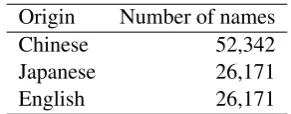
The corpora consists of two datasets. One dataset, called the “bootstrap data”, is a set of Chinese, Japanese and English names written in Chinese following the respective translitera-tion rules according to the name origins. The names are a mixture of full names, first (given) names and surnames. Table 1 shows the num-ber of names of each origin. This is the la-belled data; the origin of each name is known. The data is used to start the MaxEnt model training.
The second dataset, called the “unlabelled data”, is Chinese, Japanese and English per-sonal names written in Chinese, which have been extracted from the news articles col-lected over 6 months from Xinhua news web-site. The articles have been processed by an
Origin Number of names
Chinese 52,342
Japanese 26,171
[image:5.595.331.477.99.156.2]English 26,171
Table 1: Number of names of each origin in the bootstrap dataset.
automatic part-of-speech (POS) tagger, after which personal names and names of places have been manually identified (the latter for extracting the context features). Normally the first (given) name and surnames are identi-fied as two separate personal names. The data is split into a training set of 27,882 names with unknown origin and a testing set of 1,476 names whose origin was manually assigned. We split data in such a way that there is no overlap between patterns in the training and testing sets, although there may be overlap be-tween names. For example, if a name may be present in both training and testing sets but in a different context, making the two names two distinct patterns. The number of names of each origin in the testing set is shown in Table 2. As seen from the table, the number
Origin Number of names
Chinese 738
Japanese 369
English 422
Table 2: Number of names of each origin in the testing dataset.
4.2 Evaluation method
Following Zhang et al. (2008) to make our results comparable to theirs, we eval-uate our system using precision Po, recall Ro and F-score Fo for each origin o ∈
{“Chinese00 “Japanese00 “English00}. Let
the number of correctly recognised names of a given originobeko, and the total number of
names recognised as being of originobe mo,
while the actual number of names of origino
beno. Then the precision, recall andF-score
are given as:
Po=
ko
mo
Ro=
ko
no
Fo=
2×Po×Ro
Po+Ro
We also report the overall accuracy of the sys-tem (or, rather the overall recall), which is the ratio of the total number of correctly recog-nised names to the number of all names:
Acc= kChinese+kJapanese+kEnglish nChinese+nJapanese+nEnglish
4.3 Results
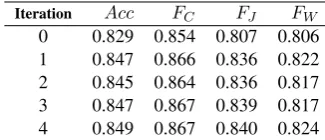
After each iteration of our MaxEnt-based EM algorithm, we record the number of patterns in the training set that changed their origin labels, as well as calculate the precision, recall and
F-score for each origin as well as the overall accuracy. The results are reported in Tables 3 and 4, where for the sake of brevity the origin subscripts are “C”, “J” and “W” for Chinese, Japanese and English name origin respectively. Compared to the 0-th iteration there is an
significant improvement in accuracy, particu-larly in recognition of Japanese names, which are relatively infrequent compared to Chinese and English ones in the unlabelled training data. This clearly shows the effectiveness of our proposed method.
[image:6.595.306.507.99.163.2]Iteration PC PJ PW RC RJ RW 0 0.887 0.724 0.857 0.823 0.911 0.761 1 0.914 0.736 0.875 0.823 0.968 0.775 2 0.910 0.736 0.874 0.823 0.968 0.767 3 0.914 0.737 0.874 0.824 0.973 0.767 4 0.913 0.742 0.875 0.825 0.968 0.778
Table 3: Results of running EM iterations, original names of the places are kept.
Iteration Acc FC FJ FW 0 0.829 0.854 0.807 0.806 1 0.847 0.866 0.836 0.822 2 0.845 0.864 0.836 0.817 3 0.847 0.867 0.839 0.817 4 0.849 0.867 0.840 0.824 Table 4: Results of running EM iterations, original names of the places are kept.
5 Conclusions
We propose extension of MaxEnt model for NOR task by using two types of data for train-ing: labelled names alone and origin-unlabelled names in their context surrounding. We show how to apply a simple EM method to make use of the contextual words as features, and improve the NOR accuracy from 82.9% to 84.9% overall, while for rare names such as Japanese the effect of using unlabelled data with context features is even greater.
The purpose of this research is to demon-strate how the unlabelled data can be used. In the future we hope to investigate the use of other context features, as well as to study the effect of data size on the NOR accuracy im-provement.
[image:6.595.321.484.208.278.2]References
[Berger et al.1996] Berger, A., Stephen A. Della Pietra, and V. Della Pietra. 1996. A maximum entropy approach to natural lan-guage processing. Computational Linguistics, 22(1):39–71.
[Byrd et al.1995] Byrd, R. H., P. Lu, and J. Nocedal. 1995. A limited memory algorithm for bound constrained optimization. SIAM Journal of Sci-entific and Statistical Computing, 16(5):1190– 1208.
[Cavnar and Trenkle1994] Cavnar, William B. and John M. Trenkle. 1994. Ngram based text cat-egorization. InProc. 3rd Annual Symposium on Document Analysis and Information Retrieval, pages 275–282.
[Knight and Graehl1998] Knight, Kevin and Jonathan Graehl. 1998. Machine translitera-tion. Computational Linguistics, 24(4).
[Kuo et al.2007] Kuo, Jin-Shea, Haizhou Li, and Ying-Kuei Yang. 2007. A phonetic similarity model for automatic extraction of transliteration pairs. ACM Transactions on Asian Language In-formation Processing, 6(2).
[Li et al.2007a] Li, Haizhou, Shuanhu Bai, and Jin-Shea Kuo. 2007a. Transliteration. InAdvances in Chinese Spoken Language Processing, chap-ter 15, pages 341–364. World Scientific.
[Li et al.2007b] Li, Haizhou, Khe Chai Sim, Jin-Shea Kuo, and Minghui Dong. 2007b. Semantic transliteration of personal names. InProc. 45th Annual Meeting of the ACL, pages 120–127.
[Qu and Grefenstette2004] Qu, Yan and Gregory Grefenstette. 2004. Finding ideographic rep-resentations of Japanese names written in Latin script via language identification and corpus val-idation. In Proc. 42nd ACL Annual Meeting, pages 183–190, Barcelona, Spain.