Revita: a Language-learning Platform at the Intersection of ITS and CALL
Anisia Katinskaia, Javad Nouri, Roman Yangarber
University of Helsinki, FinlandAbstract
This paper presents Revita, a Web-based platform for language learning—beyond the beginner level. We anchor the presentation in a survey, where we review the literature about recent advances in the fields of computer-aided language learning (CALL) and intelligent tutoring systems (ITS). We outline the establisheddesiderataof CALL and ITS and discuss how Revita addresses (the majority of) the theoretical requirements of CALL and ITS. Finally, we claim that, to the best of our knowledge, Revita is currently the only platform for learning/tutoring beyond the beginner level, that is functional, freely-available and supports multiple languages.
Keywords:Computer-assisted language learning, CALL, intelligent tutoring systems, ITS, second language acquisi-tion, SLA, foreign language acquisiacquisi-tion, FLA, learner corpus.
1.
Introduction
Over the recent years we observe a clear emerging trend toward flexible online language-learning tools that are accessible anywhere on demand. Despite the growing need for and popularity of such tools, most of the existing systems do not address the fundamen-tal requirements of language learners and teachers. In this paper, we demonstrate Revita, a freely avail-able online platform, which has been designed to sup-port language learning/tutoring beyond the beginner level. A variety of resources exist on the Web—various free and commercial applications—which support be-ginners, some with millions of users. However, once the learner has passed the beginner’s level, and reached low-intermediate to advanced (LI-A) level (i.e., above A1 on the CEFR scale), resources available to her become drastically limited. As far as our re-search has shown, no systems today provide substan-tial support for LI-A learners in multiple languages. Revita currently works with several languages—in various stages of development, ranging from initial, “beta” versions to fairly well developed ones. The languages include “big” languages—Finnish, Rus-sian, Swedish(β), German(β), and Kazakh(β)—and sev-eral endangered minority languages, currently Komi-Zyrian, Udmurt, Meadow Mari(β), Erzya(β), North Saami(β), Komi-Permiak(β), and Sakha (Yakut)(β).1 The system automatically generates a wide variety of randomized exercises targeted for the learner, based on arbitrary, realtexts, which can be chosen and up-loaded to the platform by the learner herself (or by her teacher). The system aims to adapt the level of ex-ercises to every user depending on her level of compe-tence, which it tries to estimate based on her answers to previously completed exercises.
Revita lies at the intersection of two established ar-eas of research: intelligent tutoring systems (ITS) and computer-assisted language learning (CALL)— the project seeks intelligent solutions for language learning. On the other hand, Revita has the potential
1The system is online atrevita.cs.helsinki.fi
for enriching the language teaching process as well, because the platform can be used for collecting, min-ing and analyzmin-ing educational data.
The paper is organized as follows: Section 2. presents an overview of previous work in computational ap-proaches to language learning. Section 3. describes the Revita system, a language-learning tool devel-oped at the intersection of ICALL and ITS; Section 3.2. describes the main features of the system. Section 4. positions Revita in the field of Educational Data Min-ing (EDM), and Section 5. concludes with pointers for future work.
2.
Prior work
The idea of using computers for language learning was introduced over 50 years ago. Computer-assisted language learning (CALL) is an active research area, which originated as a sub-area of computer-assisted instruction (CAI). CALL is broadly defined as “the search for and study of applications of the computer in language teaching and learning,” (Levy, 1997). CALL includes a broad variety of technologies ap-plied to language learning and teaching, in which the computer is accepted by researchers and by teachers as asupport tool; it is not considered to be a replace-mentfor the teacher. One of the early CALL systems, PLATO, (Hart, 1981) was created in the early 1970s. Most of the major, popular CALL systems today are commercial, and are intended for learning/tutoring at the elementary/beginner level, viz., Duolingo, Lin-guaLeo, Babbel, and others. Those systems that claim to cater to advanced learners, typically offer a collection of learning materials and exercises, e.g.,
https://www.deutsch-lernen.com/. Crucially, most
of these systems offer materials in the form of a closed,fixedset of exercises.
Exercises may be of several types. A type of exercise, known as a “cloze” (deletion) test,2is where a portion of the text has some of the words removed, and the learner is asked to recover the missing words. Clozes
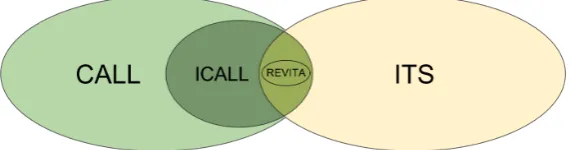
Figure 1: Landscape of tools for language learning.
require an understanding of the context, semantics and syntax in order to fill in the blanks with the cor-rect missing words. Alternatively, exercises may offer selection from a multiple-choice menu.
Thus, most of systems in the literature that we have reviewed, are based on the so-called “canned” ap-proach: i.e., exercises that the learner receives are drawn from a pre-made, fixed, and therefore limited set—even if the set may be large and varied. The ex-ercises are created in advance of the study session by human experts, and are based on fixed textual mate-rial, pre-determined by the designers of the exercises , rarely expand on a context bigger than one sentence. Overall, however, the existing systems are mainly tar-geted toward beginners. Since hand-crafting a sub-stantial volume of exercises for more advanced users requires much greater resources, it is more difficult to provide sufficient coverage to support the interme-diate/advanced learner, due to the growing cost-to-benefit ratio: the demands on the systems grow, while the market shrinks—many more learners/consumers of language learning services are at the beginner, el-ementary level, than at the LI-A levels. This ratio is a key factor that has suppressed wider emergence of CALL/ITS beyond the beginner levels.
On the other hand, offering a fixed, limited set of ex-ercises is in conflict with the principles ofadaptability
of the learning process to the profile of the particular user. Applying a “one-size-fits-all” paradigm to stu-dents with different levels of competence goes against established pedagogical practices.
Some systems do track personal progress and the user’s state of knowledge; however, they do notadapt
future exercises to the user depending on her prior er-rors; the set of exercises is the same for everyone.3 Further, most systems provide poor feedback about about the answers given by the learners. In the ex-treme, some systems provide to the learner only a summary of how many of her answers were correct, without any more specific information to help correct errors and improve in the future.4
Many of the CALL systems that do attempt to ad-dress the needs of intermediate-to-advanced learners employ complex linguistic or grammatical terminol-ogy5. This may be undesirable in certain settings, e.g.,
3For example,https://learning.lengalia.com
4For example,http://icelandiconline.is/
5For example:learning.lengalia.com,
icelandiconline.is,www.easypersian.com
in cases where the learners may have quite substan-tial competency in the language, yet lack proficiency in linguistic concepts and terminology. This is espe-cially true, e.g., of“heritage”learners; these are learn-ers who acquired passive competency in a language from hearing parents/relatives speaking in diasporic settings, or in the settings of minority languages hav-ing no official state status—but who have no formal training in it.
As CAI developed, the field of intelligent tutor-ing systems (ITS) emerged with somewhat different goals. Within ITS another role for the computer was accepted—specifically, the role of computer astutor. ITSs have been applied in various knowledge domains—mathematics, the sciences, business man-agement, etc.—and focus on the ability to generalize and apply knowledge to specific tasks, and on dy-namic adaptation depending on the user and the per-formed tasks. Initially, ITSs were envisioned as aim-ing to replicate the function of human teachers (Self, 1990; Shute, 1991)—not only to support learning, but also to attend to the learner’s progress, (Self, 1998). Decades of research have shown the effectiveness of ITS technology for learning. Students who used ITSs showed improvements in performance, compared to students who were exposed only to traditional class-room settings, (Kulik and Fletcher, 2016). Several sys-tems, which were used by tens or hundreds of thou-sands of students annually, significantly improved learning performance: e.g., Cognitive Tutor (Oxman et al., 2014; Ostrow and Heffernan, 2014), ALEKS (Craig et al., 2013), ASSISTments (Koedinger et al., 2010).
Most ITS approaches found in practice are simple; e.g., they employ simple heuristics for assessment of user progress based on the number of correct an-swers given in succession (Heffernan and Heffernan, 2014), and they do not attempt to model the underly-ing conceptual domain. Several seminal approaches have been developed to provide highly refined assess-ment, based on theoretical psychometric principles— e.g., the Knowledge Space Theory (KST), (Doignon and Falmagne, 2012; Falmagne and Doignon, 2010; Falmagne et al., 1990)—and incorporated into large-scale, commercial science-tutoring systems, such as ALEKS (Craig et al., 2013).
(possibly millions of) nodes. Each node in the graph represents a possible knowledge state of a learner— encoding the set of concepts mastered in that state— and the possible paths in the graph indicate the pos-sible paths toward acquiring full competency in the domain. More precisely, the learner’s competency is modeled as a probability distribution over the nodes in the knowledge graph: the learner is most likely to be positioned at those nodes where probability mass is concentrated.
ITS, when applied specifically for language learning—and supported by other intelligent and/or adaptive methodologies, such as adaptive systems (AS), expert systems (ES), natural language pro-cessing (NLP), automatic speech recognition (ASR), etc.—defines the domain of intelligent CALL, or ICALL. The goal of ICALL is broadly defined as building advanced applications for language learn-ing uslearn-ing NLP and language resources—corpora, lexicons, etc., (Volodina et al., 2014).
Although ITSs were seen as generally useful in ICALL, they were not in the focus of ITS research over the last two decades, because: they were not consid-ered to be intelligent enough, were felt to be too “be-havioral” in nature, and were too bound to “drill-and-kill” types of exercises, (Hubbard and Siskin, 2004); another important reason was the lack of mature tech-nology (Bush, 2008; Mozgovoy, 2012).
Currently, ITSs are acknowledged as useful for lan-guage learning, and “able to address more than just simple grammar and vocabulary teaching/learning, but they need to be designed keeping in mind learn-ers’ and instructors’ needs” (Bush, 2008). We found that most of the existing ITSs for language learning remain in theprototypestage, having been developed purely for research purposes. Our literature and on-line search has revealed only three systems which claim to be functional, and to have been in use in classroom settings:
• E-Tutor, for learning university-level German (Heift, 2008; Heift, 2010)
• TAGARELA, for learning university-level Por-tuguese (Amaral and Meurers, 2007; Amaral and Meurers, 2011)
• Robo-Sensei, for learning Japanese, mostly focus-ing on translation (Nagata, 2009)
The first two systems build adaptive learner mod-els, and tailor feedback messages depending on in-dividual performance. The third system has a sin-gle sequence of activities distributed over 24 lessons, which is fixed and identical for all users. All of these systems are monolingual—designed for a single lan-guage. Most importantly, at the time of this writing, a search on the Web shows thatnoneof these systems is currently available for use.
At the three most recent International Conferences on ITS—over the last 6 years—only four papers about language learning have been presented, and none of them relate to developing any new ITSs. Thus, overall
we observe a lack of papers about ITSs for language learning, a lack of assessment, and a lack of function-ing systems.
Golonka et al. (2014) published a review of computa-tional methodologies in language learning; the review mentions three evaluations of ITS for language learn-ing (Nagata, 1993; Nagata, 1997; Dodigovic, 2007). Al-though all three showed that ITS are more effective than traditional tutoring, the author was critical of the
evaluationof the new methodologies.
3.
Revita system description
The Revita system, situated at the intersection of ICALL and ITS—see Figure 1—attempts to address the requirements of both, and aims to move beyond existing solutions, (Katinskaia et al., 2017).
3.1.
Addressing current problems in CALL
and ITS
We briefly review the desiderata of language-learning systems and the key problems in developing ITSs— the main observed pitfalls. Many of these have been brought to light in prior surveys, e.g., in (Slavuj et al., 2015). For each desideratum or problem we briefly mention how Revita satisfies the requirement, or how we intend to address it in the future.6
1. Over-restricting the learning domain horizontally: Horizontal restriction refers to the tendency to focus on a single linguistic skill. Revita offers a variety of practice modes for exercising reading, grammar and vocabulary skills, to cover a broad range of linguistic concepts and phenomena.7 2. Over-restricting the learning domain vertically: lack
of support for learners at different levels of profi-ciency (especially CEFR levels A2–C2), typically focusing on the beginner levels. Revita targets thelow-intermediate to advancedlevels (LI-A). 3. Active vs. passive learning: i.e., focus on the user’s
skills in active production of language vs. pas-sive absorption of material. In Revita, the focus is on active skills, achieved by eliciting unrestricted user input; the learner produces word forms in the context of the story.
4. Learning materials should reflect real-world commu-nicative situations: We allow the learners/teachers to use arbitrary, real-world texts, rather than al-lowing only artificial texts pre-fabricated for in-structional purposes.
5. Providing learning materials that keep learners moti-vated during the learning process. In large part related to item 4, above: if the exercises are de-tached from real-world, useful contexts, they be-come uninteresting, and lead to loss of motiva-tion. Revita provides various types of exercises,
6See the operational platform atrevita.cs.helsinki.fi
7In the future, we will add exercises in the aural
and entertaining, engaging modes of practice, in-cluding competition against an opponent. 6. Reference to assessment scales: Most ITSs do not
link to a generalized framework of reference, such as the CEFR or ILR scale. Detailed inter-nal assessment is a crucial part of Revita. At present, the system keeps track of the learner’s performance on a large set of grammatical and lexical “concepts,”—which serves as an indica-tor of competency in the corresponding linguis-tic skills (e.g., “mastered the inflection of nouns of class X”). In future work, we plan to incorpo-rate these concepts fully into the KST framework, and model the knowledge space in accordance with the theory (Doignon and Falmagne, 2012). The model will be learned automatically from ob-served learner responses (Schrepp, 1999), and the inferred (statistical) precedence relations among the linguistic concepts.
7. Feedback messages: should be personalized, and should guide the learner toward finding the cor-rect answer. Rather than responding to the user simply with “correct vs. incorrect”, the system should point to the source of the problem and offer a chance to attempt the exercise again us-ing new clues returned by the system. Revita re-turns immediate feedback to the learner—about grammatical errors, incorrect choices in multiple-choice exercises, or wrong translations in flash-card vocabulary exercises. We plan to extend the feedback mechanisms to be more personal-ized by analyzing the history of the learner’s re-sponses.
8. Mimicking a language teacher: ITS is envisioned as being capable to mimicking (and comple-ment) successfully the functions of a language teacher. In order to do so, the ITS must be designed specifically for the purpose of lan-guage learning—i.e., based on sound pedagogy and language-teaching methodology, supported by foreign/second language acquisition theory (FLA/SLA). This theory must form the basis for designing intelligent CALL systems. In Revita we work with SLA/FLA experts, to assure adher-ence to this requirement.
Lastly (also related to problems 5, and 7) when the feedback that the system provides is limited to “right/wrong,” the system gives the impression of not caring about the learner’s development, and fail-ing to fulfil the requirements of a good tutor.
In summary, CALL systems are seen in the literature as widely available, but not sufficiently “intelligent,” nor adaptive. ITSs in the language-learning domain are intelligent, but not available to end-users, or not free of charge. Further, all ITSs that we found are monolingual; ICALL systems are multilingual, but the more languages, the simpler the system, and the more basic the level of the exercises.
The principal characteristics that distinguish an
intel-ligent tutor are: the ability to diagnose the knowledge structure and the skills of the learner; personal adap-tation of instruction to the learner; provision of per-sonalized feedback. To meet these requirements, the ITS needs to implement a(domain) knowledge model, a
student modeland aninstruction model.
1. Domain knowledge model: the (linguistic) do-main knowledge model in Revita is embodied in language-specific rules, which drive the creation of exercises, described below in Section 3.2.. The rule component is specialized for each language,8 and requires some input from language experts. 2. Student model: the system records all of the
stu-dent’s answers (correct and incorrect), which af-fect the choice of future exercises. These re-sponses will be used to implement KST func-tionality, to determine learner’s current state of knowledge. Both the Knowledge model and the Student model are based on data collected from the students’ practice sessions.
3. Instruction Model: embodies the pedagogical principles: in which order concepts and exer-cises should be presented, what feedback to pro-vide, etc. Currently, Revita uses rules as In-struction model to determine which new exer-cises should be presented to the user based on her Student model. The system then attempts to emphasize practicing those concepts: A. in which the user is not proficient, and B. which the user is best prepared to absorb next. In this pro-cess, the exercises turn less frequently—i.e., with lower probability—to concepts: 1. on which the learner previously made very few mistakes (to avoid boredom), and 2. on which she (almost) al-ways makes mistakes (to avoid frustration). Future work includes incorporating state-of-the-art theories for driving instruction by means of KST and Bayesian knowledge tracing (BKT), (Pardos and Hef-fernan, 2010).
3.2.
Exercise modes
In a broad sense, active language learning is reflected in the functionality of Revita on several levels, includ-ing: support active learning by providing the abil-ity to seek out materials to match one’s own inter-ests (and sharing interesting materials with friends), as well as selecting categories on which to concentrate in an exercise session, using progress feedback to di-rect the focus and emphasis of exercises.9
The bulk of Revita’s exercises are based on the sto-ries the user has selected. One of the bedrocks of Re-vita’s philosophy is that language learning is stimu-lated and becomes more productive when the learner
8For example, in German and Swedish, Revita creates
flash-card exercises to test the knowledge of noun gender via their articles—the article is determined by the noun’s gender. This is not relevant for gender-free languages.
9This feature is helpful for preparation for standardized
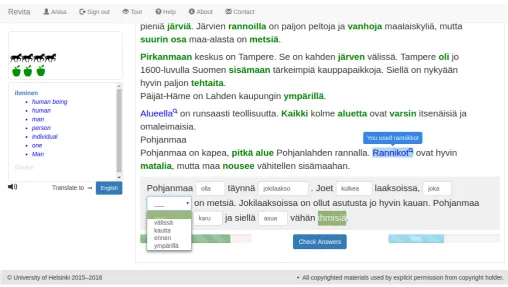
Figure 2: Practice mode. Current snippet of the story (in Finnish) at the bottom, over grey background, contains multiple choice (menu) and cloze (textbox) exercises. Previous snippets above; correctly answered questions in dark green, incorrectly answered questions in blue. User clicked the last word in the current snippet to see its meaning (shown in box on the left).
is working with materials which holdpersonal interest for the learner. The system has a small public library of texts for every language; however every learner is encouraged to upload materials into her own, private library.10Learning materials can be shared with other users of the platform (“friends”).
Several modes are available for working with a story. Thereading mode allows the learner to skim through a story and view translations of unfamiliar words— which also adds them to the personal vocabulary (stack of flashcards) for later practice.
Inpractice mode (see Figure 2), the system automati-cally generates exercises based on a story chosen by the user. The story is presented piece by piece; each piece (“snippet”) is about 30-40 words in length, with several words chosen for exercises—these words are omitted and replaced by a multiple-choice quiz, or a “close” quiz. In the figure, the current snippet is at the bottom of the screen (over a grey background). Previously completed snippets remain above the cur-rent snippet (over a white background). In the prior snippets, correctly answered exercises are highlighted in green, and incorrectly answered ones are in blue; hovering over an incorrectly answered exercise pro-vides more insights about the mistake.
For example, “Pohjanmaa on t¨aynn¨a jokilaaksoja.”
10This is done by loading a local file (.txt or .doc), by
copy-pasting text, or by providing a remote URL of the website containing text to upload into the library.
is the first sentence (in Finnish) in the snippet in Fig-ure 2, (meaning “Pohjanmaa is full of river valleys”). The system created cloze exercises by hiding the words in the boxes and providing their base forms (lemmas) to the learner as hints:
“Pohjanmaa olla t¨aynn¨a jokilaakso.”
From the verb lemma “olla” (“to be”) and noun lemma “jokilaakso” (“river valley”) the learner should derive the original, correctly inflected forms. The task of the user is to guess which form of the skipped word was used in the context by the author.
Non-inflected words (prepositions, conjunctions, etc.) are used for multiple-choice quizzes. Inflected words (nouns, verbs, etc.) are used for “close” quizzes: the base form (lemma) of the word is shown as a hint, and the learner needs to guess the appropriate grammati-cal form in context.
This approach has its advantages as well as prob-lems. On one hand, it is easy to validate the user’s answer, because the system knows the original form used in the story. On the other hand, the learner may possibly insert a different form which is valid in the given context, yet different from the form found in the story. It is a challenging NLP prob-lem to determine whether the user’s answer is also
Figure 3: Crossword mode. The current story (in Finnish) on the right contains cloze exercises, in textboxes (exercises that have been resolved are in dark green, e.g., the first word in the story). Each cloze corresponds to entries in the crossword (middle); currently selected entry (15→) is highlighted. The clues to the entries are translations of the missing words (on the left).
After the learner responds to all quizzes in the cur-rent fragment of the story, the system provides her with immediate feedback, and then moves on to the following fragment with new exercises. All possible candidates for exercises are determined and saved at the time when the story is uploaded into the system and analyzed by several lower-level natural language processing (NLP) modules including morphological analysis, disambiguation, etc.
Candidates are created using language-specific rules. For example, for Russian, the system may include rule A: [ word=’в’, POS=prep, case={loc, acc}], An-other rule, B, in 3 parts, may be:
1. [ POS=prep, case=X]
2. [ POS=adj, case=X, number=Y, gender=Z] 3. [ POS=noun, case=X, number=Y, gender=Z].
These (declarative) rules state general facts about the language, and refer to the part of speech tags and morphological tags of words that may be encountered in a story. Rule A states the preposition “в” (meaning “in”) governs the locative or accusative case. Rule B stipulates the agreement11within a noun phrase that contains the parts of speech (POS) [prep adj noun]: case agreement between preposition, adjective and noun, as well as number and gender agreement be-tween the adjective and noun. Using such rules, the system finds constructions, such as:
“... в тёмном лесу ...”
in dark-Masc.Sg.Loc forest-Masc.Sg.Loc “... in a dark forest ...”
where the case, number and gender categories agree. Then this sequence may be offered as an exercise, e.g.,
11By unification over the variables, which are in bold.
with a multiple choice for the preposition (with the re-maining options filled bydistractorprepositions), and “cloze” boxes for the noun and adjective. Various ap-proaches to the problem of generation of reliable dis-tractors are described in (Lee and Luo, 2016; Correia et al., 2010; Rakangor and Ghodasara, 2014; Sakaguchi et al., 2013; Hill and Simha, 2016; Liang et al., 2017). The actual choice of candidates for exercises de-pends on the user model—the history of answers given previously by the user. The system computes weights (probabilities) for all potential candidates in the story snippet; words or constructions receive a lower weight if they had been answered mostly in-correctly (or mostly in-correctly) in previous sessions— since that implies that they were too difficult (or too easy) for the learner at present. Candidates with smaller weights appear with a lower probability in the next exercises. Weights are assigned not only to particular words, but also to their various grammati-cal categories; thus, if a user, e.g., sometimes makes mistakes in a certain nominal case, the system will provide more exercises for this case.
The crossword mode encourages practicing grammar and vocabulary simultaneously. A crossword is built automatically and randomly based on the text of a story (see Figure 3). Candidates for the crossword are selected according to the same principles as in prac-tice mode (above); hidden words need to be inserted back into the story in the correct inflected form. As clues, the learner receives the translations of the miss-ing words (rather than their lemmas, as in practice mode). All answers are saved and used for updating the weights of candidates on subsequent exercises, as is done for the practice mode.
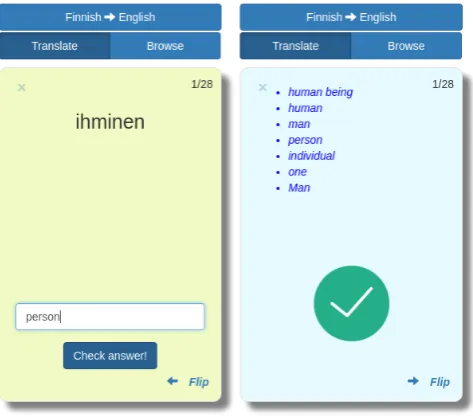
Figure 4: Flashcards for practicing vocabulary.
learner can request a translation of any unfamil-iar word. Translations are looked up in third-party on-line multi-lingual dictionaries. Words for which translations were requested are added into the user’s stack of flashcards—used in the flashcard mode, see Figure 4, to practice vocabulary. In the figure, the user first receives the word to be translated (left), types a translation in the box below, flips the card and receives feedback (right) whether the translation is among those that are recognized by the system. For all of the above exercise modes—reading, prac-tice, crossword, flashcards—Revita provides a Com-petition mode extension.12 For example, for the prac-tice mode, the idea behind the competition is that the user must guess the correct grammatical word given the context, as before, but now she is simultaneously racing to answer the questions faster than an oppo-nent, who is solving the same exercises at the same time. The learner needs to get more correct answers in a shorter period of time to win the competition. At present, the opponent is abot, which aims to imitate as nearly as possible the learner’s own rate of answer-ing questions and state of knowledge (probability of answering the given question correctly). In this way, the learner iscompeting with herself—i.e., trying to im-prove on her own previous performance.13
These exercise modes—all building on the original story text selected by the user—provide a variety of interactions, which help the user practice on one’s own, outside the classroom, and which are designed to stimulate and engage the user—more so than a tra-ditional textbook might.14
12At present, competition is implemented only the
prac-tice mode, but the idea is straightforward and the extension will be implemented for all exercise modes.
13We plan to implement competition with a human friend
as well—another user on the platform.
14In the future, the goal is to incorporate exercise modes
Figure 5:Progress visualization for numerals in Russian
3.3.
Assessment
Currently the system implements a simple system for progress assessment: it checks all of the learner’s answers, tracking how exercises involving various grammatical concepts—which are categories, such as tense and mood for verbs, number and case for nouns, etc.—were answered by the learner, and how many exercises with different concepts were practiced. The learner may keep track of her progress via a vi-sualization (see Figure 5). The size of the balls in-dicates the relative frequency with which this gram-matical concept was encountered by the user in exer-cises so far; the color ranges from green to red, de-pending on the percentage of correct answers given so far; if the majority is correct, the color tends toward green, otherwise toward red. This visualization is one way to summarize the learner’s knowledge state at the present time; we plan to extend this visualization with information about progress across time.
3.4.
Evaluation by learners and teachers
To date, we have introduced Revita to professional teachers of 12 different languages, who provided ex-tensive and useful feedback about their particular lan-guage. All of them have stated an interest in using the system in their pedagogical practice.
We are currently in the process of testing the sys-tem with students. These initial tests focus on LI-A learners of Finnish and Russian, with wider testing planned to follow.
4.
Revita as a source of educational data
Educational data mining (EDM) is defined as the “re-search field concerned with the application of data mining, machine learning and statistics to informa-tion generated from educainforma-tional settings (e.g., univer-sities and intelligent tutoring systems),” (Baker and Yacef, 2009). The goal of EDM is to help predict the learner’s behavior—which means deriving accurate [image:7.595.313.534.75.228.2]Student models from user’s feedback; the same feed-back can be used to improve the Domain models in-side the system. More generally, EDM also allows us to study the effects of the educational support pro-vided by the system, and to advance scientific knowl-edge about the process of language learning and ac-quisition.
Thus, the final aspect of Revita to which we draw at-tention in this paper is that as the platform is used by the learners, over time it builds a rich and valuable resource: the detailed educational data in the form of learner responses—correct and incorrect,—the con-texts of the responses within the stories, all words which were unfamiliar in their contexts (i.e., for which translations were requested)—as well as the timings of all of these interactions.
This is valuable data, no less valuable than learner corpora, which language educators have worked very hard to collect for decades. The larger a learner corpus grows, the better it allows us to build accurate mod-els of the learners and the learning process, to identify the common mistakes, and the patterns of mistakes. This information allows the system to derive more ac-curate Domain, Student and Instruction models. The Student model for each user is based directly on the totality of the data collected for that user. Impor-tant aspects of the Domain model are implicit in—and can be inferred from—generalizations over data col-lected from many learners. For example, if we con-sider two concepts, A and B, and over a large number of learners we can observe that those who answer B correctly also (almost always) answer A correctly, but not vice versa, then we can infer that, with high prob-ability, concept A is a pre-requisite for B.
Further, looking for patterns of the order, in which concepts are mastered by students—over a large pop-ulation of students—we can obtain statistical infor-mation about how the learner’s native language af-fects the order in which concepts in the target lan-guage are likely to be acquired. It seems intuitively clear that a group of learners with a common na-tive language will likely exhibit common traits— observable through their responses.15
It is also reasonable to assume that having the abil-ity to model these commonalities explicitly, and ex-ploit them in the learning process (in the Instruction model) will provide for a more intelligent tutoring system.
The Instruction model is currently computed by rules, which operate on the data stored in the learners’ his-tory. The same data will form the foundation for
15For example: native speakers of Turkic languages may
find some aspects of learning Finnish (the target) easier than native speakers of Slavic languages—vowel harmony is one such aspect, because it is present in similar forms in both Finnish and Turkic. On the other hand, other aspects of Finnish may be much more intuitive to Slavic speakers, be-cause historically Finnish has been in more immediate con-tact with Slavic languages, and the development of many of its linguistic features was affected through this contact.
more complex Instruction models, which we plan to explore, viz., Knowledge Space Theory, and Bayesian knowledge tracing.
It is clear that the educational data collected through Revita over time will find a variety of purposes and important applications. It will impact various as-pects of our overall enterprise—namely, gaining in-sight into the process of language learning, and im-proving the methodology of automated language in-struction and tutoring.
High-quality, detailed and large-scale data is a pri-mary requirement for the application of modern data-driven machine learning and statistical methods. The key point, however, is thatwithouta powerful, auto-mated platform such as Revita, data on a comparable scale would be impossible to collect.
5.
Conclusion
An in-depth literature review and investigation of the currently available tools indicates that ICALL systems do not exhibit sufficiently intelligent characteristics, and ITS systems described in the literature appear to be laboratory experiments, not available to learners in practice.
We have presented Revita, an open platform de-veloped at the intersection of ITS and CALL, aim-ing to address all of the main drawbacks of existaim-ing language-learning systems.
Revita aims to bring intelligent language technol-ogy into the freely available online language-learning space, which is becoming more popular, not only among the learners, but also among the teachers. It also serves as an instrument for collection of valuable educational data.
The functionality of the system is under continual de-velopment. Modifications to Revita are motivated by feedback from the users and SLA/FLA experts.
6.
Acknowledgments
This research was supported in part by the FinUgRe-vita Project, Academy of Finland, Grant No. 267097. We are grateful to Kim Salmi, Max Koppatz and Jose Mar´ıa Hoya Quecedo for their contributions to the de-velopment.
7.
Bibliographical References
Amaral, L. and Meurers, D. (2007). Conceptualizingstudent models for ICALL. In User modeling, vol-ume 2007, page 11th. Springer.
Amaral, L. A. and Meurers, D. (2011). On using intel-ligent computer-assisted language learning in real-life foreign language teaching and learning. Re-CALL, 23(1):4–24.
Baker, R. S. and Yacef, K. (2009). The state of edu-cational data mining in 2009: A review and future visions. JEDM-Journal of Educational Data Mining, 1(1):3–17.
Correia, R. P. d. S., Baptista, J., Mamede, N., Trancoso, I., and Eskenazi, M. (2010). Automatic generation of cloze question distractors. In Second Language Studies: Acquisition, Learning, Education and Technol-ogy.
Craig, S. D., Hu, X., Graesser, A. C., Bargagliotti, A. E., Sterbinsky, A., Cheney, K. R., and Okwumabua, T. (2013). The impact of a technology-based mathe-matics after-school program using ALEKS on stu-dent’s knowledge and behaviors. Computers & Ed-ucation, 68:495–504.
Dodigovic, M. (2007). Artificial intelligence and sec-ond language learning: An efficient approach to er-ror remediation. Language Awareness, 16(2):99–113. Doignon, J.-P. and Falmagne, J.-C. (2012). Knowledge
spaces. Springer Science & Business Media.
Falmagne, J.-C. and Doignon, J.-P. (2010). Learn-ing spaces: Interdisciplinary applied mathematics. Springer Science & Business Media.
Falmagne, J.-C., Koppen, M., Villano, M., Doignon, J.-P., and Johannesen, L. (1990). Introduction to knowledge spaces: How to build, test, and search them.Psychological Review, 97(2):201.
Golonka, E. M., Bowles, A. R., Frank, V. M., Richard-son, D. L., and Freynik, S. (2014). Technologies for foreign language learning: a review of technol-ogy types and their effectiveness. Computer Assisted Language Learning, 27(1):70–105.
Hart, R. (1981). Language study and the PLATO sys-tem.Studies in Language Learning, 3(1):1–24. Heffernan, N. T. and Heffernan, C. L. (2014). The
assistments ecosystem: building a platform that brings scientists and teachers together for mini-mally invasive research on human learning and teaching. International Journal of Artificial Intelligence in Education, 24(4):470–497.
Heift, T. (2008). Modeling learner variability in CALL. Computer Assisted Language Learning, 21(4):305–321.
Heift, T. (2010). Developing an intelligent language tutor. CALICO journal, 27(3):443–459.
Hill, J. and Simha, R. (2016). Automatic generation of context-based fill-in-the-blank exercises using co-occurrence likelihoods and Google N-grams. In
Proceedings of the 11th Workshop on Innovative Use of NLP for Building Educational Applications, pages 23– 30.
Hubbard, P. and Siskin, C. B. (2004). Another look at tutorial CALL.ReCALL, 16(2):448–461.
Katinskaia, A., Nouri, J., and Yangarber, R. (2017). Revita: a system for language learning and sup-porting endangered languages. InProceedings of the Joint 6th Workshop on NLP for Computer Assisted Lan-guage Learning and 2nd Workshop on NLP for Research on Language Acquisition at NoDaLiDa. Link ¨oping University Electronic Press.
Koedinger, K. R., McLaughlin, E. A., and Heffernan, N. T. (2010). A quasi-experimental evaluation of an on-line formative assessment and tutoring system.
Journal of Educational Computing Research, 43(4):489– 510.
Kulik, J. A. and Fletcher, J. (2016). Effectiveness of in-telligent tutoring systems: a meta-analytic review.
Review of Educational Research, 86(1):42–78.
Lee, J. and Luo, M. (2016). Personalized exercises for preposition learning. Proceedings of ACL-2016 Sys-tem Demonstrations, pages 115–120.
Levy, M. (1997). Computer-assisted language learn-ing: Context and conceptualization. Oxford Univer-sity Press.
Liang, C., Yang, X., Wham, D., Pursel, B., Passon-neaur, R., and Giles, C. L. (2017). Distractor gener-ation with generative adversarial nets for automati-cally creating fill-in-the-blank questions. In Proceed-ings of the Knowledge Capture Conference, page 33. ACM.
Mozgovoy, M. (2012). Towards WordBricks—a vir-tual language lab for computer-assisted language learning. In Computer Science and Information Sys-tems (FedCSIS), 2012 Federated Conference on, pages 229–232. IEEE.
Nagata, N. (1993). Intelligent computer feedback for second language instruction. The Modern Language Journal, 77(3):330–339.
Nagata, N. (1997). An experimental comparison of deductive and inductive feedback generated by a simple parser. System, 25(4):515–534.
Nagata, N. (2009). Robo-Sensei’s NLP-based error detection and feedback generation. Calico Journal, 26(3):562–579.
Ostrow, K. and Heffernan, N. (2014). Testing the mul-timedia principle in the real world: a comparison of video vs. text feedback in authentic middle school math assignments. InEducational Data Mining 2014. Oxman, S., Wong, W., and Innovations, D. (2014). White paper: Adaptive learning systems.Integrated Education Solutions.
Pardos, Z. and Heffernan, N. (2010). Navigating the parameter space of Bayesian Knowledge Trac-ing models: Visualizations of the convergence of the expectation-maximization algorithm. In Educa-tional Data Mining 2010.
Rakangor, S. and Ghodasara, Y. (2014). Automatic fill in the blanks with distractor generation from given corpus. International Journal of Computer Ap-plications, 105(9).
Sakaguchi, K., Arase, Y., and Komachi, M. (2013). Discriminative approach to fill-in-the-blank quiz generation for language learners. InProceedings of the 51st Annual Meeting of the Association for Com-putational Linguistics (Volume 2: Short Papers), vol-ume 2, pages 238–242.
Schrepp, M. (1999). Extracting knowledge structures from observed data. British Journal of Mathematical and Statistical Psychology, 52(2):213–224.
Self, J. (1998). The defining characteristics of intelli-gent tutoring systems research: ITSs care, precisely.
International Journal of Artificial Intelligence in Educa-tion (IJAIED), 10:350–364.
Shute, V. J. (1991). Rose garden promises of intelli-gent tutoring systems: Blossom or thorn. Nasa tech-nical report.
Slavuj, V., Kovaˇci´c, B., and Jugo, I. (2015). Intelli-gent tutoring systems for language learning. In In-formation and Communication Technology, Electronics and Microelectronics (MIPRO), 2015 38th International Convention on, pages 814–819. IEEE.
Taylor, W. L. (1953). Cloze procedure: A new tool for measuring readability.Journalism Quarterly, 30. Volodina, E., Pil´an, I., Borin, L., and Tiedemann, T. L.