Error Analysis of Uyghur Name Tagging: Language-specific Techniques and
Remaining Challenges
Abudukelimu Halidanmu
1, Abulizi Abudoukelimu
1, Boliang Zhang
2, Xiaoman Pan
2,
Di Lu
2, Heng Ji
2, Yang Liu
11
Tsinghua University,2Rensselaer Polytechnic Institute 1
{abdklmhldm}@gmail.com,1{keram1106}@163.com,1{liuyang2011}@tsinghua.edu.cn, 2
{zhangb8,panx2,lud2,jih}@rpi.edu
Abstract
Regardless of numerous efforts at name tagging for Uyghur, there is limited understanding on the performance ceiling. In this paper, we take a close look at the successful cases and perform careful analysis on the remaining errors of a state-of-the-art Uyghur name tagger, systematically categorize challenges, and propose possible solutions. We conclude that simply adopting a machine learning model which is proven successful for high-resource languages along with language-independent superficial features is unlikely to be effective for Uyghur, or low-resource languages in general. Further advancement requires exploiting rich language-specific knowledge and non-traditional linguistic resources, and novel methods to encode them into machine learning frameworks.
Keywords:Low-resource Languages, Name Tagging, Error Analysis
1.
Introduction
Uyghur is a language spoken by 8.2 million people, pri-marily by the Uyghur people in the Xinjiang Uyghur Au-tonomous Region of Western China. In terms of the num-ber of native speakers, it’s ranked at the 94th among all the languages in the world1, but it has extremely low
linguis-tic resources. There are very few Natural Language Pro-cessing (NLP) tools, standard annotated corpora, or lan-guage universal resources (e.g., World Atlas of Linguis-tic Structure (WALS) database (Haspelmath et al., 2005; Dryer and Haspelmath, 2013)) available. Even for natu-rally existing noisy annotations such as Wikipedia markups, Uyghur is ranked very low (the 195th 2). There are only
2,566 Uyghur pages in Wikipedia, much fewer than its re-lated languages such as Turkish (277,547 pages) and Uzbek (128,664 pages). Most Uyghur Wikipedia pages contain much less content than their counterparts in Turkish, Uzbek and English. The cross-lingual links are not carefully vali-dated and thus contain many errors.
It’s certainly important to develop automatic NLP tools for Uyghur, so as to distill information from textual documents written in Uyghur, as well as preserve their unique culture, music, art and the long history of which the Uyghurs are deeply prideful of. Unfortunately, the striking fact is that very little Uyghur NLP work has been published to catch the attention of the wider international NLP research com-munity.
Using Uyghur name tagging as a case study, some previous studies (Li et al., 2011; Arkin et al., 2013b; Rozi et al., 2013; Turhun et al., 2012; Li, 2014; Arkin et al., 2013c; Arkin et al., 2013a; Maihefureti et al., 2014; Zhang, 2014; Zhang et al., 2015; Yu et al., 2015; Nizamidin et al., 2016) have adopted popular machine learning methods which were ef-fective for other high-resource languages. The features
sug-1
https://en.m.wikipedia.org/wiki/List_of_languages_by_num-ber_of_native_speakers
2https://meta.wikimedia.org/wiki/List_of_Wikipedias
gested by these previous papers include: numbers, shape, stem, suffix, the number of suffixes, first syllable, last sylla-ble, the number of syllables, Part-of-speech tags, the closest verb, word length, position in the sentence and special rules to identify Chinese person names. Further advances in this field require us to look into language-specific problems and recommended solutions to those challenges.
In this paper, we will look at the remaining errors of a high-performing Uyghur name tagger, and decompose the re-maining errors into detailed categories in order to under-stand how varied components may contribute to improve-ment. We believe such comprehensive, quantitative and qualitative error analysis may help draw a roadmap for fu-ture research and resource development on this important and yet challenging task.
2.
Approach Overview
We use a deep neural networks based Uyghur name tagger as our target system for analysis because of two reasons: (1) it achieves top performance at NIST LoreHLT2016 Eval-uation 3 so it represents state-of-the-art; (2) unlike most
previous work, this system has already exploited extensive language-specific features. We briefly describe the system as follows.
2..1
Learning Model
This system considers name tagging as a sequence labeling problem, to tag each token in a sentence as the Beginning (B), Inside (I) or Outside (O) of a name mention with a cer-tain type (Person (PER), Organization (ORG), Geo-political Entity (GPE), and Location (LOC)). Following a frame-work similar to (Lample et al., 2016). The architecture con-sists of Bi-directional Long Short-Term Memory and Con-ditional Random Fields (CRFs) network. After processing through the Bi-LSTM networks, each token in a sentence sequence obtains a feature embedding that captures left and
right context information, which is then fed into the CRF networks.
2..2
Pre-processing
The system starts with segmenting a document into tokens based on 50 punctuations pulled from Uyghur grammar books ((translated by Anne Lee), 2003; Zakir, 2007; En-gesæth et al., 2009). Since Uyghur is a morphologically rich language, a set of name related suffixes is also extracted from grammar books, Wikitionary4and WALS5, for
stem-ming and feature encoding.
2..3
Features
Typicalimplicitlinguistic features including character em-beddings and word emem-beddings are learned from a large monolingual unlabeled corpus from LoreHLT2016 and then fed into the Bi-LSTM networks. Moreover, the following Uyghur-specificexplicitcontext-dependent linguistic fea-tures are directly fed into the final CRFs model.
• The first and the last syllables of each token, based on the intuition that Uyghur names often include suffixes, and the first syllables of person names often follow some specific patterns.
• 319 common syllable patterns from person names. The most frequent patterns include (Latin: gue), (Latin: sha), ﺮﯩﻣ(Latin: mir), ﺎﻏ(Latin: gha), (Latin: uel), (Latin: ash), ﻝﯜﮔ(Latin: guel), (Latin: buew), ﯗﺪﺑﺎﺋ
(Latin: abdu) and ﻪﻤﻣﻪﮬﯘﻣ(Latin: muhemme)
• Suffixes are categorized into three types of features: (1) indicating animacy so that the word is likely to be part of a person or an organization name, includingﯔﯩﻧ
(Latin: ning), ﻰﻧ(Latin: ni), ﻕﯘﻟ(Latin: luq), andﻚﯩﻟ
(Latin: lik). (2) locative suffixes indicating GPE/LOC names, includingﻪﻛ(Latin: ke),ﻪﮔ(Latin: ge),ﺎﻗ(Latin: qa), ﺎﻏ (Latin: gha), ﻪﺗ (Latin: te), ﻩﺩ (Latin: de), ﺎﺗ
(Latin: ta), ﺍﺩ(Latin: da),ﻦﯩﺗ(Latin: tin), ﻦﯨﺩ(Latin: din),ﻰﻜﯩﺗ(Latin: tiki),ﻰﻜﯨﺩ(Latin: diki),ﻪﭽﯩﻛ(Latin: kiche),ﻪﭽﯩﮔ(Latin: giche),ﻪﭽﯩﻗ(Latin: qiche), andﻪﭽﯩﻏ
(Latin: ghiche). (3) suffixes indicating a word is un-likely to be a name or part of a name, including ﺭﻻ
(Latin: lar) and ﺭﻪﻟ(Latin: ler).
• Two words before and two words after the current to-ken.
• Conjunction feature of stem and suffix.
• Name designators: English name designators are translated into Uyghur through a bi-lingual lexicon from LoreHLT2016.
• 446 Chinese last names are translated into Uyghur.
2..4
Post-processing
In the low-resource setting, the available resources are not sufficient to generalize some Uighur-specific linguistic phe-nomena as in high-resource language setting. We designed the following heuristic rules as post-processing to fix some obvious errors in informal genres like discussion forum and tweets.
• Remove a name if it includes digital numbers but it’s not a poster or Twitter ID.
4
https://en.wiktionary.org/wiki/Wiktionary:Main_Page
5http://wals.info/
• If a name includes a URL link, remove the URL. • Label places that don’t have governing organizations
as Location(LOC), including all continents,ﻕﺭﻪﺷ ﺍﺭﯘﺘﺗﻮﺋ
(Latin: ottura sheriq, English: Middle East), etc. • Label places with location modifiers as LOC, e.g.,
ﺎﻜﯨﺮﻣﺎﺋ ﻲﯩﺑﯘﻧﻪﺟ(Latin: jenubiy amirika, English: North America).
• Label countries of countries as GPE, e.g.,ﻰﻗﺎﭙﯩﺘﺘﯩﺋ ﺎﭘﯗﺭﯞﺎﻳ
(Latin: yawrupa ittipaqi, English: the European Union).
• Remove generic name mentions of people of the cer-tain ethnicity (e.g., ‘Uighur People’, ’Americans’, ’Arabs’) by checking the combinations of country names and suffixes indicating ‘people’.
• There are many very long nested organizations whose boundaries are difficult to determine. The basic principle is to tag every different, distinct entity by checking if it should be created as a unique en-try when we construct a knowledge base. For example,
ﯔﯩﻨﯩﺗﻼﯩﻜﺷﻪﺗ ﺕﻪﻴﯩﻧﻩﺩﻪﻣ-ﻥﻪﭘ ،ﭗﯨﺭﺎﺋﺎﻣ ﻰﺗﻼﯩﻜﺷﻪﺗ ﺭﻪﻠﺗﻪﻟﯙﺩ ﻥﻪﻜﺷﻪﻟﺮﯩﺑ ﯔﯩﻨﯩﺴﯩﻣﺭﺎﻘﺷﺎﺑ ﺶﯩﺘﯩﻗﺭﺎﺗ ﺭﯘﭼﯘﺋ ﻰﻜﯩﻣﯚﺋ ﺭﻪﻠﻠﯩﻛﻩﯞ ﻕﯘﻠﺷﯗﺭﯘﺗ ﺍﺩﻮﮕﯕﯘﺟ
(“Media Communication office from the United
Nations Educational, Scientific, and Cultural
Orga-nization in China”) should be tagged as one single
organization mention.
• Boundary extension: if a name doesn’t include any suffix and its right contextual word is a name desig-nator, then extend the name boundary to include the designator.
• Cross-genre propagation: when the types of the same name mention are conflicting between formal genres and informal genres, propagate the types from formal genres to informal genres.
• Poster names: Extract all poster names from the orig-inal thread structures, and identify all mentions in the posts, posters, and Twitter user names. Apply English entity linking (Pan et al., 2015) to each string after ‘@’ or ‘#’, and if it’s linkable and its type can be inferred based on KB properties, then assign the type; other-wise tag it as PER.
2..5
Performance
For the experiment in this paper, we used the unsequestered Uyghur documents from the NIST LoReHLT16 evaluation. We used 99 documents for training and 30 documents for test and achieved 65.23% F-score. This performance is en-couraging given the limited resources. The above explicit linguistic features achieved 2.4% F-score improvement. However, the overall performance is still much lower than other languages such as English, Spanish and Dutch (Lam-ple et al., 2016), and also much lower than Uzbek (close to 80% F-score trained from a similar size of data) which is a similar language as Uyghur but has much more linguistic resources. In next section we will take a close look at the remaining errors.
3.
Error Analysis
perform effective error analysis in order to do hill-climbing. Thus in this paper, we ask two Uyghur native speakers to focus on detailed error analysis. In this section, we aim to explain why Uyghur name tagging is so challenging, and discuss various methods we attempted to address these chal-lenges, and potential language-specific solutions.
3..1
Error distribution
In Figure 1 we present the distribution of errors which need different techniques, according to their difficulty levels. The percentage numbers are approximate because some er-rors may rely on the combination of multiple types of fea-tures.
Figure 1: Error Type Distribution
3..2
Rich Morphology
From Figure 1 we can clearly see that morphology anal-ysis dominates the causes for errors. Uyghur is a very ’sticky’ language that contains very rich morphology.90% words have arbitrary combinations of multiple suffixes de-noting person, number, case, mood, etc. Sometimes a com-pound Uyghur word may even indicate an entire sentence, as shown in Table 1. Due to a large number of suffix combi-nations, among all of the unique tokens in our corpus, only 68.1% of them exist in the LDC provided lexicon, while 31.9% are Out-of-Vocabulary (OOV) words.
More than 90% GPE names include suffixes. State-of-the-art language universal morphology analyzers such as Morfessor (Creutz, 2003) don’t perform well on identifying Uyghur suffixes for name tagging purpose. The suffixes we mined from grammar books, Wikitionary and WALS can perform some reasonable amount of stemming. However, it still remains a big challenge for machine learning models to generalize these rich suffix combinations.
3..3
Ambiguity
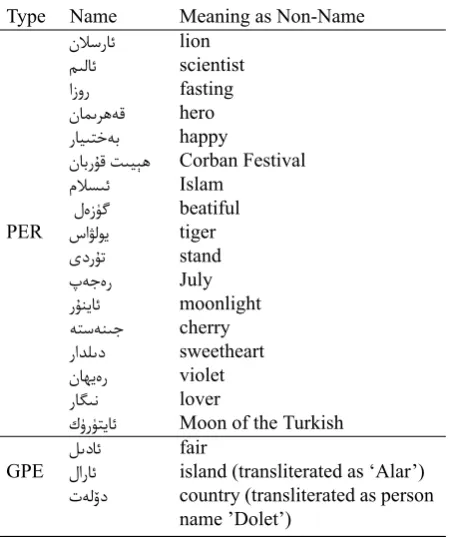
Names and their contexts are highly ambiguous in Uyghur. We further categorize the ambiguous cases as follows. Ambiguity between name and non-name. A Uyghur per-son or GPE name usually has a positive meaning, and thus
Table 1: Uyghur Suffix Derivation Examples
Uyghur English
ﻥﺎﻣﺍﺯ era zaman
ﻯﯟﯩﻧﺎﻣﺍﺯ modern zamanivi
ﺵﻼﯨﯟﯩﻧﺎﻣﺍﺯ modernization zamanivilax
ﺭﯘﺘﺷﻼﯨﯟﯩﻧﺎﻣﺍﺯ modernize zamanivilaxtur
ﻝﯗﺭﯘﺘﺷﻼﯨﯟﯩﻧﺎﻣﺍﺯ be modernized zamanivilaxturur
ﺎﻤﻟﯗﺭﯘﺘﺷﻼﯨﯟﯩﻧﺎﻣﺍﺯ can not be modernized zamanivilaxtururma
ﺰﯩﻤﻳﺎﻤﻟﯗﺭﯘﺘﺷﻼﯨﯟﯩﻧﺎﻣﺍﺯ We can not be modernized zamanivilaxtururmaimiz
Table 2: Ambiguous Uyghur Name Examples
Type Name Meaning as Non-Name
PER
ﻥﻼﺳﺭﺎﺋ lion
ﻢﯩﻟﺎﺋ scientist
ﺍﺯﻭﺭ fasting
ﻥﺎﻤﯨﺮﮬﻪﻗ hero
ﺭﺎﻴﯩﺘﺧﻪﺑ happy
ﻥﺎﺑﺭﯘﻗ ﺖﯩﻴﯧﮬ Corban Festival
ﻡﻼﺴﯩﺋ Islam
ﻝﻩﺯﯜﮔ beatiful
ﺱﺍﯟﻟﻮﻳ tiger
ﻯﺩﺭﯘﺗ stand
ﭖﻪﺟﻩﺭ July
ﺭﯘﻨﻳﺎﺋ moonlight
ﻪﺘﺳﻪﻨﯩﺟ cherry
ﺭﺍﺪﻠﯨﺩ sweetheart
ﻥﺎﮭﻳﻩﺭ violet
ﺭﺎﮕﯩﻧ lover
ﻙﯛﺭﯜﺘﻳﺎﺋ Moon of the Turkish
GPE
ﻞﯨﺩﺎﺋ fair
ﻝﺍﺭﺎﺋ island (transliterated as ‘Alar’)
ﺕﻪﻟﯙﺩ country (transliterated as person name ’Dolet’)
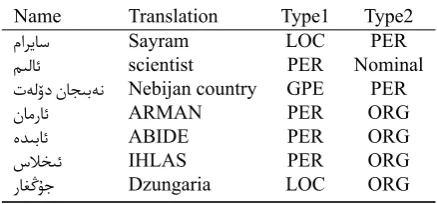
it can also be a common word (usually noun or adjective) in different contexts. Table 2 shows some examples. Ambiguity across name types. There also exists a lot of ambiguity across name types. Table 3 presents some exam-ples of name mentions indicating various types in different contexts.
Table 3: Ambiguity across name types Ambiguous
Name Translation Type1 Type2
ﻡﺍﺮﻳﺎﺳ Sayram LOC PER
ﻢﯩﻟﺎﺋ scientist PER Nominal
ﺕﻪﻟﯙﺩ ﻥﺎﺠﯩﺑﻪﻧ Nebijan country GPE PER
ﻥﺎﻣﺭﺎﺋ ARMAN PER ORG
ﻩﺪﯩﺑﺎﺋ ABIDE PER ORG
ﺱﻼﺨﯩﺋ IHLAS PER ORG
ﺭﺎﻐﯕﯘﺟ Dzungaria LOC ORG
3..4
Variety
Name variety.Names with different origins (Uyghur, Han Chinese, foreign names) have different characteristics. For example, a place name in Xinjiang can be transliterated ei-ther by Chinese pinyin or by its original Uyghur pronun-ciation. For example, both “Hetian” and “Hotan” refer to the same city that appear frequently in English news ar-ticles. There is no established standard yet for transliter-ating Uyghur names, which makes it difficult to project name gazetteers in high-resource languages such as English or Chinese onto Uyghur documents for name identifica-tion. After romanizing Uyghur, many foreign names look very similar to their English forms. For example, “donald trumpni” refers to “Donald Trump”, “nato ken” refers to “Naoto Kan”, and “amerika” refers to “America”. There-fore we tried to use a Soundex based matching method to perform cross-lingual entity linking on each romanized Uyghur ngram to English Knowledge Base and English gazetteers in order to determine whether it’s a name. How-ever, this simple approach produced many spurious errors. In the future, it might be more effective to add it as an im-plicit feature in the model.
Unlike English, there is no capitalization for names in Uyghur. For Han Chinese person names, there is a fixed list of last names which are usually one single character, and each first name is usually a limited 1-2 character. However, neither of these two characteristics exists in Uyghur person names. Similar to Turkish, a Uyghur person’s last name is his/her father’s first name. Moreover, each first name or last name is usually a common word that carries some pos-itive meaning, which yields an almost infinite number of combinations. Therefore it’s more challenging to determine Uyghur person name boundaries than English, Chinese and Turkish.
Context Variety. We also attempted to project English word embeddings to Uyghur using a bilingual lexicon. However, the available lexicon has too low coverage to pro-vide any gains. The same approach propro-vided significant gains (up to 5%) for both Turkish and Uzbek name tagging.
3..5
Informal Names
Due to historical and cultural reasons, a substantial amount of informal Uyghur names is being created, especially at so-cial media platforms. Table 4 presents some examples. Our model also missed some informal poster names and twit-ter users which don’t appear in indicate contexts. Many of these names are common words such asﺭﻪﭘﻪﺳ(“travel”). In addition, many Uighur people like to create pen names for
Table 4: Informal Names
Uyghur Name Literal Translation Referent Entity ﻰﺘﯩﻣﯜﻛﯚﮬ ﭗﻣﺍﺮﯩﺗ Trump government USA
ﻰﺘﯩﻟﯙﺩ ﻡﺎﺷ candle country Islamic State ﺵﺎﻗﺍﺭﺎﻗ thick eyebrows Karakax County ﺕﻪﺒﯩﺗ Tibetan Tibet
ﻰﺘﯩﻣﯜﻛﯚﮬ ﻰﺑﺎﺋ ﯗﺰﻨﯩﺷ Abe Shinzo govern-ment
Japan government
ﻪﻧﺎﺘﺳﺎﺋ Capital Astane County
themselves as their middle names, which are also difficult to identify.
3..6
Long Nested Organizations
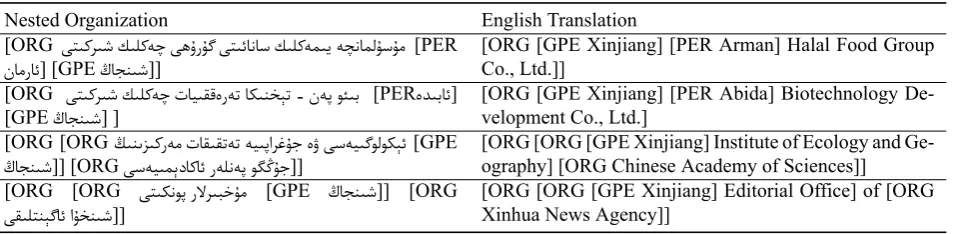
Organization names in Uyghur texts are often very long containing nested names. Some challenging examples are presented in Table 5. It’s difficult to determine their bound-aries, especially when they are not linkable to external knowledge bases, or contain names which are also com-mon words (e.g., the nested person name “Arman” means “dream”; and “Abida” means “milestone”). Addressing this challenge would require us to develop more advanced name internal structure parsing techniques.
3..7
Code Switch
Another unique challenge of Uyghur name tagging is the frequent code-switch phenomena in Uyghur texts. A large variety of names are borrowed from other languages, in-cluding Mandarin which is taught in most Uyghur schools (e.g.,ﻮﮕﯕﯘﺟ(“China”),ﻩﺰﻧﻪﺨﯩﺷ(“Shihezi”),ﯞﺎﺑﯞﺎﺗ(“Taobao”)), Arabic which is due to religious reasons (e.g., ﺕﻪﻤﻣﻪﮬﯘﻣ
(“Mohammed”)), English (e.g., ﺎﻜﯨﺮﻣﺎﺋ (“United States”),
ﭗﻣﺍﺮﯩﺗ (“Trump”)) and Russian which are due to commer-cial trades. Extracting these names correctly requires us to identify their origins and capture the detailed characteristics on how they were transliterated.
3..8
Misspellings
Many names and contextual words in Uyghur texts in both formal and informal genres are misspelled. For example, the common person nameﯔﯩﭘﯞﺎﻴﺷ ﯔﯨﺩ(Deng Xiaoping) is of-ten misspelled asﯔﯩﭘﯞﺎﻴﺷ ﯔﯦﺩeven including its Wikipedia ti-tle; the Wikipedia title ofﻮﮕﯕﯘﺟ(“China”) is also misspelled asﻮﮕﯕﻮﺟ; ﻰﭽﻣﯛﺭﯜﺋ(Urumqi) is often misspelled asﻰﭽﻣﯛﺭﯜﺋ. Up to date there are no effective Uyghur spelling correction techniques available yet.
3..9
Name Definition and Annotation Challenges
In the past two decades, many efforts have been made at defining the name tagging task, including Message Un-derstanding Conference (MUC) (Grishman and Sundheim, 1996), Automatic Content Extraction (ACE)6, and Entity,
Relation and Event (ERE) (Song et al., 2015). However, there are many open issues which may cause confusions for both human annotators and systems. In particular, for low-resource languages like Uyghur, it’s also challenging to train native speakers to follow a long annotation guideline
Table 5: Long Nested Organizations
Nested Organization English Translation
[ORG ﻰﺘﯩﻛﺮﯩﺷ ﻚﯩﻠﻛﻪﭼ ﻰﮬﯗﺭﯘﮔ ﻰﺘﯩﺋﺎﻧﺎﺳ ﻚﯩﻠﻛﻪﻤﯩﻳ ﻪﭽﻧﺎﻤﻟﯘﺳﯘﻣ [PER
ﻥﺎﻣﺭﺎﺋ] [GPEﯓﺎﺠﻨﯩﺷ]]
[ORG [GPE Xinjiang] [PER Arman] Halal Food Group Co., Ltd.]]
[ORG ﻰﺘﯩﻛﺮﯩﺷ ﻚﯩﻠﻛﻪﭼ ﺕﺎﻴﯩﻘﻗﻩﺭﻪﺗ ﺎﻜﯩﻨﺨﯧﺗ - ﻥﻪﭘ ﻮﺌﯩﺑ [PERﻩﺪﯩﺑﺎﺋ] [GPEﯓﺎﺠﻨﯩﺷ] ]
[ORG [GPE Xinjiang] [PER Abida] Biotechnology De-velopment Co., Ltd.]
[ORG [ORGﯔﯩﻨﯨﺰﯩﻛﺭﻪﻣ ﺕﺎﻘﯩﻘﺗﻪﺗ ﻪﻴﯩﭘﺍﺮﻏﯘﺟ ﻩﯞ ﻰﺳﻪﻴﯩﮔﻮﻟﻮﻜﯧﺋ[GPE
ﯓﺎﺠﻨﯩﺷ]] [ORGﻰﺳﻪﻴﯩﻤﯦﺩﺎﻛﺎﺋ ﺭﻪﻠﻧﻪﭘ ﻮﮕﯕﯘﺟ]]
[ORG [ORG [GPE Xinjiang] Institute of Ecology and Ge-ography] [ORG Chinese Academy of Sciences]]
[ORG [ORG ﻰﺘﯩﻜﻧﻮﭘ ﺭﻻﺮﯩﺒﺧﯘﻣ [GPE ﯓﺎﺠﻨﯩﺷ]] [ORG
ﻰﻘﯩﻠﺘﻨﯧﮔﺎﺋ ﺍﯘﺨﻨﯩﺷ]]
[ORG [ORG [GPE Xinjiang] Editorial Office] of [ORG Xinhua News Agency]]
(usually more than 20 pages) which may still leave many language-specific issues underspecified or unresolved. Two annotators at Linguistic Data Consortium (LDC) performed independent annotations on a subset of the LoreHLT2016 Uyghur name tagging data. Compared to the ground truth their F-scores were only 60.5% and 78.8% respectively. In the following, we will discuss some remaining gray areas which may still lead to confusions and different interpreta-tions, and thus often it’s difficult to draw a line. These prob-lems are often amplified due to the communication barrier among the guideline developers, system developers and an-notators.
• Adjective form and roles: Names in adjectival form, or modifiers, such as “[GPE American] army”, are tag-gable. But this definition causes confusions because the modifiers do not always play geo-political entity roles (e.g., “Chinese” in “[GPE Chinese] food”). On the other hand, when news organization names refer to publications instead of organization roles, they should not be tagged. For example, in “Bob enjoys reading the New York Times”, “New York Times” should not be tagged as an organization. Similarly, when a facility (e.g., “White House”) plays an ORG role (e.g., make a statement), it should be tagged as ORG. Accurately determining these semantic roles requires further deep understanding of implicit contexts.
• Designator: it’s often debatable whether GPE/LOC/ORG designators like “city” and “ com-pany” should be included in name mentions.
• Specific entity: Most guidelines indicate that names of deceased people, fictional characters, religious en-tities should all be tagged. In contrast generic persons are not taggable, such as “Americans”, “Christians”, “Arabs”, “Democrats” and “Republicans”.
• Group entity: When a GPE name is used to refer to the people of a GPE, it should not be tagged as a PER or GPE name. For example, in “The Swiss have joined us on the bus tour”, “Swiss” should not be tagged. In contrast, a group of countries such as “the European
Union” should be tagged as GPE.
• Entity subpart: a subpart of GPE that doesn’t have a government (e.g., “South America”, “North America”, “Middle East”, “South Asia”) should be tagged as a LOC.
• Nominal mentions: when a nominal mention refers to a specific entity with rich context, both human annota-tors and systems tend to mistakenly label it as a name.
For example, in the following sentence “According to the report from China News Web, the telegraph from Xinhua Network’s Bureau in Xinjiang stated that af-ter the earthquake in Kiriye, four teams, consisting of the members from the local army, the civil official, the health department, the police, the fire department, the power supply and so on, have left for the affected Atchan township. ”, it’s difficult to decide whether “the health department” and “the fire department” are names or nominals.
4.
Conclusions and Future Work
We conducted a thorough study on both quantitative and qualitative analysis on a wide variety of errors from a state-of-the-art Uyghur name tagger. We also discussed possible solutions for the remaining challenges. Recently there is a trend in the community to push the rapid development of language universal techniques for name tagging (Zhang et al., 2016; Littell et al., 2016; Tsai et al., 2016; Pan et al., 2017). These methods have achieved some success at set-ting up baseline name taggers with reasonable performance. However, based on the Uyghur case study in this paper we can clearly see that most of the remaining challenges are specific to the target language, and thus we will need to embrace language-specific resources and knowledge in or-der to break the performance ceiling. We hope that the de-tailed analysis we did in this paper can shed a light on fu-ture efforts to focus on Uyghur resource development in-stead of simply borrowing language-independent features and machine learning methods which were used by other languages.
References
Arkin, M., Hamdulla, A., and Tursun, D. (2013a). Recog-nition of uyghur place names based on rules. Communica-tions Technology, 7.
Arkin, M., Mahmut, A., and Hamdulla, A. (2013b). Per-son name recognition for uyghur using conditional random fields. IJCSI International Journal of Computer Science Issues, 10.
Creutz, M. (2003). Unsupervised segmentation of words using prior distributions of morph length and frequency.
InProc. ACL2003.
Matthew S. Dryer et al., editors. (2013).WALS Online.
Engesæth, T., Yakup, M., and Dwyer, A. (2009).Greetings
from the Teklimakan: a Handbook of Modern Uyghur.
Grishman, R. and Sundheim, B. (1996). Message under-standing conference-6: A brief history. InProceedings of
COLING1996.
Martin Haspelmath, et al., editors. (2005). World Atlas of Language Structures.
Lample, G., Ballesteros, M., Kawakami, K., Subrama-nian, S., and Dyer, C. (2016). Neural architectures for named entity recognition. InProc. the 2016 Conference of the North American Chapter of the Association for
Com-putational Linguistics–Human Language Technologies
(NAACL-HLT 2016).
Li, J., Liu, K., Aili, M., Lv, Y., Liu, Q., and Yibulayin, T. (2011). Recognition and translation for chinese names in uyghur language. Journal OF Chinese Information Pro-cessing, 25.
Li, J. (2014). Research on uyghur named entity recogni-tion and translarecogni-tion.
Littell, P., Goyal, K., Mortensen, R. D., Little, A., Dyer, C., and Levin, L. (2016). Named entity recognition for linguistic rapid response in low-resource languages: So-rani kurdish and tajik. InProceedings of COLING 2016, the 26th International Conference on Computational Lin-guistics: Technical Papers.
Maihefureti, Rouzi, M., Aili, M., and Yibulayin, T. (2014). Uyghur organization name recognition based on syntactic and semantic knowledge.Computer Engineering and Design, 35.
Nizamidin, T., Tuerxun, P., Hamdulla, A., and Arkin, M. (2016). A survey of uyghur person name recognition. In-ternational Journal of Signal Processing, Image Process-ing and Pattern Recognition, 9.
Pan, X., Cassidy, T., Hermjakob, U., Ji, H., and Knight, K. (2015). Unsupervised entity linking with abstract meaning representation. InProc. the 2015 Conference of the North American Chapter of the Association for Computational
Linguistics –Human Language Technologies
(NAACL-HLT 2015).
Pan, X., Zhang, B., May, J., Nothman, J., Knight, K., and Ji, H. (2017). Cross-lingual name tagging and linking for 282 languages. InProc. the 55th Annual Meeting of the
Association for Computational Linguistics (ACL2017).
Rozi, A., ZONG, C., Mamateli, G., Mahmut, R., and Ham-dulla, A. (2013). Approach to recognizing uyghur names based on conditional random fields. Journal of Tsinghua University Science and Technology, 53.
Song, Z., Bies, A., Strassel, S., Riese, T., Mott, J., Ellis, J., Wright, J., Kulick, S., Ryant, N., and Ma, X. (2015). From light to rich ere: Annotation of entities, relations, and events. InProceedings of the 3rd Workshop on EVENTS
at the NAACL-HLT 2015.
(translated by Anne Lee), H. T. (2003). Modern Uyghur
Grammar (Morphology).
Tsai, C.-T., Mayhew, S., and Roth, D. (2016). Cross-lingual named entity recognition via wikification. In Pro-ceedings of The 20th SIGNLL Conference on Computa-tional Natural Language Learning.
Turhun, N., Yu, H., and Li, Y. (2012). Research on crf based uyghur named entity recognition. Consumer Elec-tronics Magazine, 7.
Yu, G., Xu, Y., Ma, M., Yu, Z., and Arkin, M. (2015). Research on rule based uyghur named entity recognition.
China Science and Technology Panorama Magazine, 15.
Zakir, H. A. (2007).Introduction to Modern Uighur.
Zhang, L., Yang, Y., Mi, C., and Li, X. (2015). Recogni-tion and translaRecogni-tion of uyghur named entities in numerals class.Computer Applications and Software, 32.
Zhang, B., Pan, X., Wang, T., Vaswani, A., Ji, H., Knight, K., and Marcu, D. (2016). Name tagging for low-resource incident languages based on expectation-driven learning. InProc. the 2016 Conference of the North American Chap-ter of the Association for Computational Linguistics–
Hu-man Language Technologies (NAACL-HLT 2016).