Available online at www.ijrat.org
39
A COMPARISON OF VARIOUS MACHINE LEARNING ALGORITHMS FOR
WHEAT SEED DATASET CLASSIFICATION
B. Gnana Priya
Assistant Professor
Department of Computer Science and Engineering Annamalai University
Abstract:Machine Learning is the fast emerging technology which is poised to dominate in almost all walks of life. Machine Learning not only analyses data, but also predicts future responses/actions aimed towards greater results. Artificial Intelligence will be the prime support system for human resources, human actions and performances in all areas of application. In this work different variety of wheat Seeds were classified. The category of the seed is decided based on their morphological features. Algorithms such as K-nearest neigbour, Support vector machine, Decision Trees, Random Forest and Naive Bayes classifier were applied to the Wheat seed dataset and were compared.
KEYWORDS: Machine learning, KNN, SVM, Naive Bayes, Decision Trees, Random Forest
1. INTRODUCTION
Machine learning is employed in almost every field nowadays. Starting from the recommendations based on our interest to filtering systems in our email inbox everyone is somewhere dependent on one or several of the machine learning systems. With internet becoming more personalised, machine learning is very popular and is the key component of the future. Machine learning is making the system to act without being explicitly programmed that is allowing the computer to learn automatically. The various applications includes video surveillance, e-mail spam filtering, online fraud detection, virtual personal assistance like Alexa, automatic traffic prediction using GPS and many more.
Machine learning algorithms are broadly classified into supervised and unsupervised algorithms. Supervised learning is a method in which we train the machine using data which are well labelled or the problem for which answers are well known. Then the machine is provided with new set of examples and the supervised learning algorithm analyses the training data and comes out with predictions and produces an correct outcome from labelled data. Unsupervised learning is the training of machine using information that is neither classified nor labelled and allowing the algorithm to act on that information without guidance. Reinforcement learning approach is based on observation. The network makes a decision by observing the environment. If observation is negative, the network adjusts its
weights to be able to make a different required decision the next time.
2. RELATED WORKS
Available online at www.ijrat.org
40
3. PROPOSED WORK3.1. Wheat Seeds Dataset
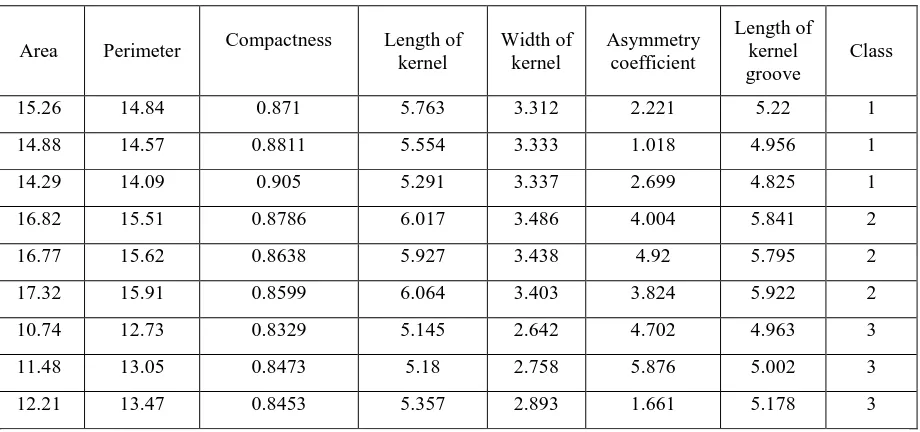
The Wheat Seeds Dataset involves the prediction of species given measurements of seeds from different varieties of wheat. The number of observations for each class is balanced. The examined group comprises of kernels belonging to three different varieties of wheat: Kama, Rosa and Canadian, 70 elements each, randomly selected for the experiment. High quality visualization of the internal kernel structure was detected using a soft X-ray technique. The variable names are as follows:
1. Area. 2. Perimeter. 3. Compactness 4. Length of kernel. 5. Width of kernel. 6. Asymmetry coefficient. 7. Length of kernel groove. 8. Class (1, 2, 3).
The baseline performance of predicting the most prevalent class is a classification accuracy of approximately 28%. The data was collected from UCI website’s database.
Area Perimeter Compactness Length of kernel
Width of kernel
Asymmetry coefficient
Length of kernel groove
Class
15.26 14.84 0.871 5.763 3.312 2.221 5.22 1
14.88 14.57 0.8811 5.554 3.333 1.018 4.956 1
14.29 14.09 0.905 5.291 3.337 2.699 4.825 1
16.82 15.51 0.8786 6.017 3.486 4.004 5.841 2
16.77 15.62 0.8638 5.927 3.438 4.92 5.795 2
17.32 15.91 0.8599 6.064 3.403 3.824 5.922 2
10.74 12.73 0.8329 5.145 2.642 4.702 4.963 3
11.48 13.05 0.8473 5.18 2.758 5.876 5.002 3
[image:2.595.70.530.285.501.2]12.21 13.47 0.8453 5.357 2.893 1.661 5.178 3
Table 1: Sample from WheatSeed Dataset
3.2 Scikit Learn
Scikit-learn is a machine learning library for python. It consists of various inbuilt algorithm like support vector machine, Random forest, Decision trees, K-nearest neighbour and more. We use the train_test_split method to split the dataset into training and testing samples. In order to make predictions we use KNeighborsClassifier, DecisionTreeClassifier, RandomForestClassifier, svm and GaussianNB. Methods like accuracy_score, classification_report, confusion_matrix are used to calculate the performance.
3.3 K-Nearest Neighbor
Available online at www.ijrat.org
41
We use the KNeighborsClassifier in thescikit-learn to implement the KNN. The model requires the number of neighbors as the input
parameter. By simply varying the number of neighbors we can find the type of seed. Using this method an accuracy of 90% is achieved.
Class Precision Recall f1-score Support
1 0.81 0.93 0.87 14
2 1.00 0.86 0.92 7
3 0.95 0.90 0.93 21
Avg /
total 0.91 0.90 0.91 42
Table 2: Seed Classification using KNN
3.4 Support Vector Machine
SVM is a linear classifier, uses hyperplane to separate the classes. If our dataset is linearly separable their exists infinite hyperplane to separate the data. For non-linearly separable data's we map the datapoints into high dimensional feature space where they will be linearly separable.
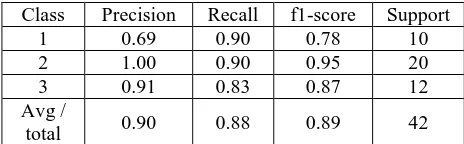
As there exists infinite hyperplanes, the one with the largest margin is chosen. The margin is a positive distance from the decision hyperplane. The support vectors are the training patterns that are close to the hyperplane and are the most difficult patterns to classify. Hyperplane is defined by a set of weights and bias. Maximum margin hyperplane for given training set need to be found. 88%
Class Precision Recall f1-score Support
1 0.69 0.90 0.78 10
2 1.00 0.90 0.95 20
3 0.91 0.83 0.87 12
Avg /
[image:3.595.182.412.129.209.2]total 0.90 0.88 0.89 42
Table 3: Seed Classification using Support Vector Machine
3.5 Decision Tree
The decision tree uses the training data to create a tree and will progressively split the data into smaller subsets in each step. The classification of a particular pattern begins at the root node which checks for a particular property of a pattern. Different branches correspond to different
categories. Based on the result to current node, we follow appropriate link to the descendent node. Each leaf node bears a category label and the test pattern is assigned the category of leaf node reached. Building a decision tree using scikit-learn for the wheat seed dataset is achieved with 92% accuracy.
Class Precision Recall f1-score Support
1 1.00 0.94 0.97 16
2 1.00 1.00 1.00 10
3 0.94 1.00 0.97 16
Avg /
total 0.98 0.98 0.98 42
Table 4: Seed Classification using Decision Tree
3.6 Random Forest
Random Forest is a type of ensemble learning method, where a group of weak models combine to form a powerful model. It is a versatile machine learning method capable of performing both classification and regression. In RF, we grow multiple trees instead of single tree. Samples of training data are chosen at random with
[image:3.595.181.413.354.426.2]Available online at www.ijrat.org
42
.Class Precision Recall f1-score Support
1 1.00 0.75 0.86 16
2 1.00 1.00 1.00 10
3 0.80 1.00 0.89 16
Avg /
[image:4.595.182.411.106.178.2]total 0.92 0.90 0.90 42
Table 5: Seed Classification using Random Forest
3.7 Naive Bayes
Naive Bayes is based on popular Bayes Decision theory which is a primitive algorithm for Machine learning Techniques. Classification decision here is based on probability. The likelihood, prior probabilities and evidence are used to compute the posterior probability. Evidence is a mere scaling factor for ensuring that the
posterior probability sums to one. The category having the highest posterior probability is selected as the resultant category for the particular test data. Naive Bayes classifier assumes that every feature contribute independently to the probability, that is one feature does not affect other. We use GaussianNB classifier of scikit-learn and got an
accuracy of 85%.
Class Precision Recall
f1-score Support
1 0.88 0.58 0.70 12
2 0.86 0.92 0.89 13
3 0.85 1.00 0.92 17
Avg /
[image:4.595.188.409.341.424.2]total 0.86 0.86 0.85 42
Table 6: Seed Classification using Naive Bayes
Classifier Accuracy
KNN 90%
SVM 88%
Decision Tree 92%
Random Forest 93%
Naive Bayes 85%
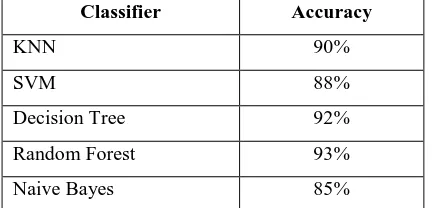
Table 7: Summary of Various Classifiers Accuracy
4. CONCLUSION
This work presents WheatSeed Dataset classification using algorithms such as KNN, Support vector machine, Random forest, Decision Trees and Naives Bayes. Built-in methods for the classifiers are used from the Scikit-learn library. The percentages of accuracy produced by the various algorithms are discussed. The machine learning classifiers can be used for any similar
classification problem where we have the features given.
5. REFERENCES
[image:4.595.191.407.474.578.2]Available online at www.ijrat.org
43
Kawa (eds.), Springer-Verlag, Berlin-Heidelberg,2010, pp. 15-24.
2) Ahmad Reza Parnian, Reza Javidan , " Autonomous Wheat Seed Type Classifier System " International Journal of Computer Applications (0975 – 8887) Volume 96– No.12, June 2014.
3) Raja Haroon Ajaz , Lal Hussain "Seed Classification using Machine Learning Techniques" Journal of Multidisciplinary Engineering Science and Technology.
4) L.Lin and L.Suhua, “Wheat Cultivar Classifications Based on Tabu Search and Fuzzy C-means Clustering Algorithm”, Fourth International Conference on Computational and Information Sciences, pp. 493-496, Aug 2012.
5) M.R. Neuman, E. Shwedy and W. Bushu , “A PC-based colour image processing system for wheat grain grading”, International Conference on Image Processing and its Applications, pp. 242-246, Jul 1989.
6) Ghamari, S. (2012). "Classification of chickpea seeds using supervised and unsupervised artificial neural networks." African Journal of Agricultural Research, 7(21), 3193-3201.
7) Ghamari, S., Borghei, A. M., Rabbani, H., Khazaei, J., & Basati, F. (2010). "Modeling the terminal velocity of agricultural seeds with artificial neural networks." Afr. J. Agric. Res, 5(5), 389-398.