Using Wizard-of-Oz simulations to bootstrap
Reinforcement-Learning-based dialog management systems
Jason D. Williams
Steve Young
Department of Engineering, University of Cambridge, Cambridge, CB2 1PZ, United Kingdom
{jdw30,sjy}@eng.cam.ac.uk
Abstract
This paper describes a method for “boot-strapping” a Reinforcement Learning-based dialog manager using a Wizard-of-Oz trial. The state space and action set are discovered through the annotation, and an initial policy is generated using a Supervised Learning algorithm. The method is tested and shown to create an initial policy which performs significantly better and with less effort than a hand-crafted policy, and can be generated using a small number of dialogs.
1
Introduction and motivation
Recent work has successfully applied Rein-forcement Learning (RL) to learning dialog strat-egy from experience, typically formulating the problem as a Markov Decision Process (MDP). (Walker et al., 1998; Singh et al., 2002; Levin et al., 2000). Despite successes, several open questions remain, especially the issue of how to create (or “bootstrap”) the initial system prior to data becoming available from on-line operation.
This paper proceeds as follows. Section 2 out-lines the core elements of an MDP and issues re-lated to applying an MDP to dialog management. Sections 3 and 4 detail a method for addressing these issues, and the procedure used to test the method, respectively. Sections 5-7 present the re-sults, a discussion, and conclusions, respectively.
2
Background
An MDP is composed of a state space, an action set, and a policy which maps each state to one ac-tion. Introducing a reward function allows us to create or refine the policy using RL. (Sutton and Barto, 1998).
When the MDP framework is applied to dialog management, the state space is usually constructed from vector components including information state, dialog history, recognition confidence, data-base status, etc. In most of the work to date both the state space and action set are hand selected, in part to ensure a limited state space, and to ensure training can proceed using a tractable number of dialogs. However, hand selection becomes im-practical as system size increases, and automatic generation/selection of these elements is currently an open problem, closely related to the problem of exponential state space size.
3
A method for bootstrapping RL-based
systems
Here we propose a method for “bootstrapping” an MDP-based system; specifically, we address the choice of the state representation and action set, and the creation of an initial policy.
3.1
Step 1: Conduct Wizard-of-Oz dialogsThe method commences with “talking wizard” interactions in which either the wizard’s voice is disguised, or a Text-to-speech engine is used. We choose human/wizard rather than human/human dialogs as people behave differently toward (what they perceive to be) machines and other people as discussed in Jönsson and Dahlbick, 1988 and also validated in Moore and Browning, 1992. The dia-log, including wizard’s interaction with back-end data sources is recorded and transcribed.
3.2
Step 2: Exclude out-of-domain turnsThis step takes an approach which is analogous to, but more simplistic than “Dialogue Distilling” (Larsson et al., 2000) which changes, adds and re-moves portions of turns or whole turns. Here rules simply stipulate whether to keep a whole turn.
3.3
Step 3: Enumerate action set and state spaceNext, the in-domain turns are annotated with dia-log acts. Based on these, an action set is enumer-ated, and a set of state parameters and their possible values to form a vector describing the state space is determined, including:
• Information state (e.g., departure-city, arri-val-city) from the user and database.
• The confidence/confirmation status of in-formation state variables.
• Expressed user goal and/or system goal. • Low-level turn information (e.g., yes/no
re-sponses, backchannel, “thank you”, etc.). • Status of database interactions (e.g., when a
form can be submitted or has been returned). A variety of dialog-act tagging taxonomies ex-ist in the literature. Here we avoid a tagging sys-tem that relies on a stack or other recursive structure (for example, a goal or game stack) as it is not immediately clear how to represent a recur-sive structure in a state space.
In practice, many information state components are much less important than their corresponding confirmation status, and can be removed.
Even with this reduction, the state space will be massive – probably too large to ever visit all states. We propose using a parameterized value function -- i.e., a value function that shares parameters across states (including states previously unob-served). One special case of this is state tying, in which a group of states share the same value func-tion; an alternative is to use a Supervised Learning algorithm to estimate a value function.
3.4
Step 4: Form an initial policyFor each turn in the corpus, a vector is created rep-resenting the current dialog state plus the subse-quent wizard action. Taking the action as the class variable, Supervised Learning (SL) is used to build a classifier which functions as the initial policy.
Depending on the type of SL algorithm used, it may be possible to produce a prioritized list of ac-tions rather than a single classification; in this case, this list can form an initial list of actions permitted in a given state.
As noted by Levin et al. (2000), supervised learning is not appropriate for optimizing dialog strategy because of the temporal/environmental nature of dialog. Here we do not assert that the SL-learned policy will be optimal – simply that it can be easily created, that it will be significantly better than random guessing, and better and cheaper to produce than creating a cursory hand-crafted strategy.
3.5
Limitations of the methodThis method has several obvious limitations: • Because a talking, perfect-hearing wizard is
used, no/little account is taken of the recog-nition errors to be expected with automated speech recognition (ASR).
• Excluding too much in Step 2 may exclude actions or state components which would have ultimately produced a superior system.
4
Experimental design
The proposed approach has been tested using the Autoroute corpus of 166 dialogs, in which a talk-ing wizard answered questions about drivtalk-ing direc-tions in the UK (Moore and Browning, 1992).
A small set of in-domain tasks was enumerated (e.g., gathering route details, outputting summary information about a route, disambiguation of place names, etc.), and turns which did not deal with these tasks were labeled OOD and excluded. The latter included gathering the caller’s name and lo-cation (“UserID”), the most common OOD type.
The corpus was annotated using an XML schema to provide the following:
• 15 information components were created (e.g., from, to, time, car-type).
• Each information component was given a status: C (Confirmed), U (Unconfirmed), and NULL (Not known).
dis-cussion (RUD), total number of routes (TR), and all information and status components for each route.
• A component called flow tracked single-turn dialog flow information from the caller (e.g., yes, no, thank-you, silence). • A component called goal tracked the (most
recent) goal expressed by the user (e.g.,
plan-route, how-far). Goal is empty unless explicitly set by the caller, and only one goal is tracked at a time. No attempt is made to indicate if/when a goal has been satisfied.
33 action types were identified, some of which take information slots as parameters (e.g., wh-question, implicit-confirmation) .
The corpus gave no indication of database in-teractions other than what can be inferred from the dialog transcripts. One common wizard action asked the caller to “please wait” when the wizard was waiting for a database response. To account for this, we provided an additional state component which indicated whether the database was working called db-request, which was set to true
whenever the action taken was please-wait
and false otherwise. Other less common database interactions occurred when town names were am-biguous or not found, and no attempt was made to incorporate this information into the state represen-tation.
The state space was constructed using only the status of the information slots (not the values); of the 15, 4 were occasionally expressed (e.g., day of the week) but not used to complete the transaction and were therefore excluded from the state space. Two turns of wizard action history were also in-corporated. This formulation of the state space leads to approximately 1033 distinct states.
For evaluation of the method, a hand-crafted policy of 30 rules mapping states to actions was created by inspecting the dialogs.1
5
Results
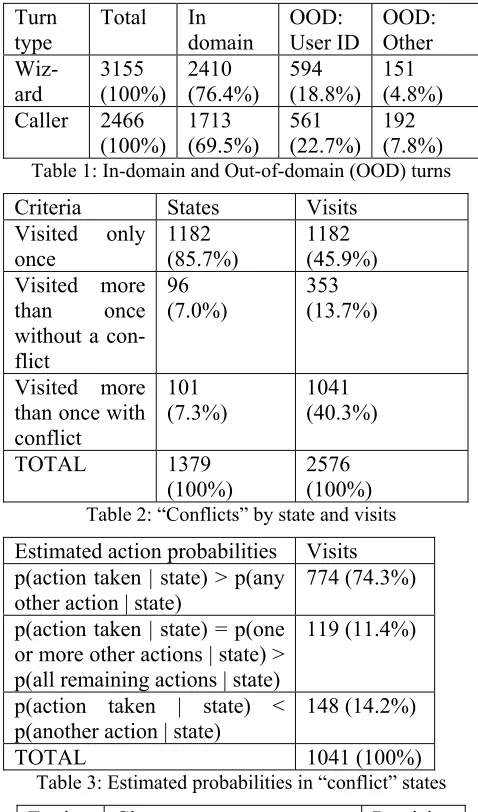
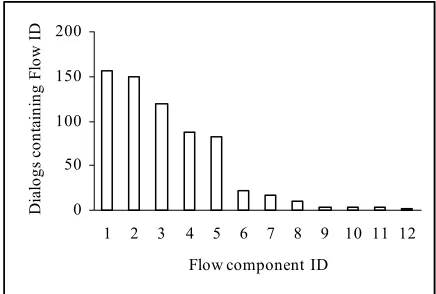
Table 1 shows in-domain vs. out-of-domain wizard and caller turns. Figures 1 through 4 show counts of flow values, goal values, action values, and state
1 It was not clear in what situations some of the actions should
be used, so some (rare) actions were not covered by the rules.
components, respectively. The most common ac-tion type was “please-wait” (14.6% of acac-tions).
Turn type
Total In domain
OOD: User ID
OOD: Other
Wiz-ard
3155 (100%)
2410 (76.4%)
594 (18.8%)
151 (4.8%) Caller 2466
(100%)
1713 (69.5%)
561 (22.7%)
192 (7.8%) Table 1: In-domain and Out-of-domain (OOD) turns Criteria States Visits Visited only
once
1182 (85.7%)
1182 (45.9%) Visited more
than once without a con-flict
96 (7.0%)
353 (13.7%)
Visited more than once with conflict
101
(7.3%) 1041 (40.3%)
TOTAL 1379 (100%)
2576 (100%) Table 2: “Conflicts” by state and visits Estimated action probabilities Visits p(action taken | state) > p(any
other action | state)
774 (74.3%)
p(action taken | state) = p(one or more other actions | state) > p(all remaining actions | state)
119 (11.4%)
p(action taken | state) < p(another action | state)
148 (14.2%)
[image:3.612.306.545.105.511.2]TOTAL 1041 (100%)
Table 3: Estimated probabilities in “conflict” states
Engine Class Precision
Action-type only 72.7% jBNC
Action-type & parameters 66.7% Action-type only 79.1% C4.5
Action-type & parameters 72.9% Action-type only 58.4% Hand-
The interaction data was then submitted to 2 SL pattern classifiers – c4.5 using decision-trees (Quinlan, 1992) and jBNC using Naïve Bayesians (Sacha, 2003). Table 4 shows both algorithms’ 10-fold cross validation classification error rates classifying (1) the action type, and (2) the action type with parameters, as well as the results for the hand-crafted policy.
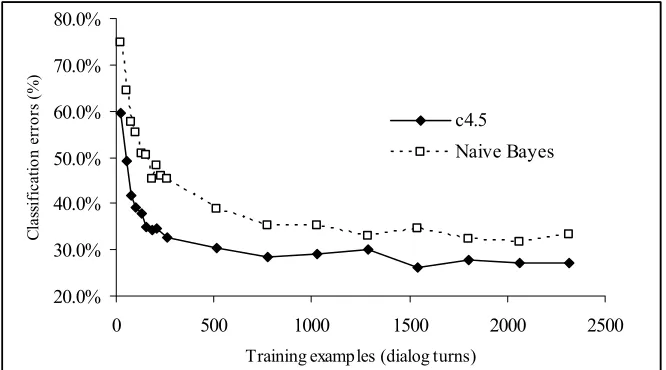
Figure 5 show the 10-fold cross validation clas-sification error rates for varying amounts of train-ing data for the two SL algorithms classifytrain-ing action-type and parameters.
6
Discussion
The majority of the data collected was “usable”: although 26.7% of turns were excluded, 20.5% of these were due to a well-defined task not under study here (user identification), and only 6.1% fell outside of designated tasks. That said, it may be desirable to impose a minimum threshold on how many times a flow, goal, or action must be ob-served before adding it to the state space or action set given the “long tails” of these elements.
0 50 100 150 200
1 2 3 4 5 6 7 8 9 10 11 12
Flow component ID
D
ia
logs
c
ont
ai
ni
ng F
low
I
[image:4.612.88.306.375.522.2]D
Figure 1: Dialogs containing flow components
0 2 4 6 8 10 12 14 16
1 2 3 4 5 6 7 8 9 10 11 12 13 Goal component ID
D
ia
logs
c
ont
ai
ni
ng G
oa
l
Figure 2: Dialogs containing goal components
About half of the turns took place in states which were visited only once. This confirms that massive amounts of data would be needed to ob-serve all valid dialog states, and suggests dialogs do not confine themselves to familiar states.
Within a given state, the wizard’s behavior is stochastic, occasionally deviating from an other-wise static policy. Some of this behavior results from database information not included in the cor-pus and state space; in other cases, the wizard is making apparently random choices.
0 50 100 150 200
1 5 9 13 17 21 25 29 33
Action ID
D
ia
logs
c
ont
ai
ni
ng A
ct
ion
Figure 3: Dialogs containing action types
0 50 100 150 200
1 3 5 7 9 11 13
Component ID
D
ial
og
s co
nt
ai
ni
ng
co
m
pone
[image:4.612.328.547.399.551.2]nt
Figure 4: Dialogs containing information components
Figure 5 implies that a relatively small number of dialogs (several hundred turns, or about 30-40 dialogs) contain the vast majority of information relevant to SL algorithms – less than expected. Correctly predicting the wizard’s action in 72.9% of turns is significantly better than the 58.4% cor-rect prediction rate from the handcrafted policy.
[image:4.612.90.299.555.704.2]errors start to occur as the user takes more initia-tive, entering less well observed states.
Hand examination of a small number of mis-classified actions indicate that about half of the actions were “reasonable” – e.g., including an extra item in a confirmation. Hand examination also confirmed that the wizard’s non-deterministic be-havior and lack of database information resulted in misclassifications.
Other sources of mis-classifications derived primarily from under-account of the user’s goal and other deficiencies in the expressiveness of the state space.
7
Conclusion & future work
This work has proposed a method for determining many of the basic elements of a RL-based spoken dialog system with minimal input from dialog de-signers using a “talking wizard.” The viability of the model has been tested with an existing corpus and shown to perform significantly better than a hand-crafted policy and with less effort to create.
Future research will explore refining this ap-proach vis-à-vis user goal, applying this method to actual RL-based systems and finding suitable methods for parameterized value functions
References
A. Jönsson and N. Dahlbick. 1988. Talking to A Com-puter is Not Like Talking To Your Best Friend.
Proceedings of the Scandinavian Conference on
ceedings of the Scandinavian Conference on Artificial Intelligence '88, pp. 53-68.
Staffan Larsson, Arne Jönsson and Lena Santamarta. 2000. Using the process of distilling dialogues to
understand dialogue systems. ICSLP 2000, Beijing.
Ester Levin, Roberto Pieraccini and Wieland Eckert. 2000. A Stochastic Model of Human-Machine
Inter-action for Learning Dialogue Structures. IEEE
Trans on Speech and Audio Processing 8(1):11-23. R. K. Moore and S. R. Browning. 1992. Results of an
exercise to collect ‘genuine’ spoken enquiries using
Wizard of Oz techniques. Proc. of the Inst. of
Acous-tics.
Ross Quinlan. 1992. C4.5 Release 8. (Software pack-age). http://www.cse.unsw.edu.au/~quinlan/
Jarek P. Sacha. 2003. jBNC version 1.0. (Software package). http://sourceforge.net/projects/jbnc/. Satinder Singh, Diane Litman, Michael Kearns, Marilyn
Walker. 2002. Optimizing Dialogue Management with Reinforcement Learning: Experiments with the
NJFun System. Journal of Artificial Intelligence
Re-search, vol 16, 105-133.
Richard S. Sutton and Andrew G. Barto. 1998.
Rein-forcement Learning: an Introduction. The MIT
Press, Cambridge, Massachusetts, USA.
Marilyn A. Walker, Jeanne C. Fromer, Shrikanth Nara-yanan. 1998. Learning Optimal Dialogue Strate-gies: A Case Study of a Spoken Dialogue Agent for
Email. Proc. 36th Annual Meeting of the ACM and
17th Int’l Conf. on Comp. Linguistics, 1345--1352.
20.0% 30.0% 40.0% 50.0% 60.0% 70.0% 80.0%
0 500 1000 1500 2000 2500
Training examples (dialog turns)
C
la
ss
ifi
ca
tio
n e
rro
rs
(%
)
[image:5.612.147.480.494.679.2]c4.5 Naive Bayes