Pseudo Relevance Feedback Method Based on Taylor Expansion of
Re-trieval Function in NTCIR-3 Patent ReRe-trieval Task
Kazuaki KISHIDA
Faculty of Cultural Information Resources
Surugadai University
698 Azu, Hanno, Saitama 357-8555 JAPAN
[email protected]
Abstract
Pseudo relevance feedback is empirically known as a useful method for enhancing retrieval performance. For example, we can apply the Rocchio method, which is well-known relevance feedback method, to the results of an initial search by as-suming that the top-ranked documents are relevant. In this paper, for searching the NTCIR-3 patent test collection through pseudo feedback, we employ two rele-vance feedback mechanism; (1) the Roc-chio method, and (2) a new method that is based on Taylor formula of linear search functions. The test collection consists of near 700,000 records including full text of Japanese patent materials. Unfortunately, effectiveness of our pseudo feedback methods was not empirically observed at all in the experiment.
1
Introduction
Relevance feedback is widely recognized as an effective method for improving retrieval effective-ness in the context of interactive IR. As often pointed out, it is difficult for users to represent their own information needs into a well-defined set of search terms or statements. The resulting short or poor queries would bring them unsatisfactory results. However, if a few relevant documents hap-pen to be found by the search, we could automati-cally or manually extract some useful terms from the documents, and add them to the initial search expression. It is obviously expected that search effectiveness of the second search using the
ex-tended query will be improved significantly. This is a basic idea of relevance feedback.
Inevitably, for executing automatic relevance feedback, the system has to obtain relevance in-formation, i.e., relevant or irrelevant documents, from the users interactively. However, some re-searchers have tried to employ relevance feedback techniques with no relevance information. The ob-jective is to enhance search performance of re-trieval models such as vector space model, probabilistic model and so on, without interaction on relevance information between system and us-ers. The technique is usually called pseudo rele-vance feedback, in which a standard feedback method (e.g., the Rocchio method) is applied by assuming that top-ranked documents searched by the initial search are relevant.
The purpose of this paper is to report results of retrieval experiments for examining effectiveness of pseudo relevance feedback in the case of search-ing a patent collection. In particular, we attempt to compare search performance of the traditional Rocchio method with that of an alternative method, which is based on Taylor approximation of trieval function proposed by Kishida[1]. This re-port is based on two experiments using the NTCIR-1 test collection and the NTCIR-3 patent test collection, respectively. As to the latter, the results were obtained at the time of NTCIR-3 Workshop held in October 2002 [2].
using the NTCIR-3 patent test collection will be shown.
2
2.1
Relevance Feedback Methods
Rocchio Method
The most typical approach to relevance feedback would be so-called the Rocchio method [3]. A ba-sic idea of the method is to add an average weight of each term within a set of relevant documents to the original query vector, and to subtract an aver-age weight within a set of irrelevant ones from the vector.
We denote a document vector and a query
vec-tor by d and q , where
is a weight of a term within a document and
is a weight of a term within the query (
i i iM
T
w w
=( 1,..., ) =(wq,...,wqM)T 1
wij wqj
M is the total number of distinct terms in the database, and
T indicates transposition).
A modified query vector is obtained by a for-mula,
∑
∑
∈ ∈ − + = D d i i D d i i i i DD : :
~ q d d
q α β γ , (1)
where D is the set of relevant documents, D is the
set of irrelevant documents, and α,β,and γ
are constants.
It has been empirically shown that the perform-ance of the Rocchio method is very good [4], and in recent, many researchers have examined the method directly or indirectly [5-8]. Also, due to its effectiveness and simplicity, the Rocchio method has been widely applied in other research areas, for example, image retrieval [0] or text categorization [10].
2.2
Feedback Method Using Taylor Formula of Retrieval FunctionKishida[1] has proposed an alternative relevance feedback method, which is suitable for the situa-tion that the degree of relevance is given as a nu-merical value, not dichotomous value (i.e., relevance or not), from actual users. In this section, according to Kishida[1], the method will be ex-plained.
In vector space model [10], typical formulas for determining term weights are as follows:
wij =logxij+1 0. (2)
(
)
wqj=(logxqj+1 0. ) log N nj (3)
where
xij: frequency of a term in a document , tj di xqj: frequency of a term tj in the query, nj : the number of documents including tj,
N : the total number of documents in the data-base.
For calculating the degree of similarity between
a document vector d and the query vector q, a
cosine formula is normally used:
i
si j w wij qj w
M
ij j qj M j M =
∑
=∑
= 1 2 11
∑
=w2 (4)
where is a numerical score indicating similarity of the document given a query vector.
si
On the other hand, a well-known formula based on probabilistic model derived from an assumption of two-Poisson distribution [12] is
∑
= + + = M j ij i ij i x l l x s1 (0.5 1.5 )
0 . 3 + + − × × 5 . 0 5 . 0 log j j qj n n N x (5) where
li xi
j M
=
∑
=1 j, and l N i li, N = − =
∑
1 1i.e., the former is a document length, and the latter is an average of the length over documents within the database. The formula (5) is a version of so-called Okapi weighting [12] under a particular set-ting of its parameters.
We can represent concisely the two important retrieval models as a linear function of vector,
s= f( )b =Ab, (6)
where is a s N dimensional vector of document
scores, s , is a linear function of
vec-tor ( ), and
=( , sN) T 1 M → N
..., s R ×1 f 1
f R: × A is a N×M matrix of
which each element is
∑
= ++
= M
j ij ij
ij x x
a 1 2 ) 0 . 1 (log ) 0 . 1
(log , (7)
in the case of vector space model (see (2) and (4)), or ij i ij ij x l l x a + + = ) 5 . 1 5 . 0 ( 0 .
3 (8)
in the case of the Okapi formula (see (5)).
Also, b is a M dimensional vector of which
each element is defined as
bj wqj j wq M
=
∑
= 21 j (9)
where wqj =(logxqj+1 0. ) log
(
N nj)
in the case ofAn approach to estimating b~ is to pay our at-tention to a difference between initial score and secondary score
fX( )b
fX(b~), and to apply so-called
Taylor approximation for obtaining a vector func-tion fX(
~ ) b , i.e.,
b x N n n
j qj
j
j
= − +
+
log .
. 0 5
0 5
(10)
in the case of the Okapi formula (see (5)).
The most important thing is that both of two well-known formulas for estimating scores to rank documents are able to be represented by a simple
form (6). f f
f
K
X X
X T
(~b) ( )b ( )b (~ )
b b b
= +∂ − +
∂ , (13)
For making ranked output, documents have to
be sorted in the decreasing order of scores, s
(i
i
N
=1,..., ). This means that each score is assumed
to indicate the degree of relevance. In other words, the score is expected to be an estimate of ‘true’ degree of relevance . ri
where K is a residual term (see [13]). If we
em-ploy (11) and assume that
rX = ), ~ (b X
f
according to a target condition (12), we can obtain that
~
(
b= +b A−X1 rX −sX), (14)
Let be a vector representing ‘true’
relevance degrees. By using this notation, we can describe operationally a purpose of retrieval sys-tem as “to estimate a vector s that is the closest to vector r when a search request is given.”
r=( ,...,r rN) T
1 (see Appendix for detail calculation). It should be
noted that K=0 due to the linearity of Equation
(11). This means (14) is not an approximation but an exact relation.
The Equation (14) contains an abnormal inverse
matrix A−X1 , which is an M×n matrix and
where is a
A A−X1 X =I
M IM M×M matrix of which
all diagonal elements are 1 and others are 0. Using singular value decomposition (SVD), transpose matrix of AX can be represented as
Of course, r is unknown in real situations, but it is possible to obtain information on a part of r
through the process of relevance feedback. For ex-ample, if a user replies a set of scores indicating
the degrees of relevance for top-ranked n
docu-ments searched by the initial query, the scores al-low us to estimate the part of r corresponding to the n documents
ATX = ΛU VT,
where
U: anM×n orthogonal matrix,
We denote a set of the top-ranked n documents
by X and the part of r corresponding to the set X
by , which is actually n dimensional vector
re-constructed by extracting n elements of the docu-ments from the original vector r. According to (6), we can write that
rX
Λ: an n n× diagonal matrix, and
V: an n n× orthogonal matrix.
By employing the decomposition, we can finally represent (14) such as
~
(
b = +b UΛ−1VT r −s
X X)
3
3.1
(15) (see Appendix for details). This is a final formula of our relevance feedback algorithm. For conven-ience, we call the algorithm “the Taylor formula based method” in this paper.
sX = fX( )b =AXb, (11) where
AX: an n×M matrix,
sX: an n dimensional vector, and
fX:RM×1→Rn×1.
Preliminary Experiment with Relevance
Information
Both of the matrix and the vector are constructed by the same way with rX.
If we establish a distance measure φ between
and s , the objective of relevance feedback can
be formally described as follows: the relevance feedback aims at estimating a modified query vec-tor such that
rX X
Purpose and Test Data
Before applying pseudo relevance feedback based on the Equation (15) to the patent test collec-tion, we try checking retrieval performance of the Taylor formula based method by using other test collection with relevance judgment information. To do this, we employ a well-known Japanese Test Collection NTCIR-1 (NII/NACSIS Test Collection
~
arg min ( , )
b r
b
= φ X sX =arg min ( , ( )) b
r b
φ X fX . (12)
for Information Retrieval - 1)1, which consists of about 330,000 bibliographic records of proceed-ings at conferences held in Japan. It should be noted that, in the preliminary experiment, rele-vance judgment information was used (i.e., not pseudo feedback).
- In the case of runs based on the Taylor
formula, TYLVEC and TYLPRB, the linear function (6) was used for matching operation.
Fifty-three topics of NTCIR-1 were employed for the experiment (from No.31 to No.83). The format of these topics is also very similar with that of TREC, i.e., a record of each topic consists of fields of <title>, <description>, <narrative> and so on. For realistic situation in which feedback meth-ods are used, it would be more reasonable to as-sume that original search statements are short. Thus we employed only <title> and <description> fields for representing each topic. This means that a kind of ‘short query’ was used for the experiment.
3.2
Procedure and type of runsProcedure of the preliminary experiment is as fol-lows:
(a) Initial search: two initial search runs were car-ried out, i.e., the first is based on vector space model from (2) to (4) and the second is probabilistic model (5). We denote the initial search runs as ORGVEC and ORGPRB, re-spectively.
(b) Query modification through relevance
feed-back: initial queries were modified by using relevance judgment information on top-ranked documents of each initial run. In this paper, we set 10 and 20 as the value of n,
n
- In the case of vector space model, we can
attempt two modification methods, i.e.,
the Rocchio method (1) (whereα =8,
β=16andγ =4) and the Taylor formula based method (7), (9) and (15). The run using the Rocchio method is denoted as ROCCHI, and the run by the Taylor for-mula based method as TYLVEC.
- In the case of probabilistic model, only
the Taylor formula based method was applied using (8), (10) and (15). We de-note this run as TYLPRB.
(c) Secondary search: each modified query was
used for second run
- In the case of ROCCHI, modified queries
were matched with document vectors by cosine formula (4).
3.3
Conversion of binary judgment into con-tinuous valueOne of the advantages of the Taylor formula based method (15) is to allow us for making use of con-tinuous values representing the degree to which each document is relevant. Unfortunately, in the experiment, such values were not available be-cause only results of binary judgments are offi-cially provided as relevance information.
Therefore, in order to testify the Taylor formula based method, we need to develop a special algo-rithm for converting each binary judgment to a continuous score. An easy way for converting a value of binary judgment into a continuous degree of relevance is to predict the degree from a docu-ment score in initial search by using a simple regression, ri = Asi +B.
It would be straightforward that the constants A
and B are determined based on maximum and
minimum values of s and for relevant and
ir-relevant documents independently. That is, we use a set of eight values for parameter estimation as follows.
i ri
- s and s : maximum and minimum values of
for ‘relevant’ documents in top-ranked n
documents,
max 1
si
1 min
- s and s : maximum and minimum values of
for ‘irrelevant’ documents in top-ranked n
documents,
max 0
si
min 0
- r and r : maximum and minimum values of
for ‘relevant’ documents in top-ranked n
documents,
max 1
ri
min 1
- r and r : maximum and minimum values
of for ‘irrelevant’ documents in top-ranked documents.
max 0
ri
n
min 0
For the set of relevant documents, we can ob-tain estimates of A and B by solving equations,
r As r As
max max
min min
1 1
1 1
= +
= +
B B
)
It is easy to show that
A=(rmax1 −rmin1 ) / (smax1 −smin1 and
B=(s1max minr1 −rmax min1 s1 ) (s1max−smin1 ).
1
Similarly, for the set of irrelevant documents, we obtain that
A=(rmax0 −rmin0 ) / (smax0 −smin0 ) and
B=(s0max minr0 −rmax min0 s0 ) (smax0 −smin0 )
3.4
3.5
4
4.1
.
Furthermore, we have to determine a priori val-ues of rmax, r , r and r ,
1 min
1 max
0
min 0
(a) For vector space model, it is reasonable
that r is assumed to be 1.0 and r is
0.0 according to cosine function (4). As
for and , it is necessary to set a
margin between them, i.e., amount of difference from minimum value for rele-vant documents to maximum value for irrelevant ones. If we take the margin as 2.0, it is automatically determined that
and r . As a result, target
values for relevant and irrelevant
documents are distributed from 0.6 to 1.0, and from 0.0 and 0.4, respectively.
max 1
rmin 1
. 6 0 =
min 0
rmax 0
ma 0
rmin 1
r
x =4 0.
i
(b) For probabilistic model, we set
arbitrar-ily that r , and
as a trial in the experiment. This means that range of document
scores is enlarged doubly, and each r
for relevant documents is to be
distrib-uted in the range from s to 2 . On
the other hand, maximum value of r for
irrelevant documents is complicated a little, i.e.,
1 max 1
max =2s rmin smax
1 = 1
max 1
smax rmin0 =0 0.
i
1
i
) , min( 0
min 1 min 0
max s s
r =
2 / )] , min( ) ,
[max( 0min
1 min 0
max 1
max s s s
s −
+ ,
since there is no guarantee that s is
al-ways greater than s , and s is always
smaller than s
max 1
max 0
min 0
min 1
Segmentation of Japanese text
The test collection NTCIR-1 basically consists of documents written in Japanese (as well as the NTCIR-3 patent test collection). We need to seg-ment each text into a set of terms automatically for indexing the Japanese documents and queries, of which text has no explicit boundary between terms unlike English.
In the experiment, each term was identified by matching with entries in a machine-readable dic-tionary. We used a dictionary of the ChaSen[14], which is a well-known morphological analyzer for
Japanese text, and selected each longest entry matched with a portion of text as a index term. Also, an “unknown” string was decomposed ac-cording to change of kinds of character, Hiragana, Katakana, Kanji and so on (Hiragana strings were not taken as index terms).
Also, for identifying compound words as con-tent-bearing terms, we employed a heuristic rule that an adjacent pair of index terms identified by dictionary matching is automatically combined into a compound word.
Results
The NTCIR-1 collection includes 332,918 records, and average document length, i.e., average of the total number of terms appearing in each document, was 118.0. Table 1 shows values of mean average precision of each run.
As shown in Table 1, the Taylor formula based method outperforms the Rocchio method slightly, but clearly there is no statistically significant dif-ference between ROCCHI and TYLVEC (.376 and .378 at top 10, and .434 and .459 at top 20).
The rate of improvement by feedback in vector space model is greater than that in probabilistic model. The run showing best performance in Table 1 is the Taylor formula based method in the vector space model (TYLVEC) using top-ranked 20 documents, which increases mean average preci-sion at 101.6% from ORGVEC (from .228 to .459).
Experiment on Pseudo Relevance
Feed-back using NTCIR-3 Patent Test
Col-lection
Procedure
In the previous section, the Taylor formula based method has proven to work well at the experiment using the NTCIR-1 test collection with relevance information. Next, we attempt to examine the ef-fectiveness of pseudo relevance feedback method using the Taylor formula based feedback in the case of searching the NTCIR-3 patent test collec-tion (with no relevance informacollec-tion).
Table 1. Mean average precision (using the NTCIR-1 collection with relevance information)
model Vector space Probabilis-tic initial search
(baseline)
ORGVEC .228
ORGPRB .268 feedback ROCCHI TYLVEC TYLPRB top 10
docu-ments
.376 (+65.2%)
.378 (+66.3%)
.396 (+48.0%) top 20
docu-ments
.434 (+90.4%)
.459 (+101.6%)
.450 (+68.1%)
[image:6.612.320.528.136.376.2]In the experiment, only six runs were executed as shown in Table 2 (at the time of the NTCIR-3 Workshop, only the six runs were submitted). We discern two kinds of run according to query (topic) fields used for run; (I) <ARTICLE> and <SUP-PLEMENT> fields and (II) <DESCRIPTION> and <NARRATIVE> fields. The <ARTICLE> field includes a news article, i.e., in the NTCIR-3 Patent Task, the participants were asked to search the document collection for a news article related to the information needs of users. The number of top-ics is 32.
Table 2. Runs in the experiment using patent test collection
Topic fields Initial run feedback
<A><S>* <D><N>** OKAPI TAYLOR Run1 Run2 VECTOR ROCCHIO Run3 Run4
OKAPI none Run5 Run6
*<A>:<ARTICLE>, <S>:<SUPPLEMENT> **<D>:<DESCRIPTION>,<N>:<NARRATIVE
4.2
ResultsIn the indexing phase, 697,262 records were proc-essed and average length of documents is 393.32.
Table 3 shows search performance of each run. Unfortunately, pseudo relevance feedback using
relevance feedback techniques has no effect on the performance. It seems that there are no statistically significant differences between any pairs of runs. However,
0 0.1 0.2 0.3 0.4 0.5 0.6 0.7 0.8 0.9
0 0.1 0.2 0.3 0.4 0.5 0.6 0.7
OKAPI-none (baseline)
T
AYL
OR and ROCCHIO
ROCCHIO
TAYLOR
Figure 1. Topic-by-topic Analysis (in the case of using <DESCRIPTION> and <NARRATIVE>)
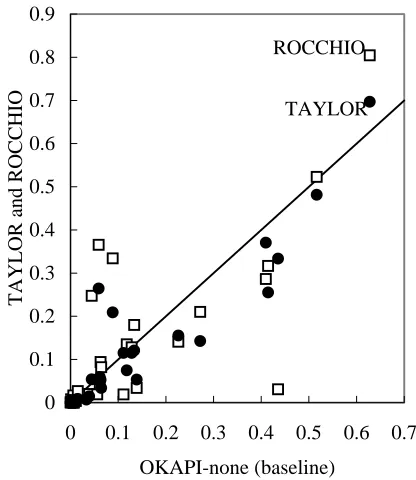
Figure 1 is a plot of values of average precision by topic. We can compare the Taylor formula based method (OKAPI-TAYLOR) and the Roc-chio method (VECTOR-ROCCHIO) with normal Okapi formula (OKAPI-none), in level of each topic. It should be noted that, in Figure 1, square indicates ROCCHIO and circle TAYLOR.
[image:6.612.75.522.609.699.2]Figure 1 shows that for most of topics, normal Okapi formula outperforms the Rocchio method and Taylor formula based method although the Rocchio method and Taylor formula based method are superior in some topics.
Table 3. Average Precision and R-precision (Using NTCIR-3 Patent Test Collection)
Topic Fields Initial run feedback Average precision R-precision
OKAPI TAYLOR 0.1152 0.1421
VECTOR ROCCHIO 0.1281 0.1565
<ARTICLE> <SUPPLEMENT>
OKAPI none 0.1282 0.1565
OKAPI TAYLOR 0.1370 0.1820
VECTOR ROCCHIO 0.1581 0.1896
<DESCRIPTION> <NARRATIVE>
5
Discussion
Although the Rocchio method and Taylor formula based method have shown good performance in the preliminary experiment using the NTCIR-1 test collection with relevance judgment with relevance judgment information, unfortunately the pseudo relevance feedback was not able to show im-provement of search effectiveness. A main reason for the failure may be that term selection process was omitted. In standard pseudo relevance feed-back methods, better terms are usually selected from the set of top-ranked documents according to the term weights. We can expect that if the term selection process is applied, the performance is improved in the case of the Rocchio method. How-ever, how can we select better terms in the case of the Taylor formula based method?
The behavior of the Taylor formula based method in the process of term re-weighting is a little complicated. For example, we assume that there are only 6 distinct terms (from term1 to term6) in a database, and that
b=( . , . , . , . , . , . )0 5 0 5 0 5 0 5 0 5 0 5T,
which means that all term weights in the initial query vector are equal. The matrix of weights of terms in top-ranked 4 documents (from doc1 to doc4) is supposed to be that
=
1 1 1 2 0 0
1 1 2 1 0 0
1 1 0 0 2 1
1 1 0 0 1 2
X
A . (16)
A row of the matrix represents each document vec-tor, e.g.,d1T =(2,1,0,0,1,1)
Furthermore, it is assumed that a set of numeri-cal values indicating degree of relevance for each document was given by a user, and difference from initial document scores was calculates such that
rX −sX =( . , . ,0 1 0 2 0 1 0 2− . ,− . )T. (17)
Under these assumptions, relevance feedback by the Taylor formula based method is as follows. First, by the SVD algorithm, the transpose matrix of the AX can be decomposed as UΛVT, and after
simple calculation, we can finally obtain that
UΛ−1VT rX−sX = 0 0 01 01 0 0 0 0 0 0− T
( ) ( . , . , . , . , . , . ) . (18)
This example represents well characteristics of the Taylor formula based method. From (17) we understand that scores of doc1 and doc2 have to be increased and those of doc3 and doc4 decreased.
Intuitively, it seems that weights of both term1 and term2 should be augmented because they are only appearing in doc1 and doc2, neither doc3 nor doc4 at all. However, a solution by (18) indicates that the weight of term1 is unchanged (only to that of term2, 0.1 is added). This is a result so as to keep the condition (17), which means that scores of doc1 and doc2 have to be increased by 0.1 and 0.2, respectively, for reaching at an ideal situation. Ac-tually, we can calculate from (16) such that
2 0 0 1 01 01× . + × . =
1 0 0 2 0 1 0
. for doc1 and that
2
× . + × . = . for doc2. The results indicate
that the condition (17) is completely satisfied. As shown in the simple calculation, the Taylor
for-mula based method takes the difference rX −sX
into consideration for re-weighting of search terms. On the other hand, in the case of the Rocchio method, re-weighting of search terms is done by
looking into only A regardless of . We
sup-pose that doc1 and doc2 were judged as relevant documents, and doc3 and doc4 irrelevant. In the condition, the Rocchio method adds simply (1+2)/2=1.5 to weights of both of term1 and term2, not considering document scores in an initial search.
X sX
As shown in above example, in the case of the Taylor formula based method, term re-weighting is
dependent on the values of r . Therefore, we
can not use simply the vector (18) for selecting better terms. We have to consider carefully how to use the Equation (18) for term selection. Further investigation will be needed for executing term selection for pseudo relevance feedback in the case of the Taylor formula based method.
s X − X
6
Concluding Remarks
[10] M. F. Moens and J. Dumortier. 2000. Text categorization: the assignment of subject de-scriptors to magazine articles. Information Processing and Management, 36: 841-861. from top-ranked documents in the case of applying
the new feedback method.
References
[1] K. Kishida. 2001. Feedback method for docu-ment retrieval using numerical values on rele-vance given by users. IPSJ SIG Notes Fundamental Infology, 61: 189-196. (in Japa-nese)
[11] C. Buckley, J. Allan, and G. Salton. 1994. Automatic routing and ad-hoc retrieval using SMART: TREC2. in D.K. Harman ed., The Second Text Retrieval Conference (TREC2). National Institute of Standards and Technology, Gaithersburg MD, 45-55.
[2] K. Kishida. 2003. Experiment on Pseudo Rele-vance Feedback Method Using Taylor Formula at NTCIR-3 Patent Retrieval Task. Proceed-ings of the Third NTCIR Workshop on Re-search in Information Retrieval, Automatic Text Summarization and Question Answering, NII, Tokyo. http://research.nii.ac.jp/ntcir/
[12] S. E. Robertson, et al. 1995. Okapi at TERC-3. in D.K. Harman ed. Overview of the Third Text Retrieval Conference (TREC-3). National Institute of Standards and Technology, Gaithersburg MD, 109-126.
[13] D. A. Harville. 1997. Matrix Algebra from a Statistician’s Perspective. Springer, New York. [3] J. J. Rocchio, Jr. 1971. Relevance feedback in
information retrieval. in G. Salton ed., The SMART Retrieval System: Experiments in Automatic Document Processing, Prentice-Hall, Englewood Cliffs, NJ, 313-323.
[14] Yuji Matsumoto, Akira Kitauchi, Tatsuo Yamashita, Yoshitaka Hirano, Hiroshi Matsuda, Kazuma Takaoka and Masayuki Asahara. 2000. Morphological Analysis System ChaSen version 2.2.1 Manual. http://chasen.aist-nara.ac.jp/ [4] G. Salton and C. Buckley. 1990. Improving
retrieval performance by relevance feedback. Journal of the American Society for
Informa-tion Science, 41: 288-297.
Appendix. Detail of Calculation
[5] P. Sarinivasan. 1996. Query expansion and MEDLINE. Information Processing and Management, 32: 431-4
If we assume a linear function (11),
∂ ∂
∂ ∂
fX T
X
T X
( )b ( ) b
A b
b A
= = ,
43.
which is a well-known result in the field of linear algebra [13]. Therefore (13) becomes that
[6] J. H. Lee. 1998. Combining the evidence of different relevance feedback methods for in-formation retrieval. Inin-formation Processing and Management, 34: 681-691.
fX(b~)= fX( )b +AX(~b−b)
(it should be noted that K=0).
By following our assumption that rX is equal to
fX(~b) and noting thatfX( )b =s , we obtain that
[7] R. Mandala, T. Tokunaga and H. Tanaka. 2000. Query expansion using heterogeneous thesauri. Information Processing and Management, 36: 361-378.
X
X
AX(b~−b)=rX−s . (A.1)
The (14) is easily derived from (A.1). [8] M. Iwayama. 2000. Relevance feedback with a
small number of relevance judgments: incre-mental relevance feedback vs. Document clus-tering. in Proceedings of the 23rd Annual International ACM SIGIR Conference on search and Development in Information Re-trieval, ACM Press, 10-16.
By using singular value decomposition we can obtain that ATX = ΛU VT. The transposition is that
( ) (
)
AX = ATX T = U VΛ T T =V UΛ T, (A.2)
because U and V are orthogonal matrixes and Λis a diagonal matrix. Substituting (A.2) into (A.1), we finally obtain that
V UΛ T b b r s X X (~− )= − .
~
[9] G. Ciocca. and R. Schettini.1999. A relevance feedback mechanism for content-based image retrieval. Information Processing and Man-agement, 35: 605-632.
) (
1
X X T r s V U b
b= + Λ −