Parser Accuracy in Quality Estimation of Machine Translation:
A Tree Kernel Approach
Rasoul Samad Zadeh Kaljahi†‡, Jennifer Foster†, Raphael Rubino†‡, Johann Roturier‡andFred Hollowood‡
†NCLT, School of Computing, Dublin City University, Ireland
{rkaljahi, jfoster, rrubino}@computing.dcu.ie ‡Symantec Research Labs, Dublin, Ireland
{johann roturier, fhollowood}@symantec.com
Abstract
We report on experiments designed to in-vestigate the role of syntactic features in the task of quality estimation for machine translation, focusing on the effect of parser accuracy. Tree kernels are used to predict the segment-level BLEU score of English-French translations. In order to examine the effect of the accuracy of the parse tree on the accuracy of the quality estimation system, we experiment with various pars-ing systems which differ substantially with respect to their Parseval f-scores. We find that it makes very little difference which system we choose to use in the quality esti-mation task – this effect is particularly ap-parent for source-side English parse trees.
1 Introduction
Much research has been carried out on quality es-timation (QE) for machine translation (MT) (Blatz et al., 2003; Ueffing et al., 2003; Specia et al., 2009; Callison-Burch et al., 2012), with the aim of solving the problem of how to accurately assess the quality of a translation without access to a ref-erence translation. Approaches differ with respect to the nature of the quality scores being estimated (binary, 5-point or real-valued scales; human evuations versus automatic metrics), the learning al-gorithms used or the feature set chosen to repre-sent the translation pairs. The aspect of the task that we focus on is the feature set, and, in particu-lar, the role of syntactic features. We ask the fol-lowing:To what extent is QE for MT influenced by the quality of the syntactic information provided to it? Does the accuracy of the parsing model used to provide the syntactic features influence the accu-racy of the QE system? We compare two pairs of parsing systems which differ with respect to their Parseval f-scores by around 17 absolute points in
a QE system for English-French MT and find that it makes little difference which system we use.
2 Related Work
Features extracted from parser output have been used before in QE for MT. Quirk (2004) uses a feature which indicates whether a full parse for a sentence can be found. Gamon et al. (2005) use part-of-speech (POS) tag trigrams, CFG produc-tion rules and features derived from a dependency analysis of the MT output. Specia and Gim´enez (2010) use POS tag language model probabilities of the MT output 3-grams. Hardmeier et al. (2012) combine syntactic tree kernels with surface fea-tures to produce a system which was ranked sec-ond in the WMT 2012 shared task on QE for MT (Callison-Burch et al., 2012). Rubino et al. (2012) explore source syntactic features extracted from the output of a hand-crafted broad-coverage gram-mar/parser and a statistical constituency parser. Avramidis (2012) builds models for estimating post-editing effort using syntactic features such as parse probabilities and label frequency. Like Hardmeier et al. (2012), we use tree kernels to represent the output of a parser, but unlike all the previous works, we explicitly examine the role of parser accuracy.
There have been some attempts to investigate the role of parser accuracy in downstream ap-plications. Johannson and Nugues (2007) intro-duce an English constituency-to-dependency con-verter and find that syntactic dependency trees produced using this converter help semantic role labelling more than dependency trees produced using an older converter despite the fact that trees produced using the older converter have higher attachment scores than trees produced using the new converter. Moll´a and Hutchinson (2003) find significant differences between two dependency parsers in a task-based evaluation involving an an-swer extraction system but bigger differences
tween the two parsers when evaluated intrinsically. Quirk and Corston-Oliver (2006) demonstrate that a syntax-enhanced MT system is sensitive to a de-crease in parser accuracy obtained by training the parser on smaller training sets. Zhang et al. (2010) experiment with a different syntax-enhanced MT system and do not observe the same behaviour. Both Miyao et al. (2008) and Goto et al. (2011) evaluate a suite of state-of-the-art English statis-tical parsers on the tasks of protein-pair interac-tion identificainterac-tion and patent translainterac-tion respec-tively, and find only small (albeit sometimes sta-tistically significant) differences between the pars-ing systems. Our study is closest to that of Quirk and Corston-Oliver (2006) since we are taking one parser and using it to train various models with dif-ferent training set sizes.
3 Parsing
For parsing we use the LORG parser (Attia et al., 2010)1 which learns a latent-variable probabilis-tic context-free grammar (PCFG-LA) from a bank in an iterative process of splitting the tree-bank non-terminals, estimating probabilities for the new rules using Expectation Maximization and merging the less useful splits (Petrov et al., 2006), and which parses using the max-rule parsing algo-rithm (Petrov and Klein, 2007).
In order to investigate the effect of parsing accu-racy, we train two parsing models – one “higher-accuracy” model and one “lower-“higher-accuracy” model – for each language. We use training set size to control the accuracy. For English, the higher-accuracy model is trained on Sections 2-21 of the Wall Street Journal (WSJ) section of the Penn Treebank (PTB) (Marcus et al., 1994) (approx 40k sentences). For French, the higher-accuracy model is trained on the training section of the French Treebank (FTB) (Abeill´e et al., 2003) (ap-prox 10k sentences). For the lower-accuracy mod-els, we first select four random subsets of vary-ing sizes from the larger trainvary-ing sets for each lan-guage2and measure the performance of the result-ing models on the standard parsresult-ing test sets3using ParsevalF1 – see Table 1. All parsing models are
trained with 5 split/merge cycles.
The worst-performing models for each lan-guage are those trained on 100 training sentences.
1https://github.com/CNGLdlab/
LORG-Release
2
Each smaller subset is contained in all the larger subsets. 3WSJ Section 23 and the FTB test set.
However, these models fail to parse about 10 and 2 percent of our English and French data respectively. Since the failed sentences are not necessarily parallel in the source and transla-tion sides, this could affect the downstream QE performance. Therefore, we opt to employ as our “lower-accuracy” models the second smallest training set sizes, which are 1K sentences for En-glish and 500 for French. For both languages, the difference in F1 between the lower-accuracy and
higher-accuracy models is about 17 points. In or-der to measure how different the parses produced by these models are on our QE data, we compute theirF1relative to each other. TheF1 for the
En-glish model pair is 71.50 and for French 63.19.
4 Quality Estimation
To minimise the effect of domain variation, we use a QE dataset for the domain on which our parsers have been trained (newswire). Since there are very few human QE evaluations available for English-French in this domain, we instead attempt to predict automatic metric scores. We experi-ment with BLEU, METEOR and TER, but due to space restrictions and the similar behaviour ob-served, we report only BLEU score predictions. We randomly select 4500 parallel segments from the News development data sets released for the WMT13 translation task.4 To remain independent of any one MT system, we translate the dataset with the following three systems, randomly choos-ing 1500 distinct segments from each:
• ACCEPT5: a phrase-based Moses system trained on training sets of WMT12 releases of Europarl and News Commentary plus data from Translators Without Borders (TWB)
• SYSTRAN: a proprietary rule-based system
• Bing6: an online translation system
The translations are scored at the segment level using segment-level BLEU. The data set is ran-domly split into 3000 training, 500 development, and 1000 test segments. Model parameters are tuned using the development set.
We encode syntactic information using tree ker-nels (Collins and Duffy, 2002; Moschitti, 2006) because they allow us to use all subtrees of the
4http://www.statmt.org/wmt13 5
http://www.accept.unige.ch/Products/ D_4_1_Baseline_MT_systems.pdf
English French
Training size 100 1K 10K 20K 40K 100 500 2.5K 5K 10K
[image:3.595.107.489.58.94.2]F1 51.06 72.53 87.69 88.47 89.55 52.85 66.51 78.55 81.85 83.40
Table 1: ParserF1s for various training set sizes: the sizes in bold are selected for the experiments.
parsed sentences as features in an efficient way, thus obviating the need for manual feature en-gineering. We use SVMLight-TK7 (Moschitti, 2006), a support vector machine (SVM) imple-mentation of tree kernels. The trees we use are constituency trees obtained by the parsing mod-els described in Section 3, and their conversion to dependency trees using the Stanford converter for English (de Marneffe and Manning, 2008) and
Const2Dep (Candito et al., 2010) for French. The labels must be removed from the arcs in the dependency trees before they can be used in SVMLight-TK – the nodes in the resulting tree representation are word forms and dependency re-lations, omitting part-of-speech tags.8 Based on preliminary experiments on our development set, we use subset tree kernels.
We build a baseline system with features provided for the WMT 2012 QE shared task (Callison-Burch et al., 2012): we use Europarl v7 and News Commentary v8 (Koehn, 2005) to ex-tract n-gram frequency, language model and word alignment features. This is considered a strong baseline as the system that used just these features was ranked higher than many of the other systems.
5 Experiments and Results
We build a QE system using constituency and dependency parse tree kernels of the source and translation sides, exploring first the higher-accuracy parse trees. Table 2 shows the perfor-mance of this system (CD-STH) compared to the
system trained on the baseline features (B-WMT). We also compare to another baseline (B-Mean) which always predicts the mean of the segment-level BLEU scores of the training instances. We evaluate performance using Root Mean Square Er-ror (RMSE) and Pearson correlation coefficient (r). To test the statistical significance of the per-formance differences (atp <0.05), we use paired bootstrap resampling (Koehn, 2004).
CD-STH achieves statistically significantly
bet-7
http://disi.unitn.it/moschitti/ Tree-Kernel.htm
8A word is a child of its dependency relation to its head and this dependency relation is the child of the head word.
ter RMSE and Pearson r than both baselines, which shows the usefulness of tree kernels in QE. We combine CD-STH and B-WMT9 – this
system B+CD-STH performs statistically
signifi-cantly better than both systems individually, sug-gesting that tree kernels can also be useful in syn-ergy with non-syntactic features.
RMSE Pearson r
B-Mean 0.1626 0
B-WMT 0.1601 0.1766 CD-STH 0.1581 0.2437 B+CD-STH 0.1570 0.2696
Table 2: Baselines, higher-accuracy parse tree ker-nels and combinations
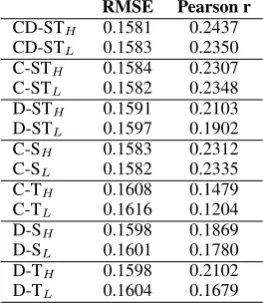
We now investigate the impact of the intrinsic quality of the parse trees on the QE system. We build a similar model to CD-STH but with the
lower-accuracy model described in Section 3. This system is namedCD-STL in Table 3. CD-STH is
also presented in this table for ease of compari-son. Surprisingly,CD-STLperforms only slightly
lower thanCD-STH and the difference is not
sta-tistically significant.
To better understand the behaviour of these systems, we break them down into their com-ponents: source constituency trees, target con-stituency trees, source dependency trees and target dependency trees. We first split based on the parse type and then based on the translation side.
C-STH and C-STL in Table 3 are the systems
with the constituency trees of both source and translation sides with higher- and lower-accuracy parsing models respectively. Although the differ-ence is not statistically significant, the system with lower-accuracy parse trees achieves better scores than the system with higher-accuracy trees. D-STH and D-STL are built with the dependency
trees of the higher- and lower-accuracy parsing models respectively. Unlike the constituency sys-tems, the system with higher-accuracy parses per-forms better. However, the difference is not sta-tistically significant. These results suggest that the intrinsic accuracy of neither the constituency
[image:3.595.345.486.246.300.2]nor the dependency parses is crucial to the perfor-mance of the QE systems. We now further split these systems based on the translation sides.
C-SH and C-SL use the higher- and
lower-accuracy constituency trees of only the source side. Similar to when constituency trees of both sides were used (C-STH and C-STL), the
sys-tem built on the lower-accuracy parses performs better although the difference is not statistically significant. The system using higher-accuracy constituency trees of the translation side (C-TH)
achieves better scores than the one using the lower-accuracy ones (C-TL), but, again, this
dif-ference is not statistically significant.
D-SH andD-SL are the systems using the
de-pendency trees of only the source side. Again, there is a small, statistically insignificant gap between the scores of these systems. On the other hand, there is a bigger performance gap be-tween the systems built on the higher- and lower-accuracy dependency trees of the translation side:
D-TH andD-TL. Although this is the only large
difference observed among all settings, it is sur-prisingly not statistically significant.10
RMSE Pearson r
CD-STH 0.1581 0.2437 CD-STL 0.1583 0.2350 C-STH 0.1584 0.2307 C-STL 0.1582 0.2348 D-STH 0.1591 0.2103 D-STL 0.1597 0.1902 C-SH 0.1583 0.2312 C-SL 0.1582 0.2335 C-TH 0.1608 0.1479 C-TL 0.1616 0.1204 D-SH 0.1598 0.1869 D-SL 0.1601 0.1780 D-TH 0.1598 0.2102 D-TL 0.1604 0.1679
Table 3: QE systems with higher- and lower-accuracy trees (C: constituency, D: dependency, ST: Source and Translation, H: Higher-accuracy parsing model,L: Lower-accuracy parsing model)
One may argue that the way the parser accu-racy is varied here could impact the results – a parser with similar F1 but different output may
lead to a different conclusion. It is possible to test this by using the parsing model from a lower split/merge (SM) cycle. For example, the models from the first SM cycle with a 10K training set size
10The high scores of
D-TH seem to be happening by chance, because on the development set, on which the pa-rameters are tuned, the scores are much lower.
for English and a 2.5K training set size for French score 73.04 and 70.22F1points on their respective
test sets. While these scores are close to those of the lower-accuracy models used above, their out-puts are different: the parses with the two lower-accuracy English models achieve only 66.46 F1
against each other and with the two French ones 66.51F1. We use the parse trees of these
alterna-tive lower-accuracy parsing models to build a new QE system. The RMSE is 0.1585 and Pearson r is 0.2316. These scores are not statistically signifi-cantly different compared toCD-STH,
strengthen-ing our conclusion that intrinsic parse accuracy is not crucial for QE.
Another question is to what extent we require a linguistically realistic syntactic structure which retains some form of regularity no matter how ac-curate. To answer this question, we build ran-dom tree structures for source and translation seg-ments. The random tree for a segment is generated by recursively splitting the sentence into random phrases and randomly assigning them a syntactic label.11 We parse the source and translation seg-ments using this method and build a QE system with the output trees. The RMSE and Pearson r are 0.1631 and -0.0588 respectively. This shows that tree kernels still require the regularity encoded in the lower- and higher-accuracy trees.
6 Conclusion
We explored the impact of parse quality in predict-ing automatic MT evaluation scores, comparpredict-ing the use of constituency and dependency tree ker-nels built from the output of parsing systems with a large accuracy gap when measured using Parse-valF1. This large difference inF1 did not have a
knock-on effect on the QE task. Our next step is to carry out the experiments in the opposite direc-tion (French-English) so that we better understand why the translation side trees were not as useful as the source side trees. Using other intrinsic parser evaluation metrics might also prove useful.
Acknowledgements
This research has been supported by the Irish Research Council Enterprise Partnership Scheme (EPSPG/2011/102 and EPSPD/2011/135) and the computing infrastructure of the Centre for Next Generation Localisation at Dublin City University.
11The English random model achieves anF
[image:4.595.115.247.401.553.2]References
Anne Abeill´e, Lionel Cl´ement, and Franc¸ois Toussenel. 2003. Building a Treebank for French. In Anne Abeille, editor,Treebanks: Building and Using Syn-tactically Annotated Corpora. Springer.
Mohammed Attia, Jennifer Foster, Deirdre Hogan, Joseph Le Roux, Lamia Tounsi, and Josef van Gen-abith. 2010. Handling Unknown Words in Statisti-cal Latent-Variable Parsing Models for Arabic, En-glish and French. InProceedings of SPMRL.
Eleftherios Avramidis. 2012. Quality Estimation for Machine Translation Output Using Linguistic Anal-ysis and Decoding Features. In Proceedings of WMT.
John Blatz, Erin Fitzgerald, George Foster, Simona Gandrabur, Cyril Goutte, Alex Kulesza, Alberto Sanchis, and Nicola Ueffing. 2003. Confidence Estimation for Machine Translation. InJHU/CLSP Summer Workshop Final Report.
Chris Callison-Burch, Philipp Koehn, Christof Monz, Matt Post, Radu Soricut, and Lucia Specia. 2012. Findings of the 2012 Workshop on Statistical Ma-chine Translation. InProceedings of WMT.
Marie Candito, Benoˆıt Crabb´e, and Pascal Denis. 2010. Statistical French Dependency Parsing: Tree-bank Conversion and First Results. InProceedings of LREC’2010.
Michael Collins and Nigel Duffy. 2002. New Ranking Algorithms for Parsing and Tagging: Kernels over Discrete Structures, and the Voted Perceptron. In
Proceedings of ACL.
Marie-Catherine de Marneffe and Christopher D. Man-ning. 2008. The Stanford Typed Dependencies Representation. In Proceedings of the COLING Workshop on Cross-Framework and Cross-Domain Parser Evaluation.
Moll´a Diego and Ben Hutchinson. 2003. Intrinsic ver-sus Extrinsic Evaluation of Parsing Systems. In Pro-ceedings of EACL.
Michael Gamon, Anthony Aue, and Martine Smets. 2005. Sentence-Level MT Evaluation without Ref-erence Translations: Beyond Language Modeling. InProceedings of EAMT.
Isao Goto, Masao Utiyama, Takashi Onishi, and Ei-ichiro Sumita. 2011. A Comparison Study of Parsers for Patent Machine Translation. In Proceed-ings of MT Summit.
Christian Hardmeier, Joakim Nivre, and J¨org Tiede-mann. 2012. Tree Kernels for Machine Translation Quality Estimation. InProceedings of WMT.
Richard Johansson and Pierre Nugues. 2007. Ex-tended Constituent-to-dependency Conversion for English. InProceedings of NODALIDA.
Philipp Koehn. 2004. Statistical Significance Tests for Machine Translation Evaluation. InProceedings of EMNLP.
Philipp Koehn. 2005. Europarl: A Parallel Corpus for Statistical Machine Translation. In Proceedings of MT Summit.
Mitchell Marcus, Grace Kim, Mary Ann
Marcinkiewicz, Robert MacIntyre, Ann Bies, Mark Ferguson, Karen Katz, and Britta Schas-berger. 1994. The Penn Treebank: Annotating Predicate Argument Structure. In Proceedings of ARPA Speech and Natural Language Workshop.
Yusuke Miyao, Rune Saetre, Kenji Sagae, Takuya Mat-suzaki, and Jun’ichi Tsujii. 2008. Task-oriented Evaluation of Syntactic Parsers and their Represen-tations. InProceedings of ACL.
Alessandro Moschitti. 2006. Making Tree Kernels Practical for Natural Language Learning. In Pro-ceedings of EACL).
Slav Petrov and Dan Klein. 2007. Improved Inference for Unlexicalized Parsing. InProceedings of HLT-NAACL.
Slav Petrov, Leon Barrett, Romain Thibaux, and Dan Klein. 2006. Learning Accurate, Compact and Interpretable Tree Annotation. In Proceedings of COLING-ACL.
Chris Quirk and Simon Corston-Oliver. 2006. The Impact of Parse Quality on Syntactically-informed Statistical Machine Translation. In Proceedings of EMNLP.
Chris Quirk. 2004. Training a Sentence-Level Ma-chine Translation Confidence Measure. In Proceed-ings of LREC.
Raphael Rubino, Jennifer Foster, Joachim Wagner, Johann Roturier, Rasoul Kaljahi, and Fred. Hol-lowood. 2012. DCU-Symantec Submission for the WMT 2012 Quality Estimation Task. In Proceed-ings of WMT.
Lucia Specia and Jes´us Gim´enez. 2010. Combining Confidence Estimation and Reference-based Metrics for Segment Level MT Evaluation. InProceedings of AMTA.
Lucia Specia, Nicola Cancedda, Marc Dymetman, Marco Turchi, and Nello Cristianini. 2009. Estimat-ing the Sentence-level Quality of Machine Transla-tion Systems. InProceedings of EAMT.
Nicola Ueffing, Klaus Macherey, and Hermann Ney. 2003. Confidence Measures for Statistical Machine Translation. InProceedings of MT Summit.