Selective Combination of Pivot and Direct
Statistical Machine Translation Models
Ahmed El Kholy, Nizar Habash
Center for Computational Learning Systems, Columbia University {akholy,habash}@ccls.columbia.edu
Gregor Leusch, Evgeny Matusov Science Applications International Corporation {gregor.leusch,evgeny.matusov}@saic.com
Hassan Sawaf eBay Inc. [email protected]
Abstract
In this paper, we propose a selective com-bination approach of pivot and direct sta-tistical machine translation (SMT) models to improve translation quality. We work with Persian-Arabic SMT as a case study. We show positive results (from 0.4 to 3.1 BLEU on different direct training corpus sizes) in addition to a large reduction of pivot translation model size.
1 Introduction
One of the main challenges in statistical ma-chine translation (SMT) is the scarcity of paral-lel data for many language pairs especially when the source and target languages are morpholog-ically rich. Morphological richness comes with many challenges and the severity of these chal-lenges increases when the richness and morpho-logical complexity are expressed differently in the source and target languages.
A common SMT solution to the lack of par-allel data is to pivot the translation through a third language (called pivot or bridge language) for which there exist abundant parallel corpora with the source and target languages. The liter-ature covers many pivoting techniques. One of the best performing techniques, phrase pivoting (Utiyama and Isahara, 2007), builds an induced new phrase table between the source and target. One of the problems of this technique is that the size of the newly created pivot phrase table is very large (Utiyama and Isahara, 2007).
Given a parallel corpus between the source and target language, combining a direct model based on this parallel corpus with a pivot model could lead to better coverage and overall translation quality. However, the combination approach needs
to be optimized in order to maximize the informa-tion gain.
In this paper, we propose a selective combina-tion approach of pivot and direct SMT models. The main idea is to select the relevant portions of the pivot model that do not interfere with the more trusted direct model. We show positive results for Persian-Arabic SMT (from 0.4 to 3.1 BLEU on different direct training corpus sizes). As a pos-itive side effect, we achieve a large reduction of pivot translation model size.
This paper is organized as follows. Section 2 briefly discusses some related work. Section 3 presents linguistic challenges and differences be-tween Arabic and Persian. In Section 4, we cuss our pivoting strategies. Then Section 5 dis-cusses our approach for selective combination. In Section 6, we present our experimental results.
2 Related Work
2.1 Pivoting
Many researchers have investigated the use of piv-oting (or bridging) approaches to solve the data scarcity issue (Utiyama and Isahara, 2007; Wu and Wang, 2009; Khalilov et al., 2008; Bertoldi et al., 2008; Habash and Hu, 2009). The core idea is to introduce a pivot language, for which there exist large source-pivot and pivot-target bilingual cor-pora. Pivoting has been explored for closely re-lated languages (Hajiˇc et al., 2000) as well as un-related languages (Koehn et al., 2009; Habash and Hu, 2009). Many different pivoting strategies have been presented in the literature. The following two are perhaps the most commonly used.1
1
Another notable strategy is to create a synthetic source-target corpus by translating the pivot side of source-pivot cor-pus to the target language using an existing pivot-target model (Bertoldi et al., 2008). A new source-target model is built from the new corpus.
The first strategy is sentence pivoting in which we first translate the source sentence to the pivot language, and then translate the pivot language sentence to the target language (Khalilov et al., 2008).
The second strategy is phrase pivoting (Utiyama and Isahara, 2007; Cohn and Lapata, 2007; Wu and Wang, 2009). In phrase pivoting, a new source-target phrase table (translation model) is induced from source-pivot and pivot-target phrase tables. We compute the lexical weights and trans-lation probabilities from the two phrase tables.
In this paper, we utilize the phrase pivoting strategy as our baseline, which is shown to be bet-ter in performance compared to sentence pivoting (El Kholy et al., 2013).
2.2 Domain Adaptation
We propose a selective combination approach of pivot and direct SMT models to improve the trans-lation quality. Our approach is similar to domain adaptation techniques where training data from many diverse sources are combined to build a sin-gle translation model which is used to translate sentences in a new domain.
Domain adaptation has been explored in the field through different methods. Some methods involve information retrieval (IR) techniques to retrieve sentence pairs related to the target do-main from a training corpus (Eck et al., 2004; Hildebrand et al., 2005). Other domain adaptation methods are based on distinguishing between gen-eral and domain specific examples (Daum´e III and Marcu, 2006). In a similar approach, Koehn and Schroeder (2007) use multiple alternative decod-ing paths to combine different translation models and the weights are set with minimum error rate training (Och and Ney, 2003).
In contrast to domain adaptation, we generate a new source-target translation model by phrase pivoting technique from two models. We then use domain adaptation approach to select relevant portions of the pivot phrase table and combine them with a direct translation model to improve the overall translation quality.
2.3 Morphologically Rich Languages
Since both Persian and Arabic are morphologi-cally rich, we should mention that there has been a lot of work on translation to and from morpho-logically rich languages (Yeniterzi and Oflazer, 2010; Elming and Habash, 2009; El Kholy and Habash, 2010a; Habash and Sadat, 2006; Kathol and Zheng, 2008; Shilon et al., 2010). Most of
these efforts are focused on syntactic and morpho-logical processing.
There have been a growing number of pub-lications that consider translation into Ara-bic. Sarikaya and Deng (2007) use joint morphological-lexical language models to re-rank the output of English-dialectal Arabic MT. Other efforts report results on the value of morphologi-cal tokenization of Arabic during training and de-scribe different techniques for detokenizing Ara-bic output (Badr et al., 2008; El Kholy and Habash, 2010b).
On the other hand, work on Persian SMT is limited to few studies. For example, Kathol and Zheng (2008) use unsupervised morpheme seg-mentation for Persian. They show that hierarchical phrase-based models can improve Persian-English translation. There are also other attempts to im-prove Persian-English SMT by working on syntac-tic reordering (Gupta et al., 2012) and rule-based post editing (Mohaghegh et al., 2012). There is also some work done on showing the effect of dif-ferent orthographic and morphological processing for Persian on Persian-English translation (Rasooli et al., 2013a).
To our knowledge, there hasn’t been a lot of work on Persian and Arabic as a language pair. One example is an effort based on improving the reordering models for Persian-Arabic SMT (Ma-tusov and K¨opr¨u, 2010). Another recent effort im-proved the quality of Persian-Arabic by pivoting through English and adding additional features to reflect the quality of projected alignments between the source and target phrases in the pivot phrase table (El Kholy et al., 2013).
3 Arabic and Persian Linguistic Issues
In this section we present our motivation and choice for preprocessing Arabic, Persian and En-glish data. Both Arabic and Persian are morpho-logically complex languages but they belong to two different language families. They both ex-press richness and linguistic complexities in dif-ferent ways (El Kholy et al., 2013).
aspect, mood, voice, state and case.2 This mor-phological richness leads to thousands of inflected forms per lemma and a high degree of ambiguity: about 12 analyses per word, typically correspond-ing to two lemmas on average (Habash, 2010). We follow El Kholy and Habash (2010a) and use the PATB tokenization scheme (Maamouri et al., 2004) in our experiments which separates all cli-tics except for the determiner cliticAl+. We use MADA v3.1 (Habash and Rambow, 2005; Habash et al., 2009) to tokenize the Arabic text. We only evaluate on detokenized and orthographically correct (enriched) output following the work of El Kholy and Habash (2010b).
Persian on the other hand has a relatively sim-ple nominal system. There is no case system and words do not inflect with gender except for a few animate Arabic loanwords. Unlike Arabic, Persian shows only two values for number, just singular and plural (no dual), which are usually marked by either the suffix
Aë
++hAand sometimesà@
++An, or one of the Arabic plural markers. Persian also possess a closed set of few broken plurals loaned from Arabic. Moreover, unlike Arabic which ex-presses definiteness, Persian exex-presses indefinite-ness with an enclitic articleø
+ +y ‘a/an’ which doesn’t have separate forms for singular and plu-ral. When a noun is modified by one or more adjective, the indefinite article is attached to the last adjective. Persian adjectives are similar to English in expressing comparative and superla-tive constructions just by adding suffixesQK
++tar ‘+er’ andáKQK
++taryn‘+est’ respectively. Verbal morphology is very complex in Persian. Each verb has a past and present root and many verbs have attached prefix that is regarded part of the root. A verb in Persian inflects for 14 different tense, mood, aspect, person, number and voice combina-tion values (Rasooli et al., 2013b).We follow El Kholy et al. (2013) and tok-enize Persian text using Perstem (Jadidinejad et al., 2010) which is a deterministic rule based ap-proach for segmentation of Persian.
English, our pivot language, is quite different from both Arabic and Persian. English is poor in morphology and barely inflects for number and tense, and for person in a limited context. English preprocessing simply includes down-casing, sepa-rating punctuation and splitting off “’s”.
2
We use the Habash-Soudi-Buckwalter Arabic transliter-ation (Habash et al., 2007) with extensions for Persian as sug-gested by Habash (2010).
4 Pivoting Strategies
In this section, we review the two pivoting strate-gies that are our baselines.
4.1 Sentence Pivoting
In sentence pivoting, English is used as an inter-face between two separate phrase-based MT sys-tems; Persian-English direct system and English-Arabic direct system. Given a Persian sentence, we first translate the Persian sentence from Per-sian to English, and then from English to Arabic.
4.2 Phrase Pivoting
In phrase pivoting (sometimes called triangulation or phrase table multiplication), we train a Persian-to-Arabic and an English-Arabic translation mod-els, such as those used in the sentence pivoting technique. Based on these two models, we induce a new Persian-Arabic translation model.
Since we build our models are based Moses phrase-based SMT (Koehn et al., 2007), we pro-vide the basic set of phrase translation probabil-ity distributions.3 We follow Utiyama and Isa-hara (2007) in computing the probability distri-butions. The following are the set of equations used to compute the lexical probabilities (φ) and the phrase translation probabilities (pw)
φ(f|a) =P
e
φ(f|e)φ(e|a)
φ(a|f) =P
e
φ(a|e)φ(e|f)
pw(f|a) =P e
pw(f|e)pw(e|a)
pw(a|f) =P e
pw(a|e)pw(e|f)
where f is the Persian source phrase. e is the English pivot phrase that is common in both Persian-English translation model and English-Arabic translation model. a is the Arabic target phrase.
We also build a Persian-Arabic reordering table using the same technique but we compute the re-ordering probabilities in a similar manner to Hen-riquez et al. (2010).
As discussed earlier, the induced Persian-Arabic phrase and reordering tables are very large. Table 1 shows the amount of parallel corpora used to train the Persian-English and the English-Arabic and the equivalent phrase table sizes com-pared to the induced Persian-Arabic phrase table.4
3
Four different phrase translation scores are computed in Moses’ phrase tables: two lexical weighting scores and two phrase translation probabilities.
4
Training Corpora Phrase Table Translation Model Size # Phrase Pairs Size
Persian-English ≈4M words 96,04,103 1.1GB English-Arabic ≈60M words 111,702,225 14GB Pivot Persian-Arabic N/A 39,199,269,195 ≈2.5TB
Table 1: Translation Models Phrase Table comparison in terms of number of line and sizes.
We follow the work of El Kholy et al. (2013) and filter the phrase pairs used in pivoting based on log-linear scores. We present some baseline re-sults to show the effect of filtering on the transla-tion quality in Sectransla-tion 6.2.
5 Approach
In this section, we discuss our selective combina-tion approach. We explore how to effectively com-bine both a pivot and a direct model built from a given parallel corpora to achieve better coverage and overall translation quality. We maximize the information gain by selecting the relevant portions of the pivot model that do not interfere with the more trusted direct model.
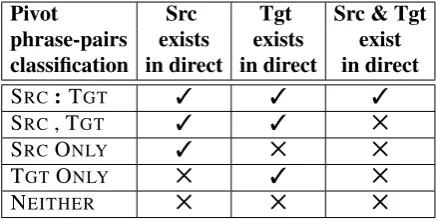
To achieve this goal, we investigate the idea of classifying the pivot phrase pairs into five differ-ent classes based on the existence of source and/or target phrases in the direct model. The first class contains the phrase pairs where the source and tar-get phrases are in the direct system totar-gether. The second class is the same as the first class except that the source and target phrases exist but not to-gether as a phrase pair in the direct system. The third, forth and fifth classes are for the existence of source phrase only, target phrase only and neither in the direct system. Table 2 shows the different classifications of the portions extracted from the pivot phrase table with their labels which are used later in our results tables.
We use one of Moses phrase table combination techniques (Koehn and Schroeder, 2007) to com-bine the direct model with the different pivot por-tions (explained in more details in section 6.1).
6 Experiments
In this section, we present our results for the se-lective combination approach between direct and pivoting models.
6.1 Experimental Setup
For the direct Persian-Arabic SMT model, we use an inhouse parallel corpus of about 165k sentences and 4 million words.
Pivot Src Tgt Src & Tgt phrase-pairs exists exists exist classification in direct in direct in direct
SRC: TGT 3 3 3
SRC, TGT 3 3 5
SRC ONLY 3 5 5
TGTONLY 5 3 5
NEITHER 5 5 5
Table 2: Phrase pairs classification of the portions extracted from the pivot phrase table.
In our pivoting experiments, we build two SMT models. One model to translate from Persian to English and another model to translate from En-glish to Arabic. The EnEn-glish-Arabic parallel cor-pus is about 2.8M sentences (≈60M words) avail-able from LDC5and GALE6constrained data. We use an in-house Persian-English parallel corpus of about 170K sentences and 4M words.
Word alignment is done using GIZA++ (Och and Ney, 2003). For Arabic language model-ing, we use 200M words from the Arabic Giga-word Corpus (Graff, 2007) together with the Ara-bic side of our training data. We use 5-grams for all language models (LMs) implemented using the SRILM toolkit (Stolcke, 2002). For English language modeling, we use the English Gigaword Corpus with 5-gram LM using the KenLM toolkit (Heafield, 2011).
All experiments are conducted using Moses phrase-based SMT system (Koehn et al., 2007). We use MERT (Och, 2003) for decoding weights optimization. For Persian-English translation model, weights are optimized using a set 1000 sen-tences randomly sampled from the parallel cor-pus while the English-Arabic translation model weights are optimized using a set of 500 sen-tences from the 2004 NIST MT evaluation test set
5LDC Catalog IDs: LDC2005E83, LDC2006E24, LDC2006E34, LDC2006E85, LDC2006E92, LDC2006G05, LDC2007E06, LDC2007E101, LDC2007E103, LDC2007E46, LDC2007E86, LDC2008E40, LDC2008E56, LDC2008G05, LDC2009E16, LDC2009G01.
6
(MT04).
We use a maximum phrase length of size 8 across all models. We report results on an in-house Persian-Arabic evaluation set of 536 sen-tences with three references. We evaluate using BLEU-4 (Papineni et al., 2002).
For the combination experiments, Moses allows the use of multiple translation tables (Koehn and Schroeder, 2007). Different combination tech-niques are available. We use the “Either” com-bination technique where the translation options are collected from one table, and additional op-tions are collected from the other tables. If the same translation option (identical source and tar-get phrases) is found in multiple tables, sepa-rate translation options are created for each occur-rence, but with different scores.
6.2 Baseline Evaluation
We compare the performance of sentence pivot-ing against phrase pivotpivot-ing with different filterpivot-ing thresholds. The results are presented in Table 3. In general, the phrase pivoting outperforms the sen-tence pivoting even when we use a small filtering threshold of size 100. Moreover, the higher the threshold the better the performance but with a di-minishing gain.
Pivot Scheme BLEU
Sentence Pivoting 19.2 Phrase Pivot F100 19.4 Phrase Pivot F500 20.1 Phrase Pivot F1K 20.5
Table 3: Sentence pivoting versus phrase pivoting with different filtering thresholds (100/500/1000).
We use the best performing setup across the rest of the experiments which is filtering with a thresh-old of 1K.
6.3 System Combinations
In this section, we investigate the selective bination approach. We start by the basic com-bination approach and then explore the gain/loss achieved from dividing the pivot phrase table to five different classes as discussed in Section 5.
6.3.1 Baseline Combination
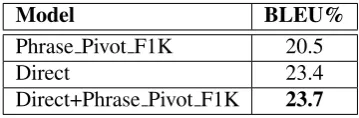
Table 4 shows the results of the basic combination in comparison to the best pivot translation model and the best direct model. The results shows that combining both models leads to a gain in perfor-mance. The question is how to improve the quality
by doing a smart selection of only relevant portion of the pivot phrase table which is discussed next.
Model BLEU%
Phrase Pivot F1K 20.5
Direct 23.4
Direct+Phrase Pivot F1K 23.7
Table 4: Baseline combination experiments be-tween best pivot baseline and best direct model.
6.3.2 Selective Combination
In this section, we explore the idea of dividing the pivot phrase pairs into five different classes based on the existence of source and/or target phrases in the direct system as discussed in Section 5. We discuss our results and show the trade off between the quality of translation and the size of the differ-ent classes extracted from the pivot phrase table.
Table 5 shows the results of the selective com-bination experiments on a learning curve of 100% (4M words), 25% (1M words) and 6.25% (250K words) of the parallel Persian-Arabic corpus.
Model Parallel data set size 4M 1M 250K
Direct 23.4 21.0 16.8 Phrase Pivot F1K 20.5
Base Combination 23.7 * 22.1* 21.7* SRC: TGT 22.9 21.2 17.3 *
SRC, TGT 23.0 21.3 18.5 *
SRCONLY 23.5 20.1 17.5 * TGTONLY 23.8* 21.4 * 18.3 *
NEITHER 23.4 21.6 * 19.9 *
Table 5: Selective Combination experiments re-sults on a learning curve. The first row shows the results of the direct system. The second row shows the result of the best pivot system. The third row shows the results of the baseline combination ex-periments with the whole pivot phrase table. Then the next set of rows show the results of the selec-tive combination experiments based on the differ-ent classifications. All scores are in BLEU. (*) marks a statistically significant result against the direct baseline.
The base combination between the direct trans-lation models and the pivot transtrans-lation model leads to a boost in the translation quality across the learning curve. As expected, the smaller the par-allel corpus used in training the more gain we get from the combination.
The results also show that some of pivot the classes provides more information gain than oth-ers. In fact some of the classes hurt the over-all quality; for example, (SRC : TGT) and (SRC
, TGT) both hurt the quality of translation when
combined with direct model trained on 100% of the parallel data (4M words).
An interesting observation from the results is that by building a translation system with only 6.25% of the parallel data (≈250K words) com-bined with the pivot translation model, we can achieve a better performance (21.7 BLEU) than a model trained on four times the amount of data (Size: 1M words; Score: 21.0 BLEU).
It is also shown across the learning curve that the best gains are achieved when the source phrase in the pivot phrase table doesn’t exist in the direct model. This is expected due to the fact that by adding unknown source phrases, we decrease the overall OOVs.
Model Parallel data set size
4M 1M 250K
SRC: TGT 0.2% 0.1% 0.1% SRC, TGT 35.2% 29.0% 16.0% SRCONLY 59.9% 63.3% 64.1% TGT ONLY 2.3% 3.4% 6.1%
NEITHER 2.3% 4.3% 13.7%
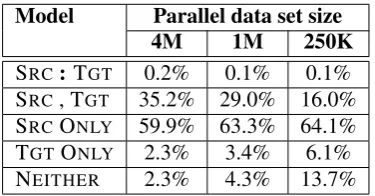
Table 6: Percentage of phrase pairs extracted from the original pivot phrase table for each pivot class across the learning curve.
Pruning the pivot phrase table is an additional benefit from the selective combination approach. Table 6 shows that percentage of phrase pairs ex-tracted from of the original pivot phrase table for each pivot class across the learning curve. The bulk of the phrase pairs are extracted in the classes where the source phrases exist in the direct model which add the least and sometimes hurt the overall combination performance.
For the large parallel data (4M words), selec-tive combination with (TGT ONLY) class gives a slightly better result in BLEU while hugely reduc-ing the size of the pivot phrase table used (2.3% of the original pivot phrase table). For smaller paral-lel data, the advantage is reduced but here comes
the trade off between the quality of the translation and the size of the model.
7 Conclusion and Future Work
We propose a selective combination approach be-tween pivot and direct models to improve the translation quality. We showed that the selective combination can lead to a large reduction of the pivot model without affecting the performance if not improving it. In the future, we plan to investi-gate classifying the pivot model based on morpho-logical patterns extracted from the direct model in-stead of just the exact surface form.
Acknowledgments
The work presented in this paper was possible thanks to a generous research grant from Science Applications International Corporation (SAIC). The last author (Sawaf) contributed to the effort while he was at SAIC. We would like to thank M. Sadegh Rasooli, Jon Dehdari and Nadi Tomeh for helpful discussions and insights into Persian.
References
Ibrahim Badr, Rabih Zbib, and James Glass. 2008. Segmentation for English-to-Arabic Statistical Ma-chine Translation. InProc. of ACL’08.
Nicola Bertoldi, Madalina Barbaiani, Marcello Fed-erico, and Roldano Cattoni. 2008. Phrase-based statistical machine translation with pivot languages. Proc. of IWSLT’08.
Trevor Cohn and Mirella Lapata. 2007. Machine translation by triangulation: Making effective use of multi-parallel corpora. InProc. of ACL’07.
Hal Daum´e III and Daniel Marcu. 2006. Domain adaptation for statistical classifiers. J. Artif. Intell. Res.(JAIR).
Matthias Eck, Stephan Vogel, and Alex Waibel. 2004. Language model adaptation for statistical machine translation based on information retrieval. InProc. LREC’04.
Ahmed El Kholy and Nizar Habash. 2010a. Ortho-graphic and Morphological Processing for English-Arabic Statistical Machine Translation. InProc. of TALN’10.
Ahmed El Kholy and Nizar Habash. 2010c. Tech-niques for Arabic Morphological Detokenization and Orthographic Denormalization. In Proc. of LREC’10.
Jakob Elming and Nizar Habash. 2009. Syntactic Re-ordering for English-Arabic Phrase-Based Machine Translation. InProc. of EACL’09.
David Graff. 2007. Arabic Gigaword 3, LDC Cat-alog No.: LDC2003T40. Linguistic Data Consor-tium, University of Pennsylvania.
Rohit Gupta, Raj Nath Patel, and Ritnesh Shah. 2012. Learning improved reordering models for Urdu, Farsi and Italian using SMT. InProc. of WMT’12. Nizar Habash and Jun Hu. 2009. Improving
Arabic-Chinese Statistical Machine Translation using En-glish as Pivot Language. InProc. of EACL’09. Nizar Habash and Owen Rambow. 2005. Arabic
Tok-enization, Part-of-Speech Tagging and Morphologi-cal Disambiguation in One Fell Swoop. InProc. of ACL’05.
Nizar Habash and Fatiha Sadat. 2006. Arabic Pre-processing Schemes for Statistical Machine Trans-lation. InProc. of NAACL’06.
Nizar Habash, Abdelhadi Soudi, and Tim Buckwalter. 2007. On Arabic Transliteration. In A. van den Bosch and A. Soudi, editors, Arabic Computa-tional Morphology: Knowledge-based and Empiri-cal Methods. Springer.
Nizar Habash, Owen Rambow, and Ryan Roth. 2009. MADA+TOKAN: A toolkit for Arabic tokenization, diacritization, morphological disambiguation, POS tagging, stemming and lemmatization. In Khalid Choukri and Bente Maegaard, editors,Proc. of the Second International Conference on Arabic Lan-guage Resources and Tools.
Nizar Habash. 2010. Introduction to Arabic Natural Language Processing. Morgan & Claypool. Jan Hajiˇc, Jan Hric, and Vladislav Kubon. 2000.
Ma-chine Translation of Very Close Languages. InProc. of ANLP’00.
Kenneth Heafield. 2011. KenLM: Faster and smaller language model queries. InProc. of WMT’11. Carlos Henriquez, Rafael E. Banchs, and Jos´e B.
Mari˜no. 2010. Learning reordering models for sta-tistical machine translation with a pivot language. Almut Silja Hildebrand, Matthias Eck, Stephan Vogel,
and Alex Waibel. 2005. Adaptation of the transla-tion model for statistical machine translatransla-tion based on information retrieval. InProc. of EAMT’05. Amir Hossein Jadidinejad, Fariborz Mahmoudi, and
Jon Dehdari. 2010. Evaluation of PerStem: a sim-ple and efficient stemming algorithm for Persian. In Multilingual Information Access Evaluation I. Text Retrieval Experiments.
Andreas Kathol and Jing Zheng. 2008. Strategies for building a Farsi-English smt system from limited re-sources. InProc. of INTERSPEECH’08.
M. Khalilov, Marta R. Costa-juss, Jos A. R. Fonollosa, Rafael E. Banchs, B. Chen, M. Zhang, A. Aw, H. Li, Jos B. Mario, Adolfo Hernndez, and Carlos A. Hen-rquez Q. 2008. The talp & i2r smt systems for iwslt 2008. InProc. of IWSLT’08.
Philipp Koehn and Josh Schroeder. 2007. Experiments in domain adaptation for statistical machine transla-tion. InProc. of WMT’07.
Philipp Koehn, Hieu Hoang, Alexandra Birch, Christo-pher Callison-Burch, Marcello Federico, Nicola Bertoldi, Brooke Cowan, Wade Shen, Christine Moran, Richard Zens, Christopher Dyer, Ondrej Bo-jar, Alexandra Constantin, and Evan Herbst. 2007. Moses: open source toolkit for statistical machine translation. InProc. of ACL’07.
Philipp Koehn, Alexandra Birch, and Ralf Steinberger. 2009. 462 machine translation systems for europe. Proc. of MT Summit XII.
Mohamed Maamouri, Ann Bies, Tim Buckwalter, and Wigdan Mekki. 2004. The Penn Arabic Treebank: Building a Large-Scale Annotated Arabic Corpus. InNEMLAR’04.
Evgeny Matusov and Selc¸uk K¨opr¨u. 2010. Improv-ing reorderImprov-ing in statistical machine translation from farsi. InProc. of AMTA’10.
Mahsa Mohaghegh, Abdolhossein Sarrafzadeh, and Mehdi Mohammadi. 2012. GRAFIX: Automated rule-based post editing system to improve English-Persian SMT output. InProc. of COLING’12. Franz Josef Och and Hermann Ney. 2003. A
System-atic Comparison of Various Statistical Alignment Models.Computational Linguistics.
Franz Josef Och. 2003. Minimum error rate training in statistical machine translation. InProc. of ACL’03. Kishore Papineni, Salim Roukos, Todd Ward, and
Wei-Jing Zhu. 2002. BLEU: a Method for Automatic Evaluation of Machine Translation. In Proc. of ACL’02.
Mohammad Sadegh Rasooli, Ahmed El Kholy, and Nizar Habash. 2013a. Orthographical and morpho-logical processing for persian to english statistical machine translation,. InProc. of IJCNLP’13. Mohammad Sadegh Rasooli, Manouchehr Kouhestani,
and Amirsaeid Moloodi. 2013b. Development of a Persian syntactic dependency treebank. InProc. of NAACL’13.
Ruhi Sarikaya and Yonggang Deng. 2007. Joint morphological-lexical language modeling for ma-chine translation. InProc. of NAACL’07.
Reshef Shilon, Nizar Habash, Alon Lavie, and Shuly Wintner. 2010. Machine Translation between He-brew and Arabic: Needs, Challenges and Prelimi-nary Solutions. InProc. of AMTA’10.
Andreas Stolcke. 2002. SRILM - an Extensible Lan-guage Modeling Toolkit. InProc. of ICSLP’02. Masao Utiyama and Hitoshi Isahara. 2007. A
com-parison of pivot methods for phrase-based statistical machine translation. InProc. of NAACL’07. Hua Wu and Haifeng Wang. 2009. Revisiting pivot
language approach for machine translation. InProc. of ACL’09.