Measuring the Effect of Discourse Relations on Blog Summarization
Shamima Mithun Concordia University Montreal, Quebec, Canada [email protected]
Leila Kosseim Concordia University Montreal, Quebec, Canada [email protected]
Abstract
The work presented in this paper attempts to evaluate and quantify the use of dis-course relations in the context of blog summarization and compare their use to more traditional and factual texts. Specif-ically, we measured the usefulness of 6 discourse relations - namely compari-son, contingency,illustration,attribution, topic-opinion, andattributive for the task of text summarization from blogs. We have evaluated the effect of each relation using the TAC 2008 opinion summariza-tion dataset and compared them with the results with the DUC 2007 dataset. The re-sults show that in both textual genres, con-tingency,comparison, andillustration re-lations provide a significant improvement on summarization content; while attribu-tion, topic-opinion, and attributive rela-tions do not provide a consistent and sig-nificant improvement. These results indi-cate that, at least for summarization, dis-course relations are just as useful for in-formal and affective texts as for more tra-ditional news articles.
1 Introduction
It is widely accepted that in a coherent text, units should not be understood in isolation but in rela-tion with each other through discourse relarela-tions that may or may not be explicitly marked. A text is not a linear combination of textual units but a hi-erarchial organized group of units placed together based on informational and intentional relations to one another. According to (Taboada, 2006), “Dis-course relations - relations that hold together dif-ferent parts (i.e. proposition, sentence, or para-graph) of the discourse - are partly responsible for the perceived coherence of a text”. For example,
in the sentence “If you want the full Vista expe-rience, you’ll want a heavy system and graphics hardware, and lots of memory”, the first and sec-ond clauses do not bear much meaning indepen-dently; but become more meaningful when we alize that they are related through the discourse re-lationcondition.
Discourse relations have been found useful in many NLP applications such as natural language generation (e.g. (McKeown, 1985)) and news summarization (e.g. (Blair-Goldensohn and McK-eown, 2006; Bosma, 2004)) to improve coherence and better simulate human writing. However, most of these work have been developed for formal, well-written and factual documents. Text avail-able in the social media are typically written in a more casual style, are opinionated and speculative (Andreevskaia et al., 2007). Because of this, tech-niques developed for formal texts, such as news articles, often do not behave as well when deal-ing with informal documents. In particular, news articles are more uniform in style and structure; whereas blogs often do not exhibit a stereotypi-cal discourse structure. As a result, for blogs, it is usually more difficult to identify and rank rel-evant units for summarization compared to news articles.
Several work have shown that discourse rela-tions can improve the results of summarization in the case of factual texts or news articles (e.g. (Ot-terbacher et al., 2002)). However, to our knowl-edge no work has evaluated the usefulness of dis-course relations for the summarization of informal and opinionated texts, as those found in the social media. In this paper, we consider the most fre-quent discourse relations found in blogs: namely comparison,contingency,illustration,attribution, topic-opinion, andattributiveand evaluate the ef-fect of each relation on informal text summariza-tion using the Text Analysis Conference (TAC)
2008 opinion summarization dataset1. We then compare these results to those found with the news articles of the Document Understanding Confer-ence (DUC) 2007 Main task dataset2. The re-sults show that in both types of texts, discourse relations seem to be as useful: contingency, com-parison, andillustrationrelations provide a statis-tically significant improvement on the summary content; while theattribution, topic-opinion, and attributive relations do not provide a consistent and significant improvement.
2 Related Work on Discourse Relations for Summarization
The use of discourse relations for text sum-marization is not new. Most notably, (Marcu, 1997) used discourse relations for single docu-ment summarization and proposed a discourse re-lation identification parsing algorithm. In some work (e.g. (Bosma, 2004; Blair-Goldensohn and McKeown, 2006)), discourse relations have been exploited successfully for multi-document sum-marization. In particular, (Otterbacher et al., 2002) experimentally showed that discourse relations can improve the coherence of multi-document summaries. (Bosma, 2004) showed how dis-course relations can be used effectively to incorpo-rate additional contextual information for a given question in a query-based summarization. (Blair-Goldensohn and McKeown, 2006) used discourse relations for content selection and organization of automatic summaries and achieved an improve-ment in both cases. Discourse relations were also used successfully by (Zahri and Fukumoto, 2011) for news summarization.
However, the work described above have been developed for formal, well-written and factual documents. Most of these work show how dis-course relations can be used in text summarization and show their overall usefulness. To the best of our knowledge, our work is the first to measure the effect of specific relations on the summarization of informal and opinionated text.
3 Tagging Discourse Relations
To evaluate the effect of discourse relations on a large scale, sentences need to be tagged automat-ically with discourse relations. For example, the sentence “Yesterday, I stayed at home because it
1
http://www.nist.gov/tac/
2http://www-nlpir.nist.gov/projects/duc/guidelines/2007.html
was raining.” needs to be tagged as containing a cause relation. One sentence can convey zero or several discourse relations. For example, the sentence “Starbucks has contributed to the popu-larity of good tasting coffee” does not contain any discourse relations of interest to us. On the other hand, the sentence “While I like the Zillow inter-face and agree it’s an easy way to find data, I’d prefer my readers used their own brain to perform a basic valuation of a property instead of relying on zestimates.” contains 5 relations of interest: onecomparison, threeillustrations, and one attri-bution.
3.1 Most Frequent Discourse Relations
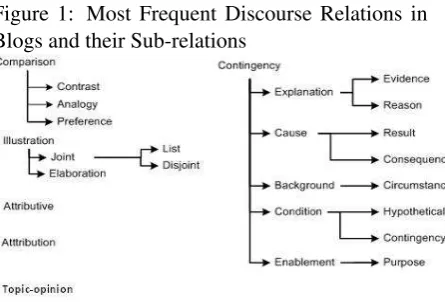
Since our work is performed within the frame-work of blog summarization; we have only con-sidered the discourse relations that are most useful to this application. To find the set of the relations needed for this task, we have first manually ana-lyzed 50 summaries randomly selected from par-ticipating systems at the TAC 2008 opinion sum-marization track and 50 randomly selected blogs from BLOG06 corpus3. In building our relation taxonomy, we considered all main discourse rela-tions listed in the taxonomy of Mann and Thomp-son’s Rhetorical Structure Theory (RST) (Mann and Thompson, 1988). These discourse relations are also considered in Grimes’ (Grimes, 1975) and Williams’ predicate lists. From our corpus anal-ysis, we have identified the six most prevalent discourse relations in this blog dataset, namely comparison,contingency,illustration,attribution, topic-opinion, and attributive. The comparison, contingency, and illustration relations are also considered by most of the work in the field of dis-course analysis such as the PDTB: Penn Disdis-course TreeBank research group (Prasad et al., 2008) and the RST Discourse Treebank research group (Carl-son and Marcu, 2001). We considered three ad-ditional classes of relations: attributive, attribu-tion, andtopic-opinion. These discourse relations are summarized in Figure 1 while a description of these relations is given below.
Illustration: Is used to provide additional infor-mation or detail about a situation. For example: “Allied Capital is a closed-end management in-vestment company that will operate as a business development concern.”
Figure 1: Most Frequent Discourse Relations in Blogs and their Sub-relations
As shown in Figure 1,illustrationrelations can be sub-divided into sub-categories: joint,list, dis-joint, and elaboration relations according to the RST Discourse Treebank (Carlson and Marcu, 2001) and the Penn Discourse TreeBank (Prasad et al., 2008).
Contingency: Provides cause, condition, reason or evidence for a situation, result or claim. For example: “The meat is good because they slice it right in front of you.”
As shown in Figure 1, the contingency rela-tion subsumes several more specific relarela-tions: ex-planation,evidence, reason,cause, result, conse-quence, background, condition, hypothetical, en-ablement, andpurposerelations according to the Penn Discourse TreeBank (Prasad et al., 2008).
Comparison: Gives a comparison and contrast among different situations. For example,“Its fast-forward and rewind work much more smoothly and consistently than those of other models I’ve had.”
Thecomparisonrelation subsumes thecontrast relation according to the Penn Discourse Tree-Bank (Prasad et al., 2008) and the analogy and preference relations according to the RST Dis-course Treebank (Carlson and Marcu, 2001).
Attributive: Relation provides details about an entity or an event - e.g.“Mary has a pink coat.”. It can be used to illustrate a particular feature about a concept or an entity - e.g. “Picasa makes sure your pictures are always organized.”. The at-tributive relation, also included in Grimes’ pred-icates (Grimes, 1975), is considered because it de-scribes attributes or features of an object or event and is often used in query-based summarization and question answering.
Topic-opinion: We introduced topic-opinion re-lations to represent opinions which are not ex-pressed by reported speech. This relation can be used to express an opinion: an internal feeling or belief towards an object or an event. For example: “Cage is a wonderfully versatile actor.”
Attribution: These relations are instances of re-ported speech both direct and indirect which may express feelings, thoughts, or hopes. For exam-ple: “The legendary GM chairman declared that his company would make “a car for every purse and purpose.””
3.2 Automatic Discourse Tagging
Once the manual analysis identified the most prevalent set of relations, we tried to measure their frequency by tagging them automatically within a larger corpus. Only recently, the HILDA (Her-nault et al., 2010) and (Feng and Hirst, 2012)’s dis-course parser were made publicly available. Both of these parsers work at the text-level, as opposed to the sentence-level, and hence currently achieve the highest tagging performance when compared to the state of the art. (Feng and Hirst, 2012)’s work showed a significant improvement on the performance of HILDA by enhancing its original feature set. However, at the time this research was done, the only publicly available discourse parser was SPADE (Soricut and Marcu, 2003) which op-erates on individual sentences. To identify illus-tration, contingency,comparison, and attribution relations, we have used SPADE discourse parser. However, we have complemented this parser with three other approaches: (Jindal and Liu, 2006)’s approach is used to identify intra-sentence com-parisonrelations; we have designed a tagger based on (Fei et al., 2008)’s approach to identify topic-opinionrelations; and we have proposed a new ap-proach to tagattributiverelations (Mithun, 2012). A description and evaluation of these approaches can be found in (Mithun, 2012). By combining these approaches, a sentence is tagged with all possible discourse relations that it contains.
3.3 Distribution of Discourse Relations
had been created to evaluate participants’ sum-maries at the TAC 2008 opinion summarization track. The collection consists of 600 blogs on 28 different topics. The dataset of the model sum-maries consists of 693 sentences.
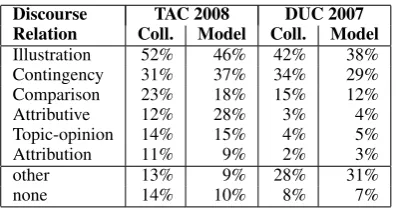
[image:4.595.83.283.294.398.2]Using the discourse parsers presented in Section 3.2, we computed the distribution of discourse re-lations within the TAC 2008 opinion summariza-tion collecsummariza-tion and the model summaries. Illustra-tion, contingency, comparison,attributive, topic-opinion, and attribution are the most frequently occuring relations in our data sets. The distribu-tion is shown in Table 14.
Table 1: Distribution of Discourse Relations in the TAC-2008 and DUC-2007 Datasets
Discourse TAC 2008 DUC 2007
Relation Coll. Model Coll. Model
Illustration 52% 46% 42% 38% Contingency 31% 37% 34% 29% Comparison 23% 18% 15% 12%
Attributive 12% 28% 3% 4%
Topic-opinion 14% 15% 4% 5%
Attribution 11% 9% 2% 3%
other 13% 9% 28% 31%
none 14% 10% 8% 7%
Table 1 shows that in the TAC 2008 input doc-ument set, theillustrationrelation occurs in 52% of the sentences; whileattributionis the least fre-quently occurring relation. In this dataset, other relations, such as antithesis and temporal rela-tions, occur in about 13% of the sentences and about 14% of the sentences did not receive any re-lation tag. As indicated in Table 1, the TAC model summaries have a similar distribution as the col-lection as a whole. Theattributiverelation seems, however, to be more frequent in the summaries (28%) than in the original texts (12%). We sus-pect that the reason for this is due to the question types of this track. To successfully generate query-relevant summaries that answer the questions of this track, candidate sentences need to contain at-tributive relations. For example, to answer the questions from this track“Why do people like Pi-casa?” or “What features do people like about Windows Vista?”, the summary needs to provide details about these entities or illustrate a particular feature about them. As a result, the summary will be composed of many attributive relations since
4In Table 1, the percentages do not add up to 100 because
a sentence may contain more than one relation.
attributiverelations help to model the required in-formation.
To compare the distribution of discourse rela-tions within more formal types of texts such as news articles, we used the Document Understand-ing Conference (DUC) 2007 Main Task input doc-ument set (collection) and their associated model summaries. The DUC 2007 dataset is a news arti-cle based dataset from the AQUAINT corpus. The DUC 2007 input document set contains 1125 news articles on 45 different topics. The model sum-maries were used to evaluate the DUC 2007 par-ticipants’ summaries. The dataset of the model summaries contains 180 summaries generated by the National Institute of Standards and Technol-ogy (NIST) assessors with a summary length of about 250 words. The distribution of relations in this dataset are shown in Table 1.
Table 1 shows that the most frequently occur-ring relation in the DUC 2007 document collec-tion and in the model summaries is illustration; while theattributionrelation is the least frequently occurring relation. Here again, it is interesting to note that the distribution of the discourse relations in the document collection and in the model sum-maries is generally comparable.
The distribution of theillustration,contingency, andcomparisonrelations in the DUC 2007 dataset is comparable to those in the TAC 2008 opinion summarization dataset. Indeed, Table 1 shows thatillustration,contingency, andcomparison re-lations occur quite frequently irrespective of the textual genre. However, in contrast to the TAC dataset,attributive, topic-opinion, andattribution relations occur very rarely in DUC 2007. We suspect that this is mostly due to the opinion-ated nature of blogs. Another observation is that temporalrelations (included in “other”) occurred very frequently (30%) in the DUC 2007 dataset whereas this relation occurs rarely in the blog dataset. This is inline with our intuition that news articles present events that inherently contain tem-poral information.
4 Evaluation of Discourse Relations
sys-tem at TAC 20085 and the best scoring system at DUC 20076. We have evaluated the effect of each discourse relation on the summaries gener-ated and compared the results. Let us first describe the BlogSum summarizer.
4.1 BlogSum
BlogSum is a domain-independent query-based extractive summarization system that uses intra-sentential discourse relations within the frame-work based on text schemata. The heart of Blog-Sum is based on discourse relations and text schemata.
BlogSum works in the following way: First candidate sentences are extracted and ranked using the topic and question similarity to give priority to topic and question relevant sentences. Since BlogSum has been designed for blogs, which are opinionated in nature, to rank a sen-tence, the sentence polarity (e.g. positive, negative or neutral) is calculated and used for sentence ranking. To extract and rank sentences, BlogSum thus calculates a score for each sentence using the features shown below:
Sentence Score =w1×Question Similarity +
w2×Topic Similarity +
w3×Subjectivity Score
where, question similarity and topic similarity are calculated using the cosine similarity based on words tf.idf and the subjectivity score is calcu-lated using a dictionary-based approach based on the MPQA lexicon7. Once sentences are ranked, they are categorized based on the discourse rela-tions that they convey. This step is critical because the automatic identification of discourse relations renders BlogSum independent of the domain. This step also plays a key role in content selection and summary coherence as schemata are designed us-ing these relations.
In order not to answer all questions the same way, BlogSum uses different schemata to gen-erate a summary that answers specific types of questions. Each schema is designed to give pri-ority to its associated question type and subjec-tive sentences as summaries for opinionated texts are generated. Each schema specifies the types of discourse relations and the order in which they should appear in the output summary for a
par-5
http://www.nist.gov/tac/
6
http://www-nlpir.nist.gov/projects/duc/guidelines/2007.html
7MPQA: http://www.cs.pitt.edu/mpqa
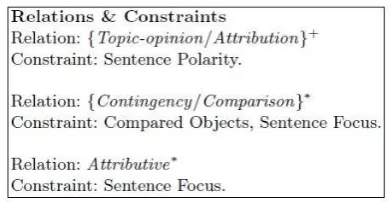
[image:5.595.318.514.226.327.2]ticular question type. Figure 2 shows a sample schema that is used to answer reason questions (e.g. “Why do people like Picasa?”). According to this schema8, one or more sentences containing atopic-opinionorattributionrelation followed by zero or many sentences containing acontingency orcomparison relation followed by zero or many sentences containing aattributiverelation should be used.
Figure 2: A Sample Discourse Schema used in BlogSum
Finally the most appropriate schema is selected based on a given question type; and candidate sen-tences fill particular slots in the selected schema based on which discourse relations they contain in order to create the final summary (details of Blog-Sum can be found in (Mithun, 2012)).
4.2 Evaluation of Discourse Relations on Blogs
To evaluate the effect of each discourse relation for blog summarization, we performed several exper-iments. We used as a baseline the original ranked list of candidate sentences produced by BlogSum before applying the discourse schemata, and com-pared this to the BlogSum-generated summaries with and without each discourse relation. We used the TAC 2008 opinion summarization dataset which consists of 50 questions on 28 topics; on each topic one or two questions were asked and 9 to 39 relevant documents were given. For each question, one summary was generated with no re-gards to discourse relations and two summaries were produced by BlogSum: one using the dis-course tagger and the other without using the spe-cific discourse tagger. The maximum summary length was restricted to 250 words.
To measure the effect of each relation, we have automatically evaluated how BlogSum performs using the standard ROUGE-2 and ROUGE-SU4
8The notation / indicates an alternative,{ }indicates
measures. For comparative purposes, Table 2 shows the official 2 (R-2) and ROUGE-SU4 (R-ROUGE-SU4) for all 36 submissions of the TAC 2008 opinion summarization track. In the table, “TAC Average” refers to the mean performance of all participant systems and “TAC-Best” refers to the best-scoring system at TAC 2008.
Table 2: Results of the TAC 2008 Opinion Sum-marization Track
System Name R-2 R-SU4
TAC Average 0.069 0.086 TAC-Best 0.130 0.139
Table 3: Effect of Discourse Relations on ROUGE-2 with the TAC 2008 Dataset
System Name BlogSum MEAD TAC-Best
R-2 R-2 R-2
Baseline 0.102⇓ 0.041⇓ 0.130 w/o Illustration 0.107⇓ 0.022⇓ 0.112⇓ w/o Contingency 0.093⇓ 0.025⇓ 0.102⇓ w/o Comparison 0.103⇓ 0.033⇓ 0.113⇓ w/o Attributive 0.113⇓ 0.050 0.124 w/o Topic-opinion 0.112⇓ 0.049 0.123 w/o Attribution 0.118⇓ 0.051⇓ 0.128 with all Relations 0.125 .053 0.138
Table 4: Effect of Discourse Relations on ROUGE-SU4 with the TAC 2008 Dataset
System Name BlogSum MEAD TAC-Best
R-SU4 R-SU4 R-SU4
Baseline 0.107⇓ 0.064⇓ 0.139 w/o Illustration 0.110⇓ 0.041⇓ 0.120⇓ w/o Contingency 0.102⇓ 0.046⇓ 0.110⇓ w/o Comparison 0.108⇓ 0.052⇓ 0.122⇓ w/o Attributive 0.115⇓ 0.072 0.130 w/o Topic-opinion 0.117 0.072 0.129 w/o Attribution 0.127⇓ 0.073⇓ 0.132 with all Relations 0.128 0.075 0.151
The results of our evaluation are shown in Ta-bles 3 (ROUGE-2) and 4 (ROUGE-SU4). As the tables show, BlogSum’s baseline is situated below the best scoring system at TAC-2008, but much higher than the average system (see Ta-ble 2); hence, it represents a fair baseline. The tables further show that using both the ROUGE-2 (R-2) and ROUGE-SU4 (R-SU4) metrics, with the TAC 2008 dataset, BlogSum performs better when taking discourse relations into account. Indeed, when ignoring discourse relations, BlogSum has a R2=0.102 and R-SU4=0.107 and misses many question relevant sentences; whereas the inclusion of these relations helps to incorporate those rele-vant sentences into the final summary and brings
the R-2 score to 0.125 and R-SU4 to 0.128. In order to verify if these improvements were sta-tistically significant, we performed a 2-tailed t-test. The results of this test are indicated with the ⇓ symbol in Tables 3 and 4. For example, the baseline setup of BlogSum performed signifi-cantly lower for both R-2 and R-SU4 compared to BlogSum with all relations. This result indicates that the use of discourse relations as a whole helps to include more question relevant sentences and improve the summary content.
To ensure that the results were not specific to our summarizer, we performed the same experi-ments with two other systems: the MEAD sum-marizer (Radev et al., 2004), a publicly available and a widely used summarizer, and with the output of the TAC best-scoring system. For MEAD, we first generated candidate sentences using MEAD, then these candidate sentences were tagged using discourse relation taggers used under BlogSum. Then these tagged sentences were filtered using BlogSum so that no sentence with a specific re-lation is used in summary generation for a par-ticular experiment. We have calculated ROUGE scores using the original candidate sentences gen-erated by MEAD and also using the filtered candi-date sentences. As a baseline, we used the origi-nal candidate sentences generated by MEAD. As a best case scenario, we have passed these candidate sentences through the discourse schemata used by BlogSum (see Section 4.1). In Tables 3 and 4, this is referred to as “MEAD with all relations”. We have applied the same approach with the output of the TAC best-scoring system. In the tables, “TAC-Best Baseline” refers to the original summaries generated by the TAC-Best system and “TAC-Best with all relations” refers to the summaries gen-erated by applying discourse schemata using the summary sentences generated by the TAC-Best system.
It is interesting to note that although infor-mal texts may not exhibit a clear discourse struc-ture, the use of individual discourse relations such as illustration, contingency and comparison is nonetheless useful in the analysis of informal doc-uments such as those found in the social media.
4.3 Effect of Discourse Relations on News
To compare the results found with blogs with more formal types of texts, we have performed the same experiments but, this time with the DUC 2007 Main Task dataset. In this task, given a topic (title) and a set of 25 relevant documents, par-ticipants had to create an automatic summary of length 250 words from the input documents. In the dataset, there were 45 topics and thirty teams par-ticipated to this shared task. Table 5 shows the of-ficial ROUGE-2 (R-2) and ROUGE-SU4 (R-SU4) scores of the DUC 2007 main task summarization track. In Table 5, “DUC Average” refers to the mean parformance of all participant systems and “DUC-Best” refers to the best scoring system at DUC 2007.
Table 5: DUC 2007 Main Task Summarization Results
System Name R-2 R-SU4
DUC Average 0.095 0.157 DUC-Best 0.124 0.177
Table 6: Effect of Discourse Relations on ROUGE-2 with the DUC 2007 Dataset
System Name BlogSum MEAD DUC-Best
R-2 R-2 R-2
Baseline 0.089 0.099 0.124⇓
w/o Illustration 0.079⇓ 0.061⇓ 0.103⇓ w/o Contingency 0.074⇓ 0.060⇓ 0.097⇓ w/o Comparison 0.086⇓ 0.078⇓ 0.114⇓ w/o Attributive 0.092 0.099 0.119⇓ w/o Topic-opinion 0.092 0.099 0.115⇓ w/o Attribution 0.093 0.099 0.120⇓ with all Relations 0.093 0.110 0.157
Tables 6 and 7 show the results with this dataset with respect to 2 and ROUGE-SU4, respectively. As the tables show, Blog-Sum’s performance with all discourse relations (R2=0.093 and R-SU4=0.132) is similar to the DUC average performance shown in Table 5 (R2=00.095 and R-SU4=0.157) which is much
Table 7: Effect of Discourse Relations on ROUGE SU-4 with the DUC 2007 Dataset
System Name BlogSum MEAD DUC-Best
R-SU4 R-SU4 R-SU4
Baseline 0.110⇓ 0.142⇓ 0.177⇓ w/o Illustration 0.117⇓ 0.118⇓ 0.138⇓ w/o Contingency 0.113⇓ 0.118⇓ 0.123⇓ w/o Comparison 0.122⇓ 0.130⇓ 0.144⇓ w/o Attributive 0.131 0.141⇓ 0.159⇓ w/o Topic-opinion 0.130 0.141⇓ 0.153⇓ w/o Attribution 0.131 0.142⇓ 0.164⇓ with all Relations 0.132 0.168 0.196
lower than the DUC-Best performance (R2=0.124, R-SU4=0.177) shown in Table 5). However, these results show that even though BlogSum was de-signed for informal texts, it still performs rela-tively well with formal documents. Tables 6 and 7 further show that with the news dataset, the same relations have the most effect as with blogs. Indeed BlogSum generated summaries also ben-efit most from the contingency, illustration, and comparisonrelations; and all three relations bring a statistically significant contribution to the sum-mary content.
Here again, as shown in Tables 6 and 7, we performed the same experiments with two other systems: the MEAD summarizer and the output of the DUC-Best system. Again, for the DUC 2007 dataset, each discourse relation has the same effect on summarization with all systems as with the blog dataset: contingency, illustration, andcomparison provide a statistically significant improvement in content; whileattributive, topic-opinionandattributiondo not reduce the content, but do not see to bring a systematic and significant improvement.
5 Conclusion and Future Work
summa-rization with the TAC 2008 opinion summariza-tion dataset and the DUC 2007 dataset. We have conducted these evaluations with our summariza-tion system called BlogSum, the TAC best-scoring system, the DUC best-scoring system, and the MEAD summarizer. The results show that for both textual genres, some relations have more effect on summarization compared to others. In both types of texts, thecontingency,illustration, and compar-ison relations provide a significant improvement on summary content; while theattribution, topic-opinion, and attributive relations do not provide a systematic and statistically significant improve-ment. These results seem to indicate that, at least for summarization, discourse relations are just as useful for informal and affective texts as for more traditional news articles. This is interesting, be-cause although informal texts may not exhibit a clear discourse structure, the use of individual dis-course relations is nonetheless useful in the analy-sis of informal documents.
In the future, it would be interesting to evaluate the effect of other relations such as the temporal relation. Indeed, temporal relations occur infre-quently in blogs but are very frequent in news arti-cles. Such an analysis would allow us to tailor the type of discourse relations to include in the final summary as a function of the textual genre being considered. In the future, it would also be inter-esting to use other types of texts such as reviews and evaluate the effect of discourse relations using other measures than ROUGE-2 and ROUGE-SU4. Finally, we would like to validate this work again with the newly available discourse parsers of (Her-nault et al., 2010) and (Feng and Hirst, 2012).
Acknowledgement
The authors would like to thank the anonymous referees for their valuable comments on an earlier version of the paper. This work was financially supported by an NSERC grant.
References
Andreevskaia, A., Bergler, S., Urseanu, M.: All Blogs are Not Made Equal: Exploring Genre Differences in Sentiment Tagging of Blogs. In Proceedings of the International Conference on Weblogs and Social Media (ICWSM-2007),(2007), Boulder, Colorado.
Blair-Goldensohn, S.J., McKeown, K.: Integrating Rhetorical-Semantic Relation Models for Query-Focused Summarization.In Proceedings of the
Doc-ument Understanding Conference (DUC) Workshop at NAACL-HLT 2006, (2006), New York, USA.
Bosma, W.: Query-Based Summarization using Rhetorical Structure Theory.In Proceedings of the 15th Meeting of Computational Linguistics in the Netherlands CLIN, (2004), Leiden, Netherlands.
Carlson, L., Marcu, D.: Discourse Tagging Reference Manual. University of Southern California Informa-tion Sciences Institute, ISI-TR-545, 2001.
Fei, Z., Huang, X., Wu, L.: Mining the Relation be-tween Sentiment Expression and Target Using De-pendency of Words. Proceedings of the 20th Pa-cific Asia Conference on Language, Information and Computation, 257–264 (2008), Wuhan, China.
Feng, V. W., Hirst, G.: Text-level Discourse Parsing with Rich Linguistic Features. In Proceedings of ACL-2012, 60–68 (2012), Stroudsburg, USA.
Grimes, J. E.: The Thread of Discourse. Technical re-port No. NSF-TR-1, NSF-GS-3180. Cornell Univer-sity, Ithaca, New York, 1975.
Hernault, H., Prendinger. H., duVerle, D. A., Ishizuka, M.: HILDA: A discourse parser using support vector machine classification.J. Dialogue and Discourse, 1(3):1–33, 2010.
Jindal, N., Liu, B.: Identifying Comparative Sentences in Text Documents.In Proceedings of SIGIR-2006, 244-251 (2006), Washington, USA.
Mann, W.C., Thompson, S. A.: Rhetorical Structure Theory: Toward a Functional Theory of Text Organ-isation.J. Text, 3(8):234–281, 1988.
Marcu, D.: From Discourse Structures to Text Sum-maries.Proceedings of the ACL’97/EACL’97 Work-shop on Intelligent Scalable Text Summarization.
1997, 82–88, Madrid, Spain.
McKeown, K.R.: Discourse Strategies for Generat-ing Natural-Language Text.J. Artificial Intelligence, 27(1):1–41, 1985.
Mithun, S.: Exploiting Rhetorical Relations in Blog Summarization. PhD Thesis, Department of Com-puter Science and Software Engineering, Concordia University, Montreal, Canada, 2012.
Otterbacher, J. C., Radev, D. R., Luo, A.: Revisions that Improve Cohesion in Multi-document Sum-maries: A Preliminary Study.In Proceedings of the ACL-2002 Workshop on Automatic Summarization, 27–36 (2002), Philadelphia, USA.
Prasad, R., Miltsakaki, E., Dinesh, N., Lee, A., Joshi, A., Robaldo, L., Webber, B.: The Penn Discourse Treebank 2.0. Annotation Manual. University of Pennsylvania, IRCS-08-01, 2008.
Soricut, R., Marcu, D.: Sentence Level Discourse Pars-ing usPars-ing Syntactic and Lexical Information.In Pro-ceedings of NAACL/HLT 2003, 149–156 (2003), Ed-monton, Canada.
Taboada, M.: Discourse Markers as Signals (or not) of Rhetorical Relations.J. Pragmatics, 38(4):567–592, 2006.