Both Worst Case and Outage Constrained Robust Design for MIMO
Wiretap Wireless Sensor Networks
Feng Zhou1, 3, *, Rugang Wang1, 2, and Jinhong Bian1, 3
Abstract—In this paper, we consider a MIMO wiretap system in wireless sensor networks (WSNs), where the confidential signal sent to the legitimate receive (Bob) may be eavesdropped by the eavesdropper (Eve). Assuming that only partial channel state information (CSI) can be obtained by the transmitter, we consider both worst case (WC) and outage-constrained (OC) robust secrecy optimizations. To solve the WC design, we propose to linearize these logarithmic determinant terms. After linearization, we tackle the CSI uncertainty using the Nemirovski lemma. Then, an alternating optimization (AO) algorithm is proposed to solve the reformulated problem. On the other hand, to solve the OC design, we transform the probabilistic constraint into safe and tractable reformulation by the Bernstein-type inequality (BTI) and large deviation inequality (LDI), and an AO algorithm is proposed. Numerical results are provided to demonstrate the performance of the proposed scheme.
1. INTRODUCTION
Wireless sensor networks (WSNs) are considered as a promising technique with numerous applications such as data acquisition, location monitoring, and node control [1, 2]. However, secure transmission has been seen as an important problem for WSN due to the openness of wireless channel [3, 4]. The physical layer security (PLS) technique, which exploits the characteristics of wireless channels, has been proved as an effective method to improve the security in wireless networks [5].
The design of transmit precoding or beamforming in multiple-input multiple-output (MIMO) wiretap channel is a typical non-convex problem [6, 7]. To solve this problem, various methods have been proposed in [8–13]. In [8], the authors proposed a transmit precoding design based on alternating optimization (AO). In [9], the authors proposed a method based on matrix generalized singular value decomposition (GSVD). In [10], the authors proposed an iterative custom-made method. In [11], the authors proposed an inexact block coordinate descent (IBCD) method to design information signal and energy signal in a secrecy MIMO system with energy harvesting (EH). Recently, the minorization-maximization (MM) based method has aroused new attention to design the precoding in MIMO wiretap channels [12, 13].
However, due to the existence of channel estimation and feedback errors, it is difficult to obtain perfect channel state information (CSI). Robust design has been widely investigated to handle this obstacle. Commonly, there are two kinds of robust design in wiretap channel, e.g., the worst case (WC) secrecy design and outage constraint (OC) secrecy design.
Specifically, the worst case robust optimizing problem was investigated in [14–18]. The technique to tackle the bounded CSI uncertainty in these works mostly involved the S-Procedure. However, for a MIMO wiretap channel, the S-Procedure is not directly workable since the secrecy rate expression
Received 28 September 2019, Accepted 19 November 2019, Scheduled 4 December 2019 * Corresponding author: Feng Zhou ([email protected]).
consists of several logarithmic determinant (log-det) terms, not the matrix trace formulation as in the multiple-input single-output (MISO) channel. To overcome this obstacle, log-det is commonly approximated as a trace by first order Taylor series expansion [14–16]. However, at high SNR region, the difference between the actual value and this approximation is huge [17]. In [18], the authors proposed an epigraph reformulation to handle the CSI uncertainty without considering artificial noise (AN).
On the other hand, the outage constraint design has been investigated in [19–23]. In [19], the authors proposed an AO method to achieve a safe approximation for the secrecy outage design. In [20], the authors proposed a successive convex approximation (SCA) based method to maximize the outage secrecy rate. In [21], the authors proposed an SCA method to maximize the harvested energy at the energy receiver subject to the outage secrecy rate constraint. Recently in [22] and [23], the authors proposed AO based methods to maximize the outage secrecy rate in MIMO channel without and with considering AN, respectively.
Motivated by these observations, in this paper, we investigate the bounded and probabilistic CSI uncertainties constraint robust designs, respectively. Specifically, considering both imperfect Bob’s and Eve’s CSIs, we aim to optimize the transmit precoding matrix and AN covariance. We propose to linearize these log-det terms and utilize epigraph reformulation to deal with CSI uncertainties. Then, an AO algorithm is proposed to solve the reformulated problem. For the outage-constraint design, we transform the probabilistic constraint into tractable reformulation by Bernstein-type inequality (BTI) and large deviation inequality (LDI), to achieve better performance and lower complexity, respectively. Finally, numerical results demonstrate the performance of the proposed scheme.
The rest of this paper is organized as follows. The system model and problem statement are given in Section 2. Section 3 investigates the worst case secrecy design. Section 4 investigates the worst case secrecy design. Simulation results are provided in Section 5. Section 6 concludes this paper.
Notations: Throughout this paper, boldface lowercase and uppercase letters denote vectors and matrices, respectively. The conjugate, transpose, conjugate transpose, trace, and rank of matrix Aare denoted as A†,AT,AH, Tr(A), and rank(A), respectively. a= vec(A) indicates to stack the columns of matrixAinto a vectora. HN+ denotes the set of allN×N Hermitian positive semi-definite matrices.
A 0 indicates that A is a positive semi-definite matrix. |·| and a denote the absolute value and Euclidean norm of vectora, respectively. ⊗denotes the Kronecker product. D(a) represents a diagonal matrix with a on the main diagonal. I is an identity matrix with proper dimension. λmax(A,B) denotes the largest generalized eigenvalue of matrices A and B. Re{a} denotes the real part of a complex variable a. CN(0,I) denotes a circularly symmetric complex Gaussian random vector with mean 0 and covarianceI. [x]+ indicates max(0, x), andE[·] stands for the statistical expectation.
2. SYSTEM MODEL AND PROBLEM STATEMENT
2.1. Problem Statement
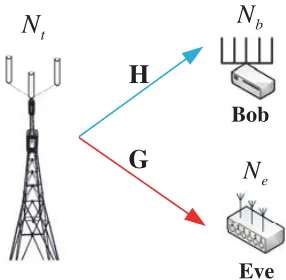
Let us consider a MIMO wiretap system, which consists of one transmitter (T), one legitimate receiver (Bob), and an eavesdropper (Eve), as shown in Fig. 1. It is assumed that the T, Bob, and Eve are equipped with Nt,Nb, andNe antennas, respectively. The channel matrices between T and Bob, and between T and Eve are denoted asH∈CNb×Nt and G∈CNe×Nt, respectively.
In this paper, we assume that only imperfect Bob’s and Eve’s CSIs can be obtained. The bounded CSI uncertainties are modeled as
H = HH=H¯ + ΔH, ΔH ≤χH
, (1a)
G = GG=G¯ + ΔG, ΔG ≤χG
, (1b)
whereH¯ andG¯ denote the estimates ofHandG, respectively; ΔHand ΔGare their respective channel uncertainties; χH and χG denote the respective sizes of the bounded channel uncertainties region.
Accordingly, the worst case secrecy rate can be expressed as
Rworst = min
Eve Bob
H
G
b
N
e
N
t
N
Figure 1. The MIMO wiretap system model.
whereCb andCe denote the mutual information at Bob and Eve, respectively, and are given by
Cb(W,Σ)
Δ
= lnI+HWWHHHσb2I+HΣHH
−1
, (3a)
Ce(W,Σ)
Δ
= lnI+GWWHGHσe2I+GΣGH
−1
. (3b)
On the other hand, for the outage constraint design, the CSI uncertainties are modeled as follows
H=HH=H¯ + ΔH, vec (ΔH)∼ CN (0,CH)
, (4a)
G =GG=G¯ + ΔG, vec (ΔG)∼ CN (0,CG)
, (4b)
where ΔHand ΔGdenote the channel uncertainties, respectively;CH and CG denote the covariances, respectively.
Accordingly, the secrecy outage probability can be expressed as
Pr
min
∀H∈H,∀G∈ GCb(W,Σ)−Ce(W,Σ)≥Rout
≥1−ρ, (5)
whereρis the secrecy outage probability, e.g., the chance of the achievable secrecy rate Rfalling below the target rate Rs due to CSI uncertainty.
2.2. Problem Statement
In this paper, we investigate the joint precoding and AN design to maximize the worst case secrecy rate and outage secrecy rate, respectively. Mathematically, the two problems can be formulated as
P1 : max
W,Σ0 ΔHminF≤χHln
I+HWWHHHσb2I+HΣHH
−1
− max
ΔGF≤χGln
I+GWWHGHσe2I+GΣGH
−1
, (6a)
s.t. TrWWH +Σ≤Ps, (6b)
P2 : max
W,Σ0 Rout (7a)
s.t. Pr
min
∀H∈H,∀G∈HCb(W,Σ)−Ce(W,Σ)≥Rout} ≥1−ρ, (7b)
(6b), (7c)
3. WORST CASE SECRECY DESIGN
P1 is highly non-convex due to maximize the difference of several log-det functions in the CSI uncertainty region. In this section, we will propose en effective method to linearize these log-det terms and handle the CSI uncertainty.
Firstly, we introduce the following Lemma.
Lemma 1[11]: Define an m by mmatrix function,
Ξ(U,V)=Δ UHNU+I−UHMV I−UHMVH,
whereN is any positive definite matrix. Then, the following three equations hold true.
Equation (1): For any positive definite matrixS∈Cm×m, we have
S−1= arg max
T0 ln|T| −Tr (TS), and
−ln|S|= arg max
T0 ln|T| −Tr (TS) +m.
Equation (2): For any positive definite matrixT, we have
˜
U= arg minΔ
U Tr (TΞ(U,V)) =
N+MVVHMH−1MV,
and
Ξ
˜ U,V
=I−U˜HMV=I+VHMHN−1MV−1. Equation (3): We have
lnI+MVVHMHN−1= arg max T0,U
ln|T| −Tr (TΞ) +m.
Equations (1) and (2) can be proven by the first-order optimality condition, while Equation (3) directly follows from Equations (1) and (2) and the identity ln|I+AB|= ln|I+BA|.
Eq. (6) is hard to handle due to the coupled variables and non-convex objective and constraints. In the following, we will decouple Eq. (6) based on these above equations.
To utilize the above equations, we denoteΣ=QQH and rewrite Rs as
Rs = lnI+σ−b2HWWHHH
I+σb−2HQQHHH−1
f1
+ lnI+σe−2GQQHGH
f2 + lnσe2I−lnσe2I+GWWHGH +GQQHGH
f3
, (8)
where
f1 = max
Ψ10,Uln|Ψ1| −Tr (Ψ1Ξ1(U,W,Q)) +Nd, (9a)
f2 = max
Ψ20,Vln|Ψ2| −Tr (Ψ2Ξ2(V,Q)) +NT, (9b)
f3 = max Ψ30
ln|Ψ3|+NE −Tr
Ψ3
σe2I+GWWHGH +GQQHGH
. (9c)
Furthermore, the matrix functionsΞ1 and Ξ2 are as follows Ξ1(U,W,Q)
Δ
=UHI+σ−b2HQQ
HHHU+I−
σ−b1U
HHW I−
σb−1U
HHWH
, (10a)
Ξ2(V,Q)=Δσ−e2VHV+
I−σe−1VHGQ I−σe−1VHGQ
H
Based on the above relationships, Eq. (6) can be rewritten as max
Ψ10,Ψ20, Ψ30,U,
V,W,Q
ln|Ψ1| −Tr
Ψ1UHU
−a−b+ ln|Ψ2| −σ−e2Tr
Ψ2VHV
−c
+ ln|Ψ3| −σ2eTr (Ψ3)−d−e,
(11a)
s.t.Tr
Ψ1
I−σ−b1U
HHW I−
σb−1U
HHWH≤
a, (11b)
TrΨ1UHHQQHHHU
≤σb2b, (11c)
Tr
Ψ2
I−σe−1VHGQ I−σ−e1VHGQ
H
≤c, (11d)
TrΨ3GWWHGH≤d, (11e)
TrΨ3GQQHGH
≤e, (11f)
(6b). (11g)
Furthermore, denoteΨ1 =T1TH1 ,Ψ2 =T2TH2 ,Ψ3 =T3TH3 , Eq. (11) can be reformulated as
max T10,T20,
T30,U, V,W,Q
2 ln|T1| −TrT1TH1 UHU
−a−b+ 2 ln|T2| −σe−2Tr
T2TH2 VHV
−c
+ 2 ln|T3| −σ2eTr
T3TH3
−d−e,
(12a)
s.t. TH1 I−σb−1U
HHW2
F ≤a, (12b)
TH1 UHHQ2F ≤σ2bb, (12c)
TH2 I−σe−1VHGQ
2
F ≤c, (12d)
TH3 GW2F ≤d, (12e)
TH3 GQ2F ≤e, (12f)
(6b). (12g)
Eq. (12) is still hard to handle due to the CSI uncertainty. Next, we will introduce the following Nemirovski Lemma to handle the CSI uncertainty. Firstly, we rewrite Eq. (12b) as
TH
1 −σ−b1TH1 UH ¯
H+ ΔHW2F ≤a, ΔHF ≤χH.
By denoting Δh = vec (ΔH) and invoking the equation vec (A1A2A3) = AT3 ⊗A1vec (A2), we obtain the relationship t1−σb−1P1Δh
2
2 ≤ a, Δh2 ≤ χH, where t1 = vec
X1HW¯ −TH1
,
P1 =WT ⊗X1 and X1 =TH1 UH.
Based on the Schur complement, the above relationship can be reformulated as
a (t1−PΔh)H
t1−PΔh I
0, Δh2≤χH. (13)
Furthermore, Eq. (13) can be rewritten as follows
a tH1 t1 I
0
P
Δh[−1 0] + −1
0
ΔhH 0 P
H
. (14)
Next, we will introduce the following Nemirovski Lemma to handle the CSI uncertainty.
Lemma 2 (Nemirovski Lemma) [24, 25]: For a given set of matrices A = AH, B and C, the following LMI is satisfied
ABHXC+CHXHB, X ≤t,
if and only if there exists a non-negative real numberμ such that
A−μCHC −tBH −tB μI
Based on the Nemirovski Lemma, Eq. (14) can be rewritten as the following LMI
⎡
⎣ a−λ1 t
H
1 0
t1 I χHP1
0 χHPH1 λ1I ⎤
⎦0. (15)
whereλ1≥0 is the introduced auxiliary variables.
Similarly, we denote t2 = vec(X1HQ¯ ), P2 =QT ⊗X1, t3 = vec(X2GQ¯ −TH2 ), P3 = QT ⊗X2, X2 =TH2 VH,t4= vec(T3GW¯ ),P4 =WT⊗T3,t5 = vec(T3GQ¯ ),P5 =QT⊗T3, then, the following
LMIs can be obtained ⎡
⎣ σ 2
bb−λ2 tH2 0
t2 I χHP2
0 χHPH2 λ2I ⎤
⎦0, (16)
⎡
⎣ c−λ3 t
H
3 0
t3 I χGP3
0 χGPH3 λ3I ⎤
⎦0, (17)
⎡
⎣ d−λ4 t
H
4 0
t4 I χGP4
0 χGPH4 λ4I ⎤
⎦0, (18)
⎡
⎣ e−λ5 t
H
5 0
t5 I χGP5
0 χGPH5 λ5I ⎤
⎦0, (19)
where{λ2 ≥0,· · · , λ5≥0}are introduced auxiliary variables.
Bases on these above operations, we obtain the following problem max
T10,T20, T30,U,
V,W,Q
2 ln|T1| −TrT1TH1 UHU
−a−b+ 2 ln|T2| −σe−2Tr
T2TH2 VHV
−c+ 2 ln|T3| −σe2Tr
T3TH3
−d−e,
(20a)
s.t. (6b),(15),(16),(17),(18),(19). (20b) To this end, we turn Eq. (6) into an equivalent problem in Eq. (12). Eq. (12) is still non-convex w.r.t all these optimization variables, but is convex w.r.t given variables when other variables are fixed. Specifically, these variables can be divided into three groups: {W,Q},{U,V}, and{T1,T2,T3}. Then,
Eq. (12) can be decoupled into four subproblems w.r.t these variables. Both these subproblems can be effectively solved by the convex optimization tool CVX [28], and the optimal solution to Eq. (6) can be achieved in an alternating method.
4. OUTAGE SECRECY DESIGN
In this section, we will handle the outage secrecy design. As discussed in the above, we find that the OCSRM problem is non-convex due to the constraints in Eq. (7b). Hence, in the following, in order to solve the OCSRM problem, we propose an effective way to convert the non-convex constraints.
Based on Equation (1) and denotingWWW =WWH, we obtain the following relationship
−lnI+σb−2HWWWH
H= max Sb0f
Sb,I+σb−2HWWWH H
, (21a)
−lnI+σe−2G(WWW+Σ)GH= max Se0f
Se,I+σe−2G(WWW+Σ)GH
, (21b)
In addition, at low signal-to-noise ratio (SNR) region, we invoke the following SNR approximation method [23],
lnI+σb−2H(WWW +Σ)H H=
σb−2Tr
H(WWW+Σ)HH, (22a) lnI+σe−2GWWWGH=σe−2Tr
GWWWGH. (22b)
By substituting Eqs. (21) and (22) into Eq. (5), we obtain the following probability constraint Prσ−b2Tr
H(WWW+Σ)HH+σe−2Tr
GWWWGH
+ max Se0f
Se,I+σ−e2G(WWW+Σ)GH
+ max Sb0f
Sb,I+σ−b2HWWWHH
≥R
≥1−ρ,
(23)
which can be further safely approximated as
Prσb−2TrH(WWW+Σ)HH+σ−e2Tr
GWWWGH
+fSe,I+σe−2G(WWW+Σ)GH
+fSb,I+σb−2HWWWHH
≥R≥1−ρ.
(24)
Next, we turn channel matricesHandGinto the following formh=h¯+C1/2h vhwhereh= vec (H) andh¯= vecH¯,vh ∼ CN(0,I),g =¯g+C
1/2
g vg. Similarly,g= vec (G),¯g= vec
¯
G,vg ∼ CN(0,I). By invoking the equations TrABCH = vec(C)HBT ⊗Ivec (A) and TrAHBCD = vec(A)HDT ⊗Bvec (C), Eq. (24) can be rewritten as the following equation
PrvH h vHg
C1/2h Θ1C 1/2
h 0
0 C1/2g Θ2C 1/2 g vh vg +2
vhH vHg
C1/2h Θ1 0 0 C1/2g Θ2
h g
+hH gH Θ01 Θ0 2
h g
+ϕ≥0
≥1−ρ,
(25)
where Θ1 = σb−2
W
WWT +ΣT⊗I− WWWT ⊗S b
, Θ2 = σe−2
WWWT ⊗I−WWWT +ΣT⊗S e
and ϕ =
−Tr (Sb) + ln|Sb|+Nb−Tr (Se) + ln|Se|+Ne−R.
Next, we will handle the CSI uncertainty based on the following BTI.
Lemma 2 [26](BTI): For any (A,u, c)∈HN×CN×R,v∼ CN (0,I) andβ∈(0,1], the following inequalities hold:
PrvvHAv+ 2 vHu+c≥0≥1−β
⇐ ⎧ ⎪ ⎪ ⎪ ⎨ ⎪ ⎪ ⎪ ⎩
Tr (A)− −2 ln (β)x+ ln (β) y + c≥0,
vec (√ A)
2u
≤x, yI+A0, y ≥0,
wherex and y are slack variables. Moreover, BTI is convex w.r.t all the variables (A,u, c, x, y). Based on BTI and denotingv=ΔvHh vHhH,
A=Δ
C1/2h Θ1C1/2h 0 0 C1/2g Θ2C1/2g
, (26)
u=Δ
C1/2h Θ1 0 0 C1/2g Θ2
h g
c=ΔhH gH Θ1 0
0 Θ2
h g
+ϕ, (28)
we obtain the following relationship
⎧ ⎪ ⎪ ⎪ ⎨ ⎪ ⎪ ⎪ ⎩
Tr (A)− −2 ln (ρ)x+ ln (ρ)y+c≥0,
vec (√ A)
2u 2
≤x,
yI+A0.
(29)
To this end, we turn Eq. (25) into a solvable reformulation.
In addition, to reduce the computation complexity of the BTI method, we propose to use the following LDI method.
Lemma 3 [27] (LDI): Let x ∼ CN(0,I), and A ∈ Hn×n, r ∈ Cn×1 are given. Then, for any
v > √1
2 and ζ >0, we have
PrxHAx+ 2 xHr≤Tr (A)−ζ
≤ ⎧ ⎪ ⎪ ⎨ ⎪ ⎪ ⎩ exp ! − ζ2
4T2 "
0< ζ ≤2¯vvT ,
exp
! −¯vvζ
T + (¯vv) 2
"
ζ >2¯vvT ,
where ¯v = 1− 21v2 and T = vAF + √1
2r. Similarly with BTI, LDI is also convex w.r.t all the
variables (A,u, c, x, y).
Based on LDI, we transform Eq. (25) into the following relationship
⎧ ⎪ ⎨ ⎪ ⎩
Tr (A) +c≥2 −ln (ρ) (x+y), u2≤√2x,
vAF ≤y,
(30)
wherev is the solution of the following equation ¯vv= (1−1/2v2)v = −ln(ρ).
For both BTI and LDI based methods, Eqs. (29) and (30) are still non-convex w.r.t all these optimization variables, but are convex w.r.t certain variables when other variables are fixed. Specifically, these variables can be divided into two groups: {WWW,Σ} and{Sb,Se}. Then, Eq. (24) can be decoupled into four subproblems w.r.t these variables. Both these subproblems can be effectively solved by the
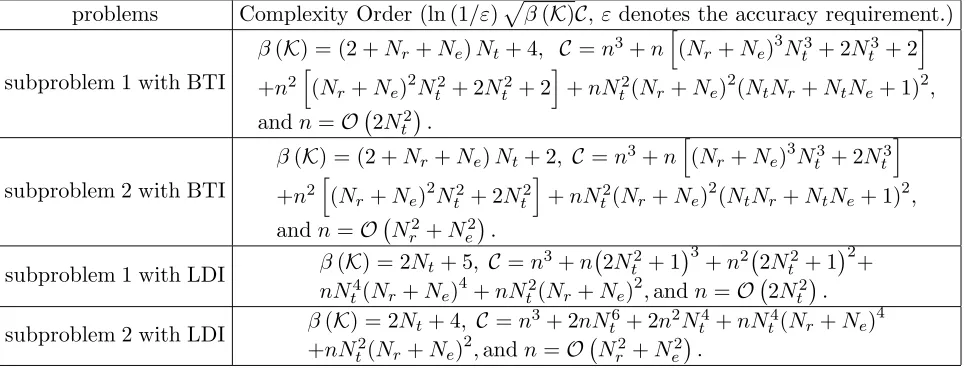
Table 1. Complexity analysis of BTI and LDI methods.
problems Complexity Order (ln (1/ε) β(K)C,εdenotes the accuracy requirement.)
subproblem 1 with BTI
β(K) = (2 +Nr+Ne)Nt+ 4, C=n3+n
#
(Nr+Ne)3Nt3+ 2Nt3+ 2
$
+n2#(N
r+Ne)2Nt2+ 2Nt2+ 2
$
+nN2
t(Nr+Ne)2(NtNr+NtNe+ 1)2, andn=O2Nt2
.
subproblem 2 with BTI
β(K) = (2 +Nr+Ne)Nt+ 2, C=n3+n
#
(Nr+Ne)3Nt3+ 2Nt3
$
+n2 #
(Nr+Ne)2Nt2+ 2Nt2
$
+nNt2(Nr+Ne)2(NtNr+NtNe+ 1)2, andn=ONr2+Ne2
.
subproblem 1 with LDI β(K) = 2Nt+ 5, C=n
3+n2N2
t + 1
3
+n22Nt2+ 1
2
+
nNt4(Nr+Ne)4+nNt2(Nr+Ne)2,andn=O
2Nt2
.
subproblem 2 with LDI β(K) = 2Nt+ 4, C =n
3+ 2nN6
t + 2n2Nt4+nNt4(Nr+Ne)4 +nNt2(Nr+Ne)2,andn=O
Nr2+Ne2
convex optimization tool CVX [28], and the optimal solution to Eq. (6) can be achieved in an alternating method.
Via a similar way to that in [27], we obtain the complexity comparison between BTI and LDI methods, which are shown in Table 1. From the comparison, we observe that the LDI method achieves lower complexity than the BTI method.
5. SIMULATION RESULTS
In this section, we evaluate the performance of our proposed design through Monte Carlo simulations. The simulation settings are assumed as follows: Ps= 10 dBW,σb2=σe2= 10−4. Each element ofH¯ and
¯
G is randomly generated by CN(0,10−4), and the channel uncertainties are χH2 = χ2G = 2×10⁻⁶ for bounded uncertainty andCH =CG = 2×10⁻⁶for the outage case, respectively. The outage probability is ρ= 0.05. For the worst case design, we compare our algorithm with the following methods: 1) The case of perfect CSI, which can be seen as the upper bound of our proposed design; 2) The no AN method, e.g., setting Σ = 0 while only optimizing W; 3) The SCA based method in [16]; 4) The MM based method in [13]. The five methods are denoted as “the proposed method”, “the perfect CSI case”, “the no AN method”, “the SCA based method”, and “the MM based method”, respectively. On the other hand, for the outage case design, we compare our BTI and LDI methods with the following methods: 1) The case of perfect CSI; 2) The no AN method; 3) The MM based method. The five methods are denoted as “the BTI method”, “the LDI method”, “the perfect CSI case”, “the no AN method”, and “the MM based method”, respectively.
5.1. Worst Case Performance
Firstly, in Fig. 2, we show the convergency of our proposed AO method with random channel realization. From this figure, we can see that for different channel conditions, the proposed method can always convergent in limited AO numbers.
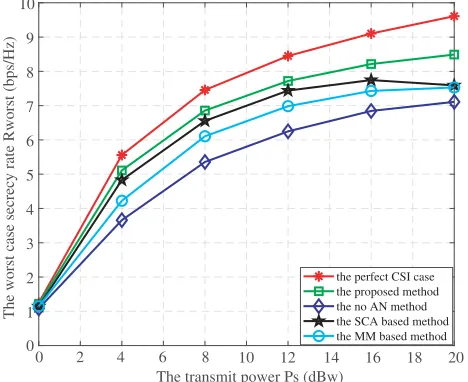
Secondly, in Fig. 3, we show the worst case secrecy rate Rworst versus the source transmit power
Ps. From this figure, we can see that our proposed method achieves better performance than the other methods. In addition, the performance gaps among the four methods with the perfect CSI case become larger with the increase ofPs, while the SCA method tends to decrease in respectively highPs region. Furthermore, in Fig. 4, we show the worst case secrecy rateRworst versus the channel uncertainty level. The proposed method achieves better performance than other methods. For all these methods,
The number of iterations 0.5
1 1.5 2 2.5 3 3.5 4 4.5
The worst case secrecy rate Rworst (bps/Hz)
channel1 channel2 channel3 channel4
1 2 3 4 5 6 7 8
Figure 2. The convergency versus the iterative numbers.
10 12 14 16 18 20
The transmit power Ps (dBw) 0
1 2 3 4 5 6 7 8 9 10
The worst case secrecy rate Rworst (bps/Hz)
the perfect CSI case the proposed method the no AN method the SCA based method the MM based method
0 2 4 6 8
The channel uncertainty level 2
3 4 5 6 7 8
The worst case secrecy rate Rworst (bps/Hz)
the proposed method the no AN method the SCA based method the MM based method
1 2 3 4 5 6 7 8 9
-6
× 10
Figure 4. The worst case secrecy rate versus the uncertainty level.
The number of iterations (BTI) 0
0.5 1 1.5 2 2.5 3 3.5 4 4.5
The outage secrecy rate Rout (bps/Hz) channel1 channel2 channel3 channel4
1 2 3 4 5 6 7 8
Figure 5. The BTI convergency versus the iterative numbers.
Rworst tends to decrease with the increase of the channel uncertainty level, which shows the impact of the channel uncertainty on the secrecy performance.
5.2. Outage Secrecy Performance
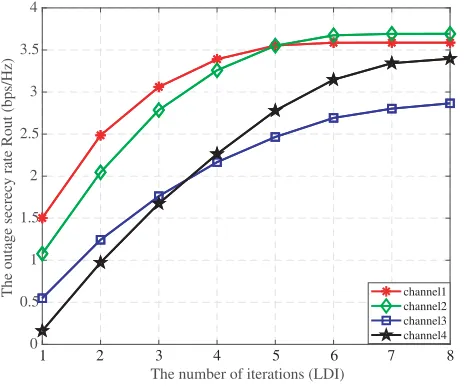
Firstly, in Fig. 5 and Fig. 6, we show the convergency of the proposed BTI and LDI methods with random channel realization. Similarly with the previous AO method, both the BTI and LDI methods can be convergent in limited AO numbers.
The number of iterations (LDI) 0
0.5 1 1.5 2 2.5 3 3.5 4
The outage secrecy rate Rout (bps/Hz) channel1 channel2 channel3 channel4
1 2 3 4 5 6 7 8
Figure 6. The LDI convergency versus the iterative numbers.
The transmit power Ps (dBw) 0
1 2 3 4 5 6 7 8 9 10
The outage secrecy rate Rout (bps/Hz)
the perfect CSI case the BTI method the LDI method the no AN method the MM based method
10 12 14 16 18 20
0 2 4 6 8
Figure 7. The outage secrecy rate versus the source transmit power.
1 2 3 4 5 6 7 8
The outage secrecy rate Rout (bps/Hz)
the BTI method the LDI method the no AN method the MM based method
The channel uncertainty level
1 2 3 4 5 6 7 8 9
-6
× 10
Figure 8. The outage secrecy rate versus the uncertainty level.
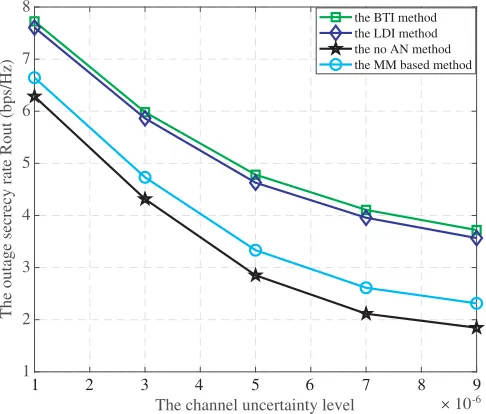
Lastly, in Fig. 8, we show the outage secrecy rateRout versus channel uncertainty level. From this figure, we can see that the gap between BTI and LDI methods is tiny. However, the performance loss for the no AN method is quite large, which suggests the necessity of AN again.
6. CONCLUSION
In this paper, we have investigated both WC and OC robust secrecy designs in MIMO wiretap WSNs. To solve the WC design, we propose to linearize log-det terms in the secrecy rate expression. After linearization, we tackle the CSI uncertainty based on epigraph reformulation and the Nemirovski lemma. Then, an AO algorithm is designed to solve the reformulated problem. Furthermore, to solve the OC design, we transform the probabilistic constraint into tractable approximation by the BTI and LDI. Numerical results are provided to demonstrate the performance of the proposed scheme.
7. FUNDING
The author(s) disclosed receipt of the following financial support for the research, authorship, and/or publication of this article: This work was part supported by the National Natural Science Foundation of China under Grant No. 61673108, part supported by the Colleges and Universities Natural Science Foundation in Jiangsu Province under contracts No. 18KJB510010 and No. 19KJA110002, part supported by the industry-university-research cooperation project of Jiangsu province under Grant No. BY2018282, part supported by the Open Project Program of the Key Laboratory of Underwater Acoustic Signal Processing, Ministry of Education, China under contracts No. UASP1801, and part supported by the Fundamental Research Funds for the Central Universities under contracts No. 2242016K30013.
REFERENCES
1. Choi, K. W., L. Ginting, P. A. Rosyady, A. A. Aziz, and D. I. Kim, “Wireless-powered sensor networks: How to realize,” IEEE Trans. Wireless Commun., Vol. 16, No. 1, 221–234, Jan. 2017. 2. Ruan, T., Z. Chew, and M. Zhu, “Energy-aware approaches for energy harvesting powered wireless
3. Wu, J., K. Ota, M. Dong, and C. Li, “A hierarchical security framework for defending against sophisticated attacks on wireless sensor networks in smart cities,” IEEE Access, Vol. 4, 416–424, Jan. 2016.
4. Deng, Y., L. Wang, M. Elkashlan, A. Nallanathan, and R.K. Mallik, “Physical layer security in three-tier wireless sensor networks: A stochastic geometry approach,” IEEE Trans. Inf. Forensics
Security, Vol. 11, No. 6, 1128–1138, Jan. 2016.
5. Liu, Y., H.-H. Chen, and L. Wang, “Physical layer security for next generation wireless networks: Theories, technologies, and challenges,”IEEE Commun. Surveys Tutorials, Vol. 19, No. 1, 347–376, First Quarter, 2017.
6. Khisti, A. and G. W. Wornell, “Secure transmission with multiple antennas — Part II: The MIMOME wiretap channel,” IEEE Trans. Inf. Theory, Vol. 56, No. 11, 5515–5532, Nov. 2010. 7. Oggier, F. and B. Hassibi, “The secrecy capacity of the MIMO wiretap channel,”IEEE Trans. Inf.
Theory, Vol. 57, No. 8, 4961–4972, Aug. 2011.
8. Li, Q., M. Hong, H.-T. Wai, Y.-F. Liu, W.-K. Ma, and Z.-Q. Luo, “Transmit solutions for MIMO wiretap channels using alternating optimization,” IEEE J. Sel. Areas Commun., Vol. 31, No. 9, 1714–1727, Sep. 2013.
9. Fakoorian, S. A. A. and A. L. Swindlehurst, “Full rank solutions for the MIMO Gaussian wiretap channel with an average power constraint,” IEEE Trans. Signal Process., Vol. 61, No. 10, 2620– 2631, May 2013.
10. Loyka, S. and C. D. Charalambous, “An algorithm for global maximization of secrecy rates in gaussian MIMO wiretap channels,” IEEE Trans. Commun., Vol. 63, No. 6, 2288–2299, Jan. 2015. 11. Shi, Q.-J., W.-Q. Xu, J.-S. Wu, E.-B. Song, and Y.-M. Wang, “Secure beamforming for MIMO broadcasting with wireless information and power transfer,” IEEE Trans. Wireless Commun., Vol. 14, No. 5, 2841–2853, May 2015.
12. Lee, H., C. Song, J. Moon, and I. Lee, “Precoder designs for MIMO Gaussian multiple access wiretap channels,” IEEE Trans. Veh. Tech., Vol. 66, No. 9, 8563–8568, Sep. 2017.
13. Masood, M., A. Chrayeb, P. Babu, I. Khalil, and M. Hasna, “A minorization-maximization algorithm for maximizing the secrecy rate of MIMOME wiretap channel,” IEEE Commun. Lett., Vol. 21, No. 3, 520–523, Mar. 2017.
14. Cumanan, K., Z. Ding, B. Sharif, G. Y. Tian, and K. K. Leung, “Secrecy rate optimizations for a MIMO secrecy channel with a multiple-antenna eavesdropper,”IEEE Trans. Veh. Tech., Vol. 63, No. 4, 1678–1690, May 2014.
15. Chu, Z., K. Cumanan, Z. Ding, M. Johnston, and S. Y. Le Goff, “Secrecy rate optimizations for a MIMO secrecy channel with a cooperative jammer,” IEEE Trans. Veh. Tech., Vol. 64, No. 5, 1833–1847, May 2015.
16. Wang, S.-H. and B.-Y. Wang, “Robust secure transmit design in MIMO channels with simultaneous wireless and information power,”IEEE Signal Process. Lett., Vol. 22, No. 11, 2147–2151, Nov. 2015. 17. Zhu, Z., Z. Chu, N. Wang, S. Huang, Z. Wang, and I. Lee, “Beamforming and power splitting designs for AN-aided secure multi-user MIMO SWIPT systems,” IEEE Trans. Inf. Forensics
Security, Vol. 12, No. 12, 2861–2874, Dec. 2017.
18. Jiang, M., Y. Li, Q. Zhang, Q. Li, and J. Qin, “Robust secure beamforming in MIMO wiretap channels with deterministically bounded channel errors,”IEEE Trans. Veh. Tech., Vol. 67, No. 10, 9775–9784, Oct. 2018.
19. Li, Q., W.-K. Ma, and A. M. Cho, “A safe approximation approach to secrecy outage design for MIMO wiretap channels,” IEEE Signal Process. Lett., Vol. 21, No. 1, 118–121, Jun. 2014.
20. Chu, Z., K. Cumanan, Z. Ding, M. Johnston, and S. L. Goff, “Robust outage secrecy rate optimizations for a MIMO secrecy channel,” IEEE Wireless Commun. Lett., Vol. 4, No. 1, 86– 89, Jun. 2015.
21. Wu, W. and B. Wang, “Efficient transmission solutions for MIMO wiretap channels with SWIPT,”
22. Khandaker, M. R. A. and K.-K. Wong, “Robust secrecy beamforming for MIMO SWIPT with probabilistic constraint,”Proc. IEEE Globecom Workshops, 1–6, Dec. 2016.
23. Yuan, Y. and Z. Ding, “Outage constrained secrecy rate maximization design with SWIPT in MIMO-CR systems,” IEEE Trans. Veh. Tech., Vol. 67, No. 6, 5475–5480, Jun. 2018.
24. Eldar, Y. C., A. Ben-Tal, and A. Nemirovski, “Robust mean-squared error estimation in the presence of model uncertainties,”IEEE Trans. Signal Process., Vol. 53, No. 1, 168–181, Jan. 2005. 25. Ben-Tal, A., L. E. Ghaoui, and A. Nemirovski, Robust Optimization, Princeton Univ. Press,
Princeton, NJ, USA, 2009.
26. Bechar, I., “A Bernstein-type inequality for stochastic processes of quadratic forms of Gaussian variables,” avaiable online at http://arxiv.org/abs/0909.3595, Sep. 2009.
27. Wang, K.-Y., A. M.-C. So, T.-H. Chang, W.-K. Ma, and C.-Y. Chi, “Outage constrained robust transmit optimization for multiuser MISO downlinks: Tractable approximations by conic optimization,” IEEE Trans. Signal Process., Vol. 62, No. 21, 5690–5705, Nov. 2014.