
Copyright © 2001, American Society for Microbiology. All Rights Reserved.
Induction of Mucosal Immune Response after Intranasal or Oral
Inoculation of Mice with
Lactococcus lactis
Producing
Bovine Beta-Lactoglobulin
JEAN-MARC CHATEL,1PHILIPPE LANGELLA,2* KARINE ADEL-PATIENT,1
JACQUELINE COMMISSAIRE,2JEAN-MICHEL WAL,1 ANDG´ERARD CORTHIER3
Unite´ d’Immuno-Allergie Alimentaire INRA-CEA, Service de Pharmacologie et d’Immunologie, Bat 136 CEA Saclay,
91191 Gif sur Yvette,1and Unite´ de Recherches Laitie`res et de Ge´ne´tique Applique´e2and Unite´ d’Ecologie
et de Physiologie du Syste`me Digestif,3INRA, 78352 Jouy en Josas, France
Received 30 May 2000/Returned for modification 19 September 2000/Accepted 6 February 2001
The bovine beta-lactoglobulin (BLG) is a major cow’s milk allergen. Here, we evaluated the immune
response against BLG induced in mice, using the organismLactococcus lactis,which has GRAS (“generally
regarded as safe”) status, as a delivery vehicle. The cDNA of theblggene, encoding BLG, was expressed and
engineered for either intra- or extracellular expression inL. lactis. Using a constitutive promoter, the yield of
intracellular recombinant BLG (rBLG) was about 20 ng per ml of culture. To increase the quantity of rBLG, the nisin-inducible expression system was used to produce rBLG in the cytoplasmic and extracellular locations.
Although the majority of rBLG remained in the cytoplasm, the highest yield (2g per ml of culture) was
obtained with a secreting strain that encodes a fusion between a lactococcal signal peptide and rBLG. Whatever the expression system, the rBLG is produced mostly in a soluble, intracellular, and denatured form. The BLG-producing strains were then administered either orally or intranasally to mice, and the immune response to BLG was examined. Specific anti-BLG immunoglobulin A (IgA) antibodies were detected 3 weeks after the immunization protocol in the feces of mice immunized with the secreting lactococcal strain. Specific anti-BLG IgA detected in mice immunized with lactococci was higher than that obtained in mice immunized with the same quantity of pure BLG. No specific anti-BLG IgE, IgA, IgG1, or IgG2a was detected in sera of mice. These recombinant lactococcal strains constitute good vehicles to induce a mucosal immune response to a model allergen and to better understand the mechanism of allergy induced by BLG.
The gastrointestinal tract is constantly exposed to substantial amounts of food and bacterial components. In the healthy gut, the immune system is able to create a balance between muco-sal immunity and systemic tolerance. In food allergy, this bal-ance is impaired and oral tolerbal-ance to dietary antigen is not achieved or maintained (14, 19, 29). Cow’s milk allergy is an important problem in infants because it affects 1.9 to 2.8% of infants in the first 2 years of life in various countries of north-ern Europe (17, 18). Beta-lactoglobulin (BLG) is the most abundant protein of the whey fraction of milk and is regarded as a dominant allergen together with casein (37). In our labo-ratory, we use BLG as a model protein to evaluate and mod-ulate the immune response to a food allergen in mice, and we have produced both anti-BLG monoclonal antibodies (MAb) (25) and recombinant BLG inEscherichia coli(8). Moreover, the BLG structure is well documented (27); it is a 162-amino-acid globular protein which contains two intramolecular disul-fide bonds. In this study, we produced BLG in Lactococcus
lactis, a food-grade bacterium, and used these recombinant
strains to measure a potential specific immune response after intranasal or oral administration in mice.
L. lactisis a gram-positive lactic acid bacterium that is
non-pathogenic, noninvasive, and noncolonizing and that has GRAS (“generally regarded as safe”) status. Its use as a vaccine de-livery system (for a review, see reference 39) using tetanus toxin fragment C (TTFC) (40) has been previously reported. Parenteral, intranasal, or oral vaccination of mice with recom-binantL. lactiscan elicit levels of systemic serum Ab against tetanus toxin which protect against subsequent challenge with otherwise lethal quantities of tetanus toxin (26, 28, 40). Con-sidering its potential as an antigen delivery system for mucosal immunization, we decided to evaluate the immune response of mice after intranasal or oral administration of recombinant
L. lactisproducing BLG. We thought that such tools would be
helpful to study and perhaps modulate the specific immuno-globulin E (IgE) response induced by BLG. BLG was previ-ously expressed in E. coli (4, 7, 8), but this gram-negative bacterium contains lipopolysaccharides which enhance the in-flammation process, and some strains are pathogenic for hu-mans and animals.
We constructed strains ofL. lactis producing recombinant bovine BLG (rBLG). Both intra- and extracellular locations of rBLG were assessed using the nisin-inducible expression sys-tem (9, 10). The highest production was obtained when the mature part of BLG was fused to the signal peptide of the majorL. lactissecreted protein Usp45 (34). The recombinant allergen was detected predominantly in a soluble, intracellular, and mostly denatured form in the different constructs. BLG-specific fecal IgA Ab were detected in mice 3 weeks after oral * Corresponding author. Mailing address: Unite´ de Recherches
Lai-tie`res et de Ge´ne´tique Applique´e, INRA, 78352 Jouy en Josas, France. Phone: 33(0)1 34 65 20 83. Fax: 33(0)1 34 65 20 65. E-mail: langella @biotec.jouy.inra.fr.
545
on August 17, 2020 by guest
http://cvi.asm.org/
or intranasal administration of the lactococcal BLG-secreting strain. BLG-specific IgE, IgA, IgG1, or IgG2a Ab were not detected in sera of the same mice. Here, we demonstrated that recombinant lactococci constitute good tools to induce a mu-cosal immune response against BLG after intranasal or oral administration to mice.
MATERIALS AND METHODS
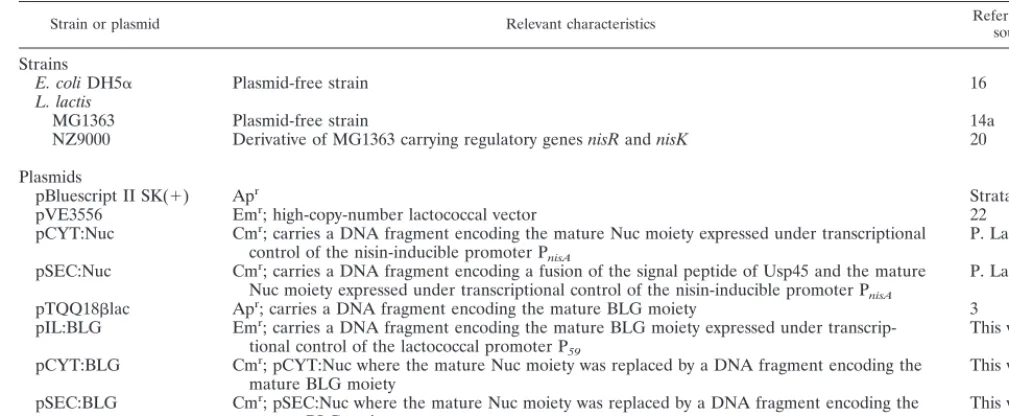
Bacterial strains, plasmids, and growth conditions.The strains and plasmids used in this study are listed in Table 1.L. lactisstrains were grown at 30°C in M17 medium containing 0.5% glucose (32).E. colistrains were grown in Luria-Bertani medium at 37°C with vigorous shaking. When required, antibiotics were added at the following concentrations, except when otherwise stated: ampicillin, 50g/ml; chloramphenicol, 25g/ml forE. coliand 10g/ml forL. lactis; and erythromycin, 5g/ml.
General DNA techniques, PCR, and transformation.Plasmid DNA was iso-lated essentially as described previously (5). ForL. lactis,cells were incubated in TES [N-tris(hydroxymethyl)methyl-2-aminoethanesulfonic acid] buffer contain-ing 10 mg of lysozyme per ml at 37°C for 10 min before alkaline lysis. Restriction enzymes and T4 DNA ligase (Gibco BRL or New England Biolabs) were used according to the instructions of the suppliers. PCR was performed with a Perkin-Elmer Cetus (Norwalk, Conn.) thermocycler. Electrotransformation ofL. lactis was performed as described previously (21), and transformants were plated on M17–0.5% glucose agar plates containing the required antibiotic.
Construction of expression plasmids carrying theblggene. (i) Cloning ofblg
under the control of a constitutive lactococcal promoter.A 550-bp DNA frag-ment encoding the entire mature BLG under the translational control of anE. coliribosome-binding site (RBS) was purified afterEcoRI digestion of plasmid pTTQ18lac.7.7.1 (kindly provided by C. Batt) (4). Thisblg gene was then inserted downstream of the strongL. lactisconstitutive promoter P59(36) by
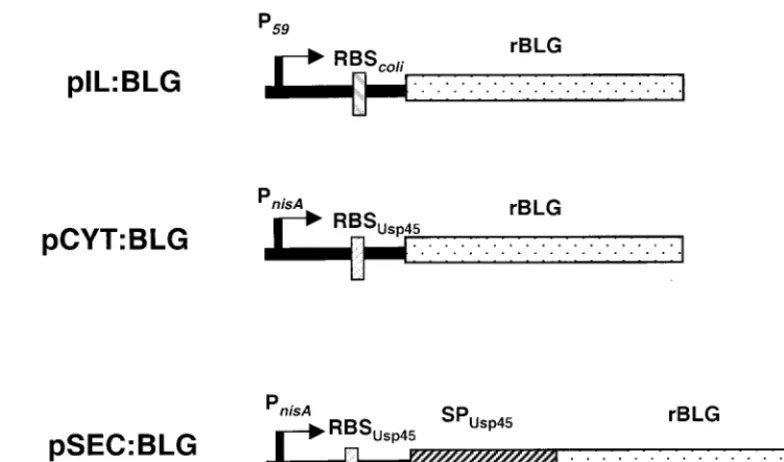
cloning the fragment in anEcoRI-linearized plasmid, pVE3556 (22). The ligation mix was then used to transformL. lactisMG1363. The structure of the resulting plasmid, pIL:BLG (Fig. 1), was confirmed by restriction enzyme digestion and DNA sequencing. pIL:BLG was then introduced intoL. lactisNZ9000 (kindly provided by Oscar Kuipers) (20) to be comparable to other inducible construc-tions (see description below).
(ii) Cloning ofblgunder the control of a nisin-inducible promoter.Theblg gene was amplified from pTTQ18lac.7.7.1 (4) using primers BLGLacF (GCC CAATGCATTGGTTCTGATCGTTACCCAGACC) and BLGLacR (GCGCTC GAGGCGCTAGATGTGGCACTGCTC), adding anNsiI site (italicized) at the N terminus of BLG and anXhoI site (italicized) at the C terminus of BLG. This PCR fragment encoded a BLG fragment starting at position Leu17of the
com-plete protein. The amplified sequence was inserted inSrfI-linearized pPCR-Script Amp SK (⫹) plasmid as described by the supplier (Stratagene, La Jolla, Calif.). The clone, named BLG-Lacto-pPCR-Script 4.1, was confirmed by DNA sequencing (MWG Biotech, Ebersberg, Germany). The expression plasmids pCYT:Nuc and pSEC:Nuc (P. Langella et al., unpublished data), which allow cloning of theblggene under the control of theL. lactisinducible promoter PnisA,
are described in Table 1. Briefly, pSEC:Nuc and pCYT:Nuc are derivatives of pNZ8010 (kindly provided by Oscar Kuipers) (9, 10) (Table 1), in which thegus gene was under the transcriptional control of the promoter ofnisA,PnisA. Thegus
gene was first deleted byXhoI digestion and replaced by aBamHI-XhoI-cut DNA fragment encoding the RBS, the signal peptide of theusp45gene product (34) and the mature part of the staphylococcal nuclease protein (22) to obtain the plasmid pSEC:Nuc. This construct allowed us to direct expression of BLG in a secreted form. By using reverse PCR, the DNA fragment encoding the signal peptide of Usp45 was also deleted to obtain pCYT, thus allowing BLG expres-sion in the cytoplasm. AnNsiI site was introduced at the 3⬘end of the RBS of Usp45 to allow the replacement of part of thenucgene segment by a DNA fragment encoding a heterologous protein. pCYT:BLG and pSEC:BLG were constructed by inserting theblggene in pCYT:Nuc and pSEC:Nuc expression vectors (Fig. 1), as follows. In parallel, pCYT:Nuc, pSEC:Nuc, and BLG-Lacto-pPCR-Script 4.1 were digested byNsiI andXhoI. Both double-digested vectors and the insert containing the BLG sequence were purified, and the insert and vector were ligated and electroporated in E. colistrain DH5␣(16). Clones containing the BLG sequence were selected by PCR and digestion with restric-tion enzyme. Plasmids were introduced by electroporarestric-tion intoL. lactisstrain NZ9000 containing on its chromosomenisRandnisK,the two regulatory genes of PnisA, which allows induction of the synthesis of foreign proteins in a
dose-dependent manner and the attainment of high-level production. Plasmids iso-lated from the resulting strains, NZ9000(pCYT:BLG) and NZ9000(pSEC:BLG), were confirmed by DNA sequencing.
Purification of BLG from cow’s milk.Natural BLG was purified from the milk of a single cow homozygous for the variant A of BLG as described by Wal et al. (38) and here is considered to be BLG in the native conformation (BLGn). Reduced and carboxymethylated BLG (BLGrcm) was prepared from BLGn as described by Negroni et al. (25) by a method slightly modified from that of McKenzie et al. (24) and here is considered to be BLG in the denatured conformation (BLGd).
Two-site enzyme immunometric assay for BLGn and BLGd.Anti-BLG MAb production and characterization and development of the two-site enzyme immu-nometric assays for BLGn and BLGd were described by Negroni et al. (25). Briefly, assays were performed in 96-well microtiter plates (Maxisorp; Nunc, Roskilde, Denmark) coated with a first MAb (capture antibody) specific for either BLGn or BLGrcm (BLGd). Fifty microliters of standard (BLGn or BLGrcm) or sample and 50l of tracer, which consists of a second MAb labeled
pSEC:Nuc Cm; carries a DNA fragment encoding a fusion of the signal peptide of Usp45 and the mature Nuc moiety expressed under transcriptional control of the nisin-inducible promoter PnisA
P. Langella
pTQQ18lac Apr; carries a DNA fragment encoding the mature BLG moiety 3 pIL:BLG Emr; carries a DNA fragment encoding the mature BLG moiety expressed under
transcrip-tional control of the lactococcal promoter P59
This work
pCYT:BLG Cmr; pCYT:Nuc where the mature Nuc moiety was replaced by a DNA fragment encoding the
mature BLG moiety This work
pSEC:BLG Cmr; pSEC:Nuc where the mature Nuc moiety was replaced by a DNA fragment encoding the
mature BLG moiety This work
aUnite´ de Recherches Laitie`res et Ge´ne´tique Applique´e, Institut National de la Recherche Agronomique, Jouy en Josas, France.
on August 17, 2020 by guest
http://cvi.asm.org/
with acetylcholinesterase (AChE) (15), a conjugate recognizing either BLGn or BLGrcm, were then added. Capture and tracer Ab are directed against different complementary epitopes. After 18 h of reaction at 4°C, the plates were washed and solid-phase-bound AChE activity was measured using the method of Ellman et al. (12). Detection limits of 30 and 200 pg/ml were obtained for BLGn and BLGrcm, respectively, with very low or negligible cross-reactivity of the other milk proteins or tryptic fragments of BLG. Cross-reactivity of the BLGn assay with BLGrcm is 0.4%, and cross-reactivity of the BLGrcm assay with BLGn is 0.018%.
SDS-PAGE and immunoblot analysis.Sodium dodecyl sulfate-polyacrylamide gel electrophoresis (SDS-PAGE) analysis was performed using a Tricine buffer as described by Schagger and von Jagow (30). For immunoblot analysis, proteins were separated by SDS–12% PAGE and electroblotted (33) onto a polyvinyli-dene difluoride membrane (Millipore, Bedford, Mass.). After blotting, nonspe-cific protein-binding sites were blocked with 1% bovine serum albumin in 50 mM Tris-HCl (pH 8)–150 mM NaCl–0.5% Tween 20. The nylon membranes were incubated overnight with a 1/100,000 dilution of MAb specific for BLGrcm (BLG-74R) (25). After washing, the membranes were incubated for 1 h with alkaline phosphatase-conjugated anti-mouse antibody (1/5,000) (Jackson Immu-noResearch Laboratories, West Grove, Pa.). Color development was obtained according to the supplier’s instructions.
L. lactisprotein extraction.Overnight cultures of strains NZ9000(pIL:BLG), NZ9000(pCYT:BLG), and NZ9000(pSEC:BLG) were used to inoculate fresh medium at a dilution of 1:250. For induction of thenisApromoter, strains were grown to an optical density at 600 nm of 0.5, and nisin (Sigma, St. Louis, Mo.) was added to a final concentration of 10 ng/ml. Growth was continued for 1 h. For strain NZ9000(pIL:BLG), growth was continued without addition of nisin until an optical density at 600 nm of 1.0 was reached. To prepare extracts, cells were pelleted by centrifugation at 5,000⫻gfor 15 min at 4°C and the superna-tant (S) was collected. The soluble cytoplasmic protein (Cs) was extracted by disrupting cells with glass beads resuspended in 1/10 of the initial volume of 50 mM Tris-HCl, pH 7.4. Extracts were then centrifuged at 10,000⫻gfor 15 min at 4°C. The supernatant corresponding to Cs was collected, and the pellet was resuspended in 1/10 of the initial volume of 50 mM Tris-HCl (pH 7.4)–8 M urea–100 mM dithiothreitol for 1 h at room temperature. After centrifugation at 10,000⫻gfor 15 min at room temperature, the supernatant containing resolu-bilized insoluble cytoplasmic protein (Ci) was collected and then dialyzed against 50 mM Tris-HCl, pH 7.4. The amounts of BLGn and BLGd in the S, Cs, and Ci preparations were assayed using the two immunoassays described above.
Immunizations.Recombinant strain NZ9000(pSEC:BLG) and control strain NZ9000(pSEC:Nuc) were grown as described above and induced for 1 h with nisin. Cells were pelleted, resuspended in sterile phosphate-buffered saline
(PBS) to obtain the same concentration of cells for each strain, aliquoted, and frozen at⫺80°C. Yields of rBLGn and rBLGd in one aliquot were determined as described above. Groups of four mice were immunized orally or intranasally with the induced recombinant strain, the induced control strain, and BLGrcm in PBS. Oral doses of 15g of BLGrcm, the quantity of cells of NZ9000(pSEC: BLG) corresponding to 15g of BLGrcm, and the same quantity of cells of NZ9000(pSEC:Nuc), in 150l of suspension, were administered intragastrically on days 1, 2, and 3. Intranasal doses of 1.5g of BLGrcm, the quantity of cells from NZ9000(pSEC:BLG) corresponding to 1.5g of BLGrcm, or the same quantity of cells from the control strain were slowly administered to mice in 15
l of suspension on days 1, 2, and 3. Serum samples and fecal pellets were taken on days 0 and 19.
ELISA for the detection of BLG-specific serum antibody.The enzyme-linked immunosorbent assay (ELISA) was previously described in detail by Adel-Pa-tient et al. (1). Briefly, 96-well microtiter plates (Maxisorp; Nunc) coated with 5
g of BLGrcm per ml were incubated overnight with serial dilutions of sera from immunized mice. After washing, IgE, IgG1, or IgG2a binding was revealed by incubation with a rat anti-mouse IgE MAb (clone LOME-3) from Serotec (Ox-ford, England) or a goat anti-mouse IgG1 or goat anti-mouse IgG2a polyclonal affinity-purified Ab (Southern Biotechnology Associates, Birmingham, Ala.) la-beled with AChE (15). AChE activity was detected using the method of Ellman et al. (12) by reading absorbance at 414 nm. The minimum detectable concen-trations are 8 pg/ml for IgE, 7 pg/ml for IgG1, and 12 pg/ml for IgG2a.
Measurement of fecal and serum IgA response.Fresh fecal pellets were col-lected at days 0 and 19 from groups of mice that had been immunized intrana-sally or orally. Fecal pellet (0.1 g) was added to 1 ml of PBS containing 1% bovine serum albumin, 50g of bacitracin per ml, 300g of benzamidine per ml, 80g of leupeptin per ml, 20g of chymostatin per ml, 25g of pepstatin per ml, and 200M phenylmethylsulfonyl fluoride (Sigma) and incubated on rotary shaker overnight at 4°C. The tubes were vortexed to disrupt all solid material and then centrifuged at 16,000⫻gfor 5 min at 4°C. The supernatant was removed and tested by ELISA for the presence of BLG-specific IgA as described above. IgA was detected using a goat polyclonal serum anti-mouse IgA (Southern Biotechnology Associates) labeled with AChE (15) and detected as described above. The same assay was used to evaluate specific IgA in serum.
RESULTS
Growth ofL. lactisproducing BLG depends on the
expres-sion system.To produce rBLG inL. lactis, the cDNA of theblg
gene was cloned in L. lactisMG1363 or NZ9000 under the FIG. 1. Schematic representation of the three expression vectors. P59, lactococcal constitutive promoter; PnisA, inducible lactococcal promoter;
RBScoliand RBSUsp45, consensual RBSs ofE. coliand Usp45, respectively; stippled bars, DNA fragment encoding the mature BLG; hatched bar, DNA fragment encoding the signal peptide of Usp45 (SPUsp45).
on August 17, 2020 by guest
http://cvi.asm.org/
control of P59, a strongL. lactisconstitutive promoter (35), on pIL, a high-copy-number plasmid, resulting in pIL:BLG (Fig. 1). To achieve inducible expression ofblg,the nisin-inducible promoter PnisAwas used to promote intracellular BLG expres-sion on plasmid pCYT:BLG (Fig. 1). To obtain a secreted form of BLG, theblggene fragment was also fused in frame with the signal sequence of Usp45, the majorL. lactissecreted protein (33), and placed under the control of PnisA, resulting in pSEC: BLG (Fig. 1). These two plasmids were introduced intoL. lac-tis, resulting in strains NZ9000(pCYT:BLG) and NZ9000 (pSEC:BLG). Growth of the three strains was monitored with-out nisin for NZ9000(pIL:BLG) and with or withwith-out nisin for the inducible strains (Fig. 2). The growth of strain NZ9000 (pIL:BLG) was similar to the growth of the inducible strains in the absence of nisin. Addition of nisin led to a marked decrease in the growth of strains NZ9000(pCYT:BLG) and NZ9000(pSEC:BLG), suggesting a disadvantage due to the induction of the production of rBLG.
The fusion with a lactococcal signal peptide leads to the
highest rBLG production in L. lactis. For the three strains,
rBLG was assayed using specific immunoassays for BLG in the native (rBLGn) or denatured (rBLGd) conformation in the supernatant fraction (S) and the soluble (Cs) and insoluble (Ci) cellular fractions (Table 2). Total production of rBLG was calculated by adding the amounts of rBLGn and rBLGd in S, Cs, and Ci for each strain. The values given in Table 2 repre-sent the means and standard deviations from five independent experiments. Total production was 20.3⫾3.2 ng/ml, 121⫾28 ng/ml, and 1,906 ⫾ 355 ng/ml of culture for strain NZ9000 containing pIL:BLG, pCYT:BLG, and pSEC:BLG, respec-tively (Table 2).
rBLG was found only in the supernatant of NZ9000(pSEC: BLG), which encodes the fusion between the signal peptide of Usp45 and rBLG. We measured 50 ng of rBLG per ml, se-creted as 92% rBLGd and 8% rBLGn. Sese-creted rBLG repre-sented 3% of the synthesized rBLG.
rBLG was found preferentially in soluble form for the three strains. Nevertheless, in the most productive strain, NZ9000 (pSEC:BLG), rBLG in Ci reached 20% of the total rBLG.
In Cs, rBLG can be either in a native or in a denatured conformation. rBLG in the denatured conformation
repre-sents 90, 98, and more than 99% of rBLG measured in Cs in strains NZ9000(pIL:BLG), NZ9000(pCYT:BLG), and NZ9000 (pSEC:BLG), respectively. The level of rBLG in the denatured conformation in Cs increased in parallel to rBLG production.
The precursor preUsp:rBLG is weakly processed.
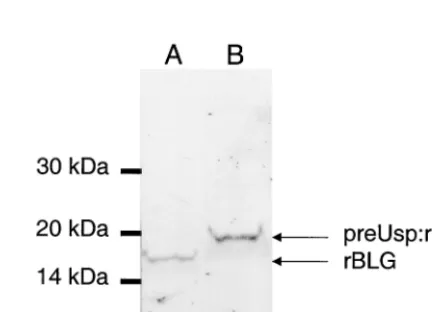
Produc-tion of rBLG was induced in strains NZ9000(pCYT:BLG) and NZ9000(pSEC:BLG) as described above. The BLG protein content of total cell extracts was analyzed by Western blot experiments using MAb specific for BLGd. rBLG produced by NZ9000(pCYT:BLG) migrated at the same distance as the native BLG (not shown), corresponding to around 18,000 Da, whereas a larger band was detected in NZ9000(pSEC:BLG) (Fig. 3). The size of this protein form corresponds to around 21,000 Da, which is the size expected for the intracellular FIG. 2. Growth curves of different strains expressing rBLG. Growth
was measured in terms of absorbance units at 600 nm (AU600). Induc-ible strains were grown with or without nisin.‚, NZ9000(pIL:BLG); , NZ9000(pCYT:BLG); F, NZ9000(pSEC:BLG); ⽧, NZ9000 (pCYT:BLG) plus nisin;䡺, NZ9000(pSEC:BLG) plus nisin.
FIG. 3. Production of rBLG in L. lactis. rBLG production was analyzed by Western blotting of induced cultures ofL. lactisNZ9000 strains containing pCYT:BLG (lane A) (encoding the cytoplasmic form) or pSEC:BLG (lane B) (encoding the secreted form). Immuno-blotting of total cell extracts of these strains was performed after 1 h of induction as described in Materials and Methods. A MAb specific for BLGd was used as the first antibody. We used different quantities of total extract to obtain comparable signals. Migration positions of the molecular mass markers are given on the left. Migration positions of precursor form (preUsp:rBLG) and mature form (rBLG) are indicated by arrows.
aThe limits of detection for BLGn and BLGd are, respectively, 30 and 200
pg/ml. Immunoassays were conducted during exponential growth for the consti-tutive promoter and after 1 h of induction by nisin for the inducible one.
bValues given represent the means⫾standard deviations from five
indepen-dent experiments.
cND, not detectable.
on August 17, 2020 by guest
http://cvi.asm.org/
precursor form preUsp:rBLG containing the signal peptide of Usp45, suggesting a very weak cleavage of the preUsp:rBLG. The same profile was obtained with different MAb recognizing different linear epitopes of BLG. A degradation band was never observed.
Mucosal antibody response. Groups of four mice were
in-oculated intranasally or orally with recombinant strain NZ9000 (pSEC:BLG), strain NZ9000(pSEC:Nuc) as a control strain, or purified denatured BLG. Three weeks after immunization, fresh fecal pellets from mice immunized intranasally or orally with NZ9000(pSEC:BLG) elicited a high BLG-specific muco-sal IgA response (Fig. 4). The specific response intensity ob-tained with strain NZ9000(pSEC:BLG) was higher after oral than after intranasal administration (P ⬍ 0.05 [t test]). In contrast, sera from immunized mice did not contain significant levels of BLG-specific IgA, IgG1, IgG2a, or IgE (data not shown). This suggests that the IgA response is located only at the mucosal level. Intranasal or oral administration of BLGrcm elicited a very low BLG-specific IgA level equivalent to that of naive mice, which represents nonspecific back-ground. Though slightly higher, the response obtained with the control strain was of the same order as that in naive mice, although it was higher after intranasal administration than after oral administration(P⬎0.05 [ttest]).
DISCUSSION
In this paper, we describe for the first time the induction of a mucosal BLG-specific immune response in mice immunized with recombinant L. lactisBLG producer strains. We deter-mined the type and the localization of immune response elic-ited in mice after administration ofL. lactisproducing BLG. Our long-term goal is to study and perhaps modulate immune responses to food allergens with BLG as the protein model and recombinantL. lactisstrains as the delivery vehicle.
For this purpose, three rBLG-producing L. lactis strains were constructed to produce rBLG in cytoplasmic and extra-cellular locations under the control of a constitutive or an inducible promoter. The rates of growth of the three stains
were very different and correlated with rBLG production. The lowest and highest rBLG production was obtained withL. lac-tis strains NZ9000(pIL:BLG) and NZ9000(pSEC:BLG), re-spectively. In strain NZ9000(pIL:BLG), rBLG was detected intracellularly at a very low level in spite of the use of a high-copy-number cloning vector and of P59, a strong lactococcal constitutive promoter. This low production is probably due to the use of anE. coliRBS that did not allow efficient translation
inL. lactis. To increase the production of rBLG, the E. coli
RBS was replaced by the RBS of theL. lactissecreted protein Usp45 and theblggene was placed under the transcriptional control of the nisin-inducible promoter PnisA. In strain NZ9000 (pSEC:BLG), theblggene was fused to the signal peptide of Usp45. These modifications led to a dramatic enhancement of the production of rBLG compared to the constitutive produc-tion: 16- and 95-fold compared to inducible and constitutive intracellular production, respectively. Our hypothesis to ex-plain this enhancement is that the precursor preUsp:rBLG could be more efficiently translated in NZ9000(pSEC:BLG) than the intracellular forms of rBLG produced in NZ9000 (pIL:BLG) or NZ9000(pCYT:BLG). These forms remain in-side the cells as aggregates close to the translation machinery and would congest it. Furthermore, the recognition of preUsp: rBLG by the machinery of secretion ofL. lactiscould allow it to escape intracellular proteolysis even if no degradation band was observed. The same observations have also been recently made in the case of production inL. lactisof the nonstructural protein NSP4 of bovine rotavirus (13) and of the Brucella
abortus ribosomal protein L7/L12 (L. Ribeiro et al.,
unpub-lished data).
rBLG is produced in the three strains mostly in the dena-tured form. This observation could be due to the absence of a homologue of DsbA (3), the protein able to build disulfide bonds inL. lactis(6). It is secreted in very small quantities, i.e., 3% of the total rBLG produced in NZ9000(pSEC:BLG), as in
E. coli. In Western blot experiments, we showed that rBLG
present in cellular fractions of strain NZ9000(pSEC:BLG) has a molecular weight higher than that in NZ9000(pCYT:BLG). This result indicates that the majority of rBLG is present as the FIG. 4. Anti-BLG IgA Ab levels in fecal extracts. Groups of four mice were orally (f) or intranasally (䡺) inoculated on days 1, 2, and 3 with the control strain NZ9000(pSEC:Nuc), the strain expressing BLG [NZ9000(pSEC:BLG)], and BLGrcm. Fecal pellets were taken on day 19 and assayed for anti-BLG IgA. Feces from a naive, nonimmunized control group were also taken and assayed. ELISA results are expressed as absorbance units at 414 nm (AU414). a, significant difference between mice orally immunized with NZ9000(pSEC:BLG) and the other groups orally immunized (P⬍0.05 [ttest]); b, significant difference between mice intranasally immunized with NZ9000(pSEC:BLG) and the other groups intranasally immunized (P⬍0.05 [ttest]); c, significant difference between mice immunized with NZ9000(pSEC:BLG) orally or intranasally (P⬍ 0.05 [ttest]).
on August 17, 2020 by guest
http://cvi.asm.org/
(23). Using the staphylococcal nuclease as the secreted model protein, Le Loir et al. (23) showed that a positive net global charge in the first 10 amino acid residues of the N-terminal part of the nuclease resulted in a dramatic decrease in its secretion efficiency inL. lactis. Analysis of the first 10 amino acid residues of the N-terminal part of rBLG revealed the presence of an Arg residue at position⫹10, resulting in a net global charge of⫹1. Experiments are currently in progress to investigate the effect of mutation of BLG at this Arg residue and of the insertion of a synthetic propeptide (23) on the secretion efficiency of rBLG.
Few eukaryotic proteins have been produced in L. lactis, with different results. Hen egg white lysozyme could be de-tected inL. lactislysates by Western blotting experiments, but no lysozyme activity was observed (35). In contrast, biologically active murine interleukin-2 (IL-2) and IL-6 were secreted byL.
lactis(900 ng/ml) (31). A biologically active bovine plasmin was
also produced (1,000 ng/ml) and weakly secreted inL. lactis
(2).
Expression of BLG in the model gram-negative bacterium
E. colihas been previously described (4, 7, 8). One difference
betweenE. coliand L. lactisis in the quantity of rBLG pro-duced. NZ9000(pSEC:BLG) produced around 2 mg/liter of culture medium, 10- to 100-fold less than E. coli (4, 7, 8). Another difference is the proportion of soluble rBLG. In
E. coli, soluble rBLG reached 30% at most (7), whereas in
L. lactisit was never less than 80%. As inE. coli, the amount
of rBLG in the native conformation inL. lactis seems to be correlated with global production of rBLG (7).
After intranasal inoculation of a recombinant inducible strain expressing TTFC, an antigen-specific Ig serum response has been observed, but no antigen-specific fecal IgA was de-tected (26). Using a constitutive strain expressing TTFC and another immunization protocol, Robinson et al. obtained an antigen-specific Ig serum response and antigen-specific IgA Ab in feces after oral or intranasal administration (28). Immu-nized mice were protected against further challenge with tet-anus toxin in both experiments. Since the biochemical charac-teristics of rBLG produced in the three strains were the same, we used recombinant strain NZ9000(pSEC:BLG) to immunize mice via the oral or intranasal route because it was the most productive strain. Both types of administration elicited a high BLG-specific enteric response, but no antigen-specific serum Ig response was detected. In our immunization experiment, we administered the same quantity of BLG alone or of BLG expressed by the recombinant strain, e.g.,15 or 1.5g. In the two types of administration, the responses elicited by the
re-Robinson et al. also noted high nonspecific binding in their TTFC-specific fecal IgA responses (28). The intensities of re-sponse obtained with their control strain represented between 20 and 60% of that measured with the recombinant strain expressing TTFC.
In our experiments, we used L. lactis that was killed by freezing. This allowed us to quantify the production of rBLG and to control exactly the quantity of rBLG administered to mice. In any case,L. lactisadministered by feeding, as in our experiments, died very rapidly and lysed, whereasL. lactisthat transits with food survives longer (11). Nevertheless, immuni-zation of mice with live bacteria is under investigation. It seems that in the L. lactis feeding experiment, secretion was not necessary because BLG is released in the digestive tract by lysis. In the case of TTFC, the recombinant protein is also intracellularly accumulated (40). Nevertheless, secretion is not a handicap, because it was demonstrated that immunization of mice with a recombinant strain coexpressing intracellular TTFC and secreting IL-2 or IL-6 increased the anti-TTFC antibody titer (31).
Our results show that addition of the signal peptide of Usp45 to obtain secretion allows a significant increase of expression even if the efficacy of secretion is low. Moreover, we demon-strate that recombinantL. lactisis a good vector to elicit local immune responses even to eukaryotic proteins. Evaluation of the effects of this recombinant strain in a high-IgE-responder mouse model of allergy to BLG is under way.
ACKNOWLEDGMENTS
We thank Oscar P. Kuipers for L. lactis strain NZ9000 and for plasmid pNZ8010. We are grateful to Alexandra Gruss, Yves Le Loir, and Se´bastien Nouaille for helpful discussions during the course of this work.
REFERENCES
1.Adel-Patient, K., C. Creminon, H. Bernard, G. Clement, L. Negroni, Y. Frobert, J. Grassi, J. Wal, and J. M. Chatel.2000. Evaluation of a high IgE-responder mouse model of allergy to bovine beta-lactoglobulin (BLG): development of sandwich immunoassays for total and allergen-specific IgE, IgG1 and IgG2a in BLG-sensitized mice. J. Immunol. Methods235:21–32. 2.Arnau, J., E. Hjerl-Hansen, and H. Israelsen.1997. Heterologous gene expression of bovine plasmin inLactococcus lactis. Appl. Microbiol. Biotech-nol.48:331–338.
3.Bardwell, J. C.1994. Building bridges: disulphide bond formation in the cell. Mol. Microbiol.14:199–205.
4.Batt, C. A., L. D. Rabson, D. W. Wong, and J. E. Kinsella.1990. Expression of recombinant bovine beta-lactoglobulin inEscherichia coli. Agric. Biol. Chem.54:949–955.
5.Birnboim, H. C., and J. Doly.1979. A rapid alkaline extraction procedure for screening recombinant plasmid DNA. Nucleic Acids Res.7:1513–1523. 6.Bolotine, A., S. Mauger, K. Malarme´, S. D. Ehrlich, and A. Sorokin.1999.
Low redundancy sequencing of entireLactococcus lactisIL 1403 genome. Antonie Leeuwenhoek76:27–76.
on August 17, 2020 by guest
http://cvi.asm.org/
7.Chatel, J. M., K. Adel-Patient, C. Creminon, and J. M. Wal.1999. Expres-sion of a lipocalin in prokaryote and eukaryote cells: quantification and structural characterization of recombinant bovine beta-lactoglobulin. Pro-tein Expr. Purif.16:70–75.
8.Chatel, J. M., H. Bernard, G. Clement, Y. Frobert, C. A. Batt, J. Gavalchin, G. Peltres, and J. M. Wal.1996. Expression, purification and immunochemi-cal characterization of recombinant bovine beta-lactoglobulin, a major cow milk allergen. Mol. Immunol.33:1113–1118.
9.de Ruyter, P. G., O. P. Kuipers, M. M. Beerthuyzen, I. Alen-Boerrigter, and W. M. de Vos.1996. Functional analysis of promoters in the nisin gene cluster ofLactococcus lactis. J. Bacteriol.178:3434–3439.
10. de Ruyter, P. G., O. P. Kuipers, and W. M. de Vos.1996. Controlled gene expression systems forLactococcus lactiswith the food-grade inducer nisin. Appl. Environ. Microbiol.62:3662–3667.
11. Drouault, S., G. Corthier, S. D. Ehrlich, and P. Renault.1999. Survival, physiology, and lysis ofLactococcus lactisin the digestive tract. Appl. Envi-ron. Microbiol.65:4881–4886.
12. Ellman, G. L., K. D. Courtney, V. Andres, and R. M. Featherstone.1961. A new and rapid colorimetric determination of acetylcholinesterase activity. Biochem. Pharmacol.7:88–95.
13. Enouf, V., P. Langella, J. Commissaire, J. Cohen, and G. Corthier.2001. Bovine rotavirus nonstructural protein 4 produced byLactococcus lactisis antigenic and immunogenic. Appl. Environ. Microbiol.67:1423–1428. 14. Fargeas, J. M., V. Theodorou, J. More, J. M. Wal, J. Fioramonti, and L.
Bueno.1995. Boosted systemic immune and local responsiveness after intes-tinal inflammation in orally sensitized guinea pigs. Gastroenterology109:53– 62.
14a.Gasson, M. J.1983. Plasmid complements ofStreptococcus lactisNCDO 712 and other lactic streptococci after protoplast-induced curing. J. Bacteriol.
154:1–9.
15. Grassi, J., Y. Frobert, P. Pradelles, F. Chercuitte, D. Gruaz, J. M. Dayer, and P. E. Poubelle.1989. Production of monoclonal antibodies against interleu-kin-1 alpha and -1 beta. Development of two enzyme immunometric assays (EIA) using acetylcholinesterase and their application to biological media. J. Immunol. Methods123:193–210.
16. Hanahan, D.1983. Studies on transformation ofEscherichia coliwith plas-mids. J. Mol. Biol.166:557–580.
17. Host, A., and S. Halken.1998. Epidemiology and prevention of cow’s milk allergy. Allergy53:111–113.
18. Host, A., H. P. Jacobsen, S. Halken, and D. Holmenlund.1995. The natural history of cow’s milk protein allergy/intolerance. Eur. J. Clin. Nutr.49(Suppl. 1):S13–S18.
19. Isolauri, E., H. Majamaa, T. Arvola, I. Rantala, E. Virtanen, and H. Ar-vilommi.1993.Lactobacillus caseistrain GG reverses increased intestinal permeability induced by cow milk in suckling rats. Gastroenterology105:
1643–1650.
20. Kuipers, O. P., P. G. de Ruyter, M. Kleerebezen, and W. M. de Vos.1998. Quorum sensing-controlled gene expression in lactic acid bacteria. J. Bio-technol.64:15–21.
21. Langella, P., Y. Le Loir, S. D. Ehrlich, and A. Gruss.1993. Efficient plasmid mobilization by pIP501 inLactococcus lactissubsp. lactis. J. Bacteriol.175:
5806–5813.
22. Le Loir, Y., A. Gruss, S. D. Ehrlich, and P. Langella.1994. Direct screening of recombinants in gram-positive bacteria using the secreted staphylococcal nuclease as a reporter. J. Bacteriol.176:5135–5139.
23. Le Loir, Y., A. Gruss, S. D. Ehrlich, and P. Langella.1998. A nine-residue synthetic propeptide enhances secretion efficiency of heterologous proteins inLactococcus lactis. J. Bacteriol.180:1895–1903.
24. McKenzie, H. A., G. B. Ralston, and D. C. Shaw.1972. Location of sulfhydryl and disulfide groups in bovine-lactoglobulins and effects of urea. Biochem-istry11:4539–4547.
25. Negroni, L., H. Bernard, G. Clement, J. M. Chatel, P. Brune, Y. Frobert, J. M. Wal, and J. Grassi.1998. Two-site enzyme immunometric assays for determination of native and denatured beta-lactoglobulin. J. Immunol. Methods220:25–37.
26. Norton, P. M., J. M. Wells, H. W. Brown, A. M. Macpherson, and R. W. Le Page.1997. Protection against tetanus toxin in mice nasally immunized with recombinantLactococcus lactisexpressing tetanus toxin fragment C. Vaccine
15:616–619.
27. Papiz, M. Z., L. Sawyer, E. E. Eliopoulos, A. C. North, J. B. Findlay, R. Sivaprasadarao, T. A. Jones, M. E. Newcomer, and P. J. Kraulis.1986. The structure of beta-lactoglobulin and its similarity to plasma retinol-binding protein. Nature324:383–385.
28. Robinson, K., L. M. Chamberlain, K. M. Schofield, J. M. Wells, and R. W. Le Page.1997. Oral vaccination of mice against tetanus with recombinant Lactococcus lactis. Nat. Biotechnol.15:653–657.
29. Sanderson, I. R., and W. A. Walker.1993. Uptake and transport of macro-molecules by the intestine: possible role in clinical disorders (an update). Gastroenterology104:622–639.
30. Schagger, H., and G. von Jagow. 1987. Tricine-sodium dodecyl sulfate-polyacrylamide gel electrophoresis for the separation of proteins in the range from 1 to 100 kDa. Anal. Biochem.166:368–379.
31. Steidler, L., K. Robinson, L. Chamberlain, K. M. Schofield, E. Remaut, R. W. Le Page, and J. M. Wells.1998. Mucosal delivery of murine interleu-kin-2 (IL-2) and IL-6 by recombinant strains ofLactococcus lactis coexpress-ing antigen and cytokine. Infect. Immun.66:3183–3189.
32. Terzaghi, B., and W. E. Sandine.1975. Improved medium for lactic strep-tococci and their bacteriophages. Appl. Microbiol.29:807–813.
33. Towbin, H., T. Staehelin, and J. Gordon.1979. Electrophoretic transfer of proteins from polyacrylamide gels to nitrocellulose sheets: procedure and some applications. Proc. Natl. Acad. Sci. USA76:4350–4354.
34. van Asseldonk, M., G. Rutten, M. Oteman, R. J. Siezen, W. M. de Vos, and G. Simons.1990. Cloning ofusp45, a gene encoding a secreted protein from Lactococcus lactissubsp. lactis MG1363. Gene95:155–160.
35. van de Guchte, M., F. J. van der Wal, J. Kok, and G. Venema.1992. Lysozyme expression inLactococcus lactis. Appl. Microbiol. Biotechnol.
37:216–224.
36. van der Vossen, J. M., D. van der Lelie, and G. Venema.1987. Isolation and characterization ofStreptococcus cremorisWg2-specific promoters. Appl. Environ. Microbiol.53:2452–2457.
37. Wal, J. M.1998. Cow’s milk allergen. Allergy53:1013–1022.
38. Wal, J. M., H. Bernard, C. Creminon, C. Hamberger, B. David, and G. Peltre.1995. Cow’s milk allergy: the humoral immune response to eight purified allergens. Adv. Exp. Med. Biol.371B:879–881.
39. Wells, J. M., K. Robinson, L. M. Chamberlain, K. M. Schofield, and R. W. Le Page.1996. Lactic acid bacteria as vaccine delivery vehicles. Antonie Leeuwenhoek.70:317–330.
40. Wells, J. M., P. W. Wilson, P. M. Norton, M. J. Gasson, and R. W. Le Page.
1993.Lactococcus lactis: high-level expression of tetanus toxin fragment C and protection against lethal challenge. Mol. Microbiol.8:1155–1162.
![FIG. 4. Anti-BLG IgA Ab levels in fecal extracts. Groups of four mice were orally (fintranasally immunized (immunized (0.05 [the control strain NZ9000(pSEC:Nuc), the strain expressing BLG [NZ9000(pSEC:BLG)], and BLGrcm](https://thumb-us.123doks.com/thumbv2/123dok_us/1925858.1252857/5.612.120.489.72.216/extracts-groups-fintranasally-immunized-immunized-control-expressing-blgrcm.webp)