TEACHERS’ROLE IN ENHANCING COMMUNICATION
SKILLS OF LEARNERS WITH SPEECH AND LANGUAGE DISORDERS. A CASE OF JOY TOWN SPECIAL PRIMARY SCHOOL KIAMBU COUNTY,
KENYA.
BY
MUNYI ALUSIAH THAARA E55/29053/2014
A THESIS SUBMITTED IN PARTIAL FULFILLMENT OF THE REQUIREMENT FOR THE AWARD OF THE DEGREE OF MASTER OF SPEECH AND LANGUAGE PATHOLOGY DEPARTMENT OF SPECIAL NEEDS EDUCATION SCHOOL OF EDUCATION KENYATTA UNIVERSITY
iii
DEDICATION
iv
ACKNOWLEDGEMENT
First, I acknowledge my adoration to our heavenly father who has offered me an opportunity to pursue this course.
I acknowledge the great initiative made by Kenyatta University for pioneering training in speech and language pathology in the country and above all for granting me an opportunity to pursue the course and award of the degree.
I gratefully acknowledge the great assistance I have received from my lecturers and supervisors Dr. Tom Abuom and Dr. Mathew Karia for their professional training and scholarly advice. Indeed, they have been of great mentorship to me in a tremendous commitment and dedication.
I acknowledge the great support I have received from the principal Thika high school for the blind, Mr. Alfred Kamau and the Deputy Principal Mrs. Ann Mwanthiby enhancing my opportunity to pursue this course.
I also acknowledge the great assistance I have received from my colleague teachers including Ann Njuguna and Ngaruiya Mburu who have constantly availed themselves whenever I needed help.
I sincerely register my appreciation to my supervisors Lorna Muthama (SLP) and Halley Gitonga (SLP) in Gertrude Children Hospital for their professional and clinical supervision during my one year full time clinical practicum where I extensively learnt and acquired comprehensive speech therapy expertise and competence on evidence based strategies for effective remediation of disabled communication.
I wish to present my appreciation to all friends who provided enormous support towards the writing of this study. Their contribution and willingness to help is highly recognized.
I appreciate and recognize the contribution of my fellow graduate students, Charles, Erick and Gregory whose cooperation and overwhelming support cannot escape my notice. They have been of great motivation and good role models.
Finally, I want to thank my dear husband, Joe and my children, Joy and Ray, whose
v
TABLE OF CONTENTS
DECLARATION... Error! Bookmark not defined.
DEDICATION... ii
ACKNOWLEDGEMENT ... iv
LIST OF TABLES ... ix
LIST OF FIGURES ... x
ABBREVIATIONS AND ACRONYMS ... xi
CHAPTER ONE : INTRODUCTION AND BACKGROUND TO THE STUDY 1 1.1. Introduction ... 1
1.2. Background to the Study ... 1
1.3. Statement of the Problem ... 7
1.3.1. Purpose of the Study ... 10
1.3.2. Objectives of the Study ... 10
1.4. Assumptions of the study ... 10
1.5. Limitations and Delimitations of the Study ... 11
1.5.1. Limitations ... 11
1.5.2. Delimitations ... 11
1.6. Significance of the Study ... 12
1.7. The Theoretical and Conceptual Framework ... 13
1.7.1. Theoretical Framework ... 13
1.7.2. Conceptual Framework ... 15
vi
CHAPTER TWO :LITERATURE REVIEW ... 20
2.1. Introduction ... 20
2.2. Teachers’ Knowledge about Meaning and Signs of Speech and Language Disorders ... 20
2.3. Extent of Knowledge Possessed by Teachers of Learners with Speech and language Disorders... 25
2.4. Teachers’ Competence in Using Teaching Strategies to Enhance Communication Skills of Learners with Speech and Language Disorders... 29
2.5. Summary of Literature Review ... 37
CHAPTER THREE : RESEARCH DESIGN AND METHODOLOGY ... 40
3.1. Introduction ... 40
3.2. Research Design... 40
3.3. Study Variables ... 40
3.4. Location of the Study ... 41
3.5. Target Population ... 41
3.6. Sampling Techniques and Sample Size ... 41
3.6.1. Sampling Techniques ... 41
3.6.2. Sample Size ... 42
3.7. Research Instruments ... 42
3.7.1. Interview Guide for Head teacher ... 42
3.7.2. Questionnaire Schedule ... 42
3.7.3. Observation Checklist ... 43
3.8. Pilot-test ... 43
3.8.1. Validity ... 43
3.8.2. Reliability ... 43
vii
3.10. Data Analysis ... 45
3.11. Logistical and Ethical Consideration ... 45
CHAPTER FOUR : PRESENTATION OF FINDINGS, INTERPRETATIONS AND DISCUSSION ... 46
4.1. Introduction ... 46
4.2. General and Demographic Information ... 46
4.2.1. General Information ... 46
4.2.2. Demographic information ... 47
4.2.3. Age bracket of respondents ... 48
4.2.4. Professional qualification of respondents ... 49
Table 4.2. Professional Qualification ... 49
4.3. Responses on Signs of Speech and Language Disorders ... 49
4.3.1. Responses on Assessment of Speech and Language Disorders ... 54
4.3.2. Responses on Diagnosis of Speech and Language Disorders ... 56
4.4. Professional Knowledge of the Respondents ... 57
4.4.1. Level of Confidence by the Respondents in Teaching Learners with Speech and Language Disorders. ... 59
4.4.2. Experience of Difficulties Working with Learners with Speech and Language Disorders ... 61
4.4.3. Presentation of Difficulties Faced by the Respondents ... 62
4.4.4. Responses on the Training of Respondents ... 64
4.4.5. Place of Training of Respondents ... 65
4.5. Teaching Strategies Used by the Respondents ... 66
4.5.1. Collaboration with any Inter-disciplinary Agencies ... 69
viii
4.5.4.3.Responses on Measures to Improve the Teaching of Learners with Speech and
Language Disorders ... 75
CHAPTER FIVE : SUMMARY, CONCLUSION AND RECOMMENDATIONS ... 77
5.1. Introduction ... 77
5.2. Summary ... 77
5.3. Conclusions ... 78
5.3.1. Teachers’ Knowledge about Signs of Speech and Language Disorders in the Communication of Learners. ... 78
5.3.2. The Extent of Knowledge Possessed by Teachers of Learners with Speech and Language Disorders. ... 79
5.3.3. Teachers Competence in Using Teaching Strategies to Enhance Communication Skills. ... 81
5.4. Recommendations ... 83
5.4.1. Policy recommendations ... 83
5.4.2. Recommendations for further research ... 85
References ... 86
APPENDICES ... 101
APPENDIX I: INTRODUCTORY LETTER ... 101
APPENDIX II: INTERVIEW GUIDE FOR HEAD TEACHER ... 102
APPENDIX III: QUESTIONNAIRE FOR TEACHERS OF CHILDREN WITH SLD ... 103
APPENDIX IV: OBSERVATION FORM FOR TEACHERS ... 107
APPENDIX V: APPROVAL OF RESEARCH PROPOSAL ... 108
APPENDIX VI: RESEARCH AUTHORIZATION ... 109
ix
LIST OF TABLES
Table 4.1 Age bracket ... 48
Table 4.3. Signs of SLD ... 50
Table 4.4. Assessment of Children with Speech and Language Disorders ... 54
Table 4.5 Diagnosis of Speech and Language Disorders ... 56
Table 4.6 Knowledge of Speech and Language Disorders ... 57
Table 4.7 Level of Confidence ... 59
Table 4.8. Area of difficulties faced by respondents ... 63
Table 4.9 Training of respondents ... 64
Table 4.10. Place of training ... 66
Table 4.11 Teaching strategies used by the respondents ... 67
Table 4.12 Interdisciplinary collaboration ... 70
Table 4.13 Availability of teaching materials ... 71
Table 4.14. Importance of teacher training ... 73
Table 4.15. Teacher training is key to intervention ... 74
x
LIST OF FIGURES
Figure 1.1. Conceptual Framework on Teachers’ Role in the intervention ... 15
Figure 4.1: Gender representation of respondents ... 47
Figure 4.2. Experience of difficulties ... 61
xi ABBREVIATIONS AND ACRONYMS
AAC: Augmentative and Alternative Communication ASHA: American Speech and Hearing Association IDEA: Individuals with Disability Education Act KICD: Kenya Institute of Curriculum Development KISE: Kenya Institute of Special Education
MOEST: Ministry of Education Science and Technology SLD: Speech and Language Disorders
SLP: Speech and Language Pathologist SLT: Speech and Language Therapist UK: United Kingdom
U.S.A: United States of America
UNESCO: United Nations Educational, Scientific andCultural Organization
xii ABSTRACT
1
CHAPTER ONE
INTRODUCTION AND BACKGROUND TO THE STUDY 1.1. Introduction
This chapter presents the background information, statement of the problem, purpose of the study, objectives of the study, research questions, significance of the study, study limitations and delimitations, assumptions, theoretical framework, conceptual framework and operational definition of terms as used in the study.
1.2. Background to the Study
2
community (Grunewald & Rolnick, 2007). Thus, teachers need to understand this critical phenomenon to make differential recognition of learners’ speech and language communication needs and informed therapeutic teaching engagement to facilitate the process of early intervention for children with SLD. The terms learners and children are used interchangeably in this thesis.
A report by the American Speech, Language and Hearing Association (ASHA, 2005), shows that the number of children with disabilities, ages 3-21, served in the public schools under the Individuals with Disabilities Education Act (IDEA) was 6,068,802 in the United States. Of these children, 1,460,583 (24.1%) received services for speech or language disorders. This report indicates the importance of using consultative model by teachers and Speech and language pathologists (SLPs) in which learners communication goals are integrated with academic and social goals, hence the need for speech and language pathology services in schools to help children become effective communicators, problem solvers and decision-makers and benefit from a successful and satisfying teaching and learning experience.
3
challenges can easily be minimized if teachers obtained a deeper understanding of SLD to enrich their expertise to competently implement interventional teaching programs.
Teachers have professional expertise and aptitudes in the educational discipline, and according to Morales, (2009),they play a very pertinent role in the intervention spectrum in enhancing language development and communication progress of learners. The key role is to identify learners with speech and language communication disorders and provide effective teaching management by proper use of classroom instructions and presentations to help learners learn new concepts and apply them in independent problem solving situations. Teachers can create a more successful and satisfying learning environment besides enriched peer relationships to promote memory training, cognitive reorganization, language enhancement and achievement of pride and self-esteem as shown by Slastenin & Podymova (2006) in a report known as
4
Teachers are required to be members of diagnostic assessment teams in collaboration with other relevant professionals such as speech therapists, audiologists, psychologists, dentists, educational counselors and parents to provide multi-disciplinary approach to comprehensive diagnostic evaluation and treatment of speech and language disorders to promote learners’ communication competence, academic excellence and social integration. A study by Gargiulo (2006), points out that in collaboration with speech and language pathologists (SLP), teachers should integrate therapy strategies including speech and language exercises and providing learners with immediate feedback to promote interventions and teaching outcome.
5
learning and communication needs. The greatest challenge is that there is little evidence in literature on the level of knowledge possessed by teachers about speech disabilities and competence to identify and teach learners with SLD in schools in the developing countries such as Kenya.
6
a negative impact on meeting the child’s needs (Barron, Holmes, MacLure and Runswick-Cole, 2007). According to the U.S Department of Education (1994) speech and language services have been expanded in schools to meet the needs of children with SLD. Teachers have a duty to consult with school-based SLPs for expert advice and professional support. Emphasis is put on working in interdisciplinary teams of special education teachers and SLPs to effectively work with children with SLD (Clark 1994). However, in many schools the availability of school-based SLPs who can liaise with teachers has been a challenge (Edgar & Rosa-Lugo, 2007).
7 1.3. Statement of the Problem
Most children are competent communicators while some require extra reinforcement to enhance their communication skills and competence. Drawing from the study background (see 1.2, paragraph 1), communication skills are very important to learners because they help them to attain academic excellence and develop effective inter-social relationships with family members at home, with teachers and peers in school and later with colleagues in the employment context. Research shows that SLD represents one of the most prevalent disabilities in early childhood (Special Ed. 2006). It is shown that with the right support by teachers, many of these children can catch up with their age peers. The prevalence is said to decline across the 0-16 years’ age range (Law, Boyle, Harris, Harkness & Nye (2000). The nature and impact of SLD change as children get older in relation to the changing educational demands (Cont-Ramsden & Botting, 1999) and the achievement of learners’ educational goals is relative to the professional development of teachers.
8
the heterogeneous needs of learners with SLD and choice of intervention approaches despite their professional teaching background.
In Kenya, speech and language training has been lacking and so teachers are not well equipped with adequate skills to effectively promote communication skills of learners with SLD which contravenes the requirement of article 29 of the United Nations (UN) statement on The Aims of Education, originally adopted in 2001, which identifies that the goal of schooling is to empower the children by developing their skills and that this can be met by ensuring availability of resources required to support learners’ learning needs and teachers’ knowledge of those needs is pertinent (UN, 2001).
Similarly, the requirements of Sessional Paper No. 1 of 2005 on a policy framework for Training and Research have not been adequately met despite the ministry of Education having set out guidelines for providing training for special education teachers in the country. Training of teachers in special needs is an on-going process in the country but, speech and language needs have continued to be overlooked making it difficult for teachers to satisfactorily meet curriculum needs for learners with SLD.
9
(KISE)devoted to the training of special education teachers also prepares educational materials and school curricular. However, the curriculum and instructional materials prepared for learners with special needs do not fully meeting individual needs of learners with SLD thereby barring teachers from helping them achieve communication skills and academic aspirations.
The Sessional Paper No. 6 of 1988 states that there is urgent need to develop teacher education including training teachers specially to work with children with speech and language communication challenges but so far, more emphasis has been put on the training of teachers in other areas of special needs while training in SLD has largely been ignored as noted earlier. Even though teachers have professional proficiency in the teaching fundamentals, they lack adequate understanding of speech and language learning and communication needs, particularly in Joy town special primary school in Thika where approximately 95% of learners have physical challenges including cerebral palsy which is a major cause of speech and language communication disorders in children.
10 1.3.1. Purpose of the Study
The purpose of the study was to investigate teachers’ role in enhancing communication skills of learners with SLD.
1.3.2. Objectives of the Study
The study was guided by the following objectives;
1. To establish teachers’ knowledge about signs of SLD in the communication of learners in Joy town primary school.
2. To find out the extent of knowledge possessed by teachers of learners with SLD in the school under the study.
3. To assess teachers’ competence in using teaching strategies to enhance communication skills of learners with SLD in Joy town primary school.
1.4. Assumptions of the study
11
1.5. Limitations and Delimitations of the Study
1.5.1. Limitations
The study involved only teachers of children with SLD in Joy town primary school. This significantly compromised the study generalization because most schools for learners identified with SLD were not included in the study. Some teachers to a large extent felt threatened by the study hence were unwilling to participate in the study and completely refused to fill the questionnaire. The researcher mitigated this problem by assuring them of strict adherence to confidentiality and anonymity. That their participation was very pertinent and the information would be used for academic purpose only.
1.5.2. Delimitations
12
were the qualification of teachers and extent of their knowledge about SLD, signs of SLD, teaching strategies, teaching materials, challenges encountered by teachers and proposed measures to the problems.
1.6. Significance of the Study
The study was significant because the findings were expected to assist in making informed decisions in the allocation of resources and provision of teacher training to advance their knowledge of SLD. Teachers’ understanding of SLD may be the baseline for informed evaluation and choice of appropriate teaching strategies to remediate the SLD affecting communication efficacy of school children. The study may promote understanding between teachers and parents or caregivers of children with SLD through school advocacy and sensitization forums to show the need to support their children at home to promote therapeutic teaching consistency.
The findings of the study may also put impetus to policy makers including Ministry of Education Science and Technology (MOEST) and other related stakeholders to make informed decisions in the formulation of educational policy frameworks that can help to meet the needs of children with communication disabilities.
13
1.7. The Theoretical and Conceptual Framework
1.7.1. Theoretical Framework
The theoretical framework for this study was guided by zone of proximal development (ZPD) a social interactionist theory (Vygostsky, 1978). Vygotsky describes knowledge as the product of social interaction. According to the theory, teachers are expected to provide an interactively conducive environment for successful learning through guidance and support.
According to Vygotsky, ZPD is the range of abilities that learners can perform with assistance but cannot yet perform independently. Vygotsky argues that the ZPD is a moving target. As children gain new knowledge, this zone moves progressively forward to a higher zone, but as learning progresses to higher levels and reinforcement reduces they can construct new knowledge on their own.
Vygotsky advances the concept of the More Knowledgeable Other (MKO) as the person who has a higher level of knowledge than the learner and provides critical guidance during the learning process. In this theory, MKO is the teacher who is required to provide initial guidance to children so that they can develop new ideas in problem solving situations. The study showed the reason why teachers must be well knowledgeable to provide informed support to learners with SLD to construct new knowledge independently.
14
15 1.7.2. Conceptual Framework
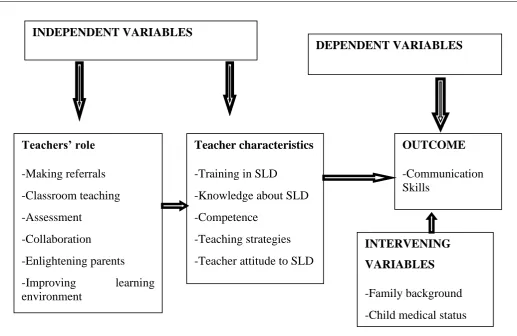
Figure 1.1. Conceptual Framework on Teachers’ Role in the intervention
Researcher’s own conceptualization of the study
OUTCOME -Communication Skills
INDEPENDENT VARIABLES
DEPENDENT VARIABLES
Teachers’ role -Making referrals -Classroom teaching -Assessment
-Collaboration
-Enlightening parents -Improving learning environment
Teacher characteristics -Training in SLD
-Knowledge about SLD -Competence
-Teaching strategies -Teacher attitude to SLD
16
17 1.8. Operational Definition of Key Terms
Approaches: A way of dealing with a situation or problem.
Communication skills :Ability to convey information to another person effectively and efficiently.
Collaboration: Action of working with someone to achieve a certain goal (Marinez-Moyano,2006).
Competence: Ability to do perform a communication task more successfully or efficiently.
Children: Young school-age persons below the legal age of maturity.
Consultation: A deliberation of professionals about a diagnosis or treatment in a particular case (Saunders, 2007).
Disorder: Impairment in the ability to comprehend and use language (ASHA, 2009). Disability: Communication difficulty that restricts learning activities and social participation.
Difficulty: State of being hard to deal with or understand speech and language disorders
Diagnosis: Identification of the nature of speech and language communication disability.
18
Early intervention: Doing things as early as possible to work on the child’s communication support needs.
Identification: Process of recognizing signs of speech and language disorders
Knowledge: Practical understanding of communication disabilities (Stanley, 2002). Language: System of symbolic communication used by human beings
(Ndung’u and Kinyua, 2009).
Learner: One who is learning literacy, communication and social skills. Speech: System of forming and producing sounds that form language
(Ndung’u and Kinyua, 2009).
Speech intelligibility: Speech clarity or a measure of how speech is understandable in given conditions.
Speech-language Pathologist/Speech therapist: A professional trained to prevent, assess, diagnose and treat speech, language and swallowing disorders in children and
adults (ASHA,2009).
Skills: Ability to carry out a task effectively within a given time (Howland, 2013).
Strategy: A plan of action designed to achieve a goal (Mintzberg, 1996). Technique: Execution of interventional teaching tasks.
19
20
CHAPTER TWO
LITERATURE REVIEW
2.1. Introduction
The reviewed literature presented the following; teachers’ knowledge about the signs of SLD in the communication of learners, extent of knowledge possessed by teachers of learners with SLD and teachers’ competence in using teaching strategies to enhance communication skills of learners with SLD.
2.2. Teachers’ Knowledge about Meaning and Signs of Speech and Language Disorders
21
Speech disorders include dysfluency of a child’s spoken words, reduced voice quality and lack of speech clarity. Language disorders include a child’s inability to understand others, make meaningful conversations, solve problems independently and difficulty with expressing thoughts independently through spoken or written words. Language and communication skills in a child’s development are extremely important in that even mild to moderate disturbances can have a profound impact on all aspects of life including poor inter-personal skills, communication difficulties and poor educational grades (Turnbull & Wehmeyer, 2007).Teachers need to have relevant knowledge to be able to identify speech and language difficulties and successfully conduct their role in supporting learners according to their needs.
22
intelligibility. This report is an evidence of the role played by SLPs in supporting teachers to promote children’s learning and communication skills in the classroom-based intervention.
Language disorders may revolve around the following linguistic components; morphology (word structure), syntax (sentence formulation), semantics (content) and pragmatics or language use in context (Batshaw, 2002). Speech and language are slightly different from each other although they are classified together. A study by Ndung’u and Kinyua (2009) points out that language is the system of symbolic communication by which human beings unlike animals communicate using spoken, written or signed modality and that literature has shown that speech and language are said to be disordered if they differ from what is considered to be the norm. The review of this literature further indicated that normal communication includes all means by which information is transmitted between the sender and the recipient. The means of communication as shown in the study are verbal and non-verbal, oral and written, formal and informal intentional and unintentional and so speech is the system of forming and producing sounds that are the basis of language.
23
Speech disorders include voice, articulation, stuttering and phonological process (Roseberry-Mckibbin, 1995). Voice is characterized by sounds produced by an individual including pitch, quality and sound volume or intensity. A voice disorder is produced due to incorrect phonation or resonation. Incorrect resonation is also associated with hyper-nasality or hypo-nasality. Pitch, volume, quality and rate are other features that determine a voice disorder.
Speech sound disorders involving articulation (sound production) encompass use of articulators such as lips, teeth, mouth and tongue to produce intelligible speech sounds. Articulation disorders may take the form of sound omission (e.g. fi’ for fish), addition errors (e.g. fisha for fish), sound deletion and consonant clusters, distortion of normal speech sounds (e.g. a lisped sh in fish), substitution errors (e.g. ‘t’ for ‘k’ as in titi for kiti, ‘d’ for ‘g’ e.g. das for gas). There are also prosody errors which affect sound intonation or rhythm and problems with phonological processes or sound patterns (Williams, 2006). These errors are often treated with a focus on speech sound (phonemes) production accuracy (Bernthal, Bankso & Flipsen, 2012). In more severe speech disorders, intervention may be improving global speech intelligibility targeting the whole word production rather than individual sounds (Camarata, 2010; Camarata, 2014). When overall speech intelligibility is extremely limited, intervention includes augmentative and alternative communication prostheses (Constantino & Bonati, 2014).
24
repeated, characterized by prolonged pauses or blocked speech (stuttering). Each of these components constitutes an important aspect of communicative competence and must be understood by all learners (Bloom, 1998).In a recent examination of persistence of SLD, Rice and Hoffman (2015), found that learners with SLD had poorer rates of vocabulary development. These results supported the earlier conclusion drawn by Stothard and colleagues (1998) that if a child’s language difficulties are still present at age 5-6 prognosis is likely to be poor and the child will be at high risk of language, literacy and educational difficulties throughout childhood and adolescence.
25
poor understanding of speech and language communication needs (Bercow Review, 2018). The report expressed concern that the issue of SLD was not taken seriously and stated the need to be training teachers about SLD on how to identify the signs in classroom to put effective intervention in place to avert long term academic and social disadvantages.
Thus, educating learners on the appropriate ways to produce speech sounds and encouraging them to practice speech and language therapeutic exercises over time may ultimately develop natural speech production and language. In this case therefore, teachers should have clear understanding of signs or characteristics of SLD and be able to identify learners who require intervention to enhance their communication skills. However, literature has shown that in the global perspectives special education teachers are not trained well in speech and language pathology and so, lack adequate knowledge. In Kenya, where speech and language pathology has been lacking, the situation is much difficult particularly among teachers in Joy town primary school for children with physical disabilities. Thus, the present study supports the need to provide adequate teacher professional development through training, workshops and seminars in speech and language to effectively perform their role in enhancing learners’ communication skills.
2.3. Extent of Knowledge Possessed by Teachers of Learners with Speech and language Disorders
26
effectively. The report asserts that professional development is an ongoing process, not an event, which prepares teachers in the effective use of appropriate academic modifications and accommodations, facilitates collaboration among staff, families and community for increased learning enhancement. The knowledge also prepares teachers to use technology within the curriculum to meet the unique needs of learners with learning disabilities. This concurs with the federal government through the Individuals with Disabilities Act (IDEA), which ensures that learners with disabilities (5-18) years old are provided with Free Appropriate Public Education that is tailored to their individual needs.
A study by Paul and Norbury, (2012) indicated that treatment programs for children with speech and language disorders require that someone usually an adult, provide an environment that promotes speech and language growth. The study thus considers professionally trained teachers as important agents of this crucial engagement in the school setting. An investigation by Sadler (2005) into levels of teacher knowledge about SLD noted that over 60% lacked confidence in their ability to work with children with SLD. This was a survey conducted in UK involving a group of training sessions for teachers and teaching assistants working with children with SLD in seven mainstream primary schools. Pre-and post-training questionnaires and classroom observations were used to examine the impact of the program.
27
that supports the development of all children’s personality, talents, mental and physical abilities to their fullest potential (UN, 2001). According to Dockrell and Lindsay (2001), teachers require additional professional development to close gaps in their knowledge, and additional support to meet the needs of children with speech and language disorders. The research reported here applied qualitative research methods to investigate the learning and schooling experiences of a sample of children with speech sound disorders in order to better inform teachers, parents and other professionals who may be involved in supporting their development and education. The research was conducted in an Australian state where speech and language pathology services were not provided within schools.
The Australian Journal of Teacher Education by Daniel and McLeod (2017) pointed out that teachers play a major role in enhancing learners’ communication abilities to achieve their educational, social and emotional gratification but noted that they may be unprepared to support learners with SLD. The study reported numerous challenges faced by teachers in meeting learners’ developmental and educational needs. The study found that these challenges were centered on the need for specific expertise in the school setting and access to material and professional services to support learners’ engagement in the learning and social environments of school.
28
in the intervention to enhance communication skills of children with SLD. According to the Developing People to Support Learning (2006) report, teacher training and development needs to be part of long-term strategic planning. This is a toolkit prepared in USA to provide advice and support to teachers and other professionals. In a study by Glover, McCormack and Smith-Tamary (2015) in Australia, teachers and SLPs expressed a desire for increased training and knowledge and collaborative practice. They expressed frustration at inadequacies with regard to funding, personnel and resources. In different parts of Australia of Australia, as in the UK, school-aged children with SLD must meet certain disability criteria to be eligible for individual funding to enable them access school-based therapy services (Health Workforce Australia, 2014) and that some do not receive it at all (McLeod & Mackinnon, 2010). As a result, most of these learners are left to teachers who are increasingly challenged by the learners’ learning and support needs (McLeod & McKinnon, 2007). Teachers are also the most commonly accessed source of information for parents in relation to their children’s special needs (McAllister, McLeod, Harrison & McCormack, 2011). Many teachers feel that they do not have the required knowledge, skills or expertise to identify signs of SLD, manage or intervene for learners (Law, Boyle, Harris, Harkness & Nye, 2000).
29
enough understanding to promote positive speech, language and communication strategies since these skills impact effective access to the whole curriculum.
From the general review of literature, there is lack of enough evidence to support the level of knowledge possessed by teachers about speech and language disorders. The review has clearly exposed lack of adequate understanding, skills and confidence as the greatest obstacle to the effective implementation of teacher school-based intervention programs in both global and local perspectives particularly, in Kenya where speech and language pathology has not been available. This is essentially important to the current study which sought to close the gap by creating insight into the need to provide relevant teacher professional development and support to effectively facilitate acquisition of communication competence, educational success and social independence for learners with SLD.
2.4. Teachers’ Competence in Using Teaching Strategies to Enhance Communication Skills of Learners with Speech and Language Disorders
30
awareness which involves understanding and awareness of sound components of words (Bialystok & Ryan, 1985). Learning to read involves the identification of sound elements and their mapping onto letters and sequences of letters (Adams, Foorman, Lundberg & Beeler. 1998; Blachman, Ball & Tangel, 2000).
In 2002, the National Reading Panel, commissioned by the U.S. Congress, identified 52 studies evaluating the effectiveness of phonological awareness training in improving reading and spelling(Ehri, Nunes, Willow, Schuster, Yaghoub-Zadeh & Shanahan, 2001), concluding that its effect was moderate. A more recent literature review by Snowling and Hulme (2011) yielded similar findings. Caravolas, Hulme and Snowling (2001)indicated that understanding what is read involves language knowledge of vocabulary, grammar, sentence meanings, understanding of story structure and verbal reasoning such as inferencing what has been spoken.
One study found that social activities and inter-relationships are more important than formal learning with children with SLD (Maxwell, 2006) and that creating a communicative supportive environment beneficial to all children in the classroom is important (Dockrell, 2006). In western education systems, learning emphasizes on constructive learning principals which mobilize learner interaction predominantly through spoken communication as central tool for learning (Vygostky, 1986). According to Vygostky, constructivist learning is described as embedded within social events and occurs as a child interacts with people, objects and events in the environment.
31
According to Slavin (2011), this technique is implemented in group-learning process such as cooperative learning pedagogies in classroom environments. An understanding of these strategies is therefore important for those who support learning engagements and educational outcome of learners with SLD.
Individualized teaching is a classroom instruction strategy which recognizes the uniqueness of each learner and thus provide for adequate tutorial guidance and other support services to help the child (Reynolds & Fletcher-Janzen, 2001). The goal is to provide learning environment that can maximize the child’s potential by learning at their own pace. Tomlinson (2001) suggests areas of individualizing instructions such as content, materials and pace of learning based on the abilities of the learner.
32
A report of a case study conducted in the UK to establish whether class-based interventions are effective in improving communication skills in children with SLD, indicated that using an enhanced collaborative model by school professionals and a combination of the above mentioned strategies has proved to be effective(Mecrow, Beckwith & Klee, 2010).The report suggests that a collaboration can be done through consultation in which teachers who have direct contact with the child in the classroom consult SLPs for expert advice (Hartas, 2004). This was a qualitative case study involving twenty five teachers and seventeen SLTs who were asked to complete questionnaires and participate in group discussions to provide information about their perception of collaboration with their colleagues at a school for children with SLD. Results suggested that most teachers and SLTs felt that time constrains limited their effort in collaborative working. However, their willingness to make professional development and learn from each other could not be underestimated. In the liaison the SLPs will provide information and rationale for the choice of strategies for teaching and supporting children with SLD to optimize their participation and success.
33
in the learning of school children as they desire to know whether their understanding is progressive or not (Lee, 2004).In the UK, Kennewell, Tanner, Jones and Beauchamp (2008), advanced this opinion arguing that direct interactive teaching is a contributing factor to success, along with discussion, pace, confidence and ambition in which learners’ contributions are encouraged, expected and extended with a high degree of autonomy and personalization.
Provision of basic functional communication systems have shown to be very effective particularly to learners with SLD (Gargiulo, 2006). There are computer software programs including First Words involving use of graphic presentations. Such systems are termed alternative and augmentative communication systems (AAC) such as gestures or facial expressions (aided communication systems), and those that require some tools or equipment (aided systems) including pictures, paper, pencil and computer-based speech-generating systems. Other alternative and augmentative systems include sign language and various communication boards, both manual and electronic that are used by persons with impaired oral motor skills (Beukelman & Mirenda, 2005).
34
basis of communication problem is largely a limitation in speech production, and receptive language abilities are relatively unaffected, computer-based electronic communication systems are likely to be effective.
One instructional method, referred to as ‘modeling’, draws on the social learning theory that emphasizes on observational learning (Bandura, 1971). With this method, the learner is provided with an elevated set of exemplars of language form and the learner is instructed to imitate a word or sentence and given feedback when he or she makes an imitative attempt. Modeling has been found to result to gains in the targeted language forms (Leonard, Camarata, Brown, & Camarata, 2004; Vasilyeva, Huttenlocher & Waterfall, 2006).
A combination of several modes of teaching are used which said to result to gains in different types of learning contexts that may be teacher-centered, learner-centered or a mix of the two (Cleave, Becker, Curran, Van Home & Fey, 2012). The teacher-centered context is more effective in a highly structured drill and practice setting. The emphasis is on high rates of listening and speaking the targeted language forms (Paul & Norbury, 2012). According to the study, the strategy is advocated on the grounds that learners with SLD need the structure and intensity of this learning context. On the contrary, learner-centered approach emphasizes on the quality of natural teacher-learner interactions through conversations allowing the teacher-learner to lead the interaction while the teacher follows.
35
focused teaching involving more directive language into the play increasing interaction engagement and positive learning outcome. According to Miller, Fenty, Scott and Park (2010), outcomes are comparable whether instructions are offered ingroups or individually.
Williams, Kraybill, Franchow and Butner (2010) identifies articulation drill, motor learning and phonological/lexical interventions as primary approaches to behavioral treatment of speech disorders including practicing moving and coordinating movements of oral structures such as lips, tongue and soft palate to improve speech accuracy (Maas, Gildersleeve-Neumann, Jakielski & Stoeckel, 2014). Articulation drill approaches focus on motor placement and production of individual sounds (phonemes) are often a primary focus of intervention for speech sounds (McCLeod & Bleile, 2004). Essentially, a learner is taught directly how to move and coordinate the articulatory mechanism for producing phonemes. For example, a learner with a mild speech disorder who says the word ‘rabbit’ as ‘wabbit’ is incorrectly producing phoneme ‘r’ as ‘w’. In this case, intervention would include direct instruction, motor practice and drill to produce an ‘r’ sound correctly.
36
approach is drawn considering speech sounds within the context of word production (Stokel, 2004). This is designed to improve word-level production rather than starting at the motor learning at individual phoneme level. Similarly, a later study by Crosbite and colleagues (2005), found that word-level speech production improved speech disorders in learners and that both speech accuracy and speech intelligibility can be improved using lexical-transactional intervention.
A number of studies have found teaching to be associated with significant gains in speech accuracy and intelligibility (Baker & McCLeod, 2011); Almost & Rosenbaum, 1998), although a literature review by Baker and McCLeod (2011) shows that there have been few long-term follow-up studies, and very few studies have been focused on learners with SLD. Similarly, in a review of literature on speech intervention in mild to moderate speech disorders, Bernthal & colleagues (2012) concluded that when comparing groups receiving speech and language communication intervention to those receiving no treatment, the intervention group consistently perform better than no treatment groups on outcome evaluation measures.
37
The reviewed findings about the diverse evidence-based practices and their benefits to learners with SLD, are predominantly significant to educational professionals and policy makers and hence extremely pertinent to the current study with a view to informing the need for teacher professional development and resource provision and intrinsic monitoring to promote speech and language expertise and competence to integrate therapy strategies with learning tasks. Furthermore, the study intends to inform the need for increased teacher-parent understanding to promote parental participation in the administration of interventional programs in the home context during holiday breaks to enhance consistency for better therapeutic outcomes. The study also, shows the need for increased collaborative support to provide additional professional understanding about SLD and expert advice to maximally minimize the impact of speech disability and satisfy educational, social and emotional needs of learners with SLD.
2.5. Summary of Literature Review
38
professionals and teachers play an integral part in this spectrum showing the need to provide relevant teacher professional development and resource support to facilitate execution of diagnostic assessment practices and achievement of therapeutic teaching goals.
Paul and Norbury ( 2012 noted that professionally trained teachers in communication disabilities are considered vital to enhance intervention programs for learners with SLD. From the general review of literature, there is lack of enough evidence to support the level of knowledge possessed by teachers about speech and language disorders. The review has exposed lack of adequate understanding, skills and confidence as the greatest obstacle to the effective implementation of teacher school-based intervention programs particularly, in Kenya where speech and language pathology has been lacking. This is essentially important to the current study which sought to close the gap by creating insight into the need to provide relevant teacher professional development and support to effectively facilitate development of communication skills of learners with SLD.
39
such as SLPs is encouraged to promote their capacity to use informed teaching strategies (Shaddock, Smyth King & Giorcelli, 2007). However, teachers feel that this support is not adequately geared towards the teaching of learners with SLD. The available support is much less in Kenya and the rest of the third world nations where speech and language pathology has been lacking.
40
CHAPTER THREE
RESEARCH DESIGN AND METHODOLOGY
3.1. Introduction
This chapter highlights the research design, study location, study variables, target population, sampling techniques and sample size, study instruments, pilot study, validity and reliability of instruments, data collection techniques and logistical and ethical consideration.
3.2. Research Design
This study adopted a case study design mainly using qualitative approach. Qualitative approach aims at exploring the social reality of individuals, groups and cultures (Creswell, 2003 & Creswell, 2012). The approach adopted the use of semi-structured interview guide, questionnaire schedule and non-participant observation checklist for collecting data (Denzin & Linoln, 1994). Case study was used because the study phenomenon had similar characteristics.
3.3. Study Variables
The study variables included independent, dependent and intervening variables. Independent variables included;
Teachers’ characteristics: teacher’s professional knowledge and competence, teaching strategies, teacher training and teachers’ attitude towards children with SLD.
41
Dependent variables included communication skills of children with SLD which was determined by the teachers’ ability to execute interventional teaching dispensations on the basis of their knowledge about signs of SLD and competence to innovate and use classroom instructional strategies.
Intervening variables included child’s medical health and family background. These are factors which are known to significantly affect the functions of both independent and dependent variables but were not part of the investigation.
3.4. Location of the Study
The study was conducted in Joy town special primary school for physically challenged children in Thika, Kiambu county. About two thirds of these learners have cerebral palsy which is one of the major causes of speech difficulties. Being the largest special primary school in the country Joy town has the highest number of teachers who have long experience in working with children with SLD, hence were able to provide adequate study population.
3.5. Target Population
This study targeted only 31 teachers working in Joy town special primary school regardless of their age and gender. This number was inclusive of the head teacher. 3.6. Sampling Techniques and Sample Size
3.6.1. Sampling Techniques
42
majority of them have SLD. All teachers working in the school were used because they were not many and since they directly interacted with children with SLD, they constituted the most suitable target population which provided the needed information for the study.
3.6.2. Sample Size
Out of the 31 targeted teachers, 2 were used during pilot-test. Therefore, the study sample size was 29 teachers who participated in the actual study. This number included the head teacher.
3.7. Research Instruments
3.7.1. Interview Guide for Head teacher
A semi-structured interview guide(see Appendix II) was prepared for the head teacher to obtain the required information. The interview guide was used in order to obtain in-depth information through probing the head teacher. Kothari (2009) asserts that this strategy allows flexibility in probing and exploring certain subjects in greater depth. 3.7.2. Questionnaire Schedule
43 3.7.3. Observation Checklist
The study used non-participant observation method (see Appendix IV) where the researcher was merely taking notes of what she observed. Observation schedule was used to observe teachers in the classroom during teaching activities.
3.8. Pilot-test
A pilot-test was conducted with two teachers in the school under the study to ascertain the validity and reliability of data collection instruments and appropriateness of the anticipated analytical techniques. This is why the study sample size was 29 instead of 31 since 2 of them participated in the pilot-test. The reason was that all teachers in the school directly interacted with learners with SLD and faced similar experiences. The two teachers filled the questionnaires. Teacher observation during pilot-testing was done on the same teachers by the researcher in classroom teaching. The head teacher was not used in the pilot-test. The teachers used for the pilot-test did not participate in the actual research. The procedure used in pre-testing was the same as the one used in the main research.
3.8.1. Validity
An instrument is valid if it measures what it is intended to measure and accurately achieves the purpose for what it was designed. Research instruments were validated through application of content validity determined by expert judgment and inclusion of supervisors ‘suggestions. Further, a pilot-testing was used to enhance the validity.
3.8.2. Reliability
44
purposively selected teachers. The study used Cronbach Coefficient Alpha test for internal consistency to obtain the average score of the split half estimates. The study coefficient alpha was 0.913. It is important to note that a liability coefficient of 0.70 is considered acceptable in most situations of social sciences. However, below 0.70, the internal consistency becomes questionable but above 0.70 to 0.10 correlation coefficient is perfectly high. In this case, the study items had a relatively high reliability.
3.9. Data Collection Techniques
45
learners before sitting at the back of the class to take notes using the observation checklist until the end of the lesson. The collection of questionnaires was done on the following day since it was not possible to have them completed on the first day. Out of 29 questionnaires, only 24 (82.8%) were returned.
3.10. Data Analysis
The researcher edited the data collected from the field to ensure they were error-free. In the case of quantitative data the researcher numbered the questionnaires appropriately. This was followed by the coding process to mark and categorize information such as gender, age and level of education. Then, data was entered into the computer program known as Statistics Package for Social Sciences (SPSS)to aid in data analysis. The quantitative data was analyzed using simple descriptive statistics such as graphs, percentages, charts, tables and frequencies. Qualitative data was analyzed thematically and sorted according to the emerging themes (Braun & Clarke, 2006).
3.11. Logistical and Ethical Consideration
46
CHAPTER FOUR
PRESENTATION OF FINDINGS, INTERPRETATIONS AND DISCUSSION
4.1. Introduction
This chapter presents the findings, interpretations and discussion according to the objectives and research questions. The objectives were as follows:
1. To establish teachers’ knowledge about signs of SLD in the communication of learners in Joy town primary school.
2. To find out the extent of knowledge possessed by teachers of learners with SLD in the school under the study.
3. To assess teachers’ competence in using teaching strategies to enhance communication skills of learners with SLD in Joy town primary school.
4.2. General and Demographic Information 4.2.1. General Information
47 4.2.2. Demographic information
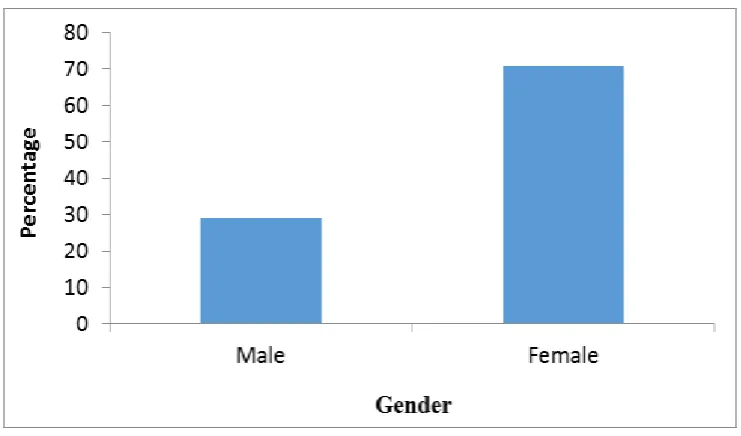
Gender disparity was observed in favor of females. The responses are shown in the figure 4.1.
Figure 4.1: Gender representation of respondents
48 4.2.3. Age bracket of respondents
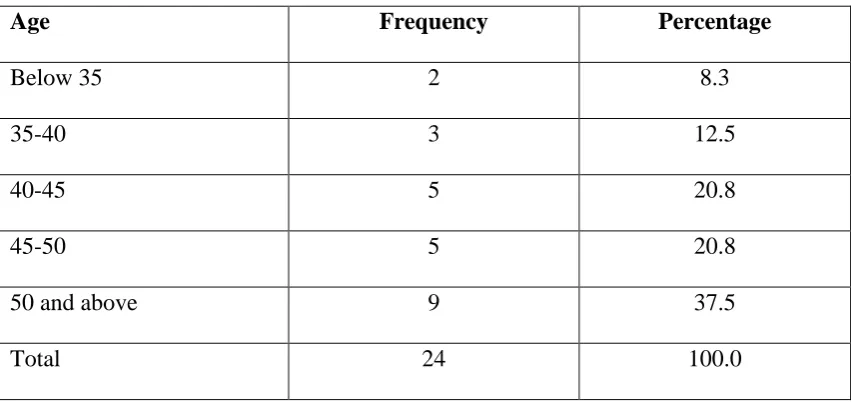
Table 4.1 shows the record of the age brackets of the respondents. Table 4.1 Age bracket
Age Frequency Percentage
Below 35 2 8.3
35-40 3 12.5
40-45 5 20.8
45-50 5 20.8
50 and above 9 37.5
Total 24 100.0
49 4.2.4. Professional qualification of respondents
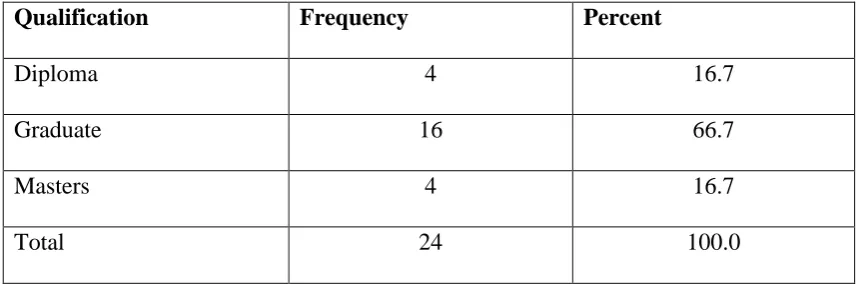
The following table is an illustration of the respondents’ professional qualification. Table 4.2.Professional Qualification
Qualification Frequency Percent
Diploma 4 16.7
Graduate 16 66.7
Masters 4 16.7
Total 24 100.0
The table indicates that 20 respondents (84.4%) had both undergraduate and postgraduate degrees in special needs education. Diploma holders were only 4 (16.7%). This information was important to determine teachers’ competence in the accomplishment of national curriculum which is the basis for the implementation of interventional teaching programs.
4.3. Responses on Signs of Speech and Language Disorders
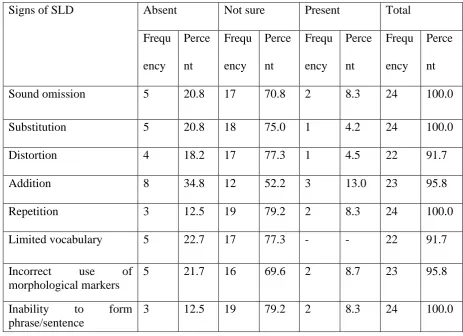
50 Table 4.3. Signs of SLD
The respondents were required to show their ability to identify signs of SLD in learners’ communication. 5 respondents (20.8%) showed absence of sound omission errors while 2(8.3%) respondents reported that learners with SLD committed sound omission errors agreeing with the view of Roseberry-Mckibbin (1995) which stated that speech disorders include, articulation (eg. sound omission) difficulties. 17 (70.8%) respondents were not sure about the errors and could not identify them, which was a clear prove of knowledge deficit in the identification of signs of SLD among the respondents which impacted negatively in meeting the different communication needs of their learners.
Signs of SLD Absent Not sure Present Total Frequ ency Perce nt Frequ ency Perce nt Frequ ency Perce nt Frequ ency Perce nt
Sound omission 5 20.8 17 70.8 2 8.3 24 100.0
Substitution 5 20.8 18 75.0 1 4.2 24 100.0
Distortion 4 18.2 17 77.3 1 4.5 22 91.7
Addition 8 34.8 12 52.2 3 13.0 23 95.8
Repetition 3 12.5 19 79.2 2 8.3 24 100.0
Limited vocabulary 5 22.7 17 77.3 - - 22 91.7
Incorrect use of morphological markers
5 21.7 16 69.6 2 8.7 23 95.8
Inability to form phrase/sentence
51
5 (20.8%) respondents indicated presence of substitution errors as identified by Williams (2003a) while 1 (4.2%) person did not note the errors. Nearly three quarters of the respondents (18)or 75% showed that they were not sure about the errors another clear indicator of inability to recognize signs of speech disorders in children. One person managed to identify sound distortion errors while 4 (18.2%) respondents did not notice any sign of distortion. Three quarters equivalent to 18 (77.3%) respondents reported that they were not sure about the errors, further indicating concern about their knowledge and competence and the need for teacher training in speech disabilities to increase understanding and skills to competently perform their role in supporting learners with speech and language difficulties.
52
The researcher clarified the meaning of concepts such as morphological marker to the respondents as a grammatical form referring to awareness of word structure(morphological awareness).2 (8.7%) respondents reported that learners with SLD presented incorrect use of morphological markers while 5 (21.7%) noted morphological competence in the language of learners with SLD. Sixteen (69.6%) respondents were not sure depicting challenge in their understanding of the different language needs of their learners.
Nineteen (79.2%)respondents pointed out that they were not sure about their learners’ inability to form phrases and sentences precisely proving that the respondents lacked the needed knowledge to recognize their learners’ weakness in the syntactic language domain. Three (12.5%) respondents showed that their learners expressed deficit in language sentence structure while only 2 (8.3%) respondents reported that learners with SLD can make accurate phrases/sentences when answering questions in class and engaging in verbal conversations with teachers and peers. Five (22.7%) respondents showed absence of limited vocabulary content indicating that learners with SLD have adequate vocabulary, while 17 (77.3%) said they were not sure and none of the respondents reported presence of limited vocabulary content. This is a further indication of lack of teachers’ knowledge to easily recognize signs of speech and language communication difficulties which is detrimental to the classroom-based intervention.
53
practices in the classroom-based intervention. Daniel and Porter (2007) points out on the importance of training teachers to be able to identify signs of speech disabilities to effectively support learners with SLD. Thus, the current study gives more insight for the need to strengthen teacher professional development to integrate training in SLD in the teacher training curriculum and workshop programs to facilitate their role in making assessment decisions and classroom instruction choices to promote learners’ communication efficacy, academic success and social fulfillment.
The one-on-one interview with the head teacher showed that teachers in the school had to be very patient to understand the speech of learners with SLD in order to identify their needs. The head teacher confirmed that he also had to listen more keenly and patiently to understand what was said by the learners.
During classroom observation, it was observed that communication needs varied between learners and the study respondents had difficulties understanding learners’ speech. It was noted that during questioning and answering activities, some teachers asked learners with poor speech intelligibility to repeat what they said which seemingly drew frustrations and discouragement among both teachers and learners.
54
4.3.1. Responses on Assessment of Speech and Language Disorders
The study sought to find out how learners with SLD in the school are assessed in order to identify their speech and language needs. The responses are indicated in the table 4.4.
Table 4.4. Assessment of Children with Speech and Language Disorders
Assessment methods Frequency Percentage
Learners are interviewed by teachers 7 29.2
Receiving assessment reports from education assessment & resource centers
1 4.2
Parents and teachers are fully responsible through interaction
1 4.2
Speech therapists 1 4.5
System 14 58.0
Total 24 100.0
55
make observation during learning activities in the classroom. The respondent reported,
‘assessment is done through observation, that is, as learning takes place the teacher is
able to tell the learner with SLD when talking or reading’. The respondent further said that parents are fully responsible for the assessment through observation during their natural interaction with their children at home. Parents are an important source of information and insight about their children and should be involved in the assessment process, but can mainly provide information about their children’s strengths and needs, and not making assessment decisions since they are not qualified to do so.
Another 1 (4.2%) respondent reported that learners with SLD were assessed by speech therapists. However, the researcher noted existence of a few school-based occupational therapists who engaged learners with sensory integrative tasks to foster mobility and school environmental adaptation, but there was no evidence of existence of a school-based speech therapy program. It is therefore, not clear where the speech therapy assessment services were offered for the learners. This concurs with a previous study by Edgar and Rosa-Lugo (2007), who reported that many public schools in the developed nations lack sufficient school-based speech therapists who can liaise with teachers and that the situation is much worse in Africa particularly in Kenya where speech and language pathology has been lacking.
56
with SLD further shows that teachers lacked adequate knowledge and skills to understand them and meet their social, academic and communication needs showing the need to train teachers in speech and language pathology to increase their understanding and competence in the assessment of learners with SLD.
4.3.2. Responses on Diagnosis of Speech and Language Disorders
The table 4.5 indicates the respondents’ views on the diagnosis of SLD. Differential diagnostic evaluation is essential to establish the specific needs of individual learners in order to decisively determine the appropriate intervention approaches.
Table 4.5 Diagnosis of Speech and Language Disorders
Who diagnose them? Frequency Percentage
Teachers 18 78.3
Speech-language pathologists 1 4.3
Doctors 2 8.7
Not sure 2 8.7
System 1 4.2
Total 24 100.0
57
signs of SLD in their wide range ‘not sure report’. Besides, recognition of symptoms of a problem is actually the basis for diagnostic and therapeutic choices for individuals with communication disorders. One respondent said that learners were diagnosed by speech therapists yet, it is not clear where speech therapy services were obtained. Two (8.7%) respondents reported that the diagnosis was done by doctors while another 2 respondents said that they were not sure about who used to diagnose their learners. The study attributes this uncertainty to lack of relevant knowledge about learners’ communication needs including need for consistent liaison in multi-disciplinary programs to realize the correct diagnostic evaluation and treatment choices for learners who require speech and language intervention.
4.4. Professional Knowledge of the Respondents
Table 4.6records the level of knowledge of SLD by the respondents and the findings for objective two.
Table 4.6 Knowledge of Speech and Language Disorders
Meaning of SLD Frequency Percent
It is speech-language difficulties in learners 16 66.7
Teachers are not conversant with SLD 1 4.2
It is learners having poor phonological, syntactical and semantic awareness
1 4.2
System 6 25
58
Sixteen(88.9%) respondents indicated that SLD is learners’ difficulties with speech and language communication abilities as emphasized by one of the respondents, ‘it is the challenges learners encounter while trying to acquire language and communicate,
They also take time to express themselves’. 1 (5.6%) respondent said that children with SLD have poor phonological and syntactical awareness and reduced semantic language skills which to a large extent affects their literacy and communication competencies. Another respondent (5.6%) reported that teachers were not conversant with SLD hence, did not understand what it meant. Six (25%) respondents expressed complete lack of understanding about SLD by referring SLD to as ‘system’. The context in which the concept ‘system’ was used in this response remains unclear to the current study further indicating knowledge deficit in SLD and the need for more training support for teachers in speech and language pathology to specifically have clear understanding of SLD to effectively enhance learners’ communication skills.
The head teacher confirmed that although he had a degree in special needs education he did not have any knowledge of SLD. However, the head teacher reported that teachers were exposed to training programs such as ‘Tusome Early Grade Reading Program’ which is a literacy enhancement program used in class one and two to improve learning outcomes.