Pa
ge
10
Finance & Banking Studies
IJFBS, VOL 8 NO 1, 2019 ISSN: 2147-4486
Contents available at www.ssbfnet.com/ojs https://doi.org/10.20525/ijfbs.v8i1.298
Effect of E-customization Capability on Financial
Performance of Commercial Banks in Kenya
Morrisson Kaunda Mutuku
Corresponding Author: Department of Management Science, Kenyatta University, Nairobi, Kenya. Tel: +254 724 675 396.
Stephen Muathe
Department of Business Administration, Kenyatta University, Nairobi, Kenya.
Rosemary James
Department of Management Science, Kenyatta University, Nairobi, Kenya.
Abstract
Financial performance of a commercial banks driven by a number of capabilities drawn from either the internal or the external environment. The Kenyan Government and commercial banks in particular have invested in e-commerce solution. Despite these invetments over the years, the impact is yet to be felt. The empirical literure reveals that there is a link between commercial banks e-commerce custiomization capability and financial peroformance.The study empirically analyzed the effect of e- commerce customization capability on financial performance of commercial banks in Kenya. E-commerce customization capability measured using online registration,online recommendation and realtime support while financial performance was measured using Return on Assets (ROA). The study was anchored on the Resource-Based View Theory. The study used explanatory design. A census of 43 commercial banks was taken; data for performance was extracted from audited banks statements for financial year 2016/2017. Data for e-commerce customization capability was collected from commercial banks websites. Data for financial performance was extracted from audited financial ststements of commercial banks. Data analysis was done using descriptive and inferential statistics. The study findings indicated that e-commerce customization capability had a significant effect on financial performance of commercial banks in Kenya. The study concluded that e-commerce customization capability significantly affected financial performance of commercial banks in Kneya. The study recommends that the management of commercial banks in Kenya should invest more in customization capability to improve their performance.
Keywords: Bank; Profitability; ROA; e-commerce customization capability; commercial banks in Kenya
Peer-reviewed Academic Journal published by SSBFNET with respect to copyright holders.
Pa
ge
11
Introduction
Every market economy requires the existing banking system ready to guarantee mobilization of funds, directing such funds towards the quest for efficient financial activities (San & Heng, 2013). Commercial banks play a crucial role of financial intermediation between depositors and borrowers, prompting a more productive allocation of resources and faster economic growth in a nation’s economy (Driga, 2006; Ongore, 2013). Performance of commercial banks has also been a subject of interest by shareholders, investors, financial analysts, bank managers and government agencies. Financial efficiency is one of the key determinants of banks’ profitability. Despite more than two decades of financial deepening by commercial banking industry in sub-Saharan Africa, commercial banks have posted mixed results (European Investment Bank, 2015). A report by International Monetary Fund (IMF) indicates that growth in overall performance has been fluctuating in numerous nations in sub-Saharan-Africa; the growth is way below the expectations (IMF, 2016).
Good performance of banks rewards shareholders for their investments, besides promoting national development and economic growth (Kenya & Gitonga, 2016). Therefore, bank performance review remains a subject of concern to researchers ever since the economic downturn in the 1940s (Ongore & Kusa, 2013). According to the researchers, commercial banks should generate sufficient earnings to cowl the operational expenses they incur during business. Therefore, banks must make profits, for their sustainable and effective intermediation.
Kenya boasts of the most established banking sector within the East Africa community (European Investment Bank, 2013). Its banking system is the fourth biggest in sub-Saharan Africa with South Africa leading, Nigeria and Mauritius closely following. Over the years, commercial banks in Kenya have been characterized by poor performance (CBK, 2016). This has led to the collapse of banks and a wave of mergers of some banks. These include the Continental Bank of Kenya and Chase Bank, among others. This has caused panic to various stakeholders in the financial sector.
Firm performance is the accrued outcome of all firm’s operations and activities (Wheelen & Hunger, 2011). Business executives measure firm performance since it prompts improved asset administration, enhanced capacity to offer customer value, improved and better firm knowledge. Carrying out financial measurement is essential for good business administration (Demirbag, Tatoglu,Tekinus & Zaim, 2006). When performance of the firm is analyzed, managerial decisions that informed firms’ cash generating activities are evaluated. This helps to determine if the valuable resources were utilized efficiently, if the firm was profitable and if financing decisions were made prudently.
There has been intense debate as to which profitability ratio best measures a firm’s financial performance. However, Zhu (2004), Hoq and Chauhan (2011 and Guerreiro (2015) recommend that e-commerce customization capability effect on firm performance should be measured in financial terms. This is because a firm’s ability to perform financially is critical to its survival in the short and long run. Similarly, bank financial performance is the best measurement in terms of profitability using ROA. The ROA estimate gives investors an idea of how efficiently the firm converts the money it invests into net income (Zhu, 2004). This study therefore used ROA to measure commercial banks’ performance.
Peer-reviewed Academic Journal published by SSBFNET with respect to copyright holders.
Pa
ge
12
Customization of e-commerce capablity is the ability to improve customer interactions through personalization of products or services (Zhu, 2004). Customization includes online registration, online product recommendation, content personalization, account management and real-time support. Configuration capability enables users to personalize products according to their tastes and preferences. Online recommendation is the ability to provide real-time online product recommendations. Real-Time Support is technical help dealt with via online representatives through voice communication or live chats (Zhu & Kraemer, 2005).
Literature Review
Theoretical LiteratureThis study is grounded on the Resource-Based View (RBV) Theory by Wernerfelt (1984). According Peteraf and Barney (2003), the RBV underlines the firm’s resources as the key determinants of competitive edge and firm performance. While valuating the sources of competitive advantage, the RBV Theory assumes that firms with a strategic group may be heterogeneous in terms of the resources that they control. Milgram (1999) observes that firm’s resources cannot be assessed in segregation; a single resource may not be as important as a set of them may be. Therefore, one resource produces more noteworthy returns when utilized in combination with others (Black & Boal, 2007). This may clarify why firms may utilize similar e-commerce technologies and obtain varying outcomes. Indeed, a synergistic mix of technological innovations with other firm resources has apparently improved firms’ performance (Huang, 2010).
Barney (1991) argues that competitive advantage founded on non-physical resources is inimitable by competitors hence a basis of sustainable competitive advantage. The argument is further supported by Kinyua, Muathe and Kilika (2015) who, using RBV Theory, identified knowledge, innovation and intellectual properties as key drivers and sources of a firm’s competitive advantage. Intangible resources include human capital, intellectual properties and reputation. Human capital provides knowledge, skills, and decision making capability to the firm.
According to Porter (2008), customer satisfaction has emerged as a key strategy that a business enterprise can use to gain competitive advantage. The researcher argues that the relationship between customers and business firms has strongly developed to a direction where the customers have a dictating position in the sense of bargaining power. With this power, customers have become more demanding towards service providers. It can be argued that many industries, especially the service-oriented ones, are under the mercy of their customers. Gaining competitive advantage in today’s service firms is a very serious task for management since they need to find a way to deliver superior value to their customers.
Empirical Literature Review
Customization is a website measure that allows users to both personalize what they see on the website. Customization capability is concerned with an unswerving customer base; customers are more like future alternatives or intangible resources; their impact on the performance of the firm is strategic, future-oriented and subtle (Zhu & Kraemer, 2005). E-commerce is allowing businesses to compete by delivering advantages to customers at lower costs and better decisions (Malkawi, 2007). For instance, at the front end, customer-facing website functionalities help firms provide real-time information to consumers, update product and pricing information; they facilitate self-service via online account management and research tools, thereby improving customer services and expanding revenue sources.
Peer-reviewed Academic Journal published by SSBFNET with respect to copyright holders.
Pa
ge
13
Another study by Davenport and Patil (2012) found out that firms that used credit cards for payment by relying on their websites to provide customized products performed better financially. The study findings also revealed that many firms utilized such customized information attract new customers and to provide an online transactions platform. However, it would be difficult to offer new products without online recommendations by the customers. Biesdorf, Court and Willmott (2013) explained that by analyzing website data, online firms received notifications when competitors lowered their prices of services and products. This study focused on customization which is only one dimension of e-commerce capablity; it left out the other dimensions. Koutsabasis, Stavrakis, Viorres, Darzentas, Spyrou and Darzentas (2008) assert that the first primary application of e-commerce is to offer customized services or products. The exploratory study contends that customers characteristically prefer to do business with the same firm via diverse channels. In addition, voluminous data generated by e-commerce platforms can be personalized in real time. Instantaneous data analytics allow business firms to provide customized services and products, including advertising. Over and above, customization enables firms to segment customers and serve them with promotional information on new offers. The study lacked theoretical backing. The current study was anchored on UTAUT and other relevant theories.
Liebowitz (2013) established that customization could lead to an increase in sales by more than 10% and contribute to approximately five to eight times the ROI on advertising costs. Wine.com used customized marketing to increase her sales volumes (Zhao 2013). Similarly, bikeberry.com used customer data, buying patterns and preferences to boost sales. Because of this marketing strategy, the company sales increased 133 percent; customer leads increased by 200 percent (Jao, 2013). Unfortunately, these studies have not been carried out on banks but manufacturing firms. Therefore, given this contextual the current study is aimed at assessing the effect of customization capability on performance of commercial banks in Kenya. The conceptual framework presents the relationship between the independent variable and the dependent variable.
Based on the conceptual framework and literature review, financial performance is the dependent variable and it is measured using ROA. The independent variable is e-commerce customization capability has three indicators: online registration. Online recommendation and real-time support.Therefore, the study proposed the following hypothesis and sub-hypothesis from the research objective indicated hereunder.
H0: E-commerce customization capability has no significant effect on financial performance of commercial banks in Kenya.
Research and Methodology
This study used explanatory research design. Explanatory design was regarded suitable in explaining the characteristics of the variables of the study (Saunders, Lewis & Thornhill, 2009). At the same time, it sought analyzing the cause-effect relationship among variables; no manipulation of the independent variables is anticipated. The target population was 43 commercial banks. This study used primary data and secondary data. Data on e- commerce customization capability was collected through website analysis of each commercial bank. Data on performance was extracted from banks financial statements and bank supervision reports for the period 2016/2017.
Figure 1: Schematic Diagram Source: Researcher (2017)
H0
Independent Variable Dependent Variable
E-commerce Customiztion Capability Online Registration
Online Recommendation Real-time Support
Financial Performance
Peer-reviewed Academic Journal published by SSBFNET with respect to copyright holders.
Pa
ge
14
Empirical Model
Numerous models can be utilized in analyzing quantitative data that include Logistic, Tobit, Probit and Regression models. Logistic, Probit and Tobit are used when the dependent variable is dichotomous (Field, 2009 & Muathe, 2010). In this study, the dependent variable is continuous. As such, linear regression model was the most suitable. Multivariate analysis was used to perform regression on the relationships among the various variables so as to establish the strength of each explanatory variable. The dependent variable was ROA.
Model 1 sought to establish the effect of e- commerce customization capability on financial performance. Composite indices of the study variables were derived using a weighted geometric mean as suggested by Zhu and Kraemer (2005).
ROAi = β0 + β1ECC i εi...Model 1 Where,
ROAi = Return on Assets of Bank i β0 = Intercept Constant
β1 = Beta Coefficient
ECCi = e- Commerce Customization Capability of Bank i ε = Error Term
Findings
The results of data analysis are presented as follows; Descriptive analysis and regressions analysis. Descriptive Results
Peer-reviewed Academic Journal published by SSBFNET with respect to copyright holders.
Pa
ge
15
Table 1: Descriptive Results for Customization Capability
Very Unsatisfacto ry Unsatisf actory Moderately
Satisfactory Satisfactory Very Satisfac
tory Mean
StdD ev
Sector
Online
Registration 27.5% 15.0% 15.0% 32.5% 10.0% 3 1.41
Online
Recommendation 22.5% 22.5% 12.5% 22.5% 20.0% 3 1.48
Real-time
Support 15.0% 25.0% 17.5% 7.5% 35.0% 3 1.53
Tier 1 Banks
Online
Registration 0.0% 0.0% 0.0% 71.4% 28.6% 4 0.49
Online
Recommendation 0.0% 0.0% 0.0% 71.4% 28.6% 4 0.49
Real-time
Support 0.0% 0.0% 0.0% 14.3% 85.7% 5 0.38
Tier 2 Banks
Online
Registration 16.7% 8.3% 8.3% 66.7% 0.0% 3 1.22
Online
Recommendation 16.7% 8.3% 8.3% 16.7% 50.0% 4 1.60
Real-time
Support 0.0% 8.3% 25.0% 16.7% 50.0% 4 1.08
Tier 3 Banks
Online
Registration 42.9% 23.8% 23.8% 0.0% 9.5% 2 1.26
Online
Recommendation 33.3% 38.1% 19.0% 9.5% 0.0% 2 0.97
Real-time
Support 28.6% 42.9% 19.0% 0.0% 9.5% 2 1.17
Source: Study Data (2018)
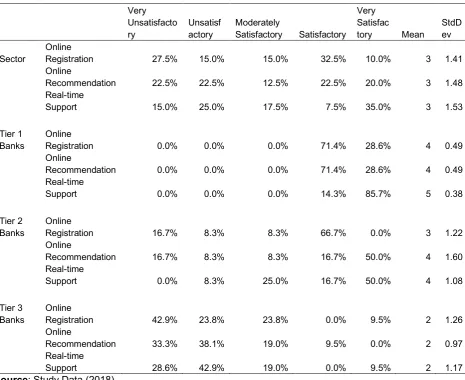
The website analysis results on online registration capability reveals that 32.5% and 10.0% had satisfactory and very satisfactory online registration capability, 15.0% had moderately satisfactory, 15.0% unsatisfactory while 27.5% had very unsatisfactory online registration capability on their e-commerce platforms. Majority of the commercial banks with satisfactory and very satisfactory were either large commercial banks or medium sized commercial banks. Small commercial banks had unsatisfactory and very unsatisfactory online registration capability as indicated by the mean of 2.
The study further sought to establish whether commercial banks in Kenya had suitable online recommendation capability on their e-commerce platforms. Online recommendation capability had a mean of 3, implying that some commercial banks had satisfactory online recommendation capability while others had unsatisfactory online recommendation capability. The findings were confirmed by the standard deviation of 1.48 which indicated high variation in online recommendation capability among commercial banks in Kenya. However, the results for large commercial banks indicated that majority of the large banks had satisfactory online recommendation capability on their e-commerce platforms compared to medium sized banks and small banks. The findings further indicate that majority of the small banks had unsatisfactory online recommendations capability on their e-commerce platforms.
Peer-reviewed Academic Journal published by SSBFNET with respect to copyright holders.
Pa
ge
16
commercial and medium size commercial banks was satisfactory as compared to small commercial banks whose majority had very unsatisfactory real time capability on their e-commerce platforms.
The finding further reaveal that the mean aggregate scores online registration, online recommendation and real-time support for the entire sector was 3 confirming that majority of the commercial banks in Kenya had moderately satisfactory online registration, online recommendation and real-time support. The standard deviations of 1.41, 1.48 and 1.53 for online registration, online recommendation and real-time support respectively reveal that the webs developers generally agreed that online registration, online recommendation and real-time support are key to e-commerce customization capability
The study findings on customization capability implied that it varied across commercial banks. Some commercial banks in Kenya had very satisfactory customization capability while others had very unsatisfactory customization capability. Large banks similarly had better customization capability on their e-commerce platforms compared to medium size and small banks. This was justified on availability of better resources in large banks and the need to handle large customers base by encouraging hall banking and e-banking.
Test of Hypothesis
To test the effect of E-commerce customization capability on financial performance, the study employed regression analysis. Hypothesis testing was done based on the findings of bivariate regression analysis. The study conducted the bivariate regression analysis to link e-commerce customization capability with both ROA respectively at 95 percent confidence level (α=0.05). The results on the fitted model are presented in tables 2 to 4.
Table 2: Model Summary for E-commerce Customization Capability and Financial Performance Model R R Square Adjusted R Square Std. Error of the Estimate
ROA .312a 0.097 0.096 2.524
a Predictors: (Constant), Customization Capacity Mean Source: Study Data (2018)
The results revealed for Adjusted R=squared = 0.096 for ROA. These findings implied that e-commerce customization capability accounted for 9.6% of the change in ROA in ROA of commercial banks in Kenya. The results further implied e-customization capabilities had a good explanatory power on financial performance of commercial banks other factors held constant. The research findings point out that enhancing customization capability would lead to increased performance of commercial banks in Kenya. Kiron, Prentice and Ferguson (2012) also revealed that customization capability results into improved financial performance. Further, Liebowitz (2013) also established that customization leads to an increase in sales and that contributes overall financial performance of the firm.
ANOVA Results
The ANOVA results for regression model fitted for e–commerce customization capability and performance (ROA) was statistically significant as indicated in Table 3.
Peer-reviewed Academic Journal published by SSBFNET with respect to copyright holders.
Pa
ge
17
Table 3: ANOVA for E-Customization Capability and Firm performance
Model Sum of Squares df Mean Square F Sig.
ROA Regression 46.264 1 46.264 7.264 .011b
Residual 229.285 36 6.369
Total 275.549 37
b Predictors: (Constant), Customization Capacity Source: Study Data (2018)
The findings of ANOVA revealed F-statistics = 7.264, p=0.011 which was less than significance level of 0.05 for the model linking e-customization capabilities and financial performance of commercial banks in Kenya. The findings implied that the models had good fitness and concluded that e-customization capabilities significant predicated financial performance of commercial banks in Kenya. The research findings point out that enhancing customization capability would lead to increased performance of commercial banks in Kenya. Kiron, Prentice and Ferguson (2012) also revealed that customization capability results into improved performance. Further, Liebowitz (2013) also established that customization leads to an increase in sales and that contributes overall performance of the firm.
Regression Coefficients Results
The coefficient of e-customization capability was at (β=5.049, p=0.009, <0.05) showed a statistically significant relationship between e-customization capability and ROE of commercial banks in Kenya. Similarly, the coefficient of customization capability was (β=0.834, p=0.011, <0.05) which also revealed a statistically significant relationship between e-commerce customization capability and ROA of commercial banks in Kenya.
Table 4: Regression Coefficients for E-Customization Capability and Firm performance
B Std. Error Beta t Sig.
ROA (Constant) 0.515 1.082 0.477 0.637
E-Customization Capacity 0.834 0.309 0.41 2.695 0.011
Source: Study Data (2018)
The research findings indicated that enhancing customization capability would lead to increase in financial performance of commercial banks in Kenya other factors held constant. Kiron, Prentice and Ferguson (2014) study findings also revealed e-commerce customization capability and transaction capability leads to improved financial performance.
Conclusion
Peer-reviewed Academic Journal published by SSBFNET with respect to copyright holders.
Pa
ge
18
The study recommends that the management of commercial banks in Kenya should invest more in customization capability to improve their performance. This will ensure reduction in operational costs especially marketing and transactions costs. For instance facilitating self-service via online account management and search tools will improve customer services and expand revenue sources. Instantaneous data analytics allow firms to provide customized services and products, including advertising. Over and above, customization enables firms to segment customers and serve them with promotional information on new offers.
References
Aranyossy, M. (2010). Business Value of Information Technology-Resource-based Analysis of E-commerce Business Value. Unpublished Doctoral Thesis.
Barney, J. (1991). Firm resources and sustained competitive advantage. Journal of management, 17(1), 99-120.
Baron, R. M., & Kenny, D. A. (1986). The moderator–mediator variable distinction in social
psychological research: Conceptual, strategic, and statistical considerations. Journal of personality and social psychology, 51(6), 1173.
Bernhardt, K. L., Donthu, N., & Kennett, P. A. (2000). A longitudinal analysis of satisfaction and profitability. Journal of business research, 47(2), 161-171.
Bhatt, G. & Grover, V. (2005). Types of information technology capability and their role in competitive advantage: an empirical study. Journal of Management Information Systems 22(2):253-278. Bhatt, G. & Grover, V. (2005). Types of information technology capability and their role in competitive
advantage: an empirical study. Journal of Management Information Systems 22(2):253-278. Chandran, D., Kang, K., & Leveaux, R. (2001). Internet culture in developing countries with special
reference to e-commerce. PACIS 2001 Proceedings of the 5th Pacific Asia Conference on Information Systems (PACIS): Information Technology for Estrategy, Seoul, pp. 656 -64.SAGE: London.
Cooper, R. N., & Porter, M. E. (2002). The Global Competitiveness Report 2001-2002. Foreign Affairs, 81(3), 163.
Croom, S. R. (2000). The impact of web-based procurement on the management of operating resources supply. Journal of Supply Chain Management, 36(4), 4- 13.
DaSilveira, G. J. (2003). Towards a framework for operations management in e- commerce. International Journal of Operations & Production Management, 23(2), 200-212.
Demirbag, M., Tatoglu, E., Tekinus, M., & Zaim, S. (2006). An analysis of the relationship between TQM implementation and firm performance: evidence from Turkish SMEs. Journal of Manufacturing Technology Management, 17(6), 829-847.
Drigă, I. (2006). The role of the banking system in the Sustainable development of the economy. vol.6, pp.55-60.
European Investment Bank (2013). Banking in sub-Saharan Africa, Challenges and Opportunities. EIB’s Economics Department Luxembourg.
European Investment Bank (2015). Banking in sub-Saharan Africa Recent Trends and Digital Financial Inclusion. Luxembourg.
Peer-reviewed Academic Journal published by SSBFNET with respect to copyright holders.
Pa
ge
19
Hoq, M. Z. & Chauhan, A. A. (2011). Effects of Organizational Resources on 373 Organizational Performance: An Empirical Study of SMEs. Interdisciplinary Journal of Contemporary Research in
Business, 2(12) 373-385.
Huang, H, & Lee, H. (2013). Product market competition and credit risk. Journal of Banking & Finance, 37(2),324-340.
IMF (2016). Financial Development and Sustainable Growth in Regional Economic Outlook, Washington DC, 51-78.
Johnston, R., & Clark, G. (2008). Service operations management: improving service delivery. Pearson Education. London.
Keisidou, E., Sarigiannidis, L., Maditinos, D. I., & Thalassinos, E. I. (2013). Customer satisfaction, loyalty and performance: A holistic approach of the Greek banking sector. International Journal of Bank Marketing, 31(4), 259-288.
Khan, M. N. H., & Haseeb, S. (2015). Impact of employee motivation and satisfaction on customer satisfaction and organizational performance: A theoretical framework. The International Journal of Business & Management, 3(1), 129.
Khan, M. N. H., & Haseeb, S. (2015). Impact of employee motivation and satisfaction on
customer satisfaction and organizational performance: A theoretical framework. The International Journal of Business & Management, 3(1), 129.
Kinyua, M. G, Muathe, S. M & Kilika, M. J (2015). Influence of Knowledge Transfer and Knowledge
Conversion on Performance of Commercial Banks in Kenya. Science Journal of Business and Management. ISSN: 2331-0626.
Kiron, D., Prentice, P. K., & Ferguson, R. B. (2012). Innovating with analytics. MIT Sloan Management Review, 54(1), 47.
Kombo, F. (2015). Customer satisfaction in the Kenyan banking industry. Journal of International Studies, 8, (2), 174-186.
Lederer, A. L., Mirchandani, D. A., & Sims, K. (2001). The search for strategic advantage from the World Wide Web. International Journal of Electronic Commerce, 5(4), 117-133.
Liebowitz, J. Ed. (2013). Big data and business analytics. CRC Press. New York.
Lin, H. F., & Lin, S. M. (2008). Determinants of e-business diffusion: A test of the technology diffusion perspective. Technovation, 28(3), 135-145.
Malkawi, B. H. (2006). E-commerce in light of international trade agreements: The WTO and the United States-Jordan Free Trade Agreement. International Journal of Law and Information Technology, 15(2), 153-169.
Merono-Cerdan, A. L., & Soto-Acosta, P. (2007). External web content and its influence on organizational performance. European Journal of Information Systems, 16(1), 66-80.
Mugo, J. G. (2012). The Effect of Financial Innovation on The growth of Microfinance Institutions in Kenya. Unpublished MBA Project, University of Nairobi.
Ongore V.O.& Kusa G.B (2013). Determinants of Performance of Commercial Banks in Kenya International Journal of e-commerce capablityonomics and Financial Issues, 237-237.
Oshlyansky, L., Cairns, P., & Thimbleby, H. (2007, September). Validating the Unified Theory of Acceptance and Use of Technology (UTAUT) tool cross-culturally. In
Peer-reviewed Academic Journal published by SSBFNET with respect to copyright holders.
Pa
ge
20
San, O. T. & Heng, T. B. (2013). Factors Affecting the Profitability of Malaysian Commercial Banks. African Journal of Business Management, 7(8), 649-660.
Saunders, M., Lewis, P., & Thornhill, A. (2009). Research methods for business students. Pearson education.
Venkatesh, V., Morris, M. G., Davis, G. B., & Davis, F. D. (2003). User acceptance of information technology: Toward a unified view. MIS Quarterly, 425-478.
Wang, I. M., & Shieh, C. J. (2006). The relationship between service quality and customer satisfaction: the example of CJCU library. Journal of Information and optimization Sciences, 27(1), 193-209.
Wernerfelt, B. (1984). A resource-based view of the firm. Strategic management journal, 5(2), 171-180.
Wheelen, T. L., & Hunger, J. D. (2011). Concepts in strategic management and business.Pearson education. Delhi.
Zhu, K. (2004). The complementarity of information technology infrastructure and e-commerce capability: A resource-based assessment of their business value. Journal of management information systems, 21(1), 167-202.