Alexander Rostovtsev [email protected] St. Petersburg State Polytechnic University
Changing probabilities of differentials and linear sums
via isomorphisms of ciphers
Ciphers y = C(x, k) and = (, ) are isomorphic if there exists invertible computable in both directions map y↔, x↔, k↔. Cipher is vulnerable if and only if isomorphic cipher is vulnerable. Instead of computing the key of a cipher it is sufficient to find suitable isomorphic cipher and compute its key. If ϕ is arbitrary substitution and T is round substitution, its conjugate
= ϕTϕ−1 is cipher isomorphism. Conjugate substitutions have the same cycle type. Conjuga-tion can be composed with affine maps.
Combining conjugation and affine equivalence, sometimes we can transform non-linear spe-cial S-box to conjugate affine substitution . Usually for given S, there are many different auxiliary substitutions ϕ. Conjugate diffusion map and XOR operation become non-linear, but taking appropriate ϕ we can get large probabilities of differentials and linear sums of diffusion map and XOR.
For example AES substitution (as finite field inverting) is approximately conjugate with bit changing substitution. That conjugate substitution has differentials and linear sums of probability 1. Corresponding byte substitution ϕ defines non-linear conjugate diffusion map and non-linear conjugate to XOR operation with round key. Probabilities of differentials (biases of linear sums) of byte substitution of conjugate diffusion map are 8−12 times more then corresponding values of original S-box. Probabilities of differentials of conjugate XOR with the round key byte de-pends on the round key and can be 1 for some key bytes.
1.
Introduction
Binary maps are widely used in cryptology. Block ciphers and hash functions are built as composition of binary maps.
Strength of cipher, hash function is determined as complexity of computing se-cret key (hash-function input) under known plaintexts and corresponding cipher-texts (hash function output). Well-known cryptanalysis methods take large number of known plaintexts/ciphertexts (differential [3] and linear [8] attacks) or few ones (algebraic attacks, based on Groebner bases [5] or agreeing/gluing methods [9]). Combination of those methods was considered in [1].
Modern ciphers resist those attacks due to special S-boxes. Let substitution S acts on set of n-bit strings and input x = (x1, …, xn) to output y = (y1, …, yn). If xi, yi
are independent variables, linear over 2 sum
1 1
n n
i i i i
i i
a x b y
= =
+
∑
∑
, ai, bi ∈ 2, takes 0and 1 with probability 0.5. But if xi, yi are input and output bits, probabilities P(0),
search linear sums with maximal absolute result biases. Hence biases of S-boxes determine the complexity of linear attack. The most weak substitutions have biases ±0.5.
Let x, x′ is a pair of inputs of substitution S, y = S(x), y′ = S(x′). Let ∆x = x +
x′, ∆y = y + y′ (notice that ∆y = 0 if and only if ∆x = 0). Probability of differential (∆x, ∆y) may be positive. As in previous case, addition modulo 2 with a constant keeps differential and its probability, linear diffusion map changes differential but keeps its probability. Probability of composition of two maps is product of corre-sponding probabilities. Differential cryptanalysis is based on search result differen-tials that have large probabilities. So complexity of differential attack is defined by S-boxes. The most weak substitution has differentials that have probability 1.
Usually S-boxes provide both minimal probabilities of most like differentials and minimal absolute bias of most (least) like linear sums.
In this paper we generalize known attacks on block ciphers and show that spe-cial S-boxes have little advantage comparatively to random ones. There are no pub-lications that defines “strong” and “weak” S-boxes with respect to algebraic at-tacks. So we illustrate proposed cryptanalysis technique only for differential and linear methods. But we believe that this approach can be used algebraic and other types of attacks.
2. Algebraic basics
Let y = T(x) is arbitrary map of set of n-bit strings to itself. This map can be de-fined using interpolating polynomials over finite field of characteristic 2. Usually normal algebraic form is used
n[x] = 2[x1, …, xn]/(x1 2
+ x1, …, xn
2
+ xn).
Ring n[x] is finite and hence is Artinian, its Krull dimension is 0 [2].
Intersec-tion of ideals coincides with their product. Each ideal can be factored as product of prime ideals. Prime ideal is maximal and consists of polynomials that take zero on given set of arguments. There exist 2n prime ideals. Prime ideal can be given by one polynomial, for example, 1 + x1…xn. Hence each ideal is principal and each
polynomial is idempotent.
Set of n-bit binary vectors x form affine space n. Ideal A ⊆ n[x] is
deter-mined by set of its zeroes in n and back, any subset of n is determined by corre-sponding ideal. Zero ideal corresponds to n, ideal n[x] = (1) corresponds to
empty set.
Automorphism of n[x] fixes 0 and 1 and maps prime ideal to prime ideal.
automorphism group of ring n[x] is isomorphic to group of all permutations of
points of n.
Similarly to ring n[x] may be defined ring
2n[x, y] = 2[x1, …, xn, y1, …, yn]/(x12 + x1, …, xn2 + xn, y12 + y1, …, yn2 + yn).
Affine functions are
1 1
n n
i i i i
i i
a x b y c
= =
+ +
∑
∑
∈2n[x, y].Set of 2n-bit vectors (x, y) form affine space 2n. Subset of 2n, where any n-bit vector x corresponds to one n-bit vector y, defines map of space n to itself, where x is input and y is output of the map.
Let y = T(x) is a map n → n. Set of polynomials that take zero in points (x,
y) forms ideal AT ⊂ 2n[x, y] of map T. There is bijection between such maps and
ideals. Ideal AT defines algebraic set V(T) that has 2 n
points.
Hence there exists quotient ring n[T] = 2n[x, y]/AT set of polynomials
de-termined up to map T.
Theorem 1. For arbitrary map T: n →n there exists ring isomorphism n[T]
≅ n[x].
Proof. Ideal AT consists of all polynomials from 2n[x, y] that take zero if y =
T(x). This equality holds in 2n points, each polynomial in AT takes at least 2 n
ze-roes. Quotient ring n[T] = 2n[x, y]/AT consists of classes of polynomials that take
arbitrary values in those 2n points. Since affine space 2n has 22n points, #n[T] =
#n[x] = 2n. Ring n[T] has characteristic 2, addition and multiplication in n[T]
corresponds to addition and multiplication in n[x]. n
If ϕ, T are elements of symmetric group G, conjugation σϕ: T →ϕTϕ−1 is auto-morphism of G.
Centralizer of substitution T is subgroup CT⊆ G such that ϕTϕ−1 = T for all ϕ∈
CT. Centralizer CT partitions group G into cosets. If T, T1 are conjugate, number of
substitutions ϕ that maps T → T1 equals to #CT. Indeed, if ψ ∈ CT, then ψTψ−
1
= T, ϕTϕ−1 = ϕψTψ−ϕ−1 = (ϕψ)T(ϕψ)−1 and if ψ runs through CT, all substitution ϕψ are
different. Hence number of substitutions conjugate to T is # # T
G
C . Substitutions T, T1 are conjugate if and only if the have the same cycle type [7]. Indeed, if T r(x) = x, T1 = ϕTϕ−
1
and z = ϕ(x), then T1
r
(z) = (ϕTϕ−1)r(z) = ϕTrϕ−1(z) = z. Conjugate substi-tutions have a cycle of the same length. Applying this statement to other cycles shows that conjugate substitutions have the same cycle types. Back, if T, T1 have
Affine substitution is given by equation y = Lx + c, where L is invertible matrix and c is arbitrary vector. Affine substitutions form subgroup of symmetric group. Substitutions T, T1 are affine equivalent if there exist affine substitutions A, B such
that T1 = ATB. Affine equivalence of substitutions can be easily detected [4].
Affine equivalence preserves probabilities of differentials and absolute biases of linear sums, but differentials and linear sums with the fixed probabilities can change. Affine equivalent substitutions can have different cycle type.
Count number of affine n-bit substitutions. There are 2n vectors c. First row of matrix L can be arbitrary but non-zero (2n − 20) possibilities. Second row can be arbitrary but non-zero and different from the first one (2n − 2) possibilities. Third row must differ from zero, first row, second row and their sum (2n − 22) possibili-ties and so on. Hence number of affine substitutions is
1
0
2 (2 2 )
n
n n i
i
−
=
−
∏
.If substitution Sn acts on n-bit words, it can be extended to substitution Sn+1
act-ing on (n + 1)-bit stract-ings adjoinact-ing identity function yn+1 = xn+1. Its cycle type is
double cycle type of substitution Sn (one set of cycles corresponds to xn+1 = 0, other
set of the same cycles corresponds to xn+1 = 1). We say that substitution Sn+1 is
equivalent to substitution Sn.
Theorem 2. Let substitution S acts on n-bit words. Next statements are equiva-lent.
1. Substitution S has linear sums with probability 1. 2. Ideal AS contains affine polynomial.
3. Substitution S is affine equivalent to substitution that acts on (n − 1)-bit words. Proof. 1 ⇔ 2. If ideal AS of substitution y = S(x) contains affine function
i i i i
a x + b y +c
∑
∑
, this function takes zero with probability 1. Back, if function takes zero with probability 1, it is in ideal AS.2 ⇒ 3. If ideal AS contains linear function
1 1
n n
i i i i
i i
a x b y
= =
+
∑
∑
, there exists suchinvertible affine change of variables that
1 n
n i i
i
x a x =
=
∑
,1 n
n i i
i
y b y =
=
∑
. Under this change xn can be expressed as linear combination of x1, …, xn−1 and yn can beex-pressed as linear combination of y1, …, yn−1. Hence function
1 1
n n
i i i i
i i
a x b y
= =
+
∑
∑
willbe changed by yn + xn, and other functions of ideal basis will depend only of x1, …,
xn−1, y1, …, yn−1 and correspond to a map that acts on (n − 1)-bit words. Assume
that this map is not invertible. Then map adjoined by identity bit cannot be invert-ible, so assumption is wrong.
3 ⇒ 2. Let substitution S if affine equivalent to substitution S1 with identity yn =
…, xn) and affine substitution A changes yn by affine function of y = (y1, …, yn), i.e.
ideal of substitution S contains affine function. n
In practice usually substitution has no linear sums with probability 0, 1. So we need generalization of theorem 2. Polynomial f(x, y) ∈2n[x, y] can be represented
by its values in 22n points of affine space 2n. Non-linearity NL(f) of polynomial f(x, y) ∈ 2n[x, y] is Hamming distance between the binary vector and the set of
vectors that correspond to affine polynomials.
Theorem 3. Maximal absolute bias of linear sums of substitution S equals to min(NL(f))/2n for all f ∈AS.
Proof follows directly from the definitions of non-linearity and of bias of linear
sums. n
Differential of substitution can be defined using formal derivations. Input and output variables x, y of ideal AS of n-bit substitution S are algebraically dependent.
Let y1 = f1(x), …, yn = fn(x). Choose a set of algebraically independent variables,
for example, x.
Derivative of polynomial f(x1, …, xn) for variable x1 can be defined as
differ-ence
1 (1 1, 2,..., ) ( ,...,1 )
x n n
f′ = f +x x x + f x x . This difference corresponds to point (1, 0, …, 0) of affine space n. Similarly we can define derivative for arbitrary point u
= (u1, …, un) as difference f(x + u) + f(x).
Substitution has differential (∆x, ∆y) of probability 1 if derivative map corre-sponding to point ∆x is constant and equals to ∆y.
3. Isomorphic and conjugate ciphers
Definition 1. Let x, y, k are plaintext, ciphertext and key correspondingly. Iso-morphism of ciphers C, is invertible computable in both directions map x ↔ , y ↔ , k ↔ such that equality y = C(x, k) hold if and only if equality = (, ) holds. Ciphers are isomorphic, if there exists an isomorphism between them.
Theorem 4. Cipher C is vulnerable if and only if isomorphic cipher is vul-nerable.
Proof. It is sufficient to map set of plaintexts, ciphertexts of original cipher to ones of vulnerable isomorphic cipher, find key of vulnerable cipher and map it to
key of original cipher. n
Well known example of cipher isomorphism is affine equivalence [4]. Consider other simple example of cipher isomorphism. Let T is round encryption function, ki
is round key and cipher is defined by equation
Texts x, y and key k do not change if we apply to them ϕ−1ϕ map for arbitrary substitutions ϕ, ψ. Then (1) can be written as
ϕ−1ϕ
y = Tψ−1ψ(ϕ−1ϕkr + ϕ−1ϕTψ−1ψ(ϕ−1ϕkr−1 + … ϕ−1ϕTψ−1ψ(ϕ−1ϕk1 +
ϕ−1ϕ
x)…)).
Left multiplying this equation by ϕ gives ϕy = ϕTψ−1ψ(ϕ−1ϕkr + ϕ−
1ϕ
Tψ−1ψ(ϕ−1ϕkr−1 + … ϕ− 1ϕ
Tψ−1ψ(ϕ−1ϕk1 + ϕ− 1ϕ
x)…)).(2)
Let = ϕ(k), = ϕ(x), = ϕ(y). Define isomorphic cipher with round encryp-tion ϕψ = ϕTψ−1, and isomorphic commutative and associative addition
ψ+ϕ = ψ(ϕ−1() + ϕ−1()). We can simplify equation (2) since
ϕ−1ϕ
(k1) + ϕ− 1ϕ
(x) = ϕ−1(1) + ϕ− 1
(), ϕ−1ϕ
Tψ−1ψ(ϕ−1(1) + ϕ−1())= ϕ−1ϕψ(1ψ+ϕ ).
Isomorphic cipher satisfies equation
= ϕψ(r ψ+ϕϕψ(r−1ψ+ϕ … ϕψ(1ψ+ϕ)…)). (3)
If round encryption function is composition of two maps T = UV, we can write
= , где = ϕVχ−1, = χUψ for arbitrary invertible map χ. This approach can be used if round encryption function contains more then two maps.
The main idea is to find such isomorphism of ciphers that isomorphic cipher will be breakable. For example, it will have more like differentials and linear sums. This approach can be used in algebraic attacks too.
For example, invertible linear map, defined as matrix L, acts on XOR operation
L+L trivially: L(L−
1
x + L−1k) = x + k because multiplying by matrix is distributive under addition.
In this paper we consider isomorphism of ciphers given by conjugation. Let ϕ is some substitution and ϕ = ϕTϕ−1, ϕ+ϕ = ϕ(ϕ−1() + ϕ−1()).
Definition 2. Ciphers C, are conjugate if isomorphism between them is given by conjugation.
Usually S-boxes are chosen using special requirements to protect known at-tacks. For example, probability of most likely differentials of substitution must be small, absolute bias of linear sums must be small.
Example of such substitution is finite field inverting (input 0 corresponds to output 0). This substitution has two fixed points (0 and 1), other points form cycles of length 2. If substitution S satisfies S(0) = 1, S(1) = 0 and S(x) = x−1 for x ≠ 0, 1, then all cycles have length 2. Hence substitution S has conjugate affine substitution
: y = x + a for arbitrary non-zero a.
Substitution S has 2n−1 cycles of length 2. Each cycle defines two input/output pairs of centralizer. Element ϕ of centralizer satisfies equation Sϕ = ϕS. For cycle (0, 1) we have Sϕ(0) = ϕ(1), Sϕ(1) = ϕ(0). We can choose arbitrary ϕ(1) (there are 2n possibilities) and find unique ϕ(0). Next cycle has 2n − 2 possibilities, etc. Car-dinality of centralizer of substitution S is #CS = 2
n
(2n− 2)(2n − 4)⋅…⋅4⋅2 ≈ 2 !n . Assume that each round has XOR operation with round key, n-bit substitution S as above and linear diffusion map L. Then there exist a large number of substitu-tions ϕ such that equation = ϕSϕ−1. Isomorphic conjugate cipher has operations ϕ+ϕ, affine substitution and conjugate diffusion map = ϕLϕ−1. Possibly there exists such substitution ϕ that both operations ϕ+ϕ, has high probability of differ-entials or large biases of linear sums. Our goal is to find such substitution ϕ.
Algorithm 1. Computing substitution ϕ. Input: conjugate n-bit substitutions S, . Output: substitution ϕ.
Method.
1. Make list of marked inputs Tb1 of substitution ϕ and list of marked outputs Tb2
of substitution ϕ with length 2n. Let Tb1 = ∅, Tb2 = ∅.
2. While Tb1, Tb2 do not contain whole set of n-bit words, do the next.
2.1.Choose arbitrary input x that is not in Tb1 and arbitrary output ϕ(x) that is
not in Tb2.
2.2.Compute ϕ(x).
2.3.Compute S(x) and ϕS(x) using equation ϕS(x) = ϕ(x). 2.4.Join x, S(x) to Tb1and sort.
2.5.Join ϕ(x) и ϕS(x) to Tb2 and sort.
3. Return: Tb2. n
Complexity of algorithm 1 is O(2n).
Assume that substitution S has such cycles that LCM of their lengths does not divide number of affine substitutions. Then there is no conjugate affine substitution
. In this case we can apply affine equivalence to original cipher, that changes cy-cle type of substitution. Affine equivalent cipher can be considered as modified original cipher, we can find isomorphic cipher, apply affine equivalence again, etc. So we obtain random walk in the set of conjugate and affine equivalent ciphers.
Search of substitution ϕ can be sensible by special choosing x, ϕ(x) on step 2.1 of algorithm 1. We need to obtain small non-linearity of a polynomial in ideal of some substitution.
4. Incrementing probabilities of differentials and linear sums:
a toy example
Show that conjugate cipher can have more likely differentials, linear sums then the original cipher. Consider a toy cipher with two operations: XOR and 4 bit sub-stitution T in each round.
0 1 2 3 4 5 6 7 8 9 10 11 12 13 14 15
1 0 9 6 13 7 3 5 15 2 12 14 10 4 11 8
T =
.
Substitution T corresponds to map x → x15 (nod 17) for group 17 *
if x ≠ 0, 1. All cycles have length 2. This substitution has the best possible differential prob-abilities and biases of linear sums equal to 0.25. Tables of differentials, linear sums are the next.
{16, 0, 0, 0, 0, 0, 0, 0, 0, 0, 0, 0, 0, 0, 0, 0}, {0, 2, 2, 2, 0, 2, 2, 2, 0, 0, 2, 0, 0, 0, 2, 0}, {0, 2, 2, 2, 4, 0, 2, 0, 2, 0, 0, 0, 0, 0, 2, 0}, {0, 2, 2, 0, 0, 0, 2, 2, 2, 2, 0, 0, 2, 0, 0, 2}, {0, 0, 4, 0, 0, 0, 2, 2, 0, 0, 0, 4, 2, 2, 0, 0}, {0, 2, 0, 0, 0, 4, 0, 2, 2, 2, 2, 0, 0, 2, 0, 0}, {0, 2, 2, 2, 2, 0, 0, 0, 2, 2, 2, 0, 0, 0, 0, 2}, {0, 2, 0, 2, 2, 2, 0, 0, 0, 2, 2, 4, 0, 0, 0, 0}, {0, 0, 0, 0, 4, 0, 0, 4, 0, 2, 0, 2, 0, 2, 0, 2}, {0, 2, 0, 0, 0, 2, 2, 2, 0, 2, 0, 0, 2, 0, 4, 0}, {0, 0, 0, 2, 0, 2, 2, 2, 0, 2, 2, 2, 0, 0, 0, 2}, {0, 0, 2, 2, 0, 2, 2, 0, 4, 0, 0, 0, 0, 2, 0, 2}, {0, 0, 0, 2, 0, 0, 2, 0, 2, 2, 0, 2, 4, 0, 0, 2}, {0, 2, 2, 0, 0, 0, 0, 0, 0, 0, 4, 0, 4, 2, 2, 0}, {0, 0, 0, 0, 2, 2, 0, 0, 2, 0, 0, 2, 2, 4, 2, 0}, {0, 0, 0, 2, 2, 0, 0, 0, 0, 0, 2, 0, 0, 2, 4, 4}
{0, 0, 0, 0, 0, 4, 0, -4, 2, -2, 2, -2, 2, 2, 2, 2}, {0, 2, -2, 0, 2, 0, 0, -2, 0, -2, 2, 0, 2, -4, -4, -2}, {0, -4, 2, -2, 0, 0, 2, 2, 0, 0, 2, 2, 4, 0, -2, 2}, {0, -2, 4, 2, -2, 0, 2, -4, -2, 0, -2, 0, 0, -2, 0, -2}, {0, -2, 0, 2, 4, 2, 0, 2, 2, 0, -2, 0, 2, 0, 2, -4}, {0, 0, 2, -2, -2, -2, -4, 0, 0, 0, 2, -2, 2, 2, 0, -4}
Probability of differential (bias of linear sum) is corresponding number in the table divided by 16.
Choose conjugate substitution as inversion of the least bit. Compute substitu-tion ϕ using algorithm 1:
0 1 2 3 4 5 6 7 8 9 10 11 12 13 14 15
0 1 2 5 7 9 4 8 11 3 13 15 12 6 14 10
ϕ =
.
Substitution does not change input differences and liner sums. Probability of differential is 1, bias of linear sum is ±0.5. Conjugate XOR operation ϕ+ϕ becomes non-linear, for fixed round key probability of differential (bias of linear sum) de-pends on the round key. If k = 0, ϕ−1() = 0, then ϕ+ϕ = ϕ(ϕ−1() + ϕ−1()) = , conjugate differentials and linear sums have probability 1. Some other keys have differentials with probability 1 and linear sums with bias ±0.5. For example key 11 gives such differentials and linear sums:
{16, 0, 0, 0, 0, 0, 0, 0, 0, 0, 0, 0, 0, 0, 0, 0}, {0, 4, 0, 0, 0, 4, 0, 0, 4, 0, 0, 0, 4, 0, 0, 0}, {0, 0, 4, 4, 0, 0, 4, 4, 0, 0, 0, 0, 0, 0, 0, 0}, {0, 0, 4, 0, 0, 0, 4, 0, 0, 0, 4, 0, 0, 0, 4, 0}, {0, 0, 0, 0, 4, 4, 0, 0, 0, 0, 0, 0, 4, 4, 0, 0}, {0, 4, 0, 0, 4, 0, 0, 0, 4, 0, 0, 0, 0, 4, 0, 0}, {0, 0, 4, 4, 0, 0, 0, 0, 0, 0, 0, 0, 0, 0, 4, 4}, {0, 0, 4, 0, 0, 0, 0, 4, 0, 0, 4, 0, 0, 0, 0, 4}, {0, 4, 0, 0, 0, 4, 0, 0, 0, 4, 0, 0, 0, 4, 0, 0}, {0, 0, 0, 0, 0, 0, 0, 0, 4, 4, 0, 0, 4, 4, 0, 0}, {0, 0, 0, 4, 0, 0, 0, 4, 0, 0, 4, 0, 0, 0, 4, 0}, {0, 0, 0, 0, 0, 0, 0, 0, 0, 0, 0, 16, 0, 0, 0, 0}, {0, 4, 0, 0, 4, 0, 0, 0, 0, 4, 0, 0, 4, 0, 0, 0}, {0, 0, 0, 0, 4, 4, 0, 0, 4, 4, 0, 0, 0, 0, 0, 0}, {0, 0, 0, 4, 0, 0, 4, 0, 0, 0, 4, 0, 0, 0, 0, 4}, {0, 0, 0, 0, 0, 0, 4, 4, 0, 0, 0, 0, 0, 0, 4, 4}
Since probability of differential, linear sum strongly depends on the round key, it is useful to modify technique of differential and linear cryptanalysis. Compute table of differences and linear sums as functions of round key. Obtained frequency of differential can help to find the key if the table of corresponding probabilities of differentials is known.
5. Application to AES
Apply proposed technique to encryption standard AES.
5.1. AES and its conjugate image
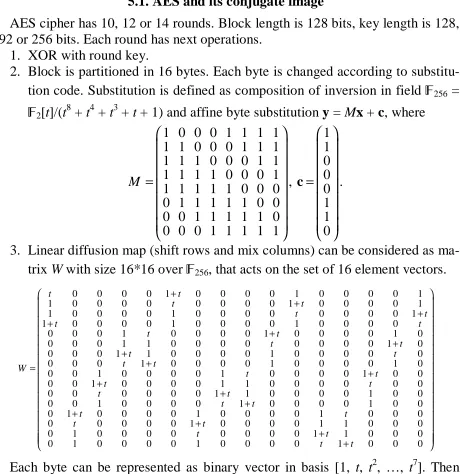
AES cipher has 10, 12 or 14 rounds. Block length is 128 bits, key length is 128, 192 or 256 bits. Each round has next operations.
1. XOR with round key.
2. Block is partitioned in 16 bytes. Each byte is changed according to substitu-tion code. Substitusubstitu-tion is defined as composisubstitu-tion of inversion in field 256 =
2[t]/(t 8
+ t4 + t3 + t + 1) and affine byte substitution y = Mx + c, where 1 0 0 0 1 1 1 1
1 1 0 0 0 1 1 1 1 1 1 0 0 0 1 1 1 1 1 1 0 0 0 1 1 1 1 1 1 0 0 0 0 1 1 1 1 1 0 0 0 0 1 1 1 1 1 0 0 0 0 1 1 1 1 1 M = , 1 1 0 0 0 1 1 0 = c .
3. Linear diffusion map (shift rows and mix columns) can be considered as ma-trix W with size 16*16 over 256, that acts on the set of 16 element vectors.
0 0 0 0 1 0 0 0 0 1 0 0 0 0 1
1 0 0 0 0 0 0 0 0 1 0 0 0 0 1
1 0 0 0 0 1 0 0 0 0 0 0 0 0 1
1 0 0 0 0 1 0 0 0 0 1 0 0 0 0
0 0 0 1 0 0 0 0 1 0 0 0 0 1 0
0 0 0 1 1 0 0 0 0 0 0 0 0 1 0
0 0 0 1 1 0 0 0 0 1 0 0 0 0 0
0 0 0 1 0 0 0 0 1 0 0 0 0 1 0
0 0 1 0 0 0 0 1 0 0 0 0 1 0 0
0 0 1 0 0 0 0 1 1 0 0 0 0 0 0
0 0 0 0 0 0 1 1 0 0 0 0 1 0 0
t t t t t t t t t t t t t t t t W t t t t t t + + + + + + + + = + + +
0 0 1 0 0 0 0 1 0 0 0 0 1 0 0
0 1 0 0 0 0 1 0 0 0 0 1 0 0 0
0 0 0 0 0 1 0 0 0 0 1 1 0 0 0
0 1 0 0 0 0 0 0 0 0 1 1 0 0 0
0 1 0 0 0 0 1 0 0 0 0 1 0 0 0
t t t t t t t t t t + + + + +
0 1 0 0 0 0 0 0 0 0 1 0 0 0 0 0 0 0 0 1 0 0 0 0 0 0 0 0 1 0 0 0 0 0 0 0 0 1 0 0 0 0 0 0 0 0 1 0 0 0 0 0 0 0 0 1 1 1 0 1 1 0 0 0
t
L
=
and E + Lt. Notice that Lt
8
+ Lt
4
+ Lt
3
+ Lt + E is zero
matrix, matrix polynomials of Lt form finite field 256. So we can consider
diffu-sion map W as block matrix over 2 with four types of blocks.
AES substitution has next cycle type: {87, 81, 59, 27, 2}. LCM of cycle lengths does not divide the group order of byte affine substitutions. Hence there is no af-fine substitution conjugate to the AES substitution.
For convenience we consider affine byte substitution y = Mx + c as a part of diffusion map W (there are 16 equal affine substitutions in the 16 byte diffusion map). This changes diffusion map W. Zero block 0 of matrix W will stay zero due to equality 0(Mx + c) = 0. Identity block E of matrix W becomes affine byte substi-tution: E(Mx + c) = Mx + c. Block Lt of matrix W becomes affine byte substitution
Lt(Mx + c) = LtMx + Ltc. Block E + Lt of matrix W becomes affine byte substitution
(E + Lt)(Mx + c) = (M + LtM)x + (E + Lt)c. Denote those three non-zero affine
sub-stitutions as M1, Mt, M1+t.
Then AES substitution becomes finite field inverting U. Substitution U has two fixed points (0 and 1), other cycles have length 2.
Define substitution V(x) = U(x) if x ≠ 0, 1, V(0) = 1, V(1) = 0. All cycles of sub-stitution V have length 2 and U(x) = V(x) with probability 1 − 2−7.
V= {1, 0, 137, 246, 199, 82, 119, 209, 228, 75, 37, 192, 176, 225, 229, 199, 116, 180, 166, 71, 149, 39, 96, 91, 84, 59, 249, 200, 251, 64, 234, 178, 54, 106, 86, 241, 85, 73, 164, 197, 193, 6, 148, 21, 48, 68, 162, 194, 40, 69, 146, 104, 243, 53, 102, 66, 242, 53, 32, 107, 119, 183, 85, 21, 25, 250, 55, 103, 41, 49, 245, 101, 167, 100, 167, 19, 84, 37, 229, 5, 233, 88, 5, 198, 72, 36, 135, 187, 20, 58, 34, 240, 81, 232, 97, 23, 22, 90, 171, 211, 69, 166, 54, 67, 244, 71, 145, 219, 51, 147, 33, 55, 117, 183, 151, 133, 16, 181, 182, 56, 182, 112, 208, 6, 161, 246, 129, 130, 131, 122, 123, 128, 150, 115, 186, 86, 151, 154, 149, 213, 247, 2, 181, 164, 218, 102, 50, 105, 212, 134, 132, 114, 38, 20, 155, 132, 245, 216, 133, 150, 247, 120, 42, 195, 139, 180, 101, 68, 38, 196, 18, 70, 202, 231, 210, 98, 8, 224, 27, 235, 17, 117, 116, 113, 165, 138, 118, 57, 185, 184, 134, 87, 7, 36, 43, 163, 214, 212, 228, 11, 165, 39, 83, 4, 23, 248, 168, 230, 118, 7, 170, 99, 197, 215, 226, 230, 148, 135, 196, 213, 153, 244, 144, 103, 177, 9, 214, 231, 198, 10, 203, 169, 4, 74, 215, 227, 89, 80, 26, 179, 87, 35, 52, 52, 100, 70, 3, 136, 217, 152, 121, 160, 201, 22, 65, 24}.
Hence substitution V has conjugate image defined as inverting of the least bit. Its differentials have probability 1 and linear sums have biases ±0.5. Centralizer of substitution V has cardinality
127
254
0
(256 2 ) 1.3 10
i
i =
− = ⋅
∏
.Auxiliary substitution ϕ acts on bytes. There is a large number of substitutions ϕ and hence a large number of conjugate ciphers with given image of substitu-tion. Denote conjugate AES as ϕ. ϕ has non-linear diffusion map and non-linear addition with round key. Block M1 becomes to 1 = ϕM1ϕ−1, block Mt
becomes to t = ϕMtϕ−
1
, block M1+t becomes to 1+t = ϕM1+tϕ−
1
5.2. Differentials and linear sums of conjugate AES
Our goal is to choose such auxiliary substitution ϕ that conjugate diffusion map and conjugate XOR will have large probabilities of differentials and linear sums. There are different ways to computing suitable substitution ϕ. It can have many fixed points; it can have many points in which it commutes with substitutions M1,
Mt, M1+t; it can be chosen so that ideals of substitutions 1, t, 1+t contain
poly-nomials with small non-linearity, etc.
If substitution ϕ has many fixed points, we choose ϕ(x) = x for all possible x in the step 2.1 of algorithm 1. In this case probabilities of conjugate XOR operation tends to increase. If substitution ϕ commutes with substitution M1 in many points,
we choose arbitrary x, compute M1(x) and if it is possible set ϕ(M1(x)) = M1(ϕ(x))
in the step 2.1 of algorithm 1. In this case maximal bias of linear sums and prob-abilities of differential of substitution 1 tends to increase.
Choose substitution ϕ using algorithm 1 so that ϕ has many fixed points (we did no significant optimization of ϕ).
ϕ = {0, 1, 2, 247, 4, 83, 6, 208, 8, 85, 10, 193, 12, 224, 14, 89, 16, 181, 18, 97, 20, 151, 22, 153, 24, 171, 26, 205, 28, 65, 30, 179, 32, 111, 34, 240, 36, 229, 38, 200, 40, 11, 42, 150, 44, 69, 46, 195, 45, 49, 50, 109, 52, 233, 54, 67, 56, 232, 33, 59, 60, 186, 62, 170, 64, 255, 66, 102, 68, 48, 70, 243, 72, 101, 74, 96, 76, 228, 78, 84, 80, 93, 82, 203, 77, 37, 86, 190, 25, 63, 35, 91, 92, 237, 94, 152, 23, 95, 98, 210, 100, 167, 55, 103, 104, 242, 106, 222, 108, 146, 110, 58, 112, 182, 114, 245, 17, 117, 118, 61, 120, 113, 122, 7, 124, 251, 126, 131, 128, 127, 130, 129, 132, 244, 134, 87, 136, 159, 138, 216, 140, 3, 142, 165, 144, 107, 51, 147, 148, 139, 133, 115, 43, 21, 154, 137, 156, 221, 158, 155, 160, 125, 47, 163, 164, 185, 166, 73, 39, 169, 19, 75, 172, 230, 174, 99, 13, 177, 178, 238, 180, 116, 121, 183, 184, 143, 119, 187, 188, 189, 135, 191, 192, 41, 194, 162, 196, 213, 198, 88, 168, 201, 202, 5, 204, 253, 173, 207, 123, 209, 175, 211, 212, 218, 214, 235, 149, 217, 197, 219, 220, 249, 145, 223, 176, 225, 215, 227, 199, 15, 206, 231, 9, 79, 234, 226, 236, 81, 31, 239, 90, 241, 57, 53, 105, 71, 246, 141, 248, 157, 250, 161, 252, 27, 254, 29}.
Probabilities of differentials and biases of linear sums of conjugate diffusion map become large. For example, substitution 1 has most likely differential (149,
2) with probability 32/256 = 0.125 it is 8 times more then differential probabili-ties of original AES. Linear sum (47, 107) has bias −46/256 = −0.18, (it is 11.5 times more then most likely biases in original AES).
Block t has the most likely differential (13, 67) with probability 34/256 =
0.133. Linear sum (202, 126) has bias −52/256 = −0,2.
Block 1+t has the most likely differential (59, 63) with probability 34/256 =
0.133. Linear sum (40, 90) has bias 44/256 = 0.17.
For key bytes in range (0, …, 255) probabilities of most likely differentials, positive and negative biases of liner sums are in the next tables (probability, bias equals to the number in corresponding position divided by 256).
{256, 10, 82, 48, 78, 42, 86, 38, 80, 74, 90, 30, 82, 72, 80, 38, 82, 80, 84, 74, 86, 42, 80, 82, 74, 82, 70, 50, 78, 50, 78, 70, 76, 90, 76, 80, 66, 38, 76, 78, 82, 48, 78, 68, 78, 82, 84, 68, 36, 30, 74, 82, 74, 40, 76, 80, 82, 72, 36, 26, 84, 38, 82, 36, 76, 40, 80, 40, 76, 34, 74, 42, 80, 46, 80, 46, 82, 70, 78, 46, 78, 46, 74, 34, 38, 36, 82, 34, 50, 40, 68, 32, 84, 38, 82, 32, 32, 28, 80, 40, 80, 34, 38, 32, 76, 72, 78, 44, 76, 40, 80, 36, 82, 30, 82, 44, 46, 38, 78, 76, 82, 70, 74, 76, 74, 56, 72, 30, 82, 42, 70, 42, 84, 70, 78, 76, 72, 46, 76, 42, 68, 50, 70, 40, 68, 72, 38, 32, 74, 72, 36, 32, 36, 32, 70, 52, 64, 44, 60, 42, 62, 50, 46, 44, 66, 42, 68, 34, 72, 34, 30, 38, 72, 74, 72, 68, 74, 52, 66, 42, 70, 36, 32, 42, 72, 46, 30, 36, 82, 40, 34, 40, 66, 24, 72, 30, 70, 70, 62, 70, 40, 40, 76, 42, 70, 44, 70, 40, 28, 40, 34, 44, 66, 42, 74, 80, 36, 40, 46, 42, 72, 48, 36, 40, 38, 38, 38, 36, 38, 48, 46, 42, 36, 40, 74, 42, 72, 36, 46, 42, 40, 48, 36, 38, 34, 32, 64, 30, 70, 38, 66, 48, 62, 48, 68}.
{128, 28, 64, 44, 72, 40, 64, 44, 60, 56, 64, 36, 64, 60, 56, 44, 64, 64, 72, 60, 64, 44, 60, 64, 56, 64, 64, 48, 56, 48, 56, 52, 60, 60, 56, 56, 52, 40, 56, 60, 64, 48, 60, 56, 60, 60, 72, 52, 40, 40, 56, 64, 60, 44, 56, 72, 64, 60, 36, 32, 64, 40, 56, 32, 64, 44, 60, 40, 64, 48, 68, 40, 60, 40, 60, 40, 68, 64, 60, 40, 60, 48, 60, 44, 40, 36, 60, 44, 48, 44, 52, 40, 60, 36, 72, 36, 40, 30, 60, 44, 60, 36, 40, 40, 52, 56, 68, 48, 60, 40, 60, 38, 60, 36, 68, 36, 40, 48, 64, 64, 64, 56, 64, 60, 56, 48, 56, 40, 72, 44, 60, 44, 60, 60, 60, 56, 60, 44, 56, 44, 56, 44, 56, 40, 60, 52, 40, 44, 60, 60, 40, 40, 44, 48, 56, 60, 56, 44, 52, 44, 64, 56, 40, 48, 52, 40, 56, 40, 56, 44, 32, 36, 60, 60, 56, 72, 60, 48, 56, 40, 56, 36, 40, 44, 60, 44, 36, 40, 60, 44, 48, 38, 56, 36, 60, 44, 56, 56, 56, 56, 40, 44, 56, 44, 64, 44, 56, 48, 40, 40, 40, 44, 60, 44, 56, 60, 44, 40, 44, 40, 60, 44, 44, 44, 40, 44, 36, 40, 44, 40, 44, 40, 36, 44, 56, 48, 52, 40, 44, 40, 48, 44, 40, 40, 48, 36, 56, 36, 64, 40, 48, 40, 48, 44, 60};
{0, 28, 68, 52, 60, 44, 72, 44, 64, 60, 68, 36, 60, 56, 68, 48, 60, 60, 60, 56, 64, 44, 60, 60, 56, 60, 60, 48, 60, 44, 60, 52, 60, 64, 60, 64, 60, 44, 60, 60, 64, 52, 68, 56, 64, 60, 72, 56, 40, 40, 64, 68, 60, 48, 60, 68, 72, 60, 48, 40, 64, 40, 60, 36, 68, 44, 64, 44, 60, 36, 60, 56, 60, 40, 72, 48, 56, 56, 60, 48, 56, 44, 64, 44, 44, 36, 60, 44, 48, 48, 56, 40, 60, 40, 64, 40, 44, 40, 64, 44, 64, 40, 44, 40, 64, 52, 60, 44, 64, 40, 68, 48, 60, 36, 64, 48, 44, 40, 68, 56, 60, 60, 60, 60, 64, 52, 60, 44, 64, 52, 60, 44, 64, 60, 64, 68, 56, 44, 60, 52, 52, 44, 56, 40, 56, 56, 40, 40, 60, 56, 40, 36, 40, 48, 60, 52, 56, 48, 60, 56, 52, 44, 44, 44, 60, 44, 56, 36, 60, 44, 40, 44, 56, 64, 60, 52, 60, 56, 56, 44, 56, 40, 44, 44, 64, 48, 40, 44, 60, 44, 36, 48, 56, 40, 60, 36, 60, 60, 52, 60, 44, 40, 56, 44, 60, 48, 64, 48, 40, 48, 40, 56, 52, 44, 64, 64, 44, 48, 52, 44, 52, 56, 40, 48, 48, 44, 40, 48, 36, 48, 48, 44, 44, 52, 56, 52, 52, 36, 52, 44, 48, 48, 40, 48, 44, 36, 56, 40, 64, 52, 52, 48, 56, -56, -56}.
Probability of round differential of original AES is defined by the number m of active S-boxes (m ≥ 1). Usually probability of round differential cannot exceed 2−6m. If we go from AES to ϕ, then -boxes becomes affine and probability of round differential depends on 16 linear conjugate XOR and at least 4 non-linear substitutions 1, t, 1+t. Truncated differentials can reduce number of
ac-tive conjugate XOR.
Proposed approach increments probabilities of differentials, linear sums for in-dividual substitutions comparatively to original AES, but it also increments the number of active non-linear substitutions. We cannot state that ϕ has more likely round differentials (linear sums) than AES. But this approach seems to be a useful tool for cryptanalysis.
because number of possible auxiliary substitutions ϕ is very large. So we can as-sume that use of special S-boxes gives little advantage comparatively to random ones with respect to given attack.
Using this approach can try to reduce complexity of Groebner basis algebraic attacks. For example, we can choose auxiliary substitution ϕ to obtain more suit-able equations that define round encryption of conjugate cipher.
References
1. M. Albrecht and C. Cid. Algebraic techniques in differential cryptanalysis. Cryptology print archive, report 2008/177, 2008 // Available at http: // e-print.iacr.org/2008/177.
2. M. Atiyah and L. Macdonald. Introduction to commutative algebra, Addi-son-Wesley, 1969.
3. E. Biham and A. Shamir. Differential cryptanalysis of DES-like cryptosys-tems // Advances in Cryptology — CRYPTO ′90. LNCS, v. 537, Springer-Verlag, 1991, pp. 2–21.
4. A. Biryukov, C. De Canniere, A. Braeken, and B. Preneel. A toolbox for cryptanalysis: linear and affine equivalence algorithms // Advances in Cryp-tology EUROCRYPT 2003. LNCS, v. 2556, Springer−Verlag, 2003, pp. 33−50.
5. J.-C. Faugere. Groebner bases. Applications in cryptology. Invited talk at FSE-07 in Luxemburg. Available at http://fse2007.uni.lu/slides/faugere. 6. H. Heyes and S. Tavares. Substitution-permutation networks resistant to
dif-ferential and linear cryptanalysis // Journal of cryptology, 1996, v. 9, pp. 1−19.
7. M. Kargapolov and Y. Merzliakov. Fundamentals of the theory of groups, Springer-Verlag, N.Y., 1979.
8. M. Matsui. Linear cryptanalysis method for DES cipher. // Advances in Cryptology — EUROCRYPT ′93, LNCS, v. 765, 1994, pp. 386–397.