Applying Time-Memory-Data Trade-Off to
Meet-in-the-Middle Attack
Jiali Choy, Khoongming Khoo, and Chuan-Wen Loe
DSO National Laboratories 20 Science Park Drive, Singapore 118230 Email: cjiali,kkhoongm,[email protected]
Abstract. In this paper, we present several new attacks on multiple encryption block ciphers based on the meet-in-the-middle attack. In the first attack (GDD-MTM), we guess a certain number of secret key bits and apply the meet-in-the-middle attack on multiple ciphertexts. The second attack (TMTO-MTM) is derived from applying the time-memory trade-off attack to the meet-in-the-middle attack on a single ciphertext. We may also use rainbow chains in the table construction to get the Rainbow-MTM attack. The fourth attack (BS-MTM) is defined by com-bining the time-memory-data trade-off attack proposed by Biryukov and Shamir to the meet-in-the-middle attack on multiple ciphertexts. Lastly, for the final attack (TMD-MTM), we apply the TMTO-Data curve, which demonstrates the general methodology for multiple data trade-offs, to the meet-in-the-middle attack. GDD-MTM requires no pre-processing, but the attack complexity is high while memory requirement is low. In the last four attacks, pre-processing is required but we can achieve lower (faster) online attack complexity at the expense of more memory in com-parison with the GDD-MTM attack. To illustrate how the attacks may be used, we applied them in the cryptanalysis of triple DES. In partic-ular, for the BS-MTM attack, we managed to achieve pre-computation and data complexity which are much lower while maintaining almost the same memory and online attack complexity, as compared to a time-memory-data trade-off attack by Biryukov et al. at SAC 2005. In all, our new methodologies offer viable alternatives and provide more flexibility in achieving time-memory-data trade-offs.
Keywords. block cipher, meet-in-the-middle, time-memory-data trade-off, triple DES.
1
Introduction
In [4], Diffie and Hellman described a meet-in-the-middle (MTM) attack that can be applied on a multiple encryption cipher consisting of a concatenation of
There were subsequent improvements on the MTM attack after its discovery. One such improvement, described in [6, Section 7.37], is to apply a determine technique to the MTM attack. We shall call this attack a guess-and-determine MTM attack (GD-MTM). The GD-MTM attack stipulates that the attacker must initially guess a certain number of key bits of the first block cipher. We propose an extension of this attack, which we call guess-and-determine MTM attack with multiple data (GDD-MTM) to cater for the case when a plaintext is encrypted by the cipher under several keys of which only one needs to be recovered. When applied to triple DES, as compared to the typical MTM attack without pre-computation which needs time complexity of 2112and memory com-plexity of 256, the GD-MTM attack achieves lower memory complexity of 248 at the cost of higher time complexity of 2120, while the GDD-MTM attack achieves lower time complexity of 2104 at the expense of 214 data and 264 memory re-quirements. We expound on the GD-MTM and GDD-MTM attacks in Section 4.
In [5], Hellman introduced the time-memory trade-off (TMTO) attack which is a generic cryptanalytic attack that can be applied to any cipher algorithm us-ing one data point. This attack circumvents exhaustive search by pre-computus-ing and pre-storing a large amount of data. During the online phase, the attack uses the data generated by an unknown key to conduct a ciphertext or keystream comparison in order to recover the key quickly. The advantage of this attack is that with pre-computation done offline, the time taken in the online stage is shortened at the expense of more memory required. Later in 2003, Oechslin [8] proposed an improved technique called rainbow chains to derive a single pre-computation table. His method reduces the TMTO attack complexity by a factor of 2.
Then in [3], Biryukov et al. suggested a time-memory-data trade-off attack adapted from [2], which we shall call the BS attack. In the BS attack, they only need to find one key out of a family of ciphertexts which are the encryptions of the same plaintext under different keys. In this way, only a portion of the key space needs to be covered in the pre-computation phase. In addition, they also performed a new unified analysis of Hellman’s attack in the presence of multiple data, thereby achieving new time-memory-data trade-offs previously unknown. This paved the way for more flexibility in attack modes depending on case-by-case time-memory-data requirements. The BS attack is a special case-by-case of this new framework which we name as the TMD attack.
two sections (on GD-MTM and GDD-MTM attacks) deal with attacks that involve no pre-computation, the last four attacks all require pre-computation.
When applying the TMTO-MTM attack to triple DES using single data, we found that the attack complexity was 280and the memory complexity was 2101. The pre-processing stage has a complexity of 2113. The Rainbow-MTM attack achieves a slightly better attack complexity of 279 while maintaining the same requirements for memory and data. These can be considered as attacks with attack and memory complexities which are in between the MTM attack without precomputation (2112 attack complexity and 256 memory complexity) and the MTM attack with precomputation (256attack complexity, 2113pre-computation and memory complexities).
The BS-MTM attack is a further generalization of the TMTO-MTM attack in which the goal is now to recover one key out of several keys which are used to encrypt the same plaintext. This attack can be viewed as an improvement of the TMTO-MTM attack as the pre-computation complexity is reduced by a factor equal to the data complexity. Also, if the data, time and memory complexities are denoted by D, M and T respectively, then M2T is reduced by a factor equal to at least D2. When applied to triple DES, with pre-computation of 299 and a data complexity of 214, we can achieve 284 complexity for online attack time and 285 complexity for memory. Thus it has comparable time and memory requirements as Biryukov et al.’s attack [3] but requires less data and pre-computation complexity. This will make the attack more feasible as it is usually very hard to obtain many encryptions (242compared to 214) of the same plaintexts under different keys. Moreover, a pre-computation complexity of 299 seems more achievable than a pre-computation complexity of 2126.
More flexibility is achieved by the TMD-MTM attack where we apply the new TMD trade-off in [3] to the MTM attack. For example, if we can afford a larger memory in our previous attack, e.g. 299, then we can reduce the online attack complexity to 271while keeping the data complexity at 214and pre-computation at 299.
2
Number of Plaintext-Ciphertext Pairs Needed for
Verification
Suppose that theB-bit encryption function,E, is the composition of two block ciphers,E1K1(·) andE2K2(·), so thatE acts on a plaintextP and outputs the
ciphertextC given by
C=E(K1,K2)(P) =E2K2(E1K1(P)).
Suppose thatK1∈GF(2)n1,K2∈GF(2)n2, and thatK1,K2are independent. Then there will be at least⌊n1+n2
B ⌋keys mapping a given plaintextP to a certain
ciphertextC. Therefore, in order to verify if a possible key (S1, S2) is indeed the cipherkey (K1, K2),q=⌈n1+Bn2⌉plaintext-ciphertext pairs
need to be tested to check if E2S2(E1S1(P Ti)) = CTi for all i. If so, then
(K1, K2) = (S1, S2).
In the case of multiple data where we only need to find one key out of several keys used to encrypt the same plaintext, the size of the key space is still fixed at 2n1+n2. Therefore, for both cases of single and multiple data, q =⌈n1+n2
B ⌉
plaintext-ciphertext pairs are required to verify the correct key.
3
Background: Meet-in-the-Middle Attack (MTM)
The meet-in-the-middle attack is a well-known attack (e.g. see [6, page 235]). We shall give a description of it here. Suppose, as before, that theB-bit encryption function is the composition of two block ciphers so that
C=E(K1,K2)(P) =E2K2(E1K1(P)),
whereK1∈GF(2)n1,K2∈GF(2)n2. Assume further, that there areq plaintext-ciphertext pairs available,
(P T1, CT1),(P T2, CT2), . . . ,(P Tq, CTq)
whereq=⌈n1+n2
B ⌉. The meet-in-the-middle (MTM) attack tries to find the key
(K1, K2) and works according to Algorithm 1 below.
Algorithm 1 : MTM Attack
1. Compute C′ = E1
K1(P T1) over all possible values of K1. Store the pair
(C′, K1) and sort according to C′. This step has complexity 2n1 and needs
2n1 memory.
2. ComputeC′′ =E2−1K2(CT1) over all possible values of K2. For all K2, look
for a match for C′′ from the pair (C′′, K2) in the stored table. Once any possible key(S1, S2)has been identified, test ifE2S2(E1S1(P Ti)) =CTi for
alli= 2, . . . , q. Discard (S1, S2)if it does not satisfy this equation for anyi. After this step, all the wrong keys will be filtered out, leaving only the correct key with overwhelming probability.
Note that ifn2< n1, we could have stored a table ofC′ =E2−1K2(C) in step
1 and then computed C′′ =E1
K1(P) to search for collision from the table in
step 2. This will take up less memory.
The meet-in-the-middle attack on multiple encryption uses 2n1memory. The
attack complexity is as follows:
1. Ifn1> B, then
attack complexity = 2n1+ 2n2+ 2n2+(n1−B)·(⌈n1+n2 B ⌉ −1).
K2. The magnitude of the last term is due to the fact that for each partially decrypted ciphertextC′′=E2−1
K2(C1), there will be 2
n1−Bkeys,S1, mapping P toC′′, so that 2n2+(n1−B)possible keys will be identified and each has to
be verified by⌈n1+n2
B ⌉ −1 other plaintext-ciphertext pairs. In this instance,
the attack complexity can be subdivided into two cases: (a) attack complexity ≈2n1+n2−B ifn
2> B; or (b) attack complexity≈2n1 ifn
2≤B. 2. Ifn1≤B, then
attack complexity = 2n1+ 2n2+ 2n2·(⌈n1+n2 B ⌉ −1)
since there will be at most one key,S1, mappingP to eachC′′. Therefore, (a) attack complexity ≈2n2 ifn
2> B; or (b) attack complexity≈max(2n1,2n2) ifn
2≤B.
Remark 1. The attack complexity is increased by a factor of at most ⌈n1+n2
B ⌉
times the approximate complexities we have given in 1(a),(b) and 2(a),(b) above. However, since⌈n1+n2
B ⌉usually lies between 2 and 4, the increase is not
signifi-cant and hence, we choose not to take it into account in our paper. We will make similar approximations in subsequent derivations.
As can be observed from the discussion above, this attack has complexity much less than the exhaustive search complexity of 2n1+n2 but requires the use
of memory.
Example 1. Suppose we apply the MTM attack on triple DES whereE1K1(·) is
encryption over the first DES block with a 56-bit key andE2K2(·) is encryption
over the remaining two DES blocks with a 112-bit key. This falls into case 2(a) and hence, the attack complexity is 2112. The memory used is 256. This is less than the exhaustive search complexity of 2168.
Sometimes when we can afford to have high pre-computation complexity and large memory, we can pre-compute step 1 of the MTM attack by fixing a par-ticular plaintext, P, to speed up the actual attack. In this case,n1 > n2. The attack complexities are similar to cases 1 and 2 described above, except that this time, we exclude the first term, 2n1, corresponding to the first step in
Al-gorithm 1 since this is done in the pre-computation. In order to ensure that the attack complexity is always given by 2n2, we shall assume that the key size
of K1 is always bounded by the effective block size by executing the attack on
⌈n1
B⌉ blocks of B-bit plaintexts, where B is the true block size of the cipher.
Then both the memory required and the pre-computation complexity will be increased to⌈n1
B⌉ ·2
n1 and the effective block size isB′ =B· ⌈n1
B⌉. In this case,
only⌈n1+n2
B ⌉ − ⌈ n1
B⌉plaintext-ciphertext pairs are needed for verification of each
Example 2. Suppose we apply the MTM attack on triple DES where E1K1(·)
is encryption over the first two DES blocks with a 112-bit key and E2K2(·) is
encryption over the remaining DES block with a 56-bit key. Since ⌈n1
B⌉ = 2,
the effective fixed plaintext is taken to be a concatenation of two 64-bit fixed plaintext blocks. We can pre-compute step 1 of the MTM attack with 2·2112= 2113 complexity and store the result in 2·2112= 2113 memory. In this way, we can recover the key from any ciphertext C encrypted from P with complexity 256by step 2 of the MTM attack.
Note that in the attack of Example 2, we require the ciphertext to be the en-cryption of a fixed plaintext. This still works in practice because many plaintext messages contain some fixed header, e.g. MIME header, postscript header, pdf header, version number, and we can take this asP T1.
To avoid confusion, we shall refer to the attack in Example 1 as a MTM attack without pre-computation and the attack in Example 2 as a MTM attack with pre-computation.
4
Applying Guess-and-Determine Method to
Meet-in-the-Middle Attack Using Single and Multiple
Data (GD-MTM and GDD-MTM respectively)
In [6, Section 7.37], there is a suggestion to independently guesssbits ofK1for some fixed s (0 ≤ s ≤ n1). In this modification of the MTM attack (without pre-computation), the table forK1requires 2n1−s memory for each set ofsbits guessed. We call this version from [6] the GD-MTM attack. As before, suppose that there areqplaintext-ciphertext pairs available,
(P T1, CT1),(P T2, CT2), . . . ,(P Tq, CTq)
whereq=⌈n1+n2
B ⌉. The GD-MTM attack is described in Algorithm 2 as follows:
Algorithm 2 : GD-MTM Attack
1. Fixs bits ofK1 at a particular value. 2. Compute C′ = E1
K1(P T1) over all values of K1 with the s bits fixed as
stated in step 1. The table forK1 will only contain2n1−s entries. This step has2n1−s time complexity and requires2n1−s memory.
3. ComputeC′′ =E2−1K2(CT1) over all possible values of K2. For all K2, look
for a match for C′′ from the pair (C′′, K2) in the table. Once any possible key(S1, S2)has been identified, test if E2S2(E1S1(P Ti)) =CTi for all i=
2, . . . , q. Discard (S1, S2)if it does not satisfy this equation for anyi. 4. Repeat steps 2 and 3 by varying the sames bits over all possible values.
The memory complexity is 2n1−ssince all computations are done online and
1. Ifn1−s > B, then
attack complexity = 2s
2n1−s+ 2n2+ 2n2+(n1−s−B)·(⌈n1+n2 B ⌉ −1)
≈2n1+ 2n2+s+ 2n1+n2−B
The last term is derived from the fact that for each value ofK1 withsbits fixed and each partially decrypted ciphertextC′′, there will be 2n1−s−Bkeys, S1, identified. Again, the attack complexity is given by:
(a) attack complexity ≈2n1+n2−B ifn
2> B; or (b) attack complexity≈2n1 ifn
2≤B. 2. Ifn1−s≤B, then
attack complexity = 2s
2n1−s+ 2n2+ 2n2·(⌈n1+n2 B ⌉ −1)
≈2n1+ 2n2+s+ 2n2+s
Therefore,
(a) attack complexity ≈2n2+s ifn
2> B; or (b) attack complexity≈max(2n1,2n2+s) ifn
2≤B.
Comparing the usual MTM attack outlined in Section 3 with the GD-MTM attack, it can be observed that ifn1≤Bandn2> B, then the GD-MTM attack is effective for building smaller lookup tables using less memory in exchange for more time needed to repeat the procedure.
We propose a simple extension of GD-MTM to GDD-MTM (guess-and-determine MTM attack with multiple data) for the case where a plaintext is encrypted by the block cipher under several keys and the attacker only needs to recover one key out of several keys. Assume that we haveD= 2dencryptions of
P using different keys and we are only required to find one of them,K1(i), K2(i)
by attacking:
C0=E(K(0) 1 ,K
(0)
2 )(P), C1=E(K (1) 1 ,K
(1)
2 )(P), . . . , C2
d−1=E
(K(2d−1)
1 ,K
(2d−1)
2 )
(P)
whereE(K1,K2)(·) =E1K1(E2K2(·)). Also assume that for eachi= 0,1, . . . ,2
d−1, we haveq′ other plaintext-ciphertext pairs available:
(P T1(i), CT1(i)),(P T2(i), CT2(i)), . . . ,(P Tq(′i), CT
(i)
q′ ),
all encrypted using key (K1(i), K (i)
2 ), where q′ = ⌈
n1+n2
B ⌉ −1. With multiple
data applied to the usual MTM attack without pre-computation described in Algorithm 1,C′ only needs to be computed over 2n1−d values of K1. However,
if we also guesss bits ofK1 at the beginning of the attack, then each table of
K1 will contain just 2n1−d−s entries. The assumption is that one of the s bits guess should correspond to at least one of the 2d keys with high probability. The
Algorithm 3 : GDD-MTM Attack
1. Fixs bits ofK1 at a particular value. 2. ComputeC′ =E1
K1(P) over2
n1−d−s values of K
1 with the s bits fixed as stated in step 1. The table for K1 will only contain 2n1−d−s entries. This step has time complexity2n1−d−s and requires2n1−d−smemory.
3. ComputeC′′
0 =E2−1K2(C0)over all possible values ofK2. For all K2, look for
a match for C′′
0 from the pair (C0′′, K2) in the table. Once any possible key (S1, S2)has been identified, test ifE2S2(E1S1(P Ti)) =CTi for ⌈
n1+n2
B ⌉ −1
other plaintext-ciphertext pairs (P Ti, CTi). Discard (S1, S2) if it does not satisfy this equation for anyi.
4. If the correct key (K1(0), K (0)
2 ) is not found, then repeat steps 3 and 4 for
j= 1, . . . ,2d−1 consecutively until one correct key is found. Note that the
set of⌈n1+n2
B ⌉ −1plaintext-ciphertext pairs used for verification need not be
uniform across all the differentCj.
5. If no correct key is found by step 4, vary the samesbits ofK1 over the rest of the2spossibilities and repeat steps 1 to 4 until a correct key is found.
In this case, the memory complexity is 2n1−d−s. The attack complexity is
given as follows:
1. Ifn1−d−s > B, then
attack complexity = 2s
2n1−d−s+ 2d 2n2+ 2n2+(n1−d−s−B)·(⌈n1+n2
B ⌉ −1)
≈2n1−d+ 2n2+d+s+ 2n1+n2−B
The two subcases are:
(a) attack complexity ≈2n1+n2−B ifn
2> B; or (b) attack complexity≈max(2n1−d,2n1+n2−B) ifn
2≤B. 2. Ifn1−d−s≤B, then
attack complexity = 2s
2n1−d−s+ 2d 2n2+ 2n2·(⌈n1+n2
B ⌉ −1)
≈2n1−d+ 2n2+d+s+ 2n2+d+s
Therefore,
(a) attack complexity ≈2n2+d+sifn
2> B; or (b) attack complexity≈max(2n1−d,2n2+d+s) ifn
2≤B.
Example 3. Now let us apply the GD-MTM attack to the 168-bit triple DES encryption of a fixed plaintextPwhereE1K1(·) is encryption of a fixed plaintext P over the first DES block with a 56-bit key and E2K2(·) is encryption over
Example 4. In this example, we shall apply the GDD-MTM attack to 168-bit triple DES encryption of a fixed plaintext P to recover one key out of a key-pool of 214 keys, that is, d= 14. We take E1
K1(·) to be encryption of a fixed
plaintext P over the first two DES blocks with a 112-bit key andE2K2(·) to
be encryption over the remaining DES block with a 56-bit key. Suppose we can afford 264memory so thatsis fixed at 34. Then the time complexity is given by max(2112−14,256+14+34) = 2104.
Comparing Examples 3 and 4, we see that with multiple data, the attacker can achieve lower time complexity at the expense of more memory requirement.
5
Applying Time-Memory Trade-Off to
Meet-in-the-Middle Attack (TMTO-MTM and
Rainbow-MTM)
In this section, we apply the time-memory trade-off (TMTO) attack of [5] to the MTM attack with pre-computation and we call it the TMTO-MTM attack. Basically, we apply the TMTO attack to the pre-computation step 1 of the MTM attack. Again we have the same restriction as Example 2, i.e. we require the ciphertext to be the encryption of a fixed plaintext P. Furthermore, for this attack and subsequent ones (Rainbow-MTM, BS-MTM, and TMD-MTM), all of which require pre-computation, we shall also assume that the key size of
K1 is always bounded by the effective block size,B′. This is done by attacking
⌈n1
B⌉blocks ofB-bit plaintexts, whereB is the effective block size of the cipher.
ThenB′=B· ⌈n1
B⌉and both the memory and pre-computation complexities are
increased by a factor of⌈n1
B⌉. LetE
′ be defined by
E(′K1,K2)(P1k. . .kP⌈nB1⌉) =E2K2(E1K1(P1))k. . .kE2K2(E1K1(P⌈ n1
B⌉)).
E1′ andE2′ are also defined in a similar way.
For the TMTO-MTM attack, assume that we haveC=E′
(K1,K2)(P) (where P is a concatenation of⌈n1
B⌉fixed plaintext blocks). Also assume that we have
q′′ other plaintext-ciphertext pairs available:
(P T1, CT1),(P T2, CT2), . . . ,(P Tq′′, CTq′′),
all encrypted with E using key (K1, K2), where q′′ = ⌈n1+Bn2⌉ − ⌈nB1⌉. The algorithm is shown in Algorithm 4.
Algorithm 4 : TMTO-MTM Attack
1. Pre-processing:
(a) Choose two positive integers m, t such that 2n1 = mt2. Fix a plaintext P (where P is a concatenation of ⌈n1
B⌉ plaintext blocks) and let C =
E2′
(b) Form t tables of size m×tas follows: For each table, randomly choose
mdistinct start pointsXi,0,i= 0,1, . . . , m−1and computemchains of values of lengtht,Xi,1=f(Xi,0),Xi,2=f(Xi,1), . . . , Xi,t=f(Xi,t−1),
where f(x) = h◦g(x) and h is a simple reversible modification of the output of f (e.g. bit shuffling) if n1 =B′; otherwise, h is a truncation from B′ bits ton
1 bits followed by a simple transformation if n1< B′. This will form a table of size m×t. Repeat this process to form t such tables where all the start points are distinct. Each hshould be different for all t tables. We expect to cover most of the key space of K1 by this process, which has complexitymt2· ⌈n1
B⌉= 2 n1· ⌈n1
B⌉.
(c) To reduce memory requirements, discard all intermediate points and sort the start and end points (Xi,0, Xi,t) according to the end points Xi,t.
Store the start and end points of each table usingmt· ⌈n1
B⌉memory.
2. Attack:
(a) ComputeC′=h(E2′−1
K2(C))over all possible values of K2.
(b) For a particular K2, check to see if C′ is equal to an end-point Xi,t of
a table. If it is, then we can guess that (Xi,t−1, K2) is a possible en-cryption key. The valueXi,t−1 can be computed from ft−1(Xi,0). Check
whetherE2′−1K2(C) =E1
′
Xi,t−1(P)to see if(Xi,t−1, K2)is a possible key.
If it is, test if E2K2(E1Xi,t−1(P Ti)) =CTi for ⌈
n1+n2
B ⌉ − ⌈ n1
B⌉
other plaintext-ciphertext pairs. Discard (Xi,t−1, K2)if it does not satisfy this equation for anyi.
(c) If not, compute fj(C′), j = 1, . . . , t−1 and check to see if it is equal to an end-pointXi,t of a table. If it is, then(Xi,t−1−j, K2)is a possible
encryption key. The valueXi,t−1−j can be computed fromft−1−j(Xi,0).
Again, check whetherE2′−1K2(C) =E1
′
Xi,t−1−j(P)to see if(Xi,t−1−j, K2)
is indeed a possible key. If it is, test ifE2K2(E1Xi,t−1−j(P Ti)) =CTifor
⌈n1+n2
B ⌉ − ⌈ n1
B⌉
other plaintext-ciphertext pairs. Discard(Xi,t−1−j, K2)
if it does not satisfy this equation for anyi. The complexity of covering a table (excluding verification) ist· ⌈n1
B⌉.
(d) If the key(K1, K2)is not found in a table, then repeat steps 2(b) and 2(c) for the othert−1tables to find the key. Thus the total complexity of cov-ering these tables for all keysK2(excluding verification) ist2·2n2· ⌈nB1⌉.
As we have noted, the pre-processing complexity in step 1 is 2n1 · ⌈n1
B⌉ =
mt2· ⌈n1
B⌉. Assuming we use a memory of 2
mem· ⌈n1
B⌉=mt· ⌈ n1
B⌉for our attack,
the attack complexity in step 2 is
t2·2n2· ⌈n1
B⌉+ 2
n2· ⌈n1+n2
B ⌉ − ⌈ n1
B⌉
= (mt2/mt)2·2n2· ⌈n1
B⌉+ 2
n2· ⌈n1+n2
B ⌉ − ⌈ n1
B⌉
= (2n1/2mem)2·2n2· ⌈n1
B⌉+ 2
n2· ⌈n1+n2
B ⌉ − ⌈ n1
B⌉
= 22(n1−mem)+n2· ⌈n1
B⌉+ 2
n2· ⌈n1+n2
B ⌉ − ⌈ n1
B⌉
Example 5. Suppose as in Example 2, we apply the TMTO-MTM attack on triple DES whereE1K1(·) is encryption over the first two DES blocks with
112-bit key andE2K2(·) is encryption over the remaining DES block with 56-bit keys.
The effective fixed plaintext is taken to be a concatenation of two 64-bit fixed plaintext blocks. Suppose we can only afford 2101 instead of 2113memory. Then the pre-processing complexity of TMTO-MTM is 2113but the attack complexity is now 22(112−100)+56= 280 instead of 256.
Thus the TMTO-MTM attack is a trade-off of less memory at the expense of more attack complexity for the pre-computed MTM attack.
In [8], Oechslin published a new way of forming the pre-computation table using rainbow chains. In this method, only one table is required withmtstarting points and chains of lengtht, wheremt2=size of key space. Each chain uses t reduction functions,fi, starting with reduction functionf1and ending with re-duction functionft. If two chains collide, they merge only if the collision appears
at the same position in both chains. The probability of success of the rainbow attack was found to be approximately equal to the success probability oft clas-sical tables of sizem×t. This method reduces the number of table look-ups by a factor oftcompared to the Hellman’s original TMTO method. Rainbow chains eliminate the occurrence of loops and any merges amongst chains are detectable. Furthermore, they reduce the total complexity of the attack by a factor of 2.
We may apply the rainbow attack to the precomputation step of the MTM attack in a way analogous to how the TMTO-MTM attack was constructed. We call this the Rainbow-MTM attack. More specifically, the process is given in Algorithm 5.
Algorithm 5 : Rainbow-MTM Attack
1. Pre-processing:
(a) Choose two positive integersm, tsuch that2n1 =mt2. Fix a plaintextP
and define a one-way function g(K) =E1′
K(P).
(b) Form a table of size mt×t as follows: Randomly choose mt distinct start pointsXi,0,i= 0,1, . . . , mt−1and computemtchains of values of lengtht,Xi,1=f1(Xi,0),Xi,2=f2(Xi,1), . . . , Xi,t =ft(Xi,t−1), where
fi(x) =hi◦g(x)andhi is a simple reversible modification of the output
off (e.g. bit shuffling) ifn1=B′; otherwise,hi is a truncation fromB′
bits ton1 bits followed by a simple transformation ifn1< B′. This will form a table of sizemt×t. Ensure that all themtendpoints are distinct. This pre-processing step has complexitymt2· ⌈n1
B⌉= 2 n1· ⌈n1
B⌉.
(c) Sort the start and end points(Xi,0, Xi,t)according to the end pointsXi,t.
Store them usingmt· ⌈n1
B⌉memory.
2. Attack:
(a) ComputeC′=E2′−1K2(C)over all possible values ofK2.
(b) For a particular K2, check to see ifht(C′)is equal to an end-point Xi,t
to see if (Xi,t−1, K2) is indeed a possible encryption key. If it is, test if E2K2(E1Xi,t−1(P Ti)) = CTi for ⌈
n1+n2
B ⌉ − ⌈ n1
B⌉
other plaintext-ciphertext pairs. Discard(Xi,t−1, K2)if it does not satisfy this equation for anyi.
(c) If the correct key is not found, computeft◦ft−1◦. . .◦ft−j+1◦ht−j(C′),
j= 1, . . . , t−1 and check to see if it is equal to an end-point Xi,t. If it
is, then(Xi,t−1−j, K2)is a possible encryption key. The valueXi,t−1−j
can be computed from the start point Xi,0. Again, check whether C′ =
E1′
Xi,t−1−j(P)to see if(Xi,t−1−j, K2)is indeed a possible key. If it is, test
if E2K2(E1Xi,t−1−j(P Ti)) = CTi for ⌈ n1+n2
B ⌉ − ⌈ n1
B⌉
other plaintext-ciphertext pairs. Discard(Xi,t−1−j, K2)if it does not satisfy this equation
for anyi.The total complexity of covering this table for all keys K2 (ex-cluding verification) is t(t+1)2 ·2n2· ⌈n1
B⌉ ≈ t2
2 ·2
n2· ⌈n1
B⌉.
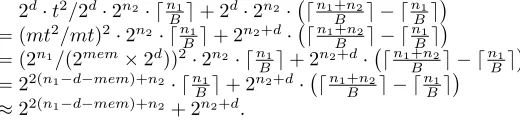
So for this attack, as compared to the TMTO-MTM attack, the time com-plexity is reduced slightly to 22(n1−mem)+n2−1· ⌈n1
B⌉+ 2
n2 while the memory and
pre-computation requirements remain the same.
Remark 2. In [1, Section 6.1], there was a criticism levelled against rainbow chains. According to them, in the Hellman scheme, it is possible to store just half the number of bits of the start and end points compared to the Rainbow scheme, reducing time complexity by a factor of 4 and therefore offsetting the claimed improvement of the Rainbow scheme which only reduces the time complexity by a smaller factor of 2. However, we believe that rainbow chains still offer other important advantages as given in [8, Section 3].
Remark 3. In [7], the authors suggested another method of dealing with the case when the key size is greater than the block size of the cipher. For their attack, the pre-processing stage computes 2n1−B tables, where each row of a particular
table starts with aB-bit string which is then concatenated with an (n1−B)-bit fixed string to encrypt the zero vector. The result is then concatenated with the fixed string again and the same procedure is repeated to obtain a chain of values. Note, however, that they assume the more stringent requirement that
B < n1≤2B.
6
Applying Biryukov-Shamir Time-Memory-Data
Trade-Off to Meet-in-the-Middle Attack (BS-MTM)
attack as the BS attack. In the BS attack, the complexity of pre-processing can be reduced fromN to N/D where N is the key space and D is the size of the keypool from which one needs to be found.
In this section, we shall try to recover the key from ciphertexts encrypted from a fixed plaintext P by applying the BS attack to the MTM attack with pre-computation. Our new attack is called the BS-MTM attack. Assume, as in Section 4 that we haveD= 2d encryptions ofP (whereP is a concatenation of
⌈n1
B⌉fixed plaintext blocks) using different keys and we only need to find one of
them, i.e. find one of (K1(i), K (i)
2 ) by attacking:
C0=E′
(K1(0),K(0)2 )(P), C1=E ′
(K(1)1 ,K2(1))(P), . . . , C2d−1=E ′ (K(2d−1)
1 ,K
(2d−1)
2 )
(P),
whereE′
(K1,K2)(·) =E1
′
K1(E2
′
K2(·)). This means that the effective block size to
beB′=B· ⌈n1
B⌉ ≥n1. Also assume that for eachi= 0,1, . . . ,2
d−1, we haveq′′ other plaintext-ciphertext pairs available:
(P T1(i), CT (i) 1 ),(P T
(i) 2 , CT
(i)
2 ), . . . ,(P T (i)
q′′, CT
(i)
q′′),
all encrypted withE using key (K1(i), K2(i)), whereq′′=⌈n1+n2
B ⌉ − ⌈ n1
B⌉.
Algo-rithm 6 illustrates the attack.
Algorithm 6 : BS-MTM Attack
1. Pre-processing:
(a) Choose two positive integersm, tsuch that2n1 =mt2. Fix a plaintextP
and define a one-way function g(K) =E1′
K(P).
(b) Form t/2d tables of sizem×t as in step 1(b) of Algorithm 4 with
com-plexitymt2/2d· ⌈n1
B⌉= 2
n1−d· ⌈n1
B⌉. This will cover1/2
d of the keyspace
of K1.
(c) Sort and store the start and end points of each table using mt/2d· ⌈n1
B⌉
memory as in step 1(c) of Algorithm 4. 2. Attack:
(a) ComputeC′
0=h(E2′−1K2(C0))over all possible values ofK2.
(b) Search to see if C′
0, f(C0′), . . . , ft−1(C0′)is equal to one of the end points of any of our stored tables and compute the keyK1from the correspond-ing start point as in steps 2(b), 2(c) and 2(d) of Algorithm 4. The com-plexity of covering these tables for all keysK2 (excluding verification) is
t/2d·t·2n2· ⌈n1
B⌉.
(c) If the correct keyK1(0), K2(0)is not contained in the space of2n1−dkeys
computed, then proceed to repeat the attack forCj,j= 1, . . . ,2d−1
con-secutively until one correct key is found. Note that the set of ⌈n1+n2
B ⌉ − ⌈ n1
B⌉
As we have noted, the pre-processing complexity in step 1 is 2n1−d· ⌈n1
B⌉.
Assuming we use a memory of 2mem· ⌈n1
B⌉=mt/2 d· ⌈n1
B⌉ for our attack, the
attack complexity in step 2 is
2d·t2/2d·2n2· ⌈n1
B⌉+ 2
d·2n2· ⌈n1+n2
B ⌉ − ⌈ n1
B⌉
= (mt2/mt)2·2n2· ⌈n1
B⌉+ 2
n2+d· ⌈n1+n2
B ⌉ − ⌈ n1
B⌉
= (2n1/(2mem×2d))2·2n2· ⌈n1
B⌉+ 2
n2+d· ⌈n1+n2
B ⌉ − ⌈ n1
B⌉
= 22(n1−d−mem)+n2· ⌈n1
B⌉+ 2
n2+d· ⌈n1+n2
B ⌉ − ⌈ n1
B⌉
≈22(n1−d−mem)+n2+ 2n2+d.
Example 6. Suppose we want to attack the 168-bit triple DES encryption of a fixed plaintext P and we only need to recover one key out of a key pool of 214 keys. We apply the BS-MTM attack where E1
K1(·) is encryption of a
fixed plaintextP over the first two DES blocks with a 112-bit key andE2K2(·)
is encryption over the remaining DES block with a 56-bit key. If we use 285 memory, then the pre-computation complexity is 2112−14·2 = 299and the attack complexity is 22(112−14−84)+56 = 284. In comparison, according to [3, Table 2], a direct application of the time-memory-data trade-off attack on triple DES where we recover one key out of a pool of 242keys requires: 284memory, 2126 pre-computation and 284attack complexity. Therefore, our BS-MTM attack achieves lower data and pre-processing complexity than the BS attack.
7
Applying TMTO - Data Curve to Meet-in-the-Middle
Attack (TMD-MTM)
In [3], the authors also presented a unifying framework for the analysis of multiple data trade-offs. The BS attack adapted from [2] is considered as a special case of this more general framework. Furthermore, they identified a new class of single table multiple data trade-offs which cannot be obtained from the BS attack. In this section, we shall apply their more general TMD attack to the MTM attack with pre-computation and we call our new attack the TMD-MTM attack. The mode of this attack follows a similar procedure to the BS-MTM attack as outlined in Algorithm 6. The main difference lies in the use of the birthday bound as will be highlighted later. Suppose, as before, thatB′ =B· ⌈n1
B⌉ ≥n1. The attack is
given by Algorithm 7 as follows:
Algorithm 7 : TMD-MTM Attack
1. Pre-processing:
(a) Fix a plaintextP and define a one-way functiong(K) =E1′
K(P).
(b) Formrtables of sizem×tas in step 1(b) of algorithm 4. The parameters (r, m, t) are chosen such that the tables will cover 1/2d of the keyspace
of K1 (where D= 2d is the number of encryptions of P using different keys). The exact conditions that they must satisfy will be given below. (c) Sort and store the start and end points of each table using rm· ⌈n1
B⌉
2. Attack:
(a) ComputeC′
0=h(E2′−1K2(C0))over all possible values ofK2.
(b) Search to see if C′
0, f(Cj′), . . . , f t−1(C′
0)is equal to one of the end points of any of our stored tables and compute the keyK1from the correspond-ing start point as in steps 2(b), 2(c) and 2(d) of Algorithm 4.
(c) If the correct key K1(0), K (0) 2
is not contained in the space of 2n1−d
keys computed, then proceed to repeat the attack and verification forCj,
j = 1, . . . ,2d−1 consecutively until one correct key is found. Note that
the set of ⌈n1+n2
B ⌉ − ⌈ n1
B⌉
plaintext-ciphertext pairs used for verifica-tion phase need not be uniform across all the differentCj.
In our TMD-MTM attack, we shall assume that the number of columns of each table is ≫1 and
time for one table look-up≈time for one invocation off.
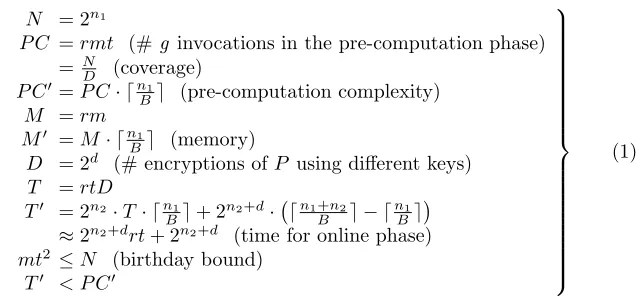
Then we have the relations:
N = 2n1
P C =rmt (#g invocations in the pre-computation phase) = N
D (coverage)
P C′ =P C· ⌈n1
B⌉ (pre-computation complexity)
M =rm
M′ =M· ⌈n1
B⌉ (memory)
D = 2d (# encryptions ofP using different keys)
T =rtD T′ = 2n2·T· ⌈n1
B⌉+ 2
n2+d· ⌈n1+n2
B ⌉ − ⌈ n1
B⌉
≈2n2+drt+ 2n2+d (time for online phase) mt2 ≤N (birthday bound)
T′ < P C′
(1)
The last inequality in (1) was added since in practical attacks, we usually require the online attacking time to be less than the offline table preparation time. We can solve forr,mandt to get:
t = N
M D ≥1 (number of columns)
m = N
T (number of rows)
r = M T
N ≥1 (number of tables)
mt2= N3
T M2D2 ≤N(birthday bound)
Based on these, we can derive the TMTO curve given by:
D =Nw
M T =Nx
M =Ny
mt2 =Nz
P C =N1−w
T =Nx−y
(3)
where
2w+x+y+z= 3 0≤w <1 0≤y, x−y <1≤x
w+y≤1 0≤z≤1
n2
n1 <1−(w+x) +y
(4)
Therefore, any set of parameters (w, x, y, z) satisfying (4) gives a valid attack. We can also express (r, m, t) in terms of (w, x, y, z) as follows:
r =Nx−1
m=N1−(x−y)
t =N1−w−y
(5)
It is now easy to see that the BS-MTM attack is a special case of the TMD-MTM attack withz = 1, i.e.mt2 =N. In Example 6, we used the parameters (w, x, y, z) = (18,1,34,1).
Example 7. Now let us apply the TMD-MTM attack to the 168-bit triple DES encryption of a fixed plaintextP to recover one key out of a keypool of 214keys. In this casew=18. As before,E1K1(·) is encryption of a fixed plaintextP over
the first two DES blocks with a 112-bit key andE2K2(·) is encryption over the
remaining DES block with a 56-bit key. In order to achieve minimum attack complexityT′ = 256·Nx−y+ 270, we take xto be minimum (i.e. x= 1) andy to be maximum (i.e.y= 1−w= 7
8). Thenz= 3−(2w+x+y) = 7
8. This gives
M′ = 299, P C′ = 299 and T′ = 271 with parameters (w, x, y, z) = (1 8,1,
7 8,
7 8). Sincer=x= 1, only 1 table is needed. Comparing with the BS-MTM attack in Example 6, this TMD-MTM attack has lower attack complexity at the expense of more memory required.
8
Conclusion
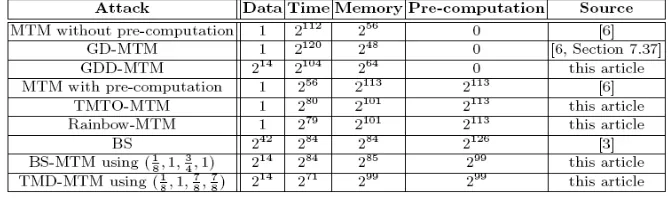
Rainbow, BS, and TMD attacks respectively to the MTM attack. Figure 1 below gives a comparison of the time-memory-data trade-offs of the attacks on triple DES.
Fig. 1.Attacks on 3-key triple DES
Remark 4. For all the attacks with pre-computation in Figure 1 except the BS attack, the attacks are done on two blocks of fixed plaintext.
As can be observed, the attacks without pre-computation generally have higher attack complexities but require less memory. The attacks with pre-computation can afford much lower online attack complexities but require larger memory and pre-computations. Another difference is that the no pre-computation attacks are known plaintext attacks while the pre-computation attacks are chosen plaintext attacks. In both types of attacks, the presence of multiple data can help reduce the time/memory/pre-computation complexities.
Our proposed attacks provide viable methods to achieve new time-memory-data trade-offs apart from previously known attacks. In particular, our new attacks involving pre-computation are desirable as they can achieve lower data and pre-computation complexity than the attacks suggested by Biryukov [3].
References
1. E. Barkan, E. Biham, and A. Shamir, “Rigorous Bounds on Cryptanalytic Time/Memory Tradeoffs”, LNCS 4117,CRYPTO 2006, pp. 1-21, Springer, 2006. 2. A. Biryukov and A. Shamir, “Cryptanalytic Time/Memory/Data Trade-offs for
Stream Ciphers”, LNCS 1976,Asiacrypt 2000, pp. 1-13, Springer-Verlag, 2000. 3. A. Biryukov, S. Mukkhopadhyay, and P. Sarkar, ”Improved Time-Memory
Trade-Off with Multiple Data”, LNCS 3897, Selected Areas in Cryptography 2005, pp. 110-127, Springer-Verlag, 2005.
4. W. Diffie and M. Hellman, “Exhaustive Cryptanalysis of the NBS Data Encryption Standard”, Computer 10 (6), pp. 74-84, June 1977.
6. A. Menezes, P. C. van Oorshot, and S. Vanstone, Chapter 7,Handbook of Applied Cryptography, CRC Press, 1996.
7. M. Mihaljevic, M. Fossorier, and H. Imai, “Security Evaluation of Certain Broad-cast Encryption Schemes Employing a Generalized Time-Memory-Data Trade-off”, IEEE Communication Letters, vol. 11, pp. 988-990, Dec. 2007.